

English Tuition Centre Punggol keeps its original 2019 title, but this page is rebuilt for families comparing English tuition centre Punggol, Punggol English tuition, Primary English tuition, PSLE English tuition, Secondary English tuition, small-group English classes, comprehension, writing, grammar, vocabulary, oral communication and personalised English feedback. The useful job of this page is not to declare one centre “best”. It is to help parents evaluate fit: whether a programme can diagnose the child’s actual bottleneck, teach a clear method, provide actionable feedback, retest the method on fresh work and reduce support as independence grows.
Current Singapore English programmes commonly foreground small-group teaching, composition or essay writing, comprehension, grammar, vocabulary, oral communication, structured practice and individual feedback. Those features can all be valuable. They are not enough by themselves. A family still needs to know how the pieces connect for one specific learner. A child with strong ideas but weak sentence control does not need the same programme emphasis as a child who reads accurately but guesses at inference, or a Secondary 4 student whose methods are sound but collapse under time.
This page therefore uses a centre-fit audit built around five questions: diagnosis, progression, feedback, transfer and independence. A centre fits when it can explain what the student needs now, why the lesson design matches that need, what progress should look like, and how the student will eventually do more without the tutor. The historical Punggol wording in the title is preserved; it should not be read as a claim that this page represents a current physical centre at a specific Punggol address.
50-second parent audit
- Diagnosis: Can the programme identify the first weak link instead of saying only “English is weak”?
- Progression: Does the work change appropriately from Primary 1 to PSLE, Secondary 1 to Secondary 4, or IP?
- Feedback: Does the student receive feedback specific enough to act on?
- Transfer: Is the correction tested on a fresh task rather than only discussed?
- Independence: Does the amount of prompting fall over time?
If a centre can answer these five clearly, families have something concrete to evaluate. If the explanation remains mainly about worksheet quantity, years of experience or class size, ask how those features change the learner’s next decision.
Fit begins with the learning job
Parents often begin by comparing location, timetable and fees. Those practical constraints matter. Educational fit begins one step earlier: what is the job? A student may need enrichment, stabilisation, repair or examination preparation. The same centre may serve several modes, but the lesson should not look identical in every mode.
| Learning job | Typical evidence | What the programme should prioritise |
|---|---|---|
| Enrich | Core work secure; student needs stretch | Wider reading, richer ideas, analysis, writing range |
| Stabilise | Performance varies from task to task | Reliable routines, mixed practice, retrieval |
| Repair | Same foundation gap breaks later work | First weak link, explicit instruction, retest |
| Prepare | Knowledge present but exam execution unstable | Timing, scope, prioritisation, checking |
A strong centre should be able to change mode as the student changes. A child who arrived for grammar remediation may later need composition enrichment. A Secondary 4 student may shift from broad tuition into narrow final-stage exam execution. Fixed programme names should not prevent adaptive teaching.
Ask how a new student is diagnosed
The first lesson should not be guesswork. Diagnosis can use recent school scripts, a short unseen passage, a brief writing sample, a small language task and conversation with the learner. The point is to identify where correct thinking first becomes unreliable.
- Did the student understand the question?
- Did they understand the text?
- Could they locate relevant evidence?
- Could they infer or explain the relationship?
- Could they express the idea clearly?
- Could they check the answer independently?
A centre that says “we cover all components every week” may still teach well, but families should ask whether the programme can prioritise when one component is clearly the bottleneck.
One overall score is not a diagnosis
An English mark compresses many decisions into one number. Two students scoring 65 can have completely different needs. One may be strong in writing and weak in comprehension; another may understand everything but lose marks through grammar and time. The programme should read beneath the score.
Ask whether the centre tracks error families. Useful categories can include question demand, evidence selection, inference, vocabulary, reference tracking, grammar, paragraph development, task fulfilment, timing and checking. The labels are less important than the ability to detect repeated mechanisms.
Check whether the programme has a real Primary progression
Primary English changes substantially from Primary 1 to Primary 6. Lower Primary often needs reading fluency, phonics, vocabulary, oral language and sentence construction. Middle Primary increasingly needs paragraph comprehension, inference, grammar transfer and composition structure. Upper Primary needs greater precision, synthesis, situational writing, oral development, listening and PSLE-oriented integration.
A centre-fit question is therefore: what changes between levels? If the only answer is “the worksheets become harder”, the progression is incomplete. The student’s thinking, independence and transfer demands should change too.
Check whether the programme has a real Secondary progression
Secondary 1 is a transition year: longer texts, more abstract ideas and greater independence. Secondary 2 often exposes cohesion, paraphrasing and transfer. Secondary 3 increasingly integrates argument, evidence, summary, editing and oral reasoning. Secondary 4 becomes a performance year in which timing, task fulfilment and mark-leak prioritisation matter strongly.
A centre should therefore be able to explain why its Secondary 1 lesson is not simply a diluted Secondary 4 lesson, and why a Secondary 4 programme does not waste time reteaching everything equally.
Check current pathway language
Families should be cautious when a programme relies heavily on obsolete stream terminology. Full Subject-Based Banding has changed the secondary landscape, and from 2027 the Singapore-Cambridge Secondary Education Certificate uses G1, G2 and G3 subject levels. For relevant 2026 candidates, GCE O-Level English Language remains syllabus 1184. A current programme should know which framework applies to the student sitting in front of it.
Curriculum labels change; durable English capabilities remain. Reading, writing, vocabulary, grammar, oral communication, listening, evidence, purpose, audience and independent checking should remain central.
Small group is useful only when visibility increases
Small-group tuition is often attractive because the teacher can potentially observe each student more closely. The key word is potentially. A class of three can still behave like a lecture if one person explains for most of the lesson and students mainly copy.
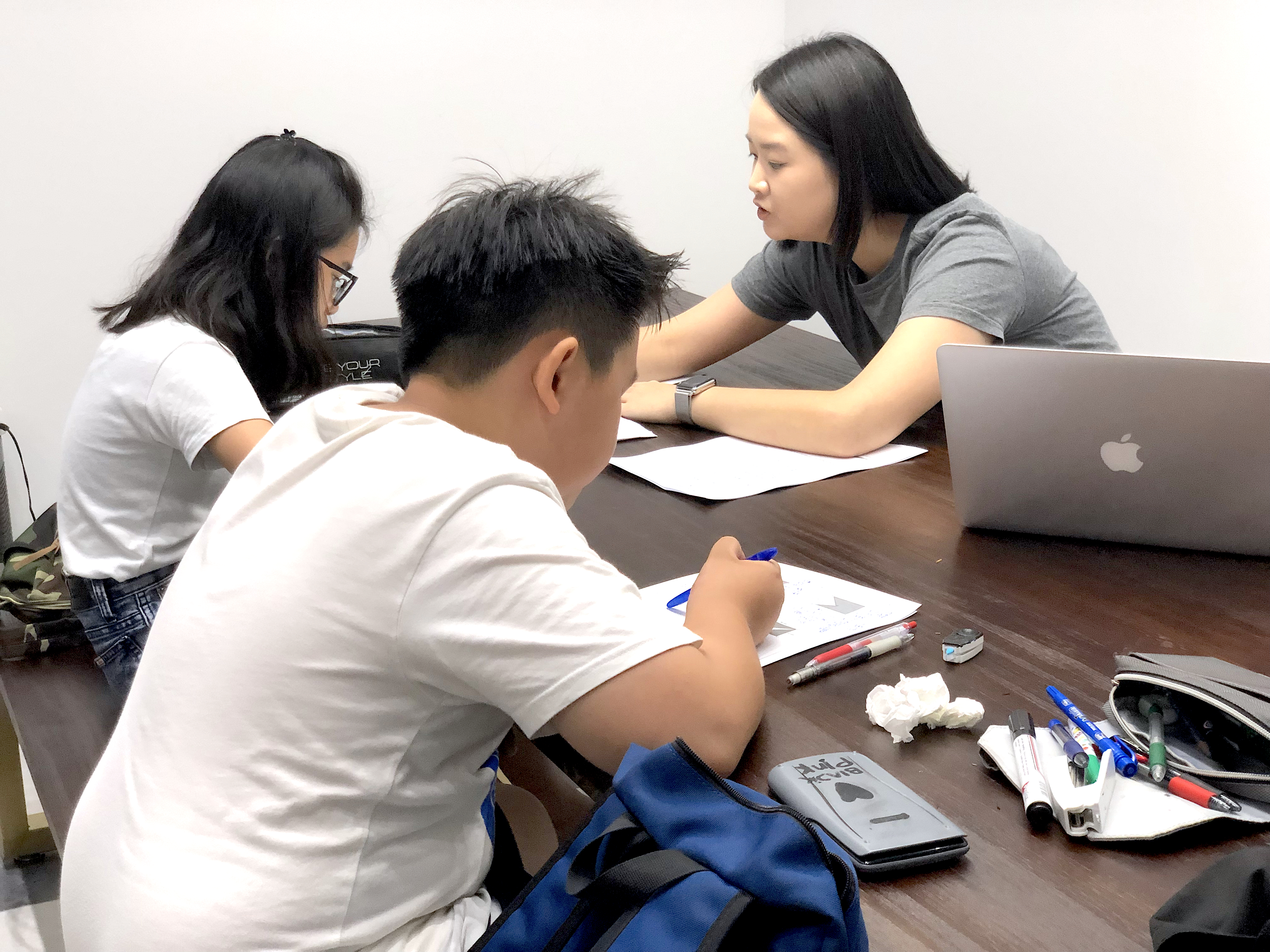
Ask what the tutor can see in a small group. Do students attempt before explanation? Does each learner explain reasoning? Are different prompts given? Does each student complete an individual retest? Small group becomes educationally meaningful when it creates more diagnostic visibility.
Compare class size by mechanism, not prestige
One-to-one tuition can be useful for severe gaps, unusual pacing, a narrow repair or a learner who struggles to participate in groups. Small groups can provide peer contrast, discussion and a lower cost per learner. Larger groups can work when the curriculum is highly structured and feedback systems remain strong.
There is no universally superior number. The relevant question is whether the teaching format makes the student’s decisions visible enough for the programme to adapt.
Ask to see what writing feedback looks like
“Improve vocabulary”, “add more detail” or “good effort” are encouraging but not precise enough to drive a revision. Strong feedback identifies the decision to change: develop the reason before giving an example, clarify who the pronoun refers to, remove a repeated sentence, strengthen task fulfilment, repair tense, or change tone for the intended reader.
A parent can ask to see a sample marked composition with personal details removed. Look for feedback the learner can actually use. Specific feedback is a stronger signal than a large number of red marks.
Feedback is incomplete without revision
Students often understand a teacher’s comments while looking at the corrected script. That does not prove the skill has changed. The student should revise the original work, then use the same underlying method on a fresh prompt.
Ask the centre what happens after feedback. Does the issue disappear into a file, or does it return through a deliberate retest?
Comprehension teaching should expose the error family
Comprehension is not one skill. A student may misread the question, choose weak evidence, guess at inference, lose reference words, misunderstand vocabulary or express an understood idea poorly. A useful programme distinguishes these.
| Error | What the student did | Useful repair |
|---|---|---|
| Scope | Answered a nearby question | Restate demand |
| Evidence | Selected weak support | Return to evidence zone |
| Inference | Added an unsupported idea | Evidence + reasoning bridge |
| Language effect | Named a technique only | Explain implication and effect |
| Expression | Understood but wrote unclearly | Rebuild sentence |
When the centre knows which family is recurring, homework and lesson time can become more targeted.
Vocabulary should become usable language
Ask how vocabulary is taught. A word list can create familiarity, but usable vocabulary requires context, collocation, connotation, word families, retrieval and production. The student should know not only what a word means but when it sounds natural.
Good programmes revisit important words after delay and require them in speaking or writing. Smaller durable sets are often more valuable than enormous lists that are never retrieved.
Grammar should transfer into real writing
A student can complete grammar exercises correctly and still repeat the same errors in composition. That is a transfer gap. Ask whether grammar moves from rule explanation into authentic sentences, paragraph editing and later fresh writing.
The centre should connect grammar to meaning. Tense controls time. Pronouns control reference. Connectors control relationships. Punctuation controls sentence boundaries. Grammar is a communication system, not a pile of isolated rules.
Reading should feed writing
A strong reading programme gives students more than answers to comprehension questions. It helps them notice how writers structure paragraphs, use evidence, shift tone, control viewpoint and choose words. Those observations can transfer into the student’s own writing.
Ask whether reading and writing are connected deliberately. One good text can become a comprehension lesson, vocabulary lesson, sentence-study lesson and writing model without copying the author’s wording.
Composition should not be taught as phrase collection
Memorised phrases may decorate a sentence without improving the underlying story or argument. Strong composition teaching begins with the central proposition. Narratives need pressure, choice and consequence. Arguments need a claim, reasons, evidence and qualification. Situational writing needs purpose, audience and task fulfilment.
Vocabulary and sentence variety then serve the writing job. A centre should teach students to make decisions, not merely reproduce language fragments.
Oral communication should be interactive
Oral practice is most useful when students answer the actual question, develop a reason, give an example and respond to follow-ups. Rehearsed scripts can help nervous learners start, but they should not become the final goal.
Small groups can be especially effective here because peers can ask authentic follow-up questions and the tutor can observe listening as well as speaking.
Listening should have an explicit method
Students can inspect questions before audio begins, predict likely information types, take concise notes and update their understanding when a speaker changes direction. These behaviours can be taught and reviewed.
If the centre says listening improves mainly through “more practice”, ask what students are supposed to do differently during that practice.
Ask how old learning returns
A weekly lesson can become a sequence of forgotten topics unless retrieval is planned. Vocabulary, grammar corrections, comprehension methods and writing decisions should return after delay.
Ask how the programme spaces review. If the student never sees an old error again, nobody knows whether the learning survived beyond the correction session.
A useful centre keeps an error ledger
The ledger does not need every wrong answer. It can record recurring families: inference, answer scope, tense, sentence boundaries, paragraph development, vocabulary misuse, timing or checking.
As a weakness disappears across fresh tasks, remove it. The record should show the learner becoming stronger, not accumulate forever.
Ask what homework is supposed to prove
Homework can test retrieval, transfer or stamina. A Primary 2 student may reread and write a short paragraph. A Primary 5 student may complete a mixed comprehension cluster. A Secondary 2 student may paraphrase a short passage. A Secondary 4 student may complete a timed section.
The programme should be able to explain why the homework exists. More pages do not automatically create more learning.
Watch how much adult help homework requires
A thick pack completed with extensive parent support can hide dependence. A shorter task completed honestly can give the tutor better diagnostic information.
Ask whether the centre wants parents to reteach at home. A mature system should gradually reduce the amount of English management required from the family.
Progress reports should describe mechanisms
Useful progress language is concrete: inference errors are falling; paragraph development is more consistent; vocabulary is being retrieved after two weeks; homework starts with fewer prompts; timed work finishes more reliably.
“More confident” can be meaningful, but ask what the learner can now do that was previously difficult.
Compare programmes by continuity
Students move across levels. Useful diagnostic history should move too. A centre should know which weaknesses were repaired, which remain active and what scaffolds the student still needs.
Continuity prevents every new year from becoming a restart. This matters especially across Primary 6 to Secondary 1 and Secondary 2 to Secondary 3.
Ask how prompts fade
A good programme should be able to describe support levels. First the tutor models. Then tutor and student solve together. Next the student receives a short prompt. Finally the student attempts independently.
If the student always receives the full model or paragraph frame, strong-looking work may hide weak independence.
The independence test is a centre-fit test
- Give a fresh task.
- Do not announce the method.
- Let the learner choose how to begin.
- Observe whether notes are needed.
- Check whether known risks are self-corrected.
- Ask the student to explain the method afterwards.
A centre fits when its teaching increasingly survives this test.
What if the student is already strong?
Strong students need fit too. A programme should not invent remediation simply because tuition is being considered. Enrichment can involve broader reading, argument, literature, inquiry, research, discussion and vocabulary nuance.
The student should still be challenged to transfer, revise and think independently. Strong performance is not a reason to stop teaching carefully.
What if the student is significantly behind?
Ask whether the centre can reduce surface difficulty while protecting the target skill. A student overwhelmed by a complex passage may need a simpler text for inference practice. A learner with weak sentence control may need short writing before full composition.
Lowering temporary task complexity is not lowering the final standard. It allows precise diagnosis and repair.
What if marks are falling?
Do not assume that more full papers are the answer. Audit recent work. Is the decline concentrated in one component? Has the student entered a transition year? Is time the issue? Has a foundational gap become more expensive as work grows harder?
The centre should be able to turn the decline into a repair plan, not only a larger practice schedule.
What if marks are inconsistent?
Inconsistency often indicates unstable transfer. The student can perform when the task looks familiar but struggles when wording changes. Mixed practice and delayed retesting are therefore important.
Ask whether the centre measures score stability across different texts and tasks, not only peak performance.
What if the student dislikes English?
Dislike can come from repeated failure, boredom, heavy workload or low relevance. The response should match the cause. A weak reader needs successful reading experiences. A bored strong learner needs richer texts. An overloaded student may need fewer, more coherent tasks.
Engagement matters because attention is part of learning. Fun is not the goal by itself, but meaningful work is easier to sustain.
A parent centre-comparison matrix
| Question | Strong signal | Weak signal |
|---|---|---|
| How do you diagnose? | Uses marked work and fresh tasks | Only age/grade placement |
| How is feedback used? | Specific revision + retest | Comments without retry |
| How does small group work? | Individual attempts and next steps | Same worksheet, same prompts |
| How is progress tracked? | Error patterns + independence | Pages completed only |
| How does support fade? | Model → guided → independent | Permanent scaffolds |
Trial lessons should reveal the system
If a trial lesson is available, observe what happens after the student makes an error. Does the tutor explain immediately, or first ask what the student was thinking? Does the student receive a chance to retry? Does the tutor change the prompt according to the response?
A trial class cannot prove long-term results, but it can reveal the teaching architecture.
Ask about teacher continuity
Continuity helps because a tutor who knows the learner’s error history can spend less time rediscovering it. If tutor changes occur, ask how diagnostic records transfer. The system should preserve important information even when personnel change.
Ask how the programme uses schoolwork
Schoolwork should be evidence, not simply extra homework for the tutor to finish. A good centre can convert a teacher’s comment into a general method, practise it on a fresh task and return the student to school better equipped.
Tuition complements school most effectively when it explains the mechanism behind the school feedback.
Ask how examination preparation is phased
Exam preparation should not begin with endless full papers if component skills are unstable. Strong programmes first repair high-cost weaknesses, then integrate them under time, then use full-paper practice to test pacing, recovery and checking.
This matters especially in PSLE and Secondary 4 years, when time becomes scarce and practice allocation should follow actual mark leaks.
Ask how enrichment fits stronger learners
Enrichment can include wider reading, literature, argument, current affairs, research, debate, creative transformation and more precise vocabulary. It should expand intellectual range rather than simply add harder versions of the same worksheet.
Ask how remediation ends
Remediation should not become a permanent low-level track. Once a repaired skill survives changed contexts and delayed retesting, the programme should raise difficulty. Success means the student no longer needs the same repair mode.
A six-week fit check after enrolment
Week 1 should clarify the starting diagnosis. Weeks 2–3 should show a focused method and guided practice. Week 4 should include fresh transfer. Week 5 should reduce a scaffold. Week 6 should compare new work with the original evidence.
At that point, families should be able to state what changed, what still repeats and what the programme will do next. If nobody can answer those questions, ask for greater clarity.
Teaching Guide: what a fit-focused 90-minute lesson can look like
Minutes 0–10: retrieval. Students reconstruct one previous method, a small vocabulary set and one corrected error without notes.
Minutes 10–25: cold attempt. Use a task linked to the student’s active weakness. Observe before teaching.
Minutes 25–40: focused teaching. Explain one mechanism with examples and non-examples.
Minutes 40–60: guided practice. Students explain decisions aloud; the tutor varies prompts according to need.
Minutes 60–75: transfer. Change the passage, prompt or audience. Remove most support.
Minutes 75–85: correction and fresh retest. Repair one high-value error, then use another item immediately.
Minutes 85–90: next-step record. Student and tutor name what improved, what repeated and what should return next lesson.
When a centre is a good fit
- The diagnosis matches evidence the family recognises.
- The lesson targets a small number of important decisions.
- Feedback is specific.
- Corrections are retested.
- Difficulty changes as readiness changes.
- The student can explain what they are learning.
- Prompt dependence decreases.
- Progress can be described in concrete terms.
When a centre may be the wrong fit
- The learner’s repeated weakness is not being diagnosed.
- Every class repeats the same routine regardless of evidence.
- The student is increasingly dependent on model answers.
- Homework volume crowds out school, reading or rest.
- Feedback remains vague.
- The programme cannot explain how progress is measured.
A centre-fit audit should include workload
A programme can be educationally sound and still be a poor fit if the workload is unsustainable. English tuition sits beside school, other subjects, CCAs, family time and sleep. Ask how much homework is typical, how long it should take, and what happens when the student has an unusually heavy school week.
The best answer is rarely “homework must always be completed regardless”. A useful system protects continuity while recognising that overloaded students may learn less from rushed, resentful practice. Short retrieval tasks can maintain contact when a full writing assignment is unrealistic.
Check whether the centre teaches self-monitoring
Independent learners notice uncertainty. They can say, “I am not sure whether this is inference or direct evidence,” or “My paragraph has an example but I have not explained why it matters.” A centre should teach this kind of self-monitoring explicitly.
One simple method is confidence marking. After selected questions, students rate confidence high, medium or low. High-confidence errors deserve attention because the learner’s internal judgement is unreliable. Low-confidence correct answers may need repeated successful reasoning rather than more teaching.
Check whether stronger students are allowed to move beyond repair
A student who has stabilised grammar and comprehension should not remain on the same remedial loop forever. Ask how the centre changes mode for stronger learners. Enrichment can include comparative reading, persuasive writing, literary or non-literary analysis, debate, research, current affairs and vocabulary nuance.
This is another fit signal: the programme should know when to increase breadth and depth instead of inventing new weaknesses to keep the same lesson structure.
Check whether weaker students are protected from false difficulty
Some programmes advertise advanced materials as proof of quality. Hard material is useful only when it exposes a learnable next step. If a passage is so difficult that vocabulary, syntax, world knowledge and inference all fail at once, diagnosis becomes noisy.
A strong centre can simplify the surface while keeping the target skill. It can teach inference on an accessible text, paragraph development on a manageable prompt or grammar control in a short paragraph, then raise difficulty when the method becomes stable.
Check whether students learn to recover when stuck
Examinations and school tasks inevitably contain uncertainty. Students need a recovery routine: restate the task, identify what is known, find the evidence zone, choose the most plausible method, attempt, then revise if the route fails.
This matters because strong students are not students who never get stuck. They are students who can recover without immediately outsourcing the problem to a teacher, parent or answer key.
Check whether the programme can explain a plateau
Progress is rarely linear. A student may improve quickly, then plateau. The centre should be able to ask why. Has the original bottleneck been solved? Is the current task now limited by another dependency? Has practice become too familiar? Is the student strong in untimed work but weak under time?
A plateau is not automatically evidence that the programme has failed. It is evidence that the model should be updated. Good centres revise their hypothesis when the data changes.
Check whether parent expectations are calibrated
Families and centres should agree on what the programme can reasonably influence. Tuition can improve skill, strategy, feedback and practice quality. It cannot guarantee a specific grade, remove every school stressor or replace the student’s own effort.
Clear expectations protect the learning relationship. A centre that explains uncertainty, variation and the need for student participation is often more useful than one that relies on absolute promises.
A simple decision after six weeks
After roughly six weeks, families should be able to answer three questions with evidence. First, what was the main learning problem at the start? Second, what can the student now do more reliably? Third, what is the next highest-value job? If those answers are clear, the programme has probably created useful visibility even if every mark has not yet moved dramatically.
If the answers remain vague, ask for a review. The centre may need to narrow the target, change task difficulty, increase independent retesting or reconsider whether the current class format fits the learner.
Centre fit should improve life outside tuition
The best evidence eventually appears outside the lesson. Homework starts with less negotiation. Reading takes less effort. The student can explain a school correction without adult translation. Writing begins with a plan. Known grammar errors are noticed before submission. These changes matter because they show that tuition is transferring into the student’s ordinary academic life.
A programme that produces polished work only inside the classroom may still be teaching useful things, but the transfer job is unfinished. The destination is a learner who carries the method beyond the centre.
One final comparison question is especially useful: What will this programme stop doing when my child improves? A mature centre should be able to name scaffolds that can disappear—model paragraphs, reminder checklists, vocabulary prompts, guided annotations or parent-managed homework routines. If nothing ever reduces, the programme may be accumulating support rather than building independence.
Fit therefore includes an exit logic. Families should know not only how the centre helps at the beginning, but how success changes the relationship later. The strongest programme is one that can become lighter because the student has become stronger.
That exit logic is also a quality-control signal: the centre is measuring capability rather than simply attendance. When support can be removed safely, the learning system has done meaningful work.
Frequently asked questions
Should I choose a centre based on class size?
Class size matters only through the teaching mechanism. A smaller class can improve observation and discussion, but ask how individual feedback and independent retesting actually happen.
Should I choose based on the tutor’s years of experience?
Experience can be valuable, but families should still ask how the tutor diagnoses, gives feedback and adapts. Years alone do not explain the current lesson design.
Are weekly compositions necessary?
Frequent writing can help, but quality of feedback and revision matters. Sometimes three focused paragraphs teach more than one full composition if the current target is paragraph development.
How do I know if personalised feedback is real?
The next action should differ according to the learner’s evidence. Personalisation is visible when prompts, correction targets, homework or difficulty change for a reason.
When should we leave a centre?
Consider changing or stopping when the programme no longer matches the learner’s need, progress cannot be explained, dependence is increasing, or the original weakness has been solved and another mode would now fit better.
The deeper purpose of a centre-fit audit
Parents do not need to identify the single “best English tuition centre” for every child. They need to identify a programme whose teaching system matches the learner’s current stage and bottleneck, and which can show evidence that the match is working.
For families searching in Punggol, that means looking beyond the historical location title and asking more useful questions: Does the centre see my child accurately? Does it teach a method rather than merely an answer? Does the method transfer? Is the student becoming less dependent?
When those answers are strong, the programme has a credible fit. When the answers are unclear, more marketing language will not solve the uncertainty.
Related English guides
- English Tuition Punggol parent decision gateway
- Primary English progression in Punggol
- Secondary English progression in Punggol
Historical image archive




















Leave a Reply