
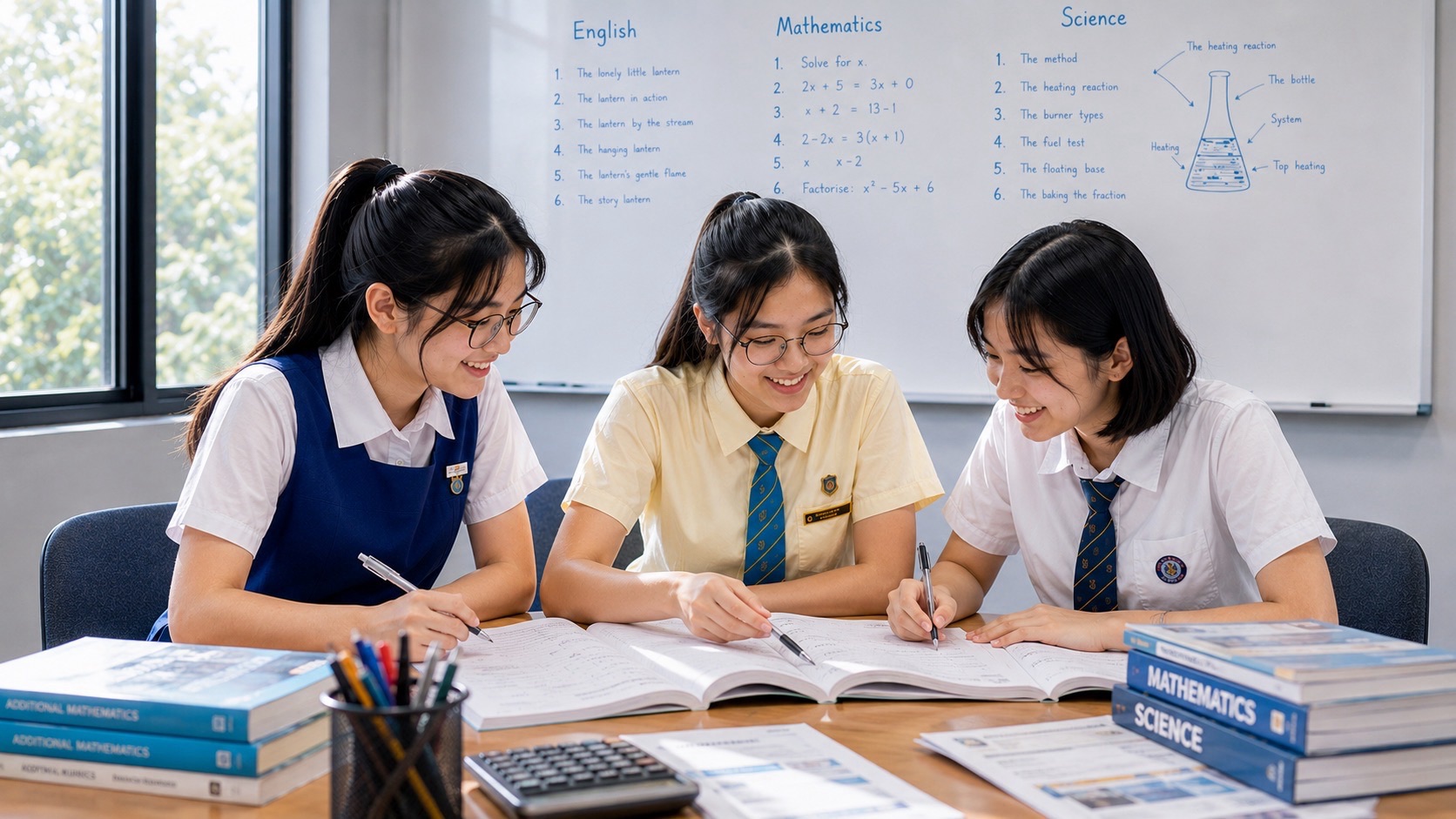
Small-group Secondary English tuition works best when the class is small enough for the tutor to see the decisions behind each answer. The important work is not simply finishing passages and essays. It is noticing where understanding breaks, why an interpretation becomes too broad, how a paragraph loses direction, and whether a corrected skill survives on unfamiliar material.
This guide is written for Secondary 1 to Secondary 4 students using the existing Sembawang English route on eduKate Yishun. The passages and exercises are original teaching examples. They are not official examination questions or school-specific marking schemes. School instructions and current assessment requirements remain the controlling reference.
Choose your reading route
Comprehension feels unpredictable
Go to reading the question, inference and evidence control.
Writing has ideas but lacks direction
Read planning, paragraph movement and revision.
The student knows the work but struggles under time
Start with timing routines and transfer practice.
I want to understand how a small group should operate
Read the small-group advantage and lesson architecture.
Contents
- 1. The small-group advantage
- 2. Lesson architecture
- 3. Read the question before the topic
- 4. Inference without overreach
- 5. Evidence control
- 6. Language effect
- 7. Summary and synthesis
- 8. Planning an argument
- 9. Paragraph movement
- 10. Counterargument
- 11. Functional writing
- 12. Narrative and reflection
- 13. Vocabulary precision
- 14. Sentence control
- 15. Discussion
- 16. Timing routines
- 17. Diagnostic teaching
- 18. Revision
- 19. Transfer
- 20. Independence
- 21. What parents should look for
- 22. A twelve-week plan
- 23. Independent workshop
1. The small-group advantage
A small class is useful only if the tutor uses the available attention. Three students listening to a lecture are still three passive students. The advantage appears when the tutor can see how each student reads, chooses, explains and revises.
English contains many invisible decisions. A student decides what the question means, which evidence matters, how certain an inference can be, what order a paragraph should follow and whether a sentence is precise enough. The final answer hides most of those choices. Small-group teaching makes them discussable.
The group itself also contributes. One student may notice a clue another misses. A second may offer a plausible interpretation that is too confident. A third may phrase the same idea more precisely. The tutor can compare these responses in real time and show why one is stronger.
2. Lesson architecture
| Stage | Student action | Tutor purpose |
|---|---|---|
| Probe | Attempt a short task | Locate the first weak decision |
| Model | Compare possible approaches | Make the decision rule visible |
| Attempt | Try independently | See whether understanding has transferred |
| Repair | Correct one bounded weakness | Change the process, not only the answer |
| Transfer | Use the skill on fresh material | Test whether learning is secure |
The order matters. If the tutor explains before seeing the student attempt anything, the lesson may solve a problem the student does not have. If the tutor assigns more work without diagnosing, the class may simply repeat the existing error.
3. Read the question before answering the topic
Students often recognise the topic and begin retrieving familiar content. This is dangerous because two questions about the same topic can require different operations.
- What does the speaker feel?
- How does the writer show the feeling changing?
- Why is the change important at this point?
- How far is another character responsible for the change?
The first identifies. The second tracks. The third interprets significance. The fourth evaluates cause and degree. Students should be trained to name the operation before drafting.
The five-second task check
- What is the command?
- What exact idea or detail is being referred to?
- Which part of the text may I use?
- What relationship must I explain?
- How certain can the answer reasonably be?
4. Inference without overreach
When Nadia reached the classroom, one chair had been left outside the semicircle. Her notebook was on it. The others were already discussing the project, and no one stopped speaking when she entered.
A literal response says Nadia’s chair is outside the group. An overconfident response says the class is deliberately excluding her. A stronger response says the arrangement may make Nadia appear separate from the group, especially because the discussion continues without acknowledgement. The passage supports a sense of distance more clearly than it supports a claim about motive.
- Locate the clue.
- State what it literally shows.
- Connect it to nearby evidence.
- Infer the strongest reasonable implication.
- Limit the conclusion.
5. Evidence control
Students often quote too much because they are not yet sure which words matter. Strong evidence selection is selective. The aim is to choose the shortest phrase that carries the relationship being explained.
If a passage describes a student entering a noisy canteen and then lowering her voice, the useful evidence may be the change in volume rather than the full description of the canteen. The question determines what matters.
A useful drill is to reduce quotations. Start with a full sentence, then underline the precise phrase that still allows the explanation to work. This forces the student to decide what is essential.
6. Explain language effect
The corridor swallowed the last strip of afternoon light.
Naming personification is only the beginning. “Swallowed” makes darkness active and consuming. If the character is reluctant to continue, the word intensifies enclosure and unease. The explanation should connect wording to meaning and then to the moment in the passage.
Students should gradually replace generic endings such as “this makes the reader interested” with specific effects: increases uncertainty, makes the setting feel enclosed, exposes impatience, weakens confidence, creates contrast or slows the pace.
7. Summary and synthesis
Summary tests hierarchy. The student must preserve central meaning while removing repetition.
Most students valued the programme, although several found the late timing difficult and two preferred shorter sessions.
“Students liked the programme” is too broad. A better summary is: “Students generally valued the programme, but some found the timing difficult and a small number preferred shorter sessions.” Important conditions remain intact.
Synthesis adds another requirement: combine information from different parts or sources without blurring their differences. If one source explains cost and another explains accessibility, a strong response shows how those factors interact rather than merging them into one vague point.
8. Plan an argument around claims
Prompt: “Convenience makes people less independent.” Discuss.
A weak plan lists examples: delivery apps, calculators, public transport and smartphones. A stronger plan identifies claims:
- Convenience can reduce independence when it removes decisions people still need to learn.
- Convenience can increase independence when it removes unnecessary barriers.
- The effect depends on whether convenience replaces useful judgment or merely reduces wasted effort.
Examples now serve the reasoning instead of controlling it.
9. Make paragraphs move
A paragraph should end with a more precise understanding than it began with. Repetition is not development.
Competition can help students improve because they want to do better than others. For example, students may study harder. This shows that competition helps them improve.
The paragraph does not explain the mechanism. A stronger version asks when comparison motivates and when it discourages:
Competition can increase effort when students see a realistic target and believe additional work can close the gap. In that situation, comparison provides information as well as motivation. However, if the gap appears impossible to overcome, the same comparison may reduce effort. Competition is therefore most useful when it points toward an attainable next step rather than merely producing a ranking.
10. Counterargument should change the position
A token “on the other hand” paragraph is not enough. A serious counterargument should force the writer to refine the claim.
If the essay argues that rules work better when people understand their purpose, a serious objection is that some rules must operate immediately in safety-critical situations. The refined position might become: explanation strengthens voluntary compliance and transfer where time permits, but enforcement remains necessary when immediate coordination matters.
Qualification makes the position more accurate, not weaker.
11. Functional writing
Functional writing succeeds when it performs the task for a specific reader. Students should identify four elements before drafting:
| Audience | Purpose | Required content | Tone |
|---|---|---|---|
| Who reads it? | What must the writing achieve? | Which details cannot be omitted? | How formal, warm, persuasive or firm? |
Every paragraph should serve the purpose. Extra content is not automatically helpful. A clever sentence that distracts from the job can make the response less effective.
12. Narrative and reflection
Strong narrative grows from pressure rather than event count. Someone wants something, an obstacle makes that difficult, a decision becomes necessary, and the consequence changes what the character understands.
Specific detail should carry information. “The room was messy” labels. “A stack of worksheets leaned against the fan, their corners lifting each time the blades turned” allows the reader to observe.
Reflection should move beyond generic morals. “I learned never to give up” is broad. “I learned that repeating the same method more intensely is not the same as improving it” is precise and transferable.
13. Vocabulary precision
| General idea | Useful distinctions |
|---|---|
| anger | irritated, resentful, indignant, hostile |
| certainty | possible, plausible, probable, likely, inevitable |
| change | adjust, shift, transform, deteriorate, recover |
| judgment | questionable, defensible, persuasive, misleading, disproportionate |
| cause | trigger, contribute to, reinforce, accelerate, constrain |
Vocabulary should be learned in families of meaning. The student has mastered a word when it can be recognised in a fresh context, distinguished from a near-synonym and used naturally for a precise reason.
14. Sentence control
Grammar becomes powerful when sentence structure makes relationships visible.
The proposal is expensive. It may still be necessary. The current system is weak.
A controlled version might be:
Although the proposal is expensive, that cost does not make it unnecessary if the current system contains weaknesses serious enough to require structural change.
The improvement is not length. It is the clear expression of concession, judgment and condition.
15. Discussion in a small group
Discussion can sharpen English when students must respond to another person’s actual reasoning.
- Build: add a reason or consequence.
- Qualify: state when the claim weakens.
- Challenge: question the evidence.
- Clarify: ask what scope the speaker intends.
A productive small group does not reward the fastest speaker. Students should sometimes write an initial view before discussion, then revise afterward. This protects individual thinking and turns discussion into evidence of learning.
16. Timing routines
Time pressure exposes weak decision systems. Students who know the content can still lose control if they spend too long deciding what to do.
- Set a fixed planning stop.
- Use section checkpoints.
- Train short timed segments before full papers.
- Reserve final time for targeted checking.
The goal is not to write faster at any cost. It is to recognise the task and choose an approach earlier.
17. Diagnostic teaching
A score is an outcome. It does not reveal the cause. Two students with the same mark can need different teaching.
| Pattern | Possible weak link | Next test |
|---|---|---|
| Literal strong, inference weak | Connecting clues | Short inference task with oral justification |
| Ideas strong, essays disorganised | Planning and hierarchy | Outline-only task |
| Advanced words, frequent misuse | Shallow vocabulary knowledge | Near-synonym discrimination |
| Untimed strong, timed weak | Decision speed | Short timed sections |
| Examples relevant, explanation thin | Evidence-to-claim connection | Ask why each example proves the point |
18. Revision that changes quality
Students often equate revision with rereading notes. English requires production and comparison. A useful weekly cycle might include one close-reading task, one paragraph revision, one vocabulary discrimination exercise, one plan, one timed section and one transfer task.
Rewriting an entire essay is not always necessary. If the problem is paragraph development, revise one weak paragraph deeply and then test the improvement in a fresh paragraph. The repair should match the defect.
19. Transfer: the proof of learning
The school introduced an online booking system for consultation slots. Within a week, every slot for the month had been taken. By the second week, teachers were receiving messages from students asking whether they could “just drop by for five minutes.”
Ask students to identify the unintended consequence, explain the quoted phrase and evaluate the system. A balanced answer recognises that the system organises demand but does not solve the shortage of consultation time.
If a student can apply earlier lessons about inference, evidence and qualification here without prompting, the learning is beginning to transfer.
20. Build independence deliberately
- Tutor models the decision.
- Tutor asks guiding questions.
- Student explains before acting.
- Student acts and self-checks.
- Student diagnoses a fresh error without prompting.
Support should reduce over time. If the student always waits for the tutor’s hint, the learning system is incomplete.
21. What parents should look for
- Can the student explain why a mark was lost?
- Can the student show what changed after feedback?
- Can the student apply the correction to fresh material?
- Does practice target a known weakness?
- Is the student becoming less dependent on prompts?
These indicators reveal whether the student is developing a stronger system rather than simply completing more pages.
22. A twelve-week improvement plan
| Weeks | Main focus | Evidence of progress |
|---|---|---|
| 1–2 | Diagnostic reading, writing and timing | Weak links become specific |
| 3–4 | Question reading, evidence, inference | Fewer unsupported answers |
| 5–6 | Sentence and paragraph reasoning | Writing becomes clearer |
| 7–8 | Argument, functional writing, vocabulary | Stronger task control |
| 9–10 | Timed mixed practice | Quality survives pressure |
| 11–12 | Independent transfer | Less prompting required |
23. Independent workshop
The school converted an unused classroom into a silent study room. During the first week, every seat was occupied. A month later, several tables remained empty although the main library was still crowded. A notice beside the door reminded students that group discussion was not allowed inside.
Task 1: What change has occurred in the use of the room?
Task 2: Why is the crowded library significant?
Task 3: What possible explanation is suggested by the final sentence?
Task 4: Write one balanced paragraph evaluating whether the room is successful.
Answer discussion
Use has declined from full occupancy to several empty tables. The crowded library shows that the decline is not simply caused by a lack of students needing study space. The ban on discussion suggests that some students may prefer spaces where collaborative work is possible, though this remains an inference rather than a proven cause. A balanced evaluation would say the room meets a need for quiet individual study but may be less useful to students who need to discuss work.
The standard
A strong Secondary English student can read the exact task, distinguish evidence from assumption, explain relationships, organise ideas around claims, use language precisely, manage time and inspect his or her own work. A strong small group should make those decisions increasingly independent.
Leave a Reply