
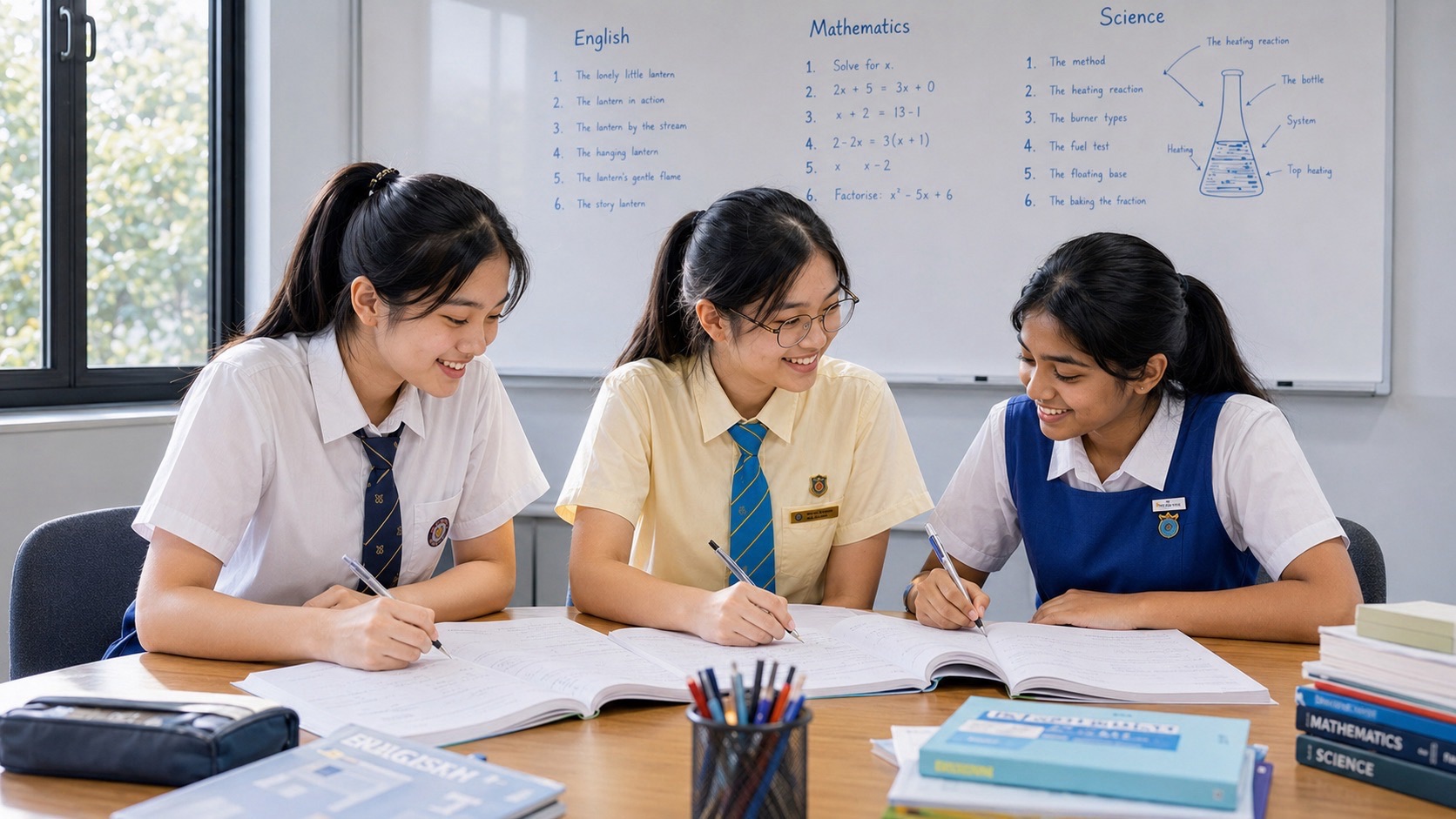
How to read this legacy title: this page keeps its older “Secondary English Tuition Centre in Yishun” URL/title for archive and search continuity, but its current owner job is the small-group learning loop. It is a learning-method guide, not proof of a current branch, timetable or class opening. For present-day Yishun information use the Yishun Tuition & Learning Guide; for curriculum ownership use the Secondary English Directory.
A small English class becomes useful when its size changes what the teacher can see, hear and repair. Three students at one table are not automatically receiving small-group teaching. The advantage appears when each student must think independently, make decisions visible, receive precise feedback, compare alternative approaches and then prove that the correction transfers to unfamiliar work.
This guide owns that specific job inside the eduKate Yishun Secondary English library: how the small-group learning loop works. For the broader skill system, use Build the Skills That Transfer. For recurring mistakes, use The Error-to-Independence Handbook. For marked-paper recovery, use From Marked Work to Independent Performance.
The three-student information advantage
Imagine three Secondary 2 students answering the same inference question. Student A selects the correct evidence but makes a conclusion that is too strong. Student B gives a cautious conclusion but chooses a weak phrase. Student C identifies both evidence and inference accurately but takes twice as long because every decision requires reassurance. One question has revealed three different learning problems.
In a productive small group, the tutor can inspect all three reasoning paths while the task is fresh. The students also gain two controlled contrasts. The group becomes a miniature comparison laboratory: not to rank students, but to expose alternative decisions and identify which part of each reasoning path needs repair.
Independent first, discussion second
Discussion too early can hide who actually understands. Each student therefore commits before hearing the group: a one-sentence inference, selected quotation, paragraph claim, vocabulary choice or brief plan. Only afterward do students compare.
After comparison, each student revises and identifies what changed. The cycle is commit → compare → explain → revise. Over time, students begin to run the comparison internally.
Make thinking visible
English difficulties often remain invisible because only the final sentence is marked. Small intermediate products reveal the process: underline the command, box evidence, rank interpretations, write the paragraph claim before the example, label a sentence relationship, or predict which response is weakest before marking.
These are temporary scaffolds. Once the decision becomes reliable, the visible step can disappear.
The feedback loop
- Attempt: make a real decision.
- Reveal: identify what produced the result.
- Repair: learn one small rule or method.
- Retry: apply it immediately to new material.
- Transfer: meet the same decision later in a different surface.
The retry is essential. Without it, the tutor has evidence that the student listened, not evidence that the student learned.
Comparison without copying
A: The character is angry because he closes the drawer loudly.
B: The forceful closing of the drawer suggests irritation, although the action alone does not establish how intense or lasting the emotion is.
C: The character is furious and wants revenge.
Students rank the responses by defensibility. B separates evidence from inference and calibrates certainty. C adds motive and intensity without support. Students then rewrite their own answer rather than copying B. The transferable lesson is evidence calibration, not memorised wording.
Shared spine, individual branches
Three students do not need three unrelated lessons. Everyone may work on inference, paragraph development or timed comprehension while each student receives a different error target, difficulty level or amount of prompting. This preserves shared comparison without teaching only to the middle.
A 90-minute learning loop
| Segment | Learning job |
|---|---|
| Opening | Check school work and identify one current target |
| Independent diagnostic | Fresh task before tutor support |
| Comparison | Expose and rank different decisions |
| Focused teaching | Repair the earliest useful weak link |
| Guided retry | Apply the repair on new material |
| Independent transfer | Remove prompts and change the surface |
| Exit reflection | Name the rule and next test |
The exact timing changes with the work in front of the group. The architecture matters more than a rigid minute-by-minute schedule.
Reading, writing and vocabulary loops
For comprehension, students independently identify command, evidence and inference, compare selections, receive a focused repair and then complete a silent transfer question. For writing, students produce paragraph claims before examples, compare whether claims are genuinely distinct, add evidence and mechanism, then repeat the structural demand on a new prompt. Vocabulary begins with discrimination between near-synonyms, strength and connotation before those distinctions are used inside reading and writing.
Discussion and timing loops
Before discussion, each student writes a position. During discussion, students build, qualify, challenge or clarify. Afterward, each writes a revised position and identifies what changed. Timing practice records where time disappears: over-planning, repeated sentence rebuilding, hesitation or over-investment in early answers. The repair targets the bottleneck rather than telling everyone to write faster.
Fade prompts deliberately
A tutor may begin by asking, “Which phrase supports that?” Later the prompt becomes a pause. Eventually the student asks the question internally. The same fading applies to planning, checking and timing. Good tuition plans for its own disappearance from the student’s decision process.
The silent round
A silent round is a fresh task completed without tutor intervention. It reveals what the student can actually carry alone. Afterward, the student identifies moments of uncertainty before receiving feedback. This develops monitoring as well as skill.
Transfer to unfamiliar work
A skill is not secure because it worked on the example used during teaching. We change topic, wording, genre and pressure. Inference moves from narrative to factual text. Paragraph development moves to a new issue. Vocabulary distinctions appear in a different context. Timing routines move from isolated sections to mixed work.
Variation is part of the teaching design. It is also why the eduKate library needs many helpful works with distinct jobs rather than duplicated pages.
Different strengths in one group
A stronger reader may still have weak timing. A fluent writer may overstate evidence. A quieter student may produce the most precise analysis. The tutor responds to the actual decision profile rather than a simple strong-or-weak label.
What parents can look for
- Can the tutor describe each student’s current error pattern?
- Does the student attempt work before receiving hints?
- Does feedback lead to an immediate retry?
- Are students comparing reasoning rather than copying answers?
- Do prompts reduce over time?
- Does the skill reappear in unfamiliar material?
- Can the student explain what changed in their own work?
Workshop: three answers, three repairs
The librarian switched off half the lights at eight-thirty. Two students began packing immediately. Mei continued writing until the announcement asked visitors to leave. Only then did she look at the clock.
Question: What does Mei’s behaviour suggest?
Student A: Mei is hardworking.
Student B: Mei is so focused on her work that she appears not to notice the earlier signal that the library is closing.
Student C: Mei is obsessed with studying and does not care about rules.
A needs to connect the inference more closely to the unusual behaviour. B is calibrated because it explains focus while remaining inside the evidence. C overstates intensity and motive. Students rank the responses, revise their own, then receive a new passage where the same evidence-calibration decision appears in a different context.
Continue through the eduKate Yishun English library
- Build the Skills That Transfer
- The Error-to-Independence Handbook
- From Marked Work to Independent Performance
- Diagnose, Teach, Transfer
- A Complete Learning System
- IP Year 2 English Tuition in Yishun
- Small Group IP English Tutorials
- English Tuition & Learning Hub
- Secondary English Directory
- The Library
The final standard: a useful small group produces more independent thinking, more precise feedback and more transfer—not simply more tutor talk. The group is working when students can explain their decisions, learn from differences without copying, repair mistakes on fresh work and gradually need less help.
Leave a Reply