
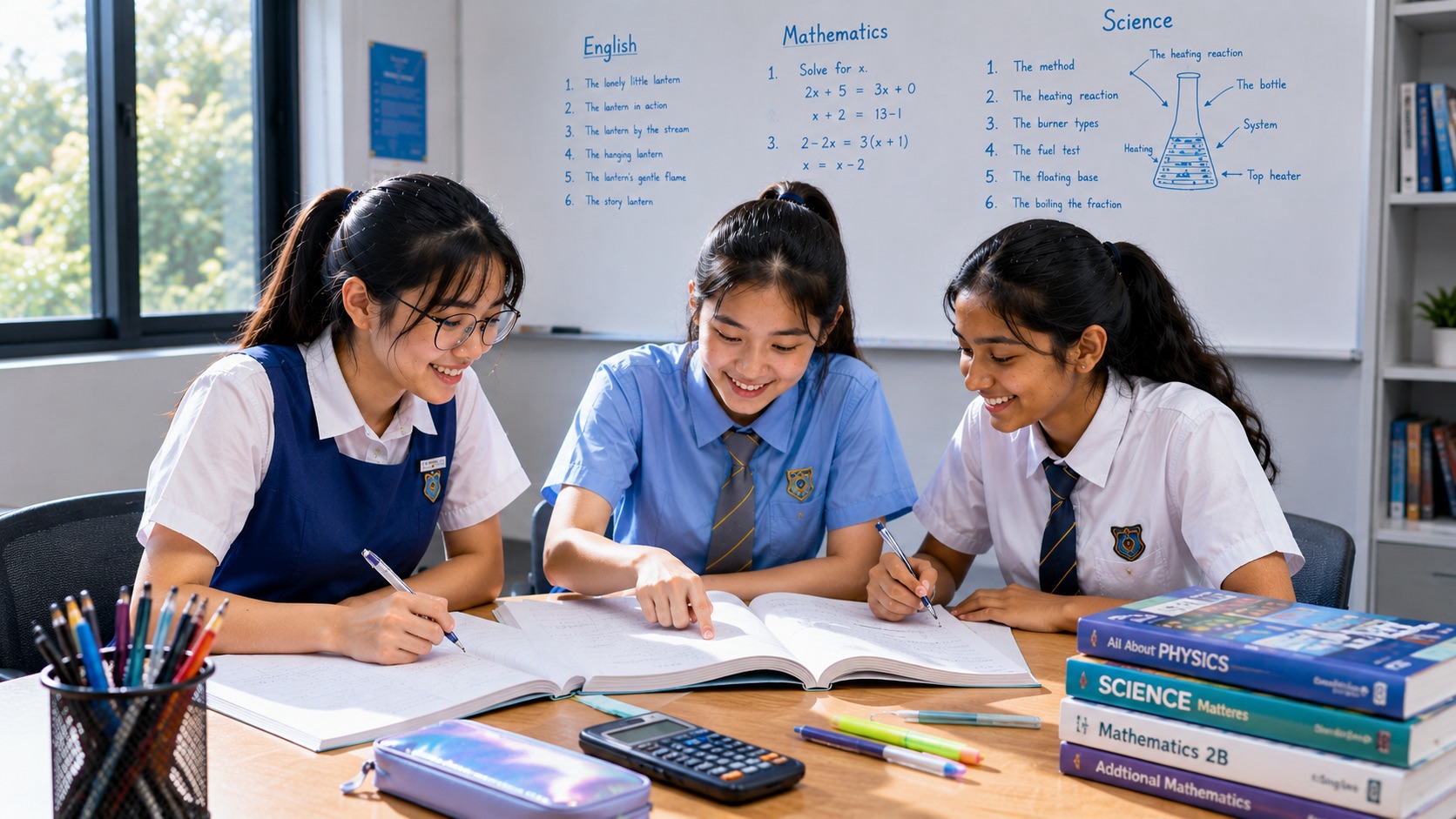
Singapore English tuition for Ahmad Ibrahim Secondary School students can strengthen a skill that sits between reading and writing: using a quotation without letting it take over the answer. A quotation is not analysis by itself. It is selected evidence that must be attributed, fitted into the writer’s grammar and explained.
This lesson teaches quotation integration through original passages. Students practise selection, embedding, punctuation, context and explanation while preserving the source’s meaning.
Who this lesson may suit
- Students who copy a whole sentence when only three words answer the question.
- Students who begin an answer with a floating quotation and no grammatical link.
- Students who use a quotation accurately but never explain what it proves.
- Students who remove a qualifier and make the source sound more certain.
- Students who confuse the narrator, character, writer and quoted speaker.
This independent teaching article does not claim affiliation with Ahmad Ibrahim Secondary School. Its passages and speakers are fictional and created for learning.
A quotation has four jobs around it
- Claim: the answer states the point being argued.
- Context or attribution: the reader knows who said or observed the words and in what situation.
- Evidence: the smallest sufficient quotation preserves the source wording.
- Explanation: the writer shows how the quoted feature supports the claim.
If one job is missing, the paragraph may become a quotation dump, a vague comment or an unsupported assertion.
Select the smallest sufficient quotation
Passage: At first, Hana dismissed the revised map as unnecessary. After the group became lost twice, she unfolded it carefully and marked the correct route.
Question: How does Hana’s attitude change? Copying both sentences is excessive. A precise answer can contrast “dismissed” with “unfolded it carefully”. The two selections capture rejection and later attention.
Small does not mean incomplete. The quotation must retain enough language to preserve the feature being analysed.
Worked example: quotation, bridge and inference
Weak answer: “She unfolded it carefully.” This shows she changed.
Stronger answer: Hana becomes more receptive after the group’s failures. The contrast between her earlier “dismissed” response and the way she later “unfolded it carefully” shows that experience has replaced her casual rejection with deliberate attention.
The explanation identifies the contrast, names the change and connects it to the events. It does not invent that Hana now loves maps or will never get lost again.
Embed quotations into the sentence grammar
A quotation should fit the surrounding grammar. If the source says The path was unexpectedly narrow, a student can write: The adjective “narrow” makes the restriction concrete. The quotation is a noun inside the new sentence.
Another form is: The path is described as “unexpectedly narrow”, emphasising that the group had not planned for the restriction. The quoted phrase completes described as.
Faulty: The writer shows the path “The path was unexpectedly narrow”. The quotation does not fit the frame. Repair the grammar before discussing the effect.
Attribute the correct source
Consider: Ravi said, “The doors were locked before I arrived,” but the caretaker’s record showed that one door remained open until 6.15 p.m.
The words about locked doors belong to Ravi, not automatically to the narrator or author. A precise answer says: Ravi claims that “the doors were locked”, but the record complicates his account. Attribution prevents the student from treating a character’s statement as an established fact.
Worked example: quotation and counter-evidence
Question: Why should the reader be cautious about Ravi’s statement?
Model answer: Ravi presents the closure as complete when he says the doors were “locked”. However, the caretaker’s record states that one door remained open until 6.15 p.m. The conflicting detail means Ravi’s statement may be mistaken, incomplete or based on what he personally saw; the passage does not establish deliberate dishonesty.
The answer preserves uncertainty. It uses the quotation, compares another source and stops where the evidence stops.
Keep qualifiers inside the evidence
Source: The trial may have reduced waiting time during the quietest hour.
Quoting only “reduced waiting time” changes a possibility into a fact and drops the limited condition. A faithful use is: The report says the trial “may have reduced waiting time” during the quietest hour.
- May must not silently become did.
- Some must not become all.
- During one trial must not become a permanent general rule.
- Appeared must not become proved.
Punctuation follows the sentence structure
Short embedded words or phrases usually sit inside the sentence: The verb “hesitated” reveals uncertainty. A complete quoted sentence after an attribution can follow a comma: Mira admitted, “I did not check the final figure.” A quotation introduced as a formal example or statement may follow a colon when the preceding clause is complete.
Punctuation is not the first decision. Students should first decide the relationship between their own sentence and the source words.
Do not manufacture a quotation
A student may paraphrase a source, but paraphrased wording should not be placed inside quotation marks. If the passage says The chairs were shifted to create a wider exit route, the answer cannot quote “improved safety” unless those words appear in the text.
Write instead: By shifting the chairs to create “a wider exit route”, the organisers appear to prioritise safer movement. The quotation is exact; the interpretation remains outside the marks.
Ellipsis and trimming require care
Removing words can make a quotation easier to fit, but the shortened version must retain the original meaning and grammar. Do not remove a negation, condition or contrast. For school analytical writing, selecting a clean short phrase is often safer than constructing a complicated ellipsis.
Before trimming, read the full source sentence and ask what meaning would disappear.
A repeatable quotation method
- Answer first. State the claim in your own words.
- Locate the decisive wording. Select the smallest phrase that carries the feature.
- Attribute when necessary. Name the character, speaker, report or writer.
- Fit the grammar. Read your whole sentence without pausing at the quotation marks.
- Preserve qualifiers. Keep negation, degree, time and condition.
- Explain the feature. Name the contrast, connotation, pattern or relationship that matters.
- Calibrate the inference. Do not claim more than the quotation and context support.
Common errors and specific repairs
Error 1: the quotation answers instead of the student
Faulty: a copied sentence with no claim. Repair: state the answer, then use only the decisive words as evidence.
Error 2: quotation dump
Faulty: several long quotations placed one after another. Repair: choose one relevant phrase, explain it and add a second only when it contributes a distinct feature.
Error 3: speaker confusion
Faulty: a character’s opinion is described as the writer’s proven fact. Repair: use attribution verbs such as claims, admits, observes or reports.
Error 4: explanation repeats the quotation
Faulty: “hesitated” shows that she hesitated. Repair: explain the implication: the pause suggests uncertainty or reluctance before the decision.
Independent practice with model answers
Practice 1: select
Passage: The crowd had already left, yet Leon continued arranging the unused chairs in straight rows. Question: What does Leon’s action suggest? A useful selection is “continued arranging”. The word continued supports persistence after the immediate need has passed.
Practice 2: preserve uncertainty
Source: The new signs could have contributed to the shorter queue. Model use: The report cautiously states that the signs “could have contributed” to the shorter queue, so it proposes a possible factor rather than a proven sole cause.
Practice 3: attribute
Passage: “No one warned us,” Tessa insisted, although the notice had been sent to every registered address. Model answer: Tessa insists that “no one warned us”, but the sent notice challenges the completeness of her claim.
Transfer and signs of progress
In comprehension, quotation control keeps evidence attached to the answer. In literature, it supports analysis of language and pattern. In argumentative writing, it helps students distinguish a source’s words from their evaluation. In oral discussion, accurate attribution prevents someone said from becoming an unsupported fact.
Progress is visible when a student selects less but explains more, reads the integrated sentence grammatically, preserves the source’s qualifiers and distinguishes quotation from inference. Test with an unfamiliar passage after a delay.
School pathway and consultation guidance
The Singapore-Cambridge Secondary Education Certificate (SEC) begins in 2027, with subjects offered at G1, G2 and G3 where applicable. This was checked on 2 October 2026 against the official SEAB SEC information. Use current school guidance and official syllabus documents for the learner’s actual subject level and assessment requirements.
For a useful consultation, bring the source passage, the exact question and one answer containing a quotation. The sample can reveal whether the main difficulty is selection, grammar, attribution, explanation or inference control.
eduKateYishun is maintained as a learning archive and recovery library. For current lesson enquiries, use eduKatePunggol. No affiliation, result, fee, timetable or placement should be inferred from this historical school-title page.
Frequently asked questions
How long should a quotation be?
Long enough to preserve the decisive wording and short enough that the student’s own reasoning remains visible. There is no fixed word count.
Can a student change a quoted word?
Not silently. Quote the exact source or paraphrase outside quotation marks. Any allowed adjustment must preserve meaning and follow the relevant academic convention.
Does every comprehension answer need a quotation?
No. Follow the task requirements and answer form. Even when quotation marks are not required, evidence should still be selected faithfully.
What matters after the quotation?
Explain which feature matters and how it supports the claim. The explanation is where the student demonstrates understanding.
Leave a Reply