
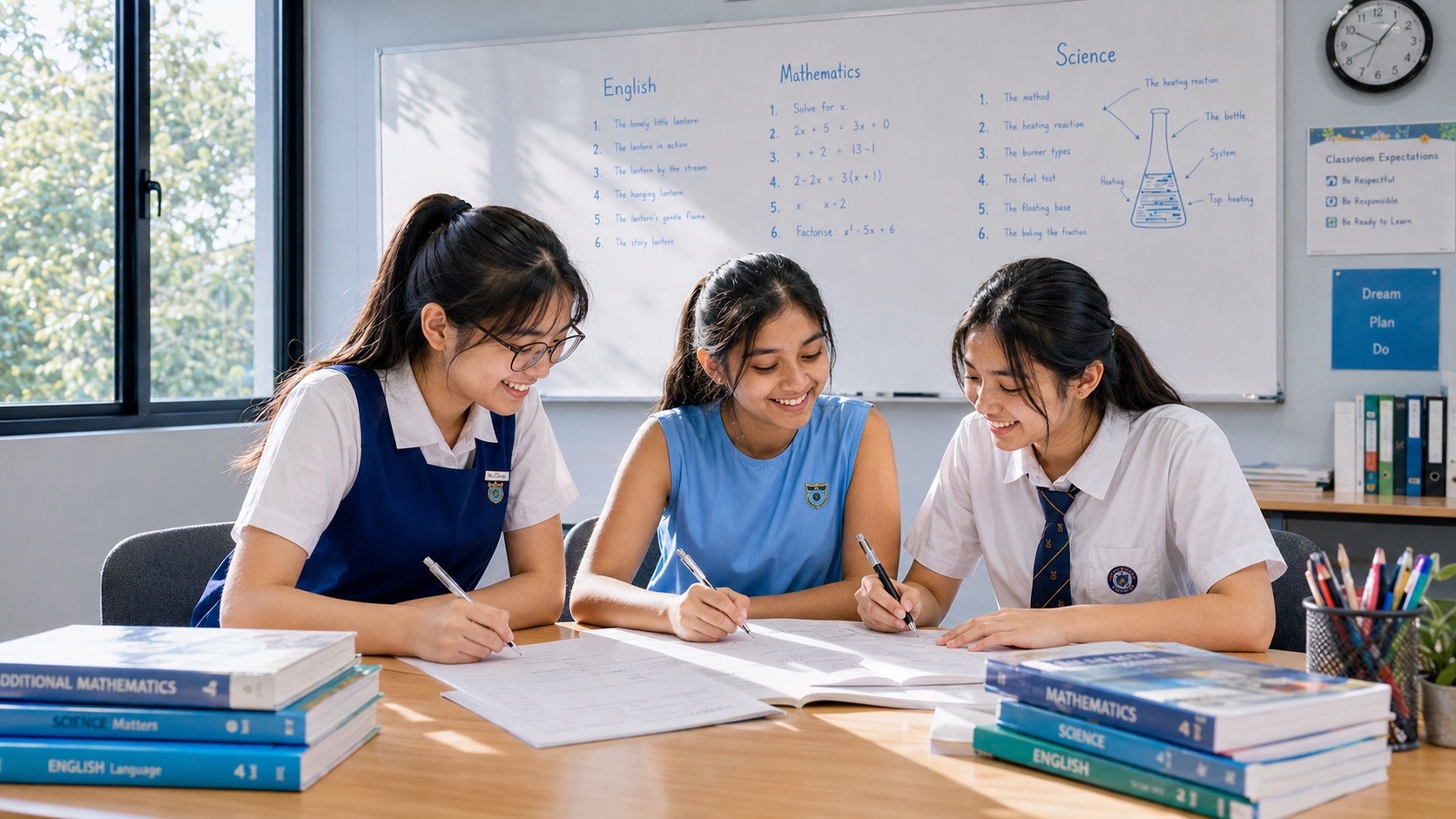
Parkway Parade Science Tuition is a historical 2019 title rebuilt around a problem that appears across Primary Science tuition Singapore, Parkway Parade Science tuition, PSLE Science tuition, small-group Science tuition, Science answering techniques, application questions, experiment questions, open-ended Science questions, misconceptions, scientific inquiry and MOE Science syllabus support: a pupil learns a rule correctly, then applies it where the conditions no longer fit.
Strong Primary Science tuition therefore has to teach more than concept mastery, keywords, Booklet A MCQ technique, Booklet B structured answering, graphs, variables, fair tests and higher-order thinking. Pupils need conditional reasoning. They should know not only that a relationship is useful, but when it applies, what assumptions it depends on, what counterexample would expose an overgeneralisation, and what new evidence would make them revise the rule.
This matters under the revised 2026 PSLE Science examination. The current Standard Science paper contains 30 multiple-choice questions in Booklet A for 60 marks and 10–11 structured questions in Booklet B for 40 marks, completed in 1 hour 45 minutes. The 2023 MOE Primary Science syllabus organises Core Ideas through Diversity, Cycles, Systems, Energy and Interactions while emphasising scientific practices including prediction, interpretation, evaluation and communication. Those practices require pupils to use rules flexibly rather than mechanically.
Scope note: this article preserves its historical title and URL. It does not claim a current Parkway Parade teaching location or affiliation. Its distinct educational job is conditional reasoning and misconception control: how pupils learn the boundary around a scientific rule, detect when a familiar statement no longer fits, and revise their model using evidence.
The danger of the almost-correct rule
Many misconceptions do not begin with nonsense.
They begin with a useful rule that has been stretched too far.
Examples:
- “Metals are attracted to magnets.”
- “Bigger objects sink.”
- “More batteries make bulbs brighter.”
- “Hotter water always evaporates faster.”
- “Plants grow better with more light.”
Each sentence may contain a relationship worth learning in a particular context, but the wording is too broad.
Science tuition should teach pupils to ask:
Under what conditions is this rule valid?
Rules are compressed models
A scientific rule is useful because it compresses many observations into a manageable relationship.
But compression removes detail.
The tutor’s job is to help pupils know which removed details matter.
For Primary Science, this means:
- identify the relevant conditions;
- state the relationship;
- test it on examples;
- test it on non-examples;
- identify a boundary case;
- revise wording if necessary.
The rule-boundary routine
Rule → Conditions → Example → Non-example → Boundary → Revised rule
This routine is powerful because it prevents children from treating Science as a list of slogans.
Worked example 1: magnetism
A pupil learns that iron objects can be attracted by magnets and then generalises:
“All metals are magnetic.”
Instead of simply correcting the sentence, test the rule.
Use several metal objects or examples that differ in magnetic response.
Ask:
- Which observations support your original rule?
- Which observation contradicts it?
- How should the rule change?
- What would you predict for a new object made from a different metal?
The pupil learns that a counterexample can improve a model.
Worked example 2: floating and sinking
A pupil observes several small objects floating and several large objects sinking.
The child creates a rule:
“Small things float; large things sink.”
Provide counterexamples within an age-appropriate context.
The child discovers that visible size alone is not a sufficient rule.
The teaching point is not to race into advanced density calculations unless appropriate. It is to show that classification by one superficial feature can fail.
Worked example 3: batteries and bulb brightness
A pupil memorises:
“More batteries make the bulb brighter.”
That may hold for particular circuit arrangements, but the relationship depends on how components are connected and the rest of the setup.
Ask the pupil to inspect the circuit, not the sentence.
Which connection changed?
What stayed the same?
What does the diagram show?
The rule becomes conditional on the actual system.
Worked example 4: evaporation
“Higher temperature means faster evaporation” can be useful under comparable conditions.
But if two setups also differ in surface area, moving air or other relevant factors, the comparison cannot isolate temperature cleanly.
This is where conditional reasoning meets fair testing.
Worked example 5: plant growth
“More light means more growth” is too crude.
Light matters, but plant growth depends on multiple conditions and biological processes.
The pupil should learn to interpret the actual experiment rather than repeat the slogan.
If water, plant type, starting size or observation period also differ, the conclusion must be cautious.
Worked example 6: heat conduction
A pupil learns that metals are good conductors of heat and then assumes every object made of metal will always feel hotter than every non-metal object.
The tutor asks:
- Are the objects at the same temperature initially?
- What are they in contact with?
- How long?
- What exactly is being measured or felt?
The concept remains useful, but conditions matter.
A misconception is a model that predicts badly
This is a useful way to frame errors.
Instead of:
“You are wrong.”
Try:
“Your rule predicts X. Let us see whether the evidence agrees.”
If the prediction fails, the child has a reason to revise.
Confidence is not evidence
Misconceptions can be held very confidently.
A pupil may say “all metals are magnetic” with far more confidence than another pupil states the correct idea.
Science teaches a healthy separation:
How certain I feel is not the same as how strong the evidence is.
The counterexample test
After a pupil states a rule, ask:
“Can you think of a case where this might not work?”
If not, provide one.
The goal is not to make pupils distrust every rule. The goal is to understand its scope.
Examples are not enough
If pupils see only examples that fit a rule, they may infer an overly broad model.
For every important concept, consider:
- a clear example;
- a clear non-example;
- a fresh example;
- a boundary or tricky case.
This creates conceptual shape.
Booklet A: distractors love overgeneralised rules
MCQ distractors often sound familiar because they contain a rule pupils learned before.
The problem is that one condition has changed.
Train pupils to ask:
- Does the familiar rule apply under these conditions?
- What changed in the diagram?
- Is this option using “always” or “all” too broadly?
- Does the evidence show the required relationship?
Booklet A becomes a test of rule control, not mere memory.
Booklet B: conditional explanations need careful language
Structured answers should not become vague because pupils fear overgeneralisation.
Instead, anchor the explanation to the setup:
“In this experiment…”
“Under the same conditions except…”
“The results show that…”
“For the materials tested…”
Use conditions when they genuinely matter.
Strong words require strong evidence
Words such as:
- always;
- never;
- all;
- only;
- must;
- proves;
make strong claims.
Ask whether the evidence is strong enough.
The boundary between observation and rule
Observation:
“These three iron objects were attracted to the magnet.”
Overgeneralised rule:
“All metals are attracted to magnets.”
The leap between the two is where misconception can begin.
Teach pupils to notice that leap.
Conditional reasoning and fair tests
A rule may seem to fail because the comparison was unfair.
Suppose one setup changes temperature and surface area at the same time.
If the result differs, which factor caused it?
The evidence cannot decide cleanly.
Before revising the scientific model, inspect the experimental design.
Conditional reasoning and measurement
A relationship may appear different because measurements were taken at different times or with different units.
Always check:
- same quantity;
- same unit;
- comparable timing;
- comparable starting condition.
Some apparent “exceptions” are measurement problems.
Conditional reasoning and graphs
A graph may show a relationship only over a particular range.
Pupils should not automatically assume the pattern continues forever beyond the displayed data.
At Primary level, the key habit is modest:
Describe the range you can actually see.
Conditional reasoning and classification
Classification rules should survive fresh examples.
If a new item cannot be placed consistently, the rule may need refinement.
This is especially useful for Diversity topics.
Conditional reasoning and systems
Systems are full of “if” relationships.
If one component changes, what happens downstream?
If a path breaks, what function is lost?
If a part is replaced with a different material, how might performance change?
The pupil learns to reason within conditions rather than recite component names.
Conditional reasoning and cycles
Cycles can be disrupted or affected by conditions.
Ask:
- What must be present for the next stage?
- What happens if the condition changes?
- Does the sequence still proceed?
Conditional reasoning and energy
Energy-related rules often depend on direction and conditions.
Teach pupils to specify:
- which objects or systems interact;
- the relevant temperature or energy difference;
- the direction of transfer where appropriate;
- the observed effect.
Conditional reasoning and interactions
Forces, magnets and environmental interactions depend on what objects or factors are present and how they interact.
“More force” without a described interaction may be meaningless.
The “what changed?” question
When a familiar rule suddenly seems wrong, ask:
What changed compared with the example where the rule worked?
This question often reveals the condition that matters.
The “what stayed the same?” question
Equally important:
What stayed scientifically comparable?
This helps pupils isolate the relevant difference.
The misconception clinic
Use five steps:
- State the pupil’s current rule.
- Predict a new case from the rule.
- Present evidence or a counterexample.
- Identify the failed prediction.
- Revise the rule and test again.
This is more durable than simply replacing one sentence with another.
Misconception clinic example: “all metals conduct heat equally”
A pupil may take the broad idea that metals conduct heat and overextend it to equal behaviour.
Ask:
- Does the syllabus claim every metal behaves identically?
- What would we need to measure to compare them?
- Would thickness, size or starting temperature matter in an experiment?
The child learns to distinguish category membership from identical properties.
Misconception clinic example: “the heaviest object always falls fastest”
At Primary level, handle according to the syllabus and context.
The teaching opportunity is to challenge a simple size-or-weight rule using evidence and controlled comparison rather than merely supplying a slogan.
Misconception clinic example: “plants get food from soil”
This misconception can persist because soil is visibly involved in plant growth.
Use the syllabus-appropriate plant model to distinguish water and mineral uptake from food production through photosynthesis.
Then ask for a prediction in a new context.
Misconception clinic example: “a bigger battery means more current everywhere”
Do not treat battery appearance as sufficient evidence.
Teach pupils to inspect the circuit arrangement and the actual question conditions.
Misconception clinic example: “condensation comes through the container”
When droplets appear outside a cold container, pupils may infer that water passed through the material.
Ask what evidence would support leakage.
Then use the condensation model at the appropriate level to explain where the water comes from.
How to make rules memorable without making them rigid
Use the structure:
Rule + condition + example + counterexample.
For instance:
“Under these comparable conditions, increasing X tends to produce Y because…”
Then immediately ask for a case where the relationship would not be a fair conclusion.
Primary 3: teach categories with non-examples
P3 pupils are ideal for boundary learning.
When teaching a category or property, show what fits and what does not.
Ask pupils to state the rule in their own words and test a fresh example.
Primary 4: teach conditions around processes
P4 pupils can begin asking:
“What must be present for this process?”
“What changes if the condition is removed?”
This develops conditional thinking naturally.
Primary 5: attack overgeneralisation deliberately
P5 should include:
- misconception questions;
- experiment flaws;
- counterexamples;
- graph ranges;
- rules that work only under stated conditions.
Primary 6: rule control under exam pressure
P6 pupils should become suspicious of familiar-sounding distractors.
Ask:
“Which condition in this question makes the familiar rule apply—or not apply?”
This is excellent MCQ preparation.
Small-group Science: pupils can challenge rules safely
In a three-student group:
- Pupil A states the rule.
- Pupil B gives a counterexample.
- Pupil C revises the rule.
Then rotate.
The goal is not debate for its own sake. The goal is conceptual precision.
The rule audit
Take five rules from the pupil’s notes.
For each, ask:
- What does the rule say?
- Under what conditions?
- Give an example.
- Give a non-example.
- What evidence would test it?
This converts passive notes into active models.
The “always/never” hunt
Give pupils several Science statements containing absolute words.
Some may be valid; others may be overgeneralised.
Ask pupils to defend or revise each statement using evidence and conditions.
This is a compact higher-order activity.
Conditional reasoning and answer precision
Do not over-condition every answer until it becomes unreadable.
The goal is to include the condition that matters.
Too weak:
“It always happens.”
Too vague:
“It might happen depending on many things.”
Better:
State the relationship under the conditions shown in the question.
Conditional reasoning and transfer
Transfer improves when pupils know the boundary of a model.
If the surface context changes but the relevant conditions remain, the model should transfer.
If a key condition changes, the pupil should reconsider.
This is more sophisticated than “same topic, same answer”.
Conditional reasoning and prediction
A prediction should include the conditions that make it reasonable.
Ask:
“What are you assuming stays the same?”
This question exposes hidden assumptions.
A 90-minute conditional-reasoning lesson
| Stage | Time | Purpose |
|---|---|---|
| Rule recall | 10 min | State one familiar relationship. |
| Boundary test | 15 min | Use examples and non-examples. |
| Concept rebuild | 20 min | Explain why the condition matters. |
| Experiment critique | 15 min | Check whether evidence isolates the rule. |
| MCQ distractors | 10 min | Identify overgeneralised options. |
| Structured answer | 10 min | Write a condition-aware explanation. |
| Exit counterexample | 10 min | Test the revised rule in a fresh context. |
The misconception error log
| Misconception type | Pattern | Repair |
|---|---|---|
| Overgeneralisation | One example becomes “always”. | Counterexamples and boundary cases. |
| Surface rule | Size, shape or familiar object drives answer. | Change surface, preserve mechanism. |
| Keyword rule | One word triggers a memorised answer. | Evidence-first concept selection. |
| Unfair-test rule | Pupil attributes result to one of several changes. | Variable control. |
| Direction error | Relationship applied backwards. | Causal arrows. |
| Scope error | Graph pattern extended beyond shown range. | Describe only supported range. |
How to correct a misconception properly
Use a six-step cycle:
- Ask the pupil to state the current rule.
- Ask for a prediction.
- Present counterevidence.
- Let the pupil explain the mismatch.
- Rebuild the rule.
- Test the new rule on a fresh case.
The pupil participates in the revision instead of receiving a replacement sentence.
Why immediate correction can sometimes be too fast
If the tutor instantly says “wrong”, the pupil may memorise the correction without confronting the model that produced the error.
When safe and practical, let the pupil see the prediction fail.
That creates a reason to change.
Parent question: “Why does my child keep making the same misconception?”
Because the underlying rule may never have been replaced.
The child memorised the correction for one question but retained the old model.
Use a fresh context and ask for a prediction before giving the answer.
If the old misconception reappears, rebuild the rule with evidence.
Parent question: “Should I correct Science language immediately?”
If the child’s underlying model is wrong, fix the model first.
Precise vocabulary matters, but polished wording around a misconception only makes the wrong idea sound better.
A twelve-week misconception-control cycle
Weeks 1–2: collect confident wrong ideas
Use cold predictions and marked papers.
Weeks 3–4: examples and non-examples
Build conceptual boundaries.
Weeks 5–6: conditional rules
State which conditions matter.
Weeks 7–8: experiment evidence
Test whether the rule is supported fairly.
Weeks 9–10: unfamiliar contexts
Challenge keyword and surface triggers.
Weeks 11–12: timed MCQ and structured transfer
Check whether the revised model survives examination pressure.
What independence looks like
A mature Primary Science pupil increasingly asks:
- Does this familiar rule fit the conditions?
- What evidence supports it?
- Is there a counterexample?
- Am I using “always” too broadly?
- What changed from the example I know?
- Should the model be revised?
Where this page sits in the eduKateYishun Science system
This page owns the conditional-rule-and-misconception job. For Primary 3–6 development, use Science Tuition Primary. For evidence discipline, read Pasir Ris Science Tuition. For fair comparison, read Jurong East Science Tuition. For causal chains, use Jurong West Science Tuition. For independence, use Punggol Science Tuition.
The standard: know the rule and know its boundary
A beginner asks:
“What is the rule?”
A stronger pupil also asks:
“When does the rule apply?”
“What condition matters?”
“What evidence supports it?”
“What would count as a counterexample?”
“How would I revise the rule if the evidence disagreed?”
That is not needless complication.
It is the difference between memorising a sentence and owning a scientific model.
Rules are useful because they simplify the world.
Science becomes powerful when pupils also know where the simplification stops.
Current official references
The boundary-condition casebook: six ways a useful rule becomes a wrong answer
Case 1: the pupil forgets “under comparable conditions”
A child learns that increasing temperature can increase evaporation rate. Later, two evaporation setups differ in temperature, surface area and moving air. The pupil attributes the result entirely to temperature.
The concept has not disappeared. The experimental conditions have changed.
The tutor should ask:
- Which relationship are you trying to use?
- What conditions must be comparable for that relationship to be tested cleanly?
- Which additional factor changed here?
- What conclusion is still possible?
The pupil learns that rules do not float above the setup. They operate inside it.
Case 2: the pupil treats category membership as identical behaviour
The child learns that many metals share certain useful properties and then assumes all metals behave identically.
Use a distinction:
same category does not mean same value for every property.
This is a powerful idea for materials, living things and classification more generally.
Case 3: the pupil extends a graph beyond the evidence
A graph rises steadily from 0 to 10 units. The pupil assumes it will continue rising at the same rate forever.
Teach:
“The graph supports the pattern over the range shown.”
Prediction beyond the range may require more evidence or a stronger model.
At Primary level, this simple caution is enough.
Case 4: the pupil turns an example into a definition
A tutor uses a raincoat to teach waterproof materials. The pupil later thinks waterproof materials are “materials used for raincoats”.
The example has replaced the property.
Reverse the relationship:
Define the property first, then generate several uses. Then present a non-example.
Case 5: the pupil remembers a model answer instead of the model
A child memorises the sentence:
“The bulb becomes brighter because more batteries provide more energy.”
Later, the circuit arrangement changes. The child repeats the same sentence automatically.
Teach the pupil to inspect the system before retrieving the phrase.
Model answers are outputs, not universal rules.
Case 6: the pupil overcorrects and becomes afraid to state any rule
After learning about exceptions, some pupils become excessively cautious:
“Anything could happen.”
That is not the goal.
Science still uses strong, useful models. The skill is to state them under the conditions where they are warranted.
The rule-strength ladder
| Level | Statement type | Problem |
|---|---|---|
| 1 | “X always causes Y.” | Often too broad. |
| 2 | “X can affect Y.” | Safer but may be too vague. |
| 3 | “When X changes under these comparable conditions, Y changes because…” | Connects condition, evidence and mechanism. |
| 4 | “The data support this relationship for the tested conditions; another factor would require a new test.” | Shows mature scope control. |
Pupils do not need to write Level 4 language in every PSLE answer. The ladder is a reasoning tool.
How to teach “if–then–because” reasoning
A compact conditional scaffold is:
If ______ changes while relevant conditions remain comparable, then ______ should happen because ______.
This structure combines prediction, fair testing and mechanism.
After practice, remove the frame.
The assumption audit
Every prediction contains assumptions.
Ask pupils:
- What are you assuming stays the same?
- What are you assuming is working normally?
- What does the question explicitly tell you?
- Which assumption would change the conclusion if it were false?
This is especially useful for experiment and system questions.
The rule-versus-evidence exercise
Give a familiar rule and a set of data that appear to conflict with it.
Ask pupils to consider three possibilities:
- the rule was applied outside its conditions;
- the experiment contained a flaw or uncontrolled factor;
- the model needs revision.
They learn not to abandon scientific knowledge too quickly and not to ignore evidence stubbornly.
Why misconceptions survive ordinary correction
A child may write a wrong answer.
The teacher writes the correct answer.
The child copies it.
Next month, the old misconception returns.
Why?
Because the original rule was never challenged.
Misconception repair must change the model, not only the sentence.
The prediction-before-correction method
Before explaining why a rule is wrong, ask the pupil to use it to predict a new case.
Then reveal the counterexample.
The child experiences the model failing.
This creates cognitive pressure to revise.
Boundary cases are especially valuable
A boundary case sits near the edge of a category or rule.
It forces precision.
For classification:
Can the rule handle an organism with an unusual feature?
For materials:
Can the property rule distinguish two superficially similar materials?
For experiments:
Does the conclusion still hold when one relevant condition changes slightly?
Rule cards for revision
Instead of ordinary flashcards with only question and answer, create four-part rule cards:
- Rule: the core relationship.
- Condition: when it applies.
- Example: one clear case.
- Trap: one common overgeneralisation.
This makes memory more flexible.
Example rule card: fair comparison
Rule: To test the effect of one factor, change that factor and measure the relevant outcome.
Condition: Other relevant conditions should remain comparable.
Example: Compare evaporation at two temperatures while surface area and other relevant conditions are kept the same.
Trap: Changing temperature and surface area together, then crediting temperature alone.
Example rule card: material suitability
Rule: A material is suitable when its properties match the required function.
Condition: The relevant property depends on the intended use.
Example: A poor conductor of heat may be suitable for a handle.
Trap: Calling one material “best” without stating the required property.
Example rule card: system function
Rule: A system depends on interactions among its parts.
Condition: The effect of changing a part depends on its role and connections.
Example: Breaking a conducting path affects circuit function.
Trap: Assuming any component change produces the same outcome.
How conditional reasoning improves open-ended answers
Without conditional reasoning, pupils may write broad textbook statements.
With conditional reasoning, answers become anchored:
“Since Setup A and Setup B differ only in ______, the observed difference in ______ can be linked to ______.”
Or:
“The conclusion cannot be made because ______ also changed.”
The answer fits the evidence.
How conditional reasoning improves MCQ
Distractors often exploit one missing condition.
Teach pupils to compare the option with the setup:
Does the option assume identical conditions that are not identical?
Does it generalise from one example?
Does it extend beyond the graph?
Does it use a correct rule in the wrong system?
How conditional reasoning improves revision
Instead of memorising:
“More X means more Y.”
Revise:
“Under what conditions does changing X affect Y, and what mechanism connects them?”
This produces richer retrieval.
How conditional reasoning improves experiments
Pupils become more alert to hidden differences.
They ask:
- What is controlled?
- What is assumed?
- What could provide an alternative explanation?
- Does the conclusion exceed the tested range?
How conditional reasoning improves transfer
Transfer depends on deciding whether a known model fits a new context.
The pupil must compare conditions:
Which relevant features are the same?
Which have changed?
Does the old rule still apply?
This is why boundary knowledge supports flexibility.
The misconception board
Keep a small list of the pupil’s recurring overgeneralisations.
Examples:
- all metals are magnetic;
- bigger means heavier;
- one correct keyword is enough;
- same final value means same process;
- a graph trend continues forever;
- one changed result proves one cause.
Review these periodically with fresh counterexamples.
Small-group misconception tournament
Give three pupils one statement.
Pupil A argues when it is true.
Pupil B finds a case where it fails.
Pupil C rewrites the statement more precisely.
Then everyone solves an independent question.
The final independent step prevents discussion from becoming performance only.
Conditional language versus hedging
Pupils should not turn every answer into “maybe, perhaps, possibly”.
Scientific caution is not vagueness.
When the evidence is strong, state the conclusion clearly.
When the evidence is limited, state the limitation clearly.
Precision goes both ways.
What parents can do with a model answer
Choose one strong answer and ask:
- Which condition does this answer rely on?
- Would the answer still work if that condition changed?
- What would a wrong overgeneralisation look like?
This turns rote revision into conceptual revision.
A twelve-week boundary-learning progression
Weeks 1–2: collect broad rules
Find statements pupils use too mechanically.
Weeks 3–4: add non-examples
Teach what does not fit.
Weeks 5–6: identify hidden conditions
Use fair tests and system diagrams.
Weeks 7–8: use counterexamples and prediction
Force the old model to make testable predictions.
Weeks 9–10: mixed unfamiliar contexts
Remove surface cues and challenge keyword rules.
Weeks 11–12: timed conditional reasoning
Check whether the pupil resists familiar but inapplicable distractors under pressure.
When has a misconception actually been repaired?
Not when the pupil can repeat the correction.
Repair is stronger when the pupil can:
- state the old rule;
- explain why it failed;
- state the revised rule;
- identify the condition that matters;
- predict a fresh example;
- reject a new distractor based on the old misconception.
The final boundary test
Give a familiar scientific relationship in a new setup.
Change one important condition.
Ask:
- Does the old rule still apply?
- Why or why not?
- What evidence decides?
- What would you predict?
- How would you test the prediction?
If the pupil can answer these calmly, the concept is no longer a slogan.
The larger lesson
Science depends on useful generalisation.
Without generalisation, every observation would remain isolated.
But good generalisation has boundaries.
Pupils therefore need two complementary habits:
recognise the pattern and check the conditions.
The first gives speed.
The second gives accuracy.
Together, they produce flexible scientific thinking.
The 60-second boundary check
Before accepting a familiar rule, the pupil can ask three questions: What conditions does this rule assume? Are those conditions present here? What evidence in the question confirms that?
This quick check is especially valuable in MCQ, where a distractor may contain a perfectly familiar statement that fails only because one condition has changed. With practice, pupils learn to resist recognition alone and test applicability.
That is the final standard for this page: not suspicion of every rule, but disciplined use of rules. A strong pupil recognises the model quickly, checks the boundary quietly, and then commits to the answer with evidence.
Final rule-boundary drill
Take one familiar rule, change one important condition, and ask the pupil whether the rule still applies. Require evidence, not intuition. Then restore the original condition and ask the pupil to explain exactly why the conclusion changes.
This quick contrast keeps scientific rules flexible without making them vague. The pupil learns to recognise a model quickly, inspect its boundary, and apply it only where the conditions justify it.
Comments
2 responses to “Parkway Parade Science Tuition”
[…] page owns the misconception-replacement job. For conditional rules and their boundaries, use Parkway Parade Science Tuition. For evidence discipline, use Pasir Ris Science Tuition. For mechanism completeness, use Marine […]
[…] a wrong model has stabilised, use Bedok Science Tuition. For conditional rules and boundaries, use Parkway Parade Science Tuition. For evidence discipline, use Pasir Ris Science Tuition. For mechanism completeness, use Marine […]