
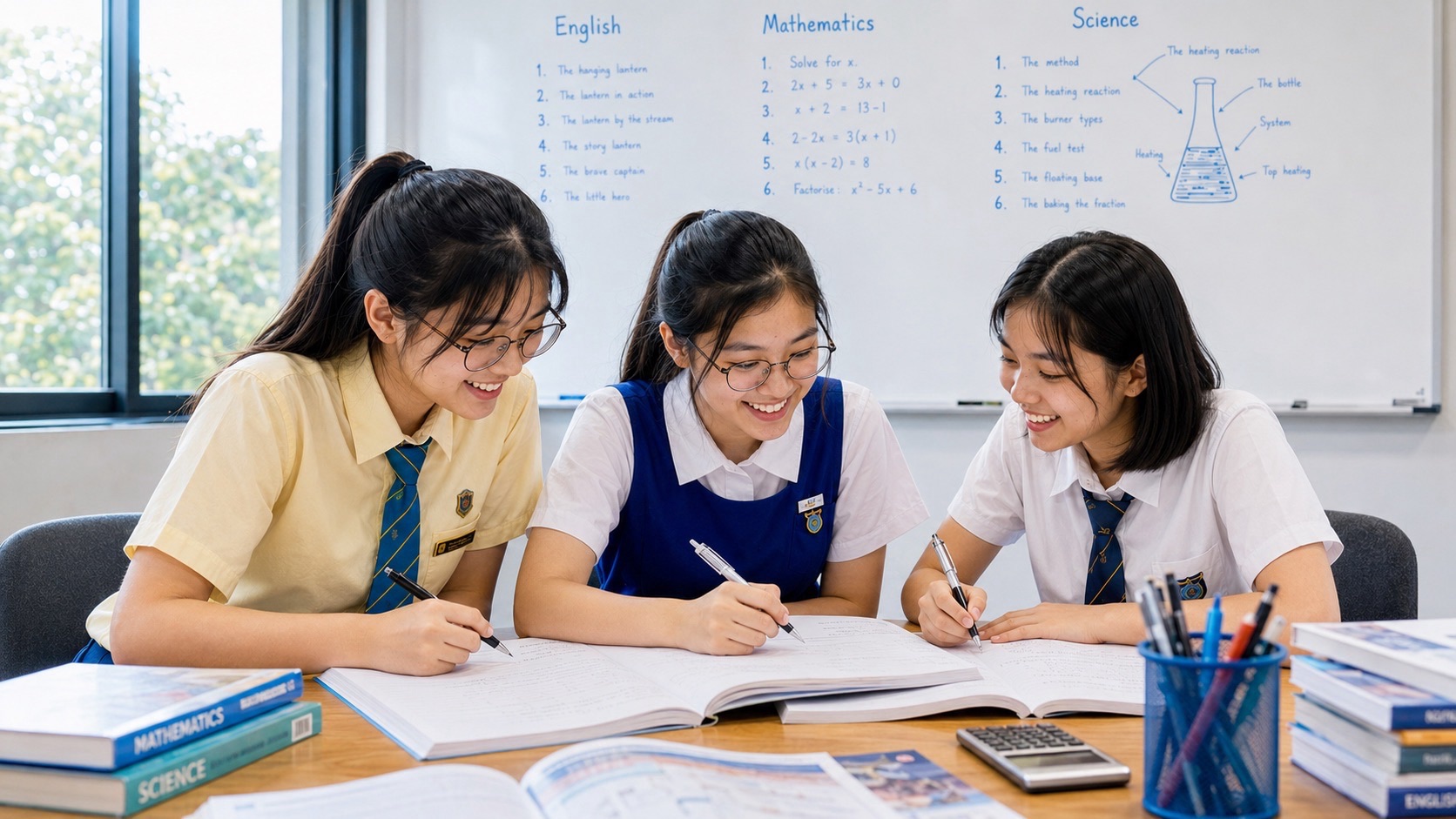
Jurong East Science Tuition is a legacy title, but the learning problem behind it is current and important. Families searching for Jurong East Science tuition, Primary Science tuition Singapore, PSLE Science tuition, small-group Science tuition, Science answering techniques, open-ended Science questions, experiments, fair tests, variables, graphs, data interpretation and concept mastery often see the same pattern: a child can spot that two setups look different, yet cannot decide whether the comparison is scientifically meaningful.
Strong Primary Science tuition therefore has to teach more than facts, keywords and worksheet routines. Pupils need to understand comparison, controlled variables, measurable outcomes, scientific evidence, fair testing, experimental design, Booklet A MCQ reasoning and Booklet B structured explanation. “Compare A and B” sounds simple, but good comparison is one of the hidden engines of Science. Pupils compare organisms, materials, forces, circuits, temperatures, graphs, rates, life cycles, systems and experimental conditions. The quality of the comparison determines the quality of the conclusion.
That is especially relevant for the revised 2026 PSLE Science examination. The current Standard Science paper contains 30 multiple-choice questions in Booklet A for 60 marks and 10–11 structured questions in Booklet B for 40 marks, with 1 hour 45 minutes for the paper. The 2023 MOE Primary Science syllabus organises Core Ideas through Diversity, Cycles, Systems, Energy and Interactions while emphasising scientific practices such as prediction, interpretation, evaluation and communication. Pupils are expected not only to know content, but to use evidence and make justified comparisons.
Scope note: this article preserves its historical title and URL. It does not claim a present Jurong East teaching location or affiliation. Its distinct educational job is comparison and fair conditions: how to help pupils decide whether two cases can be compared, what must be controlled, what should be measured, and what conclusions the evidence can legitimately support.
Comparison is everywhere in Science
Young pupils compare naturally.
“This leaf is bigger.”
“That material is harder.”
“This cup is hotter.”
“That plant grew more.”
Science does not remove this instinct. It disciplines it.
A scientific comparison asks:
- What exactly is being compared?
- On what measurable or observable basis?
- Are the conditions comparable?
- What evidence supports the difference?
- What conclusion is justified by that difference?
The phrase compared in terms of what? is one of the most useful questions a tutor can teach.
From vague comparison to precise comparison
Consider these statements:
“Material A is better than Material B.”
Better in what way?
Stronger:
“Material A is more flexible than Material B.”
Stronger still:
“Material A bends further without breaking, so it is more suitable where flexibility is required.”
The improvement comes from specifying the property and linking it to function.
This pattern appears throughout Primary Science:
evidence → comparison → relevant property or process → conclusion
The fair-test question: can these two results be compared?
A fair test is not a magical laboratory rule. It is a way of protecting a comparison.
If we want to know whether one factor affects an outcome, the competing relevant factors must be controlled well enough that the result is interpretable.
The core routine is:
- Question: What are we trying to find out?
- Changed condition: What do we deliberately vary?
- Measured outcome: What do we observe or measure?
- Controlled conditions: What else must remain comparable?
- Conclusion: What can the evidence support?
Without Step 5, pupils may perform a neat experiment and still make a poor scientific claim.
Variables should be relationships before they become labels
Pupils often memorise:
- independent variable;
- dependent variable;
- controlled variable.
The labels are useful. The relationship is more important.
Before naming the variable type, ask the pupil to complete:
“We deliberately changed ______.”
“We measured ______.”
“We kept ______ the same so that the comparison would be fair.”
Once those sentences are meaningful, terminology becomes much easier to use correctly.
Worked example 1: plants and unequal conditions
Imagine two identical plants placed in different locations. Plant A receives more light, but it also receives more water than Plant B. After two weeks, Plant A has greater growth.
A pupil may conclude:
“More light caused Plant A to grow more.”
The conclusion is tempting, but the comparison cannot isolate light because water also changed.
The tutor should ask:
- What are we trying to investigate?
- Which condition should change?
- Which other condition changed accidentally?
- Why does that weaken the conclusion?
- How would you redesign the comparison?
The pupil learns that a conclusion is only as clean as the comparison that produced it.
Worked example 2: temperature and container size
Suppose a pupil compares how quickly hot water cools in two containers. Container A is wide and shallow. Container B is narrow and tall. The starting temperature and water volume are the same.
If the question asks about one specific feature, the container shapes may introduce more than one relevant difference.
Rather than teaching a memorised “correct variable”, ask:
- Which property is supposed to be tested?
- Does the setup change anything else that might affect cooling?
- Can the current result be attributed confidently to one factor?
- What would a better pair of containers look like?
The child begins to evaluate experimental design instead of merely naming variables.
Worked example 3: materials and suitability
Material comparison questions often invite one-word answers: strong, flexible, waterproof, transparent, absorbent.
Push one step further.
If a pupil says, “Material X is waterproof,” ask:
“How does that property make it suitable for the stated use?”
If a raincoat is the context, the useful reasoning is not simply “waterproof”. It is that the material prevents water from passing through and therefore helps keep the wearer dry.
The property becomes meaningful because it is connected to function.
Worked example 4: comparing graphs
Graphs are comparisons compressed into a visual form.
Teach pupils to read them in a fixed order:
- Read the horizontal axis.
- Read the vertical axis.
- Check units.
- Identify the overall trend.
- Compare specific values or intervals.
- Describe before explaining.
A weak response:
“Graph A is better.”
A scientific response might be:
“Between 0 and 4 minutes, the temperature of A decreased by a greater amount than the temperature of B.”
Only then should the pupil explain why, if the question asks for explanation.
Worked example 5: organisms and classification
Classification is structured comparison.
To classify well, pupils need a rule that applies consistently.
Use this routine:
- Choose one observable or known characteristic.
- State the grouping rule.
- Apply it to all examples.
- Test a new example.
- Revise the rule if the new example exposes a problem.
That final step prevents pupils from inventing categories that work only for the original pictures.
Comparison errors often look like “carelessness”
Many repeated Science mistakes are described as careless even when they are systematic.
A pupil compares two graph values but forgets the units.
A pupil compares two plants even though two conditions changed.
A pupil compares “size” when the question asks about mass.
A pupil describes the final values but ignores the rate of change.
A pupil writes “more” without saying more of what.
These are comparison habits. They can be trained.
The comparison checklist
Before accepting a comparison, ask:
- Same quantity?
- Same unit?
- Comparable time?
- Comparable starting condition?
- Only the intended condition changed?
- Measured outcome clearly identified?
- Conclusion matched to the evidence?
Not every question needs every item. The checklist teaches the pupil what “fair” really means.
Booklet A: compare the options, not just the words
In MCQ questions, pupils often select the first option containing a familiar keyword.
A stronger routine:
- Predict what a correct answer should say before reading all options where practical.
- Compare each option against the evidence.
- Identify the exact difference between two plausible options.
- Eliminate the one that contradicts the data or scientific model.
- Check that the final option answers the actual question.
Comparison is therefore central even when no experiment is shown.
Booklet B: comparison answers need a basis
When asked to compare two cases, pupils should avoid vague constructions such as:
“A is higher while B is lower.”
Higher what?
Better:
“The temperature of A is higher than the temperature of B at 5 minutes.”
If the question asks for a trend:
“The temperature of A decreases more rapidly during the first five minutes than the temperature of B.”
The basis of comparison should be explicit.
Comparison versus explanation
Pupils frequently answer one command word with another job.
Compare asks for similarity or difference on a relevant basis.
Explain asks for the scientific relationship or mechanism.
State asks for the required fact or observation.
Predict asks for an expected outcome, usually with a relevant basis.
Teach pupils to identify the job before writing.
Fair does not always mean identical
A useful subtlety: controlled conditions do not mean every object in an experiment must be identical in every way. The conditions must be appropriately comparable for the question being investigated.
If the investigation deliberately compares materials, the materials must differ. If it compares surface area, surface area must differ. The goal is not sameness for its own sake. The goal is isolating the relationship we want to study.
Measurement gives comparison teeth
“This one is warmer” is an observation.
“This one is 8°C warmer at 10 minutes” is a stronger comparison.
Teach pupils to connect:
- quantity;
- instrument;
- unit;
- time or condition of measurement;
- comparison.
Measurement turns impressions into accountable evidence.
Repeats and reliability
Primary pupils can understand a simple idea: one measurement may be unusual.
Repeated trials or repeated measurements can give greater confidence when appropriate.
Ask:
- Would repeating this test help?
- If one result is very different, should we check it?
- Would several measurements show the pattern more clearly?
This introduces reliability without unnecessary complexity.
What if the data disagree?
Pupils sometimes think an experiment has “failed” if results are not neat.
Teach a better response:
- Check whether the measurements were taken correctly.
- Check whether conditions were controlled.
- Look for an unusual value.
- Consider whether the model predicted too simple a pattern.
- Ask what additional test would reduce uncertainty.
Messy data can produce excellent scientific thinking.
Primary 3: comparison begins with careful noticing
At P3, the goal is to improve ordinary language into scientific description.
Teach pupils to compare:
- shape;
- size;
- texture;
- material properties;
- living things;
- simple measurements;
- magnetic and non-magnetic objects.
Always ask “in terms of what?”
Primary 4: connect comparison to function
P4 pupils should increasingly explain why a difference matters.
If two structures differ, how does the difference affect function?
If two materials differ, how does the property affect suitability?
If two conditions differ, how might a process respond?
Primary 5: fair tests and data become central
P5 is an important year for:
- variables;
- controlled conditions;
- graph comparison;
- experimental design;
- cause-and-effect explanation;
- evaluation of conclusions.
Hidden weaknesses in comparison often become visible here.
Primary 6: comparison under mixed examination conditions
By P6, the child must compare quickly enough to protect time while remaining precise.
Use mixed practice:
- compare two graph trends;
- compare experiment setups;
- compare two MCQ options;
- compare two structured answers;
- compare the pupil’s current paper with an earlier paper to identify recurring error types.
Small-group Science: comparison becomes discussion
A three-student group is particularly useful for comparison because pupils can examine three answers to the same question.
Ask:
- Which answer uses the strongest evidence?
- Which answer identifies the right concept but misses the mechanism?
- Which answer is accurate but over-written?
- Which answer makes an unsupported assumption?
The group learns that answer quality is not mysterious. It can be analysed.
A 90-minute comparison-centred lesson
| Stage | Time | Purpose |
|---|---|---|
| Cold comparison | 10 min | Compare two familiar examples and state the basis. |
| Concept teaching | 20 min | Build the relevant property, process or system. |
| Fair-test analysis | 15 min | Identify changed, measured and controlled conditions. |
| Graph/table work | 15 min | Describe patterns precisely. |
| Independent structured answer | 15 min | Write comparison and explanation separately. |
| Peer evaluation | 5 min | Compare answer quality. |
| Exit transfer | 10 min | Use the comparison skill in a new context. |
Comparison and retrieval
One useful retrieval technique is to ask for contrasts.
Instead of “What is evaporation?” ask:
“How is evaporation different from boiling at the level you have learned?”
Instead of “What is a conductor?” ask:
“How does a conductor differ from an insulator in this context?”
Comparison strengthens memory because the pupil must identify boundaries.
Comparison and misconceptions
Misconceptions often arise from overgeneralising one comparison.
“This metal is magnetic, so metals are magnetic.”
“This large object sank, so large objects sink.”
“This plant grew more with one condition, so that condition always causes more growth.”
Counterexamples are powerful because they force the pupil to refine the rule.
The conclusion must match the experiment
A strong conclusion is neither too weak nor too broad.
If an experiment tests one type of material under one set of conditions, the conclusion should not suddenly claim that every material behaves the same way in every context.
Teach pupils to ask:
What exactly did this experiment compare?
Then write a conclusion no broader than the evidence.
Design a better test
One of the best transfer activities is to give pupils a poor experiment and ask them to improve it.
Perhaps:
- different amounts of water are used;
- containers are different sizes;
- observation times differ;
- different measuring tools are used;
- two conditions change together.
Ask the pupil to redesign the test so the intended comparison becomes clearer.
This trains evaluation, not just execution.
How parents can help at home
Parents do not need to reteach the syllabus.
Use comparison questions:
- What is the important difference here?
- Compared in terms of what?
- Is the comparison fair?
- What else changed?
- What was measured?
- What conclusion can we actually make?
These prompts help the child organise thinking without handing over the answer.
A comparison error log
| Error | What it means | Next test |
|---|---|---|
| Wrong quantity | Pupil compared the wrong feature. | New graph/table with multiple quantities. |
| Wrong unit | Pupil ignored measurement scale. | Mixed-unit reading practice. |
| Unfair comparison | More than one relevant condition changed. | Critique a new experimental setup. |
| Vague language | “More”, “better”, “higher” without a basis. | Rewrite with explicit quantity/property. |
| Overbroad conclusion | Claim exceeds evidence. | Write the narrowest defensible conclusion. |
| Surface fixation | Pupil compares appearance rather than relationship. | Same concept, new objects. |
A twelve-week comparison and fair-test cycle
Weeks 1–2: precise observation
Train quantity, unit, property and comparison language.
Weeks 3–4: fair conditions
Identify changed, measured and controlled conditions. Critique simple experiments.
Weeks 5–6: graphs and tables
Compare trends, intervals, rates and specific values before explaining.
Weeks 7–8: conclusion strength
Match claims to the evidence. Practise “supported”, “not supported” and “cannot tell from this setup”.
Weeks 9–10: mixed contexts
Use classification, materials, systems, heat, forces and life processes. Keep the comparison habit stable while topics change.
Weeks 11–12: timed independent transfer
Use mixed PSLE-style questions. Reduce prompts and check whether precision survives time pressure.
When is the skill secure?
Comparison is becoming independent when the pupil can:
- state the basis of comparison without prompting;
- identify what changed and what was measured;
- spot an unfair test;
- read axes and units correctly;
- separate description from explanation;
- write a conclusion no broader than the evidence;
- transfer the same reasoning to a different topic;
- self-correct vague comparison language.
Where this page sits in the eduKateYishun Science system
This page owns the comparison-and-fair-conditions job. For the developmental pathway from Primary 3 to Primary 6, use Science Tuition Primary. For tutor diagnosis, use Punggol Science Tutor MOE Teacher NIE Trained. For small-group reasoning, read Punggol Science Tutors Small Groups. For scientific explanation, use Singapore Science Tuition. For model transfer, use Bukit Timah Science Tuition.
The standard: compare first, conclude second
Many Science errors happen because pupils conclude too quickly.
Strong scientific thinking inserts a disciplined pause.
What is being compared?
Are the conditions comparable?
What was measured?
What does the evidence actually show?
What conclusion does that evidence justify?
Those questions are simple, but they travel well.
They help with materials, organisms, graphs, experiments, circuits, heat, forces, systems and MCQs. They help a pupil distinguish a plausible story from a defensible scientific claim.
That is why comparison is not a minor skill. It is one of the operating habits that lets Primary Science become coherent.
Current official references
Comparison casebook: six high-value situations
Case 1: two plants, one hidden confounder
Two plants are placed in different locations. One receives more light and is also watered more often. The pupil sees greater growth and immediately credits the light.
This is a classic comparison problem. The tutor should ask what else changed. If two relevant conditions differ, the result cannot cleanly isolate one factor. The repair is not “remember the definition of a fair test”. It is to redesign the experiment until the child can explain why the improved comparison is stronger.
Then change the context. Use two containers of water, two electrical setups or two surfaces. The pupil should carry the same comparison habit across topics.
Case 2: same numbers, different units
A graph or table may tempt a pupil to compare 500 mL with 0.6 L by visual size alone. Teach the pupil to normalise units before deciding which value is greater.
This sounds mathematical, but it is a scientific reading skill. Data interpretation depends on understanding what the numbers mean.
Case 3: same final value, different journey
Two graphs may end at the same final temperature while following very different paths. If the question asks which changed faster, the final value is insufficient.
The tutor asks:
- What interval should we compare?
- How much did each value change?
- Did the rate stay constant?
- Does the conclusion depend on the whole graph or one point?
This helps pupils distinguish state from rate.
Case 4: one property, two functions
A material can be suitable for one purpose and unsuitable for another. “Strong” is not automatically “best”. The pupil must compare the required function with the material property.
A transparent material may be useful for a window but not for a privacy screen. A flexible material may be useful for one component but unsuitable where rigidity is required.
The lesson is simple: comparison needs a criterion.
Case 5: two correct statements, one relevant answer
In MCQ questions, two options can contain scientifically correct statements. Only one may answer the actual question.
Train the pupil to compare relevance, not only truth. Ask which option addresses the stated condition and evidence.
Case 6: two explanations, different evidential strength
One explanation may fit the data but require an assumption not given. Another may fit the data directly. Teach pupils to prefer the explanation that requires fewer unsupported additions.
This is an early form of evidence discipline.
How to compare experiments step by step
When two experimental setups appear side by side, use a fixed visual scan.
- Circle the factor that differs.
- Box the measured outcome.
- List conditions that appear the same.
- Check whether any second relevant difference is hiding in the diagram.
- Predict the expected result if the comparison is fair.
- Decide what conclusion the result could support.
This routine reduces cognitive load. Pupils no longer stare at two complicated diagrams hoping the answer jumps out.
How to compare written answers
Science tuition can use comparison on the pupils’ own writing.
Take three responses:
Answer A: contains the correct keyword but no relationship.
Answer B: contains the correct relationship but vague language.
Answer C: uses evidence, concept and mechanism clearly.
Ask pupils to identify what changes from A to B to C.
This is useful because pupils often know a “good answer” when they see it but cannot describe why it is better. Comparison makes the quality visible.
How to compare MCQ distractors
When two options look plausible, write them side by side and underline the exact words that differ.
Then ask:
- Which word is supported by the evidence?
- Which word makes the claim too broad?
- Which option assumes something not shown?
- Which option confuses correlation with cause?
- Which option names the concept but applies it incorrectly?
MCQ becomes a language-and-reasoning exercise, not a guessing game.
Fair-test language pupils should understand
Useful phrases include:
- “to ensure a fair comparison”;
- “so that only ______ is changed”;
- “so that any difference in ______ can be linked to ______”;
- “the conclusion is not supported because another relevant condition also changed”;
- “more evidence is needed before we can conclude that…”
The pupil should not memorise these as empty templates. Each phrase must be tied to the actual setup.
Comparison and causation
Not every difference proves a cause.
Suppose two classes use different revision methods and one class scores higher. Many other differences could exist. Primary Science questions are usually more controlled than real-world studies, but the principle remains: a comparison supports causal reasoning only when competing explanations are sufficiently controlled.
This is why experimental design matters.
What does “same” really mean?
Pupils sometimes insist that two setups are identical because the drawings look similar. Teach them to check scientifically relevant properties rather than visual appearance.
Two containers may look alike but hold different volumes. Two plants may be the same species but start at different sizes. Two pieces of material may have different thicknesses.
Scientific sameness is task-dependent.
Using photographs and real objects
Comparison skills develop well with concrete materials.
Lay out several objects and ask pupils to group them using one rule. Then ask them to regroup using a different property. The same objects now support multiple valid classifications.
This teaches an important lesson: categories depend on the characteristic selected.
Later, the same logic helps with abstract data.
Comparison as a writing skill
Good comparison sentences often use structures such as:
- A is greater than B in terms of ______.
- Both A and B ______, but only A ______.
- From time X to time Y, A changes more rapidly than B.
- Unlike Setup A, Setup B ______.
- The two setups differ in ______ while ______ remains the same.
These are not scripts to memorise blindly. They are grammatical tools for precision.
When should a tutor intervene?
If a pupil is comparing the correct quantity but uses vague language, a small prompt is enough: “more of what?”
If the pupil compares the wrong quantity, return to the question demand.
If the pupil misses an unfair condition, ask what else changed.
If the pupil makes an overbroad conclusion, ask what the experiment actually tested.
Different errors deserve different prompts.
Prompt fading for comparison
At first, the tutor may say:
“Check what changed, what was measured and what stayed the same.”
Later:
“Is this comparison fair?”
Later still:
“What is your first check?”
Eventually, the pupil performs the scan automatically.
That is the transition from supported comparison to independent scientific control.
What a good correction looks like
Original error:
“Plant A grew more because it had more light.”
Correction:
“The comparison cannot show that light alone caused the difference because Plant A also received more water.”
Fresh test:
Now give a new setup where temperature and container size both change. Ask whether one factor can be isolated.
The correction is complete only when the principle transfers.
Comparison under time pressure
Timed practice should preserve the essential checks.
A useful short routine:
- Read the question job.
- Identify the basis of comparison.
- Check units and conditions.
- State the evidence.
- Write the conclusion.
With practice, these steps become fast.
The parent signal: “My child knows the topic but loses marks on experiments”
Often, the missing skill is not the topic. It is comparison control.
Look at whether the child can:
- identify the variable changed;
- identify the outcome measured;
- spot a second changed condition;
- read units;
- compare the correct interval on a graph;
- limit the conclusion to the experiment.
These checks frequently reveal the real issue.
The deeper purpose of fair comparison
Fair comparison teaches a habit larger than one examination technique.
It teaches pupils not to confuse difference with explanation.
Two things are different. Why?
Which factor changed?
What else could account for the result?
What evidence would distinguish the possibilities?
Those questions are the beginning of disciplined reasoning.
Final independence test
Give the pupil a new experiment with an unfamiliar surface context. Ask for five things without prompts:
- the question being investigated;
- the factor changed;
- the outcome measured;
- the conditions that should remain comparable;
- the strongest conclusion the evidence could support.
If the pupil can do this across several topics, the skill has become portable.
That is the standard for this page: not merely knowing the phrase “fair test”, but being able to build, inspect and defend a fair comparison independently.
A final comparison drill for independent work
Choose any two Science setups from a revision book and ask the pupil to complete a five-line comparison without help:
- Purpose: what relationship is being investigated?
- Difference: what relevant condition changes?
- Control: what should remain comparable?
- Evidence: what outcome is measured or observed?
- Conclusion: what can the evidence justify?
Then change one feature of the setup and repeat. For example, alter the container size, starting temperature, amount of water, observation time or material used. The pupil must decide whether the original conclusion still holds.
This final variation is crucial. A child who can repeat a fair-test rule may still be fragile. A child who can inspect a changed experiment and explain exactly how the comparison has been strengthened or weakened is operating scientifically.
Why this skill travels beyond experiments
The same comparison discipline appears when pupils evaluate two MCQ options, two graph trends, two materials, two organisms, two circuits or two written explanations. They ask: what is actually different, which difference matters, what evidence supports it, and what claim is justified?
That is a durable reasoning habit. It protects pupils from vague language, false cause-and-effect conclusions and quick guesses triggered by familiar keywords.
By Primary 6, the goal is for this internal checklist to run quietly and quickly. The pupil should no longer need a tutor to say “check the variables” or “read the units”. The child should notice those things automatically because comparison has become part of how Science is read.
When that happens, a fair test is no longer merely a chapter heading. It becomes a way of thinking.
The 30-second fair-comparison habit
Before committing to an answer, a Primary 6 pupil should be able to perform a compact mental scan: same question, intended difference, measured outcome, relevant controls, defensible conclusion. It does not need to be written out every time. It is a quick check that prevents several common errors at once.
For revision, deliberately include a few “bad comparisons” among correct ones. Ask the pupil to reject them and explain why. One may use different starting amounts; another may compare readings taken at different times; another may change two conditions together. The child learns that recognising a flawed comparison is as important as carrying out a correct one.
Then finish with a clean setup and ask the pupil to state the conclusion in one precise sentence. This moves from critique back to construction.
That sequence—spot the flaw, repair the comparison, state the evidence, write the conclusion—is an efficient way to convert a familiar fair-test topic into an independent scientific habit.