
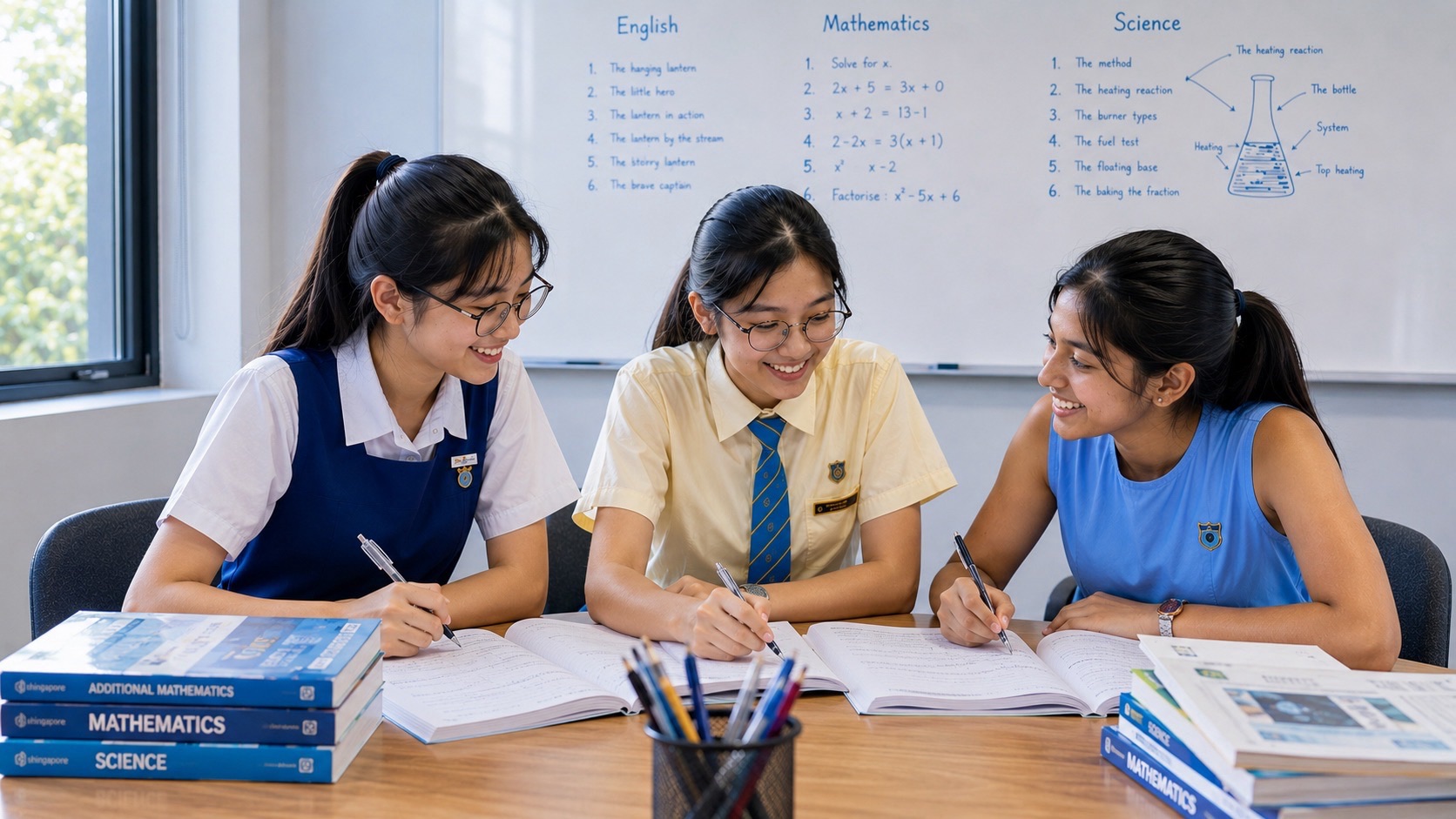
English tuition in Singapore often looks different at Primary and Secondary level. Families searching for Primary English tuition, Secondary English tuition, small-group English classes, comprehension, composition writing, grammar, vocabulary, oral communication and examination preparation are not simply choosing two versions of the same programme. The language foundation continues, but the thinking load changes.
This legacy page retains the title Parkway Parade English Tuition for Pri and Sec and its historical URL, but it does not claim a current teaching venue at Parkway Parade. The rebuilt article owns one distinct job: the transition from Primary English to Secondary English—what should remain stable, what becomes more demanding, where pupils commonly stumble and how tuition can build continuity instead of restarting English from zero.
Across current Singapore English-tuition pages, the recurring language is familiar: grammar, vocabulary, comprehension, composition, critical thinking, small-group guidance, personalised feedback, writing accuracy, confident communication and exam readiness. Those terms are useful, but the bridge matters more than the list. A pupil moving from Primary 6 to Secondary 1 needs to carry forward reading precision, sentence control and writing discipline while learning to handle longer texts, more abstract ideas, more independent responses and wider purposes for English.
Choose the transition problem
- My child did well in Primary school but feels lost in Secondary. Start at What actually changes.
- Comprehension answers are suddenly too simple. Go to Reading grows more layered.
- Writing is still story-only. Go to Writing expands beyond narrative.
- Grammar is fine in worksheets but weak in essays. Go to Language control under load.
- We need a practical bridge plan. Go to A twelve-week transition build.
1. Secondary English is not a complete restart
The pupil still needs vocabulary, grammar, comprehension and writing. What changes is how independently those skills must work together. The text may be longer. The question may allow more than one defensible answer. The writing task may require argument, reflection or functional communication rather than a familiar narrative.
The best transition teaching therefore preserves strong Primary foundations and increases complexity gradually.
2. The transition can be understood through four increases
| Increase | Primary emphasis | Secondary development |
|---|---|---|
| Text complexity | Build accurate reading | Track viewpoint, argument, implication and structure |
| Answer independence | Respond precisely to guided questions | Construct fuller explanations with selected evidence |
| Writing range | Narrative and practical writing foundations | Broader expository, argumentative and reflective purposes |
| Language control | Secure grammar and vocabulary | Maintain control while handling more complex ideas |
3. Strong Primary skills remain valuable
Close reading, pronoun reference, cause and effect, paragraph structure, sentence grammar and vocabulary precision do not disappear. In fact, Secondary English exposes weaknesses in these foundations because more attention is needed for ideas at the same time.
A pupil who never learned to track connectors such as although, therefore and unless may struggle even more when arguments become denser.
4. Reading grows more layered
Primary comprehension often establishes accurate retrieval, inference and answer scope. Secondary reading adds more sustained attention to tone, viewpoint, rhetorical choices, comparison, implied assumptions and how sections of a text work together.
The pupil should begin asking not only “What does this paragraph say?” but also “Why is it here, what is the writer doing and how does it affect the larger message?”
5. Evidence becomes more selective
Longer texts create more possible evidence. Pupils must decide which detail best supports the answer. Copying the largest available chunk becomes less useful.
Teach a simple routine: claim, best evidence, explanation. The evidence should do real work rather than sit beside the claim as decoration.
6. Inference becomes less local
A Primary inference question may turn on one or two nearby details. Secondary texts may require the reader to connect a pattern across several paragraphs. A writer’s attitude can emerge through repeated word choices rather than one sentence.
Teach pupils to gather evidence before naming the interpretation.
7. Vocabulary becomes more academic
Secondary pupils meet more abstract words: consequence, significant, justify, perspective, contradict, assumption, inevitable. These words appear across subjects, not only in English lessons.
Vocabulary teaching should include morphology, collocation and use in explanation. Knowing the word is valuable because it enables thinking and writing across contexts.
8. Reading nonfiction becomes increasingly important
Stories remain useful, but pupils also need articles, commentary, speeches, interviews, reports and informational texts. These forms expose argument, evidence, bias, purpose and structure.
A balanced reading diet helps pupils develop language for both literary and real-world communication.
9. Writing expands beyond narrative
A pupil who has learned to tell coherent stories has not wasted time. Narrative control teaches cause, pacing, character and reader awareness. But Secondary English asks for a broader writing repertoire.
The learner may need to explain, argue, reflect, describe, recommend or communicate functionally. The central question changes from “What happened?” to “What am I trying to make the reader understand, consider or do?”
10. Paragraphing becomes idea architecture
In narrative writing, a paragraph may move a scene. In argumentative or expository writing, a paragraph develops one idea. Pupils need to understand the paragraph job rather than carry over one paragraph rule from Primary school.
Ask: what claim or movement begins here, what evidence supports it and how does the paragraph connect to the next one?
11. Argument is not “give your opinion”
An opinion becomes an argument when it is supported by reasons and evidence and can survive a reasonable challenge. “School uniforms are good because I like them” is personal preference. “Uniforms can reduce visible economic differences among pupils, although they do not remove those differences” begins to reason.
Secondary teaching should introduce trade-offs rather than train pupils to produce only one-sided lists.
12. Examples must support the claim
Pupils sometimes add an example because a paragraph template says they should. The example must actually strengthen the reasoning. A vague anecdote may be less useful than a specific observed scenario or well-chosen hypothetical.
13. Counterargument is a thinking tool
Teach pupils to ask, “When might my claim not be true?” This improves judgement. A technology essay may recognise efficiency benefits while discussing distraction or unequal access. Complexity is not weakness when it is organised clearly.
14. Grammar must survive heavier thinking load
Secondary pupils often know the grammar rule but make more errors when expressing difficult ideas. Attention is divided among content, evidence, organisation and time.
The repair is transfer practice: use grammar inside real paragraphs, not only isolated exercises.
15. Sentence complexity should grow from thought
Long sentences are not automatically mature. A complex sentence is useful when the idea contains contrast, condition, cause or qualification. “Although online learning offers flexibility, it can become less effective when pupils lack a quiet space or reliable connection.” The sentence is complex because the thought is complex.
16. Register becomes more visible
Secondary English asks pupils to move across conversational, reflective, formal and persuasive registers. A phrase that suits dialogue may not suit a formal proposal. A highly formal phrase may sound artificial in a personal reflection.
Teach audience and purpose as the control system for register.
17. Editing becomes prioritisation
With longer writing, pupils cannot check everything equally. They need a personal error profile: tense shifts, agreement, sentence boundaries, pronouns, repeated words or vague claims.
A useful editing pass checks meaning first, then the highest-risk error families, then mechanics.
18. Worked transition case: from P6 answer to Sec 1 explanation
The shopkeeper watched the boy place the coin on the counter, glance at the door and then push the coin back into his pocket when another customer entered.
A simple inference might be: “The boy was probably planning to take something without paying because he hid the coin when another customer arrived.” A more developed response can explain the behaviour pattern: the boy’s decision changes when he becomes more visible, suggesting he is conscious that his intended action may be wrong.
The difference is not extra words for their own sake. It is more explicit reasoning.
19. Worked transition case: from story planning to argumentative planning
Primary narrative planning may use problem, choice and consequence. Secondary argument planning can use claim, reason, evidence, limitation and conclusion. Both require relationships.
Topic: “Should schools reduce homework?” A plan might include learning consolidation, pupil fatigue, differences among subjects, quality versus quantity and conditions under which homework is useful. The pupil is still organising causes and consequences—only the genre has changed.
20. Fictional learner: Denise loses confidence in Sec 1
Denise did well in Primary English because she recognised familiar question types. In Secondary school, longer texts make her feel she has “become bad at English”. Her tutor separates the problem: literal reading remains strong, but she needs practice tracing viewpoint across paragraphs. The foundation is preserved while one new layer is added.
21. Fictional learner: Kai writes narrative answers to every essay
Kai is an engaging storyteller. When asked to discuss an issue, he tells long personal stories without making a clear claim. The tutor keeps his strength but changes the function: anecdotes become evidence inside an argument rather than the argument itself.
22. Fictional learner: Emily knows grammar but loses control under load
Emily scores well on grammar exercises but writes run-on sentences when ideas become complex. She learns to draft one clear claim per sentence first, then combine only when the relationship is clear. Complexity follows control.
23. Small-group transition lessons can use comparison well
One pupil writes a concise answer, another over-explains, another gives evidence without interpretation. Comparing the three reveals answer design. The tutor can ask the group to identify what each response does well before revising.
Final transfer must still be individual.
24. The P6-to-Sec1 summer bridge should not become a crash course
The goal is not to pre-teach an entire Secondary syllabus. A better bridge strengthens reading stamina, paragraph reasoning, wider vocabulary, flexible writing and editing independence.
A pupil who enters Secondary 1 able to learn from unfamiliar texts is better positioned than one who memorised a stack of future worksheets.
25. A twelve-week transition build
| Weeks | Main job |
|---|---|
| 1–2 | Baseline reading, writing and grammar transfer |
| 3–4 | Longer nonfiction: structure, viewpoint and evidence |
| 5–6 | Paragraph explanation and academic vocabulary |
| 7–8 | Argument: claim, reason, example and limitation |
| 9–10 | Register, functional writing and editing under load |
| 11–12 | Fresh mixed tasks with reduced tutor scaffolding |
26. Progress should be measured by transfer
- The pupil can explain a writer’s viewpoint with evidence.
- Paragraphs develop one idea rather than accumulate sentences.
- Examples support claims.
- Vocabulary becomes more academic without becoming artificial.
- Grammar survives longer writing.
- The pupil can shift register according to purpose.
- Unfamiliar text types create less panic.
27. What not to do during the transition
- Do not tell a strong Primary pupil that everything they learned is now irrelevant.
- Do not replace reading with examination templates.
- Do not mistake long answers for developed reasoning.
- Do not demand “mature vocabulary” at the expense of accuracy.
- Do not introduce argument as a fixed five-paragraph formula only.
- Do not give Secondary worksheets before checking the Primary foundations.
28. Final transition transfer test
Give the pupil two fresh tasks on the same theme. First, a short narrative prompt about a difficult decision. Second, an expository question: “Why can difficult decisions be useful for young people?” The surface topic overlaps, but the writing jobs differ.
The pupil should preserve language control while changing architecture. The story needs character, pressure and consequence. The expository response needs a claim, explanation and relevant examples. Transfer is visible when the learner can change genre without losing control.
29. Frequently asked questions
Should Secondary preparation begin in Primary 6?
It can help to strengthen transferable skills such as reading stamina, vocabulary, paragraph reasoning and independent editing. There is usually no need to rush through an entire future curriculum.
Why can a pupil’s marks fall after entering Secondary school?
The language demands become more layered and tasks require more independent integration. A temporary drop can reveal which foundation no longer survives the increased load.
Does creative writing still matter in Secondary school?
Yes. Narrative craft builds causation, pacing, language control and reader awareness. Secondary English simply adds more writing purposes.
Is this a current tuition venue at Parkway Parade?
No. The legacy title and URL are retained for archive continuity. This rebuilt educational article does not claim a current venue or programme at Parkway Parade.
30. Related learning routes
- Primary continuous writing and causal story design
- Close reading and evidence-based comprehension
- Grammar and independent editing
- How English Works | the wider language system
31. The durable transition rule
The move from Primary to Secondary English is not a jump from “simple English” to “advanced English”. It is a move toward greater independence, abstraction and integration.
The durable strategy is therefore: protect the foundations, increase the thinking load gradually, broaden the range of texts and writing purposes, demand evidence for interpretations and keep testing whether language control survives on unfamiliar work.
Leave a Reply