
Families searching for Sembawang English tuition for Primary or Secondary students often focus on examination papers, composition and comprehension. Those components matter, but the more durable advantage comes from building academic English: the language used to explain, compare, summarise, argue, interpret and organise information across school subjects. Strong English tuition should therefore help pupils move from everyday language into increasingly precise non-fiction reading and writing as they progress from Primary to Secondary school.
Primary and Secondary English programmes in Singapore commonly emphasise comprehension, composition writing, grammar, vocabulary, oral communication, situational writing and editing. Academic language runs through all of them. A pupil needs to understand words such as contrast, consequence, significant, evidence, factor and perspective; needs to follow paragraphs that explain causes and examples; and needs to write answers that state a claim before supporting it.
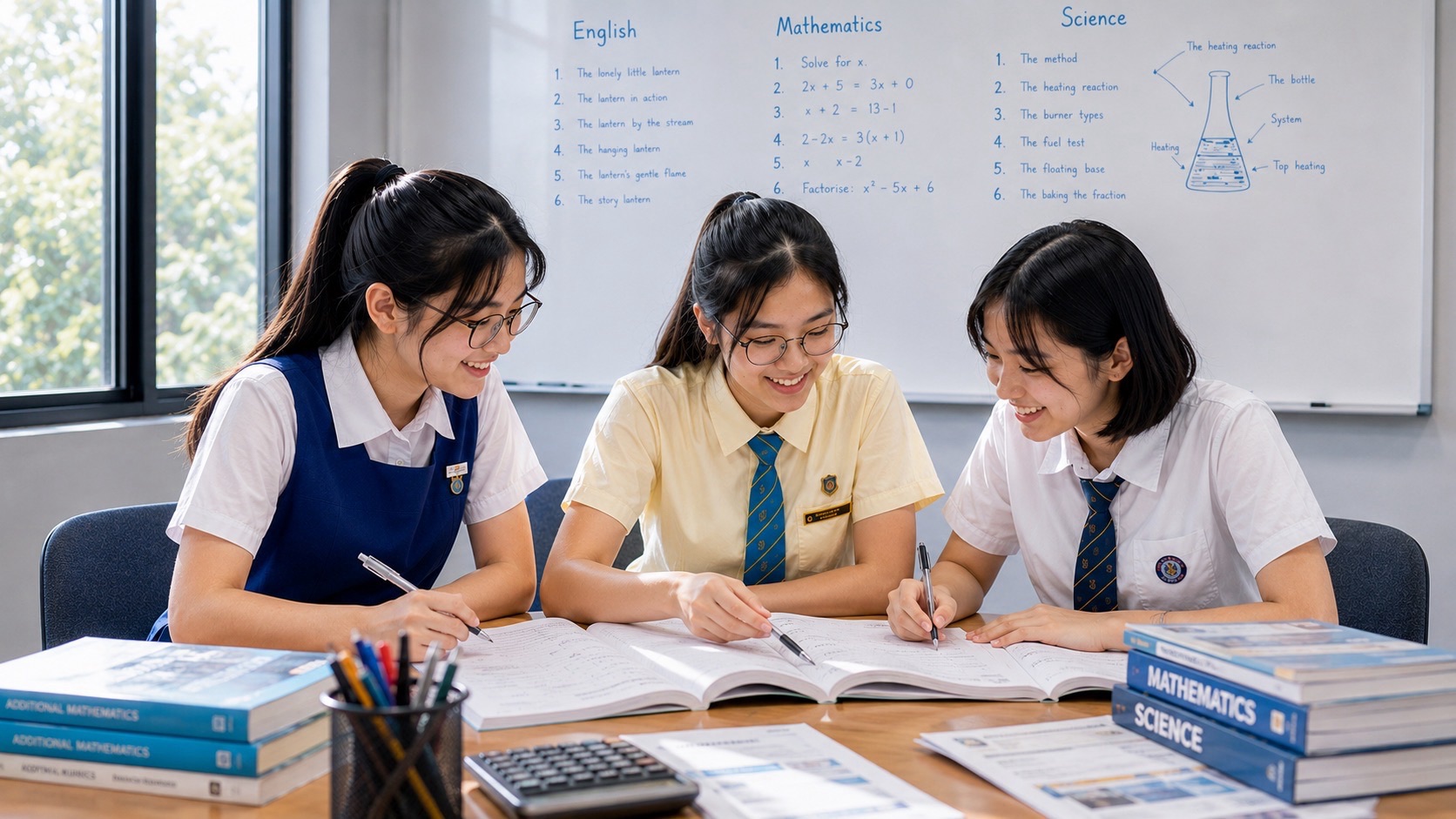
In a three-student, 90-minute tutorial, one informational text can support several levels. A Primary pupil may identify the main idea, sequence and evidence. A Secondary pupil may evaluate tone, summarise an argument or analyse how the writer develops a viewpoint. The topic can remain shared while the language demand changes. Small-group tuition becomes useful when progression means deeper thinking, not simply longer worksheets.
The historical title of this article is preserved. This guide discusses English learning for families searching in Sembawang and nearby areas; it does not imply school affiliation or a current physical branch unless separately confirmed.
Academic English Is the Language of School Thinking
Everyday English lets pupils participate in ordinary conversation. Academic English helps them handle more abstract school tasks.
- Describe: state what is observed.
- Explain: connect cause and effect.
- Compare: show relevant similarities and differences.
- Summarise: reduce a longer text without losing the central meaning.
- Evaluate: make a judgement using evidence or criteria.
- Argue: state a position and support it logically.
These functions become more demanding as pupils move through school, but the language relationships begin early.
Primary Reading: Learn How Informational Text Is Organised
Non-fiction passages often use structures such as:
- cause and effect;
- problem and solution;
- comparison;
- sequence;
- description with examples.
When pupils recognise the structure, they know what kind of information to expect. A cause-and-effect paragraph invites the reader to connect reasons and results. A comparison paragraph asks the reader to track two categories at the same time.
Headings and Topic Sentences Are Navigation Tools
Young readers sometimes treat every sentence as equally important. We teach them to use headings, subheadings and topic sentences as navigation.
Before reading closely, ask:
- What is this section likely to explain?
- Which sentence introduces the main point?
- Which sentences are examples or evidence?
- Where does the writer move to a new idea?
This supports comprehension now and note-making later.
Academic Vocabulary: Words That Organise Reasoning
Some vocabulary is important because it names a topic. Other vocabulary is important because it organises thinking.
- therefore signals result;
- however signals contrast;
- for example introduces evidence;
- in contrast prepares a comparison;
- consequently links cause to result;
- according to attributes information.
Pupils who understand these signals can read longer arguments more efficiently and build clearer paragraphs themselves.
Main Idea: Say What the Paragraph Is Mostly Doing
A main idea is not always the first sentence copied word for word. It is the central point that the supporting details develop.
We ask pupils to finish the sentence: “This paragraph is mainly explaining…” Then they identify which details support that statement.
This is an early form of summary and prepares pupils for more demanding Secondary reading.
Summarising: Keep the Meaning, Reduce the Detail
Summary is difficult because pupils must decide what can be removed.
We use three questions:
- What is the main point?
- Which details are necessary to preserve that point?
- Which examples, repetitions or minor details can be omitted?
The final wording should be the pupil’s own where the task requires paraphrase. Copying a large block may preserve information without demonstrating selection.
Paraphrasing: Change the Wording Without Changing the Meaning
Paraphrase is more than replacing every word with a synonym.
We identify the core meaning first, then reconstruct the sentence. Pupils check whether cause, time, comparison and certainty remain the same.
A paraphrase that sounds sophisticated but changes the claim is weaker than a simple accurate one.
Primary Writing: Explain Before You Argue
Primary pupils can begin with short explanatory paragraphs.
- state the main point;
- give a reason;
- provide an example;
- connect the example back to the point.
This structure supports oral communication, situational writing and later discursive writing without forcing Secondary formats prematurely.
Secondary Reading: Move From Information to Viewpoint
Secondary pupils increasingly need to identify not only what the writer says, but how the writer positions the reader.
We ask:
- What is the writer’s central claim?
- Which evidence is used?
- What tone is created?
- Which words reveal approval, doubt or criticism?
- What alternative viewpoint is absent or acknowledged?
Analysis grows from the same evidence discipline established in Primary comprehension.
Claim–Evidence–Reasoning
A useful Secondary paragraph structure is:
- Claim: state the point clearly.
- Evidence: provide an example, quotation or relevant information.
- Reasoning: explain why the evidence supports the claim.
- Link: return to the question or larger argument.
The structure is not a rigid formula for every paragraph. It makes the relationship between assertion and support visible.
Situational Writing: Academic Precision Meets Real Audience
Situational writing requires pupils to select information according to role, reader and purpose.
We ask:
- Who am I?
- Who is reading this?
- What do I need them to know or do?
- Which information is essential?
- What tone fits?
Academic language becomes practical communication rather than abstract essay vocabulary.
Editing: Read for Logic as Well as Grammar
Editing is not only spotting tense or agreement errors. Older pupils also need to check whether the paragraph’s logic is intact.
- Does the pronoun have a clear referent?
- Does the connector express the intended relationship?
- Does the example actually support the claim?
- Does a sentence repeat information without adding value?
- Has the register shifted unexpectedly?
This turns editing into thinking about the reader.
Non-Fiction Reading Builds Writing Content
Discursive and argumentative writing becomes difficult when pupils have little knowledge to draw from.
Regular reading about technology, environment, education, health, culture and society gives pupils examples, vocabulary and perspectives. We do not ask them to memorise a library of model arguments. We build enough knowledge that they can think about a fresh question.
Worked Case 1: Comprehension Good, Summary Weak
The pupil understands every paragraph but copies too much into the summary.
We highlight main ideas and classify details as essential, example or repetition. The pupil then rebuilds the passage at a smaller scale.
Worked Case 2: Secondary Essay Has Opinions but No Support
The student writes confident claims but offers vague examples.
We use claim–evidence–reasoning and require each paragraph to show why the example matters. Vocabulary is added only after the logical skeleton is clear.
Worked Case 3: Vocabulary Strong, Register Unstable
The pupil mixes conversational phrases with formal situational writing.
We compare audience and purpose. The learner rewrites the same message for a friend and for a formal recipient, making register a visible choice.
A 90-Minute Academic English Lesson
- Retrieval: academic vocabulary and connectors return.
- Read: pupils work with a narrative or informational text.
- Map structure: identify cause, comparison, sequence or argument.
- Comprehension: evidence and inference are discussed.
- Summarise or paraphrase: meaning is compressed or reconstructed.
- Write: pupils build an explanatory or analytical paragraph.
- Discuss: the topic becomes an oral question.
- Review: language and reasoning errors are separated.
Repair, Stabilise, Extend
Repair
Build the vocabulary, sentence structure and text-organisation knowledge needed to access school reading.
Stabilise
Use repeated summary, paraphrase and explanatory writing across different topics until the structures become dependable.
Extend
Increase nuance, argument, writer’s effect, register and knowledge across increasingly sophisticated non-fiction.
What Parents Can Do at Home
- Ask for the main point of an article, not a retelling of every detail.
- Discuss how two ideas are similar or different.
- Ask what evidence supports a claim.
- Read quality non-fiction as well as stories.
- Discuss one new topic each week.
- Ask the child to summarise a conversation or article in two sentences.
The Sembawang English Goal Is Language for Thinking
Academic English is not a separate language reserved for older students. It grows gradually from the first time a pupil explains why, compares two things or selects evidence from a text.
For Primary pupils, we build clear explanation and structured reading. For pupils approaching Secondary school, we deepen summary, paraphrase and viewpoint. For Secondary pupils, we strengthen analysis, argument and register.
The result we want is a learner who can read increasingly complex ideas, organise them, decide what matters and communicate a thoughtful response with evidence and precision. Properly taught kids shine a bright light into the future.
Leave a Reply