
Choose the right Mathematics route: this retained eduKateYishun article is a historical Bukit Timah search route and a learning-recovery companion. Specialist Bukit Timah Mathematics belongs with the BTT Mathematics Hub. Use this page to identify the difficulty, prepare a useful handoff and check the learner’s subsequent work. The historical title and URL do not establish an eduKateYishun physical branch, a current class or a competing specialist programme in Bukit Timah.
Bukit Timah Math Tuition should answer a more useful question than “How many worksheets will my child receive?” A family considering Mathematics support needs to know what is interrupting learning and what kind of teaching would address that particular difficulty. A long assignment is not a diagnosis.
Mathematics failure can come from several different mechanisms: missing prerequisites, weak representation, fragile algebra, poor method selection, forgotten topics, time pressure or repeated process errors. Two students with the same score may therefore need different tuition plans.
A practical sequence is to inspect an independent attempt, identify the earliest uncertain relationship, explain it, try a changed problem and return later without the original model. Keep already-secure decisions intact. The worked cases below are original illustrations of that process, not official questions, actual student records, grade guarantees or a complete curriculum.
Start with the paper, not the grade
A grade compresses many different behaviours into one number. Bring recent school papers and inspect where marks disappeared. Ask the learner what an ambiguous line was intended to do; the written answer alone does not identify every cause.
| Visible error | Possibility to investigate | Useful comparison |
|---|---|---|
| Cannot start | Recognition or representation is uncertain | Compare a supplied equation with a word problem requiring that equation |
| Method correct, answer wrong | Arithmetic, algebra or calculator execution | Locate the first divergence and check the earlier valid steps |
| Topical work stronger than mixed work | The chapter heading may have supplied the method | Remove the heading from a small set of already-taught questions |
| Paper unfinished | Time may be lost in reading, selection, calculation or checking | Record where pauses occur rather than infer the cause from duration |
| Old topic unavailable | Retrieval or understanding may need attention | Compare an unaided start, a light cue and an explained example |
These are hypotheses, not diagnoses attached automatically to each visible pattern. Missing teaching, absence, unfamiliar instructions and the conditions of the attempt can also matter. A short follow-up should help distinguish explanations instead of confirming the first one by assumption.
Teach from scratch when a foundation really is missing
“Teach from scratch” should not mean repeating every page of the textbook. It means locating the earliest unstable idea and rebuilding from there. Weak fractions may damage algebraic fractions. Weak manipulation may make trigonometry look harder than it is. Weak function understanding may later interfere with calculus.
Return to the original task after the smaller explanation. If the task still fails, inspect the new attempt. The proposed prerequisite may not have been the only obstacle, or may not have been the relevant obstacle at all. A repair earns its place by restoring access to current learning, not by producing a large backward detour.
Representation comes before calculation
Identify the quantities, variables, diagram relationships, constraints and desired result. Students who rush into manipulation can spend several minutes solving the wrong mathematical problem efficiently. Ask for a one-sentence plan before a difficult question: “I will use this relationship because…”
A diagram, table or equation should make a decision clearer. Do not require all three when one is sufficient. A learner who independently chooses a bar model has supplied a different decision from one who correctly completes a bar already drawn by the tutor. Record the support that made the attempt possible.
Algebra is infrastructure
At Secondary level, algebraic fluency supports many other topics. A student may conceptually understand coordinate geometry, trigonometry or calculus and still underperform because signs, fractions, factorisation or rearrangement consume too much attention.
Repairing algebra is therefore not automatically “going backwards”. Compare the disputed transformation with a smaller expression, make its meaning visible, then test it again inside the current topic. Preserve a sound diagram or correctly formed equation even if the manipulation that follows needs work.
Breadth, symbolic depth and the learner’s actual programme
Broad Mathematics work asks the learner to switch among number, algebra, graphs, geometry, data and interpretation. Additional Mathematics can require longer symbolic chains and closer attention to domains, transformations and function behaviour. Do not assume that success or difficulty in one represents the whole of the other.
IP, IGCSE and national examination routes need their actual course documents, school materials and assessment requirements checked separately. A tutor should not infer a student’s complete programme from a familiar subject nickname. The examples on this page illustrate reasoning difficulties across several stages; they are not a common checklist for every learner.
For examination-specific planning, the SEAB SEC syllabus directory provides the 2027 G1, G2 and G3 routes. Use the document for the student’s actual examination year and subject. A current resource should not silently turn a historic examination label into a statement about every cohort.
Harder questions are not automatically better questions
Challenge is useful when it stretches a stable concept. It is less useful when the student lacks the prerequisite and merely watches the tutor perform a clever solution. Check whether the standard version can be solved, explained and reconstructed before assuming that difficulty alone will build depth.
A strong learner can also be challenged within familiar material. Ask for a counterexample to a false rule, an alternative valid method, or a new problem with a specified answer. These tasks test control of a relationship rather than the number of advanced chapter names encountered.
Mistakes should become a usable record
Instead of recording only “Question 8 wrong”, store the observed cause: rounded too early, ignored a domain restriction, assumed a diagram was to scale, lost a negative sign, used an unsuitable calculator mode or stopped at an intermediate quantity. Distinguish the observation from an explanation that still needs testing.
The next question should test whether that error returns. Remove resolved items from intensive repair instead of making every old mistake a permanent label. A compact record of current uncertainty is more usable than an archive that treats all previous errors as equally active.
Checking should target personal risk
| Risk | Useful check | What the check does not establish |
|---|---|---|
| Equation solution | Substitute into the original equation | A simplified equation can conceal a lost original restriction |
| Factorisation | Expand the proposed factors | Matching only the first and last terms is insufficient |
| Measurement | Inspect the expected unit and a sensible bound | The right unit alone does not prove the numerical value |
| Graph | Compare scale, coordinates and the stated relationship | Visual steepness alone does not establish a numerical rate |
| Numerical answer | Estimate magnitude or reverse an operation | A plausible magnitude does not certify every digit |
Choose a second route that can reveal the likely mistake. Re-entering the same incorrect calculator expression may reproduce the same answer. Conversely, demanding a complete second solution to every routine question can consume time without adding useful evidence. Match the check to the question and the learner’s recurring risks.
Speed follows an interpretable method
Establish what the learner can do without time pressure before using a clock to investigate performance. Then compare a short timed section with similar untimed work. Note whether time is spent reading, retrieving a relationship, choosing between methods, calculating or repeatedly checking.
Past papers test integration, pacing and retrieval. They are poor instruments for explaining one narrow misconception when most of the paper covers already-secure work. Alternate paper-level review with targeted teaching when that matches the observed need. A clock measures elapsed time; it does not identify the cause of a pause.
Small-group teaching should reveal individual reasoning
Students can share a topic while needing different follow-up. One may need prerequisite repair, another standard consolidation, and another unfamiliar transfer. The evidence from the previous attempt decides the next task. A group is useful only when each learner’s own start remains visible.
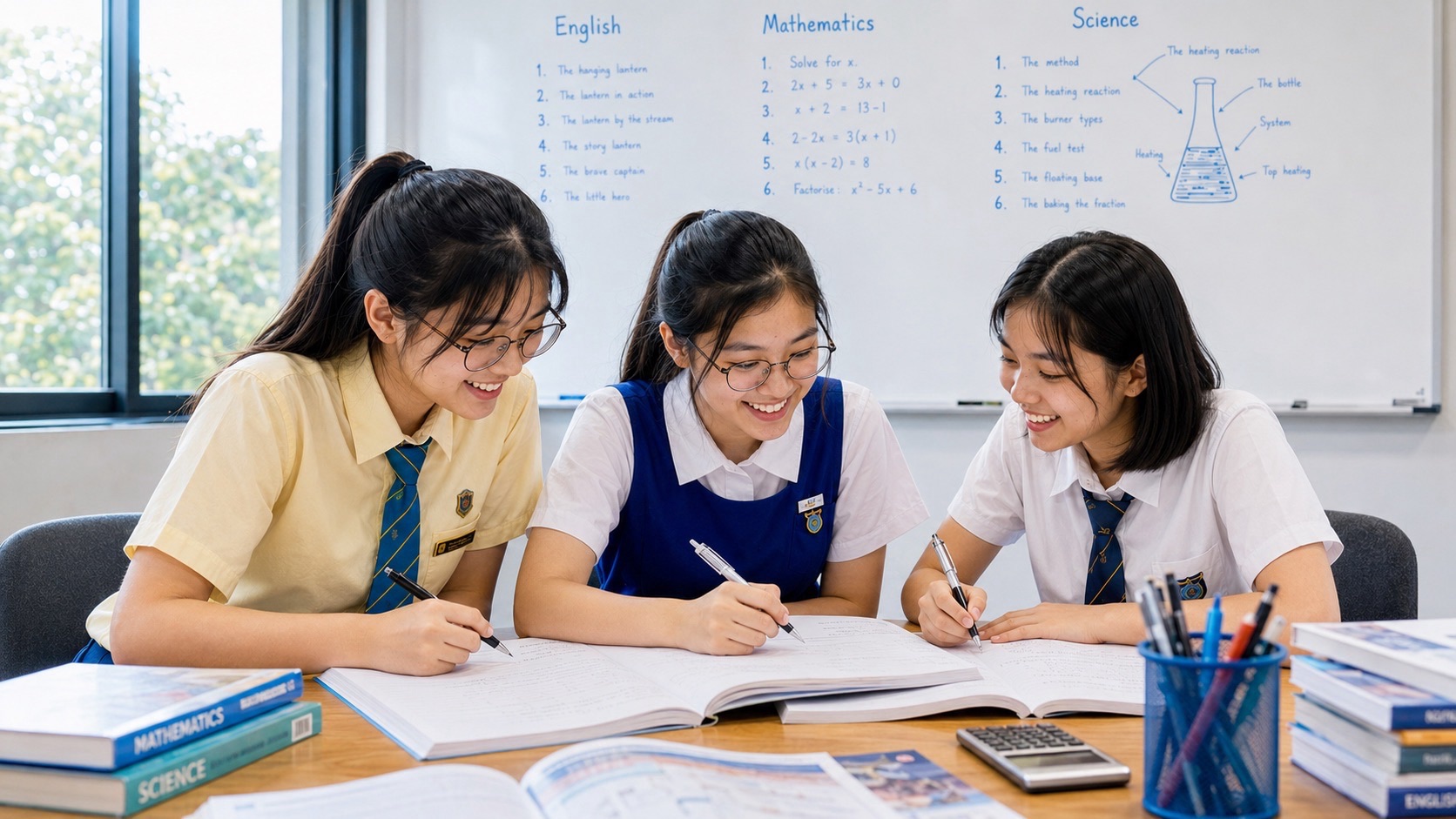
In an illustrative three-learner discussion, one student might use algebra, another a graph and another a geometric relationship. Compare which routes are valid, clear and easy to check. Afterwards, use a changed individual question. Hearing a peer’s correct explanation is not the same evidence as selecting the relationship unaided. This illustration is not a current class-size advertisement.
A tutor can begin by asking what the question wants, what is known and what representation might help. Supply a specific cue or model a step when needed, then let the learner continue. Silence is not a universal teaching rule: a learner without the required knowledge needs an explanation, not a prolonged unsupported test.
A weekly plan should change when the evidence changes
| Part of the plan | Learning job |
|---|---|
| Earlier content | Check whether a useful relationship remains available |
| Current school material | Introduce or clarify the actual next demand |
| Focused repair | Address an observed recurring error |
| Changed application | Test recognition beyond the worked example |
| Appropriate timing | Investigate performance once the method is sufficiently clear |
| Brief review | Decide what to maintain, revisit or extend |
The table is a planning example, not a fixed allocation of minutes or a promise that every student needs every component each week. A new uncertainty should change the next task. A relationship that remains secure should not occupy intensive repair time merely because it once caused difficulty.
Worked diagnosis: seven different errors, seven different responses
Use a case only when its content has been taught. Each example pairs a concrete mathematical relationship with a decision about what to repair. The cases deliberately differ; they are not instructions to invent a question after the reader reaches the page.
Case 1. A percentage answer uses the wrong whole
An item costs $75 after a 25% reduction. The final price is 75% of the original, so 0.75P = 75 and P = $100. Check forward: removing $25 from $100 leaves $75. Adding 25% of $75 instead would give $93.75, because that percentage uses the reduced price as its base.
Before reteaching division, ask the learner to identify the quantity that represents 100%. Then change the question: after a 10% reduction, a price is $81. The original is $90. The mathematical task is to reconstruct the reference whole, not to memorise “discount means subtract”. These prices are invented examples.
Case 2. Distribution fails before equation solving
Solve 3(2x − 5) = 9. Dividing both sides by 3 gives 2x − 5 = 3, hence x = 4. Expanding first also works: 6x − 15 = 9. The incorrect expansion 6x − 5 = 9 fails before any later subtraction or division.
Use the numerical comparison 3(8 − 5) = 9 versus 3 × 8 − 5 = 19 to expose the missing multiplication. Then return to a new equation, 2(3y − 4) = 16, whose solution is y = 4. Ask why each transformation is valid. A correct balance operation after an incorrect expansion should remain visible as a partial strength.
Case 3. The graph’s starting quantity is mistaken for its rate
A tank contains 30 L at time zero and 54 L after 4 minutes. Assuming a constant filling rate during the period, the rate is (54 − 30)/4 = 6 L/min. Dividing 54 by 4 includes water already in the tank and does not measure the amount added per minute.
The model is V = 30 + 6t while that constant rate applies. Reaching 72 L under the same conditions requires t = 7 minutes. Here 30 is the starting volume, 6 is the rate and 72 is a target volume. Ask the learner to attach a meaning and unit to each before deciding that graph plotting needs repair.
Case 4. A geometric variable is not the requested angle
An isosceles triangle has equal base angles (x + 12)° and a vertex angle of 48°. Then 2(x + 12) + 48 = 180, giving 2x = 108 and x = 54. Each base angle is 66°, not 54°. The angle sum checks as 66 + 66 + 48 = 180.
If the learner forms and solves the equation correctly but reports 54° as a base angle, the repair belongs to interpretation. Label the variable and the full angle expression separately. Keep the geometry and algebra already demonstrated instead of reopening both topics from the beginning.
Case 5. Averaging group means ignores group sizes
Six observations have mean 50 and four observations have mean 80. Their totals are 300 and 320, so the combined mean is 620/10 = 62. The unweighted average of 50 and 80 is 65, but it gives the two groups equal influence despite their different sizes.
Ask what the denominator counts. If it counts ten observations, the numerator must be their corresponding total. With two groups of equal size, averaging their means would work. The repair is therefore not a ban on shortcuts; it is recognising the condition that justifies the shortcut.
Case 6. A probability keeps the old sample space
A bag contains 3 red counters and 2 blue counters. Two are drawn randomly without replacement. The probability of two reds is (3/5)(2/4) = 3/10. After the first red is removed, two red counters remain among four counters.
With replacement and a fresh random draw, the second probability remains 3/5, so the probability of two reds is 9/25. Both questions involve multiplication, but their second states differ. Describe the bag after the first draw before choosing numbers for a tree or equation. A valid calculation attached to the wrong experiment is still a modelling error.
Case 7. Cancellation hides an excluded input
Solve (x² − 9)/(x − 3) = 6 over the real numbers. The original denominator excludes x = 3. Factoring and cancelling gives x + 3 = 6 on the permitted domain, whose only candidate is x = 3. That candidate is excluded, so the original equation has no solution.
Changing the right-hand side to 7 gives x = 4, which is permitted and checks in the original expression. Cancellation was legitimate away from the excluded value. The missing habit is carrying the original restriction, not avoiding factorisation or rejecting negative answers in every context.
A short return task after specialist teaching
Choose the relevant question without displaying the worked case. A: a price after a 20% reduction is $88; find the original. B: solve 4(2z − 1) = 28. C: a tank rises from 40 L to 70 L in 5 minutes at a constant rate; find the rate. D: three observations have mean 10 and two have mean 20; find the combined mean. E: solve (u² − 4)/(u − 2) = 4 with its original restriction.
A gives $110 because 0.8P = 88. B gives z = 4 and checks as 4(8 − 1) = 28. C gives 6 L/min from 30 L added over 5 minutes. D gives (30 + 40)/5 = 14. E has no solution: simplification gives u = 2, which the original denominator excludes. Record the explanation and any cue supplied, not only these final answers.
Return on a later occasion with a different surface and comparable demand. A correct prompted answer can be progress, but it should not be reported as independent selection. If a new error appears after the original relationship is used correctly, record the improvement and the new uncertainty separately.
What parents should ask a Mathematics tutor
- Which piece of work supports the proposed diagnosis?
- What can the student already do without help?
- Which prompt is currently necessary, and how will the next task test a smaller amount of help?
- How does the work fit the actual school course?
- What changed in the learner’s new attempt, rather than only in the completed worksheet?
No individual grade outcome follows automatically from a lesson plan. Evaluate the explanation, suitability of the practice, feedback and evidence of increasing independence rather than accepting a promised distinction. A good process can be inspected even when its eventual result remains uncertain.
Continue to subject teaching, then return with new evidence
Use the BTT Mathematics Hub to find the relevant specialist subject explanation. Carry the exact uncertainty: “I can cancel the factor but lose the excluded value” gives a more useful starting point than “algebra is weak”. After teaching, return to a fresh task that tests the same condition.
The eduKateYishun Mathematics Tuition & Learning Hub supports understanding and recovery. Use Student Diagnostics when the explanation remains uncertain and Examination Performance when the difficulty appears mainly under paper conditions.
Retained related reading: Additional Mathematics, E-Math and Primary Mathematics progression and Secondary IP Mathematics learning systems. The historical MOE Primary Mathematics document labelled October 2025 remains a curriculum reference, not a substitute for checking the learner’s current school requirements.
The purpose is not to make a student permanently excellent at following a tutor. It is to make the next mathematical decision increasingly their own: recognise the relationship, use it legitimately, interpret the result and know what evidence could show that it is wrong.
Leave a Reply