
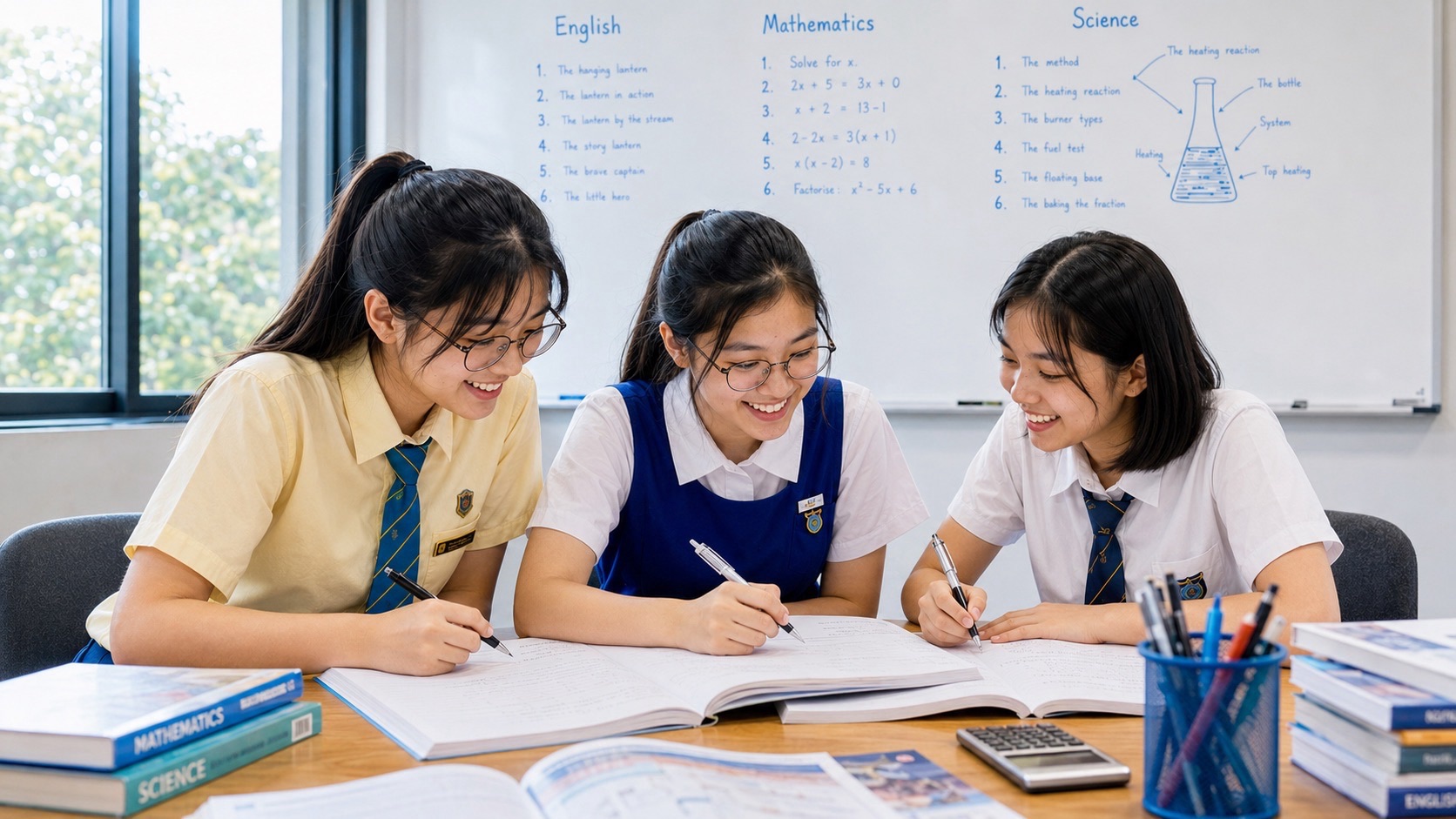
Secondary IP Mathematics Scores A* for Mid Year Examination is a historical 2016 title, so it needs one immediate clarification before the useful lesson begins: Integrated Programme schools do not all use identical grading labels, and “A*” is not a universal IP Mathematics grade. The enduring educational question is broader. What allows a student in IP Mathematics tuition, Secondary IP Maths, Year 3 Mathematics, Year 4 Mathematics or advanced Secondary Mathematics to perform strongly when the curriculum becomes deeper, faster and less dependent on routine examination patterns?
Parents searching for IP Mathematics tuition in Punggol, Dunman High Mathematics tuition, Secondary IP Maths tutor, advanced Mathematics tuition, Year 4 Maths revision or Integrated Programme tuition are often dealing with students who are already academically capable. The difficulty is not usually “teach the child more basic sums”. IP students may need broader conceptual understanding, stronger algebraic fluency, better transfer to unfamiliar problems, independent study habits and the ability to connect topics over several years.
MOE describes the Integrated Programme as a six-year pathway for academically strong students who can benefit from broader academic and non-academic learning, with time freed because they do not sit the O-Level examinations. Depending on the school, students proceed towards the Singapore-Cambridge GCE A-Level, International Baccalaureate Diploma or NUS High School Diploma. That wider runway changes the Mathematics learning job: depth, transfer and long-term coherence matter more than racing to imitate one national paper format.
IP Mathematics is not simply “O-Level Mathematics earlier”
This is one of the most important distinctions for parents. An Integrated Programme school may cover familiar Secondary Mathematics ideas, but the teaching sequence, enrichment, assessment style and depth can differ by school. Some topics may be introduced earlier, connected differently or extended beyond what a mainstream student meets at the same age.
That means an IP tutor should not begin by forcing the student into a generic O-Level timetable. The tutor should first inspect the school’s current materials, assessment papers, topic sequence and expectations. The school curriculum is the immediate operating environment.
The national pathway still matters in the background, but the student’s actual next test is written by the school. Good tuition works from the student’s real curriculum rather than from assumptions about what “Year 4 Mathematics” must look like everywhere.
Why strong IP students can still need tuition
A high-performing student may need tuition for reasons very different from a struggling student. The purpose may be to remove a bottleneck, provide deeper explanation, organise a fast-moving curriculum, stretch transfer or create a disciplined revision system.
- The student understands lessons but has gaps between topics learned months apart.
- The student is fast at routine work but slow on unfamiliar questions.
- Algebraic manipulation is accurate but inefficient.
- The student relies heavily on memory and does not see underlying structure.
- Assessment results are strong but volatile.
- The school is moving quickly into new material and the student has little revision space.
- The student wants harder extension while protecting school performance.
- The student needs better independent-study systems rather than more explanation.
Strong students still have constraints. They are simply often narrower and harder to see.
The real foundation: representation before manipulation
As Mathematics becomes more advanced, students can become seduced by symbolic speed. They see an expression and begin manipulating immediately. Sometimes that is efficient. Sometimes it hides that the student has not decided what the expression represents.
Strong IP Mathematics rests on the ability to move between representations:
- words;
- algebraic expressions;
- equations;
- graphs;
- tables;
- diagrams;
- geometrical relationships;
- functions;
- rates of change.
A student who can translate between these forms is much more flexible when a question arrives in an unfamiliar disguise.
Algebraic fluency is the language layer of advanced Mathematics
At upper Secondary level, weak algebra behaves like weak sentence grammar in English: it interferes with everything else. A student may understand trigonometry, functions or calculus conceptually and still struggle because rearrangement, factorisation, fractions or indices are unstable.
That is why IP tuition should occasionally step away from the glamorous topic and repair the symbolic tool underneath it.
| Visible problem | Possible hidden prerequisite |
|---|---|
| Cannot complete a trigonometric proof | Weak algebraic transformation |
| Errors in coordinate geometry | Fractions, signs or equation manipulation |
| Calculus solution stalls | Function notation or algebraic simplification |
| Graph interpretation weak | Cannot connect symbolic and visual forms |
| Hard question feels impossible | Student does not decompose the structure |
Repairing the prerequisite can improve several later topics at once.
High achievement is usually cumulative, not dramatic
Students and parents sometimes imagine an A-grade performance as the result of a spectacular final revision push. Strong Mathematics results are more often manufactured quietly: stable foundations, clean notes, regular retrieval, honest correction and increasing independence.
The student who performs well in Year 4 may be benefiting from habits built in Year 1 and Year 2. Algebraic notation is already comfortable. Fractions do not consume attention. Diagrams are labelled automatically. Errors are corrected when small. This frees working memory for the difficult part of the current problem.
That is why “study harder” is weak advice. The better question is: Which old skills are consuming too much attention now?
Ahead of school or aligned with school?
The old version of this page described a class working ahead so that revision time would remain before end-of-year assessments. Working ahead can be useful, but it is not automatically good tuition.
There are three sensible states:
- Behind: the student lacks prerequisites and needs repair before new acceleration.
- Aligned: tuition follows the school closely enough to deepen current understanding.
- Ahead: the student has enough stability to preview new concepts without creating shallow learning.
The right state changes through the year. A student should not remain “two weeks ahead” as a matter of branding if the current material is becoming fragile.
Previewing works best when it creates a mental hook
When tuition introduces a topic before school, the aim should not be to finish it so thoroughly that school becomes redundant. A better goal is to create a conceptual map.
For example, before formal integration work, a student can understand the big idea that integration relates to accumulation and can reverse differentiation in appropriate settings. The first preview should establish meaning, notation and a few clean examples. School lessons can then attach detail to an existing framework.
Previewing is most powerful when it reduces cognitive load later, not when it turns tuition into a race against school.
Advanced techniques should sit on top of ordinary techniques
High-performing students enjoy advanced techniques because they feel efficient and elegant. But shortcuts become dangerous when the student cannot reconstruct the standard reasoning.
A useful rule is:
- understand the standard method;
- execute it accurately;
- explain why it works;
- compare an advanced technique;
- identify when the advanced technique applies;
- retain the standard method as a recovery route.
A shortcut without conditions is merely another thing to misapply.
IP Mathematics should train proof-like thinking even when formal proof is not the topic
One difference between routine Mathematics and deeper Mathematics is the expectation that a student can justify why a step is valid. Even when a school question does not demand a formal proof, habits of justification improve problem solving.
- Why can these two expressions be equated?
- Why is this root rejected?
- Why does this transformation preserve the solution set?
- Why is the graph expected to have this shape?
- Why does this method fail at a particular value?
Students who ask these questions become less dependent on memory because they can reconstruct methods from principles.
The unfamiliar-question problem
A common pattern among strong students is high accuracy on familiar questions and hesitation on unfamiliar ones. This is not necessarily a content gap. It may be a transfer gap.
Train unfamiliarity deliberately:
- change the diagram orientation;
- change the variable names;
- embed a familiar method inside a longer problem;
- combine two topics;
- remove the chapter label;
- ask for explanation instead of calculation;
- ask the student to create a similar question;
- ask which information is unnecessary.
Transfer grows when the student learns to see the deep structure under changing surface details.
A three-level question ladder
| Level | Question type | Purpose |
|---|---|---|
| 1 | Direct application | Check basic understanding |
| 2 | Changed representation or multi-step use | Check flexible application |
| 3 | Unfamiliar combination or reasoning-heavy task | Check transfer and independence |
Strong students should move through all three levels. Jumping directly to Level 3 every lesson can hide weak basics; staying permanently at Level 1 creates false confidence.
Revision for IP students should be cumulative
An end-of-year assessment can reach far back into the year, and some school programmes expect students to integrate knowledge across multiple years. Waiting until the final month to rediscover old topics creates unnecessary pressure.
A simple cumulative system works better:
| Weekly lesson component | Job |
|---|---|
| 10-minute old-topic retrieval | Keep prior knowledge available |
| Current school topic | Maintain alignment and depth |
| One transfer problem | Train unfamiliarity |
| Error-led repair | Stop repeated weaknesses |
| Independent explanation | Check that the student owns the method |
Revision then becomes part of learning rather than an emergency season.
The error ledger for high-performing students
A strong student’s error ledger should be sophisticated enough to capture small but expensive patterns:
- starts symbolic manipulation before defining variables;
- uses an advanced method where a standard one is safer;
- fails to state restrictions or domain conditions;
- rounds too early;
- drops constants during differentiation or integration;
- assumes a geometrical relationship that was not given;
- does not return to the original question after deriving an intermediate result;
- spends too long polishing easy questions and rushes the hard final section.
At a high level, progress may come from eliminating a handful of recurring inefficiencies rather than learning another hundred questions.
Speed should emerge from structure
Fast students often move quickly because they recognise structure early. They do not necessarily calculate faster in every line. They spend less time deciding what the problem is.
That suggests a better speed-training method: show a question for thirty seconds and ask the student to describe the likely mathematical structure without solving it. What topic family is present? What information is important? What methods are plausible? What would be a warning sign?
Recognition speed can be trained separately from calculation speed.
A strong IP tutor should know when not to help
Academically strong students can become dependent on high-quality explanation precisely because the explanation is enjoyable. The tutor sees the elegant route; the student waits for it.
Good tuition includes productive silence. Give the student enough time to explore, reject a route and recover. The examination, university tutorial and future workplace will all require this.
Use a help ladder:
- wait;
- ask the student to restate the goal;
- ask what structure is visible;
- ask which known result might connect;
- give a small cue;
- model one step only;
- explain fully if the prerequisite is genuinely missing.
Progress includes needing less of the ladder.
Small-group IP Mathematics can be unusually productive
A three-student IP Mathematics group creates useful intellectual friction when students are reasonably well matched. One student may see a graphical route, another an algebraic route, and a third a geometrical interpretation. Comparing valid approaches teaches flexibility.
The group should not become a race to answer first. Speed can hide shallow reasoning. Instead, ask students to critique methods: Which is clearest? Which is easiest to verify? Which depends on an assumption? Which scales to a harder version?
This is closer to authentic mathematical thinking than silently copying one canonical solution.
Study skill becomes part of Mathematics
By Year 3 and Year 4, students are managing a growing number of subjects, activities and assessments. Mathematical ability can be undermined by poor organisation.
- Keep an error ledger by mechanism, not date.
- Maintain a small list of formulas or results that require active recall.
- Schedule old-topic retrieval before forgetting becomes severe.
- Separate “I understand when shown” from “I can retrieve independently”.
- Use school assessment dates to plan backwards.
- Reserve some practice for mixed questions rather than chapter comfort.
A mathematically strong student who cannot manage revision load will eventually feel as if the curriculum suddenly became impossible. Often the system became overloaded before the Mathematics did.
What parents should ask when choosing IP Mathematics tuition
- Does the tutor work from the student’s actual school materials?
- Can the tutor distinguish curriculum depth from simple acceleration?
- How are old topics kept active?
- Does the student solve unfamiliar problems, not only standard exercises?
- Are advanced techniques taught with conditions and reasoning?
- How does the tutor reduce dependence?
- Can the student explain methods rather than merely reproduce them?
- How are repeated errors recorded?
IP tuition should fit the student’s school and developmental stage, not impose a generic national-exam template where it does not belong.
What progress looks like in IP Mathematics
- the student recognises deeper structure more quickly;
- algebraic manipulation becomes cleaner and easier to check;
- older topics remain available without full reteaching;
- the student can solve changed versions of familiar problems;
- methods are chosen deliberately rather than randomly;
- advanced techniques are used only when appropriate;
- the student explains why an answer is valid;
- the tutor provides fewer rescue prompts over time.
These behaviours are more durable than one mid-year grade because they predict the student’s ability to survive the next increase in difficulty.
The Year 4 transition: depth before pre-university Mathematics
Year 4 in an Integrated Programme is an important transition point because the student is approaching the pre-university years without taking the O-Level examination. The absence of that national checkpoint does not mean assessment disappears. It means the school’s own curriculum and progression requirements matter greatly.
Mathematics tuition at this point should ask whether the student is ready for the next level of abstraction. Are functions understood as relationships rather than formulas? Is algebra sufficiently fluent that new concepts can sit on top of it? Can the student learn independently from a new example? Can unfamiliar questions be decomposed rather than feared?
The best preparation for pre-university Mathematics is not simply having seen more chapters. It is having stronger mathematical habits.
The useful lesson behind the old “A*” headline
The 2016 title celebrated a strong mid-year result. A modern rebuild should avoid turning one result into a guarantee or a universal grading claim. The useful lesson is what tends to sit underneath sustained high performance.
Strong results usually rest on a system: secure prerequisites, regular retrieval, explicit error correction, flexible representation, deliberate method selection, enough challenge to force transfer and enough independence that the student can recover when no model answer is nearby.
That is a much more useful definition of academic excellence than a star beside a grade. The grade is evidence from one assessment. The system is what the student carries into the next one.
Related reading
- Tuition for Primary 4 and Secondary Additional Mathematics GCE O levels and E Mathematics Classes
- Lower Secondary Mathematics for IP and High-Progress Schools | Build Depth, Speed and Transfer
- MOE: Singapore education landscape and Integrated Programme
Secondary Mathematics Routes
An A* Mid-Year Result Is Evidence, Not an Endpoint
A strong IP Mathematics result can confirm that current learning systems are working, but it should not turn into complacency. High-progress programmes often increase abstraction and pace quickly. The student should use a strong result to identify what deserves extension and which small error patterns still need removal.
IP Mathematics Rewards Depth
Integrated Programme Mathematics often asks students to move beyond routine execution into proof, generalisation, unfamiliar applications and connections between topics. Students should therefore understand why methods work, not only how to repeat them.
A strong student can be challenged by asking for a second method, a general case or an explanation of why an observed pattern must hold.
Protect Algebraic Fluency
Advanced work becomes expensive when basic algebra is slow. Factorisation, manipulation, equations and indices should be fluent enough that attention remains available for the higher-level idea.
Use Extension After Mastery
Extension should deepen the current idea rather than simply race into next year’s syllabus. Ask what changes when an assumption changes, whether a result can be generalised, or how two methods are related.
A Strong Result Still Needs Error Analysis
An A* paper can contain valuable evidence. Inspect the marks lost, questions that took too long and places where working was less clear than the final answer suggests. High-performing students benefit from refining weaknesses before they become costly at a harder level.
Speed and Elegance
As students become stronger, they can compare valid methods for efficiency. Elegance is not about writing fewer lines at any cost. It is about using a route that exposes structure and reduces unnecessary risk.
Mixed Practice for High-Progress Students
Strong students can become over-reliant on chapter cues. Mixed sets remove the label and force method selection. Include older topics regularly so fluency does not decay while new material advances.
Proof and Explanation
When a result is true, ask why it must be true. Students can begin with numerical examples, then move toward algebraic or geometric justification. This develops a more mature mathematical habit than answer production alone.
A High-Progress Weekly System
- one retrieval session for older material
- one current-topic practice block
- one unfamiliar extension problem
- one mixed set
- one error-review or proof/explanation task
Avoid Overloading a Strong Student
High achievement can lead adults to keep adding more. Strong students still need sleep, reading, hobbies and unstructured time. Extension should increase intellectual quality, not simply hours.
Prepare for the Next Level Through Transfer
The best evidence of readiness is not that next year’s chapter has already been covered. It is that the student can use current concepts in unfamiliar situations, explain reasoning and recover when a problem does not resemble practice.
The Durable IP Mathematics Principle
A strong result should widen the learner’s ambitions while sharpening the learning system. Preserve foundations, deepen reasoning, mix topics, study errors and use extension to build transfer rather than simply moving faster.
A High-Performing Student Needs a Different Error Log
For strong students, the error log may contain fewer basic mistakes and more subtle issues: inefficient method choice, incomplete justification, overlong algebra, missed constraints, or failure to generalise. These still matter because advanced Mathematics amplifies small weaknesses.
Use Non-Routine Problems Carefully
Unfamiliar problems should be difficult because of reasoning, not because they rely on hidden tricks. After solving, students should identify the transferable idea. A puzzle that teaches nothing reusable is less valuable than a hard problem built from core concepts.
Explain Why an Answer Must Be True
Move beyond “what is the answer?” Ask why the method guarantees the result, what assumptions were used and whether the conclusion would survive if one condition changed. This deepens mathematical maturity.
Prepare for Harder Courses Through Structure
Future advanced Mathematics will introduce new notation and techniques, but the habits remain familiar: parse definitions, represent relationships, test examples, generalise, justify and check. High-progress students should practise these habits deliberately.
Keep Mathematical Communication Strong
A correct result with opaque working becomes fragile at higher levels. Students should write enough structure that another mathematically literate reader can follow the argument. Clear notation is part of reasoning.
The Strong-Student Review
- Which topic is secure but shallow?
- Which method is correct but inefficient?
- Which proof or explanation skill needs work?
- Which older topic is fading?
- Where can one problem connect several ideas?
A high score should create better questions about growth, not simply more of the same practice.
From High Marks to Mathematical Maturity
A high-performing IP student should gradually move from asking “Will this be tested?” to asking “Why is this true?” and “What else follows from it?” That shift marks movement from assessment success toward mathematical maturity.
Generalisation as Extension
After solving a numerical case, replace the numbers with variables and ask whether the pattern remains. If a geometric result appears repeatedly, ask what assumptions guarantee it. Generalisation turns one problem into a family of ideas.
Counterexamples Matter
Students should learn that one example can support a conjecture but cannot prove a universal statement. Ask for a counterexample or explain why none can exist under the given conditions. This builds logical discipline.
Use Technology to Explore, Not Replace Reasoning
Graphing or computational tools can reveal patterns quickly. Students should predict before using the tool, inspect the result and then explain the mathematics behind what appeared. Exploration becomes powerful when technology creates questions rather than ending them.
Olympiad-Style Thinking Without Turning Every Lesson into Olympiad
Non-routine problems can train decomposition, invariants, parity, construction and strategic experimentation. Use them selectively to deepen reasoning. The objective is not to replace the school curriculum but to make the student more flexible within and beyond it.
High-Progress Students Need Productive Failure
Students accustomed to easy success can become uncomfortable when a problem resists immediate solution. Deliberately include tasks that require several attempts. Teach the learner to record what was tried, why it failed and what changed next.
A Strong Student Still Needs Retrieval
Advanced material can push older topics out of active memory. Use short cumulative reviews so algebra, geometry, statistics and number relationships remain accessible. Acceleration without maintenance creates hidden fragility.
A High-Progress Study Journal
- one theorem or idea understood more deeply
- one problem that required a new strategy
- one error caused by overconfidence
- one connection to an older topic
- one question worth exploring further
The journal keeps growth visible even when examination marks are already high.
The Final A* Principle
An A* result is valuable evidence that the current system works. The next step is not simply more speed. Preserve the habits that produced the result and use the available capacity to build deeper reasoning, stronger transfer and comfort with genuinely unfamiliar Mathematics.
High Achievement Needs Calibration
Students who score very well can become overconfident about topics that happened to appear in familiar forms. Use fresh, mixed and unfamiliar problems to compare perceived mastery with actual transfer. Confidence should remain accurate enough to guide future effort.
Build a “Why” Habit
After a correct answer, ask why the method was valid and what condition would make it fail. This keeps high-performing students from treating success as the end of thinking.
Use Multiple Representations
Strong students should move between equations, graphs, tables and diagrams. A relationship understood in several representations is more flexible and easier to retrieve in unfamiliar contexts.
A Strong Student Can Still Need Slower Practice
When errors appear in complex work, temporarily slow down and make every transformation explicit. Speed can return after the source of the error is understood. High ability does not remove the value of deliberate practice.
The IP Mathematics Growth Standard
The learner should become not only faster but more explanatory, more flexible and more comfortable with uncertainty. High marks are useful evidence; mathematical maturity is the broader goal.
The High-Performer’s Transfer Test
Take a familiar concept and change the context, notation or representation. A strong student should still identify the underlying relationship. This is more informative than another routine set where the method is obvious from the chapter heading.
Use Hard Problems to Study Strategy
After a difficult problem, ask what the student tried first, what evidence suggested a change of approach and what eventually unlocked the solution. The strategic history is often more valuable than the final answer.
Students who can describe strategy become better at transferring it to unfamiliar problems.
The Final High-Achievement Rule
High marks should create room for deeper Mathematics, not simply more Mathematics. Preserve fluency, increase explanation, build generalisation and keep the student comfortable with problems that do not yield immediately.
One A* Result Is Evidence, Not a Permanent Identity
A strong mid-year result is worth recognising, but the educational value lies in understanding what produced it. Which topics were secure? Which methods were selected accurately? How much independent revision occurred? Where did timing remain comfortable?
Students in IP or other high-progress Mathematics environments should avoid turning one excellent result into pressure to remain perfect. The more useful response is to preserve the learning system that worked while continuing to expose weak areas before the next assessment becomes harder.
Use Strong Results to Raise the Quality of Questions
High-performing students need more than additional routine volume. They benefit from unfamiliar problems, alternative methods, proof-like explanations and questions that require connecting several topics. Extension should deepen transfer rather than simply accelerate through future chapters.
Protect Foundations Even at High Performance
Advanced Mathematics still depends on algebra, functions, graph sense and accurate manipulation. Strong students can overlook small foundation errors because overall marks remain high. Those errors become more expensive later when several techniques are compressed into one question.
The Durable High-Performance Principle
A strong Mathematics result should create better evidence, not a fixed label. Keep what worked, investigate what still failed and raise difficulty in ways that demand explanation and transfer. Sustainable excellence is a process that can survive harder work, not one impressive score.
What to Do After a High Score
Use the paper to find the remaining weak edges. Which question consumed the most time? Which solution depended on a familiar pattern? Which topic was correct but poorly explained? High performance creates an opportunity for more precise extension because basic errors are no longer hiding the deeper limits.
The student can then move toward harder transfer: unfamiliar contexts, multiple-method comparison, proof-like explanation and questions that require combining topics. This keeps the next stage challenging without turning success into pressure for perfection.
The Final High-Performance Check
Before the next assessment, the student should be able to name what still needs improvement despite the strong result. That might be one slow topic, one fragile method or one examination habit. The goal is to preserve confidence while keeping the evidence honest.
High performance becomes sustainable when success is treated as information about a working system rather than proof that no further learning is needed.
High Achievement Still Needs Recovery Skills
Strong students also need practice recovering from an unfamiliar problem. A high score can make difficulty feel unusual and therefore more threatening. Extension work should include questions that require several attempts so the learner practises staying analytical when the first method fails.
This keeps excellence resilient. The student learns that a difficult question is information, not evidence that the earlier success was false.
The next goal after an A* is not simply another A*. It is deeper mathematical independence: the ability to face harder unfamiliar work, explain reasoning clearly and recover when the first method does not succeed.
The student should therefore carry forward the habits that produced the result—accurate reasoning, deliberate review and willingness to meet harder unfamiliar problems—rather than trying to preserve the score as an identity.
When that resilience develops, the meaning of the earlier A* changes. It is no longer something the student has to defend. It becomes one piece of evidence that disciplined reasoning, reflection and recovery can produce strong performance again under harder conditions.
That evidence-based mindset protects both ambition and perspective as the Mathematics becomes more demanding.
Leave a Reply