
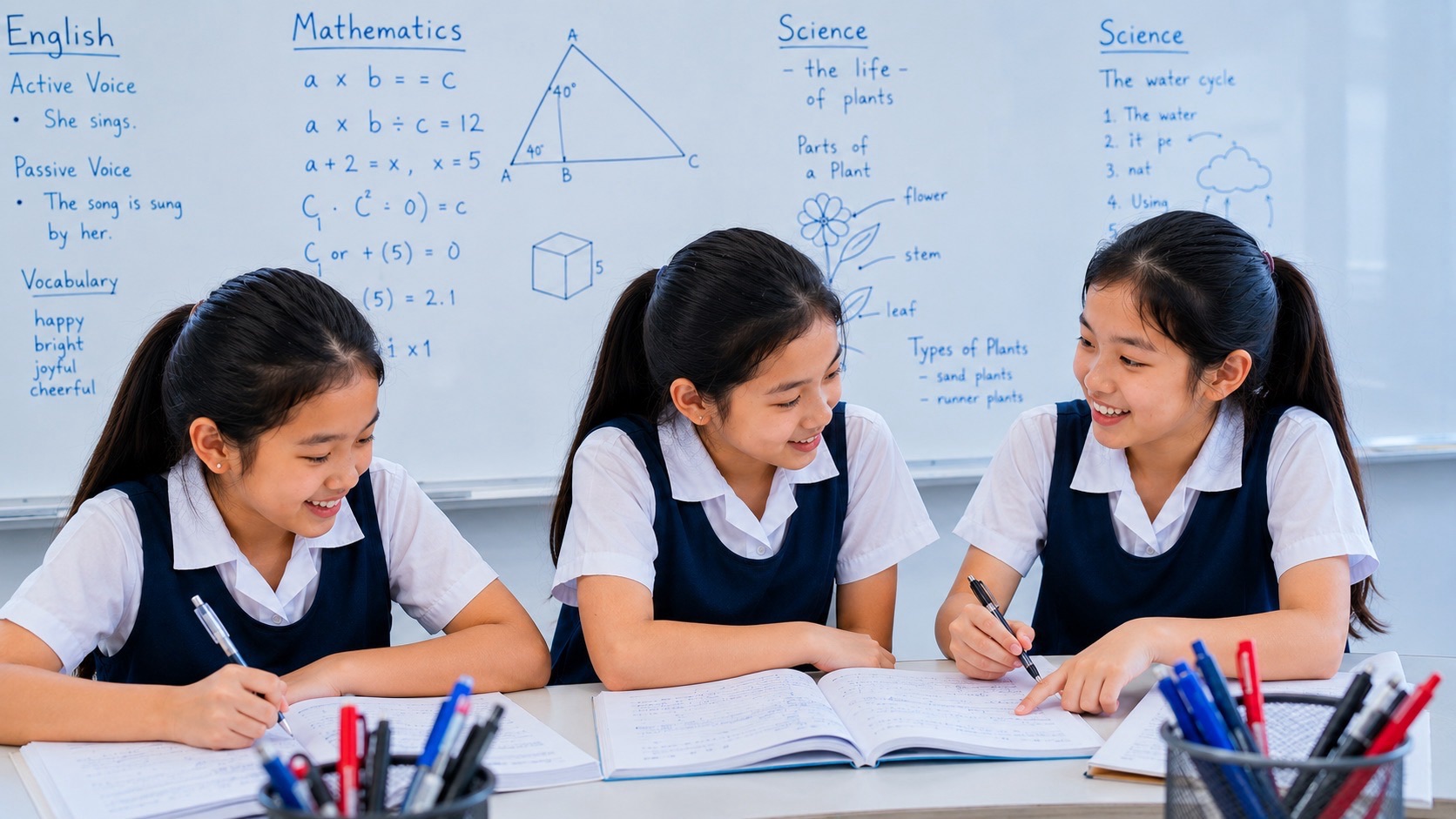
Punggol PSLE Examinations English class has all the students doing composition to brush up their creative writing skills is a long historical title with one very useful job: explain how PSLE English composition writing, Primary 6 creative writing, PSLE Continuous Writing tuition, composition planning, vocabulary and exam revision should work when the examination is close.
Parents searching for PSLE English tuition in Punggol, composition classes, creative writing tuition, PSLE writing tips, picture composition practice and Primary 6 English revision often assume the final stage is about producing more model stories. A stronger approach is to make the child’s existing writing system reliable: interpret the topic, generate a relevant story, build cause and consequence, control time and revise without depending on memorised paragraphs.
The central mechanism is topic → idea → causal plan → scene selection → draft → revise → fresh-topic transfer. Originality does not require a bizarre plot. It requires the student to make purposeful choices and develop them clearly.
The topic is a constraint, not a decoration
Before planning, the student should decide what the topic requires. A story can be beautifully written and still drift away from the central idea. Ask: what event will make the topic unmistakably relevant by the end?
Pictures are prompts, not a ready-made plot
Visual prompts should generate possibilities rather than force students into identical stories. The child should inspect people, objects, settings, actions and relationships, then decide which details can support a coherent narrative.
Build the story around a meaningful choice
- What does the character want?
- What makes that difficult?
- What choice must the character make?
- What consequence follows?
- How does the situation resolve?
- What has changed by the end?
This creates narrative causality. Events stop feeling like beads threaded randomly onto a string.
A worked planning example
Suppose the topic involves responsibility. A flat plan says: a child breaks something, feels bad, confesses and is forgiven. A stronger plan creates pressure. The broken object matters to the family. A younger sibling is likely to be blamed. The main character has an opportunity to stay silent. Now telling the truth has a cost and protects someone else.
The language can remain age-appropriate. The improvement comes from the decision structure, not from inserting ten dramatic adjectives.
Vocabulary should perform a job
Useful vocabulary clarifies action, emotion, setting or change. Students should prefer precise ordinary language over memorised phrases that do not fit the scene.
Instead of learning “fear” as a decorative theme, collect usable language: hesitated, recoiled, gripped, scanned the corridor, voice tightened, breath caught. Then discuss when each expression is appropriate.
Show emotion through evidence
“She was nervous” tells the reader directly. “She checked the clock for the fourth time and rubbed her palms against her skirt” lets behaviour carry the emotion. Students should learn both methods and choose deliberately rather than following a simplistic rule that one is always forbidden.
Dialogue should change the scene
Dialogue earns its place when it reveals information, pressure, relationship or decision. Long exchanges that repeat what the narration already explained consume valuable examination time.
Paragraphs need jobs
| Story section | Job |
|---|---|
| Opening | Establish enough context to begin |
| Trigger | Disrupt the normal situation |
| Development | Increase pressure through consequence |
| Turning point | Force a meaningful choice |
| Resolution | Settle the central problem |
| After-effect | Show what changed without over-explaining |
The middle of the composition needs protection
Many students write a polished opening, expand the middle uncontrollably and rush the ending. Timed practice should reveal this pacing fingerprint. The tutor can assign approximate checkpoints and train the student to move forward before one scene consumes the paper.
Group discussion can improve originality
A three-student class is useful when students propose different story mechanisms for the same topic. The tutor can compare them: which plan has the clearest consequence, which character choice matters most, which ending actually resolves the problem?
The point is not to merge three stories into one class model. It is to show that one prompt can support many coherent responses.
Rewrite selectively
Rewriting an entire composition after every lesson can become exhausting. Sometimes the highest-value repair is one paragraph: rewrite the turning point, tighten the dialogue, repair tense control or rebuild the ending.
Full rewrites are useful when the whole structure needs testing. Selective rewrites are useful when the tutor wants repeated practice on one mechanism.
Grammar must survive creative pressure
A student may answer grammar exercises correctly and still shift tense inside a story. Composition tuition should therefore extract recurring sentence errors from the student’s own writing and retest them in fresh paragraphs.
The final revision checklist
- Does the story clearly fit the topic?
- Is the central event developed rather than rushed?
- Does each paragraph have a purpose?
- Are character actions understandable?
- Does dialogue earn its space?
- Is tense controlled?
- Are pronoun references clear?
- Does the ending resolve the main problem?
- Is there enough time left to read the piece once?
Do not introduce ten new tricks in the final week
Near the examination, stabilise successful methods. If the student has a planning routine that works, refine it. If a story structure is reliable, practise adapting it rather than replacing it with a new acronym.
What progress looks like
- planning becomes faster and more causal;
- stories stay closer to the topic;
- the middle is better controlled;
- vocabulary becomes more natural;
- dialogue becomes purposeful;
- endings are less rushed;
- grammar errors repeat less often;
- the student can create a fresh story without waiting for a model.
The final purpose of PSLE composition tuition
Creative writing tuition should not produce a child who can reproduce the tutor’s favourite story. It should produce a student who can meet an unfamiliar topic, make sensible choices and build a coherent piece under examination conditions.
That is why discussion, vocabulary and model writing are useful only when they feed independent creation. The examination removes the tutor and the class conversation. The student must still be able to decide what happens next.
A strong final-stage composition class therefore protects creativity with structure. The plan gives the story a spine; language gives it texture; revision gives it control. When all three work together, originality stops being a mysterious talent and becomes something the student can practise deliberately.
Leave a Reply