
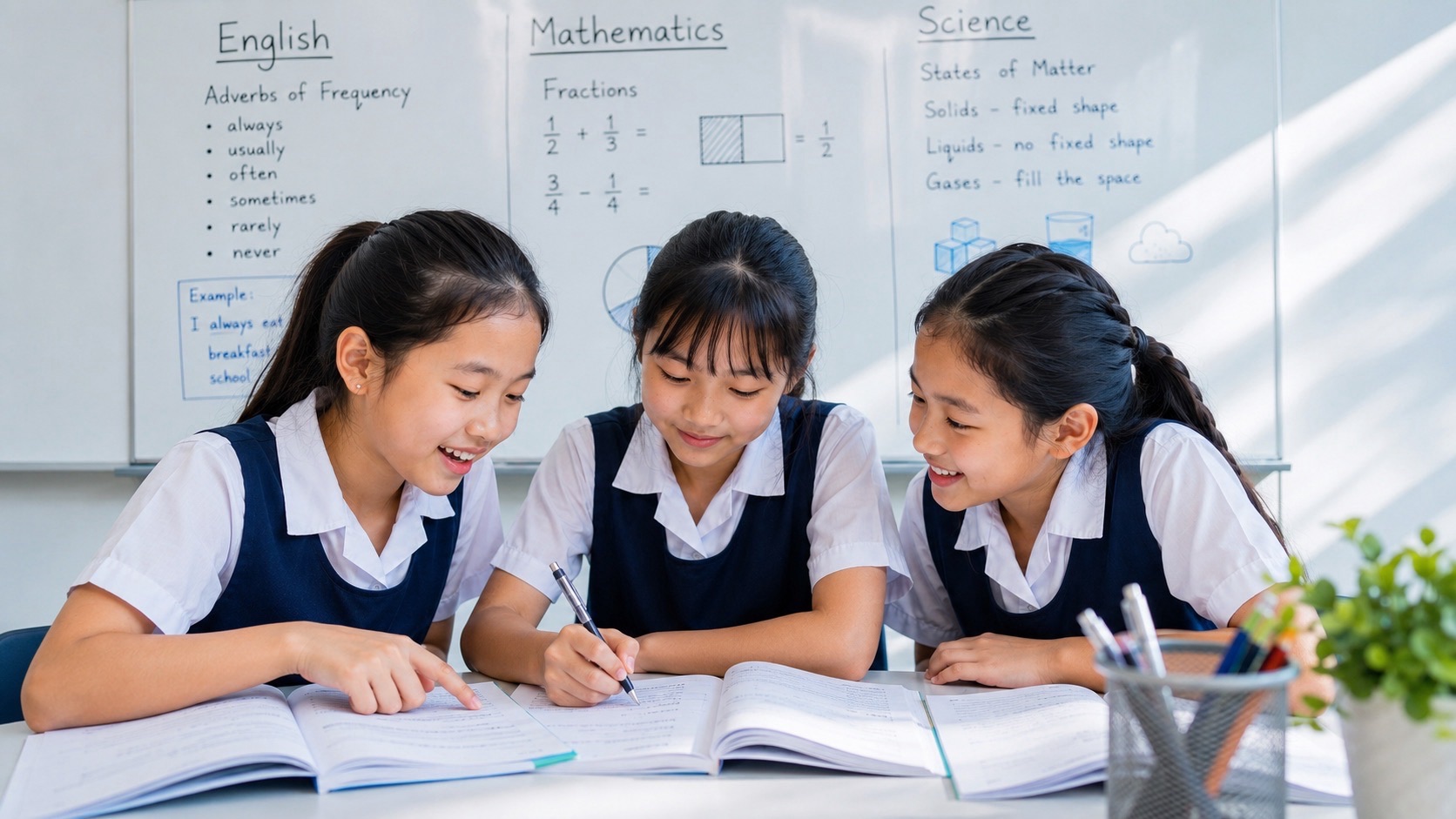
Primary Tuition Punggol Tutor Female English, Science and Math is a 2016 title built around a parent search that remains common: Primary tuition in Punggol, female tutor, Primary English tuition, Primary Maths tuition, Primary Science tuition, small-group tuition and PSLE preparation. The useful question is not whether one demographic label guarantees quality. It is how a small Primary tutorial can adapt English, Mathematics and Science teaching to the child without losing subject-specific rigour.
Families may prefer a female tutor for comfort or family reasons, and that preference can be respected. Teaching quality still has to be demonstrated through subject knowledge, patient diagnosis, clear explanation, appropriate challenge and the child’s increasing independence. A three-student class creates a particularly useful environment when the tutor can observe each learner closely while students still benefit from peer explanations.
The central mechanism is know the learner → identify the constraint → teach explicitly → let the child attempt → inspect the error → change the next task → retest later. Personalisation is not a promise that every child receives a completely different syllabus. It means evidence from this child changes what happens next.
Primary tuition should build one learner across three subjects
English, Mathematics and Science have different knowledge structures, but the same child brings reading habits, attention, memory, confidence and independence into every class. Cross-subject habits therefore matter.
| Habit | English | Mathematics | Science |
|---|---|---|---|
| Read accurately | Identify question demand | Notice conditions and units | Distinguish observation from explanation |
| Represent | Plan answer or paragraph | Model quantities | Map cause and effect |
| Explain | Support with evidence | Justify method | Connect mechanism to outcome |
| Check | Meaning and grammar | Reasonableness and units | Scientific accuracy |
English: diagnose before adding vocabulary
A child with weak composition may have plenty of vocabulary but poor story structure. A comprehension problem may come from evidence selection rather than reading fluency. Grammar may be correct in isolated exercises and unstable in writing. The tutor should identify the layer before assigning more work.
Mathematics: inspect the first decision
Many Primary Mathematics mistakes begin before arithmetic. The child may misunderstand what a number represents or start calculating before modelling the relationship. A small group allows the tutor to inspect working early and ask, “What did you decide first?”
Science: teach mechanisms, not keyword collecting
Primary Science answers need scientific vocabulary, but vocabulary must sit inside an accurate relationship. Ask what changed, what caused the change, what evidence supports the explanation and which scientific term describes the process.
Small groups allow differentiated next steps
Three students can share one concept while receiving different follow-up. One may need foundation repair, another standard application, and another unfamiliar transfer. That is a practical form of personalisation.
Patience should still contain challenge
A patient tutor gives a child time to think and enough safety to admit confusion. Patience does not mean lowering expectations. The student should still attempt, explain, revise and eventually work without rescue.
A help ladder protects independence
- Wait.
- Ask the child to reread.
- Ask what the task wants.
- Ask what is known.
- Offer one cue.
- Model one step.
- Explain fully only when the prerequisite is missing.
Progress includes needing less help for the same class of task.
Use school papers as evidence
A school paper is more useful than its total score. Classify lost marks by knowledge, reading, method, expression, timing or transfer. This turns “English weak” or “Math careless” into something teachable.
Homework should have one clear job
- retrieve old learning;
- strengthen a new method;
- transfer a skill to changed material;
- repair a recurring error;
- prepare for a school assessment.
More pages are not automatically more learning.
Confidence should be evidence-based
Durable confidence grows when the child sees difficult work becoming manageable. A comprehension answer becomes precise. A problem sum is solved without a hint. A Science explanation transfers to a new diagram. These small successes give the learner evidence of competence.
What parents should ask
- What is the normal class size?
- How are students placed?
- How are foundation gaps diagnosed?
- How are strong students stretched?
- How are recurring errors tracked?
- How much independent work happens?
- How does homework connect to class?
- How does the tutor know a correction has transferred?
What progress should look like
- the child asks more precise questions;
- old mistakes repeat less often;
- English answers use evidence more accurately;
- Mathematics working becomes more traceable;
- Science explanations become causal and concise;
- the student catches more errors independently;
- skills survive changed questions;
- the tutor provides fewer prompts.
The useful meaning of personalised Primary tuition
Personalised tuition should not create a child who can work only when a familiar tutor is nearby. It should use close attention temporarily to build stronger independent habits.
English teaches precise meaning and expression. Mathematics teaches representation and logical transformation. Science teaches evidence and mechanism. Across all three, the tutor should help the child learn how to notice a problem, choose a method, inspect failure and try again intelligently.
That is a more useful promise than guaranteed grades. The goal is a learner who increasingly knows what to do next—even when the tutor is helping someone else, and eventually when the tutor is not in the room at all.
Leave a Reply