
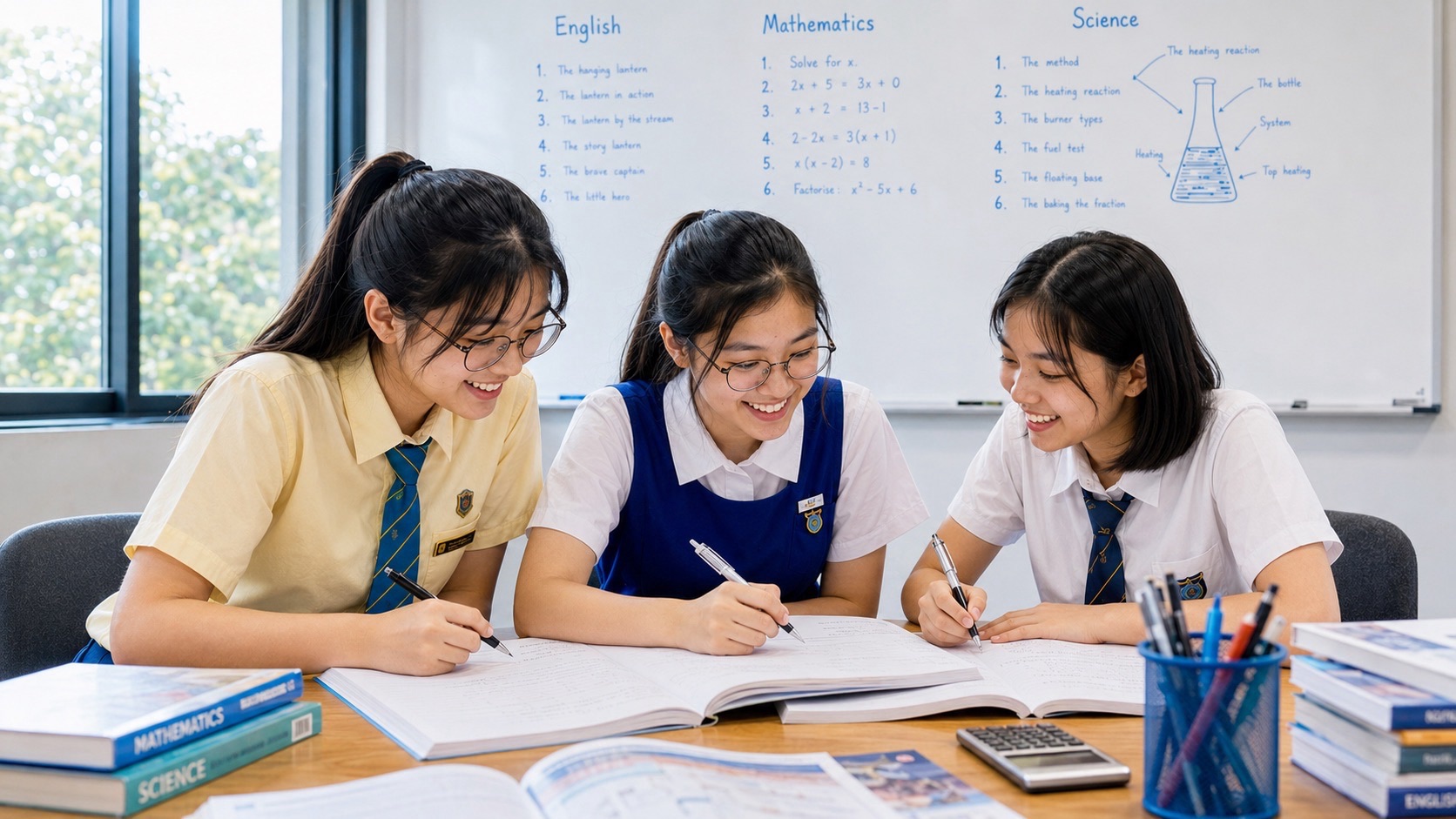
Sunday Tuition for Mathematics, 7th August 2016 began as a short record of examination preparation. The useful idea inside that old class note is still relevant: when a student has already learned most of the syllabus, Mathematics tuition has to change. Parents searching for Secondary Mathematics tuition, O-Level E-Math tuition, A-Math tuition, PSLE Mathematics revision, past-year paper practice, timed Mathematics tuition or examination preparation are no longer asking only, “Can my child do the topic?” They are asking, “Can my child still do it accurately when the paper is long, mixed, unfamiliar and timed?”
That change—from learning to performance training—is what extended Sunday Mathematics sessions can be useful for. A three-hour block should not exist merely because three hours sounds serious. It earns its place when it lets the student complete a realistic sequence of work, experience fatigue, make late-paper decisions, discover where accuracy falls, and then analyse the workflow with a tutor while the evidence is fresh.
In 2026, the final Singapore-Cambridge GCE O-Level cohort is preparing before the Secondary Education Certificate begins in 2027, while PSLE students continue to sit a very different Primary Mathematics examination. The paper names, syllabuses and age groups differ, but the training mechanism is surprisingly similar: retrieve knowledge, select a method, execute clearly, protect accuracy, manage time, recover after difficulty and keep enough attention for the final page. That is the real subject of this article.
Why ordinary tuition and examination training are not the same thing
During the learning phase, a tutor can pause after every question. The student can ask for help. Topics can be taught one at a time. Errors are useful because they expose missing understanding.
During an examination, none of those conditions exist. Topics are mixed. The next question may come from a chapter the student revised three weeks ago. Time keeps moving while the student is stuck. The paper does not tell the candidate which theorem, model or algebraic idea to retrieve.
That means exam preparation has a separate job: it must train the selection and execution of knowledge already learned. A student who can solve ten trigonometry questions after being told “today we are doing trigonometry” may still struggle when trigonometry appears without warning between algebra and geometry. The missing skill is not necessarily trigonometry. It may be recognition.
Past papers are not revision by themselves
A past paper becomes useful only when it creates information. The score is one piece of information, but not the most interesting one. The tutor should also observe:
- which questions the student recognises immediately;
- which questions create long hesitation before the first line;
- where working becomes difficult to follow;
- which topics are forgotten rather than misunderstood;
- where calculator or arithmetic errors enter;
- which methods are correct but unnecessarily long;
- when the student begins to rush;
- how often answers are checked;
- what happens immediately after a difficult question;
- whether accuracy changes near the end of the session.
A paper is therefore a diagnostic instrument. Completing five papers without analysing them can reproduce the same error five times. Completing one paper, studying its failure pattern and then testing the repair on a second paper can be much more valuable.
The four states of an examination answer
When reviewing timed Mathematics, classify answers more carefully than right or wrong.
| State | What it means | What to do next |
|---|---|---|
| Right and confident | Method is likely stable | Maintain with mixed retrieval |
| Right but unsure | Knowledge is fragile | Retest with changed wording |
| Wrong but confident | A faulty method feels correct | Diagnose urgently |
| Wrong and unsure | Gap is visible to the student | Teach or rebuild the prerequisite |
“Wrong but confident” is especially important. The student may repeat the error under pressure because nothing in the moment signals that the method is unreliable.
Speed should be the final layer, not the first
Students often hear that they must become faster. That advice is incomplete. Faster execution helps only after the representation and method are reliable. If the student begins with the wrong equation, increasing speed simply reaches the wrong answer earlier.
A useful progression is:
- solve slowly with complete understanding;
- remove unnecessary steps;
- practise retrieval without topic labels;
- time short sets;
- time mixed sections;
- complete full papers;
- complete papers when mildly fatigued, as happens in a real examination period.
Speed emerges from familiarity, method selection and clean working. It should not be forced by skipping thought.
Stamina is not simply sitting for three hours
A long Sunday session can be useful because Mathematics performance changes with fatigue. But endurance is not trained by merely remaining in a chair. The session needs realistic cognitive load.
Imagine a student who completes the first hour beautifully, becomes slower in the second, then makes three avoidable sign errors in the final forty minutes. The interesting question is not “Can this student sit for three hours?” The student clearly can. The question is “What changed in the decision process after two hours?”
Perhaps checking disappeared. Perhaps working became compressed. Perhaps the student stopped drawing diagrams because they felt slow. Perhaps frustration from one unsolved question carried into the next two. Stamina training identifies and repairs these late-session behaviours.
A useful extended Sunday Mathematics session
| Phase | Purpose | Example activity |
|---|---|---|
| Warm retrieval | Activate old knowledge | Short mixed questions without chapter labels |
| Timed block 1 | Measure fresh performance | Paper section under exam timing |
| Short review | Capture immediate process errors | Mark confidence and hesitation |
| Timed block 2 | Train switching and endurance | Different topic mix |
| Break | Restore attention realistically | Short food, water and movement break |
| Timed block 3 | Observe late-session performance | Harder unfamiliar questions |
| Error conference | Turn performance into learning | Student explains three costly mistakes |
| Transfer set | Test immediate repair | Fresh variants of the same underlying mechanisms |
The structure should change with the student and subject. The important feature is the loop between performance and analysis.
Workflow matters because working memory is limited
Mathematics errors are not always conceptual. Sometimes the student knows everything required but organises the page badly. Numbers are copied incorrectly. Variables change meaning. A diagram is unlabeled. Intermediate results are scattered. The student spends cognitive effort finding their own work.
Good mathematical workflow reduces that burden. It keeps the next step visible. It also makes checking easier because the reasoning has a trail.
- Write one logical step per line when algebra is dense.
- Label diagrams before calculating.
- Keep units visible where relevant.
- Box or clearly identify intermediate results that will be reused.
- Do not compress unfamiliar working simply to look fast.
- Use calculator memory carefully rather than re-entering long values repeatedly.
- Leave enough space to correct without creating a page of arrows.
Neatness is not the goal. Traceability is.
Primary Mathematics and Secondary Mathematics fail differently
The same training philosophy applies across age groups, but the bottlenecks differ. A PSLE Mathematics student may struggle with model representation, multi-step word problems, fractions, ratio or translating language into quantities. A Secondary E-Math or A-Math student may understand the concept but fail to identify the relevant algebraic, graphical, geometrical or trigonometric relationship under mixed-paper conditions.
For Primary students, the tutor often needs to protect conceptual models before speed. For Secondary students, the work increasingly includes symbolic fluency, topic switching and multi-stage methods. Examination training should respect those differences rather than treating all Mathematics as “do more papers”.
A PSLE problem-solving example: the first representation controls the rest
Suppose a Primary 6 question describes two quantities, a change over time and a final ratio. A student may rush directly into arithmetic because the numbers look familiar. Another student pauses and represents the before-and-after states.
The second student may appear slower for thirty seconds but can become much faster overall because the relationship is visible. Extended examination practice should teach students when slowing down at the beginning saves time later.
An E-Math example: mixed-paper recognition
In chapter practice, a question arrives under a heading such as “Trigonometry”. In a full paper, that signpost disappears. The student has to notice the triangle, the known sides or angles, the required quantity and whether the situation is right-angled, three-dimensional, bearings-based or part of a larger geometry problem.
That recognition skill is why mixed practice matters. It trains the student to ask, “What structure is this?” rather than “Which chapter is today?”
An A-Math example: technique selection
Additional Mathematics often gives students several possible routes. An equation might be solved algebraically, graphically or through a known identity. A differentiation or integration question may require an earlier expression to be rearranged before the standard technique becomes obvious.
Timed training should therefore include “method naming”. Before the student writes, ask for a one-sentence plan: “I am going to do X because Y.” That tiny pause exposes random technique selection and strengthens intentional solving.
Past-year papers should be mixed with school prelim papers carefully
National examination papers are useful because they reflect the examination system the student is preparing for. School preliminary papers can add variety and challenge, but their difficulty and style differ from school to school. Harder is not automatically better.
Use prelim papers to expose the student to unfamiliar presentations and demanding combinations, but keep the official syllabus and actual examination requirements as the anchor. Revision should stretch the student without creating a false picture of what every final paper will look like.
The error ledger: remember causes, not question numbers
Instead of writing “Paper 3, Question 8 wrong”, record the reusable cause:
- forgot to convert units before substituting;
- used the full length instead of the remaining length;
- lost a negative sign when moving a term;
- assumed a diagram was drawn to scale;
- did not check whether both roots were valid;
- rounded an intermediate value too early;
- misread “at least” as “more than”;
- spent nine minutes trying to force a method instead of moving on.
Now the student has a repair library that can be checked across different papers.
“Careless mistakes” usually have a mechanism
The phrase careless mistake is convenient because it sounds temporary. Unfortunately, if the same mistake repeats, calling it careless does not repair it.
Ask where the error enters:
- Was the question read too quickly?
- Was the representation incomplete?
- Was working compressed?
- Did the student skip a check because time was low?
- Did fatigue increase?
- Was the calculator entry wrong?
- Was a familiar formula applied without checking its conditions?
A repeated “careless” error is often a stable process error wearing an innocent name.
Stress management in Mathematics is mostly recovery training
Students cannot be promised a stress-free examination. A difficult question may appear early. A method may fail. The important skill is recovery.
Practise what happens after getting stuck:
- mark the question clearly;
- write any useful observation or starting equation;
- move on before the time loss becomes expensive;
- complete questions with higher expected return;
- return with a fresh view;
- check that frustration from one question did not contaminate the next.
Confidence comes partly from knowing that difficulty does not end the paper.
The tutor should sometimes say nothing
In ordinary tuition, help is available. In examination training, constant help can destroy the simulation. The tutor needs periods where the student works completely independently.
The tutor can observe silently: where does the student pause, erase, reread, change method, check or stop checking? After the block, the discussion can become very precise.
This is one reason extended sessions can be valuable. They reveal behaviours that never appear in a five-question homework set.
A six-week progression from topic confidence to paper confidence
| Week | Main training state | Evidence of readiness |
|---|---|---|
| 1 | Targeted topic repair | Concepts and methods correct with guidance |
| 2 | Unlabelled mixed questions | Student recognises topic independently |
| 3 | Timed short sections | Accuracy survives modest pressure |
| 4 | Half-paper simulations | Pacing becomes predictable |
| 5 | Full-paper simulations | Late-paper accuracy remains stable |
| 6 | Taper and error protection | Student uses personal checking and recovery routines |
The exact schedule changes with the examination calendar. The progression matters more than the dates.
Why full-paper practice should not happen every day
Full papers are expensive training tools. They consume time and fatigue. If a student’s main weakness is one recurring algebra error, another full paper may spend ninety percent of the session on things already secure.
Use full papers to test integration and pacing. Use targeted sets to repair specific mechanisms. Alternating the two is more efficient than turning every revision day into a mock examination.
The final week should reduce noise
Close to the paper, do not rebuild successful methods. Review the personal error ledger. Retrieve formulas and high-frequency concepts. Complete selected timed work. Check equipment and calculator familiarity. Protect sleep.
The final week is a sharpening phase. A student who has trained well does not need to prove effort by becoming exhausted.
A note for the 2026 O-Level cohort
Students sitting the 2026 GCE O-Level examinations remain under the O-Level syllabuses published for that year. From 2027, Singapore moves to the Singapore-Cambridge Secondary Education Certificate, with subjects offered at G1, G2 and G3. Future readers should therefore check the current SEAB syllabus rather than assuming a 2016 or 2026 paper structure remains unchanged.
The mathematics training principles remain durable even when qualification names change: clear representation, correct method selection, accurate execution, transfer, pacing and recovery.
What parents should ask about an extended Mathematics session
- Why does this student need a longer session?
- What will be observed that cannot be seen in the ordinary lesson?
- How much of the session is true timed work?
- How are breaks planned?
- How are repeated mistakes recorded?
- Will the student receive a short personal action list afterwards?
- How will the next session test whether the repair held?
Length without purpose is not intensity. A good extended session should produce better information about the student and a clearer next step.
What progress looks like before the next grade appears
- working starts more quickly on mixed questions;
- the student changes method less often without reason;
- late-paper sign and arithmetic errors fall;
- checking becomes targeted rather than random;
- time spent on hopeless questions decreases;
- the student can explain why a previous method failed;
- accuracy remains steadier after two hours of work;
- the same repaired behaviour appears in a different paper.
These are signs that performance is becoming more reliable, which is exactly what examination training should accomplish.
The lesson from Sunday, 7th August 2016
The original Sunday class was built around speed, stamina, workflow, diverse questions, mistakes, strategy and stress. Those ideas still hold, but they become much stronger when each one is defined precisely.
Speed means efficient correct execution. Stamina means accuracy that survives fatigue. Workflow means working that keeps the next action visible. Diverse questions train recognition and transfer. Mistake reduction means repairing processes, not saying “be careful”. Strategy means knowing how to allocate time. Stress management means recovering when difficulty appears.
That is what a serious Sunday Mathematics session should train. Not certainty that nothing will go wrong. Mathematics examinations are too interesting for that promise. The stronger goal is a student who knows what to do when something does go wrong—and can still finish the paper well.
Related Mathematics reading
- Tuition for Primary 4 and Secondary Additional Mathematics GCE O levels and E Mathematics Classes
- Lower Secondary Mathematics Exam Revision | How to Use Past Papers Properly
- SEAB: 2026 O-Level syllabuses
Mathematics Routes
This Sunday Mathematics Page Is a Historical Schedule Record
The title records a specific lesson date in August 2016. It should not be treated as current scheduling information. The durable value of the page is the question behind the lesson: what should a focused Sunday Mathematics session accomplish when students have limited time?
A Weekend Lesson Should Have a Different Job from School
Students already encounter new content during the school week. A weekend session can be used more strategically: retrieve older knowledge, repair recurring errors, connect topics and create enough uninterrupted time for one demanding problem-solving block.
Repeating the entire school week in miniature is rarely the best use of Sunday.
The Sunday Diagnostic
- Which error repeated this week?
- Which topic is understood but slow?
- Which method is forgotten after a delay?
- Which question type causes avoidance?
- What can already move to maintenance?
These questions create a narrow lesson agenda instead of a random worksheet stack.
Retrieval First
Begin by asking students to retrieve formulas, methods or key relationships without looking at notes. Retrieval shows what remains available after the week’s learning has cooled.
If a method disappears, relearn it before moving to speed or difficult applications.
One Deep Problem-Solving Block
Weekend time is useful for one longer unfamiliar problem that requires representation, method selection and persistence. The goal is not only the answer. Students should explain where they became uncertain and how they chose the next step.
Primary Mathematics Sunday Work
Primary students benefit from number fluency, fractions, ratio, models and word-problem reasoning. A strong Sunday session might include a short retrieval set, one representation lesson and a few mixed problems.
Do not turn Sunday into a full weekday of worksheets. Younger learners still need reading, movement and family time.
Secondary Mathematics Sunday Work
Secondary students can use the longer block for algebraic repair, graphs, geometry, statistics or A-Math foundations. Mixed practice becomes increasingly important because examinations do not label the topic for each question.
Error Repair Before More Questions
If the same mistake appears twice, stop the set. Ask whether the cause is concept, recognition, execution or checking. Correct practice should resume only after the student can explain the repaired step.
Build a Personal Checking Routine
Students should know which errors they personally make. Common checks include units, negative signs, copied values, graph scales, decimal placement and whether an answer is reasonable.
Checking becomes faster when it is targeted.
A 90-Minute Sunday Mathematics Session
- 10 minutes: retrieval
- 15 minutes: error review
- 20 minutes: explicit teaching
- 20 minutes: guided then independent practice
- 15 minutes: mixed or unfamiliar transfer
- 10 minutes: reflection and next-week note
A Two-Hour Sunday Session for Older Students
Older students can add one timed section after the main teaching block. The important point is sequence: do not begin with the timed section if the underlying concept is still unstable.
The final twenty minutes should classify errors and choose the next repair rather than immediately starting another paper.
Sunday Should Prepare Monday
A useful weekend session ends with a small continuation plan. Which method should be retrieved on Tuesday? Which error should be reattempted after a delay? What school topic needs attention during the coming week?
This connects tuition back to ordinary school learning.
Do Not Use Weekend Tuition to Replace Sleep
If Sunday classes begin too early after a late Saturday or continue into a heavily scheduled day, students may arrive tired and retain little. Weekend learning needs enough recovery around it to be productive.
When Sunday Tuition Is Not Necessary
A student who is learning steadily, completing revision independently and responding well to school feedback may not need another formal lesson. A free Sunday can support reading, exercise, hobbies and family life.
The Parent Sunday Test
- What specific problem is the lesson solving?
- Does the child leave understanding more?
- Is homework from the lesson manageable?
- Is Sunday still restorative overall?
- Can support reduce when the target is secure?
The Durable Sunday Mathematics Principle
A good weekend Mathematics session should concentrate value, not simply occupy time. Retrieve, diagnose, repair, transfer and stop with enough energy left for the student to begin the school week ready to learn.
A Sunday Mathematics Portfolio
Keep only selected evidence from weekend sessions: one recurring error, one repaired solution and one later fresh task. This shows whether Sunday work is creating durable improvement rather than simply more completed pages.
Use Sunday for Cross-Topic Connections
Weekend time is useful for connecting ideas that school may teach separately. Fractions connect to ratio and percentage. Algebra connects to graphs. Geometry connects to coordinate methods. Asking how two topics relate builds a network rather than a set of isolated chapters.
When a Student Is Ahead
Do not automatically accelerate into future chapters. Use deeper problems, proof, alternative methods and unfamiliar contexts. Extension should stretch reasoning before increasing syllabus speed.
When a Student Is Behind
Choose the earliest unstable foundation that blocks current work. Repair that first, then reconnect it to the present topic. A weekend lesson is valuable because it can slow down and fix something the school week moved past quickly.
Sunday Revision Before Exams
As examinations approach, shift part of the lesson toward mixed timed sections and personal checking routines. Keep concept repair active when the same error repeats. A full paper is useful only when the student is ready to learn from what it reveals.
The Final Sunday Rule
The best Sunday Mathematics session gives the student a stronger Monday. It should close one important gap, keep old learning alive and leave enough cognitive energy for the week ahead.
A Sunday Session Should Include Delayed Re-Attempts
One of the most useful weekend practices is to revisit an error from several days earlier without looking at the correction. If the student can now reconstruct the method independently, the repair is becoming durable. If the error returns, the original teaching needs another layer.
Use Sundays for Mathematical Explanation
School weeks can be rushed. A quieter weekend block is a good time to ask students to explain why a method works, compare two approaches or write a short reasoning note. Explanation strengthens conceptual control and often exposes gaps that correct answers hide.
Sunday Problem Families
Rather than choosing questions only by chapter, group some work by problem family: finding the whole, comparing rates, working backwards, interpreting graphs, using algebraic structure or proving a geometric relationship. Students learn to recognise deep structure across surface differences.
Keep One Maintenance Thread
Each Sunday, include a few questions from an older topic that has already become secure. This spaced maintenance keeps earlier learning accessible while current school topics advance.
A Sunday Exam-Season Upgrade
Closer to examinations, the lesson can add one timed mini-section and a paper-management routine. Students practise starting efficiently, skipping strategically and checking personal risk areas. The session remains targeted; it does not need to become a full paper every week.
A Sunday Student Reflection
- What became easier today?
- Which error still repeats?
- Which method can I now use without help?
- What should I retrieve again midweek?
- What can I stop practising because it is secure?
This reflection teaches students to manage their own learning rather than waiting for the next lesson to tell them what is weak.
The Final Historical-Sunday Principle
The 7 August 2016 date belongs to the archive. The lasting lesson is how to design a weekend Mathematics session: concentrated, diagnostic, connected to school, light enough to preserve recovery and useful enough to make the following week easier.
A Weekend Session Can Teach Mathematical Communication
Ask the student to explain one solution as though teaching another learner. The explanation should name the relationship, justify the method and identify the point most likely to cause an error. Teaching the solution reveals whether the student truly understands it.
Use One “No-Help” Question
End the lesson with one fresh question that the tutor does not interrupt. The result shows whether the day’s learning can operate independently. If the student gets stuck, record where the first prompt would have been needed and use that as the next lesson’s diagnostic.
Sunday Mathematics and Long-Term Memory
A weekend review is well placed for spaced retrieval because several days may have passed since the topic was taught in school. If the student can retrieve the method on Sunday, the memory is stronger than it appeared immediately after the weekday lesson.
Do Not Let Sunday Become Catch-Up Forever
If every weekend is spent repairing unfinished weekday work, the weekly system may be overloaded. The family should ask whether school routines, tuition volume or time management need adjustment. Sunday should not permanently function as an emergency buffer.
The Final Weekend Mathematics Standard
A good Sunday session should leave one durable change: a repaired misconception, a stronger method, a clearer error rule or a skill that now works without help. That is a better measure than how many pages were completed.
Sunday Mathematics and Self-Study Transfer
A weekend class is most valuable when the student can reproduce the same learning process during the week. Before ending the session, the learner should know which short task to do alone, when to revisit it and what evidence will show that the method is stable.
This creates continuity between formal tuition and independent revision. The class becomes a training ground for self-study rather than a weekly rescue event.
A Final Sunday Planning Rule
Choose one repair, one transfer task and one maintenance task. That is enough for a productive weekend session. When the agenda grows too large, depth disappears and the child leaves tired rather than stronger.
What a Sunday Mathematics Lesson Should Actually Achieve
A Sunday class should not exist merely because the weekend provides an empty slot. It should have a defined job: repair a concept, strengthen mixed problem solving, review a marked paper or prepare one specific examination routine. The student should be able to say what became more secure by the end of the lesson.
Weekend learning also has an opportunity cost. A useful class protects sleep, family time and recovery by keeping homework proportionate and avoiding repetition of work the student already controls. When the lesson adds something genuinely different—diagnosis, explanation, targeted practice or transfer—the extra session can be worthwhile.
A simple lesson cycle is retrieval, diagnosis, explicit teaching, guided practice, independent transfer and review. The final transfer task matters most because it reveals whether the learner can use the repaired skill without the teacher supplying the next move.
The Sunday Lesson Should Leave a Monday Advantage
A useful weekend Mathematics session should make the next school week easier. The student should leave with one repaired concept, one clearer checking rule or one method that can be used independently when similar work appears again. If Sunday tuition only adds tiredness and more unfinished homework, the system should be redesigned.
The most valuable outcome is therefore transfer into ordinary school learning, not the number of weekend worksheets completed.
A Final Sunday Mathematics Check
Before keeping a weekend lesson in the timetable, ask whether the student is gaining something distinct: a repaired weakness, deeper transfer, better checking or more independent problem solving. If the class has become routine without clear learning value, the schedule should be reviewed rather than preserved automatically.
The strongest Sunday routine therefore has a clear exit condition: when the student can use the repaired skill in school and fresh work without prompts, the extra session should reduce or change purpose rather than continue by habit.
When that Monday advantage is visible and the child needs less prompting over time, the extra weekend lesson has a clear educational purpose.
That is the point at which weekend tuition becomes a temporary support rather than a permanent fixture.
That is enough.
It is complete.
Leave a Reply