
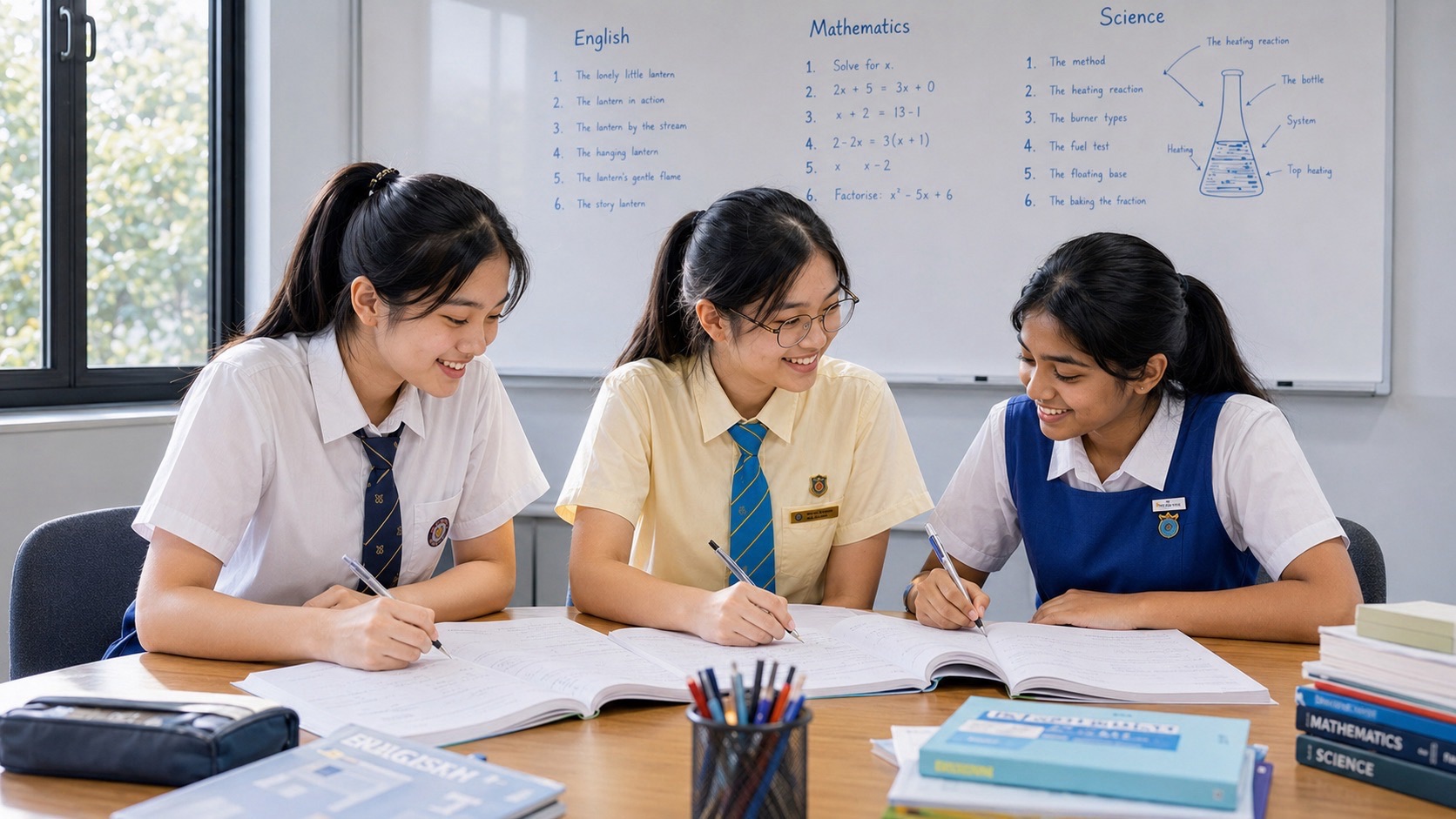
Second-chance education is not the same thing as simply trying again. A retake, a new subject level, a different post-secondary route, a return after interruption or a change of educational direction can all be sensible responses to a setback, but only when the next route changes something important about the conditions that produced the first result. This guide is the pathway-recovery owner inside the eduKateYishun Recovery Atlas: it helps a student or family decide whether to retake, rebuild, redirect or combine those moves.
For Singapore students, this decision is especially date-sensitive. In 2026, the existing GCE N(T), N(A) and O-Level examinations and private-candidate arrangements still matter. From 2027, the Singapore-Cambridge Secondary Education Certificate (SEC) combines those qualifications and records subjects at G1, G2 or G3. From 2028, MOE has announced a new Post-Secondary Admissions Exercise for SEC students. That means an old piece of advice about “retaking O-Levels” may describe the educational problem correctly while giving the wrong administrative route for the year in which the learner will actually sit the examination.
The purpose here is therefore not to publish a brittle list of dates and call it guidance. eduKateYishun teaches the durable decision system—what evidence to collect, what a retake can and cannot fix, how to compare routes, how to use waiting time, and when the old route should stop controlling the next decision—then hands current eligibility, registration, subject availability and admissions rules back to the official authority. For current examination arrangements, use SEAB’s private-candidate guidance and the SEAB SEC information. For current post-secondary pathways and admissions changes, use MOE’s post-secondary overview.
Start with the real question: what are you trying to recover?
A disappointing result can make every possible next move feel like one decision. It is not. “Should I retake?” may actually contain several different questions: Do I need a particular subject result for entry? Did the examination result underestimate what I can reliably do? Is the qualification itself the bottleneck, or is the desired destination reachable through another route? Was the failure caused by a repairable learning problem, by examination execution, by interrupted preparation, by a mismatch between the learner and the route, or by several of these at once?
Those distinctions matter because the same action can be wise in one case and wasteful in another. A learner who narrowly missed an entry requirement because of a specific, well-diagnosed weakness may benefit from a targeted retake. A learner whose entire prerequisite chain is unstable may need a rebuilding period before another examination attempt. A learner who has discovered a better-fitting educational destination may not need to recreate the old result at all. Recovery begins by naming the capability or access condition that actually needs to change.
| What seems to be the problem? | What may actually need recovery? | Useful first route |
|---|---|---|
| “I failed an exam.” | A specific entry requirement, knowledge gap, examination-control problem or route decision. | Translate the result into a repair plan. |
| “I want to retake everything.” | Possibly only one or two bottleneck subjects. | Should I Retake an Examination? |
| “I studied hard but got the same marks.” | A learning plateau caused by the wrong practice, unresolved dependency or weak transfer. | Why Marks Stop Improving. |
| “I know I will retake.” | The cause of the first result must change before the second attempt. | Build a Retake Plan. |
| “I do not know which route still makes sense.” | A comparison among available destinations, requirements, time and fit. | Compare Education Pathways. |
| “There is a long gap before the next intake.” | Continuity, capability and evidence during the waiting period. | Keep Learning Between Results and the Next Intake. |
| “The examination is very close.” | Triage: protecting high-value knowledge and execution under constraint. | Decide What Not to Study When Time Is Short. |
A second chance should change the system, not just the date
Moving the examination from one calendar year to the next does not create recovery by itself. If the learner uses the same study method, avoids the same difficult question types, receives the same unexamined feedback, practises under the same unrealistic conditions and enters the next paper with the same execution problems, the retake is simply a repeated exposure to the original system.
A useful second chance changes at least one causal condition. It might repair missing prerequisite knowledge. It might replace passive rereading with retrieval and mixed practice. It might reduce a subject load so enough time reaches the true bottleneck. It might add timed execution because untimed knowledge was not transferring to the paper. It might change the route entirely because the old qualification is no longer the best bridge to the learner’s actual destination.
The Recovery Atlas calls this distinction state change. The aim is not to restore the appearance of the old plan. The aim is to create a new condition in which the required capability can exist reliably. Sometimes that is Recover. Sometimes it is Rebuild. Sometimes the correct move is Metamorphose: change the operating model because the old one no longer fits.
The five evidence files to build before deciding
A pathway decision should not be made from one emotion-heavy number. Build five small evidence files. They do not need to be complicated, but together they prevent a family from treating every setback as the same problem.
- Result evidence. Which subjects, papers, components or task types actually limited the outcome? Separate a broad disappointing result from the mark-bearing bottleneck.
- Learning evidence. What can the learner retrieve, explain and use without help? Where does performance first break when wording or context changes?
- Execution evidence. Did timing, question interpretation, checking, stamina, anxiety under pressure, answer scope or paper navigation convert usable knowledge into lost marks?
- Pathway evidence. Which destination is the learner trying to reach, and what are the actual current entry requirements and alternatives?
- Constraint evidence. How much time, money, attention, family support and opportunity is available, and what would another year or examination cycle displace?
Notice what is deliberately missing: shame, comparison with classmates and the idea that repeating a route proves determination. Determination matters only when attached to a mechanism that can change the result.
Retake, rebuild, redirect or combine?
| Primary move | When it becomes plausible | Main risk | Evidence you need |
|---|---|---|---|
| Retake | A specific result remains necessary or valuable and the cause of underperformance is bounded and repairable. | Repeating the same preparation with a new date. | Gap map, required result, current official eligibility, realistic preparation runway. |
| Rebuild first | Too many prerequisites are unstable for immediate exam preparation to be efficient. | Spending months “revising” material that was never secure. | Dependency map, baseline tasks, progress checks, transfer tests. |
| Redirect | A different legitimate pathway reaches the learner’s goal with better fit or lower unnecessary cost. | Changing route merely to escape a temporary difficulty. | Destination requirements, route comparison, learner strengths, current admissions rules. |
| Combine | One bottleneck qualification should be repaired while the learner continues building capability elsewhere. | Overloading the learner with two full programmes at once. | Time budget, subject priority, course or work commitments, stopping rules. |
The 2026 → 2027 → 2028 transition: separate educational logic from administrative rules
As of 26 September 2026, SEAB states that registration for the 2026 GCE-Level examinations has closed and directs prospective private candidates to return in March 2027 for details of the 2027 registration exercise. SEAB also states that from 2027 the SEC replaces the GCE N(T), N(A) and O-Level certificates, with subjects taken at G1, G2 or G3; private candidates will register through the Candidates Portal subject to eligibility and the syllabuses available that year.
MOE has separately announced that from 2028 a new Post-Secondary Admissions Exercise will replace several current admissions exercises for entry to Junior Colleges, Millennia Institute, Polytechnics and ITE after the first SEC cohort receives results. That is precisely why pathway recovery must be date-aware. The durable question is “What destination am I trying to reach, and what evidence shows the best current route?” The administrative answer must then be checked against the official year-specific rule.
Official-source rule
Use eduKateYishun to understand the decision. Use SEAB and MOE to verify the current rule. Before acting on registration dates, eligibility, subject availability, examination codes, admissions exercises or entry requirements, re-check the official page for the year in which the learner will actually apply or sit the examination.
The pathway-recovery loop
The following loop prevents a second-chance decision from collapsing into “try harder”. It is deliberately compatible with the wider Recovery Atlas.
- Name the destination. Write the actual next destination: a course, institution, qualification, subject requirement, capability target or exploratory period. “Do better” is not a destination.
- Identify the gate. Determine which result, subject, prerequisite, portfolio, application or other condition currently blocks the route.
- Diagnose the first broken mechanism. Use marked work and representative tasks to find where performance first stops working.
- Check current official rules. Verify the examination year, candidate type, subject level, registration route, admissions exercise and applicable eligibility.
- Generate at least two legitimate routes. One may be a retake; the other may be a different pathway. A decision made with only one imagined option is not yet a comparison.
- Price each route in time and opportunity. Count months, weekly hours, fees, commuting, lost alternatives and the cognitive load of combining commitments.
- Choose the smallest move that changes the bottleneck. Do not rebuild five subjects if one subject is the gate. Do not retake one subject if the route has changed and no longer needs it.
- Install review points. A second chance needs dates when evidence can change the plan. If the intended improvement is not appearing, escalate, revise or redirect before the next high-stakes result.
Worked example: one result, three possible recovery routes
Imagine a student receives a result below what was expected in a key subject. The first reaction is to retake the entire examination. The Atlas does not accept that conclusion yet.
Route A: targeted retake. The student’s preferred destination still requires the subject. Other results are adequate. Marked papers show a narrow pattern: the student knows the content but loses marks when multi-step questions change form. A targeted programme of transfer practice, timed mixed sets and checking routines may make a retake rational.
Route B: rebuild before retaking. Representative questions show that the poor result was not an examination-day anomaly. Foundational knowledge is fragmented and the student needs prompts even on routine work. Immediate paper drilling would hide the dependency problem. The next months are therefore used to rebuild the prerequisite chain before examination-specific work increases.
Route C: change pathway. The student discovers that another legitimate post-secondary programme better matches their strengths and leads toward the intended field without requiring the same bottleneck result. The old score still matters as information, but it no longer controls the plan. The recovery move becomes pathway comparison plus capability building, not restoration of the old route for its own sake.
The same disappointing result can therefore justify different actions. The difference comes from destination, diagnosis, current rules and opportunity cost—not from the emotional intensity of the setback.
How subject recovery plugs into pathway recovery
Pathway recovery does not replace subject teaching. It tells the learner which subject work deserves priority and why. Once the route is clear, the Atlas hands the actual learning problem to the appropriate library.
| If the bottleneck is… | Go next to… | What to diagnose |
|---|---|---|
| English | English Learning Library | reading evidence, vocabulary, grammar, writing decisions, oral/listening demands, answer scope and transfer. |
| Mathematics | Mathematics Learning Library | number/algebra prerequisites, representation, method selection, accuracy, unfamiliar problem transfer and checking. |
| Additional Mathematics | Additional Mathematics | algebraic fluency, functions, trigonometry, calculus dependencies and multi-stage reasoning. |
| Science | Science Learning Library | concept models, evidence, variables, causal reasoning, explanation precision and cross-topic transfer. |
| Exam execution | Examination Performance | timing, question reading, paper navigation, checking, stamina and marks conversion. |
| Unknown cause | Student Diagnostics | symptom, evidence, first break, dependency and response to support. |
What parents should do in the first week after a setback
The first week should reduce uncertainty rather than increase pressure. Collect the result and any component information. Preserve marked work. Write down the destination the learner had in mind. Check whether the result actually blocks that destination. Schedule one calm review of what happened. Avoid enrolling in multiple remedies before the mechanism is visible.
A parent can also separate two conversations that are often mixed together. The first is emotional: what happened, what does the learner need now, and what should not be said while the result is still raw? The second is operational: what evidence do we need, which official rules apply, and what are the next legitimate routes? The second conversation works better when it does not pretend to solve the first.
What students should produce before committing to a route
- A one-sentence destination.
- A list of the actual gates between the current state and that destination.
- A marked-work diagnosis or fresh baseline for each academic gate.
- A screenshot, saved PDF or note of the current official eligibility/admissions information checked.
- At least two possible routes, including one that does not assume the original plan must be restored.
- A realistic weekly time budget.
- A review date and a rule for what evidence would make the plan change.
This turns the decision into something inspectable. A teacher, counsellor, tutor or parent can challenge the assumptions rather than arguing about motivation.
When a retake is not yet ready to begin
A learner may be eligible to register and still not be educationally ready to benefit from another attempt. Delay or a rebuilding phase becomes worth considering when baseline work reveals missing prerequisites across many topics; when the learner cannot explain why previous answers failed; when all practice is still heavily prompted; when the intended destination is unclear; or when the weekly time budget cannot support the required work without breaking school, work, sleep or other core obligations.
This is not an argument against retaking. It is an argument for giving the retake a mechanism. The relevant child guide is How to Build a Retake Plan That Changes the Cause of Failure.
When changing route is not “giving up”
Changing route deserves the same evidence standard as retaking. A new route should not be chosen solely because the old one became painful. It should be compared against destination fit, prerequisites, learning style, time, cost, progression options and current admissions rules. When the comparison shows that another legitimate route develops the desired capability more directly, continuing the old route simply because it was the first plan can become a form of sunk-cost thinking.
The Atlas therefore treats redirection as a possible recovery move, not as a verdict on the learner. The question is whether the new route can carry the learner from the present state to a worthwhile next state with better use of available resources. Use How to Compare Education Pathways After an Academic Setback for the full comparison method.
The waiting period is part of the education
Results, registrations and intakes create gaps. A gap can become dead time, or it can become a bridge. The strongest bridge does not require the learner to study at examination intensity every day. It protects academic fluency, repairs the bottleneck, develops transferable skills, explores the destination and creates evidence that the learner can still complete useful work.
Use How to Keep Learning Between Results and the Next Intake to build that bridge without turning an uncertain period into endless revision.
A pathway recovery plan should have exit conditions
Every recovery plan needs a way to finish. Otherwise “recovery” becomes a permanent identity. A targeted retake plan can end when the learner repeatedly meets the required performance range under representative conditions. A rebuilding phase can end when prerequisite tasks survive delay and variation. A pathway-comparison phase can end when the student has verified the current requirements, compared legitimate options and committed to a route for a defined period.
The exit condition is not certainty. Education decisions rarely offer certainty. It is sufficient evidence to make the next move and a review point at which new evidence is allowed to change it.
Frequently asked questions
Does a bad examination result automatically mean I should retake?
No. First determine whether the result is a genuine gate to the intended destination, whether the cause is repairable, whether another route exists and what another attempt would cost in time and opportunity. Use the dedicated retake decision guide.
Can I use old O-Level or N-Level retake advice for 2027?
Use old advice only for the durable learning logic, not for current administrative details. SEAB states that SEC replaces the N(T), N(A) and O-Level certificates from 2027 and that private candidates may take available subjects at G1, G2 or G3 subject levels. Check the current SEAB pages for the examination year before registering.
What if I do not know what I want to do next?
Then the first task is not a retake decision. Build a bounded exploration period: identify plausible destinations, speak with school or education-and-career guidance support where available, review MOE’s current post-secondary options, and test your assumptions against actual course content and requirements. Strategy comes before commitment when the destination is unclear.
What if the learner is already exhausted?
Protect functioning before adding a second full programme. A recovery plan that destroys sleep, attendance, health-support routines or the learner’s ability to complete ordinary work is not stable. Reduce the plan to the smallest move that changes the real bottleneck and use appropriate school or professional support when the issue extends beyond educational planning.
The Atlas route from here
If you are deciding whether to repeat the examination: go to Should I Retake an Examination?
If the retake is already decided: go to How to Build a Retake Plan That Changes the Cause of Failure.
If the route itself is uncertain: go to How to Compare Education Pathways After an Academic Setback.
If you are between results and the next intake: go to How to Keep Learning Between Results and the Next Intake.
If marks are no longer improving: go to Why Marks Stop Improving.
If the examination is close and time has become the constraint: go to How to Decide What Not to Study When Time Is Short.
Pathway recovery control line: destination → gate → evidence → current official rule → alternative routes → opportunity cost → chosen move → review point → next evidence. Return to the Recovery Atlas whenever the new evidence changes the problem.
Second-chance pathway workbook: turn the decision into evidence
The earlier sections explain the architecture. This workbook turns that architecture into a sequence a student, parent, teacher or counsellor can actually use. The point is not to make a complicated spreadsheet. The point is to prevent one disappointing result from collapsing several separate questions into one emotional decision.
Step 1: write the destination without naming the old route
Write what the learner is trying to reach in functional language. For example: “I want a post-secondary route that develops strong quantitative skills and keeps engineering-related options open,” or “I want to continue toward a writing- and communication-heavy course,” or “I am not sure of the field yet, but I need a route that gives me enough breadth to explore before narrowing.”
This matters because families often mistake the original route for the destination. “JC” is a route. “Polytechnic” is a route. “Retake O-Level” or “sit SEC as a private candidate” is a route. A destination is the capability, field, qualification or next-stage opportunity the learner is actually trying to build toward.
Step 2: name the present gate precisely
A gate is the smallest current condition that prevents the learner from moving directly into the preferred next state. It may be one subject result, an aggregate, a prerequisite, an application timing issue, a missing portfolio, a language requirement, an eligibility rule, an uncertainty about direction, or simply insufficient capability to survive the next course.
Do not call the whole result “the gate” unless the whole result truly is. A student may feel that “I failed my exams”, while the actual pathway problem is one Mathematics result. Another student may have adequate grades but no clear direction. A third may be academically eligible but not ready for the learning mode demanded by the next route. Different gates require different moves.
Step 3: separate administrative eligibility from educational readiness
These two questions are often confused. Administrative eligibility asks whether the learner is allowed to register, apply or enter. Educational readiness asks whether the learner can benefit from the route and sustain the required work. A student may be eligible to retake a subject but not yet ready to benefit from another attempt. A student may be eligible for a course but carry a prerequisite weakness that will make the first term unnecessarily difficult.
Keep both columns. For national examinations and admissions, verify the administrative column with the current official source for the actual year. SEAB’s current SEC information states that the SEC begins in 2027 and that private candidates may register for available G1, G2 or G3 syllabuses subject to current eligibility and availability. That is an administrative fact. Whether another attempt is educationally useful still depends on diagnosis, runway and route value.
Step 4: build the cause map
Take the disappointing result and decompose it into mechanisms. Use marked work, fresh tasks and teacher observations where available. Avoid explanations that cannot guide action. “Lazy”, “careless”, “weak”, “bad at English” and “not a Math person” are not useful repair mechanisms.
- Knowledge: something required was never learned accurately.
- Retrieval: the learner recognises the knowledge but cannot produce it when needed.
- Interpretation: the learner misreads the demand, condition or evidence.
- Representation: the learner translates information into the wrong model, equation, structure or explanation.
- Selection: the learner knows several possible tools but chooses poorly.
- Execution: the right route is chosen but carried out inaccurately.
- Transfer: familiar practice works but changed contexts do not.
- Timing: capability exists but does not survive examination constraints.
- Checking: predictable errors survive because checking is untargeted or too late.
- Continuity: preparation was disrupted and the capability never became stable.
A retake becomes more plausible when the main causes are bounded, observable and changeable. A redirect becomes more plausible when the old route is no longer uniquely valuable or when the cost of restoring it exceeds the value it creates.
Four worked pathway cases
Case 1: the near-miss with a clear gate
A student misses a required Mathematics result by a small margin. Other relevant subjects are stable. Fresh diagnostic work shows that core content is largely intact, but unfamiliar multi-step questions create method-selection errors and the student loses too much time recovering from them. The preferred route still requires the result.
This case points toward a targeted retake more strongly than a total restart. The learning plan should not begin with every chapter. It should concentrate on selection under mixed conditions, transfer, timing and recovery after getting stuck, while using low-cost retrieval to protect the material that already works.
The review question is concrete: after a defined period, does performance on fresh mixed timed work move into the required range repeatedly? If yes, continue. If not, re-diagnose before simply increasing hours.
Case 2: the result looks narrow but the dependency failure is broad
Another student also misses a required Mathematics result, but fresh work shows that algebraic fluency, fractions, graph interpretation and basic modelling all require heavy prompting. The student can follow a worked solution but cannot reconstruct it independently after delay.
The visible pathway gate is one result, but the educational problem is broader. Immediate paper drilling would likely create fluctuating marks rather than stable recovery. The better first move is rebuilding the prerequisite chain. A later retake may still be appropriate, but the sequence changes: rebuild → retrieve → transfer → time → retake.
This is why “same result” does not imply “same plan”. Pathway recovery begins with the mechanism, not the label on the certificate.
Case 3: the original route is no longer the only sensible route
A student planned a particular post-secondary route because it was familiar and widely discussed at school. After results, the student investigates course content more seriously and discovers that another legitimate pathway offers more applied work, stronger alignment with their demonstrated strengths and a credible progression path toward the field they actually care about.
The disappointing result is still information. It may still reveal learning gaps worth repairing. But it no longer has to control the route. The decision becomes a comparison of entry requirements, programme demands, time, fit and progression rather than a moral question about whether the student has “given up”.
In this case, redirect can be a recovery move because it converts new evidence into a better operating plan.
Case 4: the learner needs a bridge, not immediate intensity
A student has chosen the next route, but there are several months before the next intake. The family worries that any reduction in study intensity will cause the learner to “lose momentum”, so they consider daily examination papers.
The better question is what the gap must accomplish. The learner may need to maintain core academic fluency, repair one weakness, build one useful project, explore the future field and restore a sustainable weekly rhythm after a difficult examination year. Permanent exam mode can exhaust the learner without improving readiness.
Use the bridge guide to create a smaller system that keeps learning alive while allowing recovery and preparation to coexist.
The family decision meeting
A second-chance decision can become difficult because different people are solving different problems. The student may be asking, “Can I survive another year of this?” A parent may be asking, “Which route keeps the most future options open?” A teacher may be asking, “What does the learner’s work show?” A counsellor may be asking, “Which current routes and timelines are actually available?”
Bring those questions into one meeting rather than letting them compete invisibly.
- State the destination. Each person says what they think the learner is trying to reach.
- State the gate. What specific condition blocks that destination now?
- State the evidence. What does marked and fresh work show about capability?
- State the official facts. Which rules, dates or eligibility conditions have been verified for the actual year?
- Name at least two legitimate routes. Retake may be one. It should not be the only route considered by default.
- Name the main cost of each route. Time, money, workload, delayed entry, uncertainty or opportunity cost.
- Choose the next evidence-producing action. This may be a final decision, or it may be a diagnostic week, an official enquiry, an open house, or a small field-related project.
- Set a review date. The plan is allowed to change when evidence changes.
Opportunity cost: the part families often leave implicit
Every route consumes something. A retake consumes calendar time, attention and often money. Entering another pathway consumes the opportunity to use that same time elsewhere. Waiting for a future intake may create a gap that must be structured. Working while studying may reduce the hours available for deep academic repair.
Opportunity cost does not mean choosing the fastest route. A slower route can be better when it builds stronger foundations or better fit. The point is to name the trade-off rather than treating time as invisible.
A useful comparison asks: if we choose this route, what are we saying no to for the same period? Then ask whether the capability, access or future options gained justify that cost.
The route should produce capability even if the destination later changes
Good pathway choices remain useful under uncertainty. A student may later change interest, course or career direction. The strongest routes therefore build portable capability: reading, writing, quantitative reasoning, problem solving, project completion, self-regulation, communication, domain knowledge and the ability to learn independently.
This is especially important during second-chance periods. The learner should not spend an entire year producing only a new score if the year can also build more durable capability. A targeted retake can coexist with a project, reading programme, work sample or exploratory experience when workload permits.
How to prevent a second chance from becoming permanent recovery mode
Recovery needs exit conditions. Without them, the learner can remain indefinitely in a state of fixing, reviewing and preparing. The family keeps asking whether the learner is “ready yet”, but no evidence standard has been agreed.
- A retake phase can exit when representative fresh timed performances repeatedly meet the required range and the main error mechanisms are stable.
- A rebuild phase can exit when prerequisites survive delay and variation with reduced support.
- A pathway-comparison phase can exit when current official requirements are verified, legitimate alternatives are compared and the learner commits for a defined period.
- A bridge phase can exit when the next intake begins and the learner has protected core fluency, completed the planned repair and restored a stable routine.
Exit conditions turn recovery from an identity into a temporary operating state.
Common pathway myths
“Retaking proves determination.”
It may. But determination is not enough to justify a route. A retake should be chosen because it changes access or capability at an acceptable cost and because the mechanism behind the first result can be changed.
“Changing route means the first effort was wasted.”
Past learning can be converted. Knowledge, work habits, subject capability and experience can support another route. The relevant question is not whether the old plan was wasted; it is what useful capability can be carried forward now.
“A gap year or waiting period is automatically lost time.”
A gap becomes lost when it has no purpose, rhythm or output. A structured bridge can repair prerequisites, maintain fluency, clarify direction and prepare re-entry. It does not need to imitate school full-time to be educationally useful.
“The highest-status route is always the safest.”
Status is not a substitute for fit, progression, capability or current eligibility. Compare what the route actually develops and where it can lead for this learner.
Official-source checklist for Singapore decisions
Before a family pays fees, registers, withdraws from another route or commits a year, save the current official source used for the administrative part of the decision. The exact checklist changes by case, but common items include:
- the current SEAB page for the examination year and candidate type;
- the current syllabus or subject-level page for subjects being considered;
- the current MOE post-secondary overview and admissions information;
- the current institution course page for prerequisites and programme structure;
- the current application dates and required documents;
- any current progression requirement relevant to the intended later destination.
Record the date checked. Rules can change while the educational logic remains the same. The Atlas owns the decision method; official systems own the current rule.
Frequently asked second-chance questions
Should a student retake immediately after a disappointing result?
Not automatically. First verify that the result still blocks a meaningful destination, identify the mechanism behind the result, compare credible alternatives and estimate whether enough runway exists to change the mechanism. Use the dedicated retake decision guide before committing.
Should every weak subject be retaken?
No. The pathway decision should identify the actual gate. Some weak subjects may not matter to the next route; some may still deserve repair because they are foundational, but that is a separate educational reason.
What if the family cannot agree?
Move the disagreement into shared criteria: destination, gate, official eligibility, capability evidence, time, fit, cost, progression and uncertainty. Agreement may still take time, but the discussion becomes more informative than arguing from status or fear.
What if the student does not know what they want?
Then the immediate job is exploration, not forced certainty. Use bounded experiments, programme research, official guidance, school or ECG support where available, and small real tasks. Set a decision date so exploration does not become indefinite postponement.
What if a retake plan is improving the subject but not the total score?
Check whether another bottleneck now dominates. Recovery often reveals constraints sequentially. Use the learning-plateau guide to determine whether the repaired capability is real but the measurement is now limited elsewhere.
Return routes
Use Should I Retake an Examination? when the next decision is whether to repeat the examination. Use How to Build a Retake Plan once the retake is decided. Use How to Compare Education Pathways when alternative routes need a structured comparison. Use How to Keep Learning Between Results and the Next Intake when the decision is made but the next stage has not begun.
Return to the Recovery Atlas whenever new evidence changes the problem rather than merely the answer.
The one-page pathway recovery record
Keep one page that records the current state of the decision: destination, present gate, strongest existing capability, first broken mechanism, current official rule checked, routes considered, chosen move, next evidence, review date. Update it only when evidence changes. This prevents the family from reopening the entire decision every time a practice score moves or a new opinion appears.
The record should also state what is deliberately not being done. A learner may be retaking one gate subject but not rebuilding every subject; comparing two routes but not researching ten; using the waiting period to repair one prerequisite and complete one project rather than collecting courses. Explicit exclusions protect attention.
At each review, ask three questions: What changed? Does it alter the route? What is the next smallest action that produces useful evidence? If the answer to the second question is no, keep the route and adjust the work. If yes, return to the Recovery Atlas and choose again from the new state.