
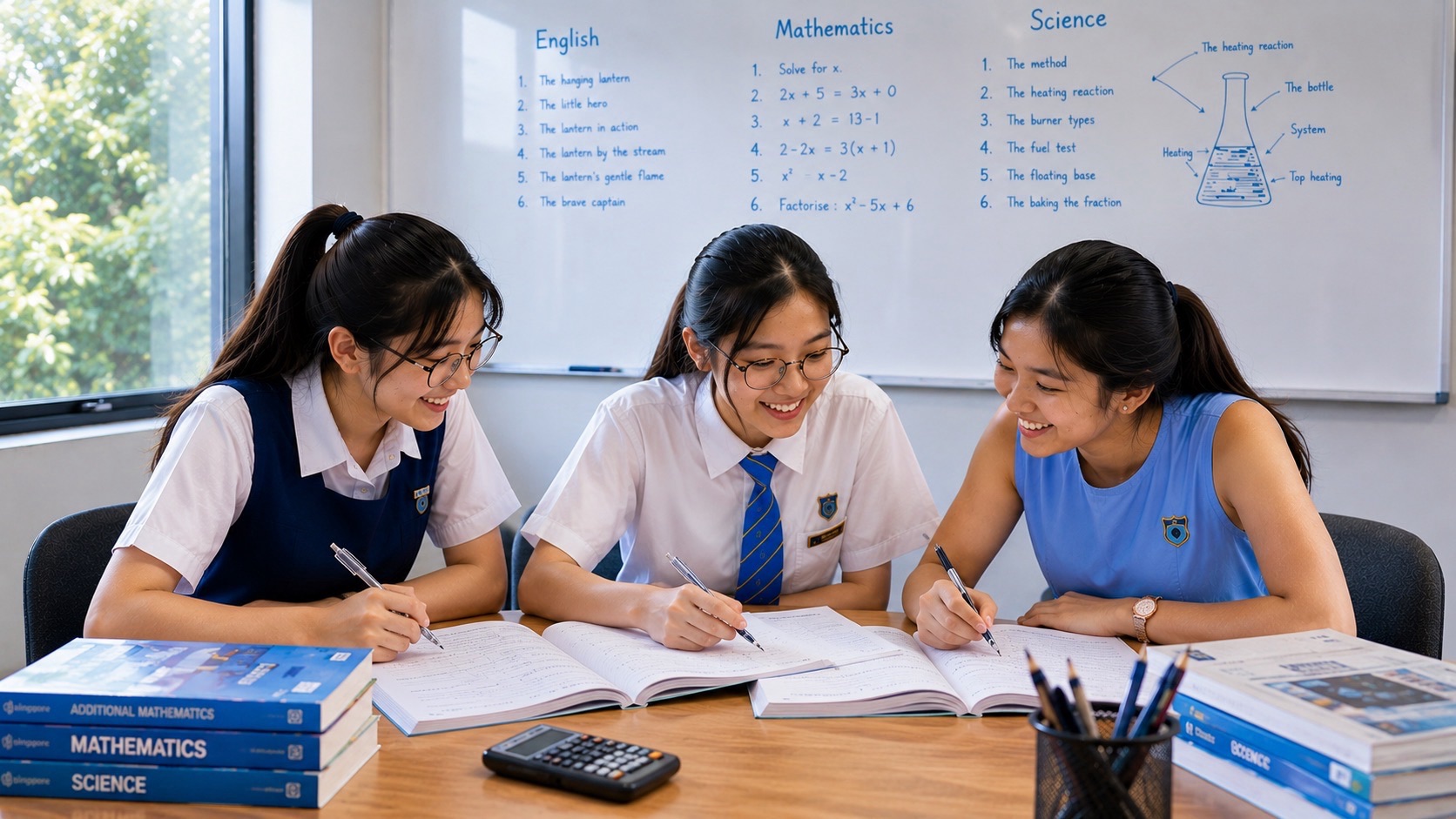
For Yishun parents whose child enters secondary school through Posting Group 1 (PG1), the most valuable Science habit is learning the difference between something observed, a conclusion supported by evidence and a guess. The child may memorise scientific facts yet struggle to read a graph, identify a fair test or explain why a result is uncertain. PG1 is a school posting category, not a separate national Science examination. This guide focuses on scientific inquiry, data handling and evidence within the official 2027 SEC G1 Science syllabus K123, translating the skills into safe, realistic routines for a Secondary 1 family in Yishun.
The published 2027 SEC G1 Science K123 assessment comprises Paper 1, a 75-minute computer-based e-examination worth 50%, and Paper 2, a 60-minute short-answer and structured written paper worth 50%. Scientific knowledge and understanding account for approximately 60% of the overall marks and handling and applying information for approximately 40%. The syllabus includes experimental and investigation skills assessed through questions, with a data-response task worth 8–12 raw marks in Paper 2; there is no separate national practical paper in this K123 structure. These are graduation-year specifications for 2027, not the lower-secondary scheme of work or automatically confirmed 2028 requirements.
- Official subject: SEAB 2027 SEC G1 Science K123; confirm the child’s actual Science level under Full SBB.
- Examination: Paper 1 e-exam, 75 minutes and 50%; Paper 2 written, 60 minutes and 50%.
- Inquiry skills: pose questions, plan fair investigations, observe, measure, organise, interpret and explain using evidence.
- Paper 2 evidence task: one data-response question worth 8–12 raw marks; experimental skills can appear in both papers.
- Safe home practice: school-provided datasets, harmless observations, labelled diagrams and brief explanations—not dangerous experiments.
- Parent action: find out whether the difficulty is concept knowledge, reading a diagram, controlling variables or explaining data.
1. The correct SEAB source and the meaning of inquiry
Use the SEAB 2027 G1 subject index and its G1 Science K123 PDF. The official syllabus identifies Practices of Science as a central part of the subject. It is not just a catalogue of facts about energy, food and the body; it also describes how scientific knowledge is developed and used to make decisions.
This guide is a deeper component article within K123, not a new standalone Science examination. For a child beginning Secondary 1, the school determines the current topic sequence and practical activities. Parents should read the national document to understand the longer-range direction while following school supervision and safety rules today.
2. PG1 does not define every subject level
Full Subject-Based Banding permits subject-level variation according to MOE criteria and school arrangements. A child posted via PG1 may be studying some subjects at G1 and others at a different level if eligible. That means a parent should not copy a friend’s G3 Science worksheets merely because they are in the same form class.
Ask for the student’s actual Science level, school scheme of work and recent teacher feedback. If a child shows sustained strength, the school can explain its review process. The first goal is to build mastery of the current material rather than chase an assumed upgrade that has not been offered.
3. Science is a way of thinking and doing
The K123 syllabus groups scientific practice under ways of thinking and doing, understanding the nature of scientific knowledge, and relating science to technology, society and the environment. Pupils should ask questions, test ideas, analyse information, communicate explanations and recognise that scientific conclusions depend on evidence.
A family can model these habits during ordinary activities. When a question arises, ask “What do we notice?” followed by “What might explain it?” and “What information would help us decide?” These three prompts encourage careful thinking without turning the home into a laboratory.
4. Observation and inference are not synonyms
An observation describes a measurement or feature noticed directly. An inference proposes an explanation or conclusion based on evidence. “The water level fell by five millilitres” is an observation. “The water evaporated” is an inference that may fit the evidence but still requires attention to other possible causes.
Ask the child to write one observation before giving a reason. If a pupil writes that an object became hotter because of sunlight, ask what temperature reading was made and whether the object could have been affected by another heat source. Reasoning improves when the learner sees why the distinction matters.
5. Start with a testable question
“Why is the world interesting?” is a valuable broad curiosity but too wide for a simple investigation. A question such as “Does the position of a container affect how much water is lost over a fixed period?” can be investigated under suitable controlled conditions. The first step is to define which change will be observed and which factor might influence it.
For a younger learner, use printed classroom experiments or safe hypothetical situations rather than running every suggested test at home. Ask what quantity would need recording and how the comparison could be made fairly. A well-defined question is often more useful than a complicated apparatus.
6. Predictions and hypotheses need clarity
A prediction states what the learner expects to happen. A hypothesis links an expected relationship to a possible explanation. The prediction should be specific enough to test, not a claim that a desired outcome must occur. Scientific work remains valuable when the prediction is incorrect because that result gives information.
Ask the child to complete: “If the factor changes in this way, I expect the measured result to change in this way, because…” Then ask what observation would count against the idea. A pupil who can imagine evidence that contradicts a prediction has begun to think scientifically.
7. Independent, dependent and controlled variables
A useful fair-test plan identifies the factor deliberately changed, the result measured and other important conditions kept as similar as possible. A student may recall the three labels but still mix them up. The meaning comes from the investigation: what was changed, what was measured and what else might matter?
Use a hypothetical seedling growth chart rather than asking children to cultivate unsafe samples. If the question concerns light exposure, the amount of light might be the changed factor, growth the measured result, and pot type, water and seed type factors to control. Discuss whether all controls could truly be equal.
8. A fair test is not the same as a perfect experiment
A fair comparison seeks to isolate an effect, but real investigations involve measurement uncertainty, limited samples and factors that are difficult to control. Students should learn to identify these limitations rather than pretend that a simple school experiment proves a universal law.
If a paper task compares two containers with different temperatures and sizes, ask which factor prevents a clear conclusion about temperature alone. Suggest a better design where other relevant conditions match. An evidence-based improvement is stronger than declaring the entire experiment useless.
9. Repeat observations rather than trusting one result
A single unusual result may reflect real variation, a reading error or an uncontrolled condition. Repetition can help establish whether a pattern is consistent. The student should not erase an inconvenient result merely because it differs from the others; that would misrepresent the evidence.
Give the pupil a small fictional dataset with one unexpected value and ask whether it should be recorded and checked. Discuss what a repeat measurement could reveal. This teaches integrity and an appreciation of uncertainty without requiring physical experimentation.
10. Choosing an appropriate measurement
Scientists select a tool that measures the quantity relevant to the question. A thermometer is useful for temperature, while a ruler can measure length; neither is interchangeable. Units and precision matter. A student should know what was measured and the instrument’s appropriate use before interpreting a figure.
Use a worksheet showing several instruments and ask the child to match each with a quantity and unit. If two options could work, discuss accuracy and suitability. The aim is thoughtful selection, not memorising apparatus names in isolation.
11. Scales have divisions that must be read correctly
Many pupils misread a measuring instrument because they assume each marked division represents one unit. The interval between labelled values may instead be two, five or ten units. A careful reader checks the number of divisions before recording the result.
Show a teacher-provided diagram of a measuring cylinder or thermometer and ask what one small division represents. Then read a value with its unit. If the child makes an error, slow down and count the divisions rather than asking them to memorise the correct number.
12. Accuracy and precision should not be confused
An accurate measurement is close to the relevant true or accepted value, while repeated measurements can be tightly grouped yet systematically incorrect if a device or method is biased. Students at G1 should develop an age-appropriate understanding of why a consistent set of readings does not automatically prove the method is valid.
Use a simple hypothetical example of three measurements clustered around a wrong value. Ask what could explain the consistent difference. This can introduce systematic error conceptually without unnecessary advanced mathematical treatment. Follow the school level for the terminology it expects.
13. Units are part of the observation
A statement that an object measured “12” is incomplete if it could mean centimetres, grams or seconds. The K123 syllabus includes quantities, symbols and units, and candidates are expected to read and record them accurately. Mixing units can turn a correct calculation into a misleading conclusion.
When the child writes a table, insist on a column label and appropriate unit where needed. Ask what the number describes. For a graph, check that axis labels and units match the original dataset. This habit transfers to Mathematics, D&T and practical daily decisions.
14. Record data before explaining it
An investigation needs a usable record of what was observed. If a pupil writes only a conclusion, the reader cannot see what evidence supports it. A table with clear headings, units and consistent rows helps the student compare results and detect discrepancies.
Give a fictional table of five time readings and temperature values. Ask what the data show without yet supplying a cause. Distinguish a recorded value from an interpretation of the trend. Encourage the child to preserve original readings rather than change them to fit a predicted pattern.
15. Graphs make patterns visible
A graph can communicate how quantities vary, but only when axes, scales and plotted points are correct. The syllabus permits questions requiring candidates to take readings, plot graphs and interpret trends. A student who enjoys colouring an attractive chart may still miss the scientific relationship.
Ask the pupil to identify the independent variable on a typical school line graph and the measured variable on the other axis, while recognising that the required choice depends on the task. Check labels, units and whether a scale represents equal intervals. A reliable graph must match the data.
16. The slope and intercept carry meaning
Where suitable, a graph’s gradient represents a rate of change, and an intercept may indicate a starting value or another meaningful quantity. The 2027 K123 assessment explicitly allows questions about gradient, intercept and intersections. However, the particular interpretation depends on the scientific context; a gradient is not always “speed.”
For a simple graph of an observed quantity against time, ask what increasing or flat sections mean. If the pupil can calculate rise over run, ask them to explain the units and physical interpretation. Build meaning before introducing complex graph computations.
17. Choose the right chart for the question
A bar chart is often useful for comparing categories, whereas a line graph may show changes across ordered measurements. The decision depends on the dataset and what the reader needs to learn. Pupils should not assume one chart type is always correct because it appears in a favourite software tool.
Show a short table with categories and another with repeated time measurements. Ask which display would make each pattern clearest and why. This develops information literacy without the need for expensive software or advanced statistics.
18. Describe a trend before giving a cause
A student who writes “the graph rose because there was more heat” may mix observation and explanation in the same sentence. The trend is what the graph shows; the proposed cause needs scientific support and may require more evidence. Separate these steps to make the answer more reliable.
Ask first, “What happens to the measured quantity as the other value increases?” Then ask, “What scientific idea might explain that pattern?” A short supported explanation is more valuable than a confident but untested assertion.
19. What is a data-response question?
In the 2027 K123 Paper 2, one data-response question carries 8–12 raw marks. It may require interpreting experimental data, evaluating observations or solving a problem using unfamiliar information while applying syllabus-level principles. The student cannot answer well by recalling a definition alone; they must read the supplied evidence.
Teach the child to read the title, quantities, units, table and question before calculating. Highlight only relevant data. A student who can explain why a particular value matters is more prepared than one who tries to use every number on the page.
20. The Paper 1 digital tasks are not games
The published 2027 Paper 1 is a 75-minute computer-based examination. Its first section includes 30 multiple-choice questions and selected-response questions, while its second section may contain short or structured tasks with video, animation or interactive stimuli. Students may need to match information, use checkboxes or interpret a short visual sequence.
At home, a student can practise reading clear digital diagrams and translating them into an explanation without assuming that clicking quickly is the skill. Follow the school’s approved platform and accessibility guidance. Screen competence matters, but it cannot replace scientific understanding.
21. Learn the command word before attempting the answer
A question asking a pupil to “state” may require a concise fact, while “describe” asks what is observed or how something is arranged. “Explain” asks for a reason; “predict” asks what should happen; “suggest” permits a scientifically defensible response. The K123 document provides a glossary of examination terms.
Take one hypothetical experiment and formulate three questions about it. Ask the student to compare the type of answer each requires. If the pupil writes a cause when only a trend was requested, discuss the instruction rather than marking the scientific idea itself as always wrong.
22. A prediction should use available evidence
Suppose the table shows an increasing measured value across several observations. A cautious prediction about the next value may be reasonable, but extrapolation beyond the measured range introduces uncertainty. A student should not pretend that a trend will continue forever simply because it rose across a few points.
Ask what range was actually observed and whether the proposed value lies inside or beyond it. Encourage terms such as “the pattern suggests” rather than absolute promises when conditions are uncertain. The answer must be grounded in the question’s information and taught scientific principles.
23. Explain causes using a scientific mechanism
A response such as “the wire got hot because electricity” is vague. A better explanation connects the relevant scientific process to what was observed, using terminology appropriate to the child’s level. A good answer is neither a copied textbook paragraph nor an imaginative story unsupported by the data.
Ask which concept from the current school chapter helps explain the outcome. Then help the pupil express one cause-and-effect relationship clearly. If the mechanism is outside the child’s syllabus, do not force advanced theory; use the explanation the teacher expects at the present level.
24. Recognise possible sources of error
A result may be affected by reading the wrong scale, inconsistent timing, unsuitable apparatus or uncontrolled conditions. The official 2027 assessment includes recognising and commenting on errors and improvements. Students should identify how a specific weakness affects the observation rather than merely write “human error.”
Give a hypothetical procedure where measurements are made at uneven times and ask what problem this creates. Then propose one concrete change, such as using consistent intervals. Naming a realistic source of error is more valuable than listing every imaginable thing that could go wrong.
25. Improvements should target an identified weakness
A generic answer such as “repeat the experiment” might be relevant but not sufficient if the question asks for a specific procedural improvement. A stronger response explains which factor would be controlled, what measurement would be made more reliable or how bias might be reduced.
Ask the child to connect each suggestion to a particular problem in the given method. For example, if one container receives sunlight and the other does not, placing both in comparable conditions may be necessary when light is not the intended variable. Precision matters more than a large number of vague suggestions.
26. Safety is an assessment skill and a family duty
The K123 syllabus includes safe and ethical scientific practice. Questions may ask candidates to comment on safe handling of apparatus or materials. At home, the child should never be encouraged to open mains-powered devices, mix unknown chemicals, heat sealed vessels, culture microbes or perform experiments involving human samples.
Use teacher-provided practical worksheets, printed diagrams and low-risk everyday observation. If a school topic involves heat, electricity or chemicals, leave the practical work to appropriate supervised facilities. Learning to identify when a procedure is unsafe is part of scientific competence.
27. Models simplify without becoming reality
Scientific models can represent parts of a system that are too complex, small or difficult to observe directly. The K123 Practices of Science includes using and developing models. Models are helpful because they highlight relevant relationships, but they may leave out details and should not be mistaken for complete reality.
Ask the pupil to compare a diagram of breathing or a basic electrical circuit with the real system it represents. What is shown clearly? What has been simplified? This develops an important habit of treating diagrams as tools for reasoning rather than exact photographs of natural processes.
28. Evidence can change a scientific explanation
Science aims to produce reliable knowledge, but an explanation may need revision when better evidence becomes available. This does not mean scientific understanding is arbitrary. It means hypotheses and models are tested, discussed and improved through transparent procedures and repeated scrutiny.
Use a simple household observation where the family initially misunderstood why something happened. Ask what new fact changed the explanation. Avoid turning this into a debate about personally held beliefs; the learning point is how evidence supports or challenges a specific scientific claim.
29. Science, technology, society and the environment
The official K123 practices ask students to consider benefits, risks and ethical, social or environmental consequences of science applications. For example, a new food-storage method may reduce waste but require resources and equipment. A responsible answer distinguishes evidence from preferences and considers plausible trade-offs.
Ask the child which people might benefit from a new technology, what risks or limitations exist and what information would help evaluate it. This is an age-appropriate decision-making conversation, not a demand for a professional policy analysis.
30. How subject content supports inquiry
The official K123 contexts are Machines Around Us (II), Food Matters, and Our Body and Health (II). Energy and electricity may supply a scenario about measurement; food safety can raise questions about controlled conditions; digestion and breathing may be examined through a labelled model. Inquiry skills do not exist only in one chapter.
A useful study plan pairs each current topic with one process skill. After learning about energy, read a table or simple diagram. After learning about food, discuss what evidence would support a safety claim. After learning about a body system, explain a model’s strengths and limitations.
31. How to read a Science question containing new equipment
An SEC data-response task may mention apparatus or a setting unfamiliar to the candidate, yet the test can focus on general syllabus skills such as reading scales, plotting data or drawing a logical conclusion. Students should not panic merely because an apparatus name is new; they should identify what the question provides.
Ask what the diagram labels, how the quantity is measured and which information is relevant. The pupil may be able to solve the task without detailed specialist knowledge of the device. Teaching calm interpretation is more reliable than attempting to memorise every possible laboratory instrument.
32. A worked hypothetical dataset for families
Consider two identical containers with 100 millilitres of water at the start. After a fixed period, fictional observations show 95 millilitres in A and 92 millilitres in B. The data establish a loss of five millilitres from A and eight from B. They do not, by themselves, prove the cause of the difference.
Ask the student what conditions should be compared, what other factors might matter and how a repeated measurement could help. Was one container handled differently? Were the readings accurate? This teaches observations, calculations and cautious inference without needing to stage the experiment at home.
33. A Yishun family case: good memorisation, weak graph answers
Imagine a student who can recall the Science textbook yet loses marks in questions about graph trends. The parent buys more content-revision notes. A marked script reveals that the child reads axis intervals incorrectly and describes the cause before stating the actual pattern. The underlying weakness is data literacy.
A more precise intervention uses short graph-reading tasks, unit checks and a two-line response: “The graph shows…” followed by “This could be explained by…”. After two weeks, test the skill with an unfamiliar graph. No particular grade is guaranteed, but the learning target is observable.
34. A second case: the child knows the concept but not the command word
Another pupil understands that heating can affect a substance but writes an explanation when the question asks only to describe a change in its appearance. The parent thinks the pupil lacks scientific knowledge. In fact, the answer may be badly matched to the instruction.
Practise three command words with one familiar scenario and ask the pupil to compare the expected response. Once the learner distinguishes description from explanation, their existing knowledge may become easier to demonstrate. This is why diagnosis should precede extra tuition.
35. A four-week inquiry routine
Week 1: collect two marked tasks and identify whether the difficulty lies in observation, variables, graphs or explanations. Week 2: practise the target skill on simple printed materials. Week 3: transfer it to a different topic or chart. Week 4: compare independent responses and check remaining misconceptions with the teacher.
These are home-learning suggestions, not an MOE-mandated schedule. Science preparation should leave room for homework, rest, exercise and family activities. One carefully explained question can yield more learning than dozens answered by guessing.
36. What parents should ask at a teacher meeting
Bring a specific graph question, an explanation response and a recent assessment. Ask which process skill the child most needs to improve and what current classroom methods are used. Clarify the pupil’s actual Science subject level, relevant topics and whether additional school support is available.
A focused conversation can end with a short action plan and review date. Avoid making the teacher account for a hypothetical future K123 paper when the child is in Secondary 1. School-based feedback should guide current practice while the national document serves as a longer-range reference.
37. When extra support may be necessary
Tuition or targeted assistance may be helpful if the child repeatedly cannot interpret data, identify variables or construct evidence-based explanations despite appropriate practice. A responsible teacher should pinpoint the gap, use safe methods and check progress through a new unaided task. A class of three can support discussion but does not guarantee distinction or subject-level promotion.
This is a Yishun information guide, not a statement that eduKate operates a physical Science laboratory in Yishun. Verify any proposed tuition venue and practical facilities, and do not pay for promises about conducting national practical exams that do not exist in the 2027 K123 structure.
Build evidence literacy across the school week
Students can practise scientific thinking even when no practical experiment is being conducted. When reading a short article, ask which statement is a reported observation and which is an interpretation. When comparing two mathematical graphs, ask what the axes represent and whether the proposed conclusion is supported. The G1 Mathematics K110 Number and Algebra guide helps with rates, calculations and numerical sense, while English K100 Paper 1 Writing supports clarity of explanation.
Likewise, the Chinese K120 Oral and Listening component guide provides another opportunity to listen carefully before deciding what was actually said. These connections are intended for understanding, not to invent shared examination tasks. A brief weekly discussion about one graph, one spoken message and one conclusion can strengthen habits that transfer among subjects while each teacher remains responsible for the actual syllabus.
Explore the four distinct PG1 component guides: K100 English Paper 1 Writing examines audience and structured communication; K110 Number and Algebra develops calculations, representation and problem-solving; K123 Scientific Inquiry teaches fair tests and evidence; and K120 Chinese Oral and Listening develops real spoken understanding. These are component-level explanations within existing 2027 G1 syllabuses, not four new SEC examination subjects. Each guide should be matched to the child’s actual school subject-level offer, classroom sequence and examination year.
38. Parent questions and the next right move
Does G1 Science K123 have a separate SEC practical paper in 2027? No; the two compulsory papers are an e-examination and a written paper, while experimental skills may be assessed in questions. What is Paper 2’s data-response value? Eight to twelve raw marks. Is a new Secondary 1 pupil expected to do every K123 topic now? No, follow the school scheme of work. Is the 2028 format certain? Check SEAB’s actual future documents.
Read the PG1 Science K123 overview, Reading Graphs and Writing Evidence, Science Measurement Practice, and the Yishun Library. Use SEAB’s official K123 syllabus for precise national requirements. The immutable Clementi tutorial format informs the diagnose-first practice approach. Tonight, let the child describe one graph and explain one supported conclusion before choosing the next skill.