
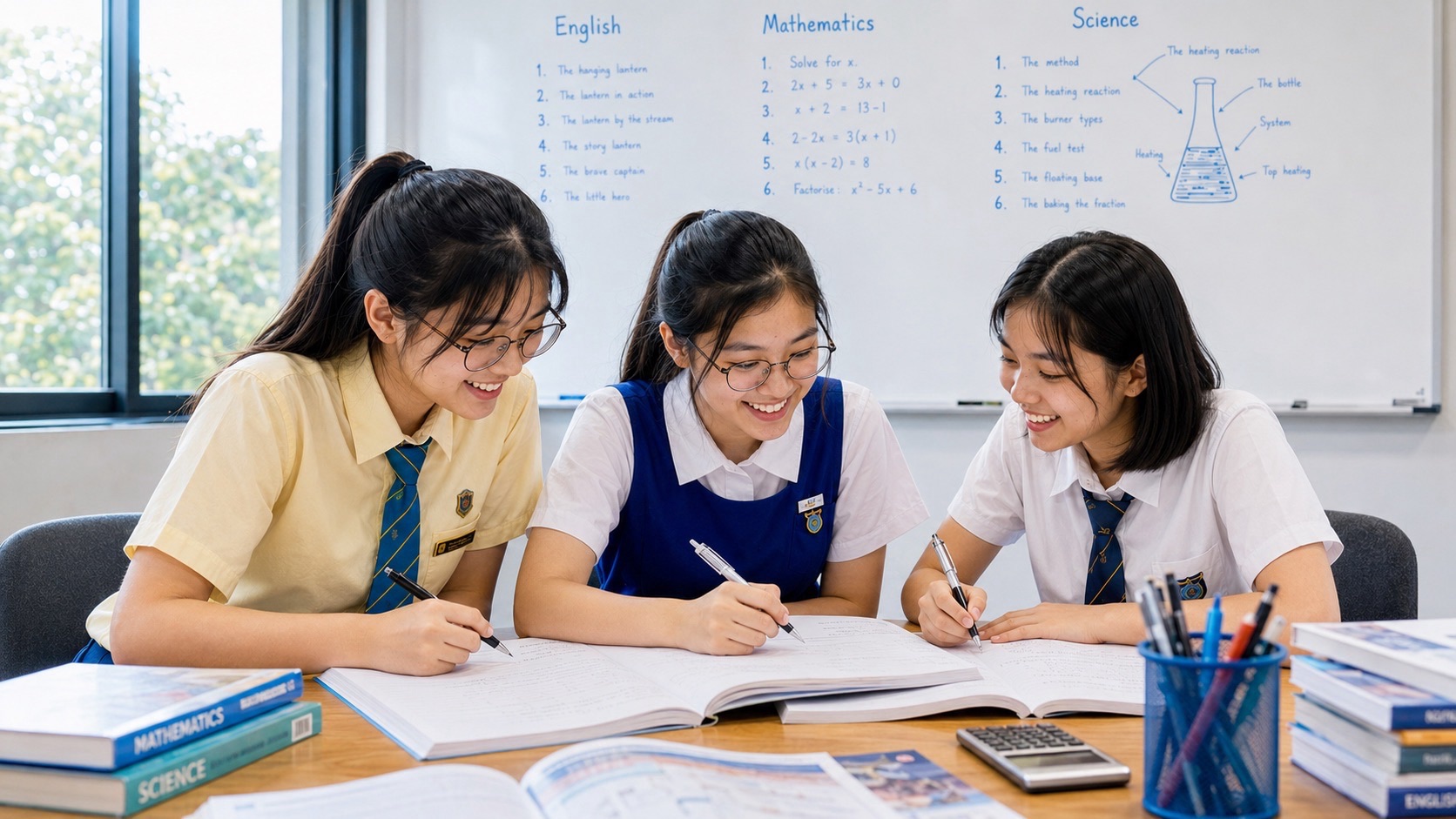
Which secondary school should I choose for a child who loves Mathematics and Science after PSLE? Start with the child’s actual PSLE Score and eligible Posting Group, then compare schools where Mathematics, Science, design and practical investigation are taught in ways the child can enjoy. For Yishun parents, Northbrooks Secondary School’s Aerospace programme and Chung Cheng High School (Yishun)’s Health and Food Science programme are two specific starting points. Northland’s human-centred technology work and other local schools may also offer meaningful experiences, but none of these programme themes guarantees a 2027 admission place or a specialised CCA.
2026 PSLE results are released on Tuesday 24 November at 11.00am. Families can submit six ordinary Secondary 1 preferences from 11.30am that day until Monday 30 November 2026 at 4.30pm. This guide helps parents compare a child’s interest in algebra, coding, science experiments, engineering and problem-solving with actual school learning. It explains PG1, PG2 and PG3, distinguishes a whole-cohort applied programme from selective enrichment, compares Yishun and nearby schools, and keeps historical cutoffs in their proper role as references—not future guarantees.
- Confirm the child’s four subject ALs, total PSLE Score and eligible Posting Group before using school cutoffs.
- Look for evidence of curiosity and sustained engagement, not just a single high Mathematics or Science grade.
- Investigate Northbrooks Aerospace, Chung Cheng High (Yishun) Health and Food Science, and other eligible schools’ actual programmes.
- Ask what every Secondary 1 pupil receives versus enrichment, electives, competition teams and CCA selection.
- Compare core Mathematics teaching, Science explanation, writing skills, laboratory safety and learning support.
- Build six genuinely preferred eligible choices with two or three less stringent historical COPs where feasible.
- Submit through the official S1 Portal by 30 November 2026 at 4.30pm and keep confirmation.
1. A child who likes STEM is not one single type of learner
Parents often describe a child as ‘good at Math and Science’ when they mean different things. One pupil loves patterns, elegant solutions and number puzzles. Another likes mixing ingredients, watching reactions and collecting evidence. A third prefers building a model, adjusting it and testing whether it works. Another may enjoy coding but find laboratory reports difficult. These differences are useful when choosing a school. The family’s job is not to give the child a fixed STEM identity at twelve; it is to locate meaningful experiences that strengthen curiosity and competence over the next four years.
A strong PSLE result does not automatically tell parents which programme will fit. Nor does a lower PSLE result erase a genuine scientific interest. A pupil can love building a drone model while needing more help with fractions and algebra. A school should offer a pathway that connects hands-on enjoyment with rigorous explanation and core subject learning. A programme that looks exciting during an open house must also help a pupil persevere through mistakes, work with others and understand why a design succeeds or fails.
2. Verify the 2026 PSLE timeline before visiting schools
| Milestone | Official 2026 date / time | Parent action |
|---|---|---|
| PSLE results released | Tuesday 24 November, 11.00am | Read real ALs and the child’s eligible Posting Group |
| S1 choices open | Tuesday 24 November, 11.30am | Use official S1 Portal with valid Singpass |
| S1 choices close | Monday 30 November, 4.30pm | Submit up to six choices and save acknowledgement |
| S1 results | Tentatively Friday 18 December | Wait for MOE’s later confirmation and school reporting directions |
The dates and guidance come from SEAB’s 2026 PSLE and S1 announcement. SEAB reminds families to choose holistically, including school culture, subjects, distinctive programmes and CCAs, and recommends putting at least two or three schools with previous cutoffs less stringent than the child’s result among their six choices. Search and visits help, but a school talk does not reserve an S1 place. Parents need to submit through official MOE S1 Posting website; a bookmark in SchoolFinder is research, not an application.
3. The official PSLE result and Posting Group control the shortlist
| PSLE total | General ordinary S1 route | STEM-search implication |
|---|---|---|
| 4–20 | PG3 | Compare eligible PG3 school rows and actual subject offerings |
| 21–22 | PG2 or PG3 option | Choose permitted route using subject readiness before comparing rows |
| 23–24 | PG2 | Check correct PG2 programmes, not old PG3 cutoffs |
| 25 | PG1 or PG2 option | Discuss starting G1/G2 learning demands and support |
| 26–30 | PG1 if English and Mathematics are both AL7 or better | Confirm condition and accessible practical learning |
| 31–32 / unusual results | Individual pathway guidance | Do not apply normal six-choice assumptions without official advice |
These are general ranges rather than a substitute for the actual result slip. The current S1 form gives a pupil’s applicable options. A child whose aggregate is 21 or 22 should not compare one school’s PG2 historic row with another school’s PG3 row and place both into an ordinary list without selecting the permitted route. At 25, the PG1/PG2 option creates a similar need to choose deliberately. The PG labels manage admission, while G1, G2 and G3 are subject levels under Full Subject-Based Banding.
Parents should understand MOE’s PSLE and Full Subject-Based Banding guide before assuming a school has one undifferentiated Mathematics curriculum. Pupils can study subjects at appropriate subject levels according to the applicable criteria and school arrangements, with opportunities to consider changes at certain points based on learning and progress. A child may be relatively strong in Mathematics and need more time with English, or vice versa. Ask schools what the actual starting offer and later review criteria would be for the child’s particular result.
4. Northbrooks Aerospace: how to investigate a concrete STEM experience
Northbrooks Aerospace Applied Learning Programme is a useful example because the school’s official 2026 programme description distinguishes broad-based learning from deeper selected opportunities. Northbrooks describes lower-secondary STEM lessons in the context of aerospace, learning journeys and introductory aviation-related experiences. Its website also describes advanced electives, competitions, Youth Flying Club and enrichment opportunities for pupils who want more. This layered design is exactly what parents should ask about: what every entrant experiences, and what requires a separate selection or greater commitment.
Aerospace can make forces, measurement, data and engineering design feel real. A child testing a glider must observe how design changes affect flight, record results, explain what may have caused a difference and refine the model. The educational benefit is not a promise that the child will become a pilot. It is the chance to connect classroom concepts with careful investigation. Parents should ask whether pupils learn to read graphs, apply formulae, discuss experimental fairness and write conclusions rather than merely watch flight demonstrations.
At an open house, ask to see a typical Secondary 1 task, the support offered to a student whose Mathematics foundation is fragile, the amount of team work and the difference between broad introductory lessons and talent programmes. A pupil who loves aircraft but dislikes complex numerical work might still gain interest through a well-supported entry experience. Another who excels at abstract Mathematics may appreciate the experiments but prefer a school offering deeper problem-solving opportunities elsewhere. Do not turn one exciting theme into a universal ranking.
5. Chung Cheng High (Yishun): food, health and scientific reasoning
Chung Cheng High (Yishun) Health and Food Science Applied Learning Programme describes a science-focused applied-learning context involving food production, processing, nutrition and waste management. These are practical themes that can connect biological, chemical, environmental and mathematical thinking. A child may investigate how food is preserved, how nutrient claims should be assessed or how waste can be reduced. The educational question is whether the programme allows pupils to ask good questions, measure carefully, interpret evidence and communicate findings rather than simply remember facts about food.
Parents must identify the Yishun campus correctly; Chung Cheng High School (Main) is a different school and should not be treated as the same admissions row. Ask which experiences are available in Secondary 1, whether parts of the programme are extended to selected participants and how safety and group work are managed. A family with a child interested in biomedical science or sustainability may find the theme meaningful, but admission still depends on the correct school programme and the child’s eligibility—not a programme description alone.
6. Northland: technology serving people
Northland Secondary’s ElderTech and human-centred design direction can provide a different kind of STEM motivation. Instead of beginning with a vehicle or chemical process, a child can begin by asking what older people need in everyday life and how a device or service might help. Such work can bring together observation, empathy, measurement, prototyping and explanation. The important parent question is how the school helps pupils turn a real problem into a testable solution, particularly when the first idea does not work.
Do not assume that an applied-learning theme means every pupil joins a dedicated robotics CCA or an advanced competition team. Ask what belongs to ordinary lessons, what activities are selected and how teachers support beginners. A practical pupil who enjoys making things might discover that design requires clear reading, patient adjustment and collaboration. A student who is strong in theoretical Mathematics might also benefit from thinking about the human consequences of technology. The programme is one part of a wider secondary education.
7. The other Yishun schools are not ‘non-STEM schools’
A child interested in Mathematics and Science should not discard Ahmad Ibrahim, Naval Base, Orchid Park, Yishun Secondary or Yishun Town merely because a directory associates them with inquiry, arts, music or other broad emphases. All mainstream schools teach core academic subjects as appropriate to their routes. A pupil who enjoys coding may also enjoy sound production, digital design or statistical work in Humanities. A future engineer needs communication, ethical judgement and teamwork as well as calculations.
Ask every eligible school about core Mathematics and Science teaching, subject-level arrangements, laboratory opportunities, support for unfamiliar topics and access to deeper learning. A school with an excellent classroom teacher and manageable journey could be a stronger individual match than a school whose programme branding sounds more technical. Confirm the actual teacher practices and current offerings with the school rather than assuming all pupils receive identical extracurricular exposure.
8. An honest eight-school research matrix for Yishun
| School | Distinctive direction to investigate | STEM-oriented question |
|---|---|---|
| Northbrooks | Aerospace applied STEM | What is broad-based for lower secondary and what is selected? |
| Chung Cheng High (Yishun) | Health and Food Science | How does scientific enquiry connect to data and explanatory writing? |
| Northland | ElderTech and design thinking | How do pupils test ideas against a real person’s needs? |
| Ahmad Ibrahim | Social inquiry and media literacy | How do pupils evaluate evidence and reliable sources? |
| Naval Base | Art and digital media | How can technology, design and measurement support creativity? |
| Orchid Park | Creative arts and collaborative projects | Where do practical design and analytical reflection meet? |
| Yishun Secondary | Sonic arts and music technology | Can digital audio develop technical problem-solving? |
| Yishun Town | Broad curriculum and student development | What Mathematics and Science support and enrichment can a new pupil access? |
This matrix is for research, not an assertion that every programme is open to every Posting Group. Use MOE SchoolFinder, current school websites and the child’s official result. It is also not a hierarchy of science teaching quality. Each family should compare the pupil’s interests, the real classroom curriculum and practical travel. Some STEM-minded children need strong writing instruction because their explanations are not yet clear; that need may be just as relevant as whether a school has an aerospace workshop.
9. Three scientific habits to look for during a visit
Asking testable questions
A meaningful project starts with a question whose answer can be investigated. Ask whether pupils learn to distinguish a vague idea such as ‘this plane is better’ from a testable question like ‘how does wing shape affect the measured flight distance under controlled conditions?’ A good classroom encourages curiosity and careful definitions rather than rewarding only the fastest answer.
Separating observation from explanation
A pupil can observe that a model flew farther and still be unsure why. Ask how teachers help students record evidence accurately, consider alternative explanations and avoid claiming more than the data show. This habit is central to Science and valuable in everyday decision-making. Attractive demonstrations are useful only when students learn to interpret what happened.
Revising after a failed attempt
Engineering and scientific work rarely produce perfect results on the first trial. Ask whether teachers show pupils how to analyse a failed design, adjust a single factor and try again. This reveals whether the school cultivates resilience and systematic thinking. Competition trophies can be impressive, but improvement between attempts is a more broadly accessible learning outcome.
10. Mathematics questions reveal more than an AL
Ask the child what kind of Mathematics they like. A pupil who enjoys mental arithmetic may struggle with algebra’s use of variables; a child who likes geometry may initially find negative numbers unfamiliar. Early secondary Mathematics brings new symbolic notation, structured equations and longer explanations. Parents can ask prospective teachers how they support the transition from Primary 6 methods to algebraic reasoning, and how they respond when the child memorises a procedure without understanding why it works.
A simple equation such as 3x = 21 illustrates this change. The child may know 3 × 7 = 21 but need to understand what the symbol x means and why both sides of an equation remain balanced. A school that emphasises explanation can help students beyond routine calculations. A pupil who is already secure can be challenged to compare multiple solutions and justify which method is more efficient, while a pupil with shaky fractions needs careful foundations before harder applications.
11. Science projects need language as well as curiosity
A child may enjoy chemistry demonstrations but find it hard to write conclusions. Scientific work involves a claim, appropriate observations, evidence and an explanation of why the evidence supports the claim. The same skills appear in reports, practical notes and examination responses. Ask whether students learn to label diagrams, use units correctly, interpret graphs and avoid confusing correlation with causation. An exciting STEM programme is strongest when language, Mathematics and subject understanding reinforce one another.
For a child who has difficulty reading lengthy questions, look for clear teaching and accessible scaffolding rather than assuming the school with the most practical projects solves the issue automatically. Conversely, a strong English writer may gain confidence by learning precise scientific vocabulary. The school-finding decision should take the complete profile seriously. One subject’s PSLE result is not the child’s destiny, but it identifies a useful conversation about the support required when lower secondary begins.
12. The difference between ALP, CCA, enrichment and DSA
| School offering | Typical function | Parent warning |
|---|---|---|
| Applied Learning Programme (ALP) | Connects curriculum learning with real-world contexts | Check which parts are broad-based and which are selected |
| CCA | Sustained after-school activity in sports, arts, uniformed groups or clubs | Selection or vacancies may apply |
| Elective / enrichment | Additional depth for interested or eligible pupils | Do not assume every new entrant receives it |
| DSA-Sec | Separate admission route based on talent and relevant requirements | Accepted DSA commitments follow separate rules |
| Ordinary PG posting | School allocation under PSLE Score, route and choices | A programme theme cannot override ineligible PG admission |
For example, Northbrooks’ Aerospace ALP has a broad lower-secondary component, but deeper activities can involve selection, electives or a CCA. A parent who hears ‘aerospace is for all’ should clarify which tier is meant before promising the child entry to a flying club or overseas programme. Similarly, a school may have a science club that is distinct from its curriculum. Parents should ask how CCA allocations work after posting and whether a beginner can join the desired activity without prior private instruction.
13. The IP and specialised school question
A mathematically strong pupil may also be interested in the Integrated Programme or specialised independent schools with strong Mathematics, Science or technology emphases. Such pathways differ in curriculum, selection conditions and qualifications, and are not automatically interchangeable with ordinary four-year SEC routes. A programme that omits the SEC exam at the usual stage can offer different learning experiences, but it is not necessarily the right fit for every academically strong child. The student must be able to manage the workload and enjoy the wider school environment.
Families near Yishun should not assume an IP or specialised school is located within the eight mainstream Yishun schools, or that an international IGCSE provider can be entered into the ordinary S1 six-choice form. Check the exact institution and admission channel, including any DSA requirements or separate application procedures. A school that is farther away may be worthwhile for a distinctive pathway, but long travel, stress and the child’s own preferences deserve equal attention.
14. Learn what the earlier cutoffs actually tell you
The existing eduKate’s eight Yishun secondary-school area comparison records the 2026 Secondary 1 intake PG3 last-posted figures for Yishun schools as 11 for Chung Cheng High (Yishun), 13 for Yishun Town, 18 for Ahmad Ibrahim, 19 for Naval Base and Orchid Park, 20 for Yishun Secondary, and 22 for Northbrooks and Northland. These are historical results for the earlier PSLE 2025 cohort, not known admission thresholds for the 2026 cohort entering January 2027. They describe selectivity for one Posting Group, not quality of STEM education.
Suppose a pupil with total 16 is eligible for PG3 and loves model aircraft. Northbrooks’ historic PG3 last-posted 22 is a numerically less stringent previous comparison, while Chung Cheng High (Yishun)’s 11 is historically more stringent. Neither outcome is guaranteed for 2027. The family can still research both when the route is eligible, while including a spread of other desirable schools. A score comparison should inform the list; it should not decide which programme the child would enjoy most.
15. Worked score cases for parents
Score 10 in PG3: a very strong aggregate with broad choices
A pupil with total 10 can investigate Yishun schools and eligible IP or specialised options where appropriate. The family must still check the exact programmes and eligibility. A strong result is a reason to consider deeper Mathematics or Science learning, but not a command to choose the most selective school irrespective of the commute or child’s wellbeing. Ask about extension, collaboration and supportive school culture.
Score 16 in PG3: more than one STEM fit can be sensible
At 16, a child may have a historically favourable score comparison with several mainstream Yishun PG3 schools, including schools associated with engineering and design. The family should choose based on actual subject interests, which broad-based programmes are available, teaching support and realistic transport. A child who enjoys nature and food science may prefer different opportunities from one who loves mechanical systems.
Score 19 in PG3: do not confuse boundaries with guarantees
At 19, the earlier PG3 figures are equal for Naval Base and Orchid Park, stronger historically than the child’s score for some schools, and numerically less stringent at Yishun Secondary, Northbrooks and Northland. These are previous outcomes only. A science-minded child could value a digital-media project or human-centred design as well as aerospace. Research the programmes and build a balanced six-choice list.
Score 22 with PG2/PG3 option: discuss subject readiness first
A total of 22 is normally in the PG2/PG3 option band. If the family chooses PG3, compare PG3 rows; if PG2, compare PG2 rows. Do not assume taking G3 in every subject is necessary to have a future science career, or that starting G2 prevents later progress. Ask how the school teaches the child’s actual starting subjects and what changes are possible under Full SBB.
Score 23 in PG2: use the correct school route
At 23, a pupil normally follows PG2. The earlier PG3 score 22 at Northbrooks or Northland cannot be used as a PG2 admission prediction. Confirm available PG2 programmes and compare matching historical rows. A child with a practical STEM interest should also ask which lessons are accessible to their route and whether the school provides adequate support for language and numeracy.
Score 25 with PG1/PG2 option: practical skill can be a strength
At 25, families may choose PG1 or PG2 in accordance with official eligibility. A child who learns through making objects can benefit from relevant applied-learning opportunities; they still need sound Mathematics, Science and language instruction. Ask about G1/G2 level fit, differentiated subject offers and confidence-building supports. Neither route should be selected to impress relatives.
Score 28 with conditional PG1 eligibility: broaden the search
For total 28, PG1 eligibility requires English and Mathematics each at AL7 or better. Verify these conditions before building a school list. The local historical PG1 cutoffs may be more stringent than the child’s total, so seek suitable programmes in nearby areas and official school advice. Practice-oriented interests can be important to future learning, but a specific school’s old cutoff cannot guarantee entry.
16. A science and Mathematics school comparison worksheet
| Factor | Question to answer | Evidence to keep |
|---|---|---|
| Official eligibility | Does the school offer the selected PG or appropriate route? | Current SchoolFinder profile and result slip |
| Core Mathematics | How are algebra and numeracy strengths or gaps addressed? | Typical Sec 1 lesson and support explanation |
| Core Science | How are observations, evidence and experiments taught? | Sample task or curriculum description |
| STEM applied learning | Is the programme broad-based or selective? | Current official programme page |
| Additional activities | Are competitions, CCA and electives open to beginners? | Actual selection requirements |
| Travel and workload | Is the weekly journey sustainable after CCA? | Observed weekday travel and school timetable |
| Historical cutoff | Is it the same school, route and completed intake year? | MOE previous-year figure, labelled historical |
Do not transform this worksheet into a fake national ranking out of 100. Eligibility is a hard gate; interest is individual; distance is practical; earlier cutoff reflects a different cohort. These dimensions matter for different reasons. A school with broad general lessons that spark curiosity may be a better fit for one child than a highly selected competition track. A different child might need precisely the additional challenge and be willing to accept a longer journey.
17. Questions to ask STEM teachers at an open house
- What does every Secondary 1 pupil actually do in the Mathematics and Science programmes?
- Which projects are part of ordinary curriculum, and which involve application or selection?
- How do teachers teach students to explain an answer rather than copy a procedure?
- Are there opportunities for pupils who enjoy practical work but have not taken private robotics classes?
- How are science laboratory safety and responsible use of equipment taught?
- What support is available when a child struggles with algebra, reading a question or writing a conclusion?
- How do students use graphs, measurement and evidence in applied projects?
- Which opportunities require travel, extra fees or long hours after school?
- How are individual G1/G2/G3 subject strengths recognised and reviewed?
- How does the school help a pupil whose interests change between Secondary 1 and Secondary 3?
18. Academic learning should still be broad
A child who enjoys engineering will also use language to explain a design, History or Geography to understand society, art to communicate an idea and teamwork to carry out a project. A school choice that protects the pupil’s interest in Science while allowing broad education may be stronger than one that pushes specialisation too early. The school does not need to predict a twelve-year-old’s university course. It should help the child build sound concepts, curiosity, self-management and positive habits across subjects.
In Singapore the Singapore-Cambridge Secondary Education Certificate is replacing the older separate N- and O-level frameworks for relevant cohorts, with subjects examined at the appropriate levels. Parents should ask how the child’s school teaches G1, G2 or G3 subjects and supports later educational decisions, not use old stream labels as permanent descriptors. Different post-secondary routes can remain relevant as strengths develop. A child’s first secondary school is the beginning of that process, not the final career decision.
19. What to do after the school is allocated
When the posting result is announced, the family should read the assigned school’s official reporting and orientation instructions. Ask about textbooks and materials for the child’s actual subject levels, any school-provided device requirements and the sequence of science practical work. Practise the route to school and check the CCA selection calendar. If the child loves Mathematics, begin with problem explanations and accurate working; if the child loves Science, encourage reading evidence and making simple observations. Neither requires buying every advanced examination workbook before classes begin.
Use the first term to watch how the child adjusts to the pace of new concepts. A strong PSLE Science result may not prevent difficulty with more formal scientific explanations, and a high Mathematics score may still leave some uncertainty about algebra. Ask whether the child can explain what they are doing, not just finish homework. If a gap appears, work with teachers to identify it early. An effective transition maintains curiosity while building the habits necessary for sustained learning.
20. Frequently asked questions
Is Northbrooks automatically the best STEM school in Yishun?
No. Its official Aerospace ALP is one specific option, with broad lower-secondary experiences and selected higher-tier activities. The best school depends on eligible PG, the child’s interests, ordinary teaching, support, CCA and travel.
Is Chung Cheng High (Yishun) the same as Chung Cheng High (Main)?
No. They are different school campuses. Always use the exact current school and appropriate intake data.
Should a pupil interested in coding choose only schools with Robotics CCA?
Not necessarily. Coding and design skills can be developed in several curricular and co-curricular settings. A named CCA might involve auditions or quotas, so confirm what new pupils can access.
Can a pupil in PG2 be good at Mathematics?
Yes. The overall score and Posting Group do not fully describe subject-specific strengths. Ask about current G2/G3 subject-level eligibility and school support under Full SBB.
Can STEM pupils still enjoy Art or Music?
Yes. Broader creativity, communication and collaboration can strengthen scientific learning. The school should be a community for the whole child.
Does a past COP of 22 guarantee admission for a child with Score 20?
No. It is a more favourable historical comparison for the correctly matched route but not a promised 2027 place.
Does an Aerospace programme mean pupils become pilots?
No. It is an applied-learning context for scientific and technical skills. Career opportunities depend on later interests, qualifications and decisions.
Do pupils need previous robotics or coding tuition to join STEM activities?
Not generally as a universal requirement. Specific selected opportunities may have requirements; ask the school about beginner access.
Should we choose an IP programme solely because the child is strong in Science?
No. Consider the full curriculum, admission requirements, workload, commuting and child’s readiness, including non-STEM learning.
When are the 2026 PSLE school choices due?
Monday 30 November 2026 at 4.30pm, after opening on 24 November at 11.30am. Submit via the official S1 Portal using Singpass.
Is the SEC qualification the same as an IB diploma?
No. SEC, IP progression and IB qualifications have different structures. Families should check the exact pathway of the named school.
What if my child loves science but failed a Mathematics test?
Investigate the actual mathematical gap and available school support. A single weak test does not erase curiosity or make one school automatically right.
21. A clear six-school decision for a STEM-minded pupil
- Check the official PSLE Score, four subjects and eligible selected Posting Group.
- Ask whether the pupil enjoys mathematical explanation, scientific experiments, engineering design, technology or a mixture.
- Verify the actual school programme and which experiences reach every Secondary 1 pupil.
- Compare core Mathematics and Science teaching, support, CCA access and sustainable travel.
- Use the school’s correct historical PG cutoff as a reference only, with two or three less stringent options where feasible.
- Rank six eligible schools the child would genuinely attend and submit through the S1 Portal before the deadline.
Official resources: SEAB’s 2026 PSLE and S1 announcement, MOE SchoolFinder, official MOE S1 Posting website, MOE’s PSLE and Full Subject-Based Banding guide. Programme-specific reading: Northbrooks Aerospace Applied Learning Programme, Chung Cheng High (Yishun) Health and Food Science Applied Learning Programme. eduKate school-selection companions: eduKate’s eight Yishun secondary-school area comparison, eduKate’s Yishun score-matching companion, Yishun home-to-school journey guide.
Final parent principle: Choose a school that lets the pupil ask questions, build sound Mathematics and Science foundations, test ideas and learn from errors. Historical selectivity and the excitement of a programme are only parts of the decision; eligibility, ordinary teaching, practical fit and a reliable daily journey matter just as much.