
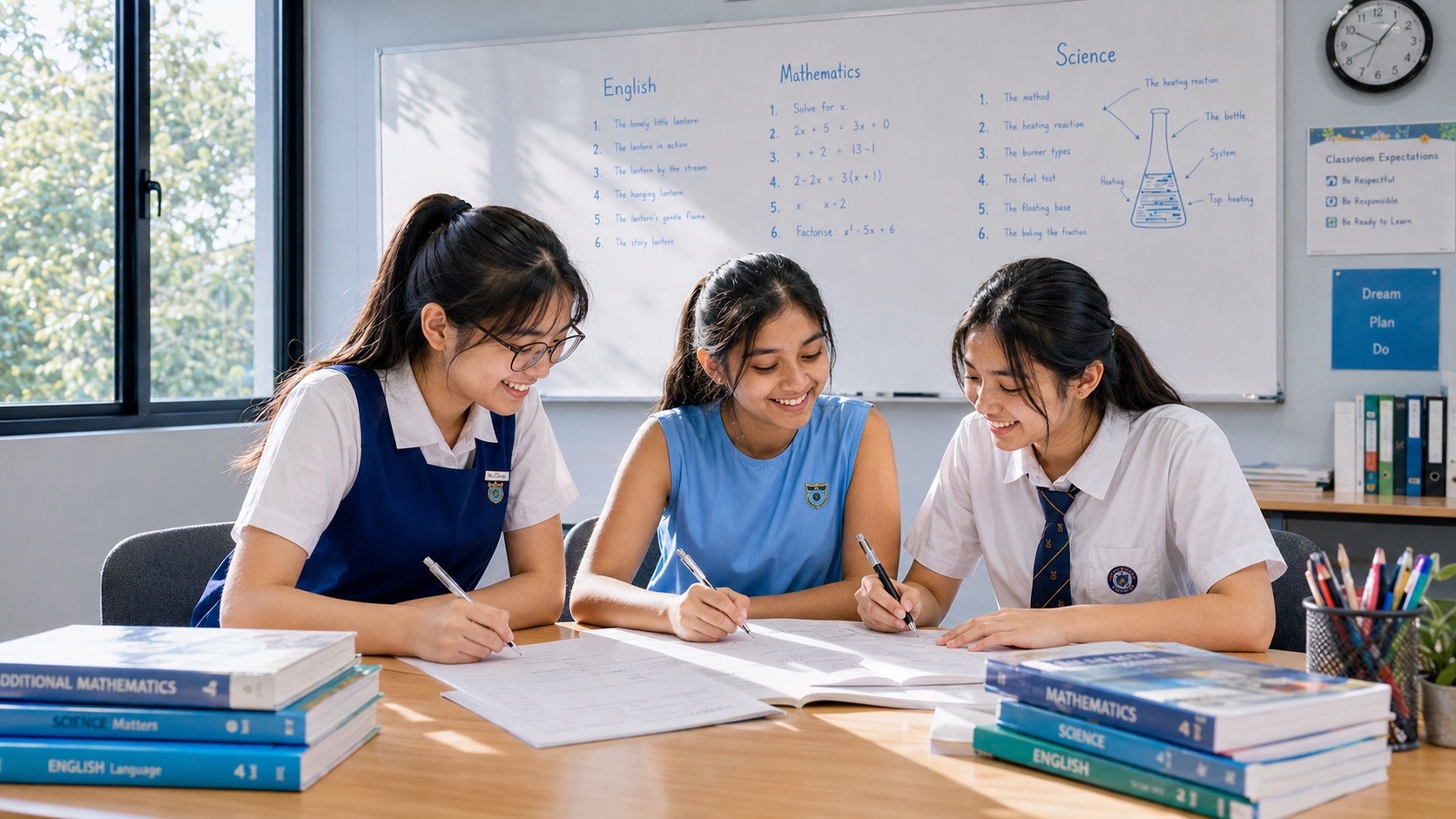
How should parents prepare a child for Secondary 1 orientation after the 2026 PSLE results? First confirm the actual allocated school and its official reporting instructions, then prepare the child’s journey, subjects, basic supplies, contact information and questions about new routines. The Singapore Ministry of Education has tentatively scheduled the 2026 Secondary 1 posting results for Friday 18 December 2026; the exact orientation, uniform collection, registration, textbook and first-day arrangements depend on the named secondary school. For Yishun families, verify the correct school campus and test the journey from the actual home rather than assuming that every school in the estate uses the same reporting dates.
The 2026 PSLE results are released on Tuesday 24 November at 11.00am. Families with ordinary S1 eligibility submit six school preferences from 11.30am on 24 November until Monday 30 November at 4.30pm. After the eventual posting, preparation should shift from comparing historical cutoffs to helping the child settle in the allocated school. This parent guide gives a practical first-month plan for Full Subject-Based Banding, G1/G2/G3 subjects, CCAs, friendships, personal learning devices, financial assistance and a calm daily routine without inventing school-specific 2027 orientation dates.
- Keep the official 24–30 November school-choice deadline separate from the tentatively scheduled 18 December posting results.
- When the posted school is known, follow that school’s actual orientation and reporting instructions.
- Verify the school identity, campus, official contact channel, subject levels and textbook requirements.
- Practise the actual door-to-gate trip and return after late activities, including a backup plan.
- Prepare personal organisation, sleep, communication, practical supplies and manageable spending.
- Ask about Full SBB subject learning and support needs rather than using old stream labels.
- Help the child make friends, approach teachers and build a sustainable first-month learning routine.
1. The first job is to confirm the real posting, not guess a school
Before Secondary 1 posting results are released, no parent can know that a child will receive a particular choice. A school appearing first on the family’s preference list is not an offer, even when the child’s score compares favourably with the previous cutoff. The correct first step after results is to obtain the official outcome. SEAB says families may access S1 posting results through the S1 Portal, SMS where a local mobile number was supplied, or the child’s primary school, according to the current arrangements.
Once the name is confirmed, verify the exact campus and programme. Singapore has schools with similar names, different secondary tracks and campuses in different areas. Chung Cheng High School (Yishun), for instance, is not interchangeable with Chung Cheng High School (Main). An allocated DSA-Sec pupil also follows the committed school route rather than a fresh ordinary six-choice allocation. Keep a digital or printed copy of the official result and use it when contacting the new school’s office.
2. The exact 2026 PSLE and S1 posting timetable
| Stage | Official date/time | Parent action |
|---|---|---|
| PSLE results | Tuesday 24 November 2026, 11.00am | Check actual score and Posting Group eligibility |
| School choices open | Tuesday 24 November, 11.30am | Complete eligible ordinary preferences using Singpass |
| School choices close | Monday 30 November, 4.30pm | Submit choices and retain acknowledgement |
| S1 posting results | Tentatively Friday 18 December 2026 | Await MOE confirmation, then read assigned-school instructions |
| Secondary 1 orientation | Set by each school | Use the allocated school’s current notices, not guessed dates |
SEAB 17 November 2026 PSLE and Secondary 1 posting release published the dates on 17 November 2026. The December date remains tentative until a later official update. Parents should not write ’18 December is definitely registration day’ on a calendar because the announcement refers to expected posting-result release, not a universal physical orientation session. Individual schools may publish separate instructions for online forms, uniform and textbook collection, briefing or the first day of lessons. Read that information directly from the allocated school, and ask if anything appears inconsistent.
3. Identify the school’s official channels and exact instructions
Open MOE SchoolFinder and the named school’s official website to verify its address, school office, email or telephone contact and current Secondary 1 information. Schools may use different methods to provide parent forms, booklists, orientation schedules or updates. The parent’s task is to locate the actual source, not rely on a screenshot forwarded without date. A school that posted instructions for the 2026 incoming cohort may revise them for pupils entering in 2027.
Make a simple information folder: official posting record, current school contact details, dates expressly confirmed by the school, forms that require action and documents the family has submitted. Avoid forwarding the child’s identification number, medical documents or home details into general parent groups. Where a school requests sensitive information, use its approved channel. One organised folder can prevent last-minute confusion without creating a complicated administrative system.
4. Check what is required, optional or not yet announced
| Item | When to act | Common mistake |
|---|---|---|
| Reporting/orientation date | After the allocated school confirms it | Assuming every Singapore school uses the same day |
| Uniform and PE attire | Use the school’s published collection instructions | Buying the wrong campus uniform |
| Textbooks/workbooks | Wait for the actual G1/G2/G3 subject-level booklist | Buying all G3 books before placement |
| Learning device | Check the school’s device programme and assistance | Buying a premium laptop unnecessarily |
| Student particulars | Use the school’s authorised forms | Posting private details in a parent chat |
| CCA selection | Follow the school’s orientation/CCA process | Assuming a PSLE school choice reserves a team place |
| Transport | Practise once the school is confirmed | Estimating from nearest MRT only |
A family can prepare stationery, a bag and basic routines ahead of time without guessing the exact course materials. Some schools provide or loan items; others direct parents to named suppliers. Financial assistance may cover various school requirements when the family qualifies, so parents who are concerned about expenses should ask before paying. The priority is to support learning and avoid waste. A pupil does not need a room full of advanced workbooks to begin Secondary 1 confidently.
5. Full Subject-Based Banding: understand the child’s actual learning
Under MOE Full Subject-Based Banding resources, PG1, PG2 and PG3 are used for Secondary 1 admission and help inform the initial subject levels, while G1, G2 and G3 describe subject learning. The child may study relevant subjects at different appropriate levels under the policy and school arrangements, in mixed form classes. This differs from treating older stream labels as fixed descriptions of a pupil’s abilities. Once the allocated school provides its subject information, read the actual timetable and ask about any part the child does not understand.
A pupil entering through PG2 may be strong in a subject and eligible for more demanding learning in that area, while needing appropriate support elsewhere. Conversely, a pupil entering through PG3 can find Secondary 1 Mathematics or English unfamiliar and need help. Parents should ask how the school identifies learning gaps and supports subject-level changes when eligibility and progress warrant them. The child’s posting group is a starting administrative route, not an instruction to compare classmates by personal worth.
6. Do not panic about the first Secondary 1 timetable
The child may have more subject teachers, different classrooms and a larger amount of independent organisation than in primary school. Orientation is a chance to learn the layout, reporting time and rules before full lessons begin. Parents can practise simple skills: reading the timetable, checking what materials to pack, writing down a task and asking which teacher to approach. A pupil who cannot memorise all the details on the first day is not failing; the aim is gradual confidence.
Instead of printing a complicated weekly plan before the school releases information, prepare a small, flexible system. One calendar for school events, a place for letters or messages and a routine for packing can be enough. When the actual timetable arrives, help the child highlight the next day’s lessons and any CCA equipment. Independence grows through repetition. Parents can move from direct checking to occasional supervision as the child becomes familiar with the routine.
7. Travel preparation for families in Yishun
The eduKate Yishun eight-school area guide identifies the eight mainstream Yishun schools: Ahmad Ibrahim, Chung Cheng High (Yishun), Naval Base, Northbrooks, Northland, Orchid Park, Yishun Secondary and Yishun Town. They are in the same broad estate but not at the same address. A child living near Khatib, Chong Pang, northern Yishun or the Yishun interchange can have very different routes to each campus. Some allocated schools may be outside Yishun, requiring bus or rail transfers.
Use the Yishun home-to-secondary-school transport guide to compare the actual address and door-to-gate approach. Include waiting for transport, road crossings, the correct school entrance and a buffer before reporting time. Test the return separately if the pupil will have CCA or additional classes that finish later. A route that seems short on a quiet weekend may be different during weekday school-start hours. Avoid inventing a travel-time estimate from the town name or a straight-line map distance.
8. Teach the child a backup route and a contact plan
A child travelling alone should know which bus or train direction to use, where to get off, which crossing leads to the campus and what to do if a service is missed. A simple backup plan can identify a safer alternate route and a trusted adult the child can contact. Practice the journey with supervision rather than demanding full independence on the first attempt. A pupil who gains confidence with the route has less uncertainty to manage during the first weeks of lessons.
Discuss what happens during heavy rain, a disrupted rail service or a late CCA dismissal. If the child has a mobile phone, agree on sensible contact routines without encouraging constant device use during lessons. If they do not have a phone, explain how to approach school staff or another trusted adult in an appropriate setting. The aim is practical readiness, not to make the child fearful about ordinary commuting.
9. Build a realistic school-day routine before January
Many children benefit from restoring a consistent sleep and waking pattern before the new term. Families can begin with the actual reporting time once it is known and work backwards through washing, breakfast, packing and travel. Avoid planning a route that assumes every bus arrives instantly and leaves the child no buffer. A calm morning can make a meaningful difference to a new pupil who is still learning classroom routines and unfamiliar social expectations.
The return routine also matters. Some pupils need a short period of rest before homework, while others prefer to begin an easy task promptly and then take a break. Families can help the child experiment with a sustainable approach rather than impose an inflexible schedule. Meals, reading, exercise, friends and family conversation remain part of healthy secondary-school adjustment. Time management should be a developing skill, not another exam the child feels compelled to pass every evening.
10. Prepare English learning without premature examination drilling
Secondary English involves reading, comprehension, writing, speaking and listening in a wider range of contexts. During the transition, parents can encourage ordinary reading and short discussions about what a text means. Ask the child to explain a paragraph, identify an unfamiliar word and describe evidence for an answer. These habits are useful whether the pupil begins at G1, G2 or G3, with the level of text and support adjusted appropriately. A large pile of worksheets is not necessary to make the first week manageable.
If the child’s PSLE English result showed a specific gap, identify it rather than label the entire subject weak. A student may need help structuring paragraphs, while another struggles with inference. The allocated school can advise on its actual curriculum and support. Encourage the child to ask teachers when confused and to use feedback after lessons begin. The goal is not to cover the whole secondary syllabus in December but to enter with curiosity and basic study habits.
11. Prepare Mathematics by understanding the first unfamiliar concepts
A transition from Primary 6 to Secondary 1 Mathematics often brings negative numbers, algebraic notation, equations and more formal explanation. A pupil who understands arithmetic can still be unsure what x represents or why both sides of an equation must balance. Parents can review number facts, fractions and simple mathematical explanations without rushing far ahead. Asking the child to describe their reasoning is more useful than simply giving harder questions.
If an earlier gap exists, such as confusion about fractions or ratio, targeted practice may be helpful. It is not necessary to buy all advanced G3 materials before confirming the actual subject level. The new school will set its own expectations and resources. A child with strong mathematical interest may prefer a few non-routine puzzles and a chance to explain multiple methods, while a child needing support may benefit from smaller, repeated successes. Learning readiness is specific to the pupil.
12. Prepare Science through observation and explanation
Science learning develops when pupils can connect observation with a reasoned explanation. Families can use everyday examples such as condensation, food preservation or simple mechanisms to ask what was observed and what might explain it. The aim is to develop questioning and careful reasoning, not to run unsafe experiments at home. Pupils who enjoy STEM may find this a way to maintain curiosity during the holidays, while pupils who struggled with Science can learn that improvement begins with understandable steps.
The Secondary 1 school may have a distinctive applied-learning programme in aerospace, food science, media or design. But a programme title does not replace core scientific knowledge. Ask what the normal lower-secondary Science curriculum requires and how practical work is assessed. A child who is confident discussing experiments may still need help writing conclusions with evidence. Teachers can advise on these needs once the actual lessons have begun.
13. Mother Tongue and Higher Mother Tongue questions
The child may study Chinese, Malay or Tamil at an appropriate subject level, or have a relevant Higher Mother Tongue option. From Secondary 1 in 2026, MOE expanded eligibility for HMTL based on strong PSLE MTL or HMTL results regardless of overall aggregate under the applicable criteria. The allocated school’s actual provision and individual eligibility must still be checked. Do not assume that a language option shown in an old brochure will be available in exactly the same timetable for the 2027 incoming cohort.
Families can encourage enjoyable language use through conversation, reading, storytelling or age-appropriate media rather than only examination practice. If the child is particularly strong in Mother Tongue but needs support elsewhere, the school should help plan a balanced timetable. Where a separate language centre or approved arrangement is relevant, parents should confirm who manages the travel and lesson times rather than invent such a route. Language strength can be celebrated without becoming an overwhelming extra workload.
14. CCAs are usually chosen after the school allocation
A child may have wanted the school because of its football, robotics, band, art or another activity. That interest is valuable, but the ordinary PSLE S1 school-choice form does not guarantee allocation to a particular CCA. After posting, schools generally explain their own CCA selection procedures, including trials, auditions, preference ranking or capacity limits where applicable. Parents should help the pupil identify more than one activity they could enjoy, rather than promise a place in a popular team.
The first term is a time to explore and understand commitments. Ask the school when new pupils can try activities, whether beginners are welcome and what time training ends. A school with a strong arts or sports reputation may have selected advanced groups and broader introductory opportunities. Clarify the difference. A child can develop meaningful teamwork and confidence without immediately representing the school in competition. A sustainable routine matters more than an early award.
15. Friends, form class and belonging
A child may enter secondary school with no close friends from primary school. Orientation should help them learn names, understand common activities and identify approachable adults. Parents can encourage small steps such as saying hello, asking a classmate about the timetable or inviting someone to have recess together. Do not demand that the child form an entire friend group on the first day. Some pupils settle quickly while others need several weeks; the child should feel able to share worries without being judged.
If the pupil is shy, allow them to prepare questions beforehand. If they are naturally outgoing, encourage respectful listening and awareness of classmates who may be quieter. A school with mixed form classes offers opportunities to meet pupils with different subject strengths and interests. Parents should reinforce that those differences do not establish social status. A strong early sense of belonging can help a pupil participate in learning and seek assistance when they need it.
16. What to ask the form teacher during the first weeks
- How does the school communicate important notices and homework expectations to parents?
- Who should the child approach when unsure of classroom, timetable or subject materials?
- How are students helped to find friends and settle into their form classes?
- What is the process for identifying gaps in reading, algebra or subject understanding?
- How does the school support different G1/G2/G3 subject levels under Full SBB?
- What are the procedures for reporting bullying, unsafe incidents or persistent distress?
- When will CCA options, selection and schedules be explained?
- How can the family raise a confidential need without sharing private details publicly?
17. Help a child take responsibility for their belongings
Secondary school often involves moving between rooms, carrying different materials and managing devices. Before the first week, practise a simple packing system based on the actual timetable. Label belongings as directed by the school, identify where important documents belong and discuss how the child should handle lost property. Avoid an over-complicated organisation method that relies on an adult checking every item forever. The goal is growing independence, with support gradually reduced as the routine becomes familiar.
For digital devices, wait for the school to publish the approved requirements and assistance arrangements. A child should learn basic responsibility for safe handling, charging, passwords and appropriate use, but the family need not buy a premium device before receiving instructions. If a device is required and cost is a concern, ask the school about the current official subsidy or support process. A practical, compliant solution is better than an expensive guess.
18. Financial help is part of orientation planning
Uniforms, textbooks, meals, transport, devices and CCA items can place pressure on a household. MOE maintains MOE financial assistance information, and schools may have additional school-based assistance. Parents should check the current scheme and qualifying criteria rather than exclude a suitable school simply because the start-of-year costs look overwhelming. Different school types and citizenship categories may have different fees or bursary arrangements. A family should seek accurate current information from the allocated school before paying for optional activities.
Sensitive income or identification documents should be submitted through official channels, not public parent chats. Ask which parts of the equipment list are compulsory, which items can be loaned and whether book or uniform support is available. A child should be able to participate in ordinary learning without being made to feel ashamed of financial assistance. Household planning can remain private while the child concentrates on school routines and belonging.
19. When the child has additional learning or accessibility needs
Some families need more than a general orientation programme because the child has an identified learning, mobility, sensory or other support need. Use MOE special educational needs guidance and the advice of the primary and posted secondary schools to arrange an appropriate handover, respecting confidentiality. Not every school has identical facilities or specialist resources, so ask about the specific child’s needs rather than assuming an impressive school reputation indicates suitability. A formal support plan may include classroom arrangements, communication or accessible travel.
The parent should identify who will receive the relevant records, when a discussion is needed and how progress will be reviewed during the first term. The school may request official information securely; avoid handing private records to casual volunteers at a crowded event. The objective is continuity between primary and secondary schooling. A pupil can have an additional support need and still enjoy CCAs, academic learning and healthy friendships when appropriate provisions are in place.
20. What the child should know about asking for help
A child should be able to say, ‘I do not understand this step,’ ‘I cannot find the classroom,’ or ‘I need to report a problem.’ These are practical sentences, not signs of failure. Practise asking a teacher for clarification calmly and explain that it is normal to need time to learn new systems. Some children are comfortable raising a hand; others may prefer speaking privately after class. The school can explain its available channels for seeking help.
Parents should also listen for signs that the child is struggling beyond normal adjustment. Persistent distress, avoidance of school, major sleep changes or recurring fears deserve attention and appropriate contact with school staff or qualified professionals. Do not dismiss these concerns as simply part of growing up, but do not diagnose the child from one difficult first day either. Calm observation and timely support are more useful than either panic or silence.
21. A practical four-week settling-in plan
| Time | Pupil focus | Parent focus |
|---|---|---|
| Before school begins | Learn the route and basic organisation | Confirm official reporting, materials and contacts |
| Orientation and first week | Know form teacher, timetable and places to seek help | Support rest, meals and calm arrival |
| Second week | Start managing homework and subject transitions | Review what is confusing without demanding perfect results |
| Third week | Explore friendships and possible CCA interests | Check schedule, workload and safe return trip |
| Fourth week | Build independence and identify one learning goal | Contact teachers if a persistent gap or issue emerges |
The table is a family planning example, not an official universal school calendar. Some schools schedule orientation, CCA trials and subject activities differently. Follow the posted school’s actual dates and routines. The first month is not the time to demand mastery of every new subject or a large friend group. The purpose is to establish reliable habits, learn where to ask questions and make early difficulties manageable. The child can become more independent through small responsibilities.
22. Do not overreact to one disappointing first assessment
A pupil who performed strongly at PSLE may find the first Secondary 1 quiz harder than expected. Another may have struggled in Primary 6 and discover they enjoy a practical subject. Avoid treating either outcome as proof that the family chose the wrong school. Identify the exact concept or learning habit that needs attention, discuss the teacher’s feedback and encourage purposeful practice. One assessment does not predict the entire four-year journey.
Parents can ask whether the child misunderstood instructions, struggled with the content, lacked practice or felt overwhelmed by organisation. The answer determines the useful response. More worksheets are not automatically needed; the child might benefit from reading instructions carefully, explaining a method aloud or using a planner. Schools can help clarify expectations. Early learning support should build independence rather than make the pupil dependent on constant adult supervision.
23. Prepare for a school that was not the family’s first choice
The posting system may allocate a second, fourth or sixth preference, or a school with vacancies if the listed choices cannot be accommodated. That can be disappointing, but the actual allocated school is now the place where preparation should begin. Parents can investigate its ordinary lessons, programmes, support, CCAs and transport without describing it to the child as a permanent defeat. A school with a less selective earlier cutoff can still provide meaningful teaching and personal growth.
If a genuine exceptional issue may warrant an appeal, follow current MOE rules and deadlines instead of promising a transfer. Meanwhile, continue preparing for the assigned school’s official reporting obligations. A child who feels that every adult calls the school a consolation prize may struggle to embrace opportunities there. The family can acknowledge disappointment while also looking for concrete strengths in the school the pupil will actually attend.
24. Yishun school identity and daily geography
Ahmad Ibrahim, Chung Cheng High (Yishun), Naval Base, Northbrooks, Northland, Orchid Park, Yishun Secondary and Yishun Town have different campuses and local transport routes. A pupil whose home is near Khatib may have a different practical journey from one living near Yishun Avenue 7 or the bus interchange. The school name is not enough to plan travel. Some families may be posted to schools in Sembawang, Woodlands, Ang Mo Kio or farther away, requiring additional route practice.
The child’s daily routine should be assessed from the actual home to the school’s intended gate, not from a generic town centre. Try to arrive with a reasonable buffer, particularly during rainy or busy periods. Practise the journey back after a late session too. Parents who relied on driving during primary school should think about independence, after-CCA pickups and alternatives during work hours. A safe and predictable journey can ease the transition substantially.
25. Why the previous year’s cutoff is no longer the main question after posting
Before the S1 deadline, families use historic school cutoffs as reference points for building their six preferences. The completed 2026 intake figures reflect the earlier PSLE 2025 cohort and are not promises for the 2027 intake. After the 2026 cohort’s actual allocation is announced, those older numbers have little bearing on how well the child will learn in the posted school. Parents should shift attention to teaching, timetable, subject support, friends and participation.
A pupil can be placed in a school with a historically less stringent cutoff and still thrive academically and socially. Another can be allocated a highly selective school and still need help with adjustment. No previous last-posted score measures an individual teacher’s care or a child’s ability to form friendships. The family should stop comparing school names as status symbols and start learning how to support the real experience of Secondary 1.
26. Questions parents frequently ask about Secondary 1 orientation
Is 18 December 2026 definitely the Secondary 1 orientation date?
No. It is the tentative S1 posting-results release date in SEAB’s announcement. Each school sets and communicates its own orientation and reporting arrangements.
How do we learn which school our child has been posted to?
Use official S1 Portal information, SMS where provided or the primary school, according to the published result channels.
Must we buy textbooks before the posting result?
No. Wait for the allocated school’s subject-level booklist and purchasing instructions to avoid buying the wrong materials.
Does PG3 mean every Secondary 1 pupil studies every subject at G3?
Not necessarily. Full SBB provides subject-level differentiation under current school and eligibility arrangements.
When do students select a CCA?
Follow the allocated school’s own orientation and CCA selection instructions. A school posting does not guarantee any particular CCA place.
What if our child knows no friends at the new school?
Orientation, form-class activities and CCAs offer opportunities to meet others. Encourage small introductions and identify trusted staff, allowing adjustment time.
Does the child need extra tuition before Secondary 1?
Not automatically. Review specific learning gaps and wait for the actual subject demands; extra support should be targeted and manageable.
Should a child start learning algebra in December?
A gentle review of fractions, negative numbers and simple variables may help, but there is no need to rush through the entire syllabus.
What if the school is far from Yishun?
Test a realistic commute, late return and backup route. Ask the school about the actual gate and reporting time before term starts.
Can financial assistance cover supplies?
Eligible pupils may receive support under current MOE and school-based schemes. Check official eligibility and actual school instructions.
What if the child has a documented special educational need?
Contact the primary and posted secondary schools through confidential channels about the handover and appropriate arrangements.
What if the family wishes to appeal?
Use official current grounds, timelines and procedures. An appeal does not guarantee transfer, so keep preparing for the allocated school.
Will the SEC be relevant to pupils starting Secondary 1 in 2027?
Yes, mainstream schools follow the new SEC framework for relevant graduating cohorts, with subjects examined at applicable G1/G2/G3 levels.
When should parents ask about the first day’s exact time?
After the allocated school publishes its current intake instructions, not from a guessed common date.
27. Final orientation checklist for parents
- Confirm the actual allocated school and use only its official orientation instructions.
- Check the current address, reporting gate, school contact and forms due.
- Verify subject levels, Mother Tongue arrangement, textbooks and device requirements before purchasing.
- Practise the full school-day journey, including a return after CCA and an alternative route.
- Create a simple timetable, packing habit, sleep routine and safe contact plan.
- Help the child identify a trusted adult and make small friendship and participation steps.
- Check available financial or learning support confidentially where needed.
- Encourage calm reading and numeracy practice without excessive holiday drilling.
- Follow the school’s actual January timetable and adjust as the child settles.
Official references: SEAB 17 November 2026 PSLE and Secondary 1 posting release, MOE S1 Posting service, MOE SchoolFinder, MOE Full Subject-Based Banding resources, MOE financial assistance information and MOE special educational needs guidance. eduKate Yishun references: eduKate Yishun eight-school area guide, Yishun home-to-secondary-school transport guide, choosing a school when learning gaps remain and ranking six eligible secondary schools.
Final parent principle: PSLE results and school allocation determine where a child starts Secondary 1; the routines, teachers, friendships, curiosity and support that follow determine much of the everyday experience. Prepare for the allocated school as it actually is, using confirmed instructions and small practical steps.