
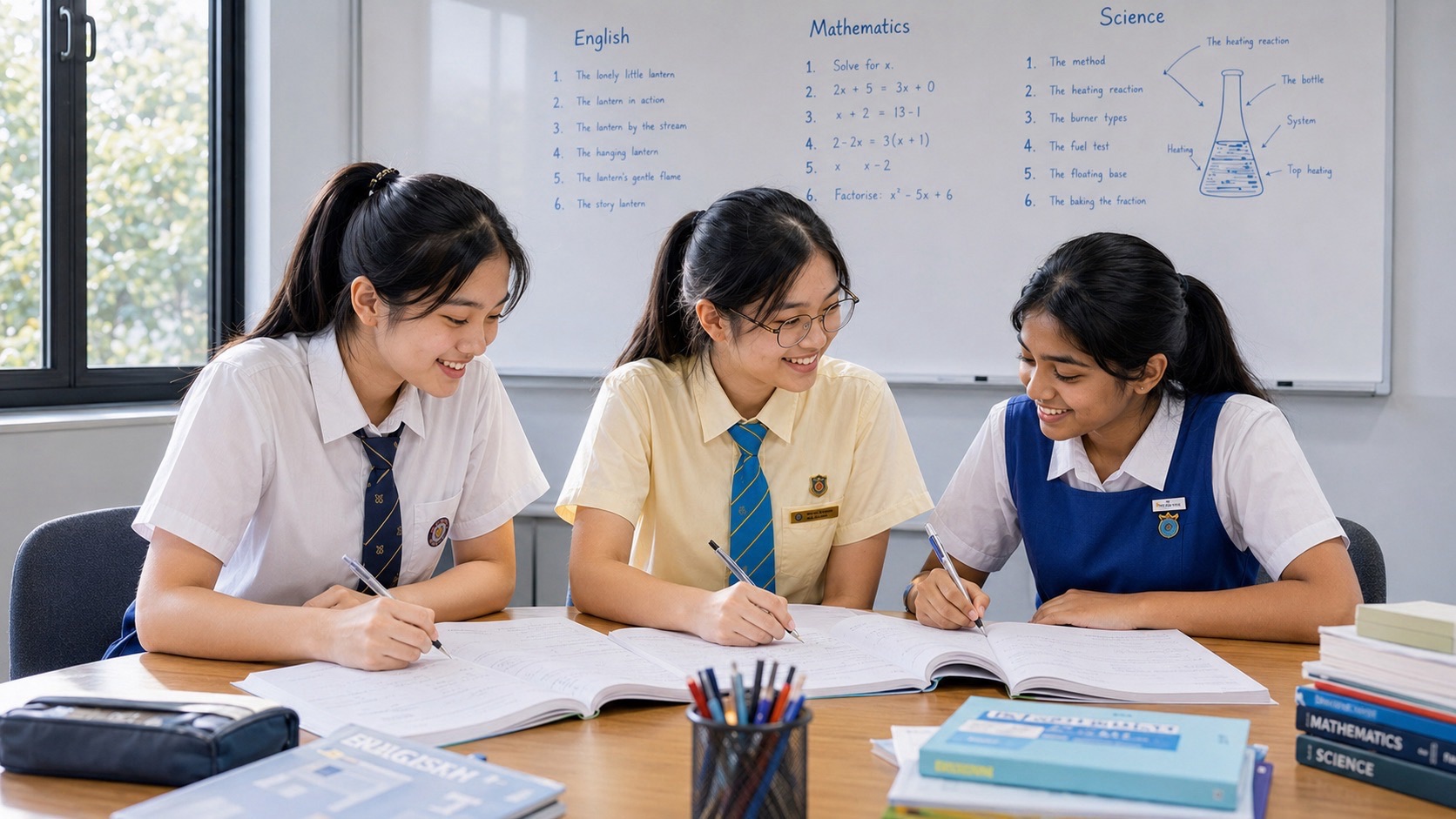
For a Yishun child entering secondary school through Posting Group 1 (PG1), the first Mathematics move is to confirm the child’s actual subject level, inspect the school’s first-term topics and find out which primary foundations are secure. PG1 is a posting category, not the name of an examination syllabus; G1 Mathematics is a subject level under Full Subject-Based Banding (Full SBB). This guide translates the verified 2027 SEAB SEC G1 Mathematics syllabus into a plan parents can follow without overwhelming their child.
SEAB’s published 2027 Singapore-Cambridge Secondary Education Certificate (SEC) G1 Mathematics syllabus K110 assesses Number and Algebra, Geometry and Measurement, and Statistics and Probability. At the national SEC examination, there are two written papers of 1 hour 30 minutes each, each contributing 50%. These are graduation-year specifications, not a Secondary 1 timetable. The term “2027/2028” here refers to the education transition and forward planning: families must check SEAB for a later examination year’s syllabus rather than assume the 2027 PDF also governs 2028.
- Identify the level: ask the school whether your child takes Mathematics at G1 or another offered level, regardless of the PG1 posting route.
- Official national benchmark: SEAB 2027 G1 Mathematics K110; two 90-minute papers, equally weighted.
- Main components: number/algebra; geometry/measurement; statistics/probability; contextual reasoning and written working.
- Immediate diagnostic: fractions, decimals, negative numbers, percentage, diagrams and multi-step word problems.
- Family routine: 15–20 minutes of focused practice, retrieval, correction and independent retry, adjusted to school demands.
- Progress measure: fewer recurring errors, clearer explanation and greater independence, not a guaranteed grade or subject-level transfer.
1. Open the official syllabus, then the child’s real school scheme of work
The national starting point is SEAB’s 2027 G1 school-candidate syllabus page, linking to the official K110 Mathematics syllabus PDF. The SEC overview explains that subject levels are recorded on the common SEC. A parent should read those documents for examination scope and then ask the school what is actually taught in Secondary 1 and Secondary 2.
The national specification includes topics examined by the end of secondary education. It does not order a new Secondary 1 child to complete every listed topic immediately. The school’s teaching sequence, textbook and teacher guidance determine this term’s work. When a workbook claims to be “latest 2028 PG1 Mathematics”, compare its contents to those sources before buying. There is no single SEC subject titled “PG1 Mathematics”.
2. PG1 does not define every subject a child will take
Full SBB allows students to offer subjects at appropriate levels. The Posting Group facilitates school admission and guides a student’s initial level. Individual subject level opportunities may differ in accordance with eligibility, subject performance, interest and school decisions. Ask the school for the assigned Mathematics level in writing, or consult the learning platform and timetable. Do not infer it from the child’s PSLE total alone.
This matters when comparing a child’s textbook with a friend’s. Two classmates can study in the same mixed form class yet attend different subject-level Mathematics lessons. A parent should not label one child “behind” simply because the page numbers do not match. The correct comparison is whether the pupil is learning and applying the appropriate curriculum with increasingly stable understanding.
3. Exactly what the 2027 K110 papers assess
In the 2027 SEC examination, Paper 1 covers Number and Algebra alongside Geometry and Measurement. Paper 2 covers Number and Algebra alongside Statistics and Probability. Each paper carries 50 marks and contributes 50% of the examination total. Each lasts 90 minutes, with short-answer questions and longer questions based on contexts. Candidates must answer all questions, and essential working matters.
SEAB identifies three assessment objectives: apply standard mathematical techniques, solve problems in various contexts, and reason and communicate mathematically. Their approximate weightings are 65%, 30% and 5% respectively. These weightings show why basic accuracy and applied reasoning belong together: memorised techniques without problem reading are incomplete, and imaginative explanations without accurate calculation also fall short.
4. The useful three-strand syllabus map
Number and Algebra: numbers, operations, approximation, numerical relationships, expressions and equations are the operating language of mathematics. Geometry and Measurement: shape, position, measurement and diagrams require careful visual reasoning and unit control. Statistics and Probability: data representations, interpretation and chance help the student read information rather than simply perform calculations.
The syllabus describes these strands separately for organisation, but real questions can combine them. A household bill might involve arithmetic, units, a graph and an explanation. A travel problem might require time calculations, a table and a judgement about which option is reasonable. Parents should therefore teach the skill and also occasionally ask, “Where might this idea appear outside a textbook?”
5. Number foundations: secure the operations before speed
Many Secondary 1 difficulties are traces of incomplete Primary 5 and Primary 6 learning. A child may calculate accurately with whole numbers but lose control when fractions, negative values or decimals appear. Begin with a small selection of tasks that reveal the reason: 0.4 + 0.08, 3/4 − 1/8, −3 + 7 and the difference between 30% and 0.30. Let the child explain what each number represents.
A useful diagnostic distinguishes concept errors, calculation slips and reading problems. If the child writes 0.4 + 0.08 = 0.12, place value is the issue; twenty harder decimals will not repair the misunderstanding. Ask the student to express 0.4 as forty hundredths, add eight hundredths and compare with an estimate. Restore meaning, then build fluency.
6. Negative numbers: a small topic with a long shadow
Negative numbers appear simple because each example is short. However, the learner must understand direction, order and operations at the same time. On a number line, −6 is less than −2 even though six is a larger counting number. A student who treats a negative sign as decoration will struggle with later algebra, graphs, substitution and formulae.
Use temperatures, financial debits or a signed number line to develop a stable representation. For −4 + 7, move seven places to the right from −4. For 3 − (−2), explain why removing a debt of two increases the net position. Avoid giving a rule such as “two minuses make a plus” without clarifying exactly which expression the rule describes.
7. Fractions, decimals and percentages should connect
A child who knows three isolated procedures may still fail a word problem because they cannot choose an appropriate representation. Ask the student to show 1/4 as 0.25 and 25%, then explain a real example such as a quarter of a weekly budget. Add a new value such as 3/5 and let the child use a diagram, division or equivalent fractions to build meaning.
Use estimation before calculation. If a supermarket item costs $20 and the discount is 10%, the reduction should be near two dollars, not twenty dollars. When a child calculates 10% of 20 as 200, the reasonableness check should catch it. This habit is often more useful than another page of routine percentage exercises.
8. Algebra: change the language without losing the mathematics
An expression such as 3x describes three equal quantities of an unknown value. An equation such as 3x = 21 states a relationship that must remain balanced. In Primary school, a learner might say, “Three groups of seven make twenty-one.” In Secondary 1, the same structural idea becomes a letter, a relationship and a solution that can be checked.
Ask the child to describe what the letter means before manipulating it. For 3x = 21, divide both sides by three and verify that x = 7 satisfies the original equation. When an operation is performed on both sides, the equality remains true. Teaching the meaning of that step is more reliable than training a pupil to “move the three across” without understanding why.
9. Algebra errors that deserve immediate attention
Repeated errors such as 2(x + 3) = 2x + 3, 5x + 2x = 7x², or x + 4 = 9 giving x = 13 are not all the same mistake. The first concerns distribution, the second confuses like terms with multiplication, and the third fails to preserve balance. Categorise each rather than writing “careless” beside the answer.
For distribution, use two groups each containing x and three counters, then translate the visual into 2x + 6. For combining like terms, ask what seven groups of x represent. For equations, put the same operation on each side. When the child can explain the correction and then solve a fresh item, the instruction has begun to transfer.
10. Geometry and measurement: the diagram is part of reasoning
Students often see geometry as a collection of labels and formulas. Stronger learners interpret the diagram before calculating. Ask what is known, what is unknown, whether the sketch is drawn to scale, which units are used and what the answer will represent. A labelled diagram can prevent a student from finding perimeter when the question needs area.
Use ordinary objects: a window frame for perimeter, a floor space for area, packaging for three-dimensional shape and a route sketch for position. The goal is not to create elaborate home experiments. It is to make terms such as length, breadth, angle, area and volume refer to something a student can visualise and explain.
11. Units, measurements and answers that make sense
A correct number with the wrong unit can be misleading. For example, 3 metres and 300 centimetres represent the same length, but an area expressed in square centimetres cannot be treated like a length. Encourage the pupil to write a unit beside each measured quantity before inserting it into a formula. When necessary, convert first and calculate second.
Approximation is another protective habit. An answer of 2,000 square metres for a small tabletop should prompt a check. In the SEC 2027 specification, unless otherwise stated, non-exact numerical answers generally follow stated accuracy conventions, including three significant figures and one decimal place for angles. The child should follow the instructions in the actual question and current school programme.
12. Statistics: read the graph before trusting the story
A bar chart, table or graph is not self-explanatory. Students need to read titles, labels, scales and units. Ask the child what one point or bar represents, whether the axis begins at zero and what comparison the display supports. A pupil can use arithmetic correctly and still misread a scale because each grid line represents five units rather than one.
Choose a real but uncomplicated dataset: rainfall, travel times, reading minutes or CCA attendance. Ask the child to describe what the data show, which conclusion is supported and what the data do not tell us. This prepares for data-response questions and also builds healthy scepticism about charts seen online.
13. Probability: make uncertainty speakable
Probability begins by distinguishing impossible, unlikely, even chance, likely and certain outcomes before using formal calculations where appropriate. A child may think the next coin flip must be heads after several tails. That expectation confuses past outcomes with the next independent event. Discuss it with a simple coin or spinner rather than a long lecture.
The value lies in explaining assumptions. Ask how many outcomes are possible, whether they are equally likely, and what information is missing. In a school task, the precise topic sequence belongs to the current level syllabus and the teacher’s plan; home practice should support the concept, not rush into more complex material solely because it appears in a future-year examination list.
14. Practical mathematics: bills, journeys and everyday decisions
The published K110 syllabus explicitly allows real-world contexts such as transport schedules, recipes, time, household bills, interest and money exchange. A Yishun family can use a simple train travel timetable, supermarket price labels or a household utility bill to develop the habit of extracting relevant information. No special equipment is required.
For example, ask: a bus leaves at 08:15 and reaches its destination at 08:52. How long is the journey? If a child answers thirty-seven minutes, ask how they checked. Next, introduce a second departure and compare waiting time. The lesson is not about memorising a particular Yishun route; it is about reading time information accurately and making a reasoned choice.
15. Teach a four-line problem-solving routine
For a word problem, have the child write or say: (1) What is being asked? (2) Which facts matter? (3) Which method fits? (4) Does the answer make sense? At first, the parent can prompt each step. Gradually, the student should initiate the sequence independently. This reduces guessing and supports marks for working.
Consider: “A notebook costs $3.50. Two notebooks and a pen cost $8.20. What does the pen cost?” The student identifies the total, subtracts $7 and obtains $1.20. A good answer shows the operations and checks that $7 + $1.20 = $8.20. The explanation matters because it makes the process reproducible when numbers or contexts change.
16. Arithmetic-to-algebra bridge for a Secondary 1 child
A parent can use one situation in three forms. Begin with “Three equal packets contain twenty-one sweets.” Draw three equal boxes. Then write 3 × ? = 21. Finally, represent the unknown as x and solve 3x = 21. The student should recognise one relationship expressed in increasingly abstract ways. This bridge is powerful precisely because it is simple.
Do not insist on abstract notation before the child can identify the unknown quantity. Some pupils need a drawing; others can move quickly to the equation. The important evidence is whether the pupil can use the idea again without coaching. A child who solves only the demonstrated question has not yet mastered the method.
17. A simple 20-minute lesson parents can repeat
Spend three minutes retrieving two earlier skills, five minutes explaining one current idea, seven minutes attempting three questions independently, and five minutes classifying and correcting errors. This is a suggested home structure, not a mandated MOE lesson. It is short enough to repeat and clear enough for a parent to observe what changed.
After a correction, ask for one fresh attempt without looking at the original. If the child cannot reproduce the step, the topic is not yet secure and the next lesson should revisit it. If the child succeeds, vary the question context rather than merely increasing the number of examples. End before fatigue turns every task into a contest.
18. The four-week repair and stabilisation cycle
Week 1: diagnose. Choose a few questions involving negative numbers, fractions, percentage, algebra and diagrams. Record whether difficulty comes from reading, concept understanding, calculation or written working. Do not conclude that every weak item requires an entirely new chapter.
Week 2: repair. Pick the two most consequential weaknesses. Teach each with a representation, a worked explanation and independent practice. Have the student keep a correction note phrased as “I used to think… Now I check…”.
Week 3: interleave. Mix older and current topics so the child must select a method. Include one real-world question and one explanation of why the answer is reasonable. Add speed only when accuracy is dependable.
Week 4: review. Repeat a parallel diagnostic set. Look for fewer errors and faster starts without hints. If the same misconception persists, ask a teacher or tutor to inspect the underlying reasoning instead of simply setting fifty more questions.
19. Three kinds of student: repair, stabilise or extend
Repair: A student cannot operate confidently with fractions or signs. Begin earlier than the current chapter and rebuild that skill. Stabilise: A student understands demonstrations but makes inconsistent mistakes when topics are mixed. Introduce retrieval, neat layout and repeated independent checks. Extend: A student is secure and curious; ask for explanations, alternative methods and carefully chosen unfamiliar applications.
These pathways are not labels attached to PG1. One pupil may need repair in algebra and extension in visual reasoning. A useful programme can adapt. The decision should be based on actual work samples, not assumptions about the child’s secondary posting band.
20. A Yishun family case: a child can calculate but freezes at word problems
Imagine a pupil who receives reasonable marks on short sums but leaves longer school questions blank. The parent initially thinks the pupil needs more drills in all topics. A closer inspection shows that the first sentence of a word problem is not being converted into useful information. The student knows subtraction but cannot decide when to subtract.
The family starts with three simple written contexts. For each, the child circles the question, underlines the quantities and explains the situation before calculating. After several sessions, the parent removes the annotation prompts. The desired improvement is an independent starting strategy. A change in grades may follow, but cannot be promised.
21. Another Yishun case: the child is confident until negative signs appear
A student solves positive-number equations quickly and then makes errors with x − 4 = −7. Rather than blame the child for being careless, the parent returns to signed numbers and number-line meaning. They rehearse −7 + 4 = −3, then confirm that −3 − 4 = −7. Only after that do they work with an algebraic representation.
This is an example of repairing the first unstable point. It can feel slower than drilling more equations, but it prevents one fragile idea from undermining later chapters. The parent logs the recurring pattern and checks whether it returns after a few days.
22. How to read a marked Mathematics paper
Sort each error into five categories: concept, method selection, calculation, question reading or presentation. A six-mark problem with correct reasoning but one arithmetic slip needs a different intervention from a blank problem where the student did not know where to begin. Repeated “careless” comments do not reveal this.
Ask the child to correct the question, explain the original mistaken step and solve a similar problem later. If the answer is right only while the solution is visible, the skill has not yet been retrieved independently. A brief error log is more informative than a thick file of unreviewed worksheets.
23. Exam habits without creating exam panic
The published 2027 SEC K110 structure shows why children eventually need to work clearly over 90-minute papers. Secondary 1 students, however, should not be forced into full SEC mock papers in the first month. Begin with correct notation, sensible layout, careful diagrams, visible units and checks after each solution. Introduce short timed sets only when the foundation is ready.
An approved calculator is permitted in both published 2027 G1 Mathematics papers, but this does not remove the need to understand arithmetic, estimation and what the calculator display means. The school may give its own rules for classwork, homework and assessments. Follow them.
24. When should a family ask the school about subject-level options?
If your child consistently shows secure understanding, interest and good progress, discuss with the relevant teacher how subject-level review operates and what evidence is required. If the workload is already excessive, the right move may be to stabilise learning before seeking greater demand. Neither a promotion nor a particular post-secondary route should be represented as an automatic reward for joining tuition.
The school will know the current MOE guidance, its curriculum structure and your child’s learning record. Parents can bring marked work, ask for the criteria and agree on one review point. That is more productive than choosing an arbitrary target level based on another child’s results.
25. Tuition, textbooks and parent involvement: what is worth paying for?
Before signing up for lessons, ask the prospective provider which mathematical misconception it intends to address and how progress will be checked. Effective support may include worked representations, guided practice, independent retry and a simple home routine. For some pupils, school resources and parental encouragement are enough. For others, the gap is persistent and outside help is sensible.
A small class can offer more chances to show working and receive feedback, but class size by itself is not evidence of grade outcomes. This Yishun article is an information guide and does not claim that eduKate operates a physical Yishun teaching centre. If travel or in-person attendance matters, verify the location and arrangements directly rather than assuming a local address.
26. Frequently asked questions from PG1 parents
Is PG1 Mathematics the same as G1 Mathematics? No: PG1 concerns school admission; G1 is one subject level. Is a student in PG1 permanently restricted to G1? No; subject-specific options exist under Full SBB, subject to relevant eligibility and school review. Will a Secondary 1 student sit the 2027 K110 paper? Normally no; the SEC is a graduation-year examination. Use the child’s actual teaching-year plan.
Should we use G2 worksheets immediately? Only when foundations and the school’s advice make them appropriate. Will fast mental calculation solve all Mathematics problems? No; interpretation, reasoning and communication matter. What if our child fails the first school assessment? Inspect the script for patterns, repair the first unstable skill and agree on a realistic review point.
27. Yishun routes through the eduKate learning library
For the official-to-school transition, read From PSLE Posting Group 1 to Subject Levels and SEC Exams. The PG1 Mathematics transition guide deals with PSLE foundations and school options. The Secondary 1 G1 Mathematics explainer introduces first-year learning rather than repeating the national examination structure.
For focused practice, continue with arithmetic-to-algebra, fractions, decimals and percentages, geometry and measurement, the practice routine and Yishun Library. The Clementi small-groups tutorial guide provides an approach to careful diagnosis and practice, while the official syllabus remains the authority for SEC content.
An evidence-based Mathematics diagnostic parents can run without pressure
Choose six short questions to represent different kinds of thinking, not simply six levels of difficulty. Include one decimal or fraction calculation, one signed-number item, one equation, one measurement problem, one table or graph and one written real-life situation. Give the child time to work independently and ask for working to be shown. Do not help during the first attempt; otherwise the parent will be measuring the quality of their own hints rather than the student’s current understanding.
For each question, record three distinct observations: whether the pupil understood the instruction, whether the chosen mathematical method was valid and whether execution was accurate. The answer “four” is not enough to assess learning if the pupil guessed it. Conversely, an incorrect final number may follow sound reasoning and one small arithmetic error. These patterns call for different next steps.
For a fractions question, ask how the pupil knows the result is reasonable. If the sum of two positive proper fractions is shown as larger than ten, a simple estimate should raise concern. For a signed-number question, ask the pupil to position values on a number line. For an equation, ask what the letter stands for and why an operation is applied to both sides. These explanations reveal whether the procedures are grounded.
For measurement, ask the child to label a simple rectangular plan and choose between perimeter and area. A student who multiplies sides when asked to find the length of a border may be misreading the question rather than forgetting multiplication. For a graph, ask about axes, scale and units before requesting calculations. A student can possess the relevant arithmetic skill and still misinterpret the data.
The last question should have an ordinary context, such as comparing two transport departure times or calculating the price of several items. Ask the student first to restate the problem in their own words. If they can calculate when the operation is named but cannot choose a method from the context, the appropriate teaching move is problem interpretation, not a new collection of harder sums.
At the end, identify one error type that appeared more than once. Design three new examples specifically for it and repeat a parallel question after several days. Keep a dated record to distinguish immediate correction from later retention. If the problem persists or the student becomes distressed, take the examples to the teacher rather than expanding homework indiscriminately. That is a more dependable basis for deciding whether outside tuition is needed.
Families comparing the complete PG1 core-subject picture can read the new English Language components, Mathematics components, Science components and Mother Tongue Language components. Each is a different subject guide; none should override the actual levels and school programme assigned to the child.
28. The next right move is small and specific
For a Yishun PG1 family, the best action today is to identify the actual Mathematics subject level, find the next school topic and look at three questions the child can and cannot solve. Choose one underlying weakness and make an achievable correction plan. Build accuracy first, use examples to develop understanding, then move from routine practice to unfamiliar contexts.
Mathematics becomes less intimidating when a pupil can explain the numbers, select a method and see that the answer makes sense. This is the kind of control a parent can help grow through steady attention rather than pressure or promises.
Worked parent-and-pupil clinic: one whole, two discounts and an algebra check
Use this fictional class-project budget to assess reasoning, not just calculator speed. A group is planning a display for a school activity. Six identical packs of card cost $48 in total before a promotion. The shop advertises 25% off the card packs. The group also needs a fixed $9 for labels. Ask the pupil first to decide what quantity counts as 100%: the $48 card subtotal, not the entire final budget. A quarter of $48 is $12, so the discounted packs cost $36. Including the labels gives a final cost of $45. The discount is not 25% of $57; that would include an item the promotion does not cover.
Now offer a changed condition: the group can spend only $41 on packs and labels, and the $9 label cost stays fixed. What pre-discount pack total could the group afford if the same 25% promotion applies? The available discounted pack budget is $41 − $9 = $32. Since $32 is 75% of the original pack cost, the largest pre-discount amount is $32 ÷ 0.75 = $42.67 to the nearest cent. Discuss whether actual pack prices and whole-pack quantities would permit that purchase; a calculated budget is not yet a product list. This distinction between mathematical result and practical constraint is an important skill.
For an algebra version, let the original pack total be x dollars. The final cost is 0.75x + 9. If the teacher gives a final cost of $45, the equation 0.75x + 9 = 45 leads to x = 48. Ask the pupil to substitute 48 back into the original sentence. This checks meaning and calculation in a different representation. For a different challenge, ask what happens if the labels receive their own separate 10% discount; pupils must identify a second base amount instead of treating the total as one discounted quantity.
In a group of three, give one pupil the diagram of the shopping basket, another the percentage method, and the third the algebra-and-units check. Rotate roles. A pupil who obtains a correct number without explaining the percentage base should not yet be considered independent. Use a fresh scenario after feedback. This is an invented teaching exercise, not a claim about real school costs, and it does not require Secondary 1 students to sit the 2027 SEC K110 papers in their first year. The subject level, teacher’s sequence and later examination year must be checked separately.
Leave a Reply