
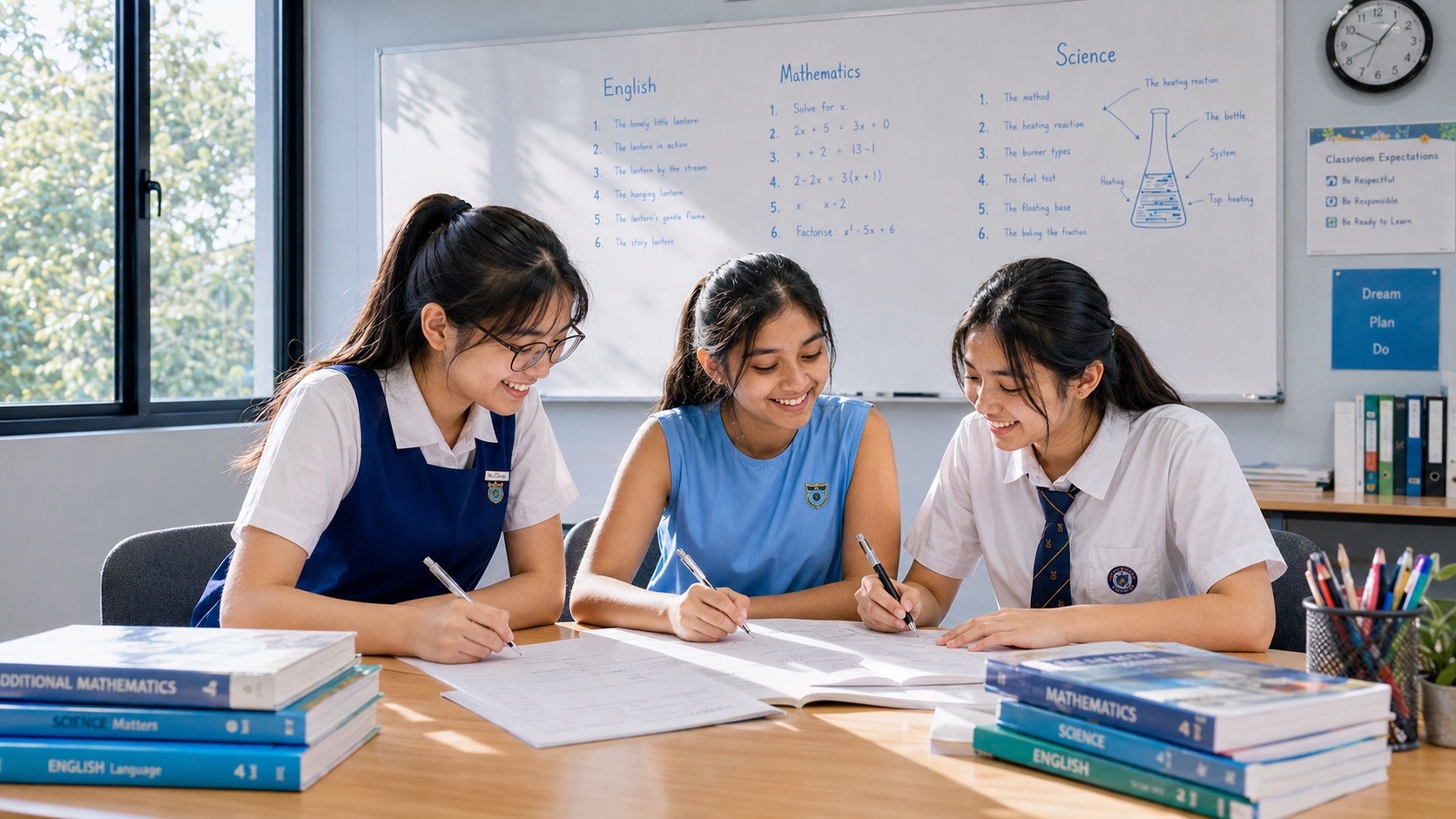
How should parents compare secondary school CCAs after PSLE? Compare the child’s real interests with the school’s current CCA options, entry trials, training days, equipment costs, travel time and ability to support a beginner. All secondary students are expected to participate in a CCA, but the presence of football, music, robotics or art on a school website is not a guarantee that the child will receive that particular CCA place. Yishun families should investigate the eight local secondary schools, then eligible nearby options where a meaningful activity and manageable journey justify looking further.
For PSLE 2026, results are released Tuesday 24 November at 11.00am, and six Secondary 1 choices can be submitted from 11.30am until Monday 30 November at 4.30pm. CCA fit is an important part of choosing a school, alongside the child’s actual PSLE Posting Group, subject learning, school culture and transport. This guide helps parents assess the four CCA categories, LEAPS 2.0, selection procedures and school programmes without claiming that a historically favourable cutoff guarantees a place for the 2027 intake.
- Start with the child’s interests and the skills they want to develop, not a medal tally.
- Check the official school’s current CCA page and whether a programme is open to beginners.
- Ask how trials, auditions, vacancies and selection affect a Secondary 1 pupil’s options.
- Compare weekly attendance, holiday practice, equipment, cost, travel home and academic balance.
- Understand LEAPS 2.0’s Participation, Achievement, Leadership and Service domains.
- Check any cluster or strategic partnership activity with the actual school before relying on it.
- Keep correct Posting Group eligibility and a balanced six-school choice list central to the PSLE decision.
1. A secondary school CCA is part of education, not a prize
Parents sometimes use the co-curricular list as a final filter: two schools have similar previous cutoffs, but one advertises a robotics club, football team or choir, so it wins. That approach is not necessarily wrong, but it is incomplete. The child will also have to attend the CCA regularly, learn alongside other pupils, accept coaching and juggle after-school time with homework and rest. The actual quality of the experience comes from sustained participation, not from the presence of a name on the website.
Some children enjoy a sport because they love practising rather than winning. Others value a club where they can solve problems quietly with friends. A child who is shy in class may discover confidence in drama, a uniformed group or helping to run a school event. The school that offers the most activities is not automatically the best. Ask where your child can begin as a beginner, receive feedback, grow in responsibility and enjoy the process over several years.
2. The official PSLE 2026 timetable and why it affects CCA research
| Milestone | When | Relevant parent task |
|---|---|---|
| PSLE results | 24 November 2026, 11.00am | Read real score and eligible PG |
| S1 preference submission opens | 24 November, 11.30am | Shortlist schools and correct programmes |
| S1 preference submission closes | 30 November, 4.30pm | Submit school choices, not specific future CCA selections |
| S1 posting result | Tentatively 18 December | Prepare for allocated school and its actual CCA briefing |
The 2026 PSLE result and posting notice from SEAB encourages parents to consider school culture, distinctive programmes, subjects and CCAs. It also recommends including two to three schools with previous cutoffs less stringent than the child’s PSLE Score among the six choices. A strong CCA fit makes a school desirable, but it does not cancel admission-route requirements. A child cannot rely on a school team’s excitement at an open house to obtain a place if the programme is not available to the child’s selected Posting Group.
3. What counts as a secondary school CCA?
Singapore secondary schools generally organise CCAs across four broad groups: Sports and Games, Visual and Performing Arts, Uniformed Groups, and Clubs and Societies. Names and availability vary from school to school. Participation in a core CCA is normally compulsory, so families should not treat the programme as an optional holiday hobby. The school will explain which activities are school-based, how selection works and what commitment a pupil accepts when joining.
| CCA category | Examples to research | Skills a child may practise |
|---|---|---|
| Sports and Games | Football, badminton, netball, basketball, volleyball, wushu | Teamwork, perseverance, fitness and sportsmanship |
| Visual and Performing Arts | Choir, concert band, dance, drama, guzheng | Creative expression, discipline, collaboration and performance |
| Uniformed Groups | NCC, NPCC, NCDCC and other groups offered at the school | Leadership, responsibility, service, teamwork and resilience |
| Clubs and Societies | Robotics, media, photography, science, debate or relevant school clubs | Problem-solving, communication, technical skills and exploration |
The examples above describe categories, not a promise that each Yishun school offers all activities. For instance, Yishun Secondary’s published CCA page lists uniformed groups including NCC, NPCC and NCDCC; performing arts including Guzheng, Indian Dance, Malay Dance, Modern Dance and Concert Band; sports such as badminton, basketball, football, netball, volleyball and wushu; and clubs including Media Club and Robotics. Its school page should be checked again for the actual 2027 cohort, because activity names, capacity and schedules may change.
4. Use LEAPS 2.0 to understand growth—not to chase numbers
MOE’s MOE’s LEAPS 2.0 framework recognises four dimensions of a pupil’s holistic development: Participation, Achievement, Leadership and Service. These domains encourage sustained involvement, contributions to an activity, appropriate opportunities to represent others and responsibility towards the community. A child does not need to be a star athlete in Secondary 1 to begin developing these qualities. Parents should be interested in whether the CCA encourages regular practice and real personal growth.
An overly narrow approach asks how quickly an activity can earn a specific point benefit in later admissions. A broader approach asks whether the child learns to practise with others, lead a small task, serve a community need and recover from mistakes. The LEAPS framework recognises various forms of development and contribution rather than treating only trophies as valuable. If the family wants to understand the current points rules or bonus-point treatment for a particular progression route, read the published official framework and the child’s school handbook rather than relying on a casual promise.
5. The first question should be: will my child actually enjoy this activity?
Many children choose a CCA because a friend is joining or a parent thinks it will look impressive. Both influences are understandable, but the child will attend the sessions. Ask what part of the activity sounds interesting: working as a team, creating music, learning first aid, building a machine, taking photographs or speaking on stage. A pupil may love the idea of an activity without understanding the weekly discipline it requires. Encourage them to ask what beginners do during their first month.
Interest is not the same as current expertise. A child who has never played an instrument may still enjoy concert band; a pupil without a private coding course may still be interested in robotics. Whether the programme accepts beginners, however, depends on its own allocation arrangements. Parents should ask about accessible entry routes rather than assume every child needs paid prior training or that every programme has unlimited places. An inclusive beginners’ pathway can be a meaningful reason to value a school.
6. The second question: is the desired CCA actually available?
A school’s public web page may be accurate but not sufficiently detailed for a Secondary 1 choice. There can be a difference between a school offering a CCA to its current students and having vacancies for all new applicants. Some sports teams hold trials, performing arts groups use auditions and clubs have equipment or staffing limits. A family should ask whether the child must list multiple acceptable CCA preferences during the later school allocation. An appealing activity that is frequently oversubscribed should not be the only reason to choose a school.
For example, Northbrooks has published information about CCAs across uniformed groups, sports, performing arts, and clubs and societies. Its 2026 CCA selection material shows that pupils could be required to rank choices and that quotas applied. This is evidence of how specific school selection processes can work; it is not a promise that the same online form, quotas or schedule will apply to the 2027 Secondary 1 cohort. Parents should ask the school for current instructions after posting.
7. Eight Yishun schools: compare available evidence, not assumptions
The eduKate Yishun eight-school comparison is a starting directory for Ahmad Ibrahim, Chung Cheng High (Yishun), Naval Base, Northbrooks, Northland, Orchid Park, Yishun Secondary and Yishun Town. The parent should open the current official CCA page for each eligible school. The school interests below are prompts, not claims that a particular CCA is guaranteed or even available for every incoming pupil. A signature applied-learning programme is not automatically the same thing as a core CCA.
Ahmad Ibrahim Secondary School
An interest in inquiry, languages and service could make media or leadership-related opportunities attractive. Parents should check the current CCA roster instead of assuming the school’s applied-learning theme is itself an available CCA. Ask what an ordinary Secondary 1 pupil can join, whether there are trials and how timetable demands affect academic work.
Chung Cheng High School (Yishun)
Food and health science themes can appeal to a pupil interested in science or sustainability, but do not assume there is a CCA with exactly that name. Investigate the real sport, arts, uniformed and clubs list, and make sure the school campus is Chung Cheng High (Yishun), not the similarly named Main school.
Naval Base Secondary School
A visually creative child may be drawn to design and digital media. Ask whether visual arts activities, media work or technical clubs are actual current core CCA choices, and what is included in ordinary curriculum instead. The school’s earlier CCA guidance also described cluster activities, but such arrangements must be confirmed for the incoming year.
Northbrooks Secondary School
A learner interested in engineering or aerospace might enjoy a practical technical club, yet the applied learning programme is separate from a guaranteed CCA allocation. Northbrooks has published selection instructions involving ranked preferences. Ask about actual current quotas, first-year trials and what alternatives a child could enjoy.
Northland Secondary School
ElderTech projects and human-centred design can suggest an interest in clubs or service, but parents should verify the current four-category CCA roster. Explore whether community work is a whole-school values activity rather than a dedicated CCA, and how a pupil can build responsibility without immediately seeking formal leadership.
Orchid Park Secondary School
The school’s official CCA section explains categories for physical sports, arts, uniformed groups and clubs and societies and links to a 2026 schedule. Ask about the 2027 cohort, arts access for beginners and audition requirements. A child interested in performance still needs a realistic academic and transport routine.
Yishun Secondary School
The published 2026 roster includes sports, performing arts, uniformed groups and Media Club or Robotics options. That makes it a good example of why families should check the exact current list rather than rely solely on a school’s signature sonic arts theme. Ask how training days, teams and auditions work for a new pupil.
Yishun Town Secondary School
A child with wide interests may prefer a school with several ordinary opportunities rather than a single specialised activity. Check its current CCA list, capacity and availability, and ask how the school helps pupils choose when they have little previous experience. The school’s academic and language programmes should be evaluated separately from its CCA allocation.
8. CCA selection is a separate event from S1 school posting
When parents enter six schools on the S1 Portal after PSLE results, they are making school preferences. They are not normally locking in a particular sports team, choir, engineering group or media club. The school a child is eventually posted to will issue its own orientation and CCA selection instructions. Some schools let students experience activities before ranking choices; some hold auditions, interviews or trials. The family must follow that school’s actual intake procedure after admission rather than assume a visit has secured a CCA place.
A child can be disappointed not to receive a first-choice CCA, just as they can be disappointed not to receive a first-choice school. Before Secondary 1 begins, discuss several genuinely interesting activities and the reasons for choosing them. Parents should not tell a pupil that a single CCA determines their success. Many valuable skills—teamwork, communication, time management and resilience—can develop in more than one activity.
9. What do trials and auditions really measure?
A trial may check present ability, coordination, teamwork, safe participation or potential; an audition may ask a child to demonstrate rhythm, musicality, expression or readiness to learn. Different schools and CCAs use different criteria. A child with a strong interest but limited experience should ask whether beginners are welcome and what the school looks for. Parents should not encourage exaggerating past experience or treating an audition as the end of the child’s learning journey.
If the school is genuinely selective, ask what other activities a pupil with related interests might consider. A child interested in competitive basketball might enjoy another team sport or a physical activity where they can build confidence. An aspiring performer who is not selected for a particular ensemble might discover drama, media production or another art form. The aim is to keep curiosity alive within real capacity constraints, not to promise that every desired club will be available on demand.
10. Look at training days and the real weekly cost
| Question | Why parents should ask | What to confirm |
|---|---|---|
| Which weekdays? | Homework and family arrangements must remain sustainable | 2027 actual schedule, not last year’s |
| What dismissal time? | The child may travel home during darker or busier hours | Actual school-gate return route |
| Any holiday practices? | Family travel and rest may be affected | Current holiday/competition policy |
| Does it require equipment? | Sporting or technical gear can be expensive | Loans, financial assistance and optional costs |
| Are trials competitive? | Desired placement may not be assured | Selection criteria and alternate choices |
| How often are competitions? | Commitment can rise during particular periods | Expected frequency and travel location |
| Can a beginner improve? | Prior private training should not be assumed | Teaching and progression for new pupils |
A CCA that meets twice a week can be entirely manageable for a child who has a short route home and organised homework habits. The same commitment can feel exhausting after a long transfer journey. A school in Admiralty or Sembawang might have the perfect activity, but parents should model the actual return journey after practice rather than the travel time during a quiet open-house day. Rest and sleep are part of the child’s ability to learn well the next morning.
11. School-based versus cluster and strategic partnership activities
Some Singapore schools have offered cluster-based CCAs with another school, while MOE and partner organisations have expanded strategic partnership CCA options for selected activities. These arrangements can widen access where a child’s own school lacks a particular activity. But eligibility, transport, available places, timetables and current partner organisations need to be checked for the actual incoming year. Do not assume a 2024 or 2025 collaboration remains unchanged in 2027 or that an external community club can automatically replace the child’s core school CCA.
For an example of why verification matters, Naval Base’s earlier published Secondary 1 guidance described cluster-based choices involving football, pipe band and robotics at named partner schools, subject to trials. This shows the possibility of inter-school participation, not an evergreen guarantee. Yishun Secondary’s current football page has also described a girls’ football cluster arrangement. If either option might affect your school choice, ask the host school and the pupil’s potential home school which arrangements will be active for 2027 and how students travel safely.
12. Sports: ask about learning and safety, not only trophies
Sport can develop teamwork, determination and healthy habits, but the family should assess practical suitability. Ask whether new members receive basic skills coaching, what equipment and safety precautions are required, and whether medical conditions need to be disclosed confidentially. Find out whether teams train at school or elsewhere, how competition travel is supervised and whether there are varying opportunities for recreational and competitive members. A child who enjoys movement but has never represented a school can still benefit from sport if a suitable route exists.
A school’s competition achievements are interesting but incomplete. They do not tell a parent how beginners are welcomed, whether coaches communicate with teachers when an athlete is overwhelmed, or how the school prevents overtraining. Ask about participation expectations outside competition season and what happens if the child is injured. Consider a realistic school week in which physical recovery, lessons and family time have to coexist.
13. Arts: understand rehearsal, selection and creative growth
Performing arts CCAs may involve regular rehearsal, public presentations and creative collaboration. Pupils can develop confidence, concentration and the ability to accept critique. Ask whether beginners can join, what auditions evaluate, what happens after a child misses a rehearsal and whether performance costumes or instruments create additional costs. A student who enjoys music technology may prefer an activity involving production rather than performance. The family should compare the real CCA roster with distinctive programmes taught during the school day.
A visually impressive arts display is not proof that every pupil receives the same opportunity. Selected ensembles can have different expectations from general classes. Ask what a new Secondary 1 learner actually does in the first term: basic technique, group exercises, observing experienced pupils or performing for an audience. If a child is shy, an environment that builds ability patiently may be a better fit than one that expects polished stage confidence from the start.
14. Uniformed groups: ask about responsibility and structure
Uniformed groups can offer a structured way to practise teamwork, leadership, service, discipline and practical skills. Parents should ask about normal meeting days, camps, outdoor activities, uniform costs, safety and how new members are guided. The style of training may appeal to some children and feel intimidating to others; the important question is whether the pupil understands the commitments and wants to learn within that structure. A school may offer several uniformed groups, each with its own ethos and activity pattern.
Do not choose a uniformed group only because a relative believes it will look prestigious later. The child will attend sessions, participate in drills or practical work, and contribute to service tasks. Ask current members what they learned in their first year, whether leaders give helpful feedback and how they support newer or quieter pupils. A child who enjoys responsibility may thrive, but the commitment should complement academic learning and wellbeing.
15. Clubs and societies: check the actual activities behind a name
A Robotics or Media Club can sound exciting, but a useful comparison asks what pupils make, how often and with what guidance. Does robotics involve basic coding, mechanical construction and careful testing? Does media involve photography, video editing, interviewing, writing scripts or school announcements? How are new pupils trained before being given equipment? Are activities open to beginners and how does the school manage different skill levels? Those concrete questions matter more than the club title.
Another pupil may enjoy chess, debate, science or environmental activities where offered. Parents can ask whether clubs are focused on competitions, service projects, learning tasks or a mixture. A pupil who prefers quieter work might still learn to collaborate in a small technical team. The best club is not necessarily the one that looks most closely connected to a university course; it is the one that develops useful habits and sustained interest.
16. How CCAs interact with academic strengths and learning gaps
A pupil receiving PG2 or PG1 can enjoy a demanding sport, art form or technical activity just as a PG3 pupil can. Posting Group is an admissions arrangement, not a measure of creativity, courage or leadership potential. CCA selection and academic level are different dimensions of education. Parents should ask whether the school is willing to help a learner coordinate extra support in English or Mathematics with attendance at meaningful activities.
If the child has a recurring learning gap, it may be tempting to remove every activity and focus exclusively on worksheets. That can be counterproductive when the CCA provides friendship, confidence and a reason to enjoy school. The sensible response is to identify the exact academic need, organise reasonable practice and choose a sustainable activity rather than abolish all interests. The school’s CCA schedule and teacher communication are essential for that balance.
17. A CCA can be a reason to search beyond Yishun
Families may consider Canberra, Sembawang, Admiralty, Woodlands or Yio Chu Kang if the current school profile offers an activity the child genuinely wants and can access. However, a prestigious sports team or selective band should not override a school’s actual Posting Group eligibility or the child’s ability to travel. A realistic short commute to a suitable CCA can sometimes matter more than a more famous programme far away. The school the child eventually attends is where the CCA commitment will live, week after week.
If an out-of-estate school becomes a candidate, check the exact school name and programme, historic cutoffs, weekday journey, school culture, subject support and CCA entry procedures. A child may be thrilled by an exhibition but not want to spend an hour or more travelling home after a late practice. Do not invent travel times; test the route from the family’s actual home. Include nearby school alternatives as part of a balanced six-choice plan.
18. Four fictional family cases with different CCA needs
Case A: A PG3 pupil who loves football but has not played competitively
The family can read Yishun Secondary’s published football details, then ask about the actual 2027 Secondary 1 boys’ or girls’ entry pathways as appropriate, trial process and training days. The child should also research two other enjoyable CCA possibilities in case football places are limited. The school’s historical cutoff and PG3 availability must be assessed separately. A promising football activity does not guarantee school posting or team selection.
Case B: A pupil with PSLE Score 22 who prefers music to sport
The pupil ordinarily has the PG2/PG3 option. The family should first discuss subject-level readiness and choose the permitted posting route. Next, compare schools with music, arts or production opportunities and ask what is available to beginners. Orchid Park’s creative arts context and Yishun Secondary’s music technology direction are good research prompts, but neither is a promise of a specific core CCA.
Case C: A pupil at Score 25 who wants robotics
The pupil may have a PG1/PG2 option and should choose the appropriate entry route before searching. A robotics interest can be nurtured through clubs, curriculum projects or independent exploration; it does not require that the child pursue a particular prestige label. Ask Northbrooks or other eligible schools what technical opportunities actually exist for new pupils and which activities require separate selection.
Case D: A pupil with a tiring commute and a favourite arts activity
The family considers a more distant school with a desired performing arts CCA. After checking the route home from rehearsal, they realise the routine may leave little time for dinner and homework. They may still apply if the benefits outweigh the costs, or choose a closer school with an alternative creative activity. The appropriate decision is based on actual evidence and the child’s wellbeing, not simply a brochure photograph.
19. Questions families often ask about CCAs after PSLE
Is CCA participation compulsory in secondary school?
Yes, secondary-school pupils are generally required to participate in at least one core CCA. The exact choice and allocation procedure comes from the school.
Can my child join the most popular sports team automatically?
No. Some activities have trials, quotas or selection criteria. Ask about beginner routes, alternative choices and the current Secondary 1 process.
Can a club or sport outside school replace a school CCA?
Do not assume so. Ordinary requirements generally centre on school-based or approved endorsed activities. Special partnership arrangements need explicit school approval.
Will a child who has no previous CCA experience be excluded?
Not necessarily. Many activities develop beginners, but individual selection criteria differ. Ask the actual school how new entrants are supported.
Is the school with more CCAs always a better school?
No. Relevance, accessibility, teaching, travel and the child’s willingness to commit are more important than the raw count.
Can my child change CCA later?
School rules differ, and changes may require approval or have timing restrictions. Ask during orientation and do not promise unrestricted switching.
Do CCAs determine entry into JC, Polytechnic or ITE?
CCA development can be recognised under the relevant LEAPS and post-secondary admission framework, but it does not independently replace required academic eligibility. Read current official rules rather than guessing.
Should a child choose a CCA to collect the most points?
A sustainable activity that develops skills and contribution is more meaningful than chasing points without interest. Understand the official recognition framework but maintain educational balance.
Does an applied learning programme count as a CCA?
Not automatically. It may be part of curriculum, an elective or selected enrichment. Ask the school to distinguish it from the core CCA roster.
When will we select the actual CCA?
Usually after the pupil has been posted and receives the new school’s Secondary 1 orientation or selection instructions. The PSLE S1 Portal school-choice submission is separate.
Can a Yishun family investigate CCAs outside Yishun?
Yes, at eligible schools elsewhere and through school-approved partnership opportunities where available. The route and travel should still be practical.
Where can I verify the 2027 CCA list?
Begin with the school’s current official site, ask the school directly and use the posted pupil’s orientation information. A 2026 timetable is not a guarantee for 2027.
20. A clear family CCA comparison worksheet
| Evidence | School A | School B | School C |
|---|---|---|---|
| Relevant preferred activities | List verified | List verified | List verified |
| Beginner access | Ask trials | Ask trials | Ask trials |
| Training and dismissal | Confirm actual year | Confirm actual year | Confirm actual year |
| Equipment or extra costs | Check assistance | Check assistance | Check assistance |
| Academic and pastoral support | School answer | School answer | School answer |
| Posting Group and historic COP | Correct PG/year | Correct PG/year | Correct PG/year |
| Family commute | Test actual route | Test actual route | Test actual route |
Use this worksheet as conversation evidence, not a mathematical ranking. Some criteria are eligibility gates rather than preferences: a pupil must be eligible for the school’s route. Others are trade-offs: a desired CCA may require a longer journey, an exciting club may be oversubscribed and an otherwise less interesting activity may offer better beginner teaching. A family can decide deliberately without pretending that every criterion reduces to a single score.
21. The PSLE six-school decision remains broader than CCA
Use the child’s actual PSLE total and selected PG before finalising school choices. The 2026 PSLE result and posting notice from SEAB asks parents to consider CCAs but also the school’s culture, programmes and subjects, and recommends two to three choices with historically less stringent COPs where possible. A pupil whose past-score comparison looks attractive at a school cannot claim a 2027 place. The MOE SchoolFinder and MOE S1 Posting should be used for school research and official submission respectively. Save the submission acknowledgement before the deadline.
- Identify at least two CCAs the child genuinely wants to explore rather than rely on one guaranteed allocation.
- Confirm which activities the named schools currently offer and how new entrants select them.
- Ask about weekly commitments, holiday practices, equipment, costs and safe return travel.
- Verify the child’s eligible school programme and the relevant previous-year Posting Group cutoff.
- Rank six real schools in true preference order and include less stringent historical comparisons where suitable.
- After posting, follow the allocated school’s actual CCA selection instructions and keep the child open to new interests.
Official and school resources: 2026 PSLE result and posting notice from SEAB, MOE’s LEAPS 2.0 framework, MOE SchoolFinder, MOE S1 Posting, Yishun Secondary’s official CCA list, Northbrooks Secondary’s CCA information, Orchid Park Secondary’s CCA information. Related eduKate Yishun reading: eduKate Yishun eight-school comparison, eduKate Yishun open-house questions and Yishun PG2 score-by-score hub.
Final parent principle: Choose a school where your child can belong, learn and participate—not a school selected solely because one team wins medals. A good CCA fit is a practical, sustainable opportunity to grow, subject to the school’s real selection rules and available places.
Comments
One response to “How to Compare Secondary School CCAs After PSLE Results? | School Finder for PSLE Results”
[…] Compare secondary-school CCAs after PSLE — ask detailed questions about participation. […]