
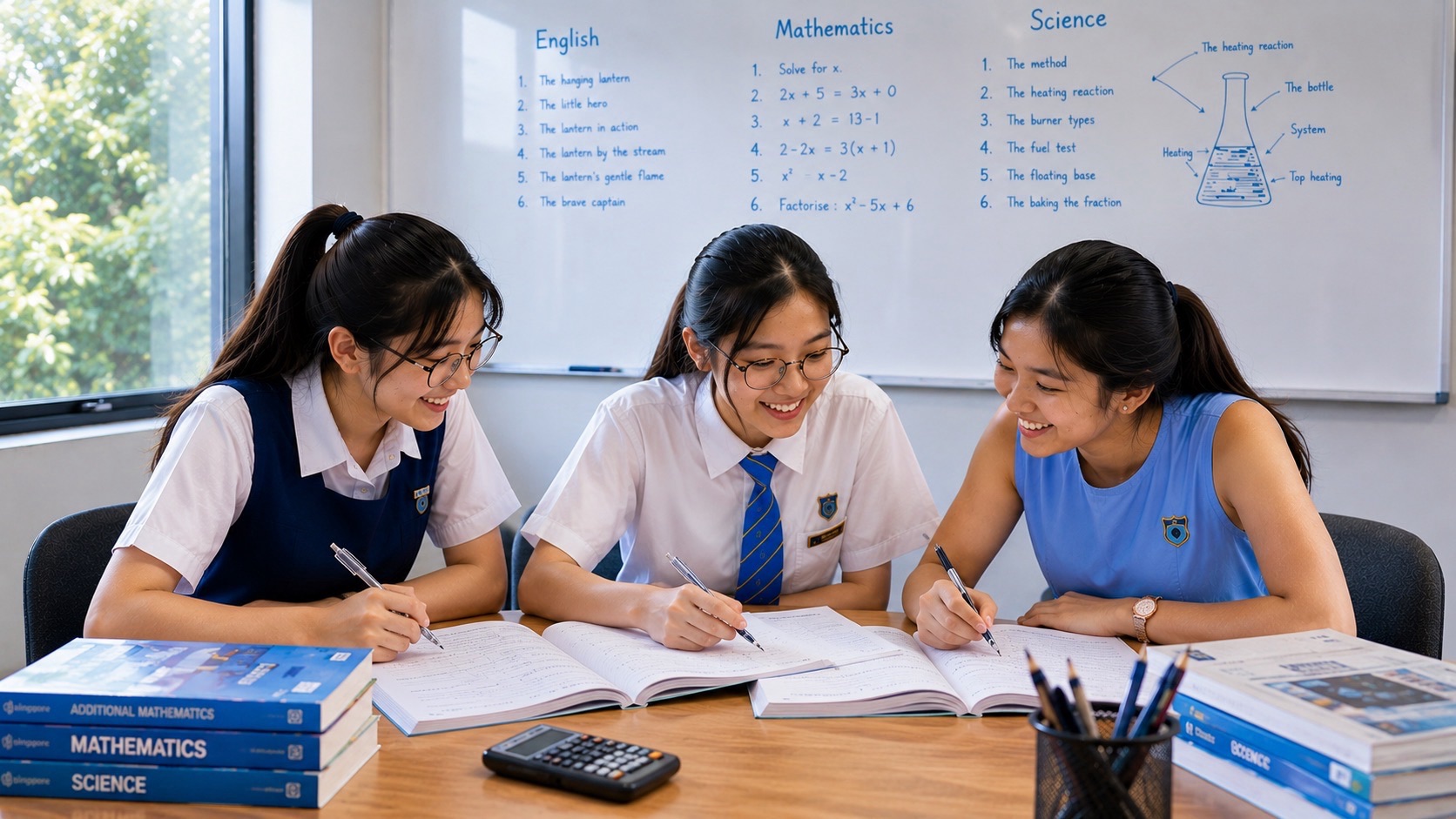
A student who entered secondary school through PSLE Posting Group 2 can prepare for G2 SEC Principles of Accounts by learning to explain what a transaction changes before deciding how to record it. Start with the subject and level confirmed by the school, then check the examination year. For the 2027 Singapore-Cambridge Secondary Education Certificate, G2 Principles of Accounts is K233. Its school-candidate listing marks the syllabus as refined, with changes to content and the assessment scheme retained.
This guide uses original fictional businesses to practise classification, double entry, adjustments, financial statements and a reasoned business choice. Parents can use the examples to ask what happened, which accounts changed and whether the written explanation agrees with the calculation. A student starting the subject in Secondary 3 should follow the school’s teaching sequence. A student preparing for the examination can use the same approach to identify a weak step and practise it with less help.
- Confirm the subject level and examination year before choosing a syllabus or specimen.
- Learn the effect of a transaction on assets, liabilities, equity, income and expenses.
- Use the account names and recording method taught in class, including both entries when a transaction needs two records.
- Check adjustments against the period and show how each affects the financial statements.
- Practise written explanations as well as calculations.
- Use original exercises for skills practice and the official specimen papers for the format of the relevant examination.
Contents
- Identify the paper and the work it asks for
- Explain the transaction before choosing an account
- Make double entry follow the event
- Separate profit from the movement of money
- Give adjustments the correct period
- Use a small trading example to build the statements
- Follow a depreciation calculation into both statements
- Use records and controls to explain reliability
- Explain a choice using evidence from the scenario
- Use a correction routine that finds the first wrong step
- Plan a revision week around evidence of learning
Identify the paper and the work it asks for
Open the 2027 G2 SEC school-candidate index and select Principles of Accounts K233. The index provides separate links to the syllabus and specimen papers. Keep the code beside any downloaded practice. If a book uses an earlier code, check the topics and format with the teacher before treating its instructions as current. If the student’s examination is later than 2027, use the applicable year’s documents when available.
The 2027 K233 syllabus sets two compulsory papers. Paper 1 lasts one hour, carries 40 marks and contributes 40 percent. Paper 2 lasts two hours, carries 60 marks and contributes 60 percent. Both require all questions. Paper 2 includes financial-statement preparation and a short scenario requiring a choice with reasons. Read the exact question instructions during practice, especially where a separate insert supplies data.
The official Paper 1 specimen should be reached through the index if a saved direct link changes. Use it to see the answer spaces and instructions. The official Paper 2 specimen illustrates using an insert with financial information. An approved calculator is permitted. The original exercises below teach particular skills and do not predict an examination question.
Start revision by giving each exercise a job. One may test the meaning of a trade receivable. Another may require an adjustment to expenses. A complete question can combine those jobs. When the student makes an error, name the earliest step that failed. They may have read a date wrongly, selected the wrong account, reversed a debit and credit, or copied a correct balance incorrectly. Naming that point makes the next practice more useful.
Explain the transaction before choosing an account
Imagine a fictional sole proprietor, Lina, starting a bicycle-repair business. She puts $4,000 from personal savings into its bank account. The business now has an asset of $4,000 at bank and equity of $4,000. In this simplified opening position, assets equal equity plus liabilities: $4,000 = $4,000 + $0. Ask the student what resource entered the business and why the owner’s contribution increases capital.
The business then buys repair equipment for $900 by bank transfer. Bank falls to $3,100 and equipment becomes $900. Total assets remain $4,000. The equipment will be used to provide repairs over time. In this exercise the payment exchanges one asset for another. A student who immediately subtracts $900 as an expense needs to revisit how the item is used and which period’s performance is being measured.
Next, a supplier provides $300 of repair supplies on credit. Treat these unused supplies as an asset for this simple classification exercise, with the treatment of actual school questions determined by their wording. The business has acquired resources and owes the supplier. Total assets are now $4,300 and liabilities $300, with capital still $4,000. The equation balances because both sides increase by $300.
Finally, Lina pays $120 of that amount by bank transfer. Bank falls from $3,100 to $2,980, the supplies remain $300 and equipment remains $900. Assets total $4,180. Trade payables fall to $180, so $4,180 = $4,000 + $180. The payment settles part of a liability already recognised. The student should explain why the same purchase is not recorded again when the supplier is paid.
Use the business purpose to classify the item
A bicycle can have different roles in different businesses. A shop might buy it for resale, while a repair business might use it for deliveries. Ask the child what this business intends to do with the item. Classification needs that information. The physical appearance of an item does not supply its accounting purpose. In a question, underline the words describing how it will be used.
Try a second example with a printer. A stationery trader buys printers to sell to customers, but uses a different printer in the office. The student can label which is inventory and which is equipment, then explain the reason in a sentence. Change the story without changing the object and ask whether the classification changes. This checks whether the student understands the relationship rather than memorising a list of possessions.
Make double entry follow the event
Begin with a small service business that earns a $240 fee on credit. The service has been provided, but the customer has not paid. Trade receivables increase by $240 and service fee revenue increases by $240. In a simple ledger exercise, debit trade receivables and credit service fee revenue. Ask the student to explain both changes before writing the entries, then identify the customer whose account needs the record.
When the customer later pays $150 by bank transfer, debit bank $150 and credit trade receivables $150. The amount still due is $90. The service revenue from the original transaction remains $240. Collecting money changes the form of an asset from a claim against the customer to bank funds. A child who credits revenue again should compare the original service date with the later collection date.
Use the same sequence from the buyer’s perspective. A business buys equipment for $500 on credit, then pays $200. The acquisition creates equipment of $500 and a liability of $500. The payment reduces bank and the liability by $200, leaving $300 payable. Keep each transaction on its own date. The two stages become easier to distinguish when the student labels the first as acquisition and the second as settlement.
For a personal withdrawal, suppose an owner takes $80 from business bank funds for a family purchase. Debit drawings and credit bank in the simple exercise. Ask why the withdrawal is recorded separately from business expenses. The personal purpose matters. A parent can change the amount and ask the student which part of the explanation stays the same. The business record needs to show the owner’s transaction clearly.
Check what equal totals can and cannot show
Suppose the student correctly records a $240 credit service, but posts it to the wrong customer’s account. The debit and credit totals can still agree. Their record may nevertheless show that the wrong person owes money. Ask the child how they would detect the error. The original document, customer name, date and amount provide a route to checking which account should have been used.
A balancing check is one useful step among several. Compare the record with the event, examine the names and dates, and look for omitted transactions. In practice, have the student check one account against the source information before checking the totals. That habit reveals mistakes which arithmetic alone cannot find. It also gives the child a reason to read business names and transaction descriptions carefully.
Separate profit from the movement of money
Consider a fictional repair business that provides $1,200 of services during a month. It receives $900 during that month and will collect $300 later. Its monthly rent is $250, electricity used is $70 and advertising costs $80. Assume those are the only income and expenses, and that the service fee is earned in the month. Profit is $1,200 − $250 − $70 − $80 = $800.
The bank movement differs. The business receives $900 and pays the three listed costs totalling $400, so its bank balance increases by $500 from those transactions. The remaining $300 of earned revenue is a trade receivable. Ask the student to explain how the $500 increase at bank and the $300 receivable relate to the $800 profit. This small example makes it possible to see why the two figures differ.
Now add a $200 contribution from the owner. The bank increase becomes $700, while the profit from the month’s services remains $800. The owner’s contribution changes capital and bank. The student can draw a line through the transactions that affect performance and leave capital transactions separately labelled. Ask them to explain the purpose of each record in the business story.
Next, suppose the owner withdraws $100. Bank increases by $600 overall from the transactions described, while profit is still $800. Closing equity is opening equity plus the $200 capital contribution plus $800 profit minus $100 drawings. A student can use this relationship to check a closing statement. Each part answers a different question about resources, performance or the owner’s interest.
A short comparison for home practice
Give the student two statements: “The business has a higher bank balance” and “The business earned a higher profit.” Ask them to invent one transaction that supports only the first statement. A fresh capital contribution is a suitable example. Then ask for a transaction that increases earned income before money is collected. A service on credit gives the student a second way to test the distinction.
The parent can listen for the event, the accounts and the reason. If the student only repeats the statement, ask what happened to create the change. Once they can invent an example, have them explain its effect using numbers. A student who can move between the story and the equation has more than a memorised phrase to use in a new question.
Give adjustments the correct period
A fictional business pays $1,200 on 1 October for insurance covering twelve months from that date. Its financial year ends on 31 December. For this simple exercise, the monthly cost is $100. Three months belong to the year ending in December, giving an insurance expense of $300. Nine months remain for the following year, so prepaid insurance at 31 December is $900.
If the entire payment was initially recorded as insurance expense, the year-end adjustment reduces that expense by $900 and recognises a prepayment asset of $900. The student should write what the adjustment accomplishes before choosing the entries. The record then shows the cost used in this year and the part paid for a future period. Checking the twelve months gives $300 + $900 = $1,200.
For an expense payable, suppose wages of $460 were paid during the final week and another $90 relating to the same financial year remained unpaid at year end. Assume the question gives no other wage items. The year’s wages expense is $550, and $90 is a liability. The fact that payment has yet to occur does not remove the cost from the period to which it relates.
For service fees received in advance, a business receives $600 in December for lessons it will provide next January. Under the stated facts, the service has yet to be delivered at year end. The receipt increases bank and creates a liability for the unearned service fee. It contributes no service fee revenue for December in this exercise. The student’s explanation should name what the business still has to provide.
A useful adjustment sheet has the original amount, the period covered, the part belonging to the current year and the amount remaining. Keep the statement effect beside it. A prepayment affects both an expense and an asset; an expense payable affects both an expense and a liability. A student who records only one effect may obtain a plausible profit but leave the financial position inconsistent.
Use a small trading example to build the statements
Imagine a fictional shop selling notebooks. It buys 100 notebooks for $4 each and pays the supplier. It sells 70 notebooks for $7 each, all paid immediately. Assume no returns, additional purchases, losses or other income and expenses. Sales revenue is 70 × $7 = $490. Cost of the notebooks sold is 70 × $4 = $280. Gross profit is $210.
The 30 unsold notebooks remain inventory at their original cost of $120 in this simplified example. The total cost of $400 divides into $280 for goods sold and $120 remaining. If the student deducts the whole purchase payment when finding gross profit, ask where the unsold goods appear. The business paid for them, but they remain resources at the reporting date.
Add shop rent of $60 for the same period, paid by bank. Profit becomes $210 − $60 = $150. Suppose the shop started with $1,000 contributed by its owner and had no other transactions. Bank after the purchase, sales and rent is $1,000 − $400 + $490 − $60 = $1,030. Inventory is $120, so total assets are $1,150.
There are no liabilities under these facts. Closing equity is initial capital of $1,000 plus profit of $150, giving $1,150. The statement of financial position therefore agrees with assets of $1,150. Ask the student to explain why bank alone is $1,030 rather than $1,150. The inventory accounts for the difference. Then have them trace the $150 profit through the performance statement and closing capital.
This example deliberately leaves out many adjustments so the student can see the complete path. The school can extend it with returns, depreciation or a period-end adjustment as those topics are taught. Keep one change at a time while the child is learning. When several changes are combined, write each calculation separately before placing the result in the correct statement line.
Add an inventory valuation question
Suppose five of the remaining notebooks are damaged. Their cost is $20, but their expected net realisable value is now $12. The other 25 remain valued at $100. Inventory becomes $112, and an $8 impairment loss reduces the period’s profit from $150 to $142. Under these added facts, bank stays $1,030 and total assets become $1,142, matching capital plus the revised profit.
Ask what new information changed the value and why the bank calculation remained the same. The student should point to the damaged goods and their lower expected recoverable amount. Then ask whether all 30 notebooks should be revalued to the damaged notebooks’ amount. The facts apply to five units. Reading which items a condition affects is essential before making a period-end adjustment.
Follow a depreciation calculation into both statements
A fictional business buys equipment for $2,400 and expects to use it for four years, after which its residual value is estimated at $400. Assume the equipment is available for use for the full year and the exercise specifies the straight-line method. The depreciable amount is $2,400 − $400 = $2,000. Dividing by four gives annual depreciation of $500. At the end of the first year, accumulated depreciation is $500 and net book value is $1,900.
The same $500 appears as the year’s depreciation expense in the performance statement. In the financial position statement, equipment at cost of $2,400 is shown with accumulated depreciation of $500 deducted to give $1,900. Ask the student to explain why the expense and the accumulated amount have the same value in year one. Then extend the example to year two, with no change to the assumptions.
After two full years, the expense for the second year remains $500, accumulated depreciation is $1,000 and net book value is $1,400. A child who writes $1,000 as the second year’s expense has combined two different measures. One describes the expense for a period and the other describes the total depreciation accumulated up to a date. Write those descriptions beside the figures and compare the dates in their headings.
The business originally paid for the equipment, and the annual depreciation does not create another payment in this example. A student can connect this observation with the earlier distinction between profit and bank movement. If depreciation was omitted, profit and the equipment’s net book value would both be overstated by $500 for the first year under the stated facts. Following both effects gives the student a way to check the adjustment.
Use records and controls to explain reliability
Imagine that a fictional shop receives $180 from a customer. The receipt identifies the customer, date and amount, but the student has entered $108 in the customer’s account. Ask what record can support the correction. The student should compare the original receipt with the account and trace the difference of $72. A guess based on what the balance ought to be can hide the reason for the correction.
Next, imagine that one employee receives money, records it and checks their own records without another review. Ask the student what could go unnoticed and what a second person could check. They might suggest comparing receipts with the record of amounts received and checking that deposits agree with the relevant supporting documents. A useful control explanation names the risk and explains how the proposed procedure could help detect or reduce it.
Keep ethics close to an ordinary decision. Suppose the owner asks the student accountant to leave out an expense because the profit would look better. The student can explain how the omission would affect the information a user sees and why the record should represent the transaction accurately. If a supplier used the overstated profit when deciding whether to extend credit, the misleading information could affect that decision. The answer needs a connection between the record and the person relying on it.
For home revision, ask the child to select one calculation and one explanation from the same topic. They might calculate a missing amount, then explain which document supports it or which control would help keep the record accurate. The pairing checks whether they can prepare information and consider how someone uses it. It also gives the teacher a more specific picture of what the student can already do independently.
Explain a choice using evidence from the scenario
A fictional stationery shop needs 100 plain folders for a school event. Supplier A quotes $2.40 each and Supplier B quotes $2.55 each. Both can provide the same quantity and quality. A’s delivery will arrive two days after the event; B guarantees delivery the day before. Assume the shop has no folders available and cannot delay the event. Which supplier should it choose under these facts?
A’s total is $240 and B’s total is $255, a difference of $15. A reasoned answer can choose B because it can meet the event’s deadline, allowing the shop to fulfil the order. The answer can also explain the cost consequence: B requires an additional $15, which the shop would need to accommodate. Those reasons link evidence to what matters in the stated situation.
A weaker response says only that B is “better quality”, even though the question says the quality is the same. Ask the student to underline the evidence supporting every reason they wrote. If they cannot locate it, revise the reason. Another weak response gives the total costs and stops. Ask what the deadline means for the decision and which supplier satisfies it.
Change the facts to create a second exercise. Suppose both suppliers now deliver on time, but A offers a lower price only if payment is immediate, while B allows thirty days. The shop expects enough money next week and has limited funds today. A justified response must use the revised facts, including whether immediate payment is actually possible. A student should ask for any missing information before assuming the business can take the discount.
In a timed answer, name the choice first, then develop the required reasons with evidence and consequences. The 2027 Paper 2 specimen gives a reference for how a decision task appears in an examination. The supplier exercises here are original teaching scenarios. They help the child practise reasoning from what is supplied.
Use a correction routine that finds the first wrong step
After a practice question, check the original data before looking at the final total. A figure copied as $540 instead of $450 can make several later calculations wrong. Ask the student to mark the point where the work first diverged from the question. Then redo the relevant step and follow its effect through the statements. Record the cause, such as a copied amount or an incorrect period.
For double entry, have the child state the event and the two changes. For an adjustment, have them identify the current period and what remains. For statements, ask whether each amount belongs to performance for a period or position at a date. These short checks make it easier to explain an error without treating every incorrect answer as the same kind of difficulty.
A student’s correction can include a fresh example with one feature changed. If the original mistake involved a credit sale, use a service on credit and collect only part of the amount. If it involved prepaid insurance, change the start date. The student needs to decide again. A copied model answer can show what the page should look like, while the new attempt shows whether the reasoning has become independent.
During a busy school week, choose one skill and one complete task. A short ledger exercise can be followed by a statement question on another day. Keep the teacher’s format and account names available during early practice, then remove the prompt when checking recall. Bring unresolved questions to class with the child’s attempt and one sentence describing what they could not decide.
Plan a revision week around evidence of learning
On the first day, choose a short transaction question and explain every account used. On the next practice day, revisit the transaction with a different payment condition. Later in the week, complete one question combining a few balances and an adjustment. Finish by explaining a choice from a business scenario. The amount of work should fit the student’s other subjects and the tasks their teacher has assigned.
A parent can ask the student to select one answer they trust and one they want checked. For the trusted answer, ask how they verified it. For the uncertain answer, ask what information they used and what still feels unclear. Keep the conversation close to the page. The student may need help interpreting “owing”, identifying the reporting date or deciding whether an item has been used.
Closer to examinations, use the correct official specimen and school-directed papers to practise the actual time limits and instructions. Review the result by skill as well as score. A recurring adjustment mistake deserves a small repair task before another complete paper. An accurate student who leaves questions unfinished may need practice moving through familiar calculations and returning to an unfinished part.
What can a student ask the teacher?
They can bring a precise question such as, “I know the customer paid only part of the bill, but I credited revenue again. How can I check that step?” Another useful question is, “I calculated the prepayment, but I am unsure where both effects appear.” Showing the attempted work lets the teacher identify the point that needs teaching and suggest a suitable next question.
How can parents help without knowing the whole subject?
Ask the child to explain the business event in everyday language, identify the period and show the check they used. You can verify that a stated sum matches the numbers in the example, or ask which sentence supports a written reason. For the accounting treatment itself, use the teacher’s guidance and syllabus. A short question about the child’s reasoning can make their next classroom conversation much more productive.
Check the 2027 K233 syllabus with a period-end adjustment example
SEAB identifies Principles of Accounts at G2 level as K233 for the 2027 SEC examination. A student’s PSLE Posting Group does not itself establish that the student is taking this subject, or taking it at G2. Check the actual school subject allocation and the examination year. The official G2 school-candidate listing is the starting point for identifying the correct syllabus. The 2027 SEC is the first combined national examination series; older school papers can support topic practice but should not be represented as its official current papers.
Consider an original business example. On 1 October, a small shop pays $1,200 for twelve months of insurance, covering October through the following September. At 31 December, three months of protection have been used. The insurance expense for the reporting period is $1,200 × 3/12 = $300, while the remaining $900 is a prepaid expense (an asset). If the whole payment was first recorded as an expense, the adjustment reduces insurance expense by $900 and recognises a prepayment of $900. This is not a new cash transaction at year end: the shop already paid the insurer in October. Ask three students to divide the reasoning: the first draws the coverage timeline, the second computes the amount used and unused, and the third explains the adjustment and why cash does not change again. Then ask each student separately how the answer changes if the year end is 31 March. They should be able to calculate six months used ($600) and six unused ($600) from the same original facts. Parents can check the fractions and timeline even without knowing all the accounting terminology; the teacher remains the source for course-specific formats.
Leave a Reply