
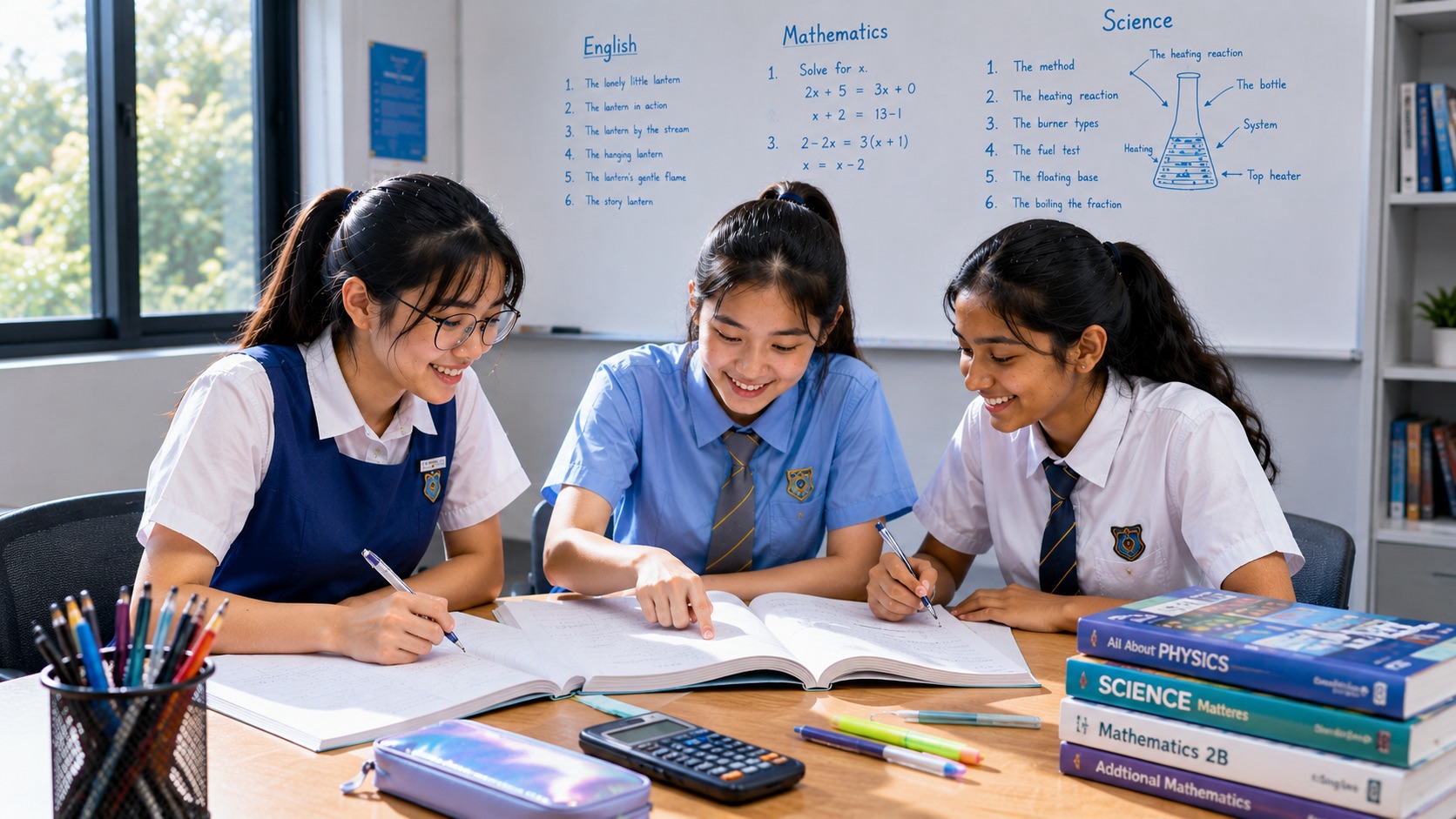
Information on G2 Mathematics K210 for the 2027 SEC: the subject has two 2-hour papers worth 70 marks and 50% each. Paper 1 has about 23 short-answer questions. Paper 2 has 9–10 compulsory Section A questions, including a real-world application, and Section B requires a choice between one Geometry and Measurement question and one Statistics and Probability question. Approved calculators are allowed in both papers, but essential working must be shown.
Parents can use this full guide to understand the three syllabus strands—Number and Algebra, Geometry and Measurement, and Statistics and Probability—along with worked examples, common misconceptions, revision planning and subject-level choices. It follows the 2027 school-candidate syllabus for K210 and translates the demands into practical learning steps. It does not treat G2 Additional Mathematics as a compulsory part of K210, and it uses original teaching questions rather than copying examination papers.
Quick parent summary
- 2027 subject: G2 Mathematics K210 (former reference code 4045), distinct from G2 Additional Mathematics K232.
- Paper 1: 2 hours, 70 marks, 50%; about 23 short-answer questions, all compulsory.
- Paper 2: 2 hours, 70 marks, 50%; Section A compulsory with final real-world task; Section B choose one of two options.
- Main strands: Number and Algebra; Geometry and Measurement; Statistics and Probability.
- Assessment also values reasoning, interpretation and communication, not merely final numerical answers.
- Approved calculator allowed both papers; formulae provided; bring geometric instruments and follow accuracy rules.
The examination is a test of thinking as well as calculation
G2 Mathematics K210 is organised around Number and Algebra, Geometry and Measurement, and Statistics and Probability. The syllabus also assesses problem-solving, mathematical communication and reasoning. A pupil who completes familiar calculations correctly may still struggle when a question combines a graph with a real-life situation. Another who sees the strategy may make sign or rounding errors. These are different problems and should not be treated as one vague weakness. Parents can help by looking at the steps rather than only the score.
SEAB’s assessment objectives describe standard techniques, problem solving across contexts, and reasoning or communication. Approximate emphasis is sixty per cent on standard techniques, thirty per cent on problem-solving and ten per cent on reasoning. These are assessment-objective weightings, not fixed allocations to individual chapters. A good lesson should therefore include accurate routine practice, one question that requires choosing a method, and one explanation of why a result is justified or plausible.
Students learn Mathematics by making relationships visible. For example, 3x = 21 is not a signal to move a number across an equals sign by magic. It states a relationship. Dividing both sides by three preserves that equality, giving x = 7; substitution confirms the result. That small first-principles explanation helps when later equations contain brackets, fractions or negative values. Explain why a transformation is valid before practising it quickly.
Paper 1 and Paper 2: know the exact format
Paper 1 lasts two hours, carries seventy marks and contributes fifty per cent of the final G2 Mathematics grade. It contains approximately twenty-three short-answer questions and requires all questions to be answered. Paper 2 also lasts two hours and carries seventy marks, worth the other fifty per cent. Its Section A has nine to ten questions, all compulsory. The final Section A question is specifically built around the application of Mathematics to a real-world scenario.
Paper 2 Section B offers two questions, and candidates answer one. These questions cover specially underlined syllabus content: one option from Geometry and Measurement, and one from Statistics and Probability. Each option carries either seven or eight marks, and the two options carry equal marks. Students should not assume that they must attempt both. The official document marks some topics as assessable only in this section, so read the actual underlining before distributing revision time.
An approved calculator may be used in both papers, but essential working must still be shown. Formulae will be provided, and students should bring appropriate geometrical instruments. Unless the question specifies otherwise, non-exact numerical answers are given to three significant figures; angles in degrees are given to one decimal place. This instruction is not permission to round every intermediate calculation. Preserve adequate precision while working and use the specified accuracy for the final answer.
How to read a G2 Mathematics word problem
The first difficulty in an unfamiliar problem is often translation rather than arithmetic. A question describes a situation in ordinary language; the student must identify relevant quantities and connect them through a mathematical relationship. Teach three preliminary moves: state what is known, define what is unknown and identify the relationship that makes the unknown calculable. It is better to spend twenty seconds clarifying the structure than to start several unrelated calculations.
Suppose a student buys three notebooks and pays a total of $14.40 after a $1.20 voucher is deducted. If each notebook costs the same, the equation is 3x − 1.20 = 14.40. Adding $1.20 to both sides gives 3x = 15.60, so each notebook costs $5.20. Check by multiplying and subtracting the voucher. The important step is not the division; it is representing the voucher correctly as a deduction from the original total.
Invite the learner to invent a similar question with a different number of items or a different kind of discount. Changing the context while preserving the equation shows mathematical transfer. When the answer is implausible, ask whether the issue is a wrong relationship, a calculation slip or a misread condition. Those diagnoses lead to different corrections. Recording just ‘careless’ does not reveal which skill needs to be rebuilt.
Numbers, estimation and the order of operations
The number strand includes operations with integers, rational and real numbers, prime factorisation, standard form, indices, approximations, ratios and percentages. These are building blocks for algebra and applied problems. Students should be comfortable checking the sign and order of magnitude of an answer before accepting a calculator display. A result of ten thousand dollars in an everyday $12 purchase question should trigger a review even if the keys were entered correctly.
Consider −3² and (−3)² as a reading exercise. Under the usual order of operations, −3² means the negative of the square and equals −9; the bracketed expression equals 9. The difference comes from notation rather than a complicated calculation. Use the example to show why symbols and brackets matter. Ask students to explain how a calculator entry might lead to a different result if the expression was transcribed incorrectly.
Estimation is not a substitute for exact working; it is an independent safeguard. Before multiplying 19.8 by 4.9, the learner can estimate 20 × 5 ≈ 100. A calculator answer near one thousand would be unreasonable. Encourage students to give an approximate range before the detailed calculation. The skill also helps when a question involves several unit conversions or percentage operations.
Fractions, ratio and direct proportion
Ratio describes a comparison, while a fraction may describe a part of a whole or a quotient. Students who treat the two as identical can misread questions about mixing, sharing or scale. The G2 syllabus includes ratios involving rational numbers, division in a ratio, map scales and both direct and inverse proportion. Build from concrete quantities before writing abstract relationships, and check whether two compared quantities have compatible units.
If a school club mixes orange and apple juice in a 2:3 ratio to make 15 litres, there are five equal parts. Each part is 3 litres, so the quantities are 6 and 9 litres. The student should be able to explain why the total number of parts is five. Change the total to 20 litres and see whether the learner can scale the solution without using an incorrect ‘add five litres to each’ shortcut. This tests proportional thinking rather than memorising one operation.
Inverse proportion is different: when one quantity increases, the other decreases in a way that preserves a constant product in the idealised model. If six identical machines finish a task in ten hours, twelve identical machines would require five hours only if they work at the same rate and other constraints are absent. Ask the learner to state the assumption. This prevents a correct-looking formula from being applied blindly to a situation where resources or setup time change the relationship.
Percentages, reverse percentages and financial contexts
Percentages appear in discounts, price increases, taxation, interest and household finance. Students should distinguish a percentage of an initial amount from a percentage change relative to that amount. Reversing a percentage is especially troublesome because learners sometimes undo a twenty-per-cent increase by subtracting twenty per cent from the new price. The reference base has changed, so the operation does not reverse the original transformation.
Suppose a jacket costs $96 after a twenty-per-cent discount. The sale price is eighty per cent of the original. The original price is therefore $96 ÷ 0.80 = $120. Subtracting twenty per cent from $96 would give the wrong direction and the wrong base. Ask the student to check that twenty per cent of $120 is $24 and that $120 − $24 equals $96. This single worked example is a good way to teach why reverse percentages require division.
More complex questions may combine successive changes. A five-per-cent rise followed by a five-per-cent fall does not restore the original amount. Starting at $100, the result is $105 after the increase and $99.75 after the reduction. Discuss why the second five per cent is calculated from $105. A learner who explains the changing base is developing reasoning that transfers to real prices, investment descriptions and other contexts.
Algebra: expressions are not equations
An expression describes a quantity, while an equation states that two quantities are equal. In 4x + 7, x may have many values and there is no single solution to find. In 4x + 7 = 27, the equality constrains x and it can be solved. Students who forget this difference may attempt to ‘solve’ every algebraic expression or simplify an equation incorrectly. Start with the meaning of each symbol before practising manipulation.
Expansion and factorisation are inverse kinds of transformations. For instance, 3(x + 4) expands to 3x + 12, while 3x + 12 factors to 3(x + 4). Neither changes the represented quantity. If a child writes 3x + 4 after expansion, ask them to test x = 2 in both forms. The original gives 18 and the incorrect expression gives 10. Substitution turns an abstract rule into evidence that the transformation failed.
Quadratic expressions add another layer. The product (x + 2)(x + 3) is x² + 5x + 6; reversing the expansion requires recognising factors whose product and sum match the coefficients. Students should keep written steps clear so that a sign error is visible. Revisit simpler integer operations if factors with negative values cause repeated confusion. Correcting the earlier numerical skill is not a distraction from algebra; it stabilises it.
Equations, inequalities and the logic of a solution
G2 Mathematics includes linear equations, simultaneous equations, quadratic equations, fractional equations that reduce to standard forms, and simple linear inequalities. Solving is not a sequence of memorised moves; it means finding values that satisfy stated conditions. When clearing denominators, students must attend to restrictions and to whether each transformation preserves the original equation. A solution should be checked in the initial form where practical.
Take 2x + y = 13 and x − y = 2. Adding the equations gives 3x = 15, so x = 5; substituting back gives y = 3. Ask why elimination works: the opposite y terms cancel when equations are added. Then have the learner solve by substitution and compare the result. Different approaches are useful because recognising the structure of a problem matters more than repeatedly choosing one routine.
Inequalities require extra care. Dividing −2x > 6 by −2 reverses the inequality, giving x < −3. Verify with x = −4, which makes the original left side 8 and satisfies the inequality. The test case helps explain why the sign must reverse instead of making it an arbitrary school rule. For every unfamiliar manipulation, ask whether the resulting statement expresses the same set of permitted values.
Graphs: turning equations into shapes
Graphs make relationships visible. The G2 syllabus covers linear and quadratic functions, selected power and exponential functions, coordinates and gradients. Students should be able to move among an equation, a table of values, a graph and a verbal description. A straight line can represent a constant rate of change, while a quadratic curve may rise and fall or fall and rise depending on its coefficients. Each form communicates different aspects of the relationship.
For y = 2x + 1, the gradient is 2 and the y-intercept is 1. When x increases by 3, y increases by 6. A student can check this using x = 0 and x = 3, producing y-values 1 and 7. Ask the learner what a negative gradient would imply and whether the units on the axes would change the interpretation. Reading a line as a relationship is more valuable than plotting isolated points without understanding.
Quadratic graphs require attention to symmetry and turning points. For y = (x − 2)² + 1, the lowest value is 1 at x = 2. The shape makes the minimum understandable. Avoid presenting all quadratics as though they must intersect the x-axis; this example does not. A good exercise asks students to predict the graph’s key features from its equation, then verify them with a sketch or calculation.
Geometry: diagrams must justify conclusions
The Geometry and Measurement strand covers angles, triangles, polygons, congruence and similarity, circle properties, trigonometry, mensuration and coordinate geometry. One recurring error is to infer equal lengths or right angles from how a printed diagram looks. Unless a property is given or can be justified, its appearance is not proof. Teach the learner to mark known quantities, identify the property used and state the reason for each major deduction.
If two triangles are similar, corresponding sides are proportional. A smaller triangle with a side of 4 cm corresponding to an 8 cm side in a larger triangle has a scale factor of 2 from small to large. A corresponding 5 cm side becomes 10 cm. Areas, however, scale by the square of the length factor, so the area ratio is 1:4 rather than 1:2. This distinction can be taught with a drawn rectangle that doubles in each dimension.
Circle problems are another opportunity to explain why a rule applies. The angle between a radius and a tangent at the point of contact is a right angle; students should know the precise condition. The ‘angle in a semicircle’ rule likewise depends on the diameter subtending the angle. Present two near-identical diagrams, one satisfying the rule and one not, and ask the child to identify what changed. This builds discrimination rather than reflexive formula use.
Trigonometry and three-dimensional reasoning
Right-angled trigonometry starts with relationships among an angle and the sides of a triangle. The G2 syllabus also includes sine and cosine for obtuse angles, the sine rule, cosine rule, and problems involving bearings, elevation and depression. A common misunderstanding is to use a right-triangle ratio in a triangle that is not right-angled without first creating an appropriate right triangle. Students must recognise the geometry before choosing a relationship.
Suppose a right triangle has a horizontal side of 6 m, vertical side of 8 m and hypotenuse of 10 m. For the angle adjacent to the 6 m side, cosine is 6/10 and tangent is 8/6. Rather than memorising SOHCAHTOA as a chant, ask which pair of lengths defines the relationship and why. Then change the diagram’s orientation. If the child still identifies opposite and adjacent correctly, they understand the role of the angle.
For bearings and elevation questions, draw the reference directions before calculating. A bearing is measured clockwise from north; a diagram that omits north can produce a plausible but incorrect angle. Three-dimensional solids may also require students to isolate a right triangle within a larger diagram. Ask them to label the triangle used and identify which lengths are actual edges and which are diagonal distances.
Mensuration, units and working with π
Mensuration addresses area, perimeter, volume, surface area and curved lengths or regions. The official syllabus includes composite plane figures and solids, arcs, sectors, segments and radian measure. The correct formula depends on what is being measured: a cylinder’s volume is not interchangeable with its curved surface area. Students should draw or mark the required region before selecting a formula, especially in a diagram involving several shapes.
If a rectangular floor is 4 m by 3 m, its area is 12 m², not 12 m. Adding a 2 m by 2 m square extension gives 16 m² if there is no overlap. Ask how the result would change if the extension partly overlaps the main rectangle. This makes an important point: the diagram’s arrangement determines whether regions should be added or subtracted. Clear units help distinguish length, area and volume.
Radian measure can initially feel like a new language. Arc length is connected to radius and angle measured in radians. A full circle is 2π radians; a half-circle is π radians. Ask the learner to describe the fraction of a circumference represented by a given central angle. Understanding the geometry makes the formula more accessible. Use the official formula sheet and paper instructions to determine which relations are supplied during the examination.
Statistics: choosing an informative summary
Statistics requires describing a dataset accurately while understanding the limitations of a summary. Mean, median and mode answer related but distinct questions. If five values are 2, 3, 4, 5 and 21, the mean is 7, while the median is 4. The unusual high value pulls the mean upward. Neither measure is universally best. The sensible choice depends on what the question asks and what the data distribution looks like.
The G2 syllabus includes grouped-data means, quartiles, percentiles, range, interquartile range and standard deviation. Students should know that two datasets can share the same mean yet differ in spread. This is a conceptual point even before calculation. If a class’s test scores cluster tightly around a mean and another class has wide variation, their averages alone do not tell the entire story. A comparison should consider both centre and spread when relevant.
Data displays can also be misleading. Truncating the vertical axis of a bar chart may exaggerate small differences. A pie chart with categories that do not form a meaningful whole can confuse the reader. Ask the child what a chart’s axes, labels and scale actually show. This strengthens both examination reasoning and everyday statistical literacy. A neat graph without an accurate explanation should not be treated as a complete answer.
Probability: separate possibility from certainty
Probability expresses the chance of an event. Students learn single events, simple combined events, lists of possible outcomes, diagrams and appropriate addition or multiplication rules. A common mistake is to multiply probabilities for events that are not independent, or add probabilities for overlapping events without accounting for shared outcomes. Ask the student to describe the sample space before reaching for a formula.
For a fair six-sided die, the chance of an even number is 3/6 = 1/2. If the die is rolled twice independently, the probability of getting an even number on both rolls is 1/2 × 1/2 = 1/4. The independence matters. If instead a bag has objects drawn without replacement, the chance of the second draw can change after the first. Comparing these situations helps learners recognise why the structure of the event is part of the Mathematics.
Students should also distinguish ‘either’ from ‘both’ in a question. In two independent coin flips, the probability of at least one head is 3/4, not 1/4, because the valid outcomes are HT, TH and HH. Drawing a small possibility diagram often prevents conceptual errors. A good parent question is: what are all the possible outcomes, and which of them meet the condition?
The real-world Paper 2 question
Paper 2 Section A ends with a real-world application question. The syllabus gives contexts such as travel plans, household finance, utilities, recipes and diagrams, and states that questions can combine several topics. Students may need to read a table, calculate a rate, compare a cost and explain what the numerical result means. The most important skill is selecting relevant information without assuming that every number in the prompt must be used.
Imagine a school trip involving two transport options with different fixed fees and per-student charges. The class must decide which is less costly for 28 students. A useful plan defines each option’s total cost as a function of the group size, substitutes 28, compares the results and considers any conditions supplied, such as capacity. The final answer needs to state the recommended option and the reason. Merely writing two arithmetic totals may not fully answer a decision question.
During practice, have the student cross out information that is irrelevant and circle constraints that can change the result. Then ask whether the answer is practical: can half a bus be hired, or must the number of vehicles be a whole number? Realistic interpretation is not an afterthought. It tests whether mathematical procedures have been connected to the situation they are supposed to model.
Section B choice: geometry or statistics
Section B of Paper 2 presents one Geometry and Measurement option and one Statistics and Probability option, both based on underlined syllabus content. Candidates choose only one. Parents should not teach a simplistic strategy of always choosing the topic the child usually scores better in. The smarter examination habit is to read both questions, identify what they require and judge which can be completed accurately with the current knowledge and remaining time.
During revision, the student should practise both strands rather than neglect one completely. A geometry task might require careful interpretation of a diagram and a stated property; a statistics task might require reading a distribution and comparing measures. The relevant underlined content is specified in the original syllabus and may not match assumptions based on older textbooks. Use the official year-specific document, not a generic online topic list.
A useful timed exercise allows a pupil two minutes to inspect both options and explain the selection before attempting the chosen one. After marking, compare whether the selection matched the student’s actual strengths. This trains decision quality as well as calculation. If a child repeatedly chooses a familiar-looking question despite not understanding its data, practise reading the conditions before choosing.
Calculator discipline and answer presentation
An approved calculator is permitted in both papers, but the student remains responsible for the mathematical method, accurate transcription and sensible interpretation. The calculator can execute a computation without knowing whether the correct quantity was entered. Encourage a brief pre-calculation prediction: should the answer be positive, less than one or in the hundreds? After calculation, compare the result with that expectation and check units.
Working should communicate a logical chain. For a percentage problem, state the base amount and percentage relationship. For a geometry problem, give the property that supports the step. For an algebra problem, make each equality valid. The official document warns that omitting essential working may lose marks. A correct final number cannot always reveal which mathematical idea was used, so neat, sufficient working protects the explanation as well as helping the learner self-correct.
Do not round too early. Suppose a calculation produces 4.56789 and later multiplies the result by another value. Rounding to 4.57 before the final step may introduce error. Retain enough digits in working and round the final non-exact answer to the required accuracy unless instructed otherwise. A reliable check is to write down the actual instruction from the question and compare the final presentation with it.
A precise error-diagnosis method for parents
One test score cannot tell the whole story. A student may lose marks through concept gaps, reading a question incorrectly, arithmetic slips, misapplied methods, poor diagrams or incomplete working. Copying an answer key may conceal all of these. Choose three representative errors and ask the child to explain the first step they would take if the same problem appeared with different values. Do not provide the operation before hearing the learner’s reasoning.
Record each mistake using a short description: ‘subtracted a discount from the wrong base’, ‘assumed a diagram was to scale’, or ‘used a mean instead of a median’. Then design one fresh question targeting that exact error. A week later, use a second unfamiliar example. Improvement means the student recognises the necessary structure without being told which chapter is being tested. This is different from remembering the corrected answer.
Where earlier foundations are insecure, return to them deliberately. A child making algebraic fraction errors may need to revisit ordinary fraction operations. Another who cannot interpret a gradient may need work on ratio and coordinates. Rebuilding a prerequisite is not a downgrade; it is a direct route to using the current topic accurately. Once the foundation is stable, introduce mixed practice and later time limits.
A four-week pathway: repair, stabilise and extend
Week one is diagnosis. Inspect a recent school paper and a few independent questions from Number and Algebra, Geometry, and Statistics. Identify whether the principal issue is missing concepts, inaccurate execution or inability to choose methods. Choose one or two targets that can realistically be improved. A plan naming every topic in the syllabus is less actionable than a plan that says ‘solve linear inequalities correctly and justify the direction change’.
Week two is rebuilding. Teach the underlying relationships with worked examples, then remove prompts. Week three mixes the target with previously learned material so that the student must identify the technique without a worksheet heading. Week four uses fresh questions to test transfer and introduces appropriate timing if accuracy is secure. Record the same error categories before and after; the aim is measurable progress, not simply more worksheets completed.
Students who are already confident may use extension problems involving unfamiliar conditions, explanation and alternative methods. Students who are inconsistent may need retrieval and checking habits more than additional topics. Students who are struggling may need a smaller, more carefully sequenced set. The common principle is to match the lesson to evidence from the learner, not to assume that one classroom pace suits every child.
How Mathematics K210 fits subject choices and future routes
G2 Mathematics K210 is a distinct registered SEC subject. G2 Additional Mathematics K232 is another subject, with its own syllabus; it is not a compulsory second paper inside K210. Parents considering both should check school availability, prerequisites, current performance and the student’s overall workload. Mathematical ambition is useful when built on reliable algebra, numerical control and a willingness to explain reasoning, not just on the wish to take more subjects.
Full Subject-Based Banding permits different subject levels according to eligibility and school arrangements. A child’s posting group should not be used as a substitute for checking the actual subject code. If a move to another level is under consideration, ask the school about evidence, timing and likely preparation needs. Do not promise that a stronger grade in one subject guarantees a particular post-secondary admission route; official criteria differ by course and year.
Consider tuition or other targeted support when the school’s feedback and work samples reveal persistent difficulties that independent revision has not repaired. The best help should identify the exact misconception and use new questions to test whether the student can apply the correction. Smaller groups may allow closer inspection of working, but teaching quality is demonstrated by evidence of learning. Ask what improvement the child should be able to show after several weeks.
Original worked statistics task: how one outlier changes a conclusion
Here is a classroom-ready question, written for this guide rather than taken from an examination paper. Five students spend 6, 7, 8, 9 and 40 minutes travelling to a library. Find the mean and median and explain which measure better represents a typical journey in this small group. The mean is (6 + 7 + 8 + 9 + 40) / 5 = 70 / 5 = 14 minutes. The ordered data have a middle value of 8, so the median is 8 minutes. The two answers are both mathematically correct, but they tell different stories because one long journey pulls the mean upwards.
A stronger response goes beyond circling ‘median’. It explains that four journeys lie between 6 and 9 minutes while one is much longer. For a description of the typical pupil’s journey, 8 minutes may be more representative than 14. In a different question, however, the mean could still be useful if the task concerns total travelling time or resource allocation. The word ‘appropriate’ must be justified by the question’s purpose, not memorised as a rule that median is always better when a number is large.
Parents can extend the task by asking: if the 40-minute journey had been 10 minutes instead, what would change? The revised total is 40 minutes, and the revised mean is 8 minutes; the median remains 8. Ask the learner to calculate before looking at the answer, then explain in one sentence why the original outlier mattered. The exercise checks number skills, reading of context and mathematical communication within one short activity. The student should label every answer in minutes.
Connect this habit to the official 2027 K210 syllabus. Paper 1 and Paper 2 are each 2 hours, 70 marks and 50% of the grade. In Paper 2, Section A is compulsory, while Section B has two equal-mark options: one from underlined Geometry and Measurement content and one from underlined Statistics and Probability content. Candidates answer only one Section B option. Teach students to inspect both tasks before choosing; having just practised statistics does not mean they should automatically select it. Accurate working, units and interpretation matter in both papers.
A parent FAQ and final preparation checklist
Are both papers calculator papers? The official syllabus permits approved calculators in Paper 1 and Paper 2. Must students show working? Yes; essential working is required. Are all questions compulsory? All Paper 1 questions and all Paper 2 Section A questions are compulsory, but students choose one of the two options in Paper 2 Section B. Should parents memorise old paper patterns? Use the published 2027 K210 document, because the subject codes and examination framework must be matched to the relevant cohort.
Which topics are most important? Number and Algebra, Geometry and Measurement, and Statistics and Probability are all assessed. A student should not ignore a strand because one topic feels difficult. Does G2 include real-world problems? Yes, including a dedicated final application question in Paper 2 Section A. Does a higher calculator speed solve poor scores? Not if the errors come from misreading conditions or incorrect mathematical models. Accuracy and interpretation remain central.
Before examination week, check the official timetable, the approved calculator list and geometrical instruments with the school. Practise writing units, showing steps and checking three-significant-figure or angle presentation rules. Review a small set of recurring mistakes rather than flooding the learner with unfamiliar resources. A sound final revision session includes one accurate solution, one explanation of the method and one independent check of the result.
Verified resources and next steps
Use the official 2027 SEAB G2 Mathematics K210 syllabus as the primary reference for topics, underlined Section B content and paper rules. The 2027 G2 syllabus directory confirms subject codes. Families comparing mathematics choices can also read Mathematics and Additional Mathematics: G2 overview. Verify school allocations, timetable and calculator approval for the actual candidate.
Leave a Reply