
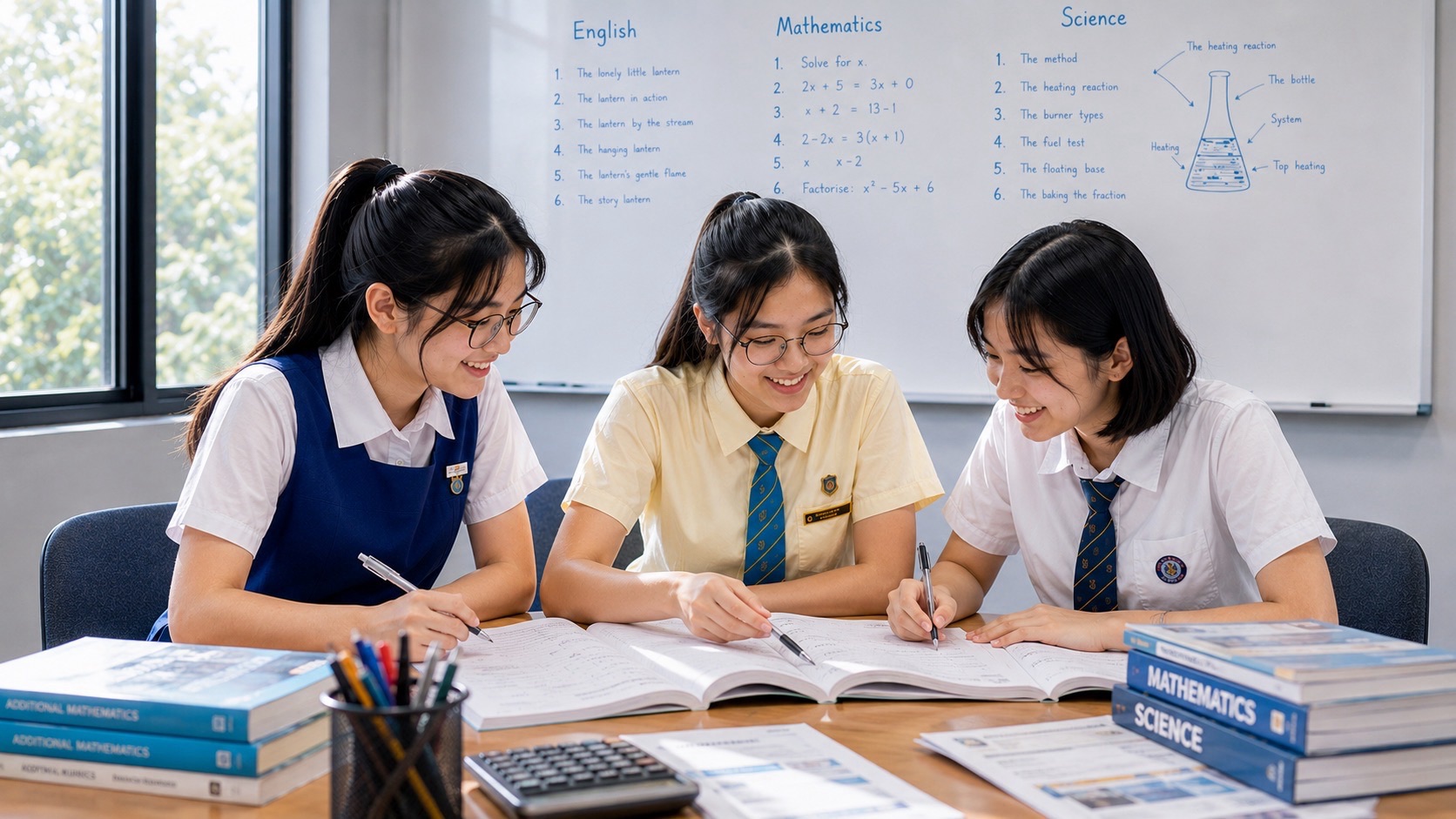
Secondary 3 Additional Mathematics small groups tuition can help students make sense of algebra, trigonometry and the foundations of calculus in a carefully matched three-learner setting. The strongest benefit is not more worksheets. It is seeing precisely where mathematical reasoning breaks, receiving a clear correction and learning to solve unfamiliar problems independently.
For parents planning around Singapore’s Full Subject-Based Banding and the Singapore–Cambridge Secondary Education Certificate (SEC), first confirm the student’s school subject level and year of examination. The published 2027 G3 Additional Mathematics syllabus is K341, but school assessments in Secondary 3 follow the school’s sequence. A good tutorial starts with that sequence, the student’s baseline and practical learning targets rather than an automatic promise of higher grades.
Quick summary for parents
- Best fit: students who benefit from frequent feedback, clearer worked explanations and small-group discussion.
- Focus: quadratic functions, surds, algebraic structure, trigonometry, coordinate geometry and calculus as appropriate to school pacing.
- Method: diagnose, model, practise, explain, test transfer and review errors.
- Group model: maximum three students where this is the provider’s stated class limit; confirm fit before enrolment.
- Exam context: 2027 SEC G3 Additional Mathematics K341; check later-year syllabuses for later cohorts.
- Decision rule: choose extra lessons only if they solve a specific learning need without crowding out rest.
What the 2027 SEC syllabus means for a Secondary 3 learner
From 2027, the SEC replaces the former N- and O-Level national examination certificates. Subjects are examined at the G1, G2 or G3 level taken by the candidate. This is not the same as saying that every Secondary 3 student takes a national exam in that year. For a student in Secondary 3 in 2026 on the standard four-year route, the relevant national examination is normally in 2027. A student entering Secondary 3 in 2027 should check the syllabus applicable to their later examination year when released. This guide deals specifically with G3 Additional Mathematics and does not silently substitute a G2 course.
What a useful three-student tutorial should feel like
Imagine three students at one table. The tutor gives each a related but not identical problem, observes the first independent attempt and asks each student to explain a decision. While one learner discusses the idea, the others must verify or challenge it. This produces more diagnostic information than watching a tutor solve the whole question. A small class alone does not guarantee success: the teacher must know the subject, match learners sensibly and intervene when an error is conceptual rather than merely computational.
A 90-minute lesson, where offered, could include ten minutes of retrieval, twenty minutes on the key misconception, twenty-five minutes of guided practice, twenty minutes of independent transfer and fifteen minutes of feedback and next-step planning. The exact allocation changes with the child and the topic. The essential principle is that every learner attempts work alone before the lesson ends.
Why G3 Mathematics foundations matter
Additional Mathematics assumes a reliable command of G3 Mathematics, yet many Secondary 3 students begin while algebraic fractions, expansion, negative indices or coordinate geometry still feel uncertain. A sensible tutor does not label every error an A-Math weakness. The first task is to distinguish missing prerequisite knowledge from a misunderstanding introduced by the new course.
Watch for the misconception. A student can factorise x²−5x+6 when prompted, but may not see why factorisation helps solve an equation or inequality. Another can manipulate fractions numerically but cancels terms incorrectly in algebraic fractions. Those are two different learning problems, even when both produce a wrong answer in the same school test.
How a three-student class can help. Three learners can each explain one step of an algebraic manipulation. The tutor asks one to identify the operation, another to challenge its validity and the third to check by substitution. The exercise reveals whether students understand equality or have simply memorised the instruction to move terms across an equals sign.
Practical check for parents. At home, ask your child to show one original school question and explain why every step is allowed. If a step cannot be explained, note its location rather than demanding ten more questions. A short prerequisite repair may remove several later difficulties simultaneously.
Quadratic functions and completing the square
The syllabus treats quadratic functions as more than a collection of factorisation exercises. Students need to connect the algebraic form of a function with its graph, turning point, range and practical interpretations. Completing the square is a particularly useful bridge: x²−6x+11 becomes (x−3)²+2, making the minimum value visible.
Watch for the misconception. A student may apply the method mechanically and lose the sign inside the bracket; another may claim the minimum is negative two because the graph looks shifted. An assessment question can also ask for a model rather than a bare expression, requiring students to interpret what the value represents in context.
How a three-student class can help. Use three representations in the tutorial: expanded form, completed-square form and a sketched parabola. One learner converts the expression, a second interprets the vertex, and a third verifies the claim with numerical substitution. The group discusses what would change if the coefficient of x² were negative.
Practical check for parents. Parents can ask for a graph with clearly labelled axes, not just a correct factorisation. A sound answer explains why a square cannot be negative and therefore why (x−3)²+2 has minimum two. That explanation is worth more than the speed of the initial calculation.
Discriminants and the number of roots
The discriminant b²−4ac connects a quadratic equation to the number of real roots and the geometry of intersections. Its value is not a mysterious sign test: it expresses the part of the quadratic formula under the square root. Positive gives two distinct real roots, zero gives one repeated real root, and negative gives no real roots.
Watch for the misconception. Students sometimes confuse ‘no real roots’ with ‘no solution of any kind’, or misread the coefficients when the equation has not been rearranged to standard form. For x²−6x+11=0, the discriminant is 36−44, which is negative; the matching graph stays above the horizontal axis.
How a three-student class can help. In a small group, compare three equations with positive, zero and negative discriminants and ask learners to sketch their expected graphs before checking. Have one student translate a line-parabola intersection into an equation, another compute the discriminant and the third explain what the answer means geometrically.
Practical check for parents. A useful family check is to ask whether the child can predict the appearance of the graph without solving every equation. If the student can compute the number but cannot interpret it, tuition should revisit the connection rather than accelerate to harder symbolic tasks.
Quadratic inequalities and intervals
Solving a quadratic inequality requires a sign argument, not merely two roots. For x²−5x+6 greater than zero, the critical points are two and three; the product (x−2)(x−3) is positive outside the interval between them. A correct result identifies the relevant ranges and includes boundary points only when the inequality permits equality.
Watch for the misconception. Common mistakes include giving only the two roots, reversing the interval, confusing ‘and’ with ‘or’, or drawing open circles for an inequality that includes equality. Students who never test a point may repeat a remembered rule that fails when the leading coefficient changes sign.
How a three-student class can help. The tutor can place three learners in charge of separate regions on a number line. They pick simple test values, calculate the sign and justify whether that region belongs in the solution set. Discuss why a sign chart remains valid even for a question whose factors look unfamiliar.
Practical check for parents. Ask your child to test a candidate value from every interval and say whether the original inequality is satisfied. This is a low-cost habit that catches a surprising number of mistakes. The aim is to make an answer testable, not to memorise a picture of shaded arrows.
Surds and exact calculation
Surds express exact quantities when a terminating decimal would lose information. Students should be comfortable simplifying radical expressions, combining like surds, expanding brackets and rationalising denominators when required. For example, 1 divided by (√5−1) can be written as (√5+1)/4 by multiplying numerator and denominator by the conjugate.
Watch for the misconception. Several errors expose shallow learning: treating √a+√b as √(a+b), canceling part of a sum, or turning a non-perfect-square root into an unnecessarily rounded decimal. A calculator can check magnitude but should not replace algebraic reasoning about exact equivalence.
How a three-student class can help. Give each learner a different-looking surd expression that simplifies to a common exact value. Students compare the routes, identify which operations preserve equivalence and explain why a conjugate removes a surd from the denominator. The tutor uses incorrect examples as discussion material rather than hiding them.
Practical check for parents. Parents can check whether a student distinguishes an exact answer from an approximation. Ask for an estimate as a reasonableness check, then ask why the written answer should stay exact. A clear verbal explanation often exposes mistakes that neat symbolic working conceals.
Simultaneous equations as intersections
Additional Mathematics extends simultaneous equations beyond two linear relationships. When one equation describes a straight line and another a curve, substitution turns a geometric intersection question into an algebraic equation. The number of valid coordinate pairs matters as much as the final value of x.
Watch for the misconception. A learner may solve the resulting quadratic correctly yet forget to substitute each root back for y. Others lose a solution by dividing through by an expression that could be zero. Such errors are procedural, but they reveal a gap in understanding what the solution set represents.
How a three-student class can help. A strong three-pax tutorial begins with a rough graph of the line and curve. Learners predict whether there are zero, one or two intersections, work algebraically and check whether the coordinate pairs fit both original equations. Peer questioning makes it harder for an unverified x-value to pass as a full answer.
Practical check for parents. At home, ask what each ordered pair means on the original diagram. Encourage substitution back into both equations, not just a check against the transformed quadratic. This small discipline produces more reliable answers across algebra and coordinate geometry.
Polynomials and remainder reasoning
The remainder theorem is a statement about evaluation: when a polynomial is divided by x−a, the remainder equals f(a). It connects synthetic or long division to function values. Factor theorem reasoning follows naturally: if f(a)=0, then x−a is a factor. These ideas later support cubic factorisation and problem-solving.
Watch for the misconception. Students may substitute negative a incorrectly when the divisor is x+a, or apply a memorised rule without tracking the sign. Others find a factor but forget to divide the original polynomial before tackling the remaining quadratic. Both create unnecessary complexity.
How a three-student class can help. In tuition, one learner computes f(a), another performs division and the third explains why both methods agree. Then the tutor presents a polynomial with one known root and asks the group to finish the factorisation. This tests connection between methods, not just repetitive division.
Practical check for parents. Parents can look for a student who can answer two questions: ‘What is the divisor?’ and ‘Which value should be substituted?’ A small sign error matters because it signals a misunderstanding of the structure, not simply careless arithmetic.
Partial fractions and the shape of denominators
Partial fractions reverse the process of combining rational expressions. For distinct linear factors, 1/[(x+1)(x+2)] equals 1/(x+1)−1/(x+2). When a factor repeats or an irreducible quadratic appears, the form of the decomposition must change. Writing the correct form is the central insight before any coefficients are calculated.
Watch for the misconception. Many students begin expanding everything immediately. Others omit a term for a repeated factor or write a constant numerator where a linear numerator is needed. In these cases, even perfect arithmetic cannot rescue the algebra because the proposed decomposition is structurally incomplete.
How a three-student class can help. Small-group teaching can compare three denominator types. Each student proposes the possible partial-fraction form and explains the role of every term before the class calculates coefficients. The tutor then recombines the answer to show that decomposition and addition genuinely undo each other.
Practical check for parents. Ask the child to combine the proposed fractions back into one expression and check the denominator. A student who can justify the form is more likely to handle unfamiliar questions than one who only remembers steps from a worked solution.
Binomial expansions and coefficients
The binomial theorem allows learners to find terms in powers of expressions without repeatedly multiplying brackets. It involves position, combinations and powers. In (1+2x)³, the expansion is 1+6x+12x²+8x³; each coefficient follows a predictable choice of terms rather than a decorative number pattern.
Watch for the misconception. Errors often arise from using the wrong power of the second term, omitting a factor such as 2³, or confusing the coefficient of a term with the term itself. Some students also expand far more than needed when a question requests only a specified coefficient.
How a three-student class can help. Assign students different requested terms from the same expansion. Each identifies the correct general term, computes the coefficient and checks the result against a complete expansion for a small power. The tutor can ask why increasing the exponent changes the number of terms.
Practical check for parents. Parents can ask the student to describe how a coefficient is formed without reciting a formula. If they can connect a selected term to choices of factors, the formula is less likely to be misused under timed conditions.
Exponential and logarithmic functions
Exponential and logarithmic functions are inverses; the equation 2³=8 is another way to express log base two of eight equals three. Students need the domain restrictions, laws of logarithms, graph interpretation and a clear distinction between multiplying logarithm arguments and adding logarithmic values.
Watch for the misconception. A learner may incorrectly claim log(a+b)=log a+log b or apply an inverse operation without checking whether an argument is positive. Such errors reflect failure to understand the meaning of the function. Calculator keystrokes can conceal that problem until a novel modelling question appears.
How a three-student class can help. In a three-pax group, start with equivalent exponential and logarithmic statements, then have learners build a small input-output table. Compare valid and invalid transformations and ask the group to explain which rule was applied. Practice changes between symbolic, verbal and graphical descriptions.
Practical check for parents. At home, ask for one concrete numerical example of each logarithm law and one counterexample to an invalid law. Students remember constraints more effectively when they see why a tempting shortcut is false.
Trigonometric graphs and radian thinking
Trigonometry in Additional Mathematics expands beyond finding a missing side of a right triangle. Students work with functions of angles, periodicity, amplitude, phase effects, identities and equations. The graph y=2sin(3x), for x measured in degrees, has amplitude two and period 120 degrees.
Watch for the misconception. Students often interchange amplitude and vertical displacement, or apply the period formula incorrectly. Others are accurate with degrees but careless with radians or forget to consider every solution in a specified interval. These difficulties are best addressed through visual and algebraic connections.
How a three-student class can help. A tutor can give each learner one changed parameter and ask them to sketch the corresponding graph. Together they explain how a coefficient inside the argument changes horizontal scale while a coefficient outside changes vertical scale. Then they solve a simple equation using the graph as a guide.
Practical check for parents. Parents can ask whether the child can explain a sine graph’s maximum, minimum and period from the expression. A correct labelled sketch shows understanding that cannot be demonstrated by a single calculator display.
Trigonometric identities versus equations
An identity is true for all values in its domain, while an equation may be true only at certain values. Students must recognise whether the task is to prove a relationship, simplify an expression or find specific solutions. Using sin²x+cos²x=1 is useful when the transformation is logically directed and clearly justified.
Watch for the misconception. An invalid proof sometimes starts by assuming the statement to be proved and rearranging until it looks familiar. Another frequent mistake is dividing by sin x or cos x without considering when that quantity is zero. Both cases show how a neat-looking solution can be logically incomplete.
How a three-student class can help. Give one learner the left-hand side, another the right-hand side and the third the role of critic. They examine which transformations are reversible and whether restrictions have been introduced. The tutor emphasises a proof as a chain of warranted equalities, not a race to the printed answer.
Practical check for parents. Parents need not know every identity to ask useful questions: ‘What are you trying to show?’ and ‘Why is this transformation valid?’ Students who can defend those choices have a stronger foundation for later mathematical reasoning.
Coordinate geometry, lines and circles
Coordinate geometry translates geometric relationships into algebra. Gradients capture direction, while the standard equation of a circle encodes its centre and radius. These tools are especially powerful when a question combines a line and a circle or asks for a geometric relationship in an unfamiliar diagram.
Watch for the misconception. Students may mistake the centre of (x−3)²+(y+2)²=25 as (3,2) instead of (3,−2), or fail to check whether a calculated point lies on the given circle. An incorrect sketch can make even a correct algebraic answer appear plausible.
How a three-student class can help. In tuition, have students derive the circle centre from the equation, draw it and check a point at distance five from the centre. Then compare lines that intersect, touch or miss the circle. The tutor encourages estimation and coordinate checks to support formal solutions.
Practical check for parents. At home, ask the child to mark the centre and radius before doing any algebra. A ten-second diagram can prevent a chain of sign errors and helps parents see whether the student understands the geometry behind the symbols.
Differentiation as change, not a magic rule
Differentiation is introduced as a way of describing local rates of change and gradients of curves. For f(x)=x³, the derivative is 3x²; for f(x)=x²−6x+11, the derivative 2x−6 vanishes at x=3, locating a stationary point. These examples should connect to graphs, not exist only as rules.
Watch for the misconception. Students may memorise the power rule but forget what the derivative means or misclassify every stationary point as a maximum. They sometimes write derivatives without a variable or evaluate a gradient at the wrong x-value. These errors become costly in interpretation questions.
How a three-student class can help. A small group can sketch a curve, predict where its tangent is flat and then compare the derivative’s sign on either side. Each student takes responsibility for one interval. The tutor makes clear that the derivative helps explain the behaviour of the original function.
Practical check for parents. Parents can ask what the gradient represents at a point and how a positive derivative differs from a negative one. If students can explain increase and decrease using a graph, formal techniques become more meaningful.
Integration as accumulation and reversal
Integration connects accumulated quantity with the derivative. An indefinite integral of 2x is x²+C, where the constant matters because many functions share the same derivative. Definite integrals require attention to limits and interpretation. The school may teach these topics in a particular sequence, so tuition should follow rather than assume a fixed term.
Watch for the misconception. A common weakness is remembering the reverse power rule while forgetting the constant of integration. Another is treating area as automatically positive even when a signed definite integral is negative. Students need to distinguish an operation from the geometrical or physical quantity it models.
How a three-student class can help. Have one learner differentiate the proposed antiderivative, another evaluate a definite integral and a third sketch what the integral represents. When answers disagree, they discuss whether the problem calls for signed accumulation or geometric area. This turns checking into an explanatory habit.
Practical check for parents. At home, ask the student to differentiate the answer to an indefinite integral. It is an accessible, powerful verification tool. When a diagram is relevant, ask how the result is connected to the region or change described.
How to prepare for real assessment without chasing speed
SEAB’s 2027 G3 Additional Mathematics syllabus K341 lists algebra, geometry and trigonometry, and calculus as major strands. It specifies two written papers of 2 hours 15 minutes, each carrying 50% of the national examination weight. The assessment objectives include routine techniques, contextual problem-solving, and mathematical reasoning and communication. A Secondary 3 school test is not itself that final examination.
Watch for the misconception. Students may overfocus on drilling familiar procedures because they are easy to count. But the assessment also expects them to interpret unusual problem statements, select relevant techniques, connect topics and justify their reasoning. Unexplained leaps or omitted working can undermine an otherwise good numerical result.
How a three-student class can help. A tutor should alternate three activities: a short fluency exercise, a nonroutine problem and a verbal explanation. The group can compare two valid solutions and ask which is clearer, less error-prone or better suited to a given question. Exam practice then becomes an exercise in mathematical choices rather than mere speed.
Practical check for parents. Parents can request anonymised examples of corrected reasoning, review whether a learner attempts unfamiliar questions and avoid promises of A1 grades. Some children need to rebuild algebra; others need better transfer or calm timed practice. The best intervention depends on the error, not the marketing claim.
Four-week plan for parents and students
Week 1: identify the actual difficulty. Collect two recent school tasks and ask the learner to work through three representative questions independently. Record the first incorrect decision rather than simply counting wrong answers. Select one foundation target and one communication target. Compare those targets with the school assessment outline. If the child is taking the course at a different subject level, stop and adjust the materials.
Week 2: repair the weakest concept. Teach the relevant principle through a clear example and a contrasting non-example. Ask the student to explain why the valid method works. Practise several questions with feedback, then close the book and attempt a related task without prompts. Avoid jumping immediately to a new chapter while the error persists.
Week 3: test transfer. Introduce a problem whose wording or graph looks different from the earlier practice but relies on the same principle. Observe whether the student can choose the method without being told. If not, revisit the conceptual link. Use a short timed set only after understanding is stable.
Week 4: review the result. Compare the independent response with the baseline. Look for clearer diagrams, more complete justifications, better checking and fewer repeated errors. Decide whether to continue, change the plan or reduce tuition. The learner should be able to describe what has improved in ordinary language.
Frequently asked questions
Is Additional Mathematics the same as Mathematics?
No. It is a separate subject that assumes a foundation in G3 Mathematics. Verify the student’s actual subject combination and examination year before purchasing a tuition package.
Is K341 the 2026 Secondary 3 school exam code?
No. K341 is the 2027 SEC G3 Additional Mathematics national examination syllabus code. Secondary 3 school assessments are set by the school and may cover only part of that syllabus.
What if the child is taking G2 Additional Mathematics?
Use the appropriate G2 syllabus instead of assuming the G3 paper applies. SEAB lists G2 Additional Mathematics separately, and the school’s subject-level information governs the student’s programme.
Should tuition teach calculus immediately?
Not automatically. Calculus becomes much harder when algebra, function notation and graphs are unstable. Teachers should sequence it according to the school’s plan and readiness.
How much practice is enough?
Enough to demonstrate independent understanding across more than one question form. Short, spaced sessions with feedback usually offer a better diagnostic signal than a large unreviewed stack of worksheets.
Can a three-student class serve different ability levels?
Possibly, if subject level and topic sequence align and the tutor can individualise practice. A group mixing incompatible syllabuses may dilute the benefit of small size.
Should a strong student still attend?
Not necessarily. If school feedback, independent work and appropriate stretch tasks are sufficient, extra tuition may not add value. Review actual learning evidence before deciding.
What should parents ask after four weeks?
Ask which two misconceptions were corrected, what the learner can now solve alone, which unfamiliar question they handled, and what the next target will be.
Do calculators replace algebra?
No. The official 2027 G3 syllabus permits approved calculators in the examinations, but full reasoning and essential working remain important.
What matters more than grade promises?
A credible diagnosis, a suitable class, specific feedback, manageable workload and observable growth in independent problem-solving. No tutor can guarantee a particular examination result.
A concrete G3 diagnostic: why checking an algebraic answer matters
A Secondary 3 student solves √(x + 5) = x − 1 and concludes that x = 4 or x = −1. This is a useful teaching opportunity rather than just an incorrect final answer. First, the right-hand side must be non-negative, so x must be at least 1. Squaring both sides yields x + 5 = (x − 1)², or x² − 3x − 4 = 0. Factorisation gives (x − 4)(x + 1) = 0. Only x = 4 satisfies the original equation: √9 = 3 and 4 − 1 = 3. The apparent solution x = −1 fails the original equation and the domain condition. This short invented example shows why an answer obtained after squaring must be checked, not simply copied from a calculator.
In a three-learner tutorial, one student can state the domain condition, a second can explain the algebraic transformation, and a third can independently verify candidate solutions before the roles rotate. The tutor should then assign a different equation to each learner to test transfer. Parents can ask to see the unassisted follow-up solution rather than a page of copied working. This addresses algebraic reasoning without promising any particular grade.
Examination-year check: SEAB lists 4049 as the 2026 GCE O-Level Additional Mathematics code and K341 as the 2027 SEC G3 Additional Mathematics code. These are national examination codes, not separate Secondary 3 school tests. A student in Secondary 3 during 2027 may take a later-year syllabus when they graduate; confirm that version when published. See the 2026 GCE directory and the 2027 SEC G3 directory.
Choosing tuition with the student’s interests in mind
Ask a prospective tutor to show how they diagnose misconceptions, organise lessons across the school’s actual topic sequence and give each child an opportunity to explain reasoning. Ask about class size, materials, fees, schedules, missed sessions and how progress will be measured. If a student’s workload is already high, one quality consultation or a short focused intervention may be better than a standing additional class. The aim is lasting capability, not the greatest number of hours purchased.
Families may also find the related eduKate guides useful: Secondary 3 Mathematics small-group tuition, Secondary 3 Additional Mathematics curriculum overview and the eduKate Mathematics Learning System. These are supplementary explanations, not examination authorities.
Official syllabus and verification
Read the SEAB 2027 SEC G3 syllabus directory, the 2027 G3 Additional Mathematics K341 syllabus and the SEC overview. Always check the version that applies to your child’s examination year and confirm school assessment requirements directly with the school. This independent parent guide explains learning choices; it is not a government publication or a substitute for SEAB instructions.
Leave a Reply