
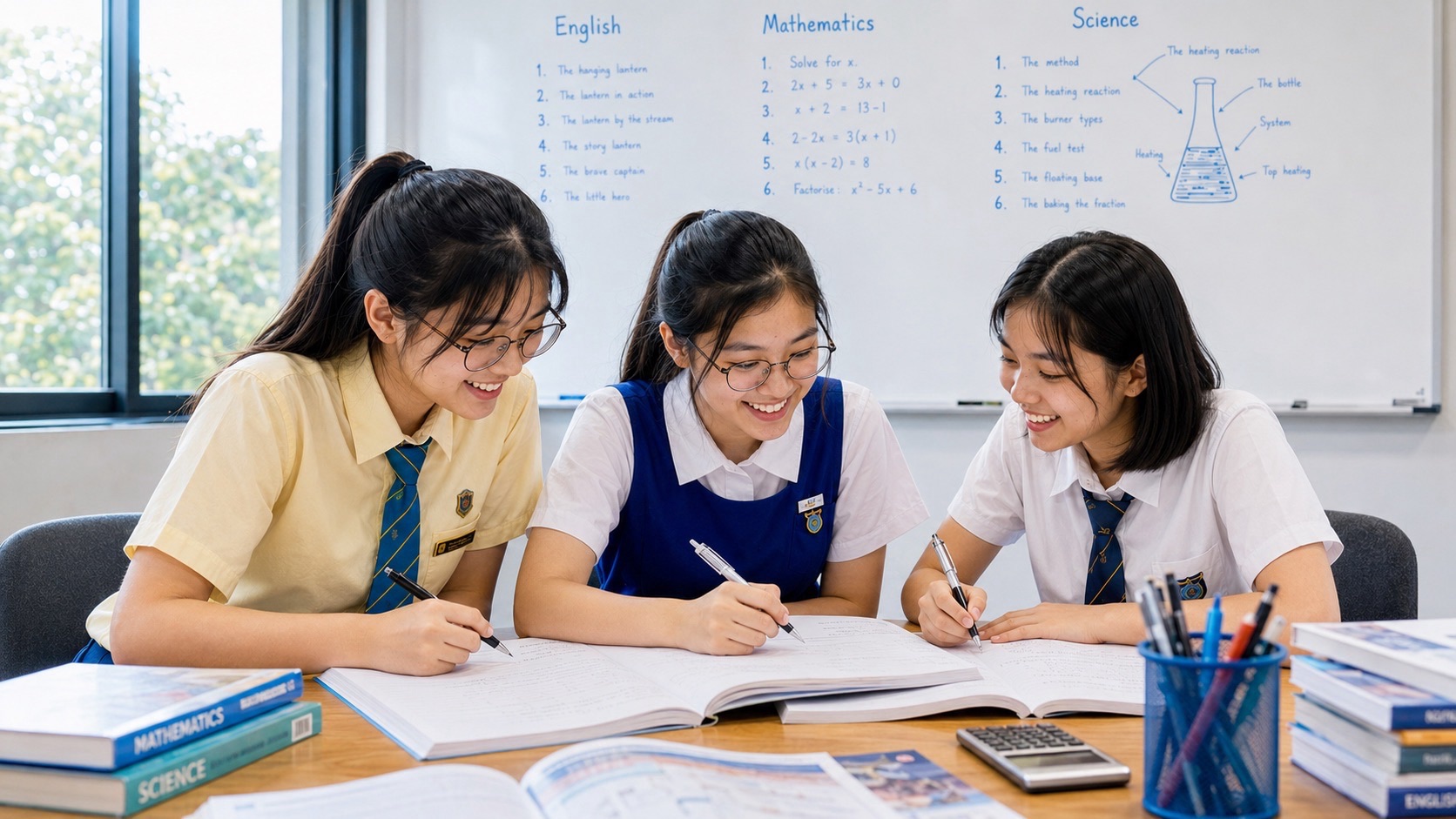
Parents of a Yishun pupil receiving the 2026 PSLE result on Tuesday, 24 November 2026 at 11.00am can use this school finder to assess Yishun Secondary School for Secondary 1 entry in January 2027. Its recorded 2026 S1 intake PG2 cut-off point was 24, based on the preceding 2025 PSLE cohort. The school’s historical PG3 and PG1 cut-offs were 20 and 27. None of these figures reserves a 2027 place. The relevant question for parents is whether the child is eligible for the correct Posting Group and whether this school’s teaching, culture, programmes and daily journey genuinely fit them.
Yishun Secondary’s 2026 intake PG2 cut-off was 24. A Score 24 family is at that previous boundary; a Score 23 family has a one-point historical margin; a Score 25 family choosing PG2 faces a more stringent historical comparison. Its distinctive Sonic Arts programme combines Music, Media and Technology, while student development materials describe a structured Secondary 1 transition and several creative and sporting CCAs. Start with the child’s actual PSLE result slip and subject ALs before ranking the six schools. Score 21 or 22 normally offers the PG2/PG3 option; Score 23 or 24 is PG2; Score 25 offers PG1/PG2. Families choosing a dual-group option must use one selected Posting Group for all six ordinary S1 choices. The S1 Portal opens at 11.30am on 24 November and closes on Monday, 30 November 2026 at 4.30pm. The following guide explains the score-specific interpretation, Yishun alternatives, N/S/E/W school searches and next steps.
- Results release: 24 November 2026, 11.00am, from the primary school; see the SEAB and MOE announcement.
- School: Yishun Secondary School, 4 Yishun Street 71, Singapore 768516.
- Completed 2026 S1 cut-offs: PG3 20 | PG2 24 | PG1 27. These are historical, not projected 2027 figures.
- PG2-eligible totals: 21–25 inclusive; PG2/PG3 choice at 21–22, PG1/PG2 choice at 25.
- School comparison: historic Yishun PG2 COPs fall into 22, 24 and 25 groups; compare the child’s score with the selected school’s correct column.
- Preferred school order: six schools the child would genuinely attend, with two or three less-stringent prior COPs where a numerical margin is available.
- Submission: parent Singpass through the MOE S1 Portal, 24 November at 11.30am to 30 November at 4.30pm.
- What to do: check subject levels, school programmes, transport, student support and the official S1 option form before submitting.
All eight Yishun PG2 secondary-school guides for the 2026 PSLE: Ahmad Ibrahim · Chung Cheng High (Yishun) · Naval Base · Northbrooks · Northland · Orchid Park · Yishun Secondary · Yishun Town. These school-specific pages use the completed 2026 Secondary 1 intake cut-offs, official school programmes and the five eligible PG2 scores 21–25. Explore the full Yishun PG2 results and school-finder hub before choosing six genuine preferences for 2027 entry. A past COP is not an admission guarantee.
What happens after the PSLE results arrive on 24 November 2026?
The 2026 PSLE results will be distributed at 11.00am on Tuesday 24 November 2026. The primary school will inform candidates of its arrangements. If the pupil cannot return, a proxy may be arranged by Thursday 26 November under the primary school’s procedures. The choice portal opens at 11.30am on results day and closes at 4.30pm on Monday 30 November. One parent needs a valid Singpass. If the family has trouble accessing the portal or cannot interpret the child’s Posting Group options, ask the primary school for help before the deadline rather than depending on an unofficial online guess.
| Event | Date and time | Family’s next step |
|---|---|---|
| Collect the result | 24 November 2026, 11.00am | Read total and subject ALs, eligibility notice and school-provided instructions. |
| S1 choice portal opens | 24 November 2026, 11.30am | Parent signs in with Singpass, checks the available group and school options. |
| Proxy collection if needed | By 26 November 2026 | Follow the school-approved proxy arrangements. |
| Final six-choice deadline | 30 November 2026, 4.30pm | Submit preferences and keep an acknowledgement. |
| Expected S1 posting outcome | 18 December 2026 — tentative | Follow MOE’s subsequent announcement for confirmation. |
The result date and submission window come from the official 17 November 2026 notice. A historical guide saying the PSLE results were released on 25 November 2025 is describing an older exercise. This year’s pupils will enter Secondary 1 in 2027, and their future school cut-offs are not known before posting. Do not relabel the completed 2026 S1 intake’s published last-admitted score as a new 2027 requirement. The school named in this article is a potential preference, not a live vacancy report.
What the 2026 S1 intake cut-offs actually mean for Yishun Secondary School
| Posting Group | Last-admitted 2026 intake score | How to use the figure |
|---|---|---|
| PG3 | 20 | Only compare if the student is eligible and selects PG3. |
| PG2 | 24 | Compare for Scores 21–25 when PG2 is the chosen group. |
| PG1 | 27 | Compare only for a student eligible for and choosing PG1, including Score 25. |
A PSLE cut-off point means the score of the last student who was actually posted in that admission group during the completed intake. It is not a published minimum examination mark, a ranking of teaching quality, or a reservation for any student who happens to match it. Under PSLE’s AL scale, lower totals reflect stronger aggregate achievement. A previous PG2 COP of 24 is a reference point for judging whether a child’s total would have been numerically better, equal or worse than that particular older boundary. The 2027 COP depends on the new cohort’s results, places and school choices.
If your child has a total of 24 and the school’s previous PG2 COP is 25, that is a one-point less-stringent historical comparison. If the previous COP is 24, the child is exactly at the older boundary. If the previous COP is 22, the older result was more stringent than 24. Do not convert that difference into an invented admission probability. MOE advises two or three less-stringent historical choices where possible, but Score 25 under PG2 is a special case: the eligible total-score band ends at 25, so a normal PG2 COP numerically above 25 cannot be found to manufacture a buffer.
Understanding PSLE Scores 21, 22, 23, 24 and 25 at Yishun Secondary School
| PSLE score | Eligible group(s) | Previous PG2 boundary compared with child | Important action |
|---|---|---|---|
| 21 | PG2 or PG3 | 3-point less-stringent prior COP | Choose one group; PG3 school ranges are different |
| 22 | PG2 or PG3 | 2-point less-stringent prior COP | Choose one group; PG3 school ranges are different |
| 23 | PG2 | 1-point less-stringent prior COP | Check genuine preferences, route and historical risk |
| 24 | PG2 | Same-score historical boundary | Check genuine preferences, route and historical risk |
| 25 | PG1 or PG2 | 1-point more-stringent prior COP | Compare PG1 with PG2 starting subject levels |
Score 21: 3-point less-stringent prior COP
For Score 21, the family is in the overlap between PG2 and PG3. The child’s individual subject ALs can reveal strong and weak areas that a total alone cannot show. If PG2 is chosen, compare the school’s previous PG2 COP 24. If PG3 is chosen, its previous PG3 COP was 20—a separate comparison that may change the shortlist completely. Discuss which starting pace the child is ready to sustain when there are homework, CCAs and new social relationships.
The most useful next step is to consult eduKate Yishun’s complete Score 21 school finder and compare other schools with their verified 2026 intake PG2 figures. A sensible shortlist contains school names the child can explain, information on current academic and CCA options, and a realistic weekday route. The 2027 cut-offs will only be determined after the posting exercise, so there is no point telling the child that they have already secured Yishun Secondary School.
Score 22: 2-point less-stringent prior COP
Score 22 likewise offers PG2 or PG3. The decision is not a vote about the child’s value or future. It determines the admission route and generally the initial level of most subjects. A pupil who chooses PG2 should evaluate this school’s PG2 COP 24 and ask about individual G3 subject opportunities, where eligibility criteria permit. A pupil who chooses PG3 must do a fresh school search using that group’s historical ranges; the six ordinary choices cannot mix the groups.
The most useful next step is to consult eduKate Yishun’s complete Score 22 school finder and compare other schools with their verified 2026 intake PG2 figures. A sensible shortlist contains school names the child can explain, information on current academic and CCA options, and a realistic weekday route. The 2027 cut-offs will only be determined after the posting exercise, so there is no point telling the child that they have already secured Yishun Secondary School.
Score 23: 1-point less-stringent prior COP
At Score 23, the ordinary Posting Group is PG2. This allows parents to concentrate on comparing school fit and past PG2 ranges rather than deciding between two admission groups. A stronger individual Mathematics or language subject may create questions about subject-level flexibility under Full SBB, but it does not change the aggregate’s posting band. Compare the child’s score with Yishun Secondary School’s historical PG2 COP 24, then ask what the child would enjoy and how the school helps when learning becomes challenging.
The most useful next step is to consult eduKate Yishun’s complete Score 23 school finder and compare other schools with their verified 2026 intake PG2 figures. A sensible shortlist contains school names the child can explain, information on current academic and CCA options, and a realistic weekday route. The 2027 cut-offs will only be determined after the posting exercise, so there is no point telling the child that they have already secured Yishun Secondary School.
Score 24: Same-score historical boundary
At Score 24, the parent should be especially careful with schools whose previous PG2 COP was exactly 24. An equal boundary may be a genuine aspirational or preferred option but cannot be called assured. Schools whose previous PG2 COP was 25 gave a one-point numerical historical margin; it is reasonable to consider suitable examples of those too. The final six must be in genuine preference order, not a sequence of identical score-matched schools that leave no meaningful alternatives.
The most useful next step is to consult eduKate Yishun’s complete Score 24 school finder and compare other schools with their verified 2026 intake PG2 figures. A sensible shortlist contains school names the child can explain, information on current academic and CCA options, and a realistic weekday route. The 2027 cut-offs will only be determined after the posting exercise, so there is no point telling the child that they have already secured Yishun Secondary School.
Score 25: 1-point more-stringent prior COP
At Score 25, the family has the option of PG1 or PG2. If PG2 is selected, any earlier PG2 COP below 25 was more stringent, and a previous COP 25 was merely an equal-score boundary. If PG1 is selected, this school had a previous PG1 COP 27, which belongs to a different starting subject-level pattern. Do not combine PG1 and PG2 school codes in a single ordinary S1 preference list. Make the learning-pathway decision before making the numbers look attractive.
The most useful next step is to consult eduKate Yishun’s complete Score 25 school finder and compare other schools with their verified 2026 intake PG2 figures. A sensible shortlist contains school names the child can explain, information on current academic and CCA options, and a realistic weekday route. The 2027 cut-offs will only be determined after the posting exercise, so there is no point telling the child that they have already secured Yishun Secondary School.
What makes Yishun Secondary School worth examining?
Sonic Arts: music, media and technology together
Yishun Secondary’s Applied Learning and Learning for Life distinctive programmes centre on sonic arts, music arrangement and technology with community outreach. That makes it a candidate for children who enjoy listening critically, composing, performing, editing sound or creating media. Parents should ask what students actually learn in Secondary 1 and how equipment and project activities are introduced to beginners. A Music programme may be personally motivating, but a future career in music is not a guaranteed result and ordinary S1 posting eligibility still applies.
For the family, the next question is practical rather than promotional. Ask which activities a new Secondary 1 student can actually access, whether selection criteria apply, how teachers help pupils at different subject levels, and how much time remains for homework and rest. The child should name one specific experience they find appealing and one possible difficulty. Those answers are more useful than treating a programme’s name or a previous COP as an all-purpose quality rating.
Three tiers: experience, engagement and excellence
The school’s published framework separates an experience tier for all students from deeper engagement and excellence opportunities for students with greater interest or aptitude. Secondary 1 students encounter foundational sonic arts and music; later years can involve music technology, masterclasses and showcases. This structure is helpful because it suggests room for a beginner to discover an interest without claiming all students enter specialist training. Families should ask about the specific criteria for higher tiers and the time involved.
For the family, the next question is practical rather than promotional. Ask which activities a new Secondary 1 student can actually access, whether selection criteria apply, how teachers help pupils at different subject levels, and how much time remains for homework and rest. The child should name one specific experience they find appealing and one possible difficulty. Those answers are more useful than treating a programme’s name or a previous COP as an all-purpose quality rating.
Real-world showcases and community projects
The school documents Arts Extravaganza, Vocalistic and community engagement as part of its distinctive programme. These provide useful questions for a child: do you enjoy rehearsing with others, presenting creative work or combining technology with community service? The school may offer different opportunities through the years, and parents should check which ones are active for the new cohort. The educational value lies in participating, working with peers and learning from feedback, not only winning competitions.
For the family, the next question is practical rather than promotional. Ask which activities a new Secondary 1 student can actually access, whether selection criteria apply, how teachers help pupils at different subject levels, and how much time remains for homework and rest. The child should name one specific experience they find appealing and one possible difficulty. Those answers are more useful than treating a programme’s name or a previous COP as an all-purpose quality rating.
CCA breadth beyond performing arts
The current CCA list also contains uniformed groups, sports such as badminton, basketball, football, netball, volleyball and wushu, and clubs including media and robotics. A child who is not musical should not assume that Sonic Arts is the only meaningful activity in the school. Ask whether the desired CCA has try-outs, vacancies, training commitments and schedule conflicts. When comparing schools, daily participation and friendships may matter more than the headline ALP.
For the family, the next question is practical rather than promotional. Ask which activities a new Secondary 1 student can actually access, whether selection criteria apply, how teachers help pupils at different subject levels, and how much time remains for homework and rest. The child should name one specific experience they find appealing and one possible difficulty. Those answers are more useful than treating a programme’s name or a previous COP as an all-purpose quality rating.
Support for the Secondary 1 transition
Yishun Secondary describes a level system that begins with belonging, identity and the transition from primary school. Its student-development material mentions orientation, leadership programmes and support from school staff. That may interest a parent whose child is anxious about unfamiliar classmates or moving between subject teachers. Ask how the Secondary 1 orientation works for the actual 2027 cohort, whether there are peer supporters and how the form teacher communicates with parents if the child struggles.
For the family, the next question is practical rather than promotional. Ask which activities a new Secondary 1 student can actually access, whether selection criteria apply, how teachers help pupils at different subject levels, and how much time remains for homework and rest. The child should name one specific experience they find appealing and one possible difficulty. Those answers are more useful than treating a programme’s name or a previous COP as an all-purpose quality rating.
The link between learning and independent interests
The school’s Student-Initiated Learning material describes opportunities to explore interests during Home-Based Learning time, including creative activities and language learning through digital resources. This is a useful sign of how a learner might practise initiative beyond prescribed homework, but the actual programme changes over time. Parents should distinguish between a school-provided resource and a mandatory activity and ask how pupils who need extra guidance are supported to work independently.
For the family, the next question is practical rather than promotional. Ask which activities a new Secondary 1 student can actually access, whether selection criteria apply, how teachers help pupils at different subject levels, and how much time remains for homework and rest. The child should name one specific experience they find appealing and one possible difficulty. Those answers are more useful than treating a programme’s name or a previous COP as an all-purpose quality rating.
A Yishun Street 71 route worth testing
Yishun Secondary is at 4 Yishun Street 71. The school publishes bus access and information for visitors, but those details should be checked against current services and the family’s home location. Some children may find the journey from Yishun MRT straightforward; others will need a feeder bus or longer walk. Try the morning route at school time and the return trip after activities. Shorter travel can allow more time for music, sport, homework and rest.
For the family, the next question is practical rather than promotional. Ask which activities a new Secondary 1 student can actually access, whether selection criteria apply, how teachers help pupils at different subject levels, and how much time remains for homework and rest. The child should name one specific experience they find appealing and one possible difficulty. Those answers are more useful than treating a programme’s name or a previous COP as an all-purpose quality rating.
Yishun school comparison: all eight secondary schools and the correct PG2 figures
The table below covers the eight Yishun secondary schools in the completed 2026 Secondary 1 intake. These figures are historical observations based on the 2025 PSLE cohort. They are not final 2027 admission requirements or promises. For PG2 selection, read the PG2 column only. Where a child can choose PG1 or PG3, change the entire six-school comparison to that selected group rather than mixing rows from several columns. All eight schools differ in programmes, school culture, teaching approaches and student activities.
| Yishun secondary school | General location | 2026 PG3 COP | 2026 PG2 COP | 2026 PG1 COP |
|---|---|---|---|---|
| Ahmad Ibrahim Secondary School | Yishun Avenue 7 | 18 | 24 | 28 |
| Chung Cheng High School (Yishun) | Yishun Street 61 | 11 | 22 | 27 |
| Naval Base Secondary School | Yishun Ring Road | 19 | 24 | 27 |
| Northbrooks Secondary School | Yishun Ring Road | 22 | 25 | 27 |
| Northland Secondary School | Yishun Street 22 | 22 | 25 | 28 |
| Orchid Park Secondary School | Yishun Street 81 | 19 | 24 | 27 |
| Yishun Secondary School | Yishun Street 71 | 20 | 24 | 27 |
| Yishun Town Secondary School | Yishun Street 21 | 13 | 22 | 27 |
Two local schools, Northbrooks and Northland, recorded previous PG2 COP 25; four, Ahmad Ibrahim, Naval Base, Orchid Park and Yishun Secondary, recorded 24; and two, Chung Cheng High (Yishun) and Yishun Town, recorded 22. A child with Score 23 can look for schools with a numerical historical margin while still keeping true favourites in order. A child with Score 24 should separate COP-24 boundaries from COP-25 historical alternatives. At Score 25 there is no ordinary PG2 COP above 25 to create a mathematical safety cushion. None of these comparisons makes one school inherently better.
North, South, East and West options beyond Yishun Secondary School
North: schools to investigate
Admiralty Secondary School, Canberra Secondary School, Sembawang Secondary School, Anderson Secondary School are examples of schools to research in this region, not a complete or guaranteed list of available PG2 places. North and north-west alternatives are often worth testing first because they may involve fewer connections from some Yishun homes. Yet Sembawang and Woodlands distances are not identical, and a direct bus to one school can be more convenient than travelling to another school nearer on the map. Review the exact admission group and historical COP through MOE SchoolFinder before including any school on the S1 Option Form.
Explore the North regional PG2 school finder for fuller school lists and the consequences of a Score 21, 22, 23, 24 or 25 in that part of Singapore. Geographic groupings do not create priority in the Secondary 1 posting process. In particular, a more distant previous PG2 COP 25 is still an equal-score boundary for a student scoring 25; distance does not manufacture numerical safety.
South: schools to investigate
Beatty Secondary School, Gan Eng Seng School, Queenstown Secondary School, Peirce Secondary School are examples of schools to research in this region, not a complete or guaranteed list of available PG2 places. Central and southern schools can be suitable when a student likes a particular programme or the family has a well-tested travel arrangement. The journey after a late CCA may be substantially longer than it appears in a normal midday map search. Do not select a school solely because a past COP was numerically convenient. Review the exact admission group and historical COP through MOE SchoolFinder before including any school on the S1 Option Form.
Explore the South regional PG2 school finder for fuller school lists and the consequences of a Score 21, 22, 23, 24 or 25 in that part of Singapore. Geographic groupings do not create priority in the Secondary 1 posting process. In particular, a more distant previous PG2 COP 25 is still an equal-score boundary for a student scoring 25; distance does not manufacture numerical safety.
East: schools to investigate
Greendale Secondary School, Punggol Secondary School, Yuying Secondary School, Bedok Green Secondary School are examples of schools to research in this region, not a complete or guaranteed list of available PG2 places. Punggol, Sengkang, Hougang, Tampines and Bedok provide additional schools, but public transport can require interchanges. Some eastern school programmes may strongly appeal to a student. That positive reason should be weighed against waking hours, homework time and the practical effort required to attend every day. Review the exact admission group and historical COP through MOE SchoolFinder before including any school on the S1 Option Form.
Explore the East regional PG2 school finder for fuller school lists and the consequences of a Score 21, 22, 23, 24 or 25 in that part of Singapore. Geographic groupings do not create priority in the Secondary 1 posting process. In particular, a more distant previous PG2 COP 25 is still an equal-score boundary for a student scoring 25; distance does not manufacture numerical safety.
West: schools to investigate
Bukit View Secondary School, Dunearn Secondary School, Clementi Town Secondary School, Yuhua Secondary School are examples of schools to research in this region, not a complete or guaranteed list of available PG2 places. A west-side school may make sense for families planning a move or with a genuine educational interest, but it should not be chosen merely to fill the final six. A child travelling across much of Singapore needs a routine that is workable on ordinary weekdays, rainy mornings and late activity days. Review the exact admission group and historical COP through MOE SchoolFinder before including any school on the S1 Option Form.
Explore the West regional PG2 school finder for fuller school lists and the consequences of a Score 21, 22, 23, 24 or 25 in that part of Singapore. Geographic groupings do not create priority in the Secondary 1 posting process. In particular, a more distant previous PG2 COP 25 is still an equal-score boundary for a student scoring 25; distance does not manufacture numerical safety.
Four realistic family situations involving Yishun Secondary School
1. Score 21 and thinking about a more demanding PG3 start
The child can choose PG2 or PG3. The school’s past PG2 COP 24 is a three-point numerical margin for a Score 21 pupil, while its past PG3 COP 20 was a one-point more stringent boundary comparison. Read the two subject-level pathways separately and ask about individual strengths.
One useful family exercise is to ask the child to make two short lists: what they are looking forward to at the school, and what makes them nervous. Parents can then explain any real costs, including travel, timetable, subject demands and whether a CCA involves late dismissal. If the child cannot name a positive reason to attend, the school should not remain in the six simply because its past COP looks suitable. A good choice is something the family can support beyond results week.
2. Score 23 who likes recording and creating music
A past PG2 COP 24 was one point less stringent than the child’s score. The Sonic Arts programme may give the student a strong reason to shortlist Yishun Secondary. Check whether the child prefers practical music learning and how much time is required for any specialist activities.
One useful family exercise is to ask the child to make two short lists: what they are looking forward to at the school, and what makes them nervous. Parents can then explain any real costs, including travel, timetable, subject demands and whether a CCA involves late dismissal. If the child cannot name a positive reason to attend, the school should not remain in the six simply because its past COP looks suitable. A good choice is something the family can support beyond results week.
3. Score 24 with concerns about settling into S1
A previous COP 24 is an exact boundary. The level-system support may be especially meaningful to a shy child, but parents need to ask how support actually works and keep other suitable PG2 choices with previous COP 25. A good school fit does not eliminate posting uncertainty.
One useful family exercise is to ask the child to make two short lists: what they are looking forward to at the school, and what makes them nervous. Parents can then explain any real costs, including travel, timetable, subject demands and whether a CCA involves late dismissal. If the child cannot name a positive reason to attend, the school should not remain in the six simply because its past COP looks suitable. A good choice is something the family can support beyond results week.
4. Score 25 drawn to arts and friends
Under PG2 the previous COP 24 was more stringent. Under PG1 the previous COP 27 was less stringent, but the typical starting academic level differs. This is a genuine PG1/PG2 decision, not an invitation to combine school codes across two groups.
One useful family exercise is to ask the child to make two short lists: what they are looking forward to at the school, and what makes them nervous. Parents can then explain any real costs, including travel, timetable, subject demands and whether a CCA involves late dismissal. If the child cannot name a positive reason to attend, the school should not remain in the six simply because its past COP looks suitable. A good choice is something the family can support beyond results week.
How to put six school preferences in a useful order
1. Confirm the child’s eligible Posting Group
Read the total PSLE score, subject ALs and personalised S1 eligibility information. Scores 21 and 22 ordinarily offer PG2 or PG3; 23 and 24 are PG2; Score 25 offers PG1 or PG2. If two groups are offered, choose one for all six ordinary school choices. A friend’s score pattern is not the child’s own.
2. Ask what makes each school attractive
Discuss with the pupil which classes, learning approaches, CCAs, sports, arts or community projects they would like. A school with distinctive programmes is not necessarily the right one if the child has no interest in them. Likewise, a school with a more stringent past COP is not automatically a better school for that individual child.
3. Compare past COPs without predicting the future
Write the school’s 2026 S1 intake COP in the correct group next to the child’s result. For a smaller PSLE total, a numerically higher COP was historically less stringent. If the past COP was exactly equal, expect boundary risk. MOE recommends two to three schools with less-stringent past COPs where this is feasible, but no ordinary PG2 COP above 25 exists for a child on Score 25.
4. Test the actual journey
Find the school gate, not just the nearest MRT or postal address. Check a morning arrival at the likely start time, and a return after CCA. The child may carry equipment or materials and will need time for dinner and homework. A distant school is not necessarily a poor choice, but the family must know why the journey is worth the effort.
5. Rank genuine favourites first
The list should reflect the child’s real preference order. MOE’s tie-breakers among eligible tied-score applicants include citizenship, school-choice order and balloting under the applicable rules. Writing a school first does not help a worse-scoring student outrank a better-scoring applicant, but genuine order can matter when the final place is contested at the same score.
6. Submit on the portal and keep evidence
Use one parent’s Singpass to log into the S1 Portal, confirm the selected group and each option code, review all six choices and submit before Monday, 30 November at 4.30pm. Save the confirmation rather than relying on memory. Ask the primary school for help if access or eligibility is unclear, and follow the official posting-result announcement in December.
Posting Group 2, G2 subjects and the Secondary Education Certificate
Posting Group 2 is primarily a Secondary 1 admissions classification, not a permanent whole-student stream. Under Full Subject-Based Banding, individual subjects are taken at levels G1, G2 or G3 according to the applicable criteria. A child may be relatively strong in Mathematics and need more support for English, or the reverse. Parents should ask their chosen school what subject levels are available at entry, what individual PSLE ALs may qualify for, and how opportunities can change with later performance. Do not promise any level upgrade until the school confirms the criteria.
Students beginning Secondary 1 in 2027 belong to the new Singapore-Cambridge Secondary Education Certificate framework. This replaces the previous arrangement of separate secondary examinations, so parents should avoid talking as if the old whole-student N-Level and O-Level streams are still the organising principle. The eventual certificate reflects the levels at which subjects are studied. A child’s progress is built over several school years through learning, teacher support and subject choices; it is not fully decided by the PSLE total.
At home, a useful December plan is measured rather than excessive. Encourage some independent reading, short practice of important Primary 6 Mathematics ideas and a healthy sleep schedule, while allowing genuine rest after PSLE. If the child has specific weaknesses in grammar, comprehension, proportional reasoning or science explanation, target those problems rather than buying unrelated tuition. Ask the school’s teachers about the first Secondary 1 learning expectations after posting; do not demand that a child master the entire new syllabus during the holiday.
Frequently asked questions about Yishun Secondary School and PG2 scores
What is Yishun Secondary School’s latest completed PG2 cut-off?
Its completed 2026 Secondary 1 intake PG2 COP was 24. This describes the last student posted in that historical intake, not the 2027 outcome.
Is Score 24 guaranteed admission to Yishun Secondary School?
No. Exactly matching a past COP is only an equal-score historical boundary. The next cohort’s posting outcomes and tie-breakers cannot be known in advance.
Can Score 21 or Score 22 choose between PG2 and PG3?
Yes. A family must select one group for the ordinary six-choice application. The school’s PG3 and PG2 cut-offs describe separate admission groups.
Can Score 23 or 24 select PG3?
The ordinary total-score band 23–24 is PG2. A strong individual subject may justify asking about G3 subject-level flexibility, which is different from PG3 admission.
Why can Score 25 choose PG1?
Score 25 is the PG1/PG2 overlap band. Choosing PG1 generally indicates a different starting level for most subjects; do not use it solely because a prior PG1 COP was numerically higher.
How many schools can we select?
Parents can submit up to six school choices through the official S1 Portal in true order of preference, using one eligible Posting Group.
Does living in Yishun give additional S1 priority?
No general local-distance priority applies to ordinary secondary school posting. Distance is still a very important family logistics and school-fit factor.
Are the 2026 S1 cut-offs confirmed admission limits for 2027?
No. They are historical scores based on the PSLE 2025 cohort. The 2027 S1 intake COPs are only known after the 2026 posting exercise.
Is a higher-number PG2 COP a sign of worse teaching?
No. It is a past last-admitted score, not a rating of teacher quality, wellbeing or a school’s suitability.
What if my child has a successful DSA-Sec placement?
Follow the specific DSA-Sec posting instructions and commitment. DSA has an earlier selection process and results-day guides do not reopen it.
When are 2026 PSLE results and school-choice deadlines?
Results: Tuesday, 24 November at 11.00am. S1 Portal: from 11.30am that day until 4.30pm on 30 November 2026.
When are Secondary 1 posting results released?
The announcement says tentatively 18 December 2026. Check MOE’s later confirmed notice before acting on that date.
Will every child study professional audio production?
The school’s Sonic Arts programme has a broad tier and deeper opportunities. Ask which activities are common in Secondary 1 and which require greater interest or selection.
Are there activities for children who do not like music?
The published CCA range includes sports, uniformed groups, performing arts and clubs. Ask about current availability and selection procedures.
Does the 2026 orientation timetable apply to 2027?
Not automatically. Use current school communications after posting for the new cohort’s orientation details.
Related eduKate Yishun guides for each score and other schools
This article connects to the eduKate Yishun PG2 School Finder Hub for Scores 21–25. For a score-specific decision, read the exact PSLE total, not the one that happens to match a friend’s result. The hub also connects North, South, East and West school finders and the other school-specific guides. Parents should treat these as decision aids, while the student’s S1 Option Form, MOE SchoolFinder and school website remain the authoritative current sources.
- 2026 Yishun PG2 School Finder — Score 21
- 2026 Yishun PG2 School Finder — Score 22
- 2026 Yishun PG2 School Finder — Score 23
- 2026 Yishun PG2 School Finder — Score 24
- 2026 Yishun PG2 School Finder — Score 25
- 2026 Yishun PG2 Score 21–25 hub
- Ahmad Ibrahim: PG2 2026 school-specific guide
- Chung Cheng High (Yishun): PG2 2026 school-specific guide
- Naval Base: PG2 2026 school-specific guide
- Northbrooks: PG2 2026 school-specific guide
- Understanding G2 and G3 subject levels under Full SBB
- Correcting the Secondary 1 option form before the deadline
- Helping your child manage PSLE results-day stress
Official sources: verification for parents
- SEAB/MOE official 2026 PSLE release and S1 posting announcement
- MOE S1 Posting, portal and current rules
- MOE SchoolFinder and official historical ranges
- MOE’s PSLE and Full Subject-Based Banding information
- 2026 intake historical COP cross-reference, check against MOE
- Yishun Secondary official contact
- Distinctive Sonic Arts Programmes
- YSS co-curricular activities
- Level System and Secondary 1 orientation
- 2026 DSA talent areas (historical application context)
The decision after PSLE: would Yishun Secondary School suit this particular child?
There is no single best school for every Yishun pupil with an eligible PG2 score. Yishun Secondary School has its own programmes, people and community, and its previous PG2 COP 24 helps describe one completed admissions exercise. The family’s real task is to decide whether the student would like to learn there, can sustain the journey and has access to the right subject-level opportunities and support. A careful decision is honest about uncertainty and avoids turning one historical number into a promise of a school place.
Use the confirmed PSLE results release on 24 November at 11.00am, talk with the child before ranking schools, and submit the six options via the MOE S1 Portal by 4.30pm on Monday, 30 November 2026. Afterwards, concentrate on a calm Secondary 1 transition rather than speculative cut-off predictions. The child will need teachers, routines, opportunities and a sense of belonging long after the PSLE posting exercise has ended.