
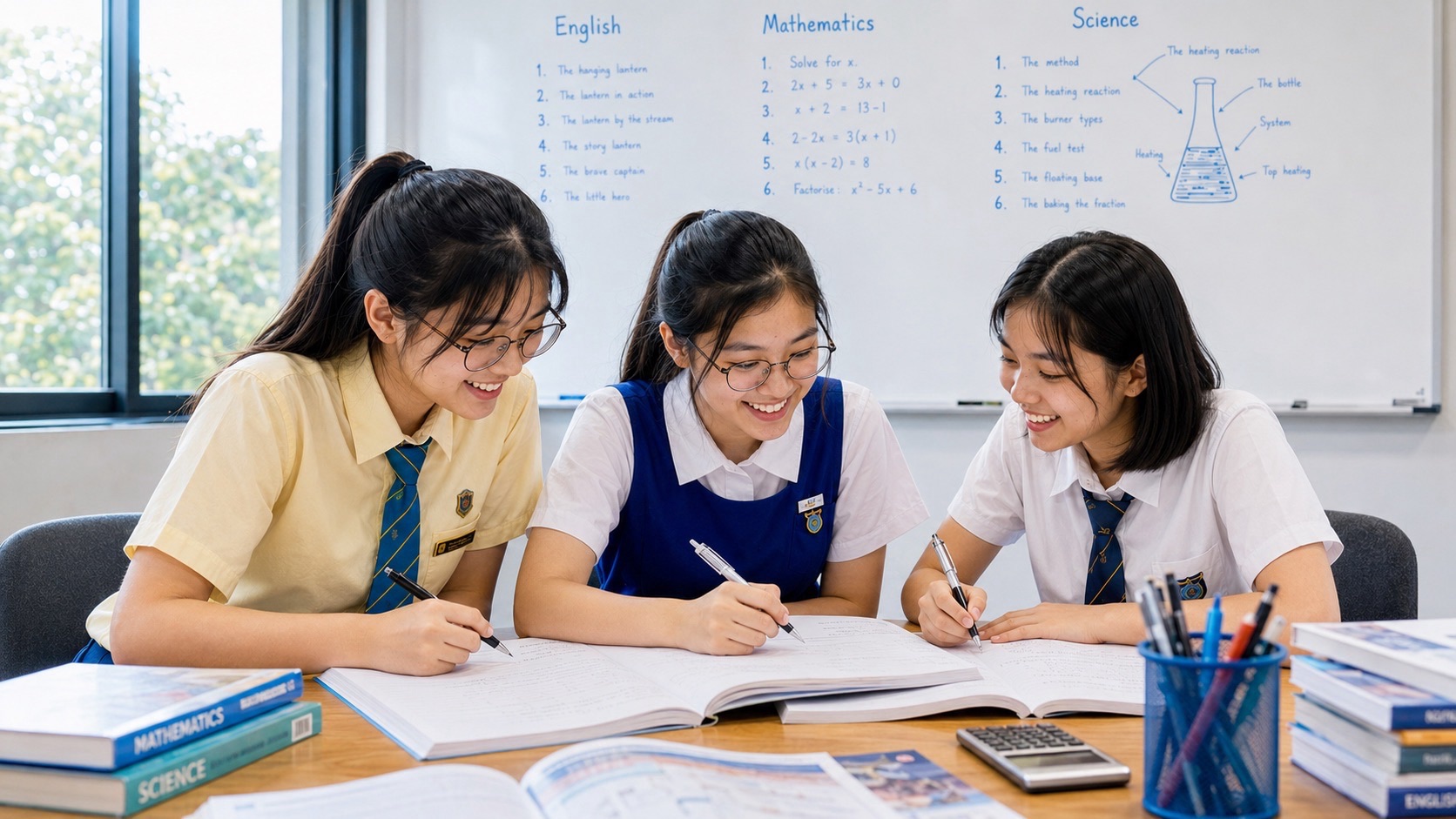
Yishun families preparing for PSLE English can start with two checks. Confirm whether your child is registered for Standard English Language or Foundation English Language, then use the corresponding exam format to plan writing, comprehension, listening and oral practice. Posting Group 1, also called PG1, comes into play after the results, when your family looks at Secondary 1 school choices.
A steady transition to Secondary 1 begins with the skills your child can already use. A student entering through Posting Group 1 will generally start most subjects at G1, and their individual English result may give them an option to take English at G2 or G3. This guide shows you how to read the two paper formats, spot the skill behind a recurring mistake and discuss the starting English level with your child’s secondary school.
- Before the PSLE: Use the English syllabus for your child’s registered subject. Standard English is 0001 and Foundation English is 0031 in the published 2026 formats.
- Practise all four papers: Both routes assess writing, language use and comprehension, listening, and oral communication. Paper 2 and listening carry different weightings between the two routes.
- After the PSLE: Use the overall score for posting eligibility and the individual English result for possible Secondary 1 English options.
- Check the PG1 option carefully: Standard English AL6 or Foundation English AL A can open G2 English. Standard English AL5 or better can open G2 or G3 English.
- Start with one skill: Choose a task your child can attempt independently and compare two samples to see which skill needs attention first.
Standard and Foundation English paper formats
The English examination tests what your child can do with language in a situation. A writer chooses what to tell a reader, a listener follows a message as it develops, and a speaker explains an experience to another person. Grammar, vocabulary and spelling help the student do all of this accurately. That is why a child can know the definition of a word and still need practice choosing whether it belongs in a particular answer.
This table uses the SEAB formats published for the 2026 examination. The documents say that these English formats were implemented from 2025. If your child will sit the examination in a later year, check the listing for their examination year when it is available and follow the instructions from their primary school.
| Paper | Standard English 0001 | Foundation English 0031 |
|---|---|---|
| 1 · Writing | 25%, 1 hour 10 minutes. Situational and continuous writing. | 25%, 1 hour 10 minutes. Situational and continuous writing. |
| 2 · Language Use and Comprehension | 45%, 1 hour 50 minutes. Includes grammar, vocabulary, visual text, cloze, editing, synthesis or transformation, and comprehension. | 40%, 1 hour. Includes grammar, punctuation, vocabulary, visual text, form filling, editing, synthesis, comprehension cloze and passage comprehension. |
| 3 · Listening Comprehension | 10%, about 35 minutes. 20 multiple-choice questions. | 15%, about 35 minutes. 15 multiple-choice questions. |
| 4 · Oral Communication | 20%, about 10 minutes including preparation. Reading aloud and stimulus-based conversation. | 20%, about 10 minutes including preparation. Reading aloud and stimulus-based conversation. |
SEAB 2026 examination formats · Standard English Language · Foundation English Language
The Paper 1 composition task differs as well. Standard English asks for at least 150 words on a given topic, using at least one of the three pictures supplied. Foundation English asks for at least 120 words based on a series of pictures. When choosing a practice book, open the book and look at a complete writing task. Check that its prompt matches the paper your child will sit. A child practising a picture sequence needs to make the links between events clear. A child practising with the Standard prompt needs to make the selected picture and given topic matter to the story.
Paper 2 carries the largest share of both examinations. It covers several different skills, so “do more Paper 2” gives your child very little direction. One child may need to reread the question before answering. Another may understand the passage and still lose the answer while trying to write a long sentence. A third may be able to explain an inference out loud but leave the supporting clue off the page. Ask your child to show how they reached an answer before deciding what to practise.
Use a recent school script to make your first decision. Put a small dot next to three places where your child knows what went wrong after looking at the answer. Put a different mark beside an error they cannot yet explain. Discuss that second group first. Try one short, fresh example that tests the same skill. If the child succeeds with the new example, ask them to name what they changed. If they still struggle, give them one worked model and return to the skill a day or two later.
Paper 1 writing
Situational writing gives the reader a job to do
A short letter or email succeeds when the intended reader understands the message and can act on it. Start a practice task by answering three questions aloud. Who am I writing to? Why am I writing? What does this person need to know? Your child can then circle the audience, underline the purpose and tick each requested detail as it appears in the response. The steps work for both English routes.
Try this original prompt. A Yishun school is organising a Saturday book exchange. Rina signed up to bring five books at 10 a.m. Her swimming class has been moved and she can reach the hall only at 10.30 a.m. The book sorting ends at 10.15 a.m. Ask your child to write to the teacher in charge to explain the problem, ask whether another time is possible and offer to drop off the books on Friday if needed. The teacher knows about the exchange. The useful new information is what Rina originally agreed to do, the conflict and which arrangements Rina can manage.
A first attempt might read, “I am sorry that I cannot come on Saturday. I have a lesson. Can I send the books on another day?” The parent can point to “cannot come” and ask, “Will you miss the whole exchange or reach it later?” The child can then make the real problem visible. “My swimming lesson has been moved, so I can reach the hall at 10.30 a.m. I understand that sorting ends at 10.15 a.m. Could I bring my five books to school on Friday instead?” The improved message narrows the issue and tells the teacher what action Rina is asking for.
Give the child a second reader to write to. If Rina tells a classmate about the change, the timing still matters but the reason for the message changes. She might ask, “Can you tell me which table I should go to when I get there?” A message to her teacher should sound courteous and include the request for permission. Comparing these versions teaches tone more concretely than telling a child to memorise a long formal greeting.
Continuous writing keeps events connected
A child may write several vivid sentences and still leave the reader wondering what happened. The middle should show what changed and why the main character had to act. A useful starting plan has three lines. “At first, my character wants __.” “Then __ happens, which makes that difficult.” “My character decides to __, and this causes __.” The plan gives a child enough direction to begin without supplying every sentence.
Consider a practice topic about keeping a promise. At a sheltered court near home, Danial has promised to wait with a younger cousin until their aunt arrives. He sees his friends heading to a game and feels tempted to leave. When the cousin looks towards the unfamiliar stairwell, Danial realises the child still needs him. He sends his friends a message and stays. A picture of a phone can support the decision because the message changes what Danial does next. A picture of an umbrella can matter if rain makes the aunt late and prolongs the wait.
A Foundation picture-series exercise might show a child finding a pencil case, noticing the class label, returning it and later meeting its owner. Connect the pictures by asking why one event leads to the next. The discovery matters because the label gives the child a way to return the pencil case. The meeting is a result of that choice. Between images, use a line of action or thought that helps the reader travel from one scene to the next. “I turned the pencil case over. A faded sticker said 6B, so I carried it to the classroom next door.” Each sentence gives the reader something useful.
In both routes, borrow a technique from ordinary conversation. When a child tells you about a broken water bottle, you may ask why they wrapped it in a towel, or which friend stayed to help. Ask a similar question of a story draft. “You say Meera was relieved. Which action showed me that?” The child might write, “Meera pushed the borrowed umbrella back into its case and took her first deep breath since the rain started.” If that sentence is too hard to control, simplify it to “Meera breathed out and smiled when the rain finally stopped.” Accuracy supports clarity.
Revise one paragraph where the reader gets lost
Have your child underline the sentence where the most important event happens. Read the sentence immediately before it and the two sentences after it. Check whether the reader understands who acted, why the event happened and what changed. If there is a gap, revise that short area. A child can learn from one carefully revised paragraph even when the rest of the composition is still rough.
Here is a draft: “Wei An saw the bag. He ran after him. Soon everything was fine.” The parent can ask which person “him” refers to, why Wei An is running and what was resolved. A revision could read, “Wei An recognised the red tag on the schoolbag. The boy in the blue cap was already halfway down the steps. Wei An called out and held the bag above the railing. The boy stopped and patted his empty shoulder before turning back.” When the child reads the revision, ask them to identify the detail that makes the chase understandable. They may notice the red tag or the boy’s empty shoulder.
Help a child begin when the page feels blank
Ask the child to tell a one-minute version of the story, with their hands away from the pencil. If they can speak the plot, have them write the decision sentence first on scrap paper. For the promise example, that sentence could be “I texted my friends to start without me because I had promised to stay.” It gives the child a fixed point to write towards. They can then begin the actual composition with the setting or the moment when the child notices the time.
If the spoken version also stalls, offer two choices that fit the prompt and ask the child to choose one. “Does Danial see the time on his phone, or hear his friends call from the court?” Then ask, “What would he do next?” The next practice can use the same topic with a different picture. When your child succeeds in both, gradually withdraw the opening choices so they have practice deciding independently.
Contents · Previous section · Next section
Paper 2 language use and comprehension
Read the question, find the evidence, give the answer
Consider this original passage. “At the community room, Tara put a chair beside the door and set an empty box on the seat. When the first visitors started stacking their donations on the windowsill, she moved the box into the middle of the room and taped a sign to it. By the time the second group arrived, the windowsill was clear.”
A direct question asks where Tara first placed the box. The answer is on the chair beside the door. A question about cause might ask why Tara moved it. Her visitors were stacking donations on the windowsill, so Tara put the box where people could see that it was the place for their donations. An inference question might ask how she knew the change had helped. The later visitors left the windowsill clear, which suggests that they were using the donation box. In every case, the child can show the words supporting the answer.
A student may answer, “She moved it because she taped a sign to it.” Both actions are in the passage, which makes the diagnosis easy to miss. Ask the child which event gave Tara a reason to act. The donations on the windowsill were the problem. Moving and labelling the box were her responses. Have the child mark the problem and the response with different symbols, then explain the answer in ten or fifteen words. This makes the reasoning visible before the child works on sentence length.
For questions about a character’s feeling, test whether the evidence fits the chosen emotion. “Upset” may fit a character who has lost something, but it is a broad word. A character who keeps checking a clock before an unfamiliar trip may be anxious. A character who expects a friend to arrive and sees the friend turn away may be disappointed. Ask, “What in the story led you to that word?” If the child can explain the difference aloud, then practise giving that evidence in the answer.
Visual texts ask students to compare conditions
Make a mock notice on paper. “Yishun neighbourhood swap morning. Saturday, 9 a.m. to noon. Drop items by 10 a.m. Bring clean storybooks or puzzles with all pieces. Volunteers report at 8.45 a.m. Exchange tokens are collected from the information desk.” Ask which condition applies to a family that arrives at 10.30 a.m. with a book and hopes to donate it. The event is still running, but the drop-off deadline has passed. The answer relies on separating the event hours from the time for a particular activity.
Next, ask your child what they would tell a new volunteer. The volunteer’s arrival time is 8.45 a.m., so using the event opening time would make the person late. Then provide a second notice with the deadlines in a different order. A student who used the heading and conditions should still answer correctly. A child who simply picked the first time on the page may need to underline the words that identify the person and purpose before scanning for the number.
Foundation form filling rewards exact choices
In a practice form for a school activity, the name in a message might be “Lucas Tan,” while the person collecting the child is an aunt, “Ms Tan Yi Ling.” The form may have separate spaces for the participant and the emergency contact. A child who writes the first name into both spaces may have read the message without checking the role of each person. Ask the child to draw a small line from each requested field to the corresponding detail in the source.
Create a second form with a new event. Include a parent’s mobile number and a public enquiry number. If the form asks for the emergency contact number, the child chooses the parent’s number. If one field has a printed “p.m.” after a blank space, discuss what the printed label already supplies. A careful check involves reading the finished form as the person who will use it, making sure each answer belongs in its space.
Cloze uses the words around the gap
Give your child this sentence. “When the rain stopped, the players were finally able to ___ the match.” More than one verb may look possible in isolation. Now add, “Both teams returned to the court. They picked up where they had left off.” The later line supports “resume” or “continue.” In reading practice, ask the child to state what the missing word has to mean before choosing the exact word. Where the exercise supplies choices, the sentence and nearby lines help narrow them.
A gap may test grammar instead. “The red notebooks on the bottom shelf ___ for the art class.” Ask what the sentence is talking about. “Notebooks” is plural, even when “shelf” sits closer to the gap. “Are” can fit a present-time context. Add “Last year” and discuss how the time changes the form to “were.” This one example makes the child check both the subject and the time of the sentence.
Editing and synthesis preserve the writer’s meaning
For editing, separate spotting a problem from fixing it. In “The children was waiting at the gate,” the child can first identify the subject as plural and then choose “were.” In “Anis recieved the note after recess,” the child may recognise the story and still need to fix the spelling of “received.” Keep a short record of repeated forms that genuinely belong to the child’s work. Review the record with fresh sentences so the child can use the correction under different conditions.
For synthesis, ask the child to say what relationship the two original sentences express. “Aina wanted to return the book. It was beginning to rain.” Given the opening “Although,” one possible response is “Although it was beginning to rain, Aina wanted to return the book.” The connecting word tells the reader there is a contrast. If the starting word were “Because,” putting the two ideas together may invent a reason that the original sentences do not give. Discuss how the cue word shapes the relationship.
Use another pair where the order matters. “Jia Yi lent Hamzah a ruler. Hamzah returned it after class.” A response beginning “After class” could be “After class, Hamzah returned the ruler that Jia Yi had lent him.” Ask who lent the ruler, who returned it and what happened after class. The sentence should let the reader answer all three questions without looking back.
Find the mistake that occurs in more than one task
Underlying language skills often appear in different exercises. A missing subject in a comprehension answer may reappear in composition. Guessing a word from its first few letters may cause trouble in editing and in reading aloud. Misreading “before” and “after” can affect both a visual text and a listening item. Review two papers together and look for a repeated choice the child makes. This is usually more helpful than treating each error as a separate skill.
If your child knows a grammar rule but keeps missing it, shrink the text first. Build two near-identical sentences in which only one feature changes. “The boy beside the bicycles is ready” and “The boys beside the bicycle are ready” help the child see what determines the verb. Then put the pair into two different short paragraphs. A child who can explain each change independently is ready to try it in a school-length exercise.
Contents · Previous section · Next section
Paper 3 listening comprehension
The 2026 English formats give students time to read the questions before a text is heard. Each text is played twice. The first seven questions in Standard English and the first four in Foundation English use graphic representations. Practise with two hearings at home. On the first, your child listens for the main message and tentative answer. On the second, they check the exact detail and listen for a condition or correction.
Read this original announcement at an ordinary speaking pace. “If you are joining the drawing activity, meet at the library entrance at ten past nine. The group will leave at half past nine. Students bringing their own materials should put them in the marked box when they arrive. If it rains, we will meet in the covered courtyard instead.” Before reading, give the child these three questions. When should students meet? Where do they go if it rains? What do students do with their own materials? Read the announcement a second time with the same wording and pace.
A child who answers “half past nine” may have heard both times and confused departure with meeting. Write the verbs “meet” and “leave” above the two times. Ask your child to tell you which one the question needs. Use a different announcement, with the departure time mentioned first, to test whether they are following the meaning. A child who answers “library entrance” for the wet-weather meeting place may need to circle the condition “if it rains” before listening.
Some questions ask the child to understand a speaker’s attitude or what a conversation implies. Try a short exchange. “We can finish the poster before lunch,” says Kavitha. “Maybe,” replies Sofian. “We still need a heading and three pictures, and the printer won’t be free until after lunch.” Ask whether Sofian expects them to finish before lunch and which detail supports the answer. He says “maybe,” but the printer timing suggests doubt. Listening for the relationship between facts gives the child more to work with than waiting for an exact phrase from the question.
Contents · Previous section · Next section
Paper 4 oral communication
Read aloud so the listener can follow the ideas
Reading aloud involves clear words, meaning and a steady pace. Use a line with a natural change in meaning. “We were halfway across the court when the lights went out.” The speaker will usually group “halfway across the court” as one idea. A short pause before the event can help the listener follow it. Ask your child to read the line once, say what happened in their own words and read it again. Understanding the line often improves the delivery.
For a notice, your child can group the instructions. “Please put the borrowed pencils in the tray / before you leave the room.” The slash is a practice mark, not part of the text. Compare that version with a reading that pauses after “borrowed.” Discuss which grouping lets the listener understand the object first. Then ask the child to mark a sensible pause in a second sentence without help. Keep the exercise short enough that the second attempt still sounds like real speech.
If your child stumbles on a word, read the sentence with them, then practise the word inside a phrase. “Entrance” sounds different as part of “at the entrance” from when the child says it on its own at dictation speed. Their next attempt can include the entire sentence. Offer one observation about clarity and one concrete next move. “I could understand the meeting place. Try slowing down for the last instruction so I can hear the time.”
Build a conversation from one clear answer and a detail
The 2026 format uses a photo for stimulus-based conversation. Reading aloud and conversation cover separate topics. For home practice, use a familiar picture or describe a scene clearly. Imagine a photo of two children sorting returned books at a library trolley. Ask, “Would you enjoy helping with this task?” A child could answer, “I would, because I like knowing where things belong. I help to return board games to the right shelf in class, and I would ask a librarian how the books are arranged before I started.” The answer supplies a position, a reason and a small personal example.
Ask a follow-up that changes the angle. “What if someone left a wet book on the trolley?” The child can think for a moment, say how they would respond and explain why. “I would tell the person in charge before putting it with the other books, because the water might damage them.” This gives the child practice listening to the follow-up. It also reduces dependence on memorised paragraphs that can become hard to adapt when the listener asks something unexpected.
A shy child may find it easier to begin with a question about a familiar routine. “How do you know which bus stop to use?” can yield a clear answer, an example and something the child would check. Ask them to speak to one person first, with no recording required. If they are comfortable, have their next attempt recorded and ask them to choose one phrase they want to make clearer. A child who already speaks at length can practise answering the question in the first sentence and selecting the most relevant example.
Contents · Previous section · Next section
A four-week practice plan
This plan assumes your child already has regular schoolwork. Add short work at home that targets one difficulty and leaves time to revisit it. Fifteen minutes of focused work is enough for a small task, such as checking which reader a message addresses or showing two clues in a passage. A full paper has a place when you want to practise managing a long session and the skills are already familiar.
| Week | Main task | What to keep as evidence |
|---|---|---|
| 1 | Use a marked script and sample each of the four skills briefly. | A writing paragraph, a comprehension answer and one listening or oral observation. |
| 2 | Practise the skill that occurs repeatedly, with a short model followed by an independent attempt. | Two attempts on different examples of the same skill. |
| 3 | Use that skill in a longer task linked to the child’s registered route. | One longer piece showing whether the habit survived under a little more pressure. |
| 4 | Try a short mixed check, compare it with Week 1 and choose the next priority. | A sentence the child can explain or a check they can carry out alone. |
In Week 1, ask your child to show you how a choice was made. A missing detail in situational writing may come from skipping part of the prompt, losing a place during drafting or never checking the response. Getting the reason right matters because each explanation points to a different exercise. A child who keeps misreading the instructions needs practice in converting the task into a checklist. A child who already understands the prompt but forgets one detail needs a habit for comparing the finished draft with that checklist.
In Week 2, choose a pair of examples that differ just enough to test the habit. If the issue is listening for changed arrangements, use one message where the meeting point changes because of rain and another where only the collection time changes. Show one example before the child tries a new one. End with a question they can use later, such as “Which arrangement changed?” Let your child answer it aloud twice in two different contexts.
In Week 3, embed the skill in a longer task. If your child has been learning to connect an inference to evidence, give them a new passage and ask them to mark only the two lines they actually used. A student who highlights half the passage may still be deciding what counts as support. Ask them to narrow it to one event, action or clue and tell you why. If they can do it with an unfamiliar text, they are developing a skill they can carry into Science and Humanities reading as well.
In Week 4, compare schoolwork or home samples that demand roughly the same skill. Suppose the original answer says “because he was upset,” while the newer answer says “because he had waited at the gate twice and the group left without him.” The second answer shows where the idea came from. If the question asked specifically for an emotion, help the child add “He felt disappointed” before the explanation. A small missing piece is much easier to address when you can see what the child has learned.
When there is only one week before the paper
Pick two high-frequency checks that your child already understands. Examples include returning to the situational writing prompt to account for each required detail, or checking which person a listening question asks about. Give them two short opportunities to use each check, leaving enough time the next day to repeat it without prompting. In the last few days, match the school’s instructions on materials, arrival and the examination schedule. Your child should know when to stop preparing and get ready for the next day.
A student who makes many errors under time pressure may benefit from a small rehearsal. Agree where they will pause to check their work. After the exercise, ask whether the pause came too late, or whether they stopped at a useful point. Use one change in the next rehearsal. A parent can say, “You remembered to reread the question about the meeting time. Let’s practise doing that on a different passage tomorrow.” This describes a successful action they can repeat.
Keep practice within a normal Yishun week
A child who has an activity near Khatib or gets home late after CCA may have one evening suited to a listening exercise and another suited to writing. Set writing for the day they can sit down with some energy. Use a bus ride, a walk or dinner conversation for a spoken prompt when it fits naturally. A child can describe what made a route confusing or explain whether they would recommend a library book to a younger cousin. A parent can ask one follow-up and listen to the answer.
Contents · Previous section · Next section
Reading the result and choosing a Secondary 1 starting level
Overall PSLE Score and the separate English result
The overall PSLE Score brings together the Achievement Levels from the subjects used in posting. For Standard English the result slip shows one of AL1 to AL8. Foundation English uses AL A, AL B and AL C. For the posting total, the Foundation grades contribute 6, 7 and 8 respectively. Keep the Foundation letter beside the mapped number when reading the slip. You need the original grade when checking which Secondary 1 subject options are open.
| What the family is trying to work out | What to check |
|---|---|
| Posting Group eligibility | Overall PSLE Score and the relevant English and Mathematics condition. |
| Whether English may start at G2 or G3 | The individual English result, its original Standard or Foundation route, and the starting levels indicated for the student. |
| How the level fits the child | The school’s onboarding information, your child’s recent independent work, and time needed for travel and other commitments. |
Under the published posting rules, a PSLE Score of 25 gives a choice between Posting Group 1 and Posting Group 2. For totals of 26 to 30, the published Posting Group 1 rule requires AL7 or better in both English and Mathematics. If either subject is at AL8 after applying the relevant Foundation mapping, check the actual instructions with the primary school. Looking at the total alone misses a condition that can matter. PSLE result slip explanatory notes · Full Subject-Based Banding posting and subject-level guidance
For students whose indicative starting level is G1, a Standard English AL6 or Foundation English AL A can give a G2 English option. A Standard English AL5 or better can give G2 and G3 English options. Use the actual school’s instructions on how to register or discuss the choice. Being offered a more demanding level for one subject can coexist with starting other subjects at G1. The school will explain which classes are common and how different subject levels fit into the timetable.
Three examples from fictional result slips
A child with Foundation English AL A. Amira has Foundation English AL A, Mathematics AL6, Science AL7 and Mother Tongue AL7. Her posting total is 26 because the Foundation English result contributes 6. English and Mathematics meet the AL7-or-better condition for the 26-to-30 band. Her Foundation English A can give her the option of G2 English. Her family can ask what G2 reading and writing tasks look like early in Secondary 1 and whether the school has examples they can discuss together.
A child with Standard English AL5. Jayden has Standard English AL5, Mathematics AL7, Science AL7 and Mother Tongue AL7. His total is also 26. His individual English result can give him the G2 or G3 English options while most of his subjects may start at G1. Jayden is comfortable discussing books and can use evidence from a text, but he still benefits from help organising longer writing. His family can show the teacher a recent independent writing sample and ask what additional reading or writing pace each choice would involve.
A child with Standard English AL7. Nabila has Standard English AL7, Mathematics AL7, Science AL6 and Mother Tongue AL7. Her total is 27, and English and Mathematics meet the condition. For English, the AL7 result points to the usual G1 start in this example. She can work on steady reading and well-organised responses, and her family can ask how the school considers future adjustments. Her stronger result in Science can be considered separately under the relevant criteria.
Ask about the lessons your child will actually attend
When a child has an offer, ask their teacher what happens in a typical week at the proposed level. Ask how much reading students usually do independently, what writing feedback looks like and how quickly they are expected to move from understanding a text to explaining an idea in writing. Your child can ask what to do if they know the answer in conversation but need longer to get it onto the page. These questions give the school a chance to describe the support it actually provides.
Review a couple of current school samples and the child’s response to feedback. A student who can reread a question, find evidence and correct a misunderstanding after one explanation may be ready to manage more independent work. A student who gets good marks on heavily guided pieces may need practice starting a new task alone. Consider how the rest of the timetable will feel, including CCA, commute and the number of subjects at more demanding levels. Ask for a review point if the family needs to see how the transition is going.
A school may explain when subject levels can be reconsidered, which school evidence it uses and whether students need bridging work to join a higher level later. Ask how this applies to English in that particular school. Keep one early sample from normal lessons. At the next check-in, bring a comparable sample and talk through what has changed. A teacher can then comment on the child’s clarity, independence or pace with something specific in hand.
Shortlisting around Yishun
Use the same school shortlisting process for a child starting English at G1 and a child considering G2 or G3. Look up schools through the family’s eligible Posting Group. Check current information on subject offerings, CCAs and support, then see how easily your child can get there on a school morning. Past score ranges describe an earlier cohort. Use them as a reference when building a balanced list of schools your child is willing to attend. SchoolFinder · Secondary 1 posting
When you visit or contact a shortlisted school, ask who explains subject-level offers during Secondary 1 registration. Find out where to send a question about an English placement and how much time families have to respond. Use the school’s current admission information and the timeline for your cohort. If your child is in a choice band, check the instructions on selecting a Posting Group before finalising the list. Record the choice and the reason in plain words so everyone in the family knows what they agreed.
Contents · Previous section · Next section
Questions Yishun families ask
Does PG1 mean my child took Foundation English?
A student may take Standard English or Foundation English at PSLE and enter Secondary 1 through Posting Group 1 if the posting criteria are met. The two English formats describe what your child sat in Primary 6. The Posting Group comes from their posting eligibility after the results. Keep both pieces of information when you read about Secondary 1 English options.
Can my child enter through PG1 and start at G2 English?
Yes, when the individual result meets the more demanding level criteria for the indicative G1 start. Standard English AL6 or Foundation English AL A can allow G2 English, and Standard English AL5 or better can allow G2 or G3. Check the actual offer and registration instructions with the school. Ask what its early term tasks and support look like so you can consider the choice with your child.
My child has a good vocabulary. Why are comprehension answers short or vague?
They may recognise the words in a passage while still being unsure how to use evidence to answer a particular question. Try a ten-minute exercise with a few lines about a character who changes a plan. Ask what changed, which words prove it and how that detail answers the question. Ask the child to put what they say into one complete sentence. If they can say a strong answer and write only part of it, teach them a short check to carry the relevant evidence across.
Should we start doing G2 or G3 papers just after the PSLE?
Ask what skill you want the practice to reveal. A student coming off a long Primary 6 year can read a short story, a library guide or a text on a subject they enjoy and explain one idea clearly. This shows more about their early reading and writing stamina than a full paper on unfamiliar formats. When the secondary school sends work or reading, use that as the next reference and ask the teacher what to prioritise.
What if my child is embarrassed about starting G1 English?
Give them a way to describe a current skill. “I can explain my answer in class, and I am practising how to put the evidence in writing.” Discuss one place where this would help, such as an English lesson or reading an instruction in another subject. Ask them which classroom support they feel comfortable using. Knowing how to ask a specific question can make the first weeks more manageable.
What should we ask if the results are close to a posting boundary?
Bring the result slip to your primary school conversation. Have the original Standard or Foundation result for each subject and the official posting information for the cohort in front of you. Ask which Posting Group or pathway applies, how to proceed with school choices and what the application timetable is. For 26 to 30, check the English and Mathematics requirement as well as the total. For a score of 25, ask the school to help you understand the two Posting Group options and the consequences for your choices.
What can we take to a teacher meeting?
Bring a recent marked paper, a short independent writing sample and a question you can answer together. “She can tell me the story, but loses track of who is speaking when she writes it. Which part should she practise first?” gives the teacher a place to begin. Your child can explain which kind of prompting helped and which felt confusing. Agree on a single skill to revisit, then compare another independent sample at the next conversation.
Where can my child begin tonight?
Choose the smallest task that gives you something to observe. Read the notice about the book exchange and draft one clear request, or read the passage about the donation box and explain why Tara moved it. Let your child try on their own, ask them how they decided, and agree on one action for the next attempt. Once you can name which skill they used, you have a starting point for the next practice and for the move into Secondary 1.
Planning the next step in Yishun? Read what Posting Group 1 means, when a student can take a subject at G2 or G3, or how to compare secondary schools in Yishun.
Leave a Reply