
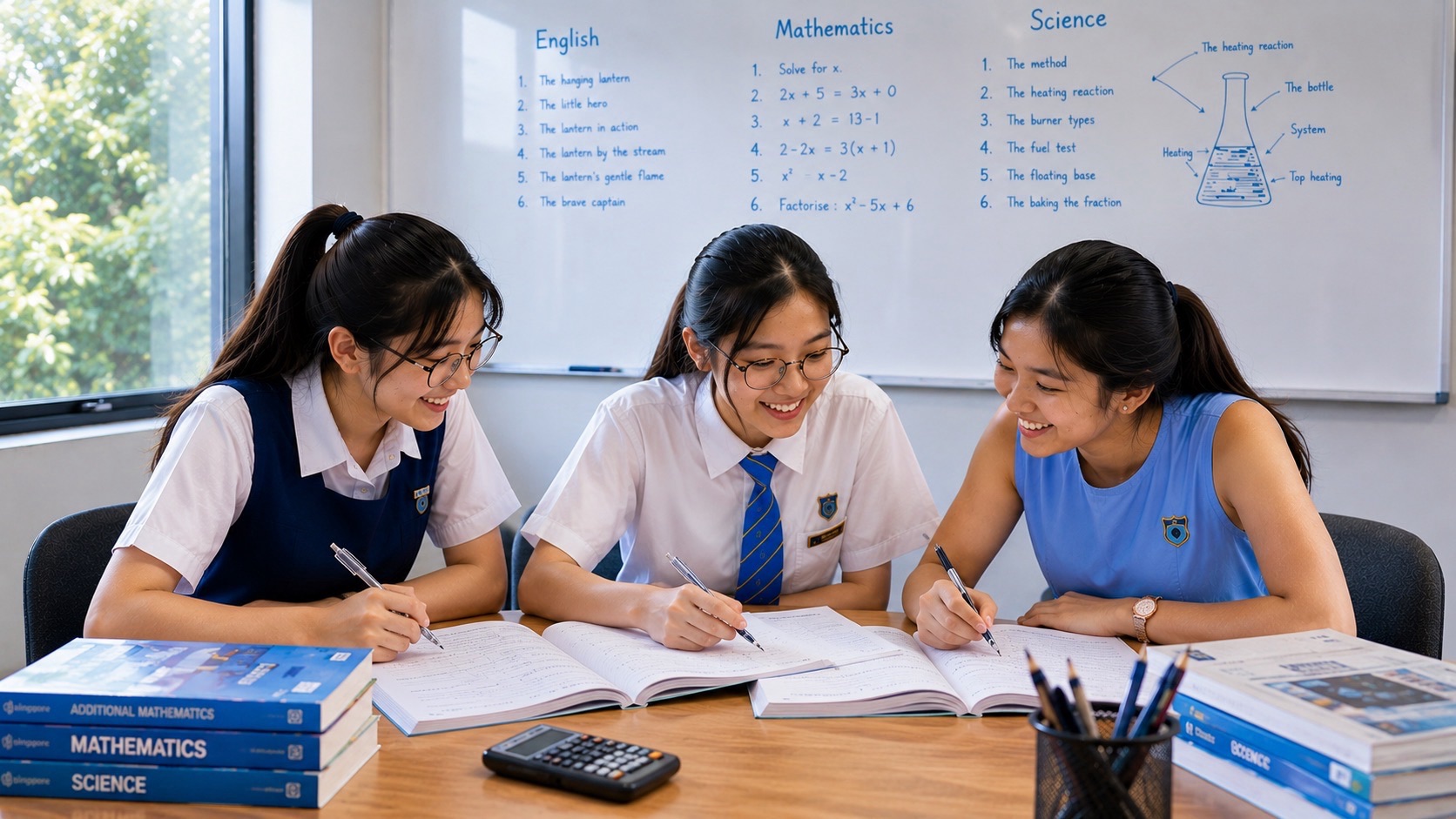
Secondary 4 G3 Mathematics is the final-year study of Mathematics at the G3 subject level for students preparing for Singapore’s national secondary examination. For the 2027 Singapore-Cambridge Secondary Education Certificate (SEC), the subject is Mathematics, syllabus K310. It brings together number, algebra, geometry, measurement, statistics and probability so that a student can calculate accurately, explain a method and solve an unfamiliar problem. G3 describes this particular subject level; a student’s other subjects can be at different levels. See the official 2027 SEAB subject list.
For parents, the most useful starting point is the child’s actual work: which questions can they begin independently, where does their reasoning break down, and can they check an answer without being told what went wrong? Secondary 4 preparation needs both completion of the school’s teaching programme and steady consolidation of earlier learning. This guide explains the 2027 examination, shows what mathematical understanding looks like through original examples, and helps families choose a manageable next step. Confirm the examination year and the school’s topic sequence before buying resources or changing a revision plan.
- Correct subject: G3 Mathematics K310 is separate from G3 Additional Mathematics K341.
- Year matters: this guide uses the published 2027 school-candidate syllabus and looks ahead to the 2028 intake.
- Study the whole course: a Secondary 4 learner still needs earlier algebra, fractions, percentages and geometry.
- Prepare in three ways: practise methods, interpret unfamiliar situations and explain why a solution makes sense.
- Choose support from evidence: a missing concept, a reading difficulty and slow working need different responses.
- Keep decisions connected: check school advice, the current syllabus and the actual requirements of any future course.
Find your next learning step
Choose the question closest to your family’s needs, or read the chapters in order.
Chapter index
Chapters 1–5
Chapters 6–10
Chapters 11–15
CHAPTER 1 OF 15 · Understand the subject
1. What changes when Mathematics reaches Secondary 4?
A student may recognise every chapter heading and still struggle when the chapter labels disappear. During a lesson on percentages, the topic itself suggests a method. In a mixed paper, the learner must first decide whether the situation involves a percentage, a ratio, a rate or an equation. That decision is a major part of final-year readiness.
Consider two children who obtain the same result on a school test. One understands the questions but leaves several unfinished. The other completes everything yet repeatedly forms the wrong equation. Giving both children the same extra paper conceals their different needs. The first may need better fluency and time decisions. The second needs to practise translating words into mathematical relationships before being asked to work faster.
The phrase “Secondary 4 topics” can also create a misleading boundary. A difficult question may require a recently taught idea and a very ordinary fraction calculation. If the fraction calculation fails, the advanced-looking question fails with it. Earlier knowledge remains active throughout the course. Parents can therefore support revision by asking which earlier skill a current mistake depends on, rather than assuming that revision must always begin with the newest chapter.
This article is written for the 2027 SEC cohort. SEAB explains that candidates take subjects at their respective levels and receive a certificate recording those subjects and levels. School candidates register through their schools. For a different examination year or a private-candidate entry, start from the appropriate official listing. The SEAB SEC overview explains these arrangements.
CHAPTER 2 OF 15 · Understand the subject
2. Turn the syllabus into a useful learning map
MOE organises G3 Mathematics around Number and Algebra, Geometry and Measurement, and Statistics and Probability, with problem solving running across the learning. The MOE G2 and G3 Mathematics curriculum provides the broader teaching framework. A family’s revision map can translate those areas into things a learner can demonstrate.
| Learning area | A useful demonstration of understanding | A question to ask |
|---|---|---|
| Number, proportion and percentages | Identify the quantity being treated as the whole. | What does 100% represent here? |
| Algebra and equations | Choose an unknown and write a valid relationship. | What does your letter mean? |
| Graphs and coordinates | Connect a visual feature to the quantities shown. | What does this gradient measure? |
| Geometry and measurement | Choose a property, then apply it to the right objects. | Which fact makes this step valid? |
| Data and probability | Interpret a result and notice its limitations. | What can this number tell us? |
| Matrices, sets and vectors | Explain what the symbols and entries represent. | What would change if the order changed? |
This table is a teaching aid, not a replacement for the official content list. Keep the school’s revision checklist alongside it. Mark a topic as secure only when the child can solve an appropriate new question, explain the main decision and check the answer. A neat page of copied corrections shows that work has been recorded; it does not yet show that the student can repeat the reasoning.
Use three simple labels: independent, needs a prompt, and needs teaching. They give a clearer picture than a page covered in ticks. The labels should change as evidence changes. A child can be independent with a basic equation and still need teaching when the same equation must be built from a written description.
CHAPTER 3 OF 15 · Understand the subject
3. Understand the 2027 assessment before planning practice
The following facts come from the official 2027 G3 Mathematics K310 syllabus.
| Paper | Time and contribution | Structure |
|---|---|---|
| Paper 1 | 2 hours 15 minutes; 90 marks; 50% | About 26 short-answer questions; all compulsory. |
| Paper 2 | 2 hours 15 minutes; 90 marks; 50% | 9–10 questions; all compulsory. The final question applies Mathematics to a real-world scenario. |
An approved calculator is permitted in both papers. Relevant formulae are supplied, geometrical instruments are needed, and essential working must be shown. The syllabus normally requires non-exact answers to three significant figures and angles in degrees to one decimal place, unless the question specifies otherwise.
The practical implication is that revision needs different scales of work. Short exercises can repair an individual skill. Mixed sets can test whether the student chooses a method independently. Complete papers can reveal pacing and endurance. None of these replaces the others. Completing a full paper every day while leaving its misunderstandings unresolved can produce a large pile of work with little evidence of improvement.
For a useful review, select one unfinished question and one incorrect question. Ask the student to describe the obstacle before discussing the solution. “I did not know which length to use” is more actionable than “I am bad at geometry.” The next practice can then target a decision the child actually needs to learn.
CHAPTER 4 OF 15 · Secure number and algebra
4. Strengthen number sense before demanding speed
The examples throughout this guide are original teaching examples, not SEAB questions or predictions. They deliberately use manageable numbers so that parents and students can see the reasoning. After understanding a method, the student should practise appropriately demanding questions supplied or recommended by the school.
A reverse-percentage example
A bag costs $102 after a 15% discount. What was its original price? Let the original price be x dollars. The sale price is 85% of the original, so 0.85x = 102. Dividing by 0.85 gives x = 120. A check is available immediately: 15% of $120 is $18, and $120 − $18 = $102.
A common wrong method is to add 15% of $102. That uses the sale price as the base, although the discount was calculated from the original price. The useful repair is to identify the base quantity. Repeating ten similar calculations without discussing that base can leave the misconception untouched.
When two percentage changes do not cancel
Suppose a quantity of 200 increases by 10% and later decreases by 10%. It becomes 200 × 1.10 × 0.90 = 198. The second percentage acts on 220, not on 200. A student who explains this clearly understands more than someone who merely remembers the final multiplier.
At home, use a quick estimate before a calculator. If an answer for the discounted bag’s original price is below $102, something has gone wrong. If a quantity grows repeatedly but the answer shrinks, inspect the multiplier. Estimation is an independent check on the interpretation, not an extra decoration after the arithmetic.
Fractions deserve similar attention. Before simplifying 3/4 ÷ 2/5, ask whether the answer should exceed 3/4. Dividing by a positive number smaller than one gives a larger result. Then calculate 3/4 × 5/2 = 15/8. Meaning and method support each other.
Algebra becomes more manageable when the student treats each line as a statement that must remain true. Take 3(2x − 5) = 9. Expanding gives 6x − 15 = 9. Adding 15 to both sides gives 6x = 24, so x = 4. Substitution checks the result: 3(8 − 5) = 9.
If the student writes 6x − 5 = 9, the error is distribution. If the expansion is correct but the next line is 6x = −6, the difficulty is maintaining an equivalent equation. These errors require different explanations. A parent can ask the child to point to the first line that no longer follows from the previous one.
Connecting an equation to a situation
A rectangle has width x centimetres and length x + 3 centimetres. Its area is 40 square centimetres. The relationship is x(x + 3) = 40, giving x² + 3x − 40 = 0. Factorising produces (x + 8)(x − 5) = 0. The algebraic solutions are −8 and 5; the width must be positive, so the rectangle is 5 cm by 8 cm.
The final rejection matters. An equation may generate a mathematically possible value that does not fit the situation. Students should therefore finish by interpreting the result in words or with the required units. Writing two roots and stopping leaves the practical question unanswered.
Restrictions are part of the expression
The expression (x² − 9)/(x − 3) simplifies to x + 3 when x ≠ 3. Factorising the numerator reveals a common factor, but the original denominator still rules out x = 3. Asking a child to substitute x = 4 into both forms is a useful check. Asking about x = 3 reveals whether they understand the restriction.
Keep an algebra correction short and specific: name the invalid operation, show the valid one, then attempt a fresh question independently. A full rewritten page is unnecessary when one clearly understood change repairs the error.
Geometry questions become easier to organise when the student separates what is given from what is inferred. A diagram may suggest that two lengths are equal, but appearance is not a mathematical reason. Mark only the equalities or angles stated in the question or established through a valid property.
For example, a triangle has angles 48° and 67°. Its third angle is 180° − 48° − 67° = 65°. The calculation is simple; the reason is the angle sum of a triangle. In a longer problem, the same habit helps the student explain where each angle came from instead of producing unexplained numbers around the diagram.
Similarity changes area differently from length
Two similar figures have corresponding lengths in the ratio 2:3. Their areas are in the ratio 4:9. If the smaller area is 20 cm², the larger area is 20 × 9/4 = 45 cm². The length factor is 3/2; area uses its square because two dimensions change.
A learner who obtains 30 cm² has probably applied the length factor directly to area. Ask them to imagine doubling both the length and width of a rectangle. Four original rectangles fit inside the enlarged rectangle. That picture explains the rule before the learner returns to the calculation.
Choose the triangle before the formula
In a right-angled triangle, suppose the side opposite an angle is 6 cm and the hypotenuse is 10 cm. Then sin θ = 6/10 and θ is approximately 36.9°. First identify the right angle and the relevant sides; only then select the ratio. If the triangle is not right-angled, this particular right-triangle ratio cannot simply be applied to whichever sides look convenient.
When reviewing work, ask the child to redraw one complicated diagram with only the relevant triangle highlighted. Reducing visual clutter can reveal that the difficulty is selecting the useful information, rather than remembering a formula.
A graph is a relationship between quantities. Before finding a gradient, read the axis labels, units and scale. A rise of three squares does not necessarily mean an increase of three units. Skipping this check can make a correct-looking calculation describe the wrong situation.
Imagine a straight distance–time graph joining 0 km at 0 minutes to 12 km at 30 minutes. Its gradient is 12/30 = 0.4 km per minute, equivalent to 24 km/h. The two numerical answers describe the same speed in different units. A student who writes only “0.4” has not yet made the meaning clear.
Now compare that with a speed–time graph showing a constant speed of 4 m/s for 20 seconds. The distance is the rectangular area below the graph: 4 × 20 = 80 m. The height represents speed, while the area represents distance. The name of the graph determines the interpretation; the visual shape alone does not.
Coordinate geometry offers another useful connection. The line through (2, 5) and (6, 13) has gradient (13 − 5)/(6 − 2) = 2. Using y = 2x + c and the point (2, 5), we get c = 1. Substituting the second point checks y = 2x + 1. Students can move between coordinates, a graph and an equation, checking that all three describe the same relationship.
A practical revision task is to take one graph and write three sentences: what each axis represents, what one visible feature means, and what conclusion the graph supports. This develops interpretation alongside calculation and exposes vague answers such as “it goes up” when the question needs a precise statement about changing quantities.
CHAPTER 8 OF 15 · Connect the ideas
8. Explain data and probability without overclaiming
Statistics asks students to choose and interpret a useful summary. For the data 4, 5, 5, 6 and 20, the mean is 8 and the median is 5. Neither calculation is wrong. They describe the data differently. The large value affects the mean strongly, while the median remains the middle value.
If these numbers represent waiting times in minutes, the parent and child can discuss what each summary helps a reader understand. The median describes the middle observation. The mean includes the effect of every observation. A clear explanation refers to the actual data rather than declaring that one measure is always superior.
Spread adds another layer. The sets 4, 5, 6 and 1, 5, 9 both have mean 5, but their ranges are 2 and 8. A report that gives only the mean hides that difference. When comparing groups, the student should check what is being compared, whether the units match and whether the evidence justifies the conclusion.
Probability changes when the situation changes
A bag contains three red counters and two blue counters. Two counters are selected without replacement. The probability of two red counters is 3/5 × 2/4 = 3/10. After a red counter is removed, two red counters remain among four counters. That change explains the second fraction.
With replacement, the first counter is returned before the second draw, so the corresponding probability is 3/5 × 3/5 = 9/25. The phrase “with replacement” changes the model. It cannot be ignored because the diagram looks familiar.
For a fresh check, ask for the probability of different colours without replacement. The two orders are red then blue and blue then red: 3/5 × 2/4 + 2/5 × 3/4 = 3/5. Naming the events prevents the student from counting one order twice or forgetting the other.
At Secondary 4, encourage an explanatory sentence after a calculation: what event was calculated, why the fractions changed, or what a statistical comparison supports. This makes misconceptions visible before they become repeated habits.
CHAPTER 9 OF 15 · Connect the ideas
9. Understand what matrices, sets and vectors represent
Some students become anxious when a familiar calculation appears in unfamiliar notation. The repair often begins by attaching meaning to each entry. A matrix can organise information; a vector can describe a directed movement; a set can collect objects that satisfy a condition.
Suppose a stall sells notebooks at $2 each and pens at $3 each. Its sales record has rows for Monday and Tuesday, and columns for notebooks and pens. The rows are [4, 2] and [1, 5]. Multiplying this sales matrix by the price column [2, 3] gives revenues of $14 and $17. Each row combines quantities with the matching prices.
The numbers alone are insufficient. If the columns are reversed but the price column is left unchanged, the result answers a different question. Labelling rows, columns and units is therefore a mathematical safeguard. Ask the learner to explain the first multiplication in a sentence before completing the rest.
For vectors, let A have coordinates (1, 2) and B have coordinates (5, 5). The movement from A to B is (4, 3), found by subtracting the starting coordinates from the destination coordinates. Its magnitude is √(4² + 3²) = 5. The reverse movement is (−4, −3), with the same magnitude but the opposite direction.
A set example highlights a different distinction. In a group of 30 students, 18 enjoy badminton, 14 enjoy swimming, and 6 enjoy both. The number enjoying at least one activity is 18 + 14 − 6 = 26. The overlap was counted twice before subtraction. Four students enjoy neither. Explaining the overlap is more useful than memorising an isolated formula.
These examples share a habit: define what the representation means before operating on it. That habit transfers to tables, diagrams, algebra and contextual problems.
CHAPTER 10 OF 15 · Solve and check
10. Build a complete solution to a practical problem
A contextual question often feels longer because it contains decisions as well as calculations. Use a clear sequence: identify the aim, collect relevant information, state the mathematical model, calculate, and interpret the result. The following invented example shows why the final interpretation matters.
A school group needs transport for 120 people. A small coach seats 24 and costs $180. A large coach seats 40 and costs $260. Assume the coaches have sufficient availability, every person needs one seat, and only the stated hire charges matter. What combination gives the lowest total cost?
Let s be the number of small coaches and l the number of large coaches. The capacity condition is 24s + 40l ≥ 120, with s and l non-negative whole numbers. The cost is 180s + 260l. These conditions prevent meaningless answers such as hiring 1.5 coaches.
| Large coaches | Small coaches needed | Seats | Total cost |
|---|---|---|---|
| 0 | 5 | 120 | $900 |
| 1 | 4 | 136 | $980 |
| 2 | 2 | 128 | $880 |
| 3 | 0 | 120 | $780 |
Three large coaches give the lowest cost among these cases. Four or more large coaches already cost at least $1,040 before adding any small coaches, so they cannot improve on $780. The conclusion is justified within the stated assumptions.
Now change one condition: only two large coaches are available. The answer becomes two large and two small coaches, costing $880. The earlier arithmetic remains correct, but the feasible choices have changed. A strong learner checks the constraints before reusing a familiar result.
This kind of exercise also improves written communication. “$780” is incomplete. “Hire three large coaches, providing 120 seats for $780 under the stated conditions” answers the practical question. Parents can ask whether the final sentence would help someone make the decision without reading every line of working.
Do not turn every practice question into a lengthy essay. The aim is a concise, complete chain of reasoning. The amount of explanation should match the question’s demand and the decision being made.
Checking is most useful when it uses a different route from the original calculation. Substitution checks an equation. An estimate checks scale. Units check the meaning of a rate. A quick sketch checks whether an angle or length is plausible. Repeating the same calculator keystrokes can repeat the same mistake.
For example, when the rectangle’s width is found to be 5 cm, multiply 5 by 8 to check the area. When a probability is calculated, check that it lies between zero and one and that its size is sensible. When a journey of a few kilometres produces a travel time of hundreds of hours, inspect unit conversion before trusting the display.
Calculator fluency should include brackets and negative signs. Compare −3² with (−3)² on paper before using a calculator: the first means −(3²) = −9, while the second is 9. The device evaluates the expression entered; it does not know what the student intended.
Keep sufficient digits during intermediate calculations, then apply the requested final accuracy. Write enough working to show the method and the values being used. A correct final number without an interpretable route gives neither the teacher nor the student a useful basis for diagnosing the next error.
Make a small personal checklist from actual mistakes. A student who often forgets square units needs a unit check. Someone who confuses degrees and radians needs a mode check when relevant. A list of twenty generic reminders is harder to use than three checks connected to the learner’s own evidence.
CHAPTER 12 OF 15 · Solve and check
12. Choose the right response to a disappointing result
Start with the script, not a judgement about effort. Sort a small sample of mistakes into practical categories. This is an informal teaching review, not a diagnosis of a learning condition. Its purpose is to make the next lesson more precise.
| Observed difficulty | Useful next action | Evidence of improvement |
|---|---|---|
| Cannot explain a basic idea | Return to a small example and teach the meaning. | Explains and solves a new example. |
| Knows methods but chooses poorly | Compare similar-looking problems and their starting decisions. | Selects a method without a topic label. |
| Correct start, repeated calculation errors | Practise the unstable operation in short sets. | Accurate working across different questions. |
| Correct untimed work, unfinished timed work | Practise short timed sets and review time decisions. | More complete answers without lost accuracy. |
A student who needs a prompt is not yet working independently, even if the eventual answer is correct. Record the prompt honestly. Was it “draw a triangle,” “use a quadratic,” or a complete first line? This distinguishes a small reminder from substantial help and prevents families from overestimating readiness.
For a learner rebuilding confidence, choose one specific target that can be checked within a week. For a learner keeping pace, use mixed practice to protect earlier learning. For a learner ready to stretch, ask for alternative methods and explanations of why a tempting wrong approach fails.
These routes can coexist within the same student. Someone may need algebra repair while being confident with statistics. A subject mark is a summary, not a map of every strength and difficulty. The plan should reflect that unevenness rather than forcing the child into one permanent label.
SEAB places English Language and Mother Tongue written examinations in September, with other written subjects in October–November and non-written components before the written examinations. Use the school’s calendar and the eventual official timetable for exact dates. The broad arrangement appears in the SEC examination overview.
For Mathematics, this means preparing alongside other subjects throughout the year. It would be unwise to leave every weak topic until after the language papers. Equally, a plan that fills every available evening with Mathematics may crowd out the subjects that arrive earlier.
At the start of Secondary 4
Bring together the school’s topic plan, the latest marked assessment and a short list of recurring mistakes. Choose two priorities: one current topic and one foundation that supports it. Ask the teacher which gaps are most likely to obstruct the next part of the course. This gives revision a direction without requiring a complete personal textbook.
During teaching and consolidation
A possible weekly pattern is a short retrieval session, a focused problem set, and a mixed review. For example, use 20 minutes to recall and apply an earlier method, 30 minutes to work on the current difficulty, and a later session to attempt unfamiliar questions that combine ideas. These are suggested starting points, not official timings or a requirement for every student.
Build correction time into that pattern. If Monday’s problem reveals a misunderstanding, Wednesday’s task should address it. Completing another set while the same misconception remains can make the schedule look productive without improving control.
When preparing complete papers
Use a full paper when the learner has enough understanding to gain useful information from it. Review where time went, which questions were postponed and whether checking changed any answers. An unfinished paper can reveal poor time allocation, but it can also reveal missing knowledge. Read the work before deciding which explanation fits.
After correction, return to a different question that tests the same idea. Then revisit the idea later among other topics. The useful question is whether the student can retrieve and choose the method after the immediate explanation has faded.
For a Yishun family, include the actual school journey, CCA commitments and time needed to settle at home. A practice slot that is repeatedly missed needs redesigning. A shorter session that the child can complete thoughtfully is a better starting point than an ambitious timetable that exists only on paper.
CHAPTER 14 OF 15 · Plan the next step
14. Connect Mathematics to subject and pathway decisions
Mathematics and Additional Mathematics have separate entries in SEAB’s 2027 G3 list. Families should therefore keep separate records of what the child is studying and where support is needed. Success in one subject does not automatically demonstrate control of every part of the other.
In Secondary 4, a proposed subject or level change needs a conversation with the school about timing, teaching coverage, registration and progression implications. Do not make the decision from a single score or assume that a change is available simply because it would suit a new timetable. Ask what the school can actually support and what the student would need to learn.
For students progressing after the 2027 SEC, MOE has announced the Post-Secondary Admissions Exercise (PSE) from 2028, covering applications to JC, Millennia Institute, polytechnics and ITE. The 2026 MOE announcement explains the new process. MOE has also announced a five-subject L1R4 framework for JC admission from 2028; see the JC admission changes.
For a real decision, check the intended course’s current subject requirements and the student’s complete combination. An aggregate, a minimum subject grade, a course prerequisite and competitive selection are different checks. Meeting one condition does not settle the others. Keep a dated note of the official information used, especially when comparing advice written for different intakes.
If extra academic support is being considered, take two pieces of work to the discussion. Ask how the tutor would identify the missing decision, coordinate with the school and check independent improvement. The value of support lies in the teaching response and feedback, rather than the number of worksheets promised. Families can continue through the eduKate Yishun Mathematics learning hub.
Does a weak Secondary 3 result mean Secondary 4 cannot improve?
A past result identifies a starting point. It does not show which parts can improve or how much support will be needed. Review specific questions, choose a manageable target and look for independent performance on fresh work. Avoid promising a particular grade; use actual progress to adjust the plan.
Should we begin revision with the hardest questions?
Begin with the most useful gap. A difficult question can reveal a weakness, but the repair may be a basic equation, a unit conversion or a misunderstood graph. Once that foundation is stable, return to the harder question and see whether the learner can connect the steps.
How do we know whether a correction worked?
Ask the student to solve a different question testing the same idea without looking at the correction. Later, include the idea in mixed practice. A correct answer immediately after seeing a model solution is encouraging, but delayed independent work gives a more useful indication of control.
Can parents help without remembering every formula?
Yes. Ask the child to explain the unknown, identify the relevant information, describe the first decision and check whether the result fits. If the explanation exposes a gap that neither of you can resolve, note the precise question for the teacher. Parents can support organisation and discussion without becoming an additional examiner at home.
What should we bring to a school consultation?
Bring the marked script, a short record of repeated errors and an example of independent practice. Ask which two changes would be most useful before the next assessment. Agree on how progress will be observed. A focused conversation about evidence is easier to act on than a general request to “do better in Maths.”
What is a sensible first action today?
Choose one recent question the student could not finish. Ask them to explain the last step they understood. Identify the next missing idea, work through a small example, then let the child attempt a fresh question. Record what they can now do independently. That small, visible improvement gives the next study session a clear purpose.
Official references and scope
Curriculum and examination information was checked on 15 November 2026 for the 2027 school-candidate SEC syllabus. Use the linked SEAB syllabus, SEAB SEC overview, MOE Mathematics curriculum and MOE admission announcements for official requirements. Teaching examples, revision patterns and diagnostic questions in this guide are eduKate explanations. School schedules, individual advice and future admission details should be checked with the responsible school or institution when decisions are made.
Comments
One response to “What is Secondary 4 G3 Mathematics”
[…] What is Secondary 4 G3 Mathematics […]