
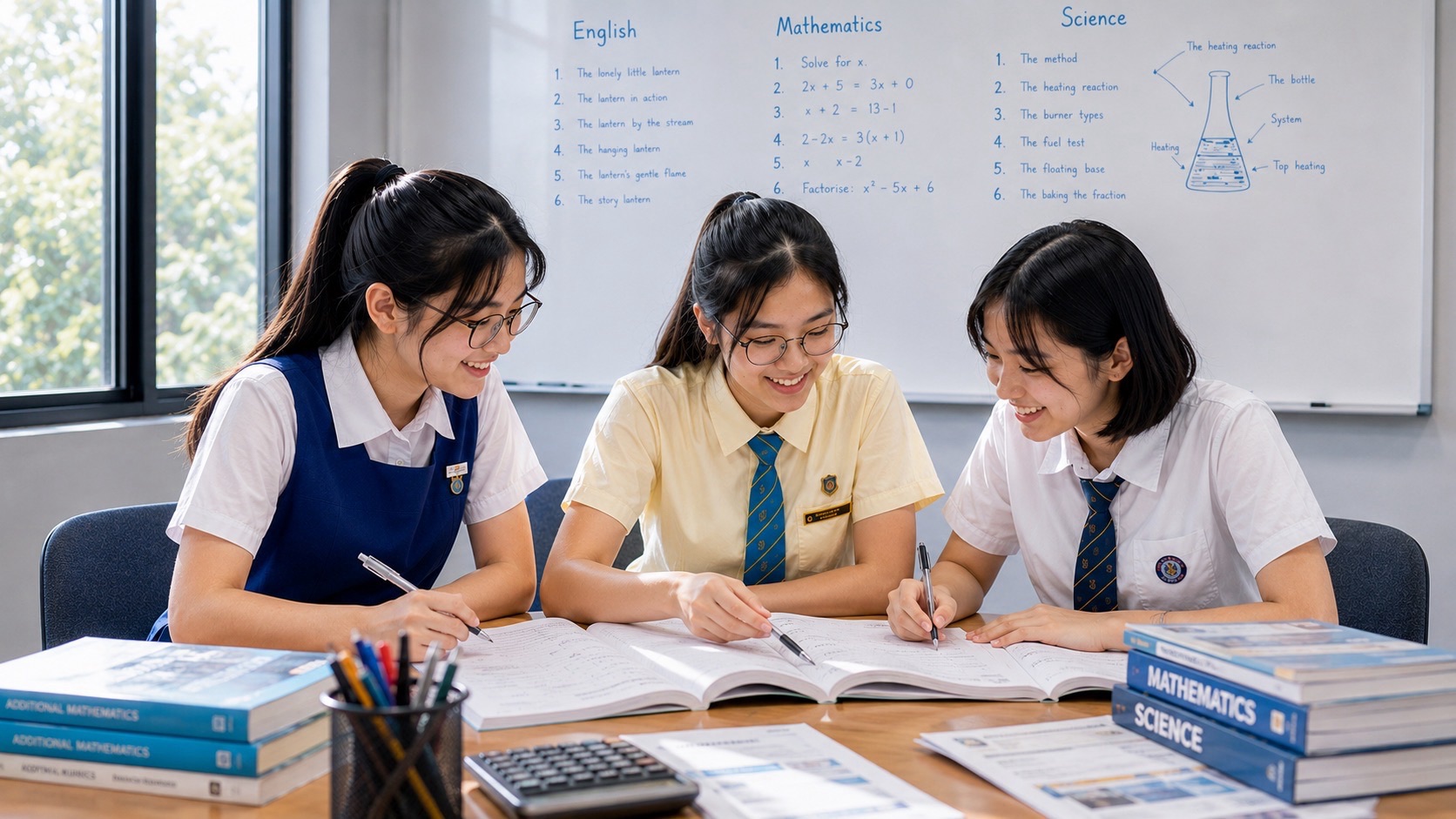
Secondary 4 G2 English Language is the study of English at the G2 subject level during Secondary 4. For the 2027 Singapore-Cambridge Secondary Education Certificate (SEC), its syllabus code is K200. Students need to understand texts, communicate ideas and use English accurately across writing, comprehension, listening and oral work. Start by checking the subject level and examination year on your child’s school documents against the official SEAB subject list.
For parents, the most useful question is where your child’s English breaks down: understanding a passage, developing an explanation, controlling sentences, following spoken information or expressing an opinion. Those difficulties need different practice. This guide explains the examination, then shows practical ways to identify and repair specific gaps. The examples are original teaching exercises. Build the plan around the school’s feedback and the SEC timetable: English written examinations take place in September, with oral and listening components scheduled earlier.
- Check the right subject: G2 English Language, K200, for the 2027 SEC examination.
- Read the assessment map: understand what each paper asks before choosing revision materials.
- Diagnose one difficulty at a time: use a recent answer and the teacher’s comments.
- Write for a real reader: make the purpose, information and requested action clear.
- Read with evidence: explain how the words in a passage support your answer.
- Practise spoken English: develop an opinion, a reason and a relevant example.
- Prepare early enough: leave time to correct work before the written-examination period.
- Discuss future options carefully: check requirements for the intended intake and course.
- Keep support proportionate: choose manageable practice that your child can explain and repeat independently.
Examination-year reference: 2027 SEC school-candidate syllabuses. Sources checked on 15 November 2026. Confirm the applicable syllabus and school instructions for your child’s examination year.
Find your next learning step
Start with the question that is most useful for your family, or read the guide in order.
- Understand the subject — chapters 1–3
- Develop writing — chapters 4–6
- Read and summarise — chapters 7–8
- Listen, speak and use words — chapters 9–11
- Plan and support — chapters 12–14
Contents
Understand the subject · chapters 1–3
Develop writing · chapters 4–6
Read and summarise · chapters 7–8
Listen, speak and use words · chapters 9–11
Plan and support · chapters 12–14
A subject label helps a family find the correct teaching and assessment requirements. It should not become a description of the whole child. Under Full Subject-Based Banding, students can have different subject-level combinations. Your child’s English level therefore does not tell you their Mathematics level or their strengths outside the classroom. MOE explains the wider arrangement in its Full SBB information.
Keep three details together whenever you look for resources: the subject name, level and examination year. A worksheet labelled only “Secondary 4 English” leaves an important question unanswered. It may provide useful reading practice, but its task lengths, timing or expectations may belong to another syllabus. Ask the teacher which materials are appropriate before treating a practice score as an indication of examination readiness.
By Secondary 4, there is also a difference between knowing an English idea and using it when needed. A student may explain past tense accurately in conversation and still switch tense halfway through a story. Another may understand a passage after a long discussion but struggle to form a concise answer alone. Both students have something useful to build on. Their next step is to make the skill available during independent work.
Try asking your child to show one answer they are pleased with and one they cannot yet explain. This creates a more informative starting point than asking whether English is “good” or “bad”. You may discover that the confident speaker needs help organising paragraphs, while the quiet reader needs more opportunities to explain a view aloud.
This guide uses the 2027 examination as its reference. The preparation routines are suggestions for families, not additional SEAB rules or a replacement for the school’s instructions.
CHAPTER 2 OF 14 · Understand the subject
2. Know the assessment before planning revision
The 2027 K200 syllabus, pages 4–6, specifies four compulsory papers. Here is a compact assessment map.
| Paper | Tasks | Marks | Weight | Duration |
|---|---|---|---|---|
| 1: Writing | Editing (10); situational writing, 180–250 words (30); continuous writing, 250–400 words, choose one of four topics (30) | 70 | 35% | 1 hour 50 minutes |
| 2: Comprehension | Section A: two texts including a visual (5); B: narrative/recount (20); C: non-narrative and summary of about 80 words, excluding supplied introductory words (25) | 50 | 35% | 1 hour 50 minutes |
| 3: Listening | Section A: recordings heard twice (22); B: note-taking, recording heard once (8) | 30 | 10% | About 45 minutes |
| 4: Oral Communication | Planned response of up to two minutes (15); spoken interaction (15), using a video | 30 | 20% | About 20 minutes, including 10 minutes of preparation |
The weighting column matters when you interpret practice work. Thirty marks in one component do not necessarily contribute the same amount to the final subject result as thirty marks elsewhere. For example, earning half the available marks in a component weighted at 20% contributes ten percentage points to the weighted total. This is arithmetic for understanding weightings, not a prediction of a final grade.
Use the map to avoid an unbalanced revision folder. If almost every completed task is an essay, look for evidence of reading, listening and speaking practice as well. Equally, a student who enjoys oral discussion still needs to practise putting ideas on paper.
Do not divide every week mechanically according to the examination percentages. Start with the child’s current evidence. A short, focused sentence lesson may improve several kinds of written work, while an unresolved listening difficulty deserves its own attention.
Choose a recent piece of marked schoolwork and examine three answers. One should be successful, one partly successful and one difficult. Ask what changed between them. Did the student understand the question? Find the relevant information? Explain it? Finish in time? This small comparison is often more useful than collecting a large pile of papers without reviewing them.
Consider an original practice question about a student who stays behind after class to repair a damaged display. If your child cannot explain what happened, begin with the passage itself. If they can explain the situation aloud but write “He was good”, the difficulty is expression and precision. If they write a clear answer about the wrong character, check question-reading and reference tracking. Similar marks can hide quite different causes.
A simple correction record can have four columns: task, my first answer, what went wrong, and my improved answer. Keep the explanation specific. “Careless” is too broad to guide practice. “I confused the person speaking with the person being described” tells the student what to check next time.
Then choose a small follow-up task. For reference tracking, underline every pronoun in a short paragraph and identify the person or thing it refers to. For a vague explanation, replace one general adjective with a supported description. For a missed instruction, state the question in your own words before answering it. These exercises isolate a difficulty that a full paper may conceal.
Check the skill again with a different passage after the correction. Repeating the original answer from memory shows that the answer was remembered; it does not yet show that the method transfers. A new example helps both parent and child see what is becoming independent.
Ask the teacher to help rank the priorities. A family may notice spelling because it is visible, while the larger obstacle is incomplete reasoning. The teacher’s view of several pieces of work can help you choose the most useful starting point.
For a short check, give the student two unfamiliar questions that require the same skill but concern different situations. Let them work without hints, then ask them to explain their choices. If one answer succeeds and the other fails, compare the wording of the questions. Perhaps a negative instruction was missed, or the second question required a reason as well as a detail. Record the difference. This keeps the next practice session connected to an observable problem instead of a general judgement about ability.
A sentence is a place where meaning and grammar meet. When a student changes words without checking the meaning, the sentence may become more complicated without becoming clearer. Begin with a short message the student understands, then inspect how the words fit together.
Here is an original teaching example: “The student carrying two books were waiting outside when the teacher arrive.” The repair is: “The student carrying two books was waiting outside when the teacher arrived.” Discuss the main subject and the time relationship. The nearby plural noun “books” can distract the writer from the singular subject “student”. The second verb also needs to fit the past situation.
For an unambiguous agreement exercise, simplify further: “Each student have a copy.” The repair is “Each student has a copy.” Ask the student to write a new sentence using “each”, then a sentence beginning with “the students”. The contrast checks whether the rule can be used beyond the original example.
Keep different problems separate. Agreement asks which verb form matches the subject. Tense asks how the event sits in time. A missing article concerns the noun phrase. A long sentence joined only by commas may need its structure reconsidered. Naming the problem gives the learner a practical way to check it.
For writing practice, mark two recurring patterns and revise those first. If every line is covered with changes, ask the child to explain just one correction fully. Why was it needed? What meaning would another version create? Can they produce a fresh example without copying?
Finish by returning to a paragraph the student wrote. A grammar exercise is most useful when the learner can recognise the same pattern in their own work. The aim is controlled communication, not a collection of rules that remains separate from writing.
Before writing, imagine the person who will receive the message. What do they already know? What do they need to decide? What information would make that decision possible? These questions turn a writing task into a communication problem with a clear purpose.
Consider this original practice situation. Your class has been offered two activities: a neighbourhood litter survey or a storytelling session for younger pupils. Write to a teacher recommending one and explaining how the class could prepare. This is a teaching example, not an official examination question. For a short exercise, invent a few practical details and clearly keep them within the example.
A weak recommendation might say, “We should do storytelling because it is interesting and meaningful.” The reader still does not know what the class will do or why this choice suits it. A developed version might say, “I recommend the storytelling session because our class can prepare short stories in small teams. Rehearsing together would also allow quieter classmates to practise before speaking to the younger pupils.”
The stronger version connects a choice to a reason and then to a practical consequence. It does not rely on an impressive adjective to carry the explanation. A second paragraph could suggest selecting age-appropriate stories, agreeing on roles and rehearsing the transitions between speakers.
Use a planning grid with four boxes: reader, purpose, required information and next action. Fill each with brief notes before composing. If the task provides details, check them against the plan. Do not add a venue, fee, date or promise merely because it makes the message sound complete.
During checking, read the piece as its intended recipient. Can the teacher identify the recommendation immediately? Are the reasons connected to the proposed activity? Does the final paragraph make a reasonable request? A polite tone helps, but politeness alone cannot supply missing information.
For parents, useful feedback can be as simple as “I understand your choice, but I still need to know how the class would prepare.” Let the child make that improvement. Rewriting the whole message for them removes the decision-making practice they need.
Continuous writing gives students room to develop an experience, viewpoint or explanation. A useful first step is to identify the exact centre of the chosen topic. A story about teamwork must show how people work together. An argument about school activities must explain a position on those activities. A prepared paragraph becomes unhelpful when it pulls the response away from the question.
For an original narrative exercise, use this prompt: “Write about a time when asking for help changed the outcome.” Plan one central difficulty, one decision to ask, and one consequence. A student preparing a class presentation might struggle with a faulty display, hesitate to admit the problem, then ask a classmate who suggests a workable alternative.
The important turning point is the decision to speak. Spend some writing time there. What made the student hesitate? What did they finally say? How did the other person respond? A story filled with unrelated travel details may leave too little room for the event that answers the prompt.
Compare “I was nervous” with “I opened the message window three times before typing a single sentence.” The second version gives the reader a visible action. It can support the emotion without a long list of dramatic adjectives. Clear detail is especially useful when it reveals what the character wants or fears.
For an argument, use a different plan. State the claim, explain the reason, give a relevant example and consider a limitation. Suppose the question concerns student responsibility for shared spaces. A paragraph might explain how agreed responsibilities make expectations visible, then acknowledge that duties should be manageable alongside schoolwork.
Check each paragraph by asking what it contributes. If two paragraphs repeat the same reason, develop a genuinely different point or combine them. If an example is vivid but does not support the claim, replace it.
A parent can respond as a reader: “I could follow the event, but I did not understand why the character changed their mind.” That observation directs attention to development while leaving the student in charge of the writing.
Reading an entire passage is only the first stage of comprehension. The student must also connect a particular question to the part of the text that answers it. Encourage a brief pause before writing: what information is being requested, and what evidence would justify the answer?
Use this original micro-passage: “When another student’s name was announced for the prize, Hana smiled and applauded. Under the table, she slowly folded the speech she had prepared.” Asked how Hana probably feels, a student might say “happy” because she smiles. A closer answer could be that she feels disappointed but is trying to respond graciously. Folding the unused speech suggests she had hoped to win; smiling and applauding show her outward response.
The interpretation remains tied to the text. It would be too much to claim that Hana hates the winner or plans to stop competing. Those ideas are possible in an invented story, but this passage does not provide evidence for them. Practising this boundary helps students distinguish inference from invention.
For a language question, move beyond naming a technique. If a writer describes a corridor as “swallowing the last footsteps”, ask what impression those words create in this particular scene. A possible explanation is that the sound disappears into an empty space, emphasising its quietness. The explanation should connect wording and effect.
When reading a poster or other visual text, inspect the relationship between image, headline and practical information. A large picture may attract attention, while a small line contains a condition that changes the message. Ask who the communication addresses and what action it encourages. Then identify the actual details that support that interpretation.
Keep an evidence margin during practice. Write a few words identifying the relevant line or phrase before drafting the answer. Later, remove this extra step when the student can make the connection reliably.
If an answer is wrong, return to the reasoning rather than memorising the replacement sentence. What was overlooked? Which assumption went beyond the passage? This makes the correction useful on the next unfamiliar text.
Summary practice is an exercise in selection and faithful compression. Begin by identifying the precise focus of the task. A passage may discuss benefits, difficulties and solutions, while the question asks for only one of these. Clear writing cannot repair the selection of irrelevant information.
Try this original exercise. A school reading club moved its meetings to lunchtime so pupils who travel far could attend. It introduced rotating discussion leaders so more members could contribute. It also stored books in a shared cupboard to reduce the need to carry them between classrooms. Summarise the changes and their purposes.
A possible compressed version is: “The club held lunchtime meetings to improve attendance, rotated discussion leaders to widen participation, and stored books together to reduce carrying them between classrooms.” The sentence preserves the three actions and their intended purposes. It removes repeated references to the club and replaces longer expressions with concise equivalents.
Now compare an inaccurate version: “The club became more popular because it bought new books.” This introduces a purchase and a result that the example did not establish. A summary must not turn an intended benefit into a confirmed outcome.
Work in three passes. First, mark relevant ideas without worrying about elegant language. Second, combine ideas that share a subject or relationship. Third, check whether each shortened phrase still means what the original meant. Counting words belongs alongside these checks, not in place of them.
Be careful with mechanical synonym swapping. “Cheap” and “affordable” can overlap, but they do not always carry the same meaning. “Some” cannot simply become “all”. Keep qualifications and relationships that matter, even when a shorter alternative looks attractive.
For a parent, a useful question is “Where did this idea come from?” Ask the child to point to the supporting material for each part of the summary. If they cannot, the sentence may need to be removed or revised.
CHAPTER 9 OF 14 · Listen, speak and use words
9. Listen for meaning, changes and relationships
Useful listening practice requires an active task. Playing English audio while doing something unrelated may provide exposure, but it does not show whether the student can identify a detail or follow an explanation. Choose a short recording and agree on a specific listening purpose.
For an original practice script, read this aloud: “The workshop was first planned for Tuesday, but the hall is unavailable. It will now take place on Thursday. Students should submit their forms by Monday.” Ask for the event day and the form deadline. A student who writes Tuesday has caught a clear word but missed the change that follows it.
Discuss the signals that organise meaning: “however” introduces contrast, “instead” replaces an earlier option, and “because” introduces a reason. These words can change how the nearby details should be understood. The exercise is not to predict a particular examination recording, but to practise following the speaker’s logic.
When taking notes, choose short forms the student can read later. Capturing every word can make it difficult to keep up. A simple note such as “Thu workshop; Mon forms” preserves the needed relationship in the example.
After listening, compare the response with the recording or transcript when one is legitimately available. Separate hearing difficulty from interpretation difficulty. Was a word not recognised? Was it heard correctly but attached to the wrong event? Did the student lose their place while writing an earlier answer?
Repeat a short passage once for learning, then try a fresh passage under the intended practice conditions. Improvement should eventually appear without repeated rescue. Follow the teacher’s instructions for examination preparation and use the official paper arrangements when practising a complete listening task.
CHAPTER 10 OF 14 · Listen, speak and use words
10. Make an oral answer clear enough to follow
A useful oral response gives the listener a position and a reason to understand it. Students sometimes try to sound fluent by speaking continuously, but a long answer can still have little direction. Practise deciding what the main point is before beginning.
Imagine an original teaching scenario showing students organising a shared study area. A prompt asks whether young people should help care for common spaces. One possible opening is: “Yes, because sharing responsibility can make students more aware of how their actions affect other users.” The speaker could then describe a practical example, such as returning furniture after a group activity.
A developed response can also recognise a condition: responsibilities should be clear and suitable for the students involved. That qualification makes the idea more precise. It does not require the speaker to abandon the original view.
For preparation, write keywords rather than a complete speech: position, reason, example, qualification. Speak from those notes and listen to a recording of the attempt. Can a listener identify the main idea? Does the example actually explain it? Are there sentences that begin again repeatedly because the speaker has not decided where they are going?
In a conversation, listen to the new question before delivering the next answer. A follow-up about fairness needs a response about fairness, even if the student has prepared a strong point about convenience. Practise with a family member who asks one sensible follow-up after each answer.
A quieter student can begin with a short response in a comfortable setting and gradually extend it. The first goal is understandable communication. A student who speaks easily may need a different challenge: remove repetition and make the reasoning more specific.
Give one piece of feedback at a time. “Your example helped me understand your reason” identifies something to retain. “I lost the connection between your first and second points” identifies something to repair. Avoid requiring an unfamiliar accent or a rehearsed personality; work on clarity, pace and meaning.
CHAPTER 11 OF 14 · Listen, speak and use words
11. Learn vocabulary that can do useful work
A vocabulary notebook becomes more useful when each word has a job. Instead of recording only a definition, add a sentence that shows the word’s meaning, a common combination and a contrast with a nearby word. Then use it in a fresh context.
Take “reluctant”. A student might write: “I was reluctant to volunteer because I had never spoken to such a large group.” Contrast this with “unable”. The first describes hesitation or unwillingness; the second describes a lack of ability or possibility. Replacing one with the other changes the explanation.
Choose words from actual reading and corrected work. If the student repeatedly uses “good”, investigate the intended meaning. Is the plan practical, fair, effective, generous or enjoyable? Each word answers a different question. Precision begins with choosing the meaning, not searching for the longest replacement.
Ask for a second sentence a few days later. The new sentence should use a different situation. This shows whether the word is available beyond the first example. A student who remembers a definition but cannot use the word may need more examples and contrasts.
Reading can supply contexts for this work. Select a manageable article, story or other appropriate text and discuss one interesting choice of language. Do not turn every page into a vocabulary test. Sometimes the most useful conversation is about a character’s decision or whether an explanation was convincing.
Keep the collection small enough to revisit. A short set of words used accurately in speech and writing provides clearer evidence of progress than a long list copied once and never used again.
CHAPTER 12 OF 14 · Plan and support
12. Build a revision sequence around the school year
Plan backwards from the school’s confirmed assessment and examination dates. SEAB’s SEC overview gives the broad examination arrangement; the school and published timetable provide the specific instructions your child must follow. Do not assume that all English preparation can wait until the period used for other written subjects.
At the start of a preparation cycle, collect a small sample: one piece of writing, a few comprehension answers and an oral attempt. Use these to choose two priorities. For example, the priorities might be developing explanations and maintaining tense. Write them in language the student understands.
A possible week could contain a short passage discussion, one paragraph-writing task, one oral response and a correction session. This is an example to adapt around schoolwork, not a required schedule. A student already receiving substantial assignments may need to improve how those assignments are reviewed rather than add a separate workload.
Move from focused practice to mixed practice. First, repair a specific skill with short exercises. Next, use it in a larger task where the student must decide when it is needed. Finally, practise completing a full component under its relevant conditions. Timing too early can repeatedly expose a difficulty without teaching the missing skill.
Closer to the examination, review the errors that still recur. Check that the student can start each task, allocate attention sensibly and finish a usable response. Avoid replacing every familiar routine with a new method simply because the date is approaching.
After a timed attempt, compare the first and final parts of the work. Did sentence control deteriorate? Were later questions unanswered? Did the student spend too long polishing an early paragraph? These observations help identify whether the next adjustment should concern knowledge, checking or time allocation.
Leave space for correction. Completing a paper and putting it away records effort, but an examined error gives the next session a purpose. Keep the cycle visible: attempt, review, repair and try again with new material.
CHAPTER 13 OF 14 · Plan and support
13. Help without taking over the student’s work
Parents do not need to become English examiners to provide useful support. They can help a child organise materials, explain a plan and notice whether a chosen practice routine is working. The teacher remains the best starting point for understanding the school’s expectations and the student’s pattern of performance.
Bring specific evidence to a conversation with the teacher. Instead of “How can we improve English?”, ask “My child can explain this answer aloud but writes very little. What should we practise first?” Another useful question is whether a recurring error reflects misunderstanding, language control or an incomplete response to the task.
For a student rebuilding confidence, begin with a task small enough to complete and explain. That might be one clear paragraph rather than a full essay. Keep the standard visible: the paragraph should answer its question and develop a reason. Making the task smaller does not mean removing its purpose.
For a student maintaining steady performance, look for inconsistency. Can they produce the same quality with an unfamiliar topic? Do they apply corrections in later work? For a student progressing comfortably, deepen the task by asking for a more precise explanation, a relevant qualification or a comparison between two reasonable interpretations.
Keep help within the student’s ownership. You can point out that an idea is unclear, ask a question or suggest checking a reference. Let the student choose the words and make the revision. An adult-polished paragraph can hide the very difficulty that the teacher needs to see.
If a digital tool is used for practice, ask the learner to explain every suggested change and check it against the task. A polished answer is not evidence that the child can produce or evaluate it independently. Follow the school’s rules for assignments and assessment, and keep practice distinct from submitted work.
For a family in Yishun, the practical plan should fit the actual school day and travel commitments. Begin with existing lessons, feedback and available school support. Extra activity is useful only when it addresses an identified need and leaves the student able to carry out the learning themselves.
CHAPTER 14 OF 14 · Plan and support
14. Read results carefully and choose the next step
A result is a summary, so examine the work behind it before deciding what to change. Compare component performance, repeated feedback and independent attempts. A stronger total with the same unresolved weakness may need a different response from a stable total accompanied by clearer explanations and fewer unfinished answers.
SEAB lists G2 grades from 1 to 6 in its SEC grading information. Do not turn a practice-paper percentage into a guaranteed national examination grade. Different tasks, marking and examination conditions can affect what the classroom result tells you.
For post-secondary planning, record the intended intake year and look up the specific route and course requirements with the school’s Education and Career Guidance support. English may be part of an aggregate and may also have its own requirement. Passing one subject therefore does not, by itself, establish eligibility for every programme. Avoid applying an older admission table automatically to a child finishing the SEC in 2027.
Does G2 English describe all my child’s subjects?
No. Check the actual subject-level combination. For planning English practice, use the registered English syllabus rather than assuming that a label attached to another subject applies here.
Should we buy more practice papers immediately?
First examine what is already available and whether it has been corrected meaningfully. If the student does not understand why an answer failed, another paper may reproduce the same problem. Choose additional material when you can explain what it will help the student practise.
What if my child speaks well but writes weakly?
Use speech as a starting point. Ask for an explanation aloud, turn its main idea into a sentence, and then develop the supporting detail. Check organisation and sentence control separately. Oral confidence and written control can develop at different rates.
What can we do this week?
Confirm K200 and the examination year. Select one marked task. Ask your child to explain one successful answer and one difficult answer. Choose a small repair, practise it, and check it on fresh material. Share a focused question with the teacher if the difficulty remains unclear.
The purpose of this sequence is to make progress observable. Your child should increasingly be able to say what they are trying to communicate, identify what went wrong, and make a useful improvement without someone supplying the answer.
Contents · Previous chapter · Explore the English learning hub
Official sources and further reading
Use the official syllabus for assessment rules. The worked examples and study routines in this guide are original learning material; school instructions govern the student’s actual arrangements.
- SEAB: 2027 SEC G2 syllabuses for school candidates
- SEAB: 2027 G2 English Language syllabus K200
- SEAB: Secondary Education Certificate overview
- MOE: Secondary school curriculum and Full Subject-Based Banding