
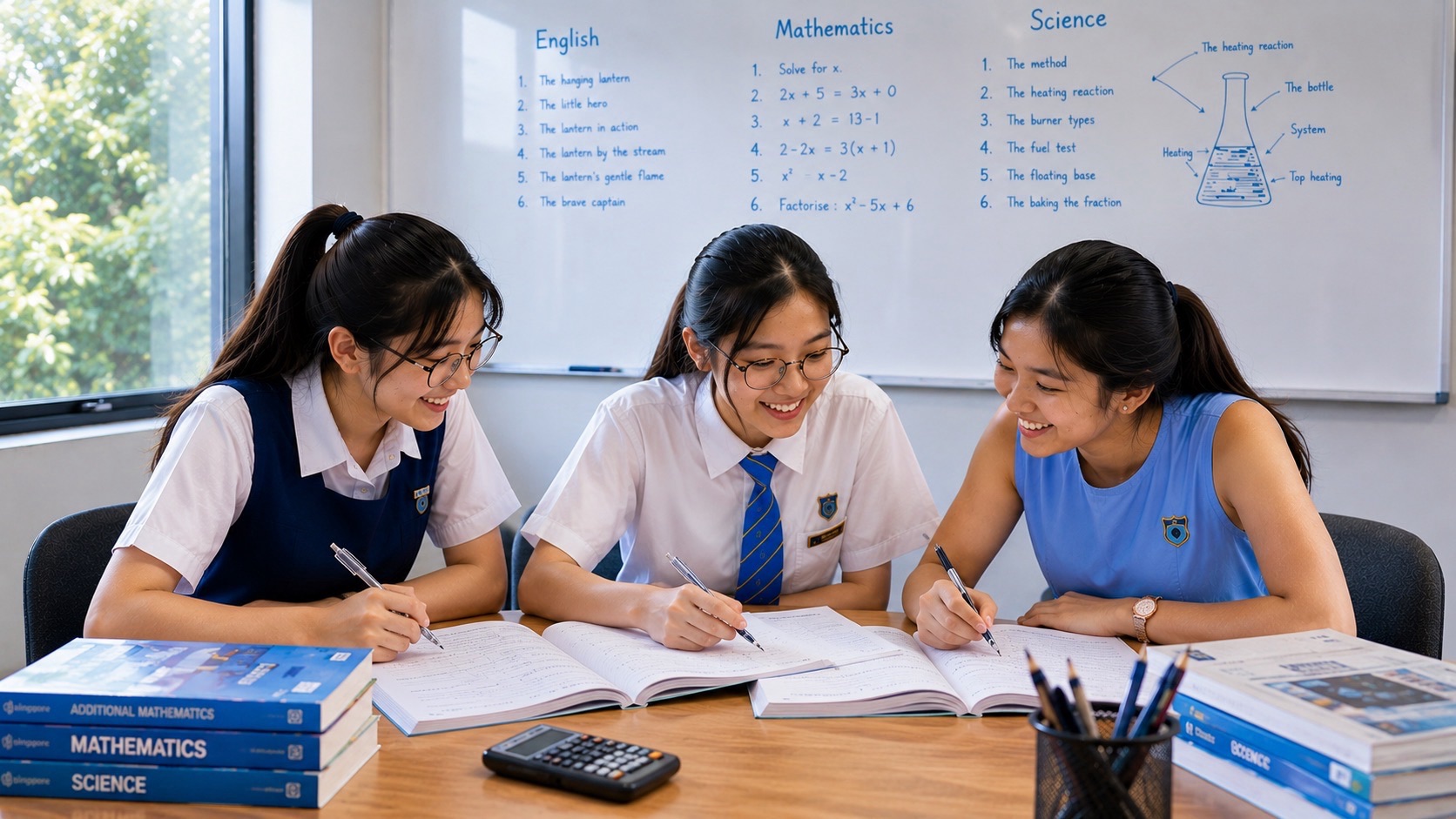
Secondary 3 G2 Mathematics is the upper-secondary Mathematics course taken at G2 subject level under Full Subject-Based Banding. Students develop the knowledge and reasoning needed to work with numbers, algebra, graphs, geometry, measurement and data. SEAB lists G2 Mathematics as syllabus K210 for the 2027 SEC school-candidate examination. For parents, the first useful question is whether a child understands the relationships behind a solution and can use them independently when the question changes.
Begin with the school’s Secondary 3 topic sequence, assessment information and marked work. The 2027 K210 document describes the terminal examination rather than a separate national Secondary 3 examination. A student entering Secondary 3 in 2027 would ordinarily reach Secondary 4 in 2028, so confirm the applicable examination-year syllabus with the school. Use the first upper-secondary year to connect earlier foundations with current learning, repair specific gaps and develop dependable habits before attempting large amounts of timed revision.
- Subject level: G2 refers to Mathematics in this guide; the student’s other subjects may be taken at different levels.
- Course understanding: connect calculations, algebraic relationships, diagrams and explanations.
- First checks: inspect fractions, negative numbers, equation balance, units and question reading when unfamiliar work becomes difficult.
- School alignment: use the teacher’s sequence and assessment scope instead of assuming every school introduces topics in the same term.
- Practice: begin with a clear example, vary it, then try a fresh problem without prompts.
- Assessment: distinguish Secondary 3 school tests from the later SEC paper requirements.
- Parent support: ask the child to explain one decision and identify one next step; keep correction focused and manageable.
Find the section you need
Choose a reading route, or open the chapter index and continue through the full guide.
Chapter index
Chapters 1–8
- Understand the course before building a revision plan
- Check the foundation hidden inside a harder question
- Treat algebra as a way to describe relationships
- Make equation solving preserve equality
- Connect factorisation, quadratic equations and context
- Read graphs as representations of change
- Control percentages, ratios and units
- Use geometry to reason from given information
Chapters 9–16
- Choose the relationship in a right-angled triangle
- Keep measurement and spatial thinking connected
- Read statistics with attention to what the data represents
- Make probability start with possible outcomes
- Understand the SEC assessment and use tools carefully
- Build a manageable practice and correction routine
- Make support and subject-level decisions from evidence
- Questions parents and students often ask
CHAPTER 1 OF 16 · Build the foundations
1. Understand the course before building a revision plan
MOE organises G2 Mathematics around three broad strands: Number and Algebra, Geometry and Measurement, and Statistics and Probability. Its G2 and G3 Mathematics curriculum document also emphasises problem solving, communication and applications. The important implication for a parent is that a chapter list describes only part of the learning. A student needs to recognise when an idea applies and explain how the answer relates to the problem.
Imagine a child who can calculate the area of a rectangle but struggles when a question asks how many tiles must be purchased. The arithmetic may be secure. The difficulty could be converting units, interpreting the arrangement, allowing for whole tiles or recognising which information matters. Giving another page of identical area calculations would not necessarily address that difficulty.
Organise revision around two questions: what relationship is being learned, and what prevents the student from using it? This creates a more useful plan than colouring a chapter green because its exercises were completed. Completion records activity; an independent explanation shows more about understanding.
The examples in this guide are original teaching illustrations drawn from ordinary mathematical relationships. They are not official examination questions, predictions or a complete list of Secondary 3 lessons. Some revisit earlier foundations because those foundations can become the point of failure in upper-secondary work. Follow the school’s current scope when choosing which examples are timely.
A good starting folder contains the current topic list, recent marked work and a short record of recurring errors. It should help the learner decide what to practise next, rather than become another large collection of papers that nobody reviews.
CHAPTER 2 OF 16 · Build the foundations
2. Check the foundation hidden inside a harder question
Upper-secondary work can expose an earlier weakness without looking like an earlier topic. A quadratic expression may be difficult because the student loses a negative sign during expansion. A trigonometry question may fail because the learner divides in the wrong direction. A percentage problem may reveal uncertainty about fractions rather than a new difficulty with percentages.
Start with a brief check connected to the actual error. Suppose the student simplifies −3(2x − 5) as −6x − 15. Ask what −3 × −5 equals, then reconnect that multiplication to the bracket. The correct expansion is −6x + 15. The goal is to identify the point where the reasoning changed, not to attach a broad label such as “weak at algebra”.
Substitution provides a useful check. When x = 1, the original expression is −3(2 − 5) = 9. The correct expansion gives −6 + 15 = 9; the incorrect one gives −21. A numerical check can expose this particular error, although testing one value does not prove that two expressions are always identical.
Use a second example with different signs to see whether the correction transfers. Then return to the school question that first revealed the problem. Repair is most useful when the child can see how an earlier skill makes the current task manageable.
Keep this process proportionate. A student does not need to repeat an entire primary-school workbook because of one uncertain fraction operation. Identify the smallest prerequisite that is unstable, teach it clearly, check it with a fresh example and reconnect it to the present topic.
CHAPTER 3 OF 16 · Use algebra and relationships
3. Treat algebra as a way to describe relationships
Algebra becomes easier to reason about when letters stand for something clear. Consider an illustrative school activity that charges a fixed preparation fee of $12 and $3 for each participant. If n is the number of participants, the total charge is C = 12 + 3n. The expression contains both a fixed amount and an amount that changes with attendance.
For eight participants, C = 12 + 3(8) = $36. If one more participant joins, the total rises by $3, not by $15. Ask the learner to explain that change before calculating another total. The explanation shows whether the two parts of the formula have distinct meanings.
Now suppose the total charge is $57. The relationship becomes 12 + 3n = 57. Subtracting 12 from both sides gives 3n = 45, and dividing both sides by 3 gives n = 15. The answer should be checked in the original situation: $12 plus fifteen charges of $3 equals $57.
Notice the difference between an expression and an equation. The expression 12 + 3n represents a quantity. The equation 12 + 3n = 57 states that this quantity equals a particular value. Students who mix these ideas may try to “solve” an expression that has no stated equality.
Parents can ask the child to identify each symbol, the quantity it represents and any relevant restriction. Here, a participant count is a whole number that cannot be negative. Such restrictions come from the context; they should be considered when interpreting an algebraic answer, rather than added mechanically to every question.
CHAPTER 4 OF 16 · Use algebra and relationships
4. Make equation solving preserve equality
A reliable equation method keeps both sides equal. Take 4x − 7 = 2x + 9. Subtracting 2x from both sides gives 2x − 7 = 9. Adding 7 to both sides gives 2x = 16, so x = 8. Substitution confirms that both original sides equal 25.
The explanation matters because remembered shortcuts can become unreliable when the equation changes. Ask what operation was performed and why it preserves equality. Once the student understands that structure, shorter written working can still reflect sound reasoning.
For simultaneous equations, the same concern with valid operations remains. Suppose two notebooks and one pen cost $7, while one notebook and one pen cost $4. Let n and p represent their prices. The equations are 2n + p = 7 and n + p = 4. Subtracting the second equation from the first gives n = 3, and substitution gives p = 1.
This answer can be checked against both purchases: two $3 notebooks and one $1 pen total $7; one of each totals $4. Checking only one equation is incomplete because a proposed pair must satisfy both conditions. The meaning of the variables also keeps the final response clear.
Use these examples to compare reasoning, rather than require one method for every situation. Substitution may be convenient in one question and elimination in another. Ask the learner what makes their chosen method efficient. If a step cannot be explained, pause there before adding more lines of calculation or another set of questions.
Inequalities need a related but distinct check. For −2x < 8, dividing both sides by −2 reverses the inequality, giving x > −4. Test a permitted value such as zero: the original inequality becomes 0 < 8, which is true. A value such as −5 gives 10 < 8, which is false. These checks help the learner notice the direction of the solution. The result describes a set of values, so writing only x = −4 would answer a different question. Ask the student to explain that difference before moving to more complicated examples.
CHAPTER 5 OF 16 · Use algebra and relationships
5. Connect factorisation, quadratic equations and context
Factorisation rewrites a sum as a product. For example, x² + 5x + 6 = (x + 2)(x + 3). Expanding the brackets checks the relationship: x² + 3x + 2x + 6 returns the original expression. The factorised form becomes particularly useful when the expression is set equal to zero.
If x² + 5x + 6 = 0, then (x + 2)(x + 3) = 0. A product of two real numbers is zero when at least one factor is zero, so x = −2 or x = −3. The student should connect the two answers with the two factors rather than stop after finding the first value.
Now consider a different original example. A rectangle has width x metres and length x + 3 metres, and its area is 40 m². The equation is x(x + 3) = 40, which becomes x² + 3x − 40 = 0. Factorising gives (x + 8)(x − 5) = 0, so the algebraic possibilities are x = −8 or x = 5.
The width must be positive in this model. Therefore x = 5 metres, and the length is 8 metres. Their product is 40 m². Rejecting −8 requires a reason from the context, not a general belief that negative answers are always wrong.
Follow the methods and scope taught in school when a quadratic does not factorise conveniently. Do not force a familiar factorisation onto an unsuitable expression. A useful learning checkpoint is whether the student can distinguish expanding, factorising and solving as three related tasks with different purposes.
CHAPTER 6 OF 16 · Use algebra and relationships
6. Read graphs as representations of change
A graph is a statement about quantities, not just a set of points to plot. Begin by identifying the variables and the scale on each axis. A small square might represent one unit, two units or a fraction of a unit. Reading the scale incorrectly can spoil an otherwise sensible interpretation.
Consider the line y = 2x + 1. When x takes the values 0, 1 and 2, the corresponding y-values are 1, 3 and 5. Every increase of one unit in x produces an increase of two units in y. The gradient describes that relationship, while the y-intercept identifies the value when x is zero.
Using the points (1, 3) and (4, 9), the gradient is (9 − 3)/(4 − 1) = 6/3 = 2. Keep the subtraction order consistent between numerator and denominator. Reversing both orders gives the same result; reversing only one changes the sign incorrectly.
Attach a meaning when the question supplies one. If a graph represents distance against time, the axes determine the units and the interpretation of a slope. A rising line does not mean the same thing in every context. A graph of temperature and a graph of money remaining require different explanations.
For independent practice, ask the student to describe a graph in words before calculating from it. Then ask which feature supports the description. The response might identify an intercept, a turning point or an interval of change, depending on the graph taught. This links visual information with mathematical language.
A quadratic example can connect graph reading with factorisation. For y = x² − 4x + 3, the values of y at x = 0, 1, 2, 3 and 4 are 3, 0, −1, 0 and 3. The equal pairs suggest symmetry about x = 2, and rewriting the expression as (x − 2)² − 1 confirms the minimum point (2, −1). Factorisation gives y = (x − 1)(x − 3), explaining the horizontal-axis crossings at x = 1 and x = 3. Different representations now describe the same relationship.
CHAPTER 7 OF 16 · Use algebra and relationships
7. Control percentages, ratios and units
Percentage errors often begin with an unclear reference amount. Suppose an item costs $72 after a 20% discount. The sale price is 80% of the original price, so the original price is 72 ÷ 0.8 = $90. Adding 20% of $72 gives $86.40 and does not reverse the discount, because the percentage is then being applied to a different base.
Check the answer forward: 20% of $90 is $18, leaving $72. This check is easy to explain and shows why the calculation fits the story. Encourage the learner to name the original quantity, the change and the final quantity before choosing an operation.
Ratios need the same attention to meaning. If two quantities are in the ratio 3:5 and their total is 64, there are eight equal parts. One part is 64 ÷ 8 = 8, so the quantities are 24 and 40. If the question instead gives their difference as 64, the eight-part calculation no longer applies: the difference represents two parts.
Units can change a relationship just as decisively. A journey of 18 kilometres taking 45 minutes has an average speed of 18 ÷ 0.75 = 24 km/h. Dividing by 45 gives kilometres per minute, not kilometres per hour. The arithmetic alone cannot correct a missing unit conversion.
A useful practice set varies one condition at a time: total versus difference, original versus final price, minutes versus hours. Ask the student what changed before asking for the answer. That question develops recognition, which is often the missing link between knowing a method and selecting it correctly.
CHAPTER 8 OF 16 · Reason with shapes and measures
8. Use geometry to reason from given information
A diagram can suggest a relationship without establishing it. Students should distinguish what is given, what follows from a mathematical property and what merely appears true in the drawing. A line that looks horizontal or two sides that look equal should not be treated as evidence unless the question supplies the relevant condition.
For a simple example, a triangle has angles 48° and 67°. Its third angle is 180° − 48° − 67° = 65°. The reason is the angle sum of a triangle. If an adjacent exterior angle is requested, identify the straight-line relationship as well; it would be 180° − 65° = 115° in this arrangement.
Writing the reason beside the relevant step helps the learner check the chain. “Because of the diagram” is too vague. “Angles on a straight line sum to 180°” identifies the property being used and allows another person to follow the argument.
Similarity adds a proportional relationship. Suppose two similar triangles have corresponding sides of 4 cm and 10 cm. The enlargement factor from the smaller triangle to the larger is 10/4 = 2.5. A different 6 cm side of the smaller triangle corresponds to a 15 cm side of the larger triangle.
Before multiplying, confirm which sides correspond and which direction the scale factor describes. Redraw or label the triangles if their orientation makes that difficult. A student can understand ratios perfectly and still choose the wrong pair of sides. The appropriate repair is then diagram interpretation rather than another general lesson on multiplication.
CHAPTER 9 OF 16 · Reason with shapes and measures
9. Choose the relationship in a right-angled triangle
Right-angled triangle problems become more manageable when the learner first identifies what is known and what is required. Pythagoras’ theorem relates the three side lengths. Trigonometric ratios connect an acute angle with ratios of side lengths. Choosing between these relationships should follow the information available.
Suppose the perpendicular sides of a right-angled triangle are 9 cm and 12 cm. If c is the hypotenuse, c² = 9² + 12² = 81 + 144 = 225. Therefore c = 15 cm. The positive value is appropriate because c represents a length, and the result is longer than either perpendicular side.
If the hypotenuse is 13 cm and one perpendicular side is 5 cm, the other side satisfies b² = 13² − 5² = 169 − 25 = 144, giving b = 12 cm. Adding the squares in this situation would treat the wrong side as the hypotenuse. Naming the hypotenuse before calculating prevents that error.
For an acute angle θ in the 9–12–15 triangle, suppose the side opposite θ is 9 cm and the adjacent perpendicular side is 12 cm. Then tan θ = 9/12 = 0.75, so θ is approximately 36.9°. Use degree mode for this degree-based example, and follow the question’s accuracy instruction.
Rotate the triangle and repeat the identification without recalculating. The hypotenuse remains opposite the right angle; opposite and adjacent are determined relative to the chosen acute angle. This small variation checks understanding of the diagram instead of familiarity with one picture.
CHAPTER 10 OF 16 · Reason with shapes and measures
10. Keep measurement and spatial thinking connected
Mensuration questions combine shape, quantity and units. Begin by naming the quantity being found: length, area, surface area or volume. These are different measurements, so a correct-looking formula may still answer the wrong question. Sketching the relevant face, boundary or solid can clarify the task.
For an original example, consider a rectangular container with internal dimensions 30 cm by 20 cm by 15 cm. Its internal volume is 30 × 20 × 15 = 9,000 cm³. Since 1,000 cm³ equals one litre, the corresponding capacity is 9 litres. This calculation assumes the stated dimensions describe the usable rectangular interior.
If asked for the area of its base, the answer is 30 × 20 = 600 cm². If asked about material needed for an open-top container, the learner must identify the base and four sides; simply using the volume calculation cannot answer that surface-area question.
Unit conversion deserves its own explanation. One metre equals 100 centimetres, but one square metre contains 100 × 100 = 10,000 square centimetres. A square area scales in two directions. Thinking about a one-metre square can prevent the common mistake of dividing an area by only 100.
Before finishing, check whether the result is plausible and whether the unit matches the quantity. A capacity of 9,000 litres for the small container would be a signal to inspect the conversion. Estimation will not replace exact working, but it can identify an answer that deserves another look.
CHAPTER 11 OF 16 · Read data and assessment
11. Read statistics with attention to what the data represents
Statistics begins before a calculation. What was measured, who or what was included, and what does each value mean? An average can be computed correctly yet interpreted carelessly. Parents can support this habit by asking the student to describe the data in a complete sentence before finding a summary.
Consider these five illustrative waiting times: 4, 5, 5, 6 and 20 minutes. Their mean is (4 + 5 + 5 + 6 + 20)/5 = 40/5 = 8 minutes. Their median is 5 minutes, and their mode is also 5 minutes. The unusually long wait affects the mean more strongly than the median.
Which summary is useful depends on the question. The mean uses all the recorded times. The median identifies the middle of the ordered data. A student should explain the choice in relation to the purpose, rather than memorise that one average is always best.
Now compare a second illustrative set: 6, 7, 8, 9 and 10 minutes. Its mean is also 8 minutes, although its values are arranged differently around that mean. Identical means do not establish that two experiences are identical. The learner should inspect the data or an appropriate representation before drawing a broad conclusion.
Keep claims within the evidence. Five observations at one location do not establish the waiting time for an entire town. When interpreting a chart, inspect labels, units and axis scales as carefully as the plotted values. A diagram can make a difference appear dramatic without changing the underlying numbers.
CHAPTER 12 OF 16 · Read data and assessment
12. Make probability start with possible outcomes
Probability requires a clear situation and a justified model. For a fair six-sided die with faces numbered 1 to 6, the equally likely outcomes can be listed. The probability of an even number is 3/6 = 1/2 because the favourable outcomes are 2, 4 and 6.
The word “fair” matters. Counting favourable outcomes and dividing by the number of possible outcomes uses the assumption that those outcomes are equally likely. If a question describes a different situation, the student must examine that information instead of applying the familiar fraction automatically.
For another original example, a bag contains three red counters and two blue counters. One counter is selected at random, with each counter equally likely to be chosen. The probability of red is 3/5, while the probability of blue is 2/5. The two probabilities sum to one because these are the only colours in the stated bag.
A probability of 3/5 does not mean every group of five trials must contain exactly three red selections. It describes chance under the stated model. When discussing repeated experiments, specify how the situation is restored or changed between trials; otherwise the learner may reason from an unstated assumption.
For current schoolwork, use the event types and representations the teacher has introduced. The important starting habits are to define the event, identify the possible outcomes and check that the final probability lies between zero and one. These habits remain useful when later questions require more elaborate reasoning.
CHAPTER 13 OF 16 · Read data and assessment
13. Understand the SEC assessment and use tools carefully
For SEC 2027 K210, Paper 1 and Paper 2 are each two hours, 70 marks and 50%. An approved calculator may be used in both. Paper 2 has compulsory Section A questions and a Section B choice of one of two questions. Underlined syllabus content is assessed only in Section B. These details come from the official 2027 assessment scheme; use the school’s separate plan for Secondary 3 tests.
Do not turn the Section B choice into a reason to omit topics casually. Ask the teacher how the class is approaching the applicable content and examination preparation. The published document’s underlining carries meaning that may disappear when a topic list is copied into plain text.
SEAB also states that omitting essential working can lose marks. A calculator result therefore needs a clear mathematical setup and an answer that fits the question. Before entering values, decide which operation expresses the relationship; afterwards, inspect the sign, magnitude and units.
A useful calculator check is to predict a rough answer first. For example, 19.8 × 5.1 should be close to 20 × 5 = 100. A display near 10 or 1,000 should prompt a review of the entry. For trigonometry, check the angle mode appropriate to the task rather than assuming the calculator retained the required setting.
Check current approval requirements through the school before the examination year. Familiarity with one approved model can make routine use less distracting, but no model chooses the mathematical relationship for the student. Keep enough written working for the reasoning to remain visible.
CHAPTER 14 OF 16 · Practise and support
14. Build a manageable practice and correction routine
A useful study session has a limited purpose. Choose one current skill, one older relationship that supports it and one question that requires a choice of method. The exact number of questions should fit the learner’s workload and the time available for reviewing them properly.
Begin with an explanation of one example, then ask the student to attempt a variation. Change an amount, orientation or condition. Once the relationship is secure, mix the question with a different type so the learner must recognise what to do without a chapter heading providing the answer.
When an error occurs, classify its source: interpretation, concept, method choice, calculation, notation or checking. A wrong sign during expansion needs a different response from selecting the wrong side in a triangle. Record the first incorrect decision, not just the final incorrect answer.
Correction should include a fresh question after a gap. Rewriting a solution immediately may show that the student followed the explanation; independent work later gives better evidence that the idea remains usable. Keep the follow-up small enough to identify what changed.
Parents can ask, “Which line are you confident about?” and “Where did you stop knowing what to do?” These questions make the difficulty easier to discuss. If the same blockage continues, bring the work to the teacher and request a precise next step. The aim is a shorter list of unresolved relationships, not an increasingly heavy pile of unfinished worksheets.
CHAPTER 15 OF 16 · Practise and support
15. Make support and subject-level decisions from evidence
MOE’s Full Subject-Based Banding pathway guide explains that students can take subjects at different levels, with school guidance on adjustments. Discuss the child’s Mathematics needs through actual work, sustained progress and the demands of the overall timetable. One disappointing test or one strong worksheet is too narrow a picture for a major decision.
For a teacher conversation, bring two representative examples: one the student completed independently and one that exposed a recurring difficulty. Ask which prerequisites need attention, what support is available and how improvement will be checked. This makes the discussion more practical than asking only whether the child is “good at Maths”.
Mathematics and Additional Mathematics are separate subjects. Families considering that choice can use the existing guide to choosing G2 Mathematics and Additional Mathematics. This article concentrates on understanding and studying Secondary 3 Mathematics itself.
Future admissions depend on the relevant course’s actual requirements and admission year. Avoid treating a subject title alone as a guarantee of a pathway. Keep the immediate learning question clear: can the student interpret a problem, choose a defensible method, carry it out accurately and explain the result?
By the end of a useful period of support, the learner should need fewer prompts for the targeted work and be better able to identify remaining uncertainty. That is progress a family can observe alongside marks. It gives the next school term a clearer starting point.
CHAPTER 16 OF 16 · Practise and support
16. Questions parents and students often ask
Does G2 mean every subject on the timetable is G2?
No. Check the student’s actual subject combination. Use G2 Mathematics materials for this subject and confirm the appropriate level separately for each other subject.
Why can my child do examples but struggle with a test?
Examples often reveal the intended method. A test may require the learner to recognise the relationship independently. Try a fresh mixed question and ask where method selection becomes uncertain before deciding that more speed practice is needed.
Should we finish the entire syllabus early?
Follow the school sequence while checking the foundations required for each new topic. Moving ahead can be useful when earlier learning is secure; an unfinished misunderstanding can also follow the student into several later chapters.
How much working should be shown?
Follow school feedback and the question’s requirements. Make the key relationship, substitution and important steps visible. A reader should be able to follow the reasoning without reconstructing unexplained calculator entries.
What if my child keeps calling every error careless?
Look at one error closely. Did it begin while reading, choosing a method, calculating or copying? Naming the point of failure makes a useful correction possible and avoids turning a specific skill gap into a judgement about effort.
What should we do this week?
Choose one recurring difficulty from recent work, agree on a small practice task and arrange a fresh independent check. If the child cannot explain the correction, ask the teacher for help with that exact step. A clear, achievable next action is a good place to begin.
Official sources and related reading
Official references checked on 15 November 2026. Worked examples and suggested study routines are original teaching illustrations. School instructions and the student’s applicable examination-year syllabus govern lessons and assessments.
More Secondary 3 G2 subject guides
- What is Secondary 3 G2 English Language
- What is Secondary 3 G2 Science (Physics, Chemistry)
- What is Secondary 3 G2 Humanities (Social Studies, History)
- What is Secondary 3 G2 Principles of Accounts
- What is Secondary 3 G2 Design and Technology
- What is Secondary 3 G2 Nutrition and Food Science
- What is Secondary 3 G2 Art