
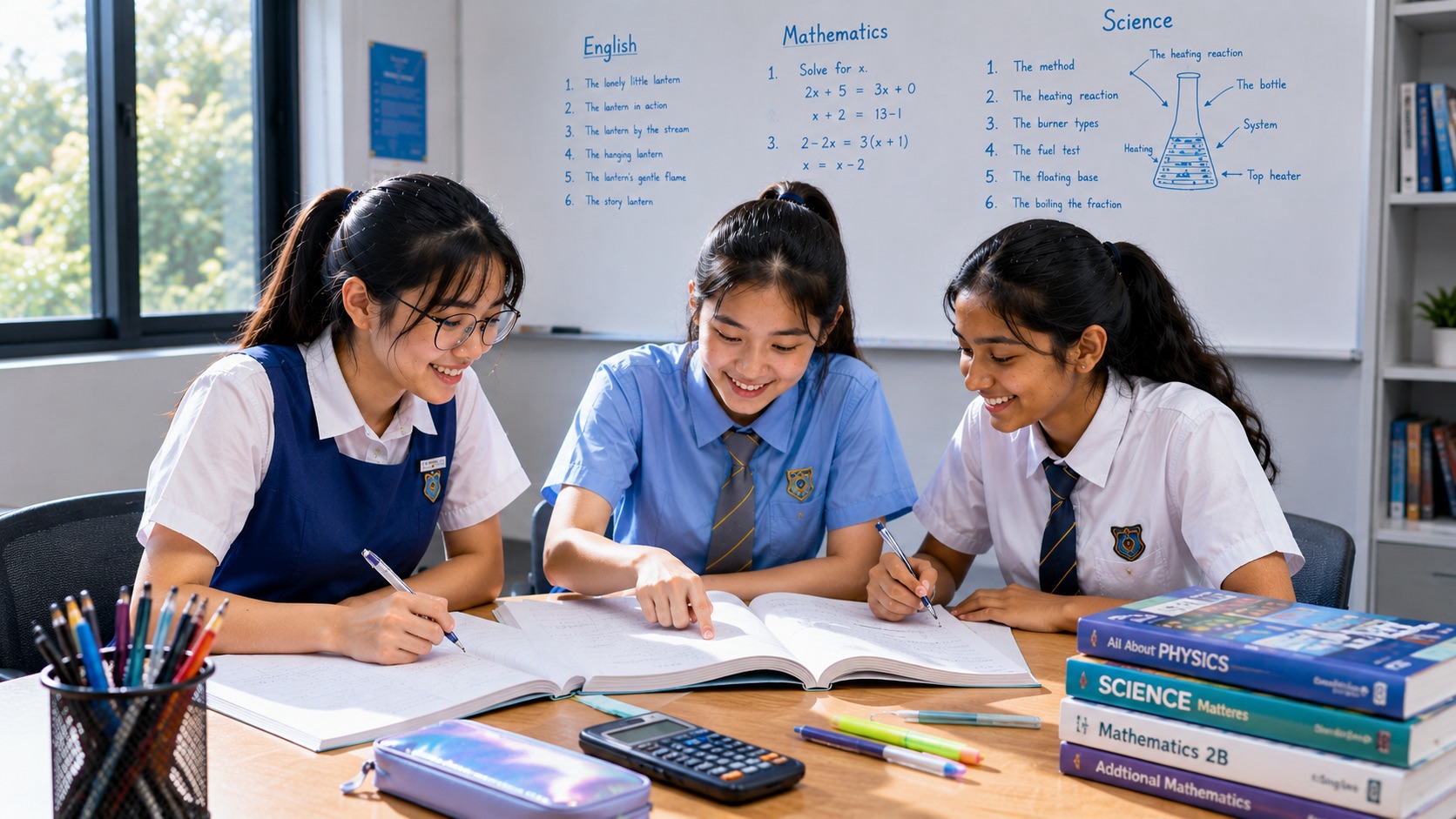
Yishun Mathematics Tuition Centre for Sec 3 E-Maths should help a Secondary 3 student understand why Mathematics suddenly feels less forgiving even when individual chapters seem familiar. Families searching for Sec 3 E-Maths tuition in Yishun, a Secondary 3 Maths tutor, G3 Mathematics tuition, upper-secondary Mathematics support, small-group E-Maths tuition, algebra help, graph skills, trigonometry tuition, geometry revision or exam preparation are often seeing the same transition: the student can follow a lesson, but mixed school questions expose weaknesses that were easy to hide in lower secondary. A sign error appears inside coordinate geometry. Weak factorisation blocks an equation. A graph question becomes difficult because the student cannot connect its equation to its shape. A trigonometry problem is lost before the calculator is even used because the diagram was read incorrectly.
Good Secondary 3 E-Maths tuition therefore needs more than topic coverage. Sec 3 is where error diagnosis becomes a powerful teaching tool. Instead of responding to every wrong answer with another worksheet from the same chapter, the student should learn to identify the failure mechanism: concept not understood, earlier prerequisite missing, method not recognised, representation misread, algebraic manipulation weak, notation inconsistent, calculation careless, or answer not checked. Once the mechanism is known, the repair can be smaller and more precise.
This guide gives this page a distinct job inside the eduKateYishun Mathematics estate: diagnosing and repairing the recurring error systems that appear when students enter upper-secondary E-Mathematics. It is not a duplicate of the broader Secondary 3 method-selection owner, nor a generic syllabus summary. The focus is practical. When a student loses marks in algebra, graphs, geometry, trigonometry, percentage, statistics or mixed questions, how do we find the first weak link, repair it, test whether the repair transfers and prevent the same error from returning under a different topic name?
Why Secondary 3 reveals weaknesses that Secondary 2 could hide
Lower-secondary Mathematics gives students time to learn a new symbolic language. By Secondary 3, that language is expected to be usable. The question no longer announces every prerequisite. Algebra, negative numbers, fractions, proportional reasoning, coordinates and geometric properties may appear inside a new context without warning.
This is why a student can say, truthfully, “I understand the new topic,” and still perform poorly. The new idea may be understood while the supporting machinery is unstable. A trigonometry question may fail because of algebra. A graph problem may fail because of ratio. A statistics question may fail because the student misreads the scale. A mensuration problem may fail because units are inconsistent. The visible topic is not always the real cause.
The educational advantage of Sec 3 is that there is still time to repair these systems before examination pressure dominates. If the student learns to classify errors now, every school paper becomes more useful. Marks stop being the only output. The paper begins to show where the system breaks.
The seven error families
A practical diagnostic framework can classify most Mathematics mistakes into seven broad families.
- Concept error: the underlying mathematical idea is not understood.
- Prerequisite error: the current topic is blocked by an older weak skill.
- Recognition error: the student knows the method but does not recognise when to use it.
- Representation error: the student cannot translate between words, diagrams, tables, graphs and equations.
- Execution error: the correct method is chosen but algebra, arithmetic or calculator work fails.
- Communication error: working, notation, units or reasons are incomplete or unclear.
- Control error: time, checking, sequencing or attention breaks down under pressure.
These categories are useful because they lead to different interventions. A concept error needs explanation. A prerequisite error needs targeted repair. A recognition error needs mixed practice. A representation error needs translation tasks. An execution error needs fluency and routines. A communication error needs disciplined presentation. A control error needs timed practice and examination strategy. “Do more Maths” is too vague to solve all seven.
Error family 1: concept not understood
A concept error occurs when the student lacks the relationship that gives the procedure meaning. For example, a learner may know how to substitute numbers into a formula but not understand what the variables represent. They may memorise the quadratic formula without understanding that it produces solutions to a quadratic equation. They may use percentage change without identifying the original quantity.
The repair is not more speed. It is reconstruction. Use a simpler example, a diagram, numerical cases, a verbal explanation or a comparison. Ask the student to predict before calculating. Ask what would happen if one quantity increased. Ask for a counterexample. Conceptual repair should make the method feel inevitable rather than arbitrary.
Then return to symbolic work. The aim is not to keep the student in concrete examples forever, but to use meaning to stabilise abstraction.
Error family 2: an older prerequisite is failing
Sec 3 exposes prerequisite gaps because new questions combine old tools. A learner struggling with simultaneous equations may actually have weak expansion. A trigonometry problem may collapse because the student cannot rearrange a formula. A graph question may fail because coordinates and substitution are unreliable. A percentage problem may reveal fraction weakness.
One diagnostic question is: “If I remove the new topic, can you do the supporting mathematics?” If the answer is no, repair the prerequisite directly. Do not force the student through a complicated trigonometry question when the real issue is equation manipulation. That creates frustration without useful learning.
Prerequisite repair should be narrow. A student does not need to repeat an entire lower-secondary year. They need the specific earlier mechanism that is blocking present work, followed by immediate reconnection to the current topic.
Error family 3: method known, method not recognised
This is one of the most important upper-secondary problems. During topical practice, the heading tells the learner what method to use. “Factorisation worksheet” is already a hint. “Trigonometry practice” is already a hint. In a test, those labels disappear.
A recognition error occurs when the student has the method in memory but cannot retrieve it from the features of the question. The solution is mixed classification. Before solving, ask the learner to identify what evidence points toward a method. Are there two unknowns and two independent relationships? Does a right-angled triangle make a trigonometric ratio plausible? Does a repeated percentage change suggest a multiplier? Does an intersection represent equal values?
Method recognition improves when students compare. Put two similar-looking questions requiring different methods side by side. Ask what feature changes the decision. Then put two very different-looking questions that share the same structure side by side. Ask what remains mathematically the same.
Error family 4: representation translation breaks
Mathematics can express one relationship in several forms. A rate can appear in words, a table, a graph or an equation. A geometric relationship can be shown in a diagram and then encoded algebraically. Data can move between a raw list, a frequency table and a graph. Students who understand only one representation become fragile when the question changes form.
Translation practice is therefore central. Give a word situation and ask for an equation. Give an equation and ask for a possible context. Give a graph and ask for a verbal description. Give a table and ask what type of relationship might fit. Give a diagram and ask the student to write every justified mathematical fact before calculating.
This kind of work feels slower than drilling, but it builds the flexibility that upper-secondary papers demand.
Error family 5: execution fails after a correct start
Execution errors are frustrating because the student often “knew what to do.” The method was correct, but a sign changed, a bracket was mishandled, a value was copied incorrectly, the calculator entry was wrong or a unit conversion was missed.
The repair is routine design. Write one algebraic transformation per line. Keep equal signs meaningful. Substitute into a written formula rather than typing directly into a calculator. Annotate diagrams. Convert units before long calculations. Estimate the expected direction or size. Delay rounding. Use brackets deliberately in calculator entries.
Execution reliability improves when working becomes inspectable. Neatness is not an aesthetic demand; it reduces the number of hidden state changes in the solution.
Error family 6: the mathematics is right but the communication loses marks
Some students think showing working is only for the marker. It is also for the solver. Working records decisions, exposes mistakes and reduces memory load. In geometry, reasons establish that a step follows from known information. In mensuration, units identify the kind of quantity. In equations, clear transformations show where an error occurred.
Communication errors can include missing units, unclear notation, unsupported geometry claims, incomplete working, ambiguous rounding and answers that are not interpreted in context. These should be practised deliberately rather than mentioned casually after each test.
Error family 7: control fails under time pressure
A student can have adequate content knowledge and still lose control in a timed paper. They may spend too long on one difficult question, rush an accessible section, fail to return to skipped items or stop checking because the final minutes disappear.
Control is trainable. Begin with timed clusters rather than immediate full papers. Ask the student to mark a question when they cross a time threshold and move on. Practise returning later. Build a final-check routine. Track not only whether a question was correct but how long the decision took.
Timing should never replace understanding, but understanding must eventually become available within the time constraints of assessment.
Algebra diagnosis: look past the final wrong answer
Algebra is a good place to see how diagnostic teaching differs from ordinary correction. Suppose a student solves 3(2x – 5) = 4x + 7 and gets the wrong answer. Several different failures are possible. They may expand 3(2x – 5) incorrectly. They may expand correctly but mishandle the negative constant. They may combine unlike terms. They may perform different operations on each side. They may reach the right value and then copy it incorrectly.
Each failure needs a different response. If distribution is weak, return to structure. If signs are weak, isolate signed operations. If equality is weak, use the balance principle. If copying is the issue, improve line-by-line layout. The answer alone does not identify the lesson.
Graphs diagnosis: is the problem plotting, scale or relationship?
Graph errors also have different causes. A student may plot coordinates incorrectly, misread a non-unit scale, swap axes, misunderstand what an intercept represents, or fail to connect a gradient with a rate of change. Asking for “more graph practice” can miss the actual weakness.
A diagnostic sequence can separate these skills. First ask the student to read values from an existing graph. Then plot given points. Then create a table. Then move from an equation to the table and graph. Then interpret what the graph says in context. The stage where performance breaks identifies the repair target.
Geometry diagnosis: evidence before appearance
Geometry problems often reveal a representation error disguised as a calculation error. The student sees a diagram and assumes something is equal because it looks equal. Or they overlook a marking that establishes parallel lines. Or they know an angle property but cannot identify it when the diagram is rotated.
One useful intervention is to delay calculation. Ask the learner to annotate all known facts and write the reason beside each derived fact. Only then calculate. This changes geometry from visual guessing into a chain of evidence.
Trigonometry diagnosis: most mistakes happen before the button press
Students sometimes describe trigonometry problems as calculator problems. The calculator is usually the least important part. The real decisions are identifying the right triangle, selecting the reference angle, labelling opposite, adjacent and hypotenuse correctly, choosing the appropriate ratio, writing the equation, rearranging if necessary and interpreting the result.
Diagnosis should therefore stop before calculator entry. Can the student label the sides? Can they predict whether the unknown length should be longer or shorter than a known side? Can they write the symbolic ratio first? If those steps are secure, calculator errors are much easier to isolate.
Percentage diagnosis: the base quantity is usually the clue
A common percentage mistake comes from using the wrong denominator. If a quantity increases from 80 to 100, the increase is 20, but percentage increase is 20 divided by the original 80. If a price is 20% off, the final price represents 80% of the original. In reverse-percentage work, that relationship must be reversed correctly.
Ask the student “percentage of what?” before any calculation. That question reveals whether the base quantity is understood. It also transfers to profit, discount, growth, comparison and finance contexts.
Statistics diagnosis: wrong calculation or wrong question?
A student may calculate a mean accurately when the median is the more useful measure for the context. Or read a chart without noticing a truncated scale. Or compare percentages when sample sizes differ. These are interpretation errors, not arithmetic errors.
Before calculating, ask what the question is trying to compare. What does each measure capture? What could distort it? Which information is unavailable? Statistical maturity begins when the student recognises that a correct computation can still support a poor conclusion.
The repair loop: isolate, explain, practise, mix, delay
A useful error-repair loop has five stages.
- Isolate: remove unnecessary complexity and reproduce the error in a simpler form.
- Explain: rebuild the relationship or rule so the student knows why the method works.
- Practise: complete a small focused set until the new behaviour becomes accurate.
- Mix: place the skill among neighbouring topics so the student must recognise when it applies.
- Delay: revisit it after several days or weeks without warning to test retention.
Skipping the mix stage produces students who succeed only on labelled worksheets. Skipping the delay stage produces corrections that disappear by the next test.
Worked example: repairing a factorisation error
Suppose a student is asked to factorise 6x + 9 and writes 3(2x + 9). The visible error is incomplete division of the second term. But ask why the 3 was chosen. If the student says “because 3 goes into 6,” they may not be viewing factorisation as extracting a common factor from every term.
Return to numerical structure: 6 apples + 9 apples can be grouped into 3 lots of 2 apples + 3 apples, so 6 + 9 = 3(2 + 3). Then return to algebra: 6x + 9 = 3(2x + 3). Expand the factorised form to check. The reverse operation becomes a built-in verification.
Worked example: repairing a simultaneous-equations recognition error
A word problem gives two relationships involving two unknown quantities. The student knows substitution and elimination but does not know where to begin. The repair is not another page of already-written simultaneous equations. It is translation.
Ask the student to define the unknowns, turn each sentence into one equation and check whether the two equations express independent information. Only then choose substitution or elimination. This moves the difficulty from “Which method do I remember?” to “What relationships does the problem give me?”
Worked example: repairing a trigonometry setup error
Suppose the unknown is a side adjacent to the given angle and the hypotenuse is known. A student chooses sine because sine was used in the last example. The repair should make side relationships determine the ratio. Relative to the chosen angle, identify opposite, adjacent and hypotenuse. The known and unknown sides are adjacent and hypotenuse, so cosine connects them.
Then ask the student to rotate the triangle. The labels should follow the angle relationship, not the page orientation. This checks whether the concept survived the change in appearance.
The error log: convert mistakes into a dataset
An error log becomes useful when it records causes rather than merely questions. A simple entry can contain date, source, topic, error family, exact cause, corrected principle and retest date. After several assessments, patterns become visible.
For example, a student may think graphs are the problem because several graph questions are wrong. The log may show that most of those errors are actually scale-reading mistakes. Or the learner may blame geometry when the recurring issue is algebraic rearrangement inside geometric formulas. Data prevents vague conclusions.
The log should shrink over time. If the same error appears repeatedly without a change in intervention, the correction strategy is not working.
How to distinguish a careless mistake from a weak routine
“Careless” is often used as a diagnosis when it is only a description. If a student makes one isolated copying mistake, it may genuinely be random. If the same kind of mistake appears every week, there is a weak routine.
Repeated sign errors suggest that negative quantities are not being handled visibly. Repeated unit errors suggest the student is treating units as decoration. Repeated calculator errors suggest expressions are being entered without structure or estimation. Repeated misreading suggests the student lacks a deliberate reading routine.
Turn repeated “carelessness” into procedure. Circle negative values. Write units during setup. Use brackets in calculator entries. Underline what the question asks. Predict the rough answer. Routines convert attention from something the student must remember into something the working itself supports.
Mixed practice should be designed around decisions
Randomly mixing topics is not enough. The set should teach discrimination. If a student confuses direct proportion with percentage change, place those structures near each other and ask what evidence separates them. If the learner uses trigonometry whenever a triangle appears, include triangles solved more naturally with Pythagoras, similarity or angle properties.
Good mixed practice asks two questions before calculation: what structure is present, and why is this method appropriate? Once those decisions become faster, examination performance improves even before raw calculation speed changes.
Retrieval: the correction must survive time
Students often feel that they have “fixed” a mistake immediately after seeing the solution. That is the weakest possible test because the method is still active in working memory. A better test occurs later, without the correction in view.
Revisit the same underlying structure after two days, one week and several weeks. Change the numbers and surface context. If the student can retrieve the method and avoid the original error, the repair is becoming durable. If not, the teaching cycle should continue.
How homework can support diagnosis
Homework should generate evidence. A useful set might contain four focused repair questions, four mixed retrieval questions from earlier topics and two unfamiliar application questions. The student marks where help was needed and how long difficult items took.
This gives the tutor more information than a large sheet of homogeneous questions. The tutor can see whether the repaired skill works independently, whether older material is being retained and whether method selection is improving.
How small-group tuition can improve error awareness
Small groups create useful comparison opportunities. Students can examine anonymous wrong solutions and identify where the reasoning first broke. They can compare two correct methods and discuss efficiency. They can explain why a tempting method does not apply.
This builds metacognition without turning the lesson into a lecture. Seeing another student’s misconception can clarify one’s own. Explaining an error often reveals more understanding than simply producing a correct answer.
When marks are acceptable but the error pattern is dangerous
A student can score reasonably well while carrying a risky pattern. Perhaps familiar questions are strong but unfamiliar wording causes blanks. Perhaps algebra is accurate when isolated but unstable inside geometry. Perhaps the learner relies heavily on tuition prompts. These weaknesses may not dominate a short weighted assessment but can become costly as papers broaden.
Look beyond the percentage score. How many questions were attempted independently? How many corrections could the student reproduce later? Which error families recur? Is performance robust when the question format changes? Stability matters more than a single comfortable paper.
When marks are falling sharply
A sharp decline should trigger triage. First determine whether the problem is broad or concentrated. If multiple topics fail because algebra is weak, algebra may be the highest-leverage repair. If the student knows methods but leaves blanks, recognition or confidence may be the bottleneck. If the paper is unfinished, time and fluency matter.
Do not react by assigning every available resource at once. The student needs a smaller number of clear priorities. Repair one system, verify transfer, then move to the next. Visible progress helps restore engagement.
When the student is already strong
Strong Sec 3 students benefit from error diagnosis too. Their mistakes are often fewer but more interesting: unnecessary complexity, inefficient method choice, assumptions hidden in working, over-reliance on calculator output or weak explanation. Extension can focus on comparing methods, generalising patterns and predicting how answers change when conditions change.
The goal is not merely harder questions. It is better mathematical control.
A ten-week error-repair cycle
- Week 1: collect two or three recent assessments and classify errors.
- Week 2: repair number, sign and fraction issues that affect multiple topics.
- Week 3: repair algebraic manipulation and equation balance.
- Week 4: test algebra inside graphs, formulas and applied questions.
- Week 5: diagnose representation translation using tables, graphs, diagrams and equations.
- Week 6: repair geometry and trigonometry setup routines.
- Week 7: revise percentage, ratio, rate and units through mixed contexts.
- Week 8: build mixed method-selection sets.
- Week 9: introduce timed clusters and control routines.
- Week 10: retest the original error families and compare frequencies.
This plan should be adapted. The value lies in the diagnostic sequence, not rigid week numbers.
What parents can monitor without reteaching E-Maths
Parents can ask whether corrections are reproducible a few days later. They can look for repeated categories of lost marks. They can notice whether the student is always surprised by mixed papers despite doing well on topical homework. They can ask the learner to explain one recent mistake and the rule that now prevents it.
The key question is not “Did you correct it?” but “What changed in the way you will solve the next one?”
How this guide fits the eduKateYishun Mathematics estate
This article owns Sec 3 E-Maths error diagnosis and repair. For the wider Mathematics map, use the Mathematics Tuition & Learning Hub. The Secondary Mathematics directory organises the rest of the Secondary Mathematics estate. Students who need a broader diagnostic starting point can use Student Diagnostics.
A separate modern Secondary 3 Mathematics owner on this site focuses on choosing methods when questions change. This page stays narrower: what went wrong, what caused it, and how do we know the repair will last?
Frequently asked questions
Understanding an explanation and independently retrieving a method are different stages. The student may need reduced prompting, mixed practice and delayed retrieval before the knowledge becomes independently usable.
Are careless mistakes really fixable?
Repeated “careless” errors usually have identifiable routines behind them. Sign errors, unit errors, calculator-entry errors and misreading can be reduced by changing the working process rather than simply telling the student to concentrate harder.
Should a student redo every wrong question?
Reattempting is useful, but the underlying cause should also be tested in a new question. Otherwise the student may remember the correction rather than learn the transferable principle.
How often should old topics return?
Regularly enough that retrieval is normal. Short weekly mixed sets are often more useful than waiting for a major revision period when many topics have already faded.
When should full-paper practice begin?
Full papers become most informative once enough core systems are stable. Timed clusters and mixed sections can begin earlier to train recognition and control without overwhelming the learner.
The Secondary 3 repair checklist
- Errors are classified by cause, not only by topic.
- Prerequisite gaps are repaired before more advanced repetition.
- Algebra is tested inside multiple topics.
- Graphs are translated between equation, table and context.
- Geometry uses evidence rather than appearance.
- Trigonometry setup is secure before calculator entry.
- Percentage questions begin with the correct base quantity.
- Units are handled during working, not added at the end.
- Mixed practice requires method recognition.
- Corrections are retested after a delay.
- The same error family becomes less frequent over time.
- The student can explain what changed after a mistake.
The goal is not fewer red marks today; it is fewer repeated failures tomorrow
Secondary 3 is an excellent time to change the way a student responds to mistakes. A wrong answer is not just something to erase and replace. It is evidence about a mathematical system. If the cause is found early, the repair can be precise. If the repair is mixed and revisited after a delay, it can become durable.
That is the purpose of this Sec 3 E-Maths guide. Algebra, graphs, geometry, trigonometry, percentage and statistics will continue to grow, but the learner does not need to meet each new difficulty as a separate crisis. With a diagnostic framework, the student can ask a better question: where did the reasoning first break? Once that point is visible, teaching becomes clearer, practice becomes more efficient and upper-secondary Mathematics becomes much more manageable.
Build an error-to-intervention matrix
Once error families are identified, link each one to a default intervention. This prevents correction from becoming improvised. A concept error triggers explanation and contrasting examples. A prerequisite error triggers a short lower-level repair followed by reconnection to the current topic. A recognition error triggers mixed classification. A representation error triggers translation between words, diagrams, tables, graphs and equations. An execution error triggers fluency and working routines. A communication error triggers explicit modelling of notation, units or reasons. A control error triggers timed clusters and sequencing practice.
The matrix matters because the same wrong answer can arise from different causes. If two students both fail a graph question, one may not understand gradient while the other may simply misread the scale. Giving both another page of graph questions wastes diagnostic information. The intervention should follow the cause, not the topic label.
Retest the mechanism, not the memorised question
After correction, students often succeed on the exact same question because they remember the route. That is useful but insufficient. A real retest changes the numbers, wording or surface context while preserving the underlying mechanism. If the original error involved factorisation, the retest should require factorisation in a new form. If the original error involved recognising a percentage base, change the story while keeping the base decision.
A three-stage retest is practical: immediate new example, delayed mixed example after several days, then another version embedded in a later assessment. The first tests understanding, the second tests retention and the third tests transfer. Only when all three improve should the error be considered substantially repaired.
Measure shrinking error frequency
Students sometimes feel they are “still making mistakes” even when the pattern is improving. Count categories over time. If sign errors fall from eight per paper to three, the routine is working even though perfection has not arrived. If method-recognition blanks fall while calculation errors remain steady, the next priority becomes clearer. Progress becomes visible when mistakes are treated as data.
This also protects against false confidence. A student may score higher on one easier paper while the same underlying error family remains unchanged. Trend the cause, not only the total mark. The most important Sec 3 improvement is not one unusually good score; it is a mathematical system that fails less often across changing questions.
The tutor should progressively remove rescue cues
During repair, prompts are useful. The tutor may ask what the unknown represents, point to a diagram marking or remind the student to inspect the base quantity. But those rescue cues must fade. First ask the question with prompts. Then ask a similar one with fewer prompts. Then mix it among unrelated topics. Finally revisit it after a delay. The student is ready when the mathematics, not the tutor, supplies the cue.
This fading process is especially important in Secondary 3 because upper-secondary independence is still being built. Permanent prompting can create good lesson performance and weak test performance. The purpose of tuition is therefore not to make every lesson look smooth. It is to make independent work more reliable.
Secondary Mathematics learning route: Continue to the Secondary Mathematics directory · Student Diagnostics. For a current tuition-service decision rather than this free learning guide, use the Yishun Tuition Centre Hub and confirm current arrangements separately.
Part II · From the Legacy “E-Maths” Search Term to Current Secondary 3 Mathematics
The repeated template expansion that previously occupied this section has been removed. What follows is a substantive Secondary 3 upper-secondary guide built around the actual learning problems behind the historical E-Maths search intent. Current official requirements should always follow the learner’s school and the relevant SEAB syllabus for the learner’s examination cohort.
1. Why the historical E-Maths title needs a current bridge
The title “Sec 3 E-Maths” is preserved because it reflects the historical language used by families and the original URL. Current national examination terminology has moved to the Singapore-Cambridge Secondary Education Certificate with subject levels. SEAB publishes 2027 G3 Mathematics separately under the SEC structure, so students and parents should use current school language and the official documents for the learner’s actual examination cohort.
The educational problem behind the old search term remains recognisable: families are looking for upper-secondary Mathematics support that strengthens algebra, graphs, geometry, trigonometry, statistics, probability and problem solving. This page can therefore keep the legacy title while making the body current and precise.
A good tuition centre should be comfortable explaining the transition. Search language is not the same thing as syllabus ownership. Historical SEO wording should never be treated as an official examination label.
2. Secondary 3 is the step-up year
Secondary 3 is where previously separate skills begin to collide. Algebra appears inside geometry. Ratio appears inside similarity and rates. Graphs require signed-number control and equation reading. Trigonometry requires diagram interpretation before calculator use. Statistics and probability ask students to interpret as well as compute.
This makes the year a step-up in coordination, not merely difficulty. A learner can understand every chapter in isolation and still struggle when a test removes the chapter headings.
The tuition centre’s role is therefore to make the connections explicit before examination-year pressure arrives. The best evidence of progress is not a thicker file; it is more reliable method selection on mixed work.
3. Build a dependency map
Instead of revising by chapter order alone, map which earlier ideas feed later ones. Signed numbers support algebra and coordinates. Fractions support algebraic manipulation, ratio and probability. Algebra supports graphs, geometry equations and formulae. Ratio supports similarity, percentage and rates.
A high-connectivity weakness deserves priority because one repair can improve several topics. A learner who appears weak in three geometry questions may actually have one equation-rearrangement problem.
This dependency view makes tuition more economical. The centre can repair the common cause rather than assigning three separate topic packs.
4. Algebra must become portable
By Secondary 3, algebra should not exist only on an algebra worksheet. It should be usable inside graphs, geometry, formulae and word problems. The centre should therefore test whether a learner can recognise algebraic structure when the context changes.
Expansion, factorisation where taught, substitution, equations and formula rearrangement need to be sufficiently fluent that they do not consume all working memory during a multi-step question.
When algebra fails, locate the layer: notation, sign, term classification, bracket structure, equation balance or translation. “Weak algebra” is too broad to guide the next lesson.
5. Like terms and powers
A student should classify terms before combining coefficients. In 5x²+3x-2x²+4x, the x² terms combine to 3x² and the x terms to 7x. The answer is 3x²+7x, not 10x².
This error is about structure. x² and x are not the same variable part. More arithmetic practice will not solve a classification problem.
Use contrast examples until the learner can see the term families quickly, then return to mixed algebra where the classification must happen without prompting.
6. Expansion and negative multipliers
Expansion is the act of multiplying a grouped quantity without changing its value. In -3(x-4), both terms receive the multiplier, giving -3x+12.
A common wrong line, -3x-12, is a signed-multiplication error embedded inside expansion. The centre should repair the sign routine rather than treating the entire expansion method as unknown.
A useful check is substitution. If x=5, the original expression is -3(1)=-3; the expanded form -15+12 is also -3.
7. Factorisation as reverse structure
Where factorisation is in the current course, it should be connected to expansion. If x²+7x+12 factorises to (x+3)(x+4), expanding returns the original expression.
Students who guess bracket pairs without seeing the product-and-sum structure often become unreliable when coefficients or signs change. The reverse check provides a second source of evidence.
A centre should not rush every Secondary 3 learner into advanced factorisation beyond current school scope. The useful principle is reversibility: an algebraic transformation should preserve the same expression.
8. Equations with structure
Equation solving should remain based on equality, not on a collection of transposition tricks. For 5(x+2)=35, dividing both sides by five first gives x+2=7 and x=5. Expansion is also valid but longer.
Comparing valid methods helps the learner recognise structure. An efficient route becomes a consequence of understanding, not an unexplained shortcut.
Every equation can be checked by substitution into the original. That habit becomes increasingly valuable when answers are fractional or algebraic.
9. Formula rearrangement
Formulae are equations with named quantities. Making a different variable the subject uses the same inverse-operation logic as ordinary equations.
For A=bh/2, h=2A/b when b is non-zero. The centre should ask what each symbol represents and what unit the target should carry before treating rearrangement as pure symbol movement.
Later topics become easier when students can rearrange confidently without memorising a separate version of every formula.
10. Graphs as a translation system
A graph can be read as a visual form of a relationship. Tables, equations and points should not feel like separate topics. If y=3x-4, a table of values and the plotted line are two representations of the same rule.
The student should read axes, scale and units first. A steep-looking line on one pair of scales may not represent a greater rate of change than a less steep-looking line on another.
Move deliberately among equation, table, graph and verbal description. That flexibility is what upper-secondary graph work requires.
11. Gradient and intercepts where taught
Where gradient is in the current course, calculate vertical change over horizontal change using consistent point order. Then interpret the sign and units where a context is given.
An x-intercept has y=0. A y-intercept has x=0. Students sometimes reverse these because both are “axis crossings”. Setting the relevant variable to zero makes the distinction operational.
A centre can combine gradient, intercept and equation work in one graph rather than teaching them as disconnected mini-topics.
12. Geometry evidence before algebra
A diagram should be read as a set of stated or marked relationships, not as a picture to trust visually. If two sides are marked equal, opposite angles can be equal. If lines are stated parallel, angle relationships may become available.
Once the geometry is correct, algebra may be used to solve for an unknown. If the equation later fails, preserve the geometric reasoning and repair the algebra separately.
This layered diagnosis prevents a student from relearning geometry when the first wrong line was actually symbolic manipulation.
13. Pythagoras: condition first
Pythagoras applies to right-angled triangles. The right angle and hypotenuse should be identified before any substitution.
A student who applies the theorem to a non-right triangle has a method-selection problem, not a square-number problem.
Use contrast pairs: one triangle where two sides determine the third through Pythagoras, another where an angle is needed and trigonometry is the appropriate relationship.
14. Trigonometry: label before formula
In a right triangle, the labels opposite and adjacent depend on the chosen acute angle; the hypotenuse remains opposite the right angle. The learner should label these before choosing sine, cosine or tangent.
Many trigonometry mistakes happen before the calculator is touched. If the side labels are wrong, perfect button pressing cannot rescue the solution.
Rotate diagrams and change the reference angle during practice so the ratio belongs to the relationship rather than one familiar picture.
15. Calculator discipline in trigonometry
Once the trigonometric equation is correct, calculator use becomes a separate execution layer. The student should check the required angle mode, use brackets correctly and keep enough working accuracy before final rounding.
A geometric plausibility check catches many input mistakes. A leg should not exceed the hypotenuse; an acute angle in a right triangle should be in the expected range.
The centre should record whether an error came from ratio choice, algebraic rearrangement or calculator input. They require different repairs.
16. Similarity and correspondence
Similarity relies on correct correspondence before scale. Students should pair matching vertices or sides explicitly rather than use page position.
Once correspondence is secure, use a common linear scale factor. Where area or volume scale relationships are taught, distinguish their dimensional factors from the linear factor.
A rotated or mirrored diagram is an excellent transfer test because it removes visual-position shortcuts.
17. Mensuration and decomposition
Composite regions should be decomposed into familiar parts. A learner can partition and add, or enclose and subtract, depending on which dimensions are easiest to determine.
Intermediate lengths should be labelled. This makes the solution auditable and prevents a derived measurement from being mistaken for a final area or perimeter.
For perimeter, trace the actual boundary. For area, calculate covered region. The same composite figure may require different decompositions for the two questions.
18. Units as an error-detection system
Units should be written during the work, not added as decoration at the end. Length, area, volume and rates carry different dimensions.
If centimetres and metres appear together, align units before combining. If a probability appears with a unit, or an area appears in cm rather than cm², the output itself signals a conceptual mismatch.
This makes unit discipline one of the fastest checks available in mixed papers.
19. Percentage and reverse percentage
Sec 3 Mathematics often expects percentage to be understood as a relative relationship rather than a keyword. Percentage change uses the original quantity as the reference; reverse percentage reconstructs an original from a final value.
If a value after a 15% discount is 170, the final represents 85% of the original. The original is 170/0.85=200.
A good centre contrasts forward and reverse forms so the learner must identify what 100% represents.
20. Compound change
Successive percentage changes multiply. A 10% increase followed by another 10% increase gives a multiplier 1.21, or a 21% increase overall.
A 10% increase followed by a 10% decrease gives 0.99 of the original, not exactly the original. The second change uses a different base.
Multipliers offer a concise model once the reference concept is secure.
21. Rate and speed
Average speed is total distance divided by total time. It is not generally the arithmetic mean of speed readings.
For 60 km at 30 km/h and another 60 km at 60 km/h, the journey takes 2 hours plus 1 hour; average speed is 40 km/h.
A timeline or table makes the model visible and reduces formula guessing.
22. Statistics: calculate and interpret
A mean, median, mode or spread measure should answer a question about data. The same dataset can produce different useful summaries.
Compare 4,5,5,6,30 with 8,9,10,11,12. Both have mean 10, but their distributions differ strongly.
A student who only calculates the mean has not yet completed the interpretation.
23. Probability: sample space first
Before calculating a probability, define the possible outcomes. In two fair coin tosses, the ordered outcomes are HH, HT, TH and TT.
Exactly one head occurs in HT and TH, giving probability 1/2. A learner who lists only H and T has ignored the two-stage process.
Trees and tables should be used because they organise the sample space, not because every question demands the same diagram.
24. Replacement and conditional structure
In a without-replacement draw, the population changes after the first outcome. The second-stage probability must be updated.
With replacement, the original composition returns. Comparing the two models using the same starting bag is more useful than memorising separate formulas.
This is one of the clearest places where conditions control method.
25. Rounding and accuracy
Accuracy instructions belong to the question. Significant figures and decimal places are different conventions. Intermediate rounding can also distort a final result.
Keep sufficient working accuracy unless instructed otherwise and apply the requested rule at the final stage.
A centre should treat repeated rounding loss as a small, teachable output routine rather than a mysterious carelessness problem.
26. Mixed practice and recognition
Once a topic is understood directly, it must enter mixed work. A worksheet of only trigonometry tells the learner the method before the question begins.
Mix nearby methods that genuinely compete: Pythagoras and trigonometry, direct and reverse percentage, expansion and factorisation, mean and median.
Ask for the first line or method choice before full solving. This isolates recognition from calculation.
27. Retrieval before review
Before opening notes, ask the learner to produce the formula condition, method or relationship from memory. This reveals what is available under examination conditions.
If retrieval fails, review the missing piece, then close the notes and retrieve again. The correction is incomplete until the method can be produced without the source visible.
Spacing the retrieval over days and weeks turns revision into long-term access.
28. The marked-paper repair loop
A marked paper should generate a sequence: locate first error, classify mechanism, repair, solve a near-transfer item, solve a mixed item later and retest after a delay.
Copying the official answer is only one stage and often the least informative. The learner needs to show that the changed decision survives a fresh question.
A centre can track the strongest prompt needed at each retest as a measure of independence.
29. Small-group diagnosis
Three students can work on the same trigonometry question and need three different interventions. One labels sides incorrectly, one rearranges the equation incorrectly, and one enters the calculator badly.
The shared discussion can compare the layers, but follow-up practice should separate them. Everyone then completes a fresh individual question.
Small groups are valuable when the centre can see individual mechanisms inside a shared task.
30. Parent decision: what to ask the centre
Ask how the centre uses school papers, how it identifies first errors, how it handles subject-level differences, how it measures prompt dependence and how it knows a repair has survived a delay.
Ask what current class arrangements are rather than relying on an old page. A historical title should not be used as proof of current venue, schedule or programme format.
A good centre should answer with actions and evidence rather than slogans.
31. Upper-secondary study notes
Keep notes compact: key relationship, condition, worked example, common error, check. Then attach a retrieval prompt.
Copying a textbook chapter word for word can create familiarity without retrieval. A useful note should help the learner reconstruct the method, not merely recognise it.
As the year progresses, old notes should be consolidated rather than multiplying without limit.
32. A twelve-week Sec 3 step-up cycle
Weeks 1–2: diagnostic map. Weeks 3–4: repair high-connectivity prerequisites. Weeks 5–6: reconnect repairs to current algebra, graph or geometry work.
Weeks 7–8: mixed recognition and delayed retrieval. Weeks 9–10: multi-step transfer and short timed sections if accuracy is stable. Weeks 11–12: independent audit and next-cycle map.
The calendar is illustrative; the learning functions are the important part.
33. How to know a topic is secure
A topic is secure when the learner can retrieve the method after a delay, recognise it in mixed work, apply it to a changed representation and use an appropriate check with little support.
A perfect topical worksheet immediately after a lesson is useful evidence but not enough.
Once secure, the topic should move into maintenance so revision time can shift to what remains fragile.
34. How to challenge a strong learner
Use construction, counterexamples, reverse unknowns, multiple methods and modelling assumptions before simply accelerating to later content.
Ask the learner to create a quadratic expression with a given factorisation, a graph with a specified intercept, or a probability model with a given result where those ideas are in scope.
Depth makes knowledge more flexible and often reveals hidden assumptions that routine questions do not.
35. How to rebuild after a fall in marks
A fall in marks should trigger comparison, not panic. Did the paper become more mixed? Did new graph or trigonometry content expose algebra weakness? Did timing reduce completion?
Rank the recurring mechanisms and repair only the high-value ones first. Preserve topics that remained secure.
Recovery becomes believable when the learner can point to a changed process on later work.
36. The Secondary 4 handover
Before Secondary 4, create a concise handover: secure foundations, active weaknesses, personal checking routines, method-selection risks and the strongest prompt still required.
The examination year should begin with this map rather than a complete restart of every Secondary 3 topic.
That is the purpose of the step-up year: build enough connected control that final-year revision can become selective.
Original Upper-Secondary Worked Clinics
Upper-Secondary Worked Clinic 1: Algebra expansion
Expand -2(3x-5) = -6x+10. Substitute x=2 to check both forms give -2.
Upper-Secondary Worked Clinic 2: Factorisation
x²+7x+12=(x+3)(x+4), where this factorisation is in scope.
Upper-Secondary Worked Clinic 3: Equation
4(2x-1)=28 gives 2x-1=7, x=4.
Upper-Secondary Worked Clinic 4: Formula
A=bh/2 makes h=2A/b.
Upper-Secondary Worked Clinic 5: Reverse percentage
170 after 15% discount means original 200.
Upper-Secondary Worked Clinic 6: Compound percentage
+10% then -10% gives factor 0.99.
Upper-Secondary Worked Clinic 7: Ratio
3:5 with first quantity 18 gives second 30.
Upper-Secondary Worked Clinic 8: Average speed
60 km at 30 km/h then 60 km at 60 km/h gives 40 km/h average.
Upper-Secondary Worked Clinic 9: Linear rule
y=3x-4; x=2 gives y=2.
Upper-Secondary Worked Clinic 10: Intercept
y=2x-6 has x-intercept 3.
Upper-Secondary Worked Clinic 11: Gradient
(1,3) to (5,11) gives gradient 2 where taught.
Upper-Secondary Worked Clinic 12: Pythagoras
legs 9 and 12 give hypotenuse 15.
Upper-Secondary Worked Clinic 13: Trigonometry
hypotenuse 10, opposite to 30° is 5 where taught.
Upper-Secondary Worked Clinic 14: Similarity
linear scale factor 2.5 sends length 6 to 15.
Upper-Secondary Worked Clinic 15: Area scale
linear factor 3 gives area factor 9 where taught.
Upper-Secondary Worked Clinic 16: Mean
five values mean 14 gives total 70.
Upper-Secondary Worked Clinic 17: Missing value
known total 51 with six values mean 11 gives missing 15.
Upper-Secondary Worked Clinic 18: Probability
two fair coins: exactly one head has probability 1/2.
Upper-Secondary Worked Clinic 19: Complement
P(A)=0.38 gives P(not A)=0.62.
Upper-Secondary Worked Clinic 20: Rounding
7.84631 to 3 significant figures gives 7.85.
Upper-Secondary Worked Clinic 21: Composite area
12×8 rectangle minus 3×2 notch gives 90 square units.
Upper-Secondary Worked Clinic 22: Coordinate distance
(-2,1) to (4,9) gives differences 6 and 8, distance 10 where taught.
Upper-Secondary Worked Clinic 23: Error analysis
2(3x+4)=6x+4 is wrong; correct is 6x+8.
Upper-Secondary Worked Clinic 24: Graph scale
axis beginning at 95 can visually exaggerate a change from 98 to 100.
Upper-Secondary Worked Clinic 25: Method choice
right triangle with two sides known suggests Pythagoras; angle+side suggests trig where taught.
Secondary 3 Mathematics FAQ
Is E-Maths still the official name?
This title is historical. Current SEC syllabus information is published by subject level; use the learner’s school terminology and official cohort documents.
Should Secondary 3 students start full papers immediately?
Not automatically. Mixed sections and diagnostic school work can be more useful while content is still being taught. Full papers are best when enough syllabus coverage exists and the purpose is integration.
What is the most important algebra skill?
There is no single one. Reliable sign control, term classification, bracket structure, equations and translation work together. Diagnose the first failing layer.
How often should old topics return?
Use spaced retrieval. Secure topics appear less often; fragile dependencies return sooner.
What if the student is strong?
Increase transfer and reasoning before simply accelerating. Construction and counterexample tasks are excellent depth work.
What if the student is struggling badly?
Repair the highest-connectivity prerequisite first and reconnect it quickly to current school work. Avoid restarting everything unless evidence requires it.
How should parents help?
Ask what the current repair is, support a manageable routine and avoid adding competing methods without coordination.
How do we know tuition is working?
Look for independent starts, reduced prompts, fewer repeated mechanisms and successful delayed mixed work.
What should be reported after a test?
The first recurring errors, preserved strengths, active repairs and next retest—not just the total mark.
What should a student carry into Secondary 4?
A connected study map, retrieval habit, personal error checks, reliable core methods and a recovery routine.
Current SEC reference
SEAB currently publishes 2027 SEC syllabus information by subject level, including a dedicated G3 Mathematics route. This page keeps its historical E-Maths title for continuity, but current teaching and examination planning should use the learner’s actual subject level and cohort documents. See the 2027 SEC G3 school-candidate syllabus page and the broader SEC syllabus portal.
Final Secondary 3 standard
The student should enter Secondary 4 with algebra that travels across topics, proportional reasoning that survives context changes, graph and geometry interpretation based on evidence, calculators used as tools rather than authorities, and a revision loop that turns errors into delayed retests. The goal is connected mathematical control, not a historical label.
Leave a Reply