
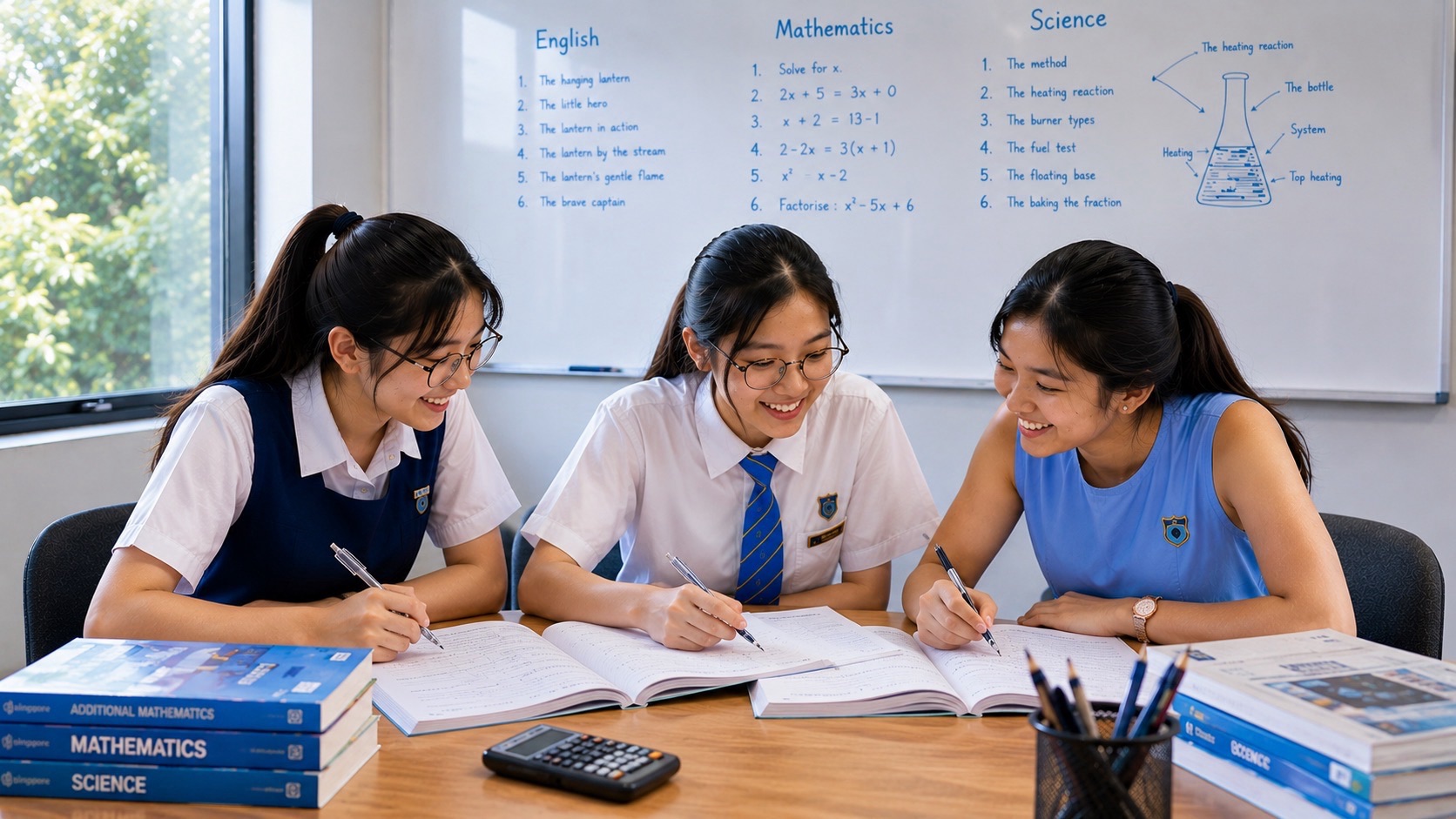
Yishun Mathematics tuition for Secondary 4 should do more than add another weekly worksheet. By the final secondary year, students searching for Secondary 4 Maths tuition, E-Math tuition, O-Level Mathematics tuition, small-group Maths tuition, exam techniques, past-year paper practice and an MOE-aligned Mathematics programme usually need one thing above all: a system that turns everything already learned into reliable performance under time pressure.
For a Secondary 4 student in Yishun, the problem may be algebra, functions, graphs, geometry, trigonometry, statistics or probability. Just as often, however, the deeper problem is execution. The student can do a chapter in isolation but cannot recognise it inside a mixed paper; knows a formula but chooses it late; solves correctly but loses marks to units or notation; or spends twelve minutes on a question that should have taken four. Good Secondary Maths tuition in Singapore must therefore combine conceptual understanding with retrieval, problem solving, clear mathematical communication and examination control.
The examination context is also changing. Students sitting Secondary 4 G3 Mathematics in 2026 still work within the GCE O-Level system, where Mathematics 4052 remains the relevant subject code. From the 2027 graduating cohort, the Singapore-Cambridge Secondary Education Certificate replaces the previous N(T), N(A) and O-Level certificates; students sit subjects at G1, G2 or G3, and G3 Mathematics becomes K310 with 4052 retained as its reference code. The useful response is not panic about names. It is to build the mathematical knowledge, reasoning, application and communication that the assessment system is designed to test.
Start with the real learning problem
A Mathematics page is useful only when it helps a family decide what the student should do next. The score matters, but the score is evidence rather than a diagnosis. Two students can both receive 55% and require completely different interventions: one may be missing a concept, while the other understands the Mathematics but loses marks through weak working, poor question reading or time pressure.
This guide therefore works from the student outward. We look at what the student knows, where the working first becomes unstable, how school assessment exposes that weakness, and what kind of practice can turn partial understanding into dependable performance. The aim is not to create dependence on tuition. The aim is to build a student who can eventually diagnose, choose, solve, check and learn with increasing independence.
Quick route for parents and students
Choose the description that is closest to the present situation. The route matters because doing more questions is not automatically the same as fixing the right problem.
- The syllabus is mostly known, but papers are inconsistent — build mixed retrieval, paper judgement and checking routines.
- Several topics are genuinely weak — diagnose the first broken concept, repair it, then reconnect it to exam questions.
- The student runs out of time — measure where time is being spent and train decision points, not just raw speed.
- The student is aiming higher — replace repetitive easy practice with unfamiliar, connected and explanation-rich problems.
- The exam is close — prioritise high-leverage gaps, recurring error patterns and realistic paper practice rather than trying to relearn everything at once.
If several descriptions fit, begin with the earliest broken layer. In Mathematics, later difficulty is often the shadow of an earlier weakness. Repairing the first unstable layer usually gives more leverage than adding another pile of difficult questions at the top.
Secondary 4 is a conversion year
Earlier years are largely about acquiring and connecting Mathematics. Secondary 4 is the year in which that accumulated system must be converted into marks. The student needs enough knowledge to solve a question, enough recognition to know which knowledge applies, enough fluency to execute without wasting working memory, and enough discipline to present the solution in a form that can be followed and awarded.
That is why a student can spend hours revising and still feel strangely unprepared. Reading notes increases familiarity. Watching someone else solve increases recognition. Neither guarantees that the method can be retrieved quickly from a blank page. Examination readiness is built when the student repeatedly makes decisions under progressively more realistic conditions.
The final-year question is therefore not “Have you finished the syllabus?” It is “Can you use the syllabus when the chapter label has disappeared?”
Understand the 2026-to-2027 examination transition without letting it distract from learning
For families comparing old and new terminology, the safest anchor is the official SEAB material for the student’s actual graduating cohort. In 2026, school candidates still see the GCE O-Level Mathematics listing, including Mathematics 4052. SEAB states that the Singapore-Cambridge SEC begins with the 2027 graduating cohort, when subjects are taken at G1, G2 and G3 levels.
The important learning point is continuity. The assessment still expects students to use mathematical techniques, solve problems in varied contexts, reason, communicate and connect ideas. A sensible Secondary 4 programme therefore avoids chasing labels and trains the durable capabilities beneath them.
Diagnose mark leakage before adding more revision
A marked paper can be treated like a crime scene in the nicest possible sense. We reconstruct what happened. Where did marks leave the page? Were they lost because the student did not know the topic, chose the wrong method, copied a value incorrectly, misread a graph, abandoned a question too early, over-invested time, or failed to communicate enough working?
This produces a mark-leakage map. One student may discover that most lost marks come from three recurring issues: negative signs in algebra, unlabelled geometric reasoning and incomplete probability statements. Another may discover that knowledge is sound but the final quarter of the paper collapses because the first hour is too slow. Their revision plans should not look the same.
- Concept gap
- Retrieval gap
- Method-selection gap
- Execution gap
- Communication gap
- Checking gap
- Time-allocation gap
Build a connected syllabus map
The Mathematics syllabus is easier to remember when it is organised as a connected system rather than a long chapter list. A useful map groups the work into number and algebra, geometry and measurement, and statistics and probability, then draws the bridges between them. Algebra appears in coordinate geometry. Ratio appears in similarity and scale. Graphs represent relationships. Trigonometry is geometry expressed through numerical relationships. Statistics asks students to interpret evidence rather than merely compute.
Those bridges matter in examinations because questions are allowed to move. A problem can begin in a real-world context, require an equation, pass through a graph and end with an interpretation. Students who revise only by chapter often recognise each tool separately but hesitate when several tools appear in one question.
Algebra must become automatic enough to carry harder thinking
By Secondary 4, algebra is infrastructure. Expanding, factorising, rearranging, solving equations and inequalities, substituting accurately and handling indices should not consume all of the student’s attention. If routine algebra remains effortful, more demanding reasoning becomes expensive because working memory is spent on mechanics.
We therefore distinguish algebra fluency from algebra understanding. Fluency means the student can perform standard operations accurately and efficiently. Understanding means the student knows why transformations preserve equivalence and can adapt when the expression looks unfamiliar. Both are needed. Speed without structure becomes brittle; structure without enough fluency becomes slow.
Functions and graphs: read the story, not just the axes
Students sometimes treat graphs as drawing exercises. In examination Mathematics, a graph is a representation of a relationship. The useful questions are: What changes? At what rate? Where does the relationship cross an axis? What does a turning point mean? Which region is relevant? What value can be estimated and how precise should that estimate be?
Graph work improves when students move deliberately among four forms: words, table, equation and picture. If one representation is weak, the others can support it. A student who can explain what a graph is saying in ordinary language is far less likely to perform a mechanically correct calculation and then give an absurd interpretation.
Geometry and trigonometry: turn diagrams into arguments
A diagram should not be decorative. It carries constraints. Parallel lines imply angle relationships. Similarity creates proportional relationships. Circle properties create specific equalities. Pythagoras and trigonometry connect lengths and angles. The student’s job is to identify which relationships are guaranteed and which are merely suggested by the sketch.
We encourage annotation before calculation. Mark known angles, state why an equality holds, identify the relevant triangle, label the side relationships and only then choose the formula. This prevents “formula fishing”, where a student tries several equations hoping one will produce a plausible number.
Statistics and probability: calculation plus judgement
Statistics is often underestimated because some procedures appear straightforward. Yet interpretation can be demanding. A student may calculate an average correctly and still fail to explain what it tells us. A probability answer may be numerically right but based on an incomplete sample space. A graph may be read without noticing scale, grouping or context.
We teach students to ask what the data can support, what it cannot support, and whether the result makes sense in the original situation. This brings mathematical communication into the centre of the topic rather than leaving it as a final sentence added after the calculation.
Real-world contexts are not a separate chapter
Modern assessment increasingly asks students to extract Mathematics from context. The wording may involve finance, measurement, travel, rates, data or a practical scenario, but the underlying task is to identify quantities, relationships, assumptions and constraints. Students who search for a memorised “type” can become stuck when the surface story changes.
Our approach is to strip the problem to structure. What is known? What is unknown? Which quantities vary together? Are we comparing, accumulating, scaling, estimating or optimising? Once the structure is visible, the story becomes less intimidating.
Past-year papers are diagnostic instruments, not trophies
Completing many past papers can create a comforting stack without producing much improvement. The value comes from what happens after marking. Each error should change the next practice decision. If the same error appears three times, the student does not need another full paper yet; the student needs a focused repair set and then a fresh mixed test.
A useful paper cycle is: attempt under realistic conditions, mark honestly, classify errors, repair the highest-leverage patterns, reattempt selected questions without notes, then complete a new paper to test whether the correction transfers. This turns paper practice into an experiment rather than a ritual.
Paper control: time is a mathematical resource
Time management improves when it becomes observable. We record how long the student spends on sections and identify the point where pacing changes. Some students are slow because they write too much. Some repeatedly restart solutions. Some refuse to leave a stubborn question. Some rush easy marks because they are anxious about later questions.
The intervention should match the pattern. We may use time budgets, checkpoint times, “leave-and-return” rules, short timed clusters or deliberate accuracy blocks. The objective is not frantic speed. It is controlled allocation: enough time to think, not so much that one question consumes the rest of the paper.
Stop calling every mistake “careless” in Secondary 4
“Careless” is one of the least useful words in a Mathematics diagnosis because it collapses many different causes into one label. A student cannot repair a category that has not been named. We therefore separate mistakes and look for repeated patterns.
- Concept errors: the student does not yet understand the relationship or rule.
- Recall errors: the student once understood but cannot retrieve the fact, formula or method.
- Reading errors: a condition, unit, scale, inequality sign or key phrase is missed.
- Symbol errors: negatives, brackets, indices, equality signs or algebraic notation are mishandled.
- Arithmetic errors: the method is sound but the calculation fails.
- Method-selection errors: a familiar procedure is used on the wrong problem structure.
- Representation errors: the student cannot move reliably between words, diagrams, tables, graphs and equations.
- Time-control errors: the student spends too long early, rushes late or checks inefficiently.
- Presentation errors: the reasoning is difficult to follow, important steps are omitted or units disappear.
In final-year papers, error classification should be connected to marks and time. A two-mark loss caused by one unstable sign rule may be high priority if the rule appears across algebra, graphs and trigonometry. A rare difficult question may be lower priority even though it looks more impressive. We repair by leverage, not by drama.
Once the pattern is visible, improvement becomes less mysterious. The student can use a specific countermeasure, test whether it works and keep it only if the error rate falls. That is far more useful than promising to “be more careful” next time.
Why a three-student tutorial can matter in Secondary 4 Mathematics
Mathematics errors are highly specific. A wrong final answer tells us that something happened; it does not tell us what happened. The useful information lives in the working: the line where a negative sign disappeared, the assumption that was not justified, the formula chosen for the wrong shape, the graph scale misread, or the moment a student stopped understanding and began copying a remembered pattern.
A three-student class gives the tutor enough room to inspect those details while keeping the social energy of a small group. Students hear another method, explain their own reasoning, compare approaches and discover that a classmate can reach the same destination by a different valid route. At the same time, there is very little room to remain quietly confused for forty minutes.
- working can be checked while the student is still thinking, not only after the worksheet is complete;
- questions can be adjusted for each student without fragmenting the entire lesson;
- a student can be asked to explain why a method works, revealing hidden misconceptions;
- practice can move from guided to independent at different speeds for different learners;
- older gaps can be repaired without turning the whole class into a generic remedial session;
- stronger students can be extended through unfamiliar applications rather than simply receiving more of the same.
Small-group tuition is therefore not valuable merely because the class number is small. It is valuable when the tutor uses that small number to observe thinking, respond precisely and gradually hand responsibility back to the student.
The Secondary 4 learning loop: understand, retrieve, apply, explain, correct
A reliable Mathematics lesson is a loop rather than a performance. The tutor explains; the student attempts; the working is inspected; the mistake is classified; the idea is explained again from the correct level; the student attempts a fresh question; and later the concept is retrieved after enough time has passed for forgetting to become possible.
1. Understand the structure
Before speed, the student needs a mental model. What quantities are present? What relationship connects them? Which representation makes that relationship visible: an equation, a diagram, a graph, a table, a ratio, a coordinate pair? This prevents Mathematics from becoming a box of disconnected tricks.
2. Retrieve without the example beside you
Recognition feels comfortable. Retrieval is harder and more honest. We ask students to recall a method after the worked example has disappeared, and later to recall it again when another topic sits beside it. That is how a method becomes available during a real test rather than only during a familiar worksheet.
3. Apply to a changed question
A small change can expose whether the student owns the idea. Change the numbers, reverse the question, hide one quantity, put the same relationship into words or a graph, or combine it with another chapter. Transfer is where understanding becomes useful.
4. Explain the decision
Students are regularly asked: What are you trying to find? Why did you choose this equation? Why is this angle equal? Why is this graph increasing? What tells you that the answer is reasonable? Explanation slows down guessing and exposes fragile reasoning.
5. Correct the error pattern
The corrected answer is not the end. We record what kind of error occurred and what action should prevent it next time. A concept error needs reteaching. A sign error may need layout discipline and slower symbolic handling. A reading error may need annotation. A time-control error needs timed mixed practice. Different causes deserve different repairs.
What a focused 90-minute Secondary 4 Mathematics lesson can look like
The exact sequence changes with the student and the school calendar, but a useful lesson has a rhythm. It reactivates old learning, teaches or repairs one important structure, creates enough supported practice for the idea to settle, and then tests whether the student can use it without the tutor carrying the solution.
- Retrieval warm-up: a short mixed set from earlier topics to test memory and fluency.
- Diagnostic check: one or two questions that reveal the day’s most important weakness.
- Concept explanation: the tutor builds the idea from meaning, notation and worked reasoning.
- Guided practice: the student attempts fresh questions while prompts are still available.
- Independent application: prompts are removed and the student must choose and execute the method.
- Mixed or timed section: current and earlier ideas are combined, with timing added when useful.
- Error review: mistakes are classified and corrected rather than merely crossed out.
- Continuation work: a small, purposeful set is assigned to strengthen the exact lesson rather than create homework volume for its own sake.
There is room for humour and conversation in a serious Mathematics lesson. A calm student thinks better than a frightened one. The standard remains high; the atmosphere does not need to be grim. The best sign of a productive lesson is often that the student begins arguing with the Mathematics instead of avoiding it: “That cannot be right because the value should be smaller.” That sentence is evidence of ownership.
Three Secondary 4 pathways: rescue, stabilise, extend
1. Rescue
This student has several serious gaps and may be avoiding papers because too much feels unfamiliar. The plan begins by identifying the minimum set of foundations that unlock the largest number of marks. We rebuild those foundations, practise standard applications and create early wins before asking for full-paper endurance.
2. Stabilise
This student can pass or occasionally score well but performance moves around. The focus is usually mixed retrieval, error-pattern reduction, clearer working and more consistent paper timing. The student already owns much of the syllabus; the task is to make access reliable.
3. Extend
This student is secure and wants stronger performance. Practice becomes less repetitive and more selective. We use unfamiliar contexts, multi-topic problems, alternative methods, explanation, difficult final-part questions and stricter time targets. The objective is not simply to “do harder questions” but to improve judgement when the route is not obvious.
A twelve-week revision architecture
Twelve weeks is long enough to create real change when the work is sequenced. It is also short enough that priorities matter. We do not pretend every student needs exactly the same calendar, but the following structure is useful.
- Weeks 1–2: audit. Analyse recent papers, map topic security, identify recurring error types and establish a realistic baseline.
- Weeks 3–5: repair. Rebuild the highest-leverage conceptual and procedural gaps with focused practice and short mixed retrieval.
- Weeks 6–8: connect. Increase interleaving, real-world contexts and multi-topic questions. Introduce timed clusters.
- Weeks 9–10: simulate. Complete selected full papers or substantial sections under realistic constraints, followed by deep correction.
- Weeks 11–12: consolidate. Reduce novelty, revisit the error ledger, secure formulas and routines, and practise calm paper execution.
A student starting later can compress the architecture, but should not skip diagnosis. When time is scarce, choosing the right work becomes even more important.
Calculator discipline and checking
A calculator is powerful precisely because it can produce a wrong answer very efficiently when the input is wrong. Students need habits for brackets, negative numbers, degree mode, memory, rounding and transcription. They should also know when an estimate can expose a bad entry immediately.
Checking is not “do the whole paper again”. Good checking is targeted. Re-read conditions, verify signs, inspect units, test whether an answer lies in a plausible range, substitute where possible, scan graph scales and revisit questions with unusually short working. The best check is often designed while solving: clean layout makes later verification faster.
The final week before an examination
The last week should become calmer, not more chaotic. New difficult material has diminishing returns if it displaces sleep, confidence and reliable routines. The student should revisit the personal error ledger, complete short retrieval sets, refresh formulas and commonly forgotten facts, practise a few representative questions and rehearse paper timing.
The night before is not the time to discover an entire forgotten chapter through a six-hour marathon. A well-prepared student enters the paper with a manageable plan: collect available marks, keep working legible, leave a problem when the time cost becomes unreasonable, return intelligently and use the final minutes for targeted checking.
What parents can watch for in Secondary 4 Mathematics
Parents do not need to reteach the syllabus at the dining table. The more useful role is to notice patterns in independence, routine and recovery. A student who asks for help on one difficult question is not necessarily struggling. A student who cannot begin any homework without a model answer probably is.
- Can the student begin a paper without waiting to be told which topic each question belongs to?
- Are the same errors recurring despite repeated correction?
- Does the student complete school tests, or does performance collapse late in the paper?
- Can the student explain why a method works rather than only reproduce steps?
- Are practice scores becoming more stable across different papers?
- Does revision include active solving and retrieval, or mostly reading and watching?
- Is sleep being protected during heavy assessment periods?
Bring marked school papers, recent worksheets and examples of unfinished homework to a consultation. Do not tidy the evidence. The crossed-out line and abandoned attempt are often more informative than a clean final answer. We are looking for the point where thinking becomes unstable.
Progress should also be discussed in more than one number. Better marks are welcome, but earlier signs can include faster starts, cleaner working, fewer repeated sign errors, more precise questions, better retention from one week to the next and the ability to explain a method without the notes open.
Frequently asked questions
Is Secondary 4 Mathematics tuition mainly about doing more papers?
No. Papers are useful when they diagnose and test. If a student repeatedly makes the same algebra mistake, another full paper may merely reproduce it. Focused repair followed by a fresh test is usually more efficient.
Should a weak student start with the hardest exam questions?
Usually not. The first objective is to secure the foundations and standard applications that unlock dependable marks. Difficulty should rise once the underlying system is stable enough to learn from harder questions.
How often should full papers be attempted?
The useful frequency depends on the student’s stage. Early in revision, targeted topic and mixed sections may create more improvement. As the examination approaches, full-paper practice becomes more important for timing, stamina and decision-making.
What if my child understands in tuition but still performs badly in school tests?
That gap usually tells us to test independence, retrieval and pressure. We reduce prompts, mix topics, add timing and analyse what changes between the supported lesson and the real assessment.
Does the 2027 SEC change mean old Mathematics knowledge becomes irrelevant?
No. The examination label changes with the Full Subject-Based Banding system, but the mathematical capabilities—techniques, problem solving, reasoning, communication and application—remain central. Families should always check the official syllabus for the student’s cohort.
Can E-Math and A-Math be treated as one programme?
They support each other but they are separate subjects. A strong algebra base helps both, yet Additional Mathematics has its own syllabus and progression. Students should not allow A-Math practice to replace essential Mathematics preparation, or vice versa.
Worked diagnosis: why a 62% paper may be closer to 75% than it looks
Imagine a student scores 62%. A quick response is to assign every weak chapter. A better response is to reconstruct the lost marks. Suppose eight marks came from unanswered final questions because the student spent too long on an early geometry problem; six came from algebra sign errors in otherwise correct methods; four came from missing units and rounding; and another four came from one probability misconception. The paper does not describe a student who understands only 62% of the syllabus. It describes several different problems with different repair costs.
We would first protect the cheap marks: units, rounding, signs and paper timing. Those may improve quickly because the concepts are already present. Then we would repair the probability misconception and retest it in a mixed set. Only after that do we ask whether a broad topic rebuild is needed. This is why diagnosis can feel surprisingly optimistic: it turns a disappointing score into a map of recoverable marks.
From topical revision to mixed-paper judgement
Topical revision has an important role. It isolates a skill so the student can learn it without too many competing demands. The danger is staying topical for too long. Real examinations do not announce, “This is the chapter on simultaneous equations.” The student must identify the structure from the wording, diagram or data.
We therefore use a progression. First, blocked practice stabilises the method. Second, near-neighbour questions are mixed so the student learns to distinguish them. Third, questions from distant chapters are interleaved. Finally, paper sections require the student to decide not only how to solve, but what kind of Mathematics is present and how much time it deserves. Each stage removes a cue. By the end, the chapter title has disappeared and the student is carrying the decision-making.
The personal formula and fact sheet should shrink over time
A revision sheet is useful when it is an active memory tool, not a decorative summary. Students can begin with a larger sheet containing formulas, common relationships, calculator reminders and personal error warnings. Each week, items that can be recalled reliably are removed. What remains is the material still requiring attention.
The shrinking sheet is psychologically useful because it makes mastery visible. Instead of staring at an enormous syllabus, the student sees a decreasing list of unresolved items. The final version should be small, personal and high value: the exact formulas, facts and traps that still deserve a last look.
How to use school prelims and weighted assessments
A school paper is valuable twice. The first value is the score. The second, larger value is the data. After each assessment we compare the new error map with the previous one. Did sign errors fall? Did timing improve? Are old topics holding? Did a new class of error appear under pressure? The comparison tells us whether the intervention is working.
This avoids the emotional whiplash of treating every score as a verdict. One paper may be harder, the school may emphasise different topics, or a student may have an unusually poor day. We care about the pattern across evidence: independent work, timed sections, school papers and the error ledger. The trend is more informative than a single number.
What strong examination confidence actually looks like
Confidence is not loudness and it is not the belief that every question will be easy. Strong examination confidence is procedural. The student knows what to do when the first method fails. They can leave a question without feeling defeated, return later, use an estimate to challenge an answer, and keep the rest of the paper intact after one unpleasant problem.
That kind of confidence is built through repeated recovery. In lessons, we occasionally allow a student to reach a dead end, then practise backing out: reread the condition, redraw, choose a different representation, test a simpler case or move temporarily. The student learns that being stuck is a state, not an identity. On examination day, that distinction matters.
Continue through the eduKateYishun Mathematics library
- Secondary 3 Mathematics — build the system before the final year
- Secondary 2 Mathematics — connected reasoning before upper secondary
- Additional Mathematics Hub
- Lower Secondary Mathematics for high-progress schools
Official reference points
- SEAB — 2026 GCE O-Level syllabuses
- SEAB — Singapore-Cambridge Secondary Education Certificate (SEC)
- SEAB — 2027 SEC G3 syllabuses
Secondary 4 Mathematics: build the learner, not just the worksheet
Secondary 4 is not a year for theatrical promises. It is a year for conversion: knowledge into decisions, decisions into working, working into marks, and mistakes into information that makes the next attempt better. A calm, well-diagnosed system beats panic revision because it tells the student what to do on Monday, what to test on Friday and what evidence counts as progress.
A strong Mathematics programme should eventually make itself less necessary. The student learns how to notice confusion, return to the right foundation, choose a method, write clearly, check intelligently and recover after a mistake. That is the kind of improvement that can survive a change of chapter, teacher, examination and year.
Properly taught kids shine a bright light into the future.
Secondary Mathematics learning route: Continue to the Secondary Mathematics directory · Examination Performance. For a current tuition-service decision rather than this free learning guide, use the Yishun Tuition Centre Hub and confirm current arrangements separately.
Part II · Secondary 4 Tuition Centre Programme Architecture
This section of the preserved guide explains how intake, small-group teaching, differentiated practice, homework, parent reporting, prelim analysis, timed sections and final revision fit into one coherent programme. It is distinct from the individual tutor and final repair-cycle pages.
Current cohort and subject-level requirements should be checked through school guidance and the official SEAB SEC syllabus portal. The architecture below supports that learning context rather than replacing it.
1. Centre intake audit
Centre function. turn the first lesson into a learning map.
Common programme failure. placing every new student into the same revision sequence. Final-year time is limited, so generic volume can crowd out the repair that matters most.
Diagnostic action. review recent papers, current school work and one short cold set. Keep the student’s independent attempt visible and distinguish what was already secure from what actually failed.
Programme sequence. record secure areas, active repairs and support needed. Shared teaching is followed by differentiated practice, mixed transfer and reduced prompting.
Outcome. build a programme from evidence. The centre should become more selective as the learner becomes stronger.
2. School alignment
Centre function. connect centre work to the student’s actual school demands.
Common programme failure. running a detached private syllabus. Final-year time is limited, so generic volume can crowd out the repair that matters most.
Diagnostic action. track current topics, assessment dates and teacher feedback. Keep the student’s independent attempt visible and distinguish what was already secure from what actually failed.
Programme sequence. repair prerequisites then reconnect to school questions. Shared teaching is followed by differentiated practice, mixed transfer and reduced prompting.
Outcome. make tuition immediately usable. The centre should become more selective as the learner becomes stronger.
3. Subject-level fit
Centre function. match pace and task complexity to the learner’s actual level.
Common programme failure. using one generic Secondary 4 worksheet. Final-year time is limited, so generic volume can crowd out the repair that matters most.
Diagnostic action. use school placement and cohort materials as scope. Keep the student’s independent attempt visible and distinguish what was already secure from what actually failed.
Programme sequence. differentiate questions and scaffolds. Shared teaching is followed by differentiated practice, mixed transfer and reduced prompting.
Outcome. avoid false deficits. The centre should become more selective as the learner becomes stronger.
4. Small-group entry task
Centre function. protect independent evidence before discussion.
Common programme failure. letting the first confident student reveal the method. Final-year time is limited, so generic volume can crowd out the repair that matters most.
Diagnostic action. begin with quiet individual attempts. Keep the student’s independent attempt visible and distinguish what was already secure from what actually failed.
Programme sequence. compare first decisions afterward. Shared teaching is followed by differentiated practice, mixed transfer and reduced prompting.
Outcome. make the group diagnostic. The centre should become more selective as the learner becomes stronger.
5. Shared-teaching core
Centre function. teach one relationship that genuinely benefits the group.
Common programme failure. forcing unrelated weaknesses into one lecture. Final-year time is limited, so generic volume can crowd out the repair that matters most.
Diagnostic action. choose a common dependency or current school concept. Keep the student’s independent attempt visible and distinguish what was already secure from what actually failed.
Programme sequence. model it with multiple representations. Shared teaching is followed by differentiated practice, mixed transfer and reduced prompting.
Outcome. use group time efficiently. The centre should become more selective as the learner becomes stronger.
6. Differentiated follow-up
Centre function. branch practice after the shared core.
Common programme failure. giving identical work regardless of error mechanism. Final-year time is limited, so generic volume can crowd out the repair that matters most.
Diagnostic action. assign repair, consolidation or extension based on evidence. Keep the student’s independent attempt visible and distinguish what was already secure from what actually failed.
Programme sequence. keep same conceptual anchor where possible. Shared teaching is followed by differentiated practice, mixed transfer and reduced prompting.
Outcome. personalise without fragmenting the class. The centre should become more selective as the learner becomes stronger.
7. Independent exit task
Centre function. end with proof of personal understanding.
Common programme failure. finishing on a guided example. Final-year time is limited, so generic volume can crowd out the repair that matters most.
Diagnostic action. use one fresh question without the demonstrated surface. Keep the student’s independent attempt visible and distinguish what was already secure from what actually failed.
Programme sequence. record strongest prompt required. Shared teaching is followed by differentiated practice, mixed transfer and reduced prompting.
Outcome. make every lesson produce evidence. The centre should become more selective as the learner becomes stronger.
8. Weekly retrieval
Centre function. keep older knowledge available.
Common programme failure. revising only current chapter. Final-year time is limited, so generic volume can crowd out the repair that matters most.
Diagnostic action. start with a short cumulative set. Keep the student’s independent attempt visible and distinguish what was already secure from what actually failed.
Programme sequence. retire secure prompts gradually. Shared teaching is followed by differentiated practice, mixed transfer and reduced prompting.
Outcome. protect long-term access. The centre should become more selective as the learner becomes stronger.
9. Prelim diagnostic
Centre function. use prelims to reveal mixed-paper weaknesses.
Common programme failure. redoing the entire paper uniformly. Final-year time is limited, so generic volume can crowd out the repair that matters most.
Diagnostic action. classify first errors and time distribution. Keep the student’s independent attempt visible and distinguish what was already secure from what actually failed.
Programme sequence. rank by mark cost/connectivity. Shared teaching is followed by differentiated practice, mixed transfer and reduced prompting.
Outcome. shape final-term plan. The centre should become more selective as the learner becomes stronger.
10. Secure-mark maintenance
Centre function. protect reliable topics efficiently.
Common programme failure. over-revising comfortable chapters. Final-year time is limited, so generic volume can crowd out the repair that matters most.
Diagnostic action. use low-volume spaced retrieval. Keep the student’s independent attempt visible and distinguish what was already secure from what actually failed.
Programme sequence. keep most time for active risks. Shared teaching is followed by differentiated practice, mixed transfer and reduced prompting.
Outcome. preserve performance floor. The centre should become more selective as the learner becomes stronger.
11. Active-repair queue
Centre function. limit simultaneous weaknesses.
Common programme failure. keeping every mistake active. Final-year time is limited, so generic volume can crowd out the repair that matters most.
Diagnostic action. rank recurrent high-impact mechanisms. Keep the student’s independent attempt visible and distinguish what was already secure from what actually failed.
Programme sequence. work on a small queue. Shared teaching is followed by differentiated practice, mixed transfer and reduced prompting.
Outcome. make revision manageable. The centre should become more selective as the learner becomes stronger.
12. Algebra repair station
Centre function. repair algebraic leaks affecting several topics.
Common programme failure. treating graph/geometry/trig errors separately when algebra is common cause. Final-year time is limited, so generic volume can crowd out the repair that matters most.
Diagnostic action. audit signs, brackets, equations and rearrangement. Keep the student’s independent attempt visible and distinguish what was already secure from what actually failed.
Programme sequence. retest inside multiple topics. Shared teaching is followed by differentiated practice, mixed transfer and reduced prompting.
Outcome. recover marks broadly. The centre should become more selective as the learner becomes stronger.
13. Percentage repair station
Centre function. separate forward, change and reverse percentage.
Common programme failure. using one routine for all percentage questions. Final-year time is limited, so generic volume can crowd out the repair that matters most.
Diagnostic action. label reference and multiplier first. Keep the student’s independent attempt visible and distinguish what was already secure from what actually failed.
Programme sequence. contrast similar-looking intents. Shared teaching is followed by differentiated practice, mixed transfer and reduced prompting.
Outcome. build reliability. The centre should become more selective as the learner becomes stronger.
14. Ratio repair station
Centre function. restore multiplicative scaling.
Common programme failure. using additive change. Final-year time is limited, so generic volume can crowd out the repair that matters most.
Diagnostic action. identify unit or scale factor. Keep the student’s independent attempt visible and distinguish what was already secure from what actually failed.
Programme sequence. connect to similarity and rate. Shared teaching is followed by differentiated practice, mixed transfer and reduced prompting.
Outcome. strengthen proportional system. The centre should become more selective as the learner becomes stronger.
15. Graph repair station
Centre function. read axes, scales and coordinates accurately.
Common programme failure. interpreting by appearance. Final-year time is limited, so generic volume can crowd out the repair that matters most.
Diagnostic action. annotate graph before calculation. Keep the student’s independent attempt visible and distinguish what was already secure from what actually failed.
Programme sequence. translate points/rules where relevant. Shared teaching is followed by differentiated practice, mixed transfer and reduced prompting.
Outcome. reduce graph losses. The centre should become more selective as the learner becomes stronger.
16. Geometry repair station
Centre function. use properties instead of appearance.
Common programme failure. assuming unmarked equalities. Final-year time is limited, so generic volume can crowd out the repair that matters most.
Diagnostic action. mark givens and reason chains. Keep the student’s independent attempt visible and distinguish what was already secure from what actually failed.
Programme sequence. rotate diagrams. Shared teaching is followed by differentiated practice, mixed transfer and reduced prompting.
Outcome. build robust evidence use. The centre should become more selective as the learner becomes stronger.
17. Trigonometry repair station
Centre function. separate diagram reading, ratio choice, algebra and calculator.
Common programme failure. calling all trig errors one problem. Final-year time is limited, so generic volume can crowd out the repair that matters most.
Diagnostic action. diagnose which layer failed. Keep the student’s independent attempt visible and distinguish what was already secure from what actually failed.
Programme sequence. repair and retest each layer. Shared teaching is followed by differentiated practice, mixed transfer and reduced prompting.
Outcome. make trig controllable. The centre should become more selective as the learner becomes stronger.
18. Mensuration repair station
Centre function. distinguish attribute, formula and units.
Common programme failure. using area/perimeter/volume interchangeably. Final-year time is limited, so generic volume can crowd out the repair that matters most.
Diagnostic action. name measured quantity first. Keep the student’s independent attempt visible and distinguish what was already secure from what actually failed.
Programme sequence. decompose composite shapes. Shared teaching is followed by differentiated practice, mixed transfer and reduced prompting.
Outcome. strengthen dimensional control. The centre should become more selective as the learner becomes stronger.
19. Statistics repair station
Centre function. pair calculation with interpretation.
Common programme failure. calculating summaries mechanically. Final-year time is limited, so generic volume can crowd out the repair that matters most.
Diagnostic action. read data and instruction first. Keep the student’s independent attempt visible and distinguish what was already secure from what actually failed.
Programme sequence. compare centre/spread where appropriate. Shared teaching is followed by differentiated practice, mixed transfer and reduced prompting.
Outcome. improve judgement. The centre should become more selective as the learner becomes stronger.
20. Probability repair station
Centre function. organise sample space before arithmetic.
Common programme failure. guessing denominators. Final-year time is limited, so generic volume can crowd out the repair that matters most.
Diagnostic action. use list/table/tree. Keep the student’s independent attempt visible and distinguish what was already secure from what actually failed.
Programme sequence. update for replacement conditions. Shared teaching is followed by differentiated practice, mixed transfer and reduced prompting.
Outcome. reduce omissions. The centre should become more selective as the learner becomes stronger.
21. Calculator protocol
Centre function. make technology execute a written model.
Common programme failure. typing before representing. Final-year time is limited, so generic volume can crowd out the repair that matters most.
Diagnostic action. write expression and estimate first. Keep the student’s independent attempt visible and distinguish what was already secure from what actually failed.
Programme sequence. check input/mode/plausibility. Shared teaching is followed by differentiated practice, mixed transfer and reduced prompting.
Outcome. keep judgement visible. The centre should become more selective as the learner becomes stronger.
22. Working protocol
Centre function. make solutions auditable but efficient.
Common programme failure. either hiding too much mentally or writing every micro-step. Final-year time is limited, so generic volume can crowd out the repair that matters most.
Diagnostic action. show high-risk transformations and labels. Keep the student’s independent attempt visible and distinguish what was already secure from what actually failed.
Programme sequence. compress routine secure steps. Shared teaching is followed by differentiated practice, mixed transfer and reduced prompting.
Outcome. balance clarity and speed. The centre should become more selective as the learner becomes stronger.
23. Unit protocol
Centre function. keep units visible throughout.
Common programme failure. adding units at final line from memory. Final-year time is limited, so generic volume can crowd out the repair that matters most.
Diagnostic action. state expected unit early. Keep the student’s independent attempt visible and distinguish what was already secure from what actually failed.
Programme sequence. use dimensional mismatch as warning. Shared teaching is followed by differentiated practice, mixed transfer and reduced prompting.
Outcome. protect completion. The centre should become more selective as the learner becomes stronger.
24. Command-word protocol
Centre function. align solution with instruction.
Common programme failure. solving the wrong task well. Final-year time is limited, so generic volume can crowd out the repair that matters most.
Diagnostic action. translate command into action. Keep the student’s independent attempt visible and distinguish what was already secure from what actually failed.
Programme sequence. contrast same data under different commands. Shared teaching is followed by differentiated practice, mixed transfer and reduced prompting.
Outcome. protect easy marks. The centre should become more selective as the learner becomes stronger.
25. Error log
Centre function. track mechanisms not question numbers.
Common programme failure. collecting every mistake without pattern. Final-year time is limited, so generic volume can crowd out the repair that matters most.
Diagnostic action. record recurring first weak links. Keep the student’s independent attempt visible and distinguish what was already secure from what actually failed.
Programme sequence. attach one prevention cue. Shared teaching is followed by differentiated practice, mixed transfer and reduced prompting.
Outcome. make review usable. The centre should become more selective as the learner becomes stronger.
26. Correction cycle
Centre function. turn marked work into changed behaviour.
Common programme failure. copying teacher solutions. Final-year time is limited, so generic volume can crowd out the repair that matters most.
Diagnostic action. repair first error, transfer, delay, retest. Keep the student’s independent attempt visible and distinguish what was already secure from what actually failed.
Programme sequence. hide original model later. Shared teaching is followed by differentiated practice, mixed transfer and reduced prompting.
Outcome. prove retention. The centre should become more selective as the learner becomes stronger.
27. Spacing plan
Centre function. return to repaired skills after delay.
Common programme failure. cramming and abandoning. Final-year time is limited, so generic volume can crowd out the repair that matters most.
Diagnostic action. schedule short spaced retests. Keep the student’s independent attempt visible and distinguish what was already secure from what actually failed.
Programme sequence. lower frequency when secure. Shared teaching is followed by differentiated practice, mixed transfer and reduced prompting.
Outcome. build durability. The centre should become more selective as the learner becomes stronger.
28. Interleaving plan
Centre function. train method selection.
Common programme failure. keeping revision topical too long. Final-year time is limited, so generic volume can crowd out the repair that matters most.
Diagnostic action. mix commonly confused methods. Keep the student’s independent attempt visible and distinguish what was already secure from what actually failed.
Programme sequence. ask for first-line choice. Shared teaching is followed by differentiated practice, mixed transfer and reduced prompting.
Outcome. prepare mixed papers. The centre should become more selective as the learner becomes stronger.
29. Contrast plan
Centre function. teach boundaries between methods.
Common programme failure. memorising shortcuts without conditions. Final-year time is limited, so generic volume can crowd out the repair that matters most.
Diagnostic action. pair similar-looking questions. Keep the student’s independent attempt visible and distinguish what was already secure from what actually failed.
Programme sequence. state distinguishing feature. Shared teaching is followed by differentiated practice, mixed transfer and reduced prompting.
Outcome. reduce overgeneralisation. The centre should become more selective as the learner becomes stronger.
30. Worked-example fading
Centre function. reduce class scaffolding gradually.
Common programme failure. leaving model visible. Final-year time is limited, so generic volume can crowd out the repair that matters most.
Diagnostic action. remove steps and cues. Keep the student’s independent attempt visible and distinguish what was already secure from what actually failed.
Programme sequence. finish with independent variant. Shared teaching is followed by differentiated practice, mixed transfer and reduced prompting.
Outcome. measure transfer. The centre should become more selective as the learner becomes stronger.
31. Homework architecture
Centre function. give each item a job.
Common programme failure. assigning pages by volume. Final-year time is limited, so generic volume can crowd out the repair that matters most.
Diagnostic action. combine retrieval, repair, transfer and one check. Keep the student’s independent attempt visible and distinguish what was already secure from what actually failed.
Programme sequence. keep workload sustainable. Shared teaching is followed by differentiated practice, mixed transfer and reduced prompting.
Outcome. make home practice diagnostic. The centre should become more selective as the learner becomes stronger.
32. Parent progress note
Centre function. report useful evidence.
Common programme failure. sending raw scores only. Final-year time is limited, so generic volume can crowd out the repair that matters most.
Diagnostic action. name one secure strength, one active repair and one independence measure. Keep the student’s independent attempt visible and distinguish what was already secure from what actually failed.
Programme sequence. give one home support action. Shared teaching is followed by differentiated practice, mixed transfer and reduced prompting.
Outcome. align adults. The centre should become more selective as the learner becomes stronger.
33. Parent workload conversation
Centre function. coordinate total study load.
Common programme failure. adding tuition work without regard to school burden. Final-year time is limited, so generic volume can crowd out the repair that matters most.
Diagnostic action. review school deadlines and fatigue. Keep the student’s independent attempt visible and distinguish what was already secure from what actually failed.
Programme sequence. reduce low-value repetition. Shared teaching is followed by differentiated practice, mixed transfer and reduced prompting.
Outcome. keep programme executable. The centre should become more selective as the learner becomes stronger.
34. Class pace management
Centre function. keep group pace productive.
Common programme failure. teaching to fastest or slowest learner only. Final-year time is limited, so generic volume can crowd out the repair that matters most.
Diagnostic action. use shared core with differentiated follow-up. Keep the student’s independent attempt visible and distinguish what was already secure from what actually failed.
Programme sequence. use extension/repair branches. Shared teaching is followed by differentiated practice, mixed transfer and reduced prompting.
Outcome. balance cohesion and individual need. The centre should become more selective as the learner becomes stronger.
35. Peer method comparison
Centre function. use classmates as reasoning resources.
Common programme failure. copying the fastest solution. Final-year time is limited, so generic volume can crowd out the repair that matters most.
Diagnostic action. compare why methods work. Keep the student’s independent attempt visible and distinguish what was already secure from what actually failed.
Programme sequence. require independent revision. Shared teaching is followed by differentiated practice, mixed transfer and reduced prompting.
Outcome. preserve ownership. The centre should become more selective as the learner becomes stronger.
36. Tutor observation notes
Centre function. capture first decisions and support level.
Common programme failure. recording only final score. Final-year time is limited, so generic volume can crowd out the repair that matters most.
Diagnostic action. note start, representation, first error and prompt. Keep the student’s independent attempt visible and distinguish what was already secure from what actually failed.
Programme sequence. compare across weeks. Shared teaching is followed by differentiated practice, mixed transfer and reduced prompting.
Outcome. measure independence. The centre should become more selective as the learner becomes stronger.
37. Timed-section progression
Centre function. add pressure in stages.
Common programme failure. jumping to full paper timing. Final-year time is limited, so generic volume can crowd out the repair that matters most.
Diagnostic action. move from untimed mixed to shorter timed sections. Keep the student’s independent attempt visible and distinguish what was already secure from what actually failed.
Programme sequence. track where time is lost. Shared teaching is followed by differentiated practice, mixed transfer and reduced prompting.
Outcome. build controlled speed. The centre should become more selective as the learner becomes stronger.
38. Paper navigation training
Centre function. practise first pass, return and checking.
Common programme failure. leaving navigation until exam day. Final-year time is limited, so generic volume can crowd out the repair that matters most.
Diagnostic action. simulate park/re-entry choices. Keep the student’s independent attempt visible and distinguish what was already secure from what actually failed.
Programme sequence. record re-entry notes. Shared teaching is followed by differentiated practice, mixed transfer and reduced prompting.
Outcome. protect global performance. The centre should become more selective as the learner becomes stronger.
39. Stop-loss routine
Centre function. prevent one item consuming the paper.
Common programme failure. equating persistence with staying forever. Final-year time is limited, so generic volume can crowd out the repair that matters most.
Diagnostic action. set sensible move-on threshold. Keep the student’s independent attempt visible and distinguish what was already secure from what actually failed.
Programme sequence. return with new representation. Shared teaching is followed by differentiated practice, mixed transfer and reduced prompting.
Outcome. make recovery procedural. The centre should become more selective as the learner becomes stronger.
40. Late-paper stamina
Centre function. train accuracy under fatigue.
Common programme failure. assuming late mistakes are concept gaps. Final-year time is limited, so generic volume can crowd out the repair that matters most.
Diagnostic action. compare errors by segment. Keep the student’s independent attempt visible and distinguish what was already secure from what actually failed.
Programme sequence. simulate late sections after prior work. Shared teaching is followed by differentiated practice, mixed transfer and reduced prompting.
Outcome. separate stamina from knowledge. The centre should become more selective as the learner becomes stronger.
41. Final-answer audit
Centre function. catch unit, rounding and target errors.
Common programme failure. stopping after intermediate answer. Final-year time is limited, so generic volume can crowd out the repair that matters most.
Diagnostic action. reread command and answer form. Keep the student’s independent attempt visible and distinguish what was already secure from what actually failed.
Programme sequence. check requested accuracy. Shared teaching is followed by differentiated practice, mixed transfer and reduced prompting.
Outcome. recover marks. The centre should become more selective as the learner becomes stronger.
42. Full-paper cycle
Centre function. use papers as integration tests.
Common programme failure. paper after paper without repair. Final-year time is limited, so generic volume can crowd out the repair that matters most.
Diagnostic action. sit paper, classify, repair, retest. Keep the student’s independent attempt visible and distinguish what was already secure from what actually failed.
Programme sequence. compare repeated mechanisms. Shared teaching is followed by differentiated practice, mixed transfer and reduced prompting.
Outcome. make papers productive. The centre should become more selective as the learner becomes stronger.
43. Six-week final runway
Centre function. narrow programme close to exams.
Common programme failure. collecting more resources continuously. Final-year time is limited, so generic volume can crowd out the repair that matters most.
Diagnostic action. rotate retrieval, repair, timed sections and selected papers. Keep the student’s independent attempt visible and distinguish what was already secure from what actually failed.
Programme sequence. reduce novelty. Shared teaching is followed by differentiated practice, mixed transfer and reduced prompting.
Outcome. stabilise system. The centre should become more selective as the learner becomes stronger.
44. Final-fortnight taper
Centre function. protect availability and routine.
Common programme failure. introducing new tricks. Final-year time is limited, so generic volume can crowd out the repair that matters most.
Diagnostic action. review known methods and risks. Keep the student’s independent attempt visible and distinguish what was already secure from what actually failed.
Programme sequence. keep workload manageable. Shared teaching is followed by differentiated practice, mixed transfer and reduced prompting.
Outcome. arrive ready. The centre should become more selective as the learner becomes stronger.
45. Exam-day routine rehearsal
Centre function. make first minutes familiar.
Common programme failure. waiting until exam day to decide process. Final-year time is limited, so generic volume can crowd out the repair that matters most.
Diagnostic action. practise reading, target identification and pacing. Keep the student’s independent attempt visible and distinguish what was already secure from what actually failed.
Programme sequence. use personal checklist. Shared teaching is followed by differentiated practice, mixed transfer and reduced prompting.
Outcome. reduce cognitive noise. The centre should become more selective as the learner becomes stronger.
46. Post-assessment review
Centre function. convert every paper into next lesson.
Common programme failure. looking only at total mark. Final-year time is limited, so generic volume can crowd out the repair that matters most.
Diagnostic action. classify first errors and time. Keep the student’s independent attempt visible and distinguish what was already secure from what actually failed.
Programme sequence. update repair queue. Shared teaching is followed by differentiated practice, mixed transfer and reduced prompting.
Outcome. make programme adaptive. The centre should become more selective as the learner becomes stronger.
47. Secondary 4 parent decision support
Centre function. help families understand what centre support can and cannot do.
Common programme failure. selling volume or certainty. Final-year time is limited, so generic volume can crowd out the repair that matters most.
Diagnostic action. explain mechanism, workload and review points. Keep the student’s independent attempt visible and distinguish what was already secure from what actually failed.
Programme sequence. show evidence of changing support. Shared teaching is followed by differentiated practice, mixed transfer and reduced prompting.
Outcome. keep expectations grounded. The centre should become more selective as the learner becomes stronger.
48. Exit criteria
Centre function. know when a skill no longer needs active teaching.
Common programme failure. keeping every topic on equal rotation forever. Final-year time is limited, so generic volume can crowd out the repair that matters most.
Diagnostic action. require delayed mixed success with low prompting. Keep the student’s independent attempt visible and distinguish what was already secure from what actually failed.
Programme sequence. move to maintenance. Shared teaching is followed by differentiated practice, mixed transfer and reduced prompting.
Outcome. free time. The centre should become more selective as the learner becomes stronger.
49. Programme handoff
Centre function. return control to the student.
Common programme failure. keeping centre dependence high until the end. Final-year time is limited, so generic volume can crowd out the repair that matters most.
Diagnostic action. review secure areas, risks and routines with learner. Keep the student’s independent attempt visible and distinguish what was already secure from what actually failed.
Programme sequence. let student manage revision map. Shared teaching is followed by differentiated practice, mixed transfer and reduced prompting.
Outcome. complete transition to independence. The centre should become more selective as the learner becomes stronger.
Two fictional learners score 58. One loses marks to algebraic signs across several topics; the other knows methods but leaves a quarter of the paper unfinished. The centre should not place both on the same repair plan.
The first learner receives dependency repair; the second receives retrieval, timed-section and navigation work. The score is the starting clue, not the diagnosis.
Centre case: three-student group
Three learners attempt one geometry-algebra problem. One misreads the property, one forms the right equation but loses a sign, and one solves correctly.
Shared discussion addresses the property; follow-up branches into diagram reading, algebra control and extension. Small-group teaching becomes genuinely differentiated.
Centre case: prelim decline
A learner’s prelim falls despite regular attendance. Review shows harder mixed questions and late-paper fatigue rather than widespread conceptual loss.
The programme shifts from topical volume to mixed timed control and targeted checking while preserving secure topics.
Centre case: parent requests more worksheets
The student already completes large volumes but repeats the same reverse-percentage error. The centre reduces quantity and inserts reference-labelling, contrast and delayed retest.
The programme demonstrates why smarter practice can be smaller.
Centre case: strong student
Routine work is secure. The centre uses construction, counterexamples, reverse questions and alternative methods rather than simply racing into later content.
Depth maintains challenge while preserving alignment with current course.
Centre case: dependent student
A learner succeeds only after the tutor identifies the topic. The centre tracks this prompt explicitly and removes it gradually across fresh questions.
Progress is the lighter prompt, not only the correct final answer.
Centre case: calculator errors
The written model is correct but calculator entries are unreliable. The centre creates an estimate-expression-input-check routine.
The concept is preserved while technology control is trained.
Centre case: final month
The learner has several secure topics and two recurring risks. The centre narrows resources instead of opening new workbooks.
Revision becomes retrieval, targeted repair, selected papers and personal checks.
Final centre standard
A strong Secondary 4 Mathematics tuition centre should become more selective as the examination approaches. Secure knowledge receives maintenance, active weaknesses receive precise repair, mixed-paper control is trained under realistic conditions, and tutor prompts reduce. The student finishes with a smaller active problem list and a stronger personal system.
Part III · Centre Operations Manual
Centre operation: intake conversation
The first conversation should establish current school topic, recent assessment pattern, subject level, workload and the student’s own account of where Mathematics breaks. A centre should not interpret a single score without seeing the actual questions and working.
The result should be a small starting map: secure strengths, one or two active repairs and the level of support currently required.
Centre operation: baseline storage
Keep one independent baseline sample before heavy teaching begins. This provides a comparison point for later work and prevents progress from being judged only through memory.
The baseline should include the student’s original working, not just the final score, because changes in method selection and checking matter.
Centre operation: lesson opener
Begin with brief retrieval rather than administrative discussion. Use older material that is relevant to current dependencies and vary it across weeks.
The opener should reveal availability without consuming the lesson. Secure prompts become less frequent; fragile prompts return sooner.
Centre operation: lesson diagnosis
Use one current school or mixed question to expose the active mechanism. Observe the start before teaching.
The first wrong line or hesitation determines the repair. This keeps the lesson responsive rather than pre-scripted.
Centre operation: teaching block
Teach the smallest relationship that unlocks the task. Use a model, diagram, table or equation only when it clarifies the mechanism.
The teaching block should be followed quickly by learner action so explanation does not become passive listening.
Centre operation: guided practice
Use two or three direct examples while the relationship is new. Reduce hints across examples.
The centre should record whether the student still needs topic naming, representation or formula cues.
Centre operation: contrast practice
Place a near-neighbour method beside the repaired one. Examples include direct versus reverse percentage, Pythagoras versus trigonometry, area versus perimeter or mean versus median.
The learner states which condition changes the method before completing the arithmetic.
Centre operation: mixed transfer
Remove the chapter heading and place the repaired skill among other topics.
This tests recognition and provides a more realistic bridge into paper practice.
Centre operation: independent exit
Finish with a fresh question completed individually. Group discussion and tutor explanation are not enough evidence.
Record the strongest prompt needed. This becomes the starting point for the next lesson.
Centre operation: delayed retest
Bring the same mechanism back after several days with changed surface features.
Delayed success is stronger evidence than same-day familiarity and should determine whether the topic moves to maintenance.
Centre operation: homework selection
Choose a small set with retrieval, active repair, one transfer question and one check. The exact quantity depends on school workload and learner stamina.
Homework should produce information for the next lesson, not simply occupy time.
Centre operation: marking
Mark for first-error mechanism as well as final correctness. A wrong answer caused by a late arithmetic slip should not receive the same reteaching as a wrong method from the first line.
This makes marking part of diagnosis.
Centre operation: parent update
Report one secure strength, one current repair, one support level and one next test. Keep the update concise and evidence-based.
Parents can then support the routine without becoming a second tutor.
Centre operation: workload review
Periodically compare school, tuition and home practice. If volume prevents correction, retrieval or rest, reduce low-value repetition.
An executable plan is more valuable than an impressive schedule that the learner cannot sustain.
Centre operation: group matching
Small groups work best when tasks, pace and support needs are reasonably compatible. Matching should use actual work, not only year level or total mark.
Students can differ in score while sharing a useful instructional target, and identical scores can conceal different needs.
Centre operation: extension lane
Secure students receive method comparison, construction, counterexamples and unfamiliar combinations within current scope.
Extension should deepen control before accelerating into unrelated future content.
Centre operation: repair lane
Students with a fragile prerequisite receive smaller numbers or clearer representations but remain connected to the current concept.
Repair is temporary scaffolding, not a separate identity.
Centre operation: timed lane
Once methods are stable, short timed sections train retrieval, selection and checking.
The centre should record why time is lost rather than merely demanding faster work.
Centre operation: paper lane
Full or substantial paper practice is introduced when enough content is secure and the purpose is integration.
Every paper should produce an error map and a changed revision decision.
Centre operation: prelim review meeting
After prelims, compare question type, timing, recurring mechanisms and unfinished marks. Avoid treating the overall score as the only information.
Build the next two or three weeks around the highest-value clusters.
Centre operation: final-six-week board
Maintain a visible but compact plan: active repairs, maintenance topics, selected papers and personal checks.
The board should shrink as skills stabilise; it should not collect every topic permanently.
Centre operation: final-fortnight taper
Reduce novelty and focus on known methods, representative questions and checking routines.
A taper protects availability and prevents late revision from becoming an uncontrolled search for more resources.
Centre operation: exam-week support
Keep communication calm and specific. Avoid adding new strategies unless a genuine gap remains.
The student’s own routine should be more prominent than the centre’s instructions at this stage.
Centre operation: post-paper reflection
After a practice or school paper, separate feelings from evidence. Wait for the actual work before making a new plan.
A difficult-feeling paper may still contain strong performance, and an easy-feeling paper may hide repeated errors.
Centre operation: support fading
Review which decisions tutors still supply and remove one support category at a time.
A centre succeeds when the learner needs less orchestration for routine work as the year progresses.
Centre operation: maintenance rules
Secure topics receive spaced retrieval and occasional mixed use, not the same practice volume as active weaknesses.
Maintenance keeps access without crowding out repair.
Centre operation: reactivation rules
If a maintenance topic fails repeatedly on changed tasks, return it temporarily to active repair.
The programme should respond to new evidence rather than assume mastery is permanent.
Centre operation: final handoff
Create one page with secure areas, active risks, personal checks, navigation routine and strongest remaining prompt.
This handoff should be understandable to the student, not only to the tutor.
Centre operation: quality audit
Ask whether the programme is producing changed independent work, not only completed worksheets and satisfied lesson time.
The centre should be able to show why the current practice exists and what evidence will cause it to change.
Centre operation: exit standard
A student exits intensive final-year support when routine mathematical and paper-control decisions are largely self-managed.
Tutoring can still provide challenge, but dependence on tutor-led starts and correction should be much lower.
Final operational standard
The centre programme is strongest when every layer points toward independence: intake creates a precise map, lessons repair one mechanism at a time, homework reinforces the map, papers test integration, parent updates stay specific and support fades as the learner becomes more capable. The system should not require continuous high-volume activity to prove that tuition is happening.
For Secondary 4, that selectivity becomes especially important. The centre should help the learner arrive at the examination with secure foundations, a short active-risk list, reliable paper routines and the ability to recover when a question changes. That is the operational purpose of this preserved tuition-centre guide.
Part IV · Final-Year Centre Casework and Closing Protocols
Casework: algebra leak across the centre programme
A fictional learner appears weak in graphs, geometry and trigonometry. Review shows correct setups followed by faulty algebraic rearrangement. The centre temporarily shifts one lesson block to equation manipulation, then immediately retests the same skill inside the three affected topics.
Several apparent topic problems shrink together. The case illustrates why centre diagnosis should look for common dependencies before assigning separate remediation packs.
Casework: reverse-percentage recurrence
A learner repeatedly applies the percentage to the final value rather than the original. The centre introduces a rule: write the reference quantity or 100% line before calculating. Contrast direct, change and reverse questions in one short set.
A delayed mixed retest checks whether the reference label appears without prompting. Only then does the topic return to maintenance.
Casework: good knowledge, unfinished papers
A student answers completed questions accurately but leaves a large late section blank. Observation shows slow retrieval and repeated checking of easy questions rather than topic ignorance.
The centre reduces topical reteaching, adds short retrieval and selective checking, and rehearses navigation. The intervention targets performance, not knowledge that is already secure.
Casework: fast learner, recurring small losses
The learner finishes comfortably but loses signs, units and rounding marks. The centre builds a three-risk card from actual papers.
Timed sections continue at the learner’s natural pace, but checks are inserted at those specific high-risk moments. Controlled speed replaces generic ‘slow down’ advice.
Casework: dependent learner
A student completes difficult questions only after the tutor names the method. The centre tracks topic cue as a support category and begins removing it on fresh problems.
Progress is recorded when the learner selects the method independently even if later algebra still needs help.
Casework: overloaded family schedule
School tests, CCA and tuition homework create rushed corrections and poor sleep. The centre reduces low-value repetition and protects retrieval plus active repair.
The programme becomes smaller but higher quality. Workload management is treated as part of programme design, not a private family problem.
Casework: strong student needs depth
Routine final-year work is secure. The centre uses alternative methods, counterexamples, construction and unfamiliar combinations before adding more advanced content.
The learner develops transfer and checking without destabilising alignment with the current course.
Casework: late joining student
A learner joins close to prelims. The centre does not attempt to reproduce an entire year’s programme. It builds a rapid evidence map from recent papers and current school topics.
High-connectivity gaps and paper-control issues receive priority. The late-start plan is selective by necessity.
Final-month protocol: resource freeze
Four weeks out, the centre stops adding unnecessary new books and notes. Active resources are reduced to an error log, retrieval deck, selected sections and representative papers.
This prevents revision from becoming a search problem and makes progress easier to track.
Final-month protocol: weekly paper review
One substantial mixed paper or set may be used according to readiness, but its value depends on review. The centre classifies first errors, time loss and checking failures.
The next week’s plan is changed from those findings. A paper that changes nothing has not been fully used.
Final-month protocol: repair day
Dedicate one session to the highest-value error cluster rather than another full paper. Use smaller examples, contrast, fresh transfer and delayed retest.
This prevents paper volume from simply rehearsing the same weakness.
Final-month protocol: maintenance day
Secure topics receive compact mixed retrieval so they remain available without consuming major time.
The student experiences revision as selective rather than endless.
Final-month protocol: timed-section day
Use a shorter timed section to practise paper decisions, calculator control and checking under realistic pressure.
A short section allows cleaner diagnosis of time loss than a full paper every time.
Final-month protocol: recovery rehearsal
Insert one question likely to cause difficulty and practise park-reset-return behaviour.
The learner rehearses emotional and mathematical recovery before examination day.
Final-month protocol: personal checklist review
The learner rewrites the personal risk card from memory. If a check cannot be recalled, it is unlikely to appear automatically under pressure.
The card should contain only recurrent high-impact risks, not every possible mistake.
Final-month protocol: final-week taper
Reduce novelty, maintain representative retrieval and preserve normal routines. The centre avoids dramatic last-minute strategy changes.
The goal is availability and stability, not exhaustion.
Parent protocol: concise weekly update
In final weeks, report only what changed: current repair, evidence from retest, paper-control issue and next action.
Parents receive useful information without being drawn into every technical detail.
Parent protocol: avoid resource stacking
If families bring additional books or online sets, the centre should decide whether they add a needed type of practice before integrating them.
More material is not automatically more coverage if the same error remains untreated.
Student protocol: own the map
The learner should be able to name secure topics, active risks and checking routines without reading the tutor’s plan.
This is a practical sign that revision management itself is becoming independent.
Student protocol: ask precise questions
Encourage requests such as ‘I cannot pair the corresponding sides’ rather than ‘I don’t get this’.
Precise questions allow the centre to support the weak step without replacing the whole solution.
Student protocol: finish corrections actively
A correction is not finished until the learner solves a changed question and later retrieves the same mechanism.
Copying a full model answer is only one part of the process.
Student protocol: maintain strong topics lightly
The learner should understand that fewer questions on a secure topic is a sign of progress, not neglect.
Maintenance protects knowledge while respecting limited final-year time.
Exit review: evidence not impressions
Compare baseline and current mixed work, prompt level, repeated-error rate and paper completion.
The centre should be able to show specific changes in process even when marks fluctuate between different papers.
Exit review: unresolved risks
Any remaining risk is stated narrowly with a prevention action and retest condition.
The student leaves with a manageable map rather than vague anxiety.
Exit review: independence
The final question is what the student can now do without the centre: identify methods, manage time, check risks and recover.
The programme is successful when those routines remain visible after support fades.
Centre closing statement
The final-year centre should not measure success by how much material it can keep adding. It should measure how accurately it can diagnose, how selectively it can repair, how well it can convert repairs into mixed-paper performance and how much of the operating system can be handed back to the student before the examination.
That is the long-form role of this preserved Secondary 4 tuition-centre page: one coherent architecture from intake evidence to independent final-year control.
Secondary 4 Centre FAQ
How should a centre decide whether a student needs more topical work?
Use recent independent performance. If the method itself is unstable, topical work is appropriate. If the method is secure but selection fails in mixed sets, the student needs transfer and recognition rather than more blocked repetition.
How should a centre decide whether a student needs more timed work?
Timing is useful when understanding is already reliable and the remaining bottleneck is retrieval, method selection, calculator execution or paper navigation.
What if a student performs much better in class than in tests?
Compare the support present in class with the independence required in tests. The centre may need to reduce prompts and increase fresh mixed exit tasks.
What if a student performs worse in class than at home?
Inspect fatigue, group pace, unfamiliarity and the type of questions being used. One setting should not be assumed to reveal the entire learner.
What if parents want daily revision plans?
Provide a simple structure, but keep responsibility increasingly with the student. Over-managed revision can preserve dependence.
Should every class end with homework?
Only if homework serves a clear retrieval, repair or transfer purpose. Sometimes the most useful next step is a delayed retest rather than more same-day volume.
How should tutors share one class with different needs?
Teach a common relationship where useful, then branch follow-up. Small groups are most effective when shared discussion and individual accountability coexist.
How can the centre avoid teaching to the fastest learner?
Use quiet starts, differentiated follow-up and extension tasks. Pace should not be determined by who answers first.
How can the centre avoid teaching to the slowest learner?
Preserve the shared core, then provide temporary scaffolds while secure learners move to deeper application. Differentiation prevents one pace from becoming everyone’s pace.
When should a student move from repair to maintenance?
After delayed mixed success with little or no prompting. Immediate same-day accuracy is useful but not enough.
When should a student move back from maintenance to repair?
When the same mechanism fails repeatedly on fresh work and affects current performance materially.
How should centre tutors use teacher comments?
Treat them as evidence about school expectations and observed problems. Combine them with the student’s actual work before deciding the repair.
What if school and centre methods differ?
Use mathematically valid methods that respect school expectations for submitted work. Explain connections rather than creating unnecessary conflict.
How should the centre treat old GCE labels on legacy pages?
Preserve historical titles where required, but use current official cohort and subject-level information for present teaching and examination planning.
What should a useful final progress report contain?
Current strengths, active risks, support level, paper-control routines and the next independent test. Avoid vague claims of guaranteed outcomes.
How should the centre handle a very late enrolment?
Prioritise diagnosis, high-connectivity gaps and paper control. Do not attempt to recreate months of routine teaching indiscriminately.
What should happen if a student misses classes close to exams?
Use the next session to identify what was missed and what still matters. Avoid compensating automatically with excessive catch-up volume.
Should the centre provide model answers?
Yes when useful for teaching a decision, but models should be followed by hidden-model transfer. The learner must eventually reconstruct the method.
How should a centre evaluate its own programme?
Ask whether independent work changes, repeated errors decline, prompts fade and revision becomes more selective. Attendance and worksheet count are not enough.
What does a successful final handoff look like?
The student can describe the revision map, personal risks, checking routines and paper strategy without relying on the centre to organise every step.
A final weekly operating rhythm
One practical final-year rhythm is: retrieval and diagnosis at the start of the week, focused repair in the middle, mixed timed application later, then review and delayed retest before the next cycle begins. Secure topics appear briefly throughout rather than receiving full reteaching.
This rhythm is not mandatory. Its value is the sequence: evidence first, repair second, performance third, retest last. When those functions are present, the exact number of lessons can adapt to school calendars and student needs.
Final centre handoff
The final handoff should be understandable to the learner in under a minute: what is secure, what still risks marks, what checking routine catches it, how to navigate the paper and what to do when a question becomes stuck. If the student can explain that system and use it on fresh work, the centre has transferred more than content.
That is the closing standard for this page: a centre programme that becomes more selective, more evidence-led and less externally controlling as examination readiness increases.
Final Centre Verification Studio
The final verification should be short, mixed and tutor-light. It is not another mock examination. Its purpose is to confirm that the centre’s teaching has transferred into independent routines that survive fresh work.
Final centre check: algebra
Use one fresh equation or manipulation task and record whether the student can select the transformation and verify it without tutor cues. Use a changed follow-up if the response is uncertain, then schedule a delayed retest if this mechanism has been a recurring mark loss. The result should change the final revision map rather than simply add another score.
Final centre check: percentage
Use one reverse-percentage problem and require the reference quantity to be stated before calculation. Use a changed follow-up if the response is uncertain, then schedule a delayed retest if this mechanism has been a recurring mark loss. The result should change the final revision map rather than simply add another score.
Final centre check: geometry
Rotate a familiar diagram and require property-based reasoning rather than visual recognition. Use a changed follow-up if the response is uncertain, then schedule a delayed retest if this mechanism has been a recurring mark loss. The result should change the final revision map rather than simply add another score.
Final centre check: graph
Use an unfamiliar scale and ask the learner to read axes before interpretation. Use a changed follow-up if the response is uncertain, then schedule a delayed retest if this mechanism has been a recurring mark loss. The result should change the final revision map rather than simply add another score.
Final centre check: probability
Require the sample space or event structure before arithmetic. Use a changed follow-up if the response is uncertain, then schedule a delayed retest if this mechanism has been a recurring mark loss. The result should change the final revision map rather than simply add another score.
Final centre check: calculator
Require estimate, written expression and plausibility check. Use a changed follow-up if the response is uncertain, then schedule a delayed retest if this mechanism has been a recurring mark loss. The result should change the final revision map rather than simply add another score.
Final centre check: timing
Use a short mixed section and record where pauses occur, not merely total completion time. Use a changed follow-up if the response is uncertain, then schedule a delayed retest if this mechanism has been a recurring mark loss. The result should change the final revision map rather than simply add another score.
Final centre check: navigation
Practise park-and-return on one deliberately difficult item. Use a changed follow-up if the response is uncertain, then schedule a delayed retest if this mechanism has been a recurring mark loss. The result should change the final revision map rather than simply add another score.
Final centre check: checking
Ask the learner to choose the most relevant check for each of three different question types. Use a changed follow-up if the response is uncertain, then schedule a delayed retest if this mechanism has been a recurring mark loss. The result should change the final revision map rather than simply add another score.
Final centre check: retrieval
Test older secure topics without notes to ensure they remain available. Use a changed follow-up if the response is uncertain, then schedule a delayed retest if this mechanism has been a recurring mark loss. The result should change the final revision map rather than simply add another score.
Final centre check: delayed repair
Retest one former active weakness after several days with no visible model. Use a changed follow-up if the response is uncertain, then schedule a delayed retest if this mechanism has been a recurring mark loss. The result should change the final revision map rather than simply add another score.
Final centre check: independence
Observe whether the learner can begin and continue a mixed set without the tutor naming methods. Use a changed follow-up if the response is uncertain, then schedule a delayed retest if this mechanism has been a recurring mark loss. The result should change the final revision map rather than simply add another score.
Final centre check: self-diagnosis
Ask the student to identify the two most valuable revisions after the set. Use a changed follow-up if the response is uncertain, then schedule a delayed retest if this mechanism has been a recurring mark loss. The result should change the final revision map rather than simply add another score.
Final centre check: maintenance
Move genuinely secure topics to low-frequency review rather than continuing heavy practice. Use a changed follow-up if the response is uncertain, then schedule a delayed retest if this mechanism has been a recurring mark loss. The result should change the final revision map rather than simply add another score.
Final centre check: handoff
Create the final one-page map with secure areas, active risks, checks and paper-control routine. Use a changed follow-up if the response is uncertain, then schedule a delayed retest if this mechanism has been a recurring mark loss. The result should change the final revision map rather than simply add another score.
Closing verification
Compare the student’s first baseline with the final mixed verification. Look for stronger starts, clearer representation, fewer repeated errors, better paper navigation and lighter tutor prompts. Marks remain important, but these process changes explain whether the programme has built something durable underneath the score.
The strongest final outcome is a learner who can continue the system after leaving the centre: retrieve what is needed, identify the relationship, solve, check, recover and update the plan from evidence. That independent loop is the final product of the programme.
Final Centre Questions
What should the centre stop doing as the student becomes ready?
It should stop supplying routine first moves, stop giving secure topics equal revision time, and stop adding resources merely to create visible activity. The programme should become narrower as the learner becomes stronger.
What should the centre keep doing until the end?
Keep checking current evidence, keep secure topics lightly retrievable, keep active risks precise, and keep paper-control routines familiar. Challenge can remain, but unnecessary dependence should continue to fall.
What should parents see in the final month?
A smaller revision map, clearer priorities and more student ownership. If the plan keeps expanding, the centre should ask whether every resource still serves a current need.
What should the student be able to explain?
The student should be able to name the remaining mark risks, the checking routines attached to them, the paper-navigation plan and the method for recovering after a blocked question.
What if one topic remains fragile?
Keep it specific. Identify the prerequisite, representation or operation that still fails, repair only that component, and retest it under changed conditions. One fragile topic does not require restarting the whole programme.
What counts as final readiness?
Readiness means the learner can handle representative mixed work with controlled timing, select methods without constant prompting, check known risks and recover after uncertainty. It does not mean every practice question is perfect.
Final handover sentence
The centre’s final responsibility is to leave the learner with a smaller active-risk list, a stronger mathematical system and substantially less need for external organisation. When those conditions are visible on fresh delayed work, the final-year programme has completed its deepest job.
Closing centre review
Before the final handoff, compare three pieces of evidence: the earliest baseline, a recent mixed timed section, and one delayed retest of a former weakness. The centre should be able to explain what changed between them. A stronger start, fewer repeated sign or unit errors, better question navigation and lighter tutor prompts are meaningful improvements even when different papers produce different raw marks.
If the learner still needs help, state exactly where. “Needs a prompt to identify reverse percentage” is far more useful than “still weak at percentage”. A narrow remaining dependency can be practised without disturbing the rest of the student’s revision system.
The final plan should fit on one page and be manageable without centre staff standing beside the student. It should contain secure areas for maintenance, the few active risks still worth attention, personal checks, a paper-navigation routine and the learner’s own recovery process for difficult questions.
When that one-page system remains usable on fresh work after support fades, the centre has transferred its organisation into the learner. That is the practical end-state of Secondary 4 Mathematics tuition.
The last safeguard is honesty about support. If a student still depends on a tutor cue for one recurring mechanism, keep that cue visible in the handoff and schedule another fresh retest. Do not inflate independence simply because the examination is near. A precise remaining risk is easier to manage than a vague claim of readiness.
At the same time, remove supports that are no longer needed. A final-year programme that keeps every old scaffold active can overload the learner and weaken confidence in independent judgement. The centre should finish with fewer active interventions than it started with.
That combination—accurate diagnosis, selective repair, lighter support and a learner-owned paper routine—is the closing standard for this Secondary 4 tuition-centre guide.
A final independent mixed task should confirm the handoff. The learner identifies the target, selects a representation, works through high-risk steps visibly, uses the agreed checking routine and manages one deliberately difficult item without losing the rest of the set. The centre observes rather than leads.
If those routines remain stable after a delay, the learner can carry the system forward with maintenance rather than continuous intensive intervention. That durable transfer—more independent starts, fewer repeated mark leaks and clearer recovery after uncertainty—is the final evidence that the programme has moved beyond worksheet completion into genuine examination control.
The centre should finish by simplifying the learner’s revision environment. Secure topics sit on a light retrieval schedule, active risks remain few and clearly defined, and the student owns the checking and navigation routine. If one remaining weakness still needs support, it should be described precisely enough that a short targeted repair can address it without reopening the entire syllabus.
That selective final state is intentional. A programme that has worked should need fewer worksheets, fewer tutor prompts and fewer active interventions because more of the mathematical system now belongs to the learner.
The final proof is delayed independent work. When the student can return days later, recognise the structure, select the method, check the answer and manage the paper without the centre recreating the lesson around them, the programme has transferred its core routines successfully.
That final independence is the closing standard: the centre provides structure while it is needed, then progressively hands the structure back to the learner.
Once those routines remain stable on fresh work after a delay, revision can stay selective and the student can carry the system forward without continuous centre-led intervention.
That durable handoff completes the centre’s final-year teaching cycle.
The learner now owns more of the mathematical and examination process.
That handoff is complete.
Leave a Reply