
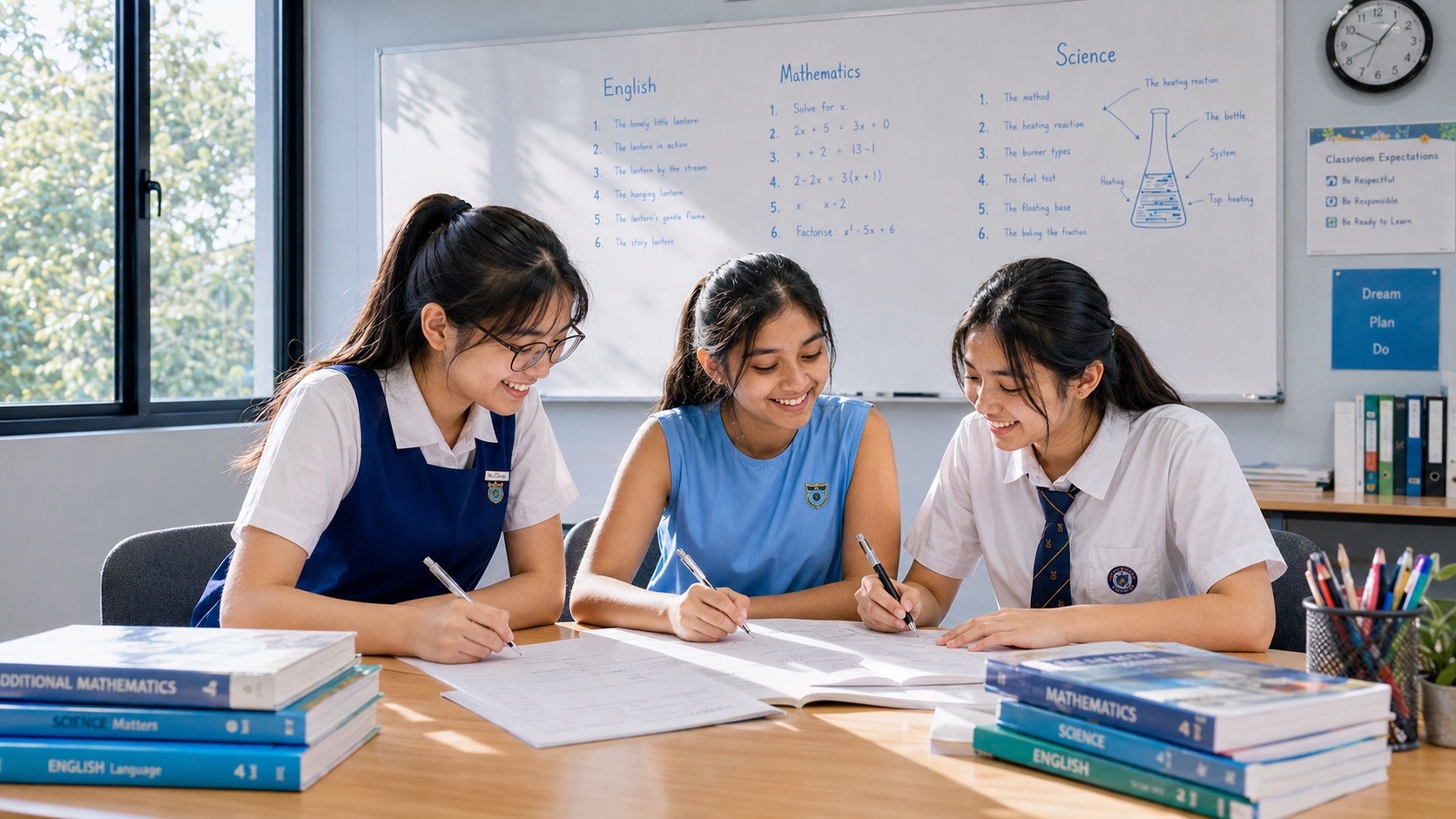
Yishun Maths Tuition Centre for Secondary 3 should help a student manage the point where lower-secondary foundations become an upper-secondary workload. Families searching for Secondary 3 Mathematics tuition in Yishun, Sec 3 Maths tuition, G3 Mathematics support, E-Mathematics tuition, Additional Mathematics support or a small-group Maths tuition centre are often seeing the same shift: algebra becomes more central, graphs carry more meaning, geometry becomes more demanding, trigonometry enters serious use, school assessments become less predictable and some students now have two Mathematics subjects to manage at once. The challenge is no longer one difficult chapter. It is coordination.
For current students moving toward the 2027 Singapore-Cambridge Secondary Education Certificate, SEAB lists G3 Mathematics as K310, with 4052 shown as the reference code from 2026 and earlier, and G3 Additional Mathematics as K341, with 4049 as the earlier reference. A good Sec 3 Maths tuition centre should therefore work within the current G1, G2 and G3 Full Subject-Based Banding landscape while keeping attention on the actual mathematics. Subject codes matter for accuracy; they should not replace the work of building algebra, graphs, geometry, proportional reasoning, statistics, probability and mathematical problem solving.
This page has one distinct job inside the eduKateYishun Mathematics estate: the Secondary 3 tuition-centre programme for upper-secondary workload integration. Other Sec 3 owners already focus on method selection, error diagnosis, modelling and connected-syllabus fluency. This article focuses on programme orchestration: how a centre should coordinate current school topics, lower-secondary repair, E-Mathematics and Additional Mathematics where applicable, cumulative retrieval, timed work and the handoff into the final year.
Secondary 3 is where mathematical workload becomes interconnected
In Sec 1 and Sec 2, many students can still survive by learning topics largely one at a time. Sec 3 exposes the weakness of that strategy. A new geometry question may require algebra. A graph question may rely on coordinate sense and proportional reasoning. A trigonometry question may require formula rearrangement. Additional Mathematics, for students taking it, increases the demand for algebraic fluency even further.
A centre should therefore stop thinking only in chapters. It should think in systems and dependencies.
Build a Sec 3 dependency map
The dependency map asks which foundations support the widest range of upper-secondary work.
- Signed numbers support algebra, coordinates, graphs and formula work.
- Fractions support algebra, ratio, probability and rates.
- Algebraic manipulation supports equations, graphs, geometry, trigonometry and A-Math where taken.
- Ratio and proportional reasoning support percentage, scale, similarity and rate.
- Graph interpretation supports functions, modelling and data reasoning.
- Geometric evidence supports trigonometry, similarity and later circle work.
When a student struggles, the centre should trace backward along this map before assigning more of the visible topic.
Current school content and foundation repair must run in parallel
A Sec 3 centre cannot pause the school year for two months of remediation. It also cannot ignore foundational weakness. The practical solution is parallel lanes.
- Current lane: support the topic being taught in school.
- Repair lane: address one high-dependency weak link.
- Retrieval lane: keep older secure topics available.
- Integration lane: use mixed questions to connect systems.
These lanes do not require four separate lessons. One lesson can move through them in sequence.
The centre should distinguish E-Mathematics from Additional Mathematics without separating them completely
For students taking Additional Mathematics, the two subjects should not become isolated worlds. A-Math places heavier demands on algebra, functions and symbolic fluency, while E-Math continues to build broad mathematical application, geometry, statistics, probability and problem solving.
The centre should identify shared foundations. Strong algebra benefits both. Graph thinking can transfer. Clear working and equation structure matter everywhere. When a shared dependency is weak, repair it once and apply it across both subjects.
At the same time, do not assume every Sec 3 student takes Additional Mathematics. The core programme should remain valid for the student’s actual subject combination.
Algebra should receive daily-level attention
Sec 3 algebra is infrastructure. A centre should maintain it through frequent short retrieval rather than occasional large blocks.
- simplifying expressions;
- expanding and factorising;
- substitution;
- solving equations;
- formula rearrangement;
- working with fractions and indices where appropriate;
- reading algebraic structure.
Then embed these skills in geometry, graphs and applications. Algebra that only works on an algebra worksheet is not yet dependable.
Graphs should connect visual and symbolic thinking
The centre should teach students to move between equation, table, graph and verbal description. A graph is a model of a relationship, not a drawing task.
Ask what an intercept means. Ask what a change in gradient suggests. Ask what an intersection represents. Ask how changing a coefficient changes the graph. These questions build the connected thinking required later.
Geometry and trigonometry should share one diagram discipline
A strong Sec 3 centre establishes common diagram routines across geometry and trigonometry. Read markings. Annotate known facts. Identify the target. Add justified relationships. Only then choose a formula or method.
For trigonometry, label sides relative to the reference angle before choosing sine, cosine or tangent where appropriate. For geometry, state reasons rather than trusting appearance. The same disciplined diagram reading supports both.
Proportional reasoning should remain visible
Percentage, rate, scale and similarity all depend on proportional structure. Students should keep asking “compared with what?”
A centre can build mixed proportional sets: a percentage change, a unit-rate problem, a scale drawing and a similar-shape question. The surface changes; the reference relationship remains central.
Statistics and probability need more than formulas
Sec 3 students should calculate and interpret. The centre should ask what the data supports, what a measure tells us and what assumptions are being made.
For probability, define the sample space and represent multi-stage situations systematically. Trees, tables and lists reduce ambiguity when they are used for structure rather than decoration.
The centre should teach a common error language
Instead of saying “careless,” students should learn to classify mistakes.
- concept not understood;
- prerequisite weak;
- method not recognised;
- representation misread;
- algebra or arithmetic execution;
- calculator or unit error;
- communication incomplete;
- time-control failure.
A shared error language makes tutor feedback faster and helps students become better self-diagnosticians.
Use school papers as programme feedback
The centre should compare tuition performance with school evidence. If tuition questions are strong but school papers remain weak, investigate the gap.
Are tuition questions too labelled? Are hints given too early? Is timing absent? Are school questions combining topics more heavily? Is the student forgetting between lessons?
The programme should adapt to the evidence rather than simply intensify.
The centre should build cumulative mini-assessments
Every few weeks, use a short cumulative set covering current and older systems. The goal is not another formal grade. It is checking whether the curriculum remains connected in memory.
Track recurring error frequency, independent starts and recognition speed. A twenty-minute mini-assessment can reveal more about the learning system than a long topical worksheet.
Timed work should begin before the final year
Sec 3 is the right time to introduce controlled timing. Start with short clusters once methods are reasonably accurate. Measure where time is being lost.
If the student reads slowly, work on representation. If method recognition is slow, use mixed classification. If calculation is slow, build fluency. If they refuse to move on, practise a move-on rule.
The centre should protect cumulative retrieval
Every week, bring back older Mathematics. Rotate across number/proportion, algebra, graphs, geometry/trigonometry and data/probability.
Do not let a topic disappear simply because the school has moved on. Upper-secondary papers will mix the syllabus later.
Worked example: algebra across subjects
A student taking both E-Math and A-Math repeatedly mishandles factorisation. Rather than treating the problem twice, the centre creates one factorisation repair sequence. First common factors, then quadratic-style factorisation where appropriate, then applications inside each subject.
One dependency repair supports multiple contexts.
Worked example: geometry plus algebra
A triangle has angles x, x + 30° and 2x – 10°. The angle-sum property gives x + (x + 30) + (2x – 10) = 180.
Simplify to 4x + 20 = 180, so x = 40. The question requires geometric evidence and algebraic execution. The centre should use such cross-topic tasks deliberately.
Worked example: graph comparison
Two service plans are represented by straight-line graphs. One starts higher but rises more slowly. The intersection shows where costs are equal. Before the intersection, one plan is cheaper; after it, the other may be.
The centre can ask students to express the same comparison algebraically. Graph and equation become connected representations.
A model 90-minute Sec 3 centre lesson
- 10 minutes: cumulative retrieval.
- 20 minutes: current school topic.
- 15 minutes: dependency repair.
- 20 minutes: cross-topic guided practice.
- 20 minutes: independent mixed or timed work.
- 5 minutes: classify errors and set the next target.
The lesson should feel connected rather than fragmented. The student should understand why each component is there.
A model four-week cycle
- Week 1: current topic + algebra/number dependency.
- Week 2: current topic + graph/representation connection.
- Week 3: current topic + geometry/trigonometry integration.
- Week 4: cumulative mixed assessment + repair plan.
For students taking Additional Mathematics, A-Math dependencies can be folded into the same cycle where appropriate.
Homework should be coordinated across the workload
Sec 3 students may have heavy school workloads. A centre should not add large assignments automatically. Homework should target the current bottleneck and maintain retrieval.
For a student taking two Mathematics subjects, coordinate practice so the same algebraic foundation is not drilled redundantly while other weaknesses are ignored.
Strong students need integration, not just acceleration
A strong student can deepen by comparing methods, modelling situations, creating counterexamples and connecting topics.
Ask how a graph changes when an equation changes. Ask for two ways to solve a problem. Ask the student to design a geometry question requiring algebra. Depth prepares the learner for unfamiliar problems without turning Sec 3 into premature final-year cramming.
Struggling students need triage
When marks are falling across several topics, search for dependencies. Test signed numbers, fractions, algebra, ratio and graph reading. A small number of weak systems may be causing widespread failure.
Choose the repair with the widest payoff. Reconnect it to current school work and retest in mixed form.
Parent communication should address workload, not only marks
Sec 3 can become overwhelming. A useful centre update can describe whether the issue is mathematical knowledge, subject coordination, retrieval, homework volume or time control.
For example: “The student’s E-Math content is broadly sound, but algebraic manipulation is creating problems in both E-Math and A-Math. We are consolidating the shared dependency rather than adding separate worksheet volume.”
Prepare a Sec 4 handoff before the year ends
A strong centre should not let Secondary 4 begin with a blank slate. Create a handoff document that identifies:
- secure systems;
- three recurring error families;
- topics that fade quickly;
- timing issues;
- calculator or notation routines still requiring attention;
- the first three Sec 4 revision priorities.
This makes the final year a continuation rather than another diagnostic reset.
Current 2027 SEC context
SEAB’s 2027 school-candidate listings show G3 Mathematics as K310, with 4052 as the earlier reference, and G3 Additional Mathematics as K341, with 4049 as the earlier reference. The current framework continues to emphasise mathematical reasoning, application, communication and connected understanding.
The centre should use this context accurately while keeping the programme centred on the mathematical systems students need to master.
How this page fits the eduKateYishun Mathematics estate
This guide focuses on the Secondary 3 tuition-centre programme for upper-secondary workload integration. For the broader map, use the Mathematics Tuition & Learning Hub and the Secondary Mathematics directory. For wider diagnostic support, use Student Diagnostics.
The focus here is programme coordination: how the centre helps a Sec 3 student manage connected mathematics and enter the final year without a hidden backlog.
Frequently asked questions
Why does Sec 3 Maths feel much heavier than Sec 2?
Because topics become more connected, algebra is used more widely, school assessments become less predictable and some students also begin managing Additional Mathematics.
Should E-Math and A-Math tuition be taught completely separately?
The subjects have distinct content, but shared foundations such as algebra should be coordinated. Repairing a common dependency can support both.
When should timed work begin?
Once the relevant methods are reasonably accurate. Short timed clusters can begin in Sec 3 so fluency and control are not left entirely to the final year.
Should a strong student rush into Sec 4 material?
Not automatically. Depth, cross-topic connection and flexible method selection may provide more durable preparation than broad early exposure.
The Sec 3 centre-integration checklist
- A dependency map guides repair priorities.
- Current content and foundation repair run in parallel.
- E-Math and A-Math shared foundations are coordinated where applicable.
- Algebra receives frequent retrieval.
- Graphs connect equation, table and context.
- Geometry and trigonometry share diagram discipline.
- Proportional reasoning remains visible.
- Statistics and probability include interpretation.
- A common error language is used.
- School papers provide programme feedback.
- Cumulative mini-assessments are used.
- Timed clusters begin before Sec 4.
- Older topics return every week.
- Homework is coordinated with school workload.
- Strong students deepen through integration.
- Struggling students receive dependency triage.
- A Sec 4 handoff is prepared.
The outcome: a centre that turns workload into a connected mathematical system
The strongest Secondary 3 Mathematics tuition centre does not treat every new chapter as another object to add to the pile. It helps the student connect the pile. Algebra supports graphs and geometry. Proportion supports rate and scale. Diagram reasoning supports trigonometry. Retrieval keeps earlier systems alive.
When the workload is integrated this way, Secondary 4 begins with more usable Mathematics and less hidden repair debt. That is the programme goal of Sec 3.
The centre should coordinate two kinds of difficulty
Sec 3 students face content difficulty and coordination difficulty. Content difficulty is a hard topic. Coordination difficulty is having several partly secure topics active at the same time. A student may understand algebra and geometry separately but fail when a geometry question requires algebraic manipulation.
The centre should train both. Topic lessons address content. Mixed and cross-topic lessons address coordination. Without the second layer, the student remains vulnerable when assessments combine ideas.
Build a workload map for students taking two Mathematics subjects
Where a student takes both E-Math and Additional Mathematics, list shared foundations and distinct content. Shared algebra should be consolidated once and applied twice. Distinct topics should receive their own practice. This prevents duplicated homework while preserving depth.
The workload map also helps with scheduling. A heavy A-Math week may require lighter E-Math homework if school has already assigned substantial practice. Good coordination protects learning quality.
Use a dependency heat map
A dependency heat map shows which weak skills are affecting the most areas. Mark algebra, fractions, ratio, graph reading, geometry reasoning and formula rearrangement against the topics they support. A weakness appearing across many columns receives priority.
The heat map prevents the centre from reacting only to the latest chapter. It helps tutors repair causes with the widest payoff.
The centre should schedule cross-topic laboratories
Once or twice a month, run a cross-topic laboratory. Students solve a small number of problems chosen because each requires more than one system. Examples include geometry plus algebra, graph plus percentage, trigonometry plus formula rearrangement, or statistics plus proportional comparison.
After each problem, ask students to identify the contributing systems. This makes connectedness explicit.
Method comparison should become normal
Upper-secondary students benefit from knowing more than one possible route. A tutor can place two correct solutions side by side and ask which is shorter, clearer or less error-prone.
Method comparison develops judgement. Fluency is not only knowing a technique; it is choosing well among techniques.
Train representation switching
When a student is stuck, ask for another representation. Turn words into an equation, an equation into a graph, a graph into a table, or a geometry description into a diagram. Representation switching reduces cognitive load and often reveals hidden structure.
The centre should make this a routine strategy rather than a tutor-only rescue technique. Students should eventually choose the representation themselves.
Teach students to identify the hidden prerequisite
After a wrong question, ask: “What earlier skill had to be secure for this to work?” In a graph question, perhaps ratio. In trigonometry, perhaps algebra. In similarity, perhaps proportional reasoning.
This question teaches students to see dependencies and helps them repair intelligently.
Run monthly cumulative checkpoints
A monthly checkpoint should mix current and earlier content. Keep it short enough to diagnose. Track independent starts, method-recognition time, execution errors and completion.
Use the results to adjust the next month’s dependency repair and retrieval schedule.
Time budgeting begins before Sec 4
Sec 3 students should learn how long common tasks take. During timed clusters, record start time, calculation time and check time. Slow performance can then be diagnosed.
A student who spends too long choosing needs recognition practice. One who chooses quickly but manipulates slowly needs fluency. One who finishes but never checks needs a control routine.
The centre should teach a weekly priority stack
Sec 3 workload becomes manageable when the student knows the priority order. A simple stack can be: urgent school content, high-dependency repair, spaced retrieval, mixed transfer. Not every priority receives equal time every week, but the student knows what comes first.
This reduces random studying and helps students taking multiple demanding subjects allocate time more rationally.
Build a tutor handoff between E-Math and A-Math where needed
If different tutors handle E-Math and A-Math, they should share a concise note on common dependencies. Repeated factorisation weakness, sign errors or graph interpretation should not be discovered independently in two separate rooms.
Coordination reduces duplicated diagnosis and produces a more coherent student experience.
Use holiday intensives for repair, not just acceleration
A holiday intensive can be useful, but it should begin with evidence. Select the high-dependency weaknesses from the term. Repair them, mix them and retest them. Only then use remaining time to preview later content.
This approach creates a cleaner return to school and prevents the student from accumulating advanced exposure on top of unstable foundations.
Build a final-year readiness dashboard
Near year end, rate the student on five dimensions: foundation stability, cumulative retrieval, mixed method selection, timed fluency and independence. The dashboard should be evidence-based, using school papers and centre checkpoints.
The lowest dimension becomes an early Sec 4 priority. This makes the handoff actionable.
A final Sec 3 principle: integration should reduce anxiety
When students see every chapter as separate, the syllabus feels enormous. When they see recurring structures—algebra, proportion, graphs, geometric evidence—the subject becomes more coherent. Integration reduces the number of “different things” the student believes they must remember.
A strong centre should leave the student with that coherence. Sec 4 will still be demanding, but the Mathematics will feel like one connected system rather than a pile of unrelated chapters.
Build a centre-wide Sec 3 operating board
An operating board can track current school topics, shared dependencies, retrieval priorities and upcoming assessments for each student. The purpose is not administrative complexity. It is preventing the programme from becoming reactive.
For a student taking both Mathematics subjects, the board can show where one algebra repair supports both. For a student taking only G3 Mathematics, the board keeps the workload focused on the relevant syllabus and current weak links.
Schedule algebra maintenance
Algebra should have a small permanent place in the week even when school is teaching geometry or statistics. Five to ten minutes of algebra maintenance can prevent skill decay.
The maintenance set should vary: one simplification, one equation, one factorisation or formula rearrangement. Then use at least one algebraic skill inside another topic later in the lesson.
Use graph laboratories for modelling
Once a month, the centre can run a graph laboratory. Students move from a real situation to a table, then an equation and graph. They compare two models and interpret an intersection or rate.
This makes graph work functional and connects it to algebra and application. It also prepares students for unfamiliar contexts in later assessments.
Use geometry laboratories for proof and trigonometry
A geometry laboratory can begin with one diagram and ask students to list every justified fact before calculating. Later, add a length or angle requiring algebra or trigonometry.
The lesson shows how geometric evidence, algebra and trigonometric relationships work together instead of appearing as separate chapters.
Plan for peak workload weeks
Sec 3 often contains weeks where several subjects have tests or projects. The centre should teach a reduced Mathematics routine for those periods: complete essential school work, retrieve one old skill and keep one active repair target alive.
This minimum viable routine prevents the learning system from collapsing completely during busy periods and makes it easier to resume full consolidation later.
Use performance checkpoints before major exams
Several weeks before a major assessment, run a mixed checkpoint under moderate timing. Diagnose recognition latency, execution accuracy and completion. Use the results to decide whether revision should emphasise content, mixed selection or timing.
This avoids discovering the performance problem only during the actual examination.
Teach selective note-making
Upper-secondary students can drown in notes. The centre should teach them to record only high-value items: one definition, one structural example, one common error and one check. Notes should support retrieval rather than become a transcription exercise.
A compact page of useful relationships is easier to revisit than pages of copied solutions.
Build a “why this method?” habit
During mixed practice, students should occasionally write a five-word justification for method choice: “right triangle, need side,” “final is 80%,” “two equations, two unknowns.” The short phrase forces recognition to become explicit.
Over time, the tutor can remove the written requirement while keeping the mental habit.
Create a final-year preview without over-teaching
Late in Sec 3, preview the structure of final-year revision: cumulative retrieval, mixed sets, timed sections and error analysis. Students do not need to complete large numbers of Sec 4 papers early. They need to understand how the next year will use the knowledge they already have.
This reduces surprise and helps them enter Sec 4 with realistic expectations.
The handoff should include workload strategy
The Sec 4 handoff should record not only weak topics but how the student manages workload. Do they postpone corrections? Do they over-practise one subject? Do they wait for hints? Do they maintain retrieval?
Final-year success depends partly on these operating habits. The centre should carry the useful ones forward and repair the weak ones early.
Teach students to separate urgent work from important repair
Sec 3 students often prioritise only what is due tomorrow. A centre should teach a two-column plan: urgent school work and important dependency repair. Urgent work keeps pace with school; important repair stops old weakness from spreading.
Both need space. If urgent work consumes every week, repair debt grows. If repair ignores current school deadlines, the student falls behind. The centre helps balance the two.
Use a cross-subject error register where useful
For students taking both Mathematics subjects, keep a small register of shared errors: sign handling, expansion, factorisation, formula rearrangement and graph interpretation. This prevents the same weakness from being corrected separately in two silos.
One shared repair can then be tested in both E-Math and A-Math contexts.
Build pre-exam mixed sets from the dependency map
Before school exams, the centre can create mixed sets that deliberately sample high-dependency systems rather than simply reproduce chapter order. Include algebra embedded in geometry, proportion embedded in scale, graph interpretation and one data problem.
The set tests whether the network is functioning, which is more informative than another sequence of isolated topical questions.
A final Sec 3 centre goal: make Sec 4 feel like continuation
The best sign of a strong Sec 3 programme is that Secondary 4 does not feel like a complete reset. The student already retrieves cumulatively, understands their error patterns, works under moderate time and knows how E-Math systems connect.
That continuity reduces both academic and emotional load in the final year.
A final integration test before Sec 4
Near year end, run one integrated assessment built around dependencies rather than chapters. Include algebra inside geometry, proportional reasoning inside scale or rate, graph interpretation connected to an equation, and one data or probability task requiring explanation.
After the assessment, students should identify which systems each question used. This reflection matters as much as the score. It shows whether the learner can see connections rather than treating the paper as a sequence of unrelated surprises.
The centre then creates the Sec 4 opening plan from that evidence. Strong dependencies remain on light retrieval. Weak dependencies receive early repair. Timing issues become controlled practice. The student starts the final year with an operating map instead of a vague instruction to “revise everything.”
This is how Sec 3 integration pays forward: fewer hidden gaps, faster recognition and a clearer final-year programme.
A final integration principle: reduce the number of separate things the student must remember
Integration makes the syllabus mentally smaller. Algebra, graphs, geometry, trigonometry and proportion stop being isolated boxes and become related tools. A student who sees these links has fewer independent procedures to memorise because one structural idea can explain several question types.
The centre should keep asking what two topics share, what earlier skill supports both and which representation makes the relationship clearest. These questions build a connected mental model.
That mental model is the real Sec 3 asset carried into Sec 4: more knowledge organised into fewer, stronger systems.
When Sec 3 ends well, the student can look at a mixed question and see familiar structures even when the surface is new. They can ask which dependency is active, which representation will help and which method is most efficient. This is more valuable than simply having touched more chapters. It means the centre has turned workload into connected mathematical understanding and made the transition to final-year revision substantially more manageable.
The centre should preserve this connected view in the Sec 4 handoff. Instead of listing twenty chapters, it should name the systems that are dependable and the dependencies that still need attention. A student may need stronger algebraic manipulation, faster graph recognition or more stable geometric reasoning. Those are actionable priorities. They allow the final year to begin with targeted work, while the rest of the syllabus remains active through light cumulative retrieval.
The strongest Sec 3 programme also leaves the student able to explain their own workload. They know which Mathematics is current, which dependency is being repaired, what older system is due for retrieval and which assessment behaviour needs attention. That clarity reduces random studying and makes the final-year transition more deliberate. Sec 4 then begins with an organised learner as well as an organised syllabus.
This organised handoff matters because final-year Mathematics will ask for both knowledge and performance. A student who already understands dependencies, retrieval and mixed selection can spend Sec 4 refining examination control instead of rebuilding the entire subject under pressure.
That is the point of Sec 3 integration: stronger connections now create a calmer, more efficient final year later.
The student enters Sec 4 with connected knowledge, better retrieval and a clearer strategy for difficult questions.
Ready.
Secondary Mathematics learning route: Continue to the Secondary Mathematics directory · Student Diagnostics. For current tuition-service decisions, use the Yishun Tuition Centre Hub and confirm current arrangements separately.
Part II · How a Secondary 3 Maths Tuition Centre Should Manage the Upper-Secondary Step-Up
This section gives the page its distinct centre role: intake, group matching, shared teaching, differentiated practice, algebra/graph/geometry integration, homework, school alignment, assessment review and the handoff into Secondary 4. Current group sizes, schedules and venues should be confirmed directly rather than inferred from historical content.
Use current school materials and official SEAB SEC information for the learner’s subject level and examination cohort. The centre system here supports that scope.
1. Upper-secondary intake
Centre role. identify which lower-secondary foundations will affect the current Secondary 3 workload.
Operational risk. assuming the step-up is only about harder new topics.
Diagnostic move. review recent algebra, ratio, graph, geometry and school work before prescribing practice.
Lesson sequence. verify the picture with a cold mixed sample.
Programme outcome. begin the centre programme from the actual transition state.
2. Subject-level fit
Centre role. match pace and question complexity to the student’s current Mathematics subject level.
Operational risk. using a single Sec 3 worksheet for all learners.
Diagnostic move. follow school placement and current taught content as the immediate guide.
Lesson sequence. differentiate scaffolds and extension.
Programme outcome. avoid artificial gaps.
3. Transition baseline
Centre role. establish independent starts on new upper-secondary representations.
Operational risk. teaching every method before seeing what the student can already do.
Diagnostic move. sample algebra, graph, geometry, rate and data problems without topic cues.
Lesson sequence. record first weak decisions and support needed.
Programme outcome. create a comparison point for later independence.
4. Group matching
Centre role. form small groups that can share meaningful core teaching.
Operational risk. matching by age alone.
Diagnostic move. compare current topic, pace, subject level and repair needs.
Lesson sequence. use common relationships with differentiated follow-up.
Programme outcome. make the group teachable.
5. Individual first attempt
Centre role. protect each student’s thinking before shared explanation.
Operational risk. letting one quick learner announce the method for everyone.
Diagnostic move. begin with quiet work or a first-line response.
Lesson sequence. collect different starts.
Programme outcome. make discussion evidence-led.
6. Shared core lesson
Centre role. teach one relationship when several students genuinely need it.
Operational risk. giving unrelated mini-lessons inside one group.
Diagnostic move. select a common algebraic, graphical or geometric dependency.
Lesson sequence. model the critical decision clearly.
Programme outcome. use the group for comparison rather than copying.
7. Differentiated follow-up
Centre role. branch by error mechanism and readiness.
Operational risk. giving identical worksheets after the shared explanation.
Diagnostic move. assign repair, standard transfer or extension versions.
Lesson sequence. preserve the shared mathematical core.
Programme outcome. personalise within the group.
8. Independent exit
Centre role. finish with fresh individual application.
Operational risk. ending on the final modelled example.
Diagnostic move. change values, orientation, wording or unknown.
Lesson sequence. remove method labels and record prompt dependence.
Programme outcome. prove lesson transfer.
9. Algebra intake
Centre role. test notation, like terms, expansion, factorisation where relevant, equations and substitution.
Operational risk. treating all algebra errors as one category.
Diagnostic move. locate the first unstable layer.
Lesson sequence. repair narrowly and then embed it in current topics.
Programme outcome. make algebra a dependable engine.
10. Signed-number dependency
Centre role. protect algebra and graph work from negative-sign errors.
Operational risk. calling recurring sign loss careless.
Diagnostic move. use brackets, explicit negative products and signed coordinate checks.
Lesson sequence. mix signs across algebra and graphs.
Programme outcome. stabilise a cross-topic dependency.
11. Fraction dependency
Centre role. keep fraction operations available inside algebra and probability.
Operational risk. assuming lower-secondary fraction work remains automatic.
Diagnostic move. test simple operations and fraction equations.
Lesson sequence. reconnect quickly to current Secondary 3 work.
Programme outcome. avoid repeated leakage.
12. Ratio and proportion
Centre role. preserve multiplicative reasoning before similarity and rate.
Operational risk. using additive differences when scale is required.
Diagnostic move. write a ratio table or scale factor first.
Lesson sequence. move to corresponding sides and percentage links.
Programme outcome. prepare proportional upper-secondary work.
13. Percentage readiness
Centre role. separate forward, change and reverse percentage.
Operational risk. using one procedure on every percentage problem.
Diagnostic move. identify the reference and multiplier.
Lesson sequence. contrast similar-looking intents.
Programme outcome. build modelling control.
14. Expansion
Centre role. treat brackets as grouped quantities.
Operational risk. missing cross-products or second terms.
Diagnostic move. use area or grid models when needed.
Lesson sequence. fade to efficient symbolic working.
Programme outcome. support later algebra.
15. Factorisation
Centre role. understand factorisation as reverse expansion.
Operational risk. guessing brackets without checking.
Diagnostic move. identify common structure and expand back to verify.
Lesson sequence. pair factorisation with expansion.
Programme outcome. build reversible algebra.
16. Quadratic readiness
Centre role. where the current course includes it, connect coefficients and factor structure.
Operational risk. memorising patterns without understanding.
Diagnostic move. use expansion to explain the middle and constant terms.
Lesson sequence. check every factorisation by reversing it.
Programme outcome. prepare for equation work.
17. Equation solving
Centre role. preserve equality under multi-step transformations.
Operational risk. transposing mechanically and losing signs.
Diagnostic move. state inverse operations or balance logic.
Lesson sequence. use substitution checks.
Programme outcome. make solving auditable.
18. Formula rearrangement
Centre role. treat formulae as equations.
Operational risk. memorising many rearranged versions.
Diagnostic move. identify the target variable and undo operations.
Lesson sequence. check with simple values.
Programme outcome. support modelling and geometry.
19. Word-to-equation translation
Centre role. turn descriptions into algebra before manipulating.
Operational risk. searching for keywords.
Diagnostic move. define the variable and map each relationship.
Lesson sequence. practise equation construction separately.
Programme outcome. separate reading from execution.
20. Tables and rules
Centre role. connect input-output values to algebraic relationships.
Operational risk. copying tables without seeing pattern.
Diagnostic move. compare changes and identify a rule where appropriate.
Lesson sequence. generate new values and reverse the process.
Programme outcome. prepare for graphs.
21. Graph construction
Centre role. turn rules and tables into plotted relationships.
Operational risk. plotting points with no interpretation.
Diagnostic move. read axes and scale first.
Lesson sequence. plot, then describe the relationship.
Programme outcome. connect symbolic and visual forms.
22. Gradient reasoning
Centre role. where taught, connect coordinate change to rate.
Operational risk. memorising formula with inconsistent point order.
Diagnostic move. write vertical over horizontal change consistently.
Lesson sequence. interpret sign and unit.
Programme outcome. build modelling meaning.
23. Intercept reasoning
Centre role. distinguish x and y intercepts.
Operational risk. reversing coordinates.
Diagnostic move. set the appropriate coordinate to zero.
Lesson sequence. verify the point on the graph.
Programme outcome. protect straightforward graph marks.
24. Pythagoras readiness
Centre role. identify right-triangle conditions.
Operational risk. using theorem whenever side lengths appear.
Diagnostic move. mark right angle and hypotenuse first.
Lesson sequence. contrast with trig and non-right cases.
Programme outcome. make formula conditional.
25. Trigonometry selection
Centre role. label H/O/A relative to the reference angle.
Operational risk. choosing ratios from memory without reading diagram.
Diagnostic move. mark reference angle before formula.
Lesson sequence. rotate diagrams and vary unknown.
Programme outcome. build orientation-independent selection.
26. Trig calculator use
Centre role. separate correct equation from device entry.
Operational risk. blaming concept when mode or brackets are wrong.
Diagnostic move. estimate angle/side range.
Lesson sequence. check mode, input and rounding.
Programme outcome. keep calculator use controlled.
27. Similarity
Centre role. pair corresponding sides before scale.
Operational risk. matching sides by visual position.
Diagnostic move. mark vertices or build a side table.
Lesson sequence. apply one scale factor consistently.
Programme outcome. prepare for complex diagrams.
28. Scale dimensions
Centre role. distinguish linear, area and volume factors where taught.
Operational risk. using one factor for every measure.
Diagnostic move. name target dimension.
Lesson sequence. compare changes on the same similar figures.
Programme outcome. develop dimensional reasoning.
29. Geometry reason chains
Centre role. write short evidence-based deductions.
Operational risk. trusting appearance.
Diagnostic move. separate given fact, property and conclusion.
Lesson sequence. rotate figures and reproduce logic.
Programme outcome. make geometry transferable.
30. Mensuration
Centre role. choose perimeter, area, surface or volume by target.
Operational risk. formula hunting.
Diagnostic move. name physical attribute and unit first.
Lesson sequence. decompose composite figures.
Programme outcome. protect measurement reasoning.
31. Rate
Centre role. keep compound units and reference quantities visible.
Operational risk. calculating with bare numbers.
Diagnostic move. write unit rate or formula relationship.
Lesson sequence. use unitary reasoning and checks.
Programme outcome. connect ratio to applied problems.
32. Average speed
Centre role. use total distance over total time.
Operational risk. averaging component speeds directly.
Diagnostic move. build a journey table.
Lesson sequence. sum distances and times before dividing.
Programme outcome. model rates correctly.
33. Statistics
Centre role. calculate requested measures and interpret them.
Operational risk. treating one statistic as the complete data story.
Diagnostic move. organise data and read instruction first.
Lesson sequence. compare distributions and summaries.
Programme outcome. build statistical judgement.
34. Probability
Centre role. construct sample space and event.
Operational risk. guessing denominator.
Diagnostic move. use list, table or tree as appropriate.
Lesson sequence. compare event and complement.
Programme outcome. prepare for sequential probability.
35. Replacement awareness
Centre role. update later-stage probabilities where objects are not replaced.
Operational risk. keeping branches unchanged.
Diagnostic move. track remaining outcomes explicitly.
Lesson sequence. contrast with replacement.
Programme outcome. make two-stage models reliable.
36. Calculator discipline
Centre role. use technology after the mathematical setup is visible.
Operational risk. entering expressions before modelling.
Diagnostic move. write, estimate, input, inspect and round.
Lesson sequence. practise relevant functions only.
Programme outcome. reduce device dependence.
37. Error log
Centre role. store mechanisms and prevention cues.
Operational risk. collecting corrected questions without pattern.
Diagnostic move. record first error, cause, check and retest date.
Lesson sequence. remove stable entries.
Programme outcome. make review usable.
38. Retrieval start
Centre role. begin lessons with old and current knowledge.
Operational risk. opening notes immediately.
Diagnostic move. use short closed-book prompts.
Lesson sequence. review only missing pieces.
Programme outcome. strengthen access.
39. Spacing
Centre role. return after forgetting begins.
Operational risk. cramming a topic and abandoning it.
Diagnostic move. schedule short delayed retests.
Lesson sequence. lower frequency after repeated success.
Programme outcome. build durability.
40. Interleaving
Centre role. mix methods after direct accuracy is stable.
Operational risk. keeping topical blocks until exams.
Diagnostic move. pair commonly confused methods then broaden.
Lesson sequence. ask for first-line method choice.
Programme outcome. train recognition.
41. Worked-example fading
Centre role. reduce model dependence.
Operational risk. showing full solutions forever.
Diagnostic move. remove steps, labels and cues progressively.
Lesson sequence. finish with fresh work.
Programme outcome. measure autonomy.
42. Homework architecture
Centre role. give each question a learning function.
Operational risk. assigning high volume by default.
Diagnostic move. combine retrieval, repair, contrast and transfer.
Lesson sequence. fit school workload.
Programme outcome. make homework informative.
43. Assessment preparation
Centre role. progress from understanding to mixed performance.
Operational risk. using strict timing too early.
Diagnostic move. move through direct, mixed untimed, timed sections and representative papers.
Lesson sequence. analyse first errors afterward.
Programme outcome. convert knowledge into control.
44. Parent reporting
Centre role. report mechanisms and independence.
Operational risk. sending only scores or vague effort comments.
Diagnostic move. state secure strength, active repair, support level and next retest.
Lesson sequence. give one aligned home action.
Programme outcome. keep family coordinated.
45. Secondary 4 handoff
Centre role. finish the year with a connected readiness map.
Operational risk. entering examination year with hidden dependencies.
Diagnostic move. audit algebra, proportion, graphs, geometry, data, calculator and study routines.
Lesson sequence. use mixed delayed tasks.
Programme outcome. make Secondary 4 more selective.
A fictional student labels the triangle correctly but cannot rearrange the trig equation. The centre protects trig understanding and repairs algebraic rearrangement directly.
Fresh equations and later trig problems test the common dependency.
Centre Case: graphing without interpretation
The learner plots accurately but cannot explain scale, intercept or change. The centre adds graph-reading language and table-equation translation.
A new context tests whether the representation has meaning beyond plotting.
Centre Case: strong lower secondary, transition shock
A capable student feels suddenly weak because several new representations arrive at once. The centre identifies which parts are genuinely new and which old skills remain strong.
Confidence is rebuilt from a precise map rather than broad reassurance.
Centre Case: mixed group needs
One learner needs fraction repair, one needs standard algebra transfer, and one is ready for extension. A common algebra problem is used, then follow-up branches.
Small group teaching remains coherent and individual.
Centre Case: homework overload
School and centre work together are too heavy. The centre reduces home volume to retrieval, one active repair and one transfer item.
The learner gets more useful evidence with less fatigue.
Centre Case: strong student overgeneralises
A high-performing learner uses fast shortcuts outside their valid conditions. The centre uses counterexamples and condition statements.
Depth improves without racing unnecessarily ahead.
Centre Case: quiet learner
The student contributes little verbally but solves accurately after thinking time. The centre uses written first attempts before discussion.
Participation is judged by mathematical reasoning, not speed of speech.
Centre Case: support fading
The tutor initially names the topic and provides the diagram. Later only a target question is needed, then none.
The centre tracks this reduction as a core outcome.
Centre FAQ
What is the biggest Secondary 3 centre challenge?
Managing new upper-secondary content while repairing only the lower-secondary dependencies that actually block it.
Should every student start trigonometry at the same pace?
Follow the student’s school scope and readiness. Diagram reading, algebra and calculator control may require different levels of support.
How should algebra be prioritised?
Because it supports many topics, repeated algebra errors often deserve high priority. But diagnose the exact layer rather than assigning generic algebra volume.
When should mixed practice begin?
After direct execution is stable enough that the main challenge can shift to method selection.
How should parents judge progress?
Look for independent starts, fewer repeated error types, better transfer and lighter prompts as well as marks.
Should tuition accelerate into Secondary 4?
Only when current foundations are secure and there is a clear purpose. Connected depth may be more valuable.
How should homework be sized?
Enough to retrieve, repair and transfer without overwhelming school commitments.
What if the group has different school topics?
Use compatible core relationships where possible and differentiate follow-up. If needs diverge too far, group fit should be reviewed.
What should happen after a test?
Classify first errors, preserve secure areas, repair high-value mechanisms and schedule delayed retests.
What is the final centre goal?
A learner who enters Secondary 4 with connected upper-secondary foundations and less dependence on tutor-led method selection.
A model Secondary 3 centre cycle
Cycle 1 establishes the baseline and upper-secondary dependency map. Cycle 2 repairs the highest-connectivity weakness. Cycle 3 connects repair to current school topics. Cycle 4 introduces mixed transfer and delayed retrieval. Cycle 5 adds timed sections and paper control. Cycle 6 runs the Secondary 4 readiness audit.
The length of each cycle follows evidence rather than a fixed promise. Strong learning should gradually reduce support and practice volume on secure topics.
Final Secondary 3 centre standard
A strong centre leaves the learner with upper-secondary Mathematics that is more connected and less tutor-dependent. Algebra supports graphs and geometry; proportional thinking supports rate and similarity; representations can be translated; errors can be diagnosed; and mixed questions can increasingly be started without chapter cues.
Extended Learning Manual
This page now owns the tuition-centre architecture for the Secondary 3 upper-secondary step-up: how a small-group centre can diagnose, group, teach, differentiate, report progress and build examination readiness without turning the year into premature final-exam panic.
The standing eduKateYishun direction is rehabilitation, connection and independence. Protect what already works, diagnose the first broken mechanism, consolidate it, convert it into fresh application, recover when the first route fails, and reduce support as the learner becomes able to carry the process alone. Current school work remains the immediate context; official syllabus and examination details should be checked against the student’s school and SEAB information for the relevant cohort.
1. Diagnostic baseline
Tuition-centre purpose. what the learner can do independently before a new teaching cycle begins.
Common breakdown. starting from a generic worksheet sequence before inspecting actual work.
Diagnostic move. use one short mixed sample plus recent school work and record the first unsupported decision.
Teaching and practice. teach only the dependency exposed by that evidence before returning to current school questions.
Transfer test. make the next lesson respond to the learner rather than to a fixed worksheet order.
2. Error taxonomy
Tuition-centre purpose. how concept, representation, method, execution, interpretation and control errors differ.
Common breakdown. calling every wrong answer careless or weak Mathematics.
Diagnostic move. classify the first error in the solution chain and preserve every correct decision before it.
Teaching and practice. build one repair task for the error family instead of repeating the whole topic.
Transfer test. let repeated error patterns determine practice priority.
3. Retrieval practice
Tuition-centre purpose. making important prior knowledge available without notes.
Common breakdown. rereading examples until they feel familiar.
Diagnostic move. begin selected lessons with short closed-book prompts from earlier learning.
Teaching and practice. review only the missing relationship, then retrieve it again later.
Transfer test. reduce working-memory load when new topics depend on old knowledge.
4. Spacing
Tuition-centre purpose. returning to repaired learning after some forgetting has begun.
Common breakdown. cramming one topic intensely and then abandoning it.
Diagnostic move. schedule a same-week retest and a later delayed retest.
Teaching and practice. lower review frequency once performance remains stable.
Transfer test. turn same-day correction into durable memory.
5. Interleaving
Tuition-centre purpose. choosing methods when chapter headings disappear.
Common breakdown. keeping every practice set blocked by topic until an assessment.
Diagnostic move. mix methods only after direct execution is reasonably secure.
Teaching and practice. ask for the first line or representation before full solving.
Transfer test. train method selection rather than only procedure repetition.
6. Worked examples
Tuition-centre purpose. using a complete model when a relationship is genuinely new.
Common breakdown. showing models forever or withholding support too early.
Diagnostic move. explain why each step is legal and what quantity it changes.
Teaching and practice. remove one step at a time until the learner reconstructs the solution.
Transfer test. convert model reading into independent problem solving.
7. Prompt fading
Tuition-centre purpose. reducing tutor control as capability grows.
Common breakdown. treating a correct answer after several hints as independent mastery.
Diagnostic move. record whether the tutor supplied the topic, representation, formula, first line or error location.
Teaching and practice. offer a lighter prompt on the next fresh task.
Transfer test. make independence measurable rather than assumed.
8. Signed-number control
Tuition-centre purpose. keeping positive and negative values stable across arithmetic and algebra.
Common breakdown. memorising sign slogans without understanding direction or grouping.
Diagnostic move. use number-line reasoning and bracketed signed values where errors occur.
Teaching and practice. embed signed numbers inside substitution, coordinates and equations.
Transfer test. prevent one old weakness from leaking into several topics.
9. Fraction foundations
Tuition-centre purpose. keeping fraction magnitude and operations usable inside later Mathematics.
Common breakdown. treating fractions as a completed lower-school chapter.
Diagnostic move. check equivalent fractions, common units and operations only as needed for current work.
Teaching and practice. move quickly from numeric fractions into algebra, ratio or probability contexts.
Transfer test. repair a high-connectivity prerequisite without restarting everything.
10. Ratio reasoning
Tuition-centre purpose. preserving multiplicative relationships and common scale factors.
Common breakdown. using additive differences when a ratio must stay constant.
Diagnostic move. identify one ratio unit or scale factor before calculating.
Teaching and practice. move among tables, bars and equations as appropriate.
Transfer test. prepare the learner for proportion, rate and scale problems.
11. Percentage reference
Tuition-centre purpose. anchoring a percentage to the correct whole or original quantity.
Common breakdown. using the nearest visible number as the percentage base.
Diagnostic move. write the reference quantity or 100% value before calculation.
Teaching and practice. contrast forward, change and reverse percentage questions.
Transfer test. prevent reference drift in mixed word problems.
12. Algebraic notation
Tuition-centre purpose. reading variables, coefficients, powers and brackets as mathematical language.
Common breakdown. seeing symbols as visual codes detached from quantity meaning.
Diagnostic move. translate expressions into words and simple quantity stories.
Teaching and practice. move from words back into symbols on fresh examples.
Transfer test. make later manipulation meaningful.
13. Like-term classification
Tuition-centre purpose. separating terms by variable structure before arithmetic.
Common breakdown. combining unlike terms because the coefficients are nearby.
Diagnostic move. mark variable parts and powers before adding coefficients.
Teaching and practice. use contrast sets containing x, y, x² and constants.
Transfer test. stabilise simplification before more complex algebra.
14. Expansion
Tuition-centre purpose. treating a multiplier as acting on every term in a grouped quantity.
Common breakdown. distributing to only the first term or losing a negative sign.
Diagnostic move. use a temporary area or group model when the structure is unclear.
Teaching and practice. fade to symbolic work and include positive and negative multipliers.
Transfer test. build reversible algebraic understanding.
15. Factorisation readiness
Tuition-centre purpose. seeing factorisation as the reverse of expansion where it is in scope.
Common breakdown. guessing brackets without checking equivalence.
Diagnostic move. identify a common factor or product structure and expand proposed answers to verify.
Teaching and practice. pair factorisation practice with its reverse expansion.
Transfer test. make algebraic structure easier to reconstruct.
16. Equation balance
Tuition-centre purpose. preserving equality while undoing operations.
Common breakdown. moving terms and changing signs mechanically.
Diagnostic move. name the inverse operation applied to both sides and keep one high-risk change per line.
Teaching and practice. progress from simple equations into contextual or geometric equations.
Transfer test. make equation solving dependable across topics.
17. Word-to-equation translation
Tuition-centre purpose. turning a verbal relationship into a mathematical one before manipulation.
Common breakdown. searching for keywords without defining what the numbers represent.
Diagnostic move. define the unknown and restate the comparison or total relationship.
Teaching and practice. practise equation construction separately from solving when needed.
Transfer test. separate language difficulty from algebra difficulty.
18. Formula use
Tuition-centre purpose. connecting symbols, quantities and units before substitution.
Common breakdown. plugging numbers into any remembered formula that contains familiar letters.
Diagnostic move. label the variables and target quantity first.
Teaching and practice. estimate and inspect units after calculation.
Transfer test. make formula use conditional rather than ritual.
19. Coordinate fluency
Tuition-centre purpose. keeping ordered pairs, axes and negative positions under control.
Common breakdown. reversing x and y or ignoring signed coordinates.
Diagnostic move. trace horizontal position first and vertical position second.
Teaching and practice. move between plotted points, tables and simple rules.
Transfer test. support graph and geometry work.
20. Graph literacy
Tuition-centre purpose. reading axes, units, scale and key points before interpreting shape.
Common breakdown. describing a graph by appearance alone.
Diagnostic move. state what one grid interval means and identify the variables.
Teaching and practice. translate selected points into a table or rule where appropriate.
Transfer test. turn graph reading into evidence-based interpretation.
21. Geometry evidence
Tuition-centre purpose. reasoning from given and derived properties instead of appearance.
Common breakdown. assuming equal sides, parallel lines or right angles because they look plausible.
Diagnostic move. mark givens separately from deductions and write short reason chains.
Teaching and practice. rotate or redraw figures while preserving the same properties.
Transfer test. make geometry robust under unfamiliar layouts.
22. Angle relationships
Tuition-centre purpose. distinguishing triangle, straight-line, point and other angle structures.
Common breakdown. using 180 or 360 automatically.
Diagnostic move. name the geometric relationship before writing an equation.
Teaching and practice. mix nearby angle contexts deliberately.
Transfer test. reduce formula-selection mistakes.
23. Mensuration
Tuition-centre purpose. distinguishing perimeter, area, surface area and volume by the quantity measured.
Common breakdown. choosing a formula from the visible dimensions alone.
Diagnostic move. state the physical attribute and expected unit before calculating.
Teaching and practice. contrast the same dimensions under different questions.
Transfer test. build dimensional sense.
24. Composite figures
Tuition-centre purpose. decomposing unfamiliar shapes into manageable parts.
Common breakdown. searching for one memorised formula for the whole diagram.
Diagnostic move. draw partition or enclosure lines and derive missing dimensions.
Teaching and practice. compare two valid decompositions for clarity and efficiency.
Transfer test. develop representation choice.
25. Measurement conversion
Tuition-centre purpose. aligning units before combining quantities.
Common breakdown. adding or comparing bare numerals with incompatible units.
Diagnostic move. write the conversion relationship and direction first.
Teaching and practice. use estimation to check the converted magnitude.
Transfer test. build unit discipline for later rates and geometry.
26. Rate reasoning
Tuition-centre purpose. treating a rate as a relationship with compound units.
Common breakdown. dropping units and manipulating numbers without meaning.
Diagnostic move. name numerator and denominator quantities before division.
Teaching and practice. use a table or unitary method when the relationship is not yet stable.
Transfer test. prepare for speed and other applied contexts.
27. Statistics meaning
Tuition-centre purpose. using mean, median, mode and range as different descriptions.
Common breakdown. calculating whichever statistic is remembered first.
Diagnostic move. read the instruction and inspect data organisation before calculation.
Teaching and practice. compare datasets with similar centres and different spreads.
Transfer test. build statistical judgement.
28. Mean-total-count
Tuition-centre purpose. using total = mean × count as a reversible relationship.
Common breakdown. knowing only the forward mean formula.
Diagnostic move. write the total relationship before reverse or missing-value questions.
Teaching and practice. practise forward and backward forms.
Transfer test. make average questions flexible.
29. Probability foundations
Tuition-centre purpose. defining the event and sample space before forming a probability.
Common breakdown. guessing the denominator from the most visible number.
Diagnostic move. list or organise outcomes with an appropriate representation.
Teaching and practice. contrast an event with its complement and change the model when conditions change.
Transfer test. make uncertainty systematic.
30. Command-word control
Tuition-centre purpose. matching words such as simplify, solve, calculate, state and explain to the required output.
Common breakdown. performing valid Mathematics that does not answer the instruction.
Diagnostic move. build a compact glossary from actual school tasks.
Teaching and practice. compare the same mathematical data under different commands.
Transfer test. align the final response with the task.
31. Representation choice
Tuition-centre purpose. selecting a model, table, equation, graph or diagram because it exposes the relationship.
Common breakdown. using one favourite representation everywhere.
Diagnostic move. ask what needs to become visible before choosing.
Teaching and practice. solve selected problems with two representations and compare efficiency.
Transfer test. build flexible problem-solving judgement.
32. Intermediate labels
Tuition-centre purpose. keeping multi-step results attached to their meanings.
Common breakdown. carrying bare numbers through several steps and reusing them incorrectly.
Diagnostic move. write a short quantity label and unit beside important intermediate answers.
Teaching and practice. refer to the label before the next operation.
Transfer test. protect working memory and state control.
33. Estimation
Tuition-centre purpose. predicting sign and approximate magnitude before exact calculation.
Common breakdown. copying implausible arithmetic or calculator output.
Diagnostic move. use simple benchmarks, bounds or geometric constraints.
Teaching and practice. compare the exact result with the prediction.
Transfer test. create an independent error-detection layer.
34. Checking by type
Tuition-centre purpose. using verification that matches the problem.
Common breakdown. rereading working without knowing what risk is being checked.
Diagnostic move. choose substitution, inverse operation, estimation, units, angle sums or another representation.
Teaching and practice. practise checks during ordinary work rather than only before tests.
Transfer test. make checking efficient and purposeful.
35. Homework architecture
Tuition-centre purpose. giving every home task a reason.
Common breakdown. assigning large repetitive sets because volume looks serious.
Diagnostic move. combine retrieval, current repair and one transfer item.
Teaching and practice. keep the load small enough that corrections can be analysed.
Transfer test. make homework diagnostic.
36. Small-group architecture
Tuition-centre purpose. using group discussion without losing individual accountability.
Common breakdown. letting one confident learner reveal the route before others have tried.
Diagnostic move. begin and end with quiet individual attempts.
Teaching and practice. use discussion to compare methods between those attempts.
Transfer test. turn peers into reasoning resources rather than answer sources.
37. Parent communication
Tuition-centre purpose. reporting mechanisms and independence rather than only scores.
Common breakdown. sending broad labels such as good, weak or careless.
Diagnostic move. name one secure strength, one active repair and one next retest.
Teaching and practice. show a concrete change in work where useful.
Transfer test. align home support with the teaching plan.
38. Assessment preparation
Tuition-centre purpose. moving gradually from understood methods to mixed performance.
Common breakdown. starting strict timing before the mathematics is stable.
Diagnostic move. progress from direct practice to mixed untimed work and then timed sections.
Teaching and practice. classify first errors after each assessment-like set.
Transfer test. convert knowledge into dependable performance.
39. Time management
Tuition-centre purpose. locating where time is actually lost.
Common breakdown. treating every unfinished paper as a general speed problem.
Diagnostic move. observe whether delays come from reading, retrieval, method choice, execution or checking.
Teaching and practice. train the bottleneck rather than imposing indiscriminate haste.
Transfer test. build controlled speed.
40. Recovery routine
Tuition-centre purpose. knowing what to do when the first route fails.
Common breakdown. repeating the same failed step or waiting passively for help.
Diagnostic move. return to the target, givens and representation, then try a different route or smaller subproblem.
Teaching and practice. practise park-and-return behaviour on mixed sets where appropriate.
Transfer test. make uncertainty procedural.
41. Independence audit
Tuition-centre purpose. measuring what remains possible after prompts disappear.
Common breakdown. equating quiet work with true independence.
Diagnostic move. record the strongest prompt still required on fresh work.
Teaching and practice. remove one support at a time and retest after a delay.
Transfer test. make autonomy an explicit outcome.
42. Next-stage handover
Tuition-centre purpose. carrying secure foundations and active risks into the next year.
Common breakdown. restarting the entire subject at each level.
Diagnostic move. create a one-page map of secure skills, recurring risks, useful representations and checking routines.
Teaching and practice. keep strong areas on maintenance and active risks specific.
Transfer test. make progression cumulative.
43. Pythagorean selection
Tuition-centre purpose. using the right-triangle side-length relationship only when its condition is satisfied.
Common breakdown. applying the theorem to any triangle with three side lengths.
Diagnostic move. mark the right angle and hypotenuse before substitution.
Teaching and practice. contrast with a trigonometric and a non-right-triangle case.
Transfer test. tie formula choice to conditions.
44. Trigonometric selection
Tuition-centre purpose. choosing sine, cosine or tangent from the reference angle and known/required sides.
Common breakdown. reciting SOHCAHTOA while labelling sides relative to the wrong angle.
Diagnostic move. mark H, O and A before choosing a ratio.
Teaching and practice. rotate diagrams and change the unknown.
Transfer test. make trig independent of orientation.
45. Trigonometric calculator control
Tuition-centre purpose. separating correct setup from calculator execution.
Common breakdown. changing the mathematical method when the input or mode caused the error.
Diagnostic move. estimate angle or side magnitude before entry.
Teaching and practice. check brackets, mode and geometric plausibility.
Transfer test. keep technology subordinate to reasoning.
46. Similarity correspondence
Tuition-centre purpose. pairing corresponding sides before applying a scale factor.
Common breakdown. matching by visual position on the page.
Diagnostic move. mark corresponding vertices or create a side-pair table.
Teaching and practice. apply one consistent factor and verify it.
Transfer test. prepare for unfamiliar orientations.
47. Mathematical modelling
Tuition-centre purpose. stating the assumptions behind a simplified relationship.
Common breakdown. treating a model as literal reality.
Diagnostic move. name variables, assumptions and what is held constant.
Teaching and practice. test what changes if an assumption is altered.
Transfer test. build critical application.
Secondary 3 Maths Tuition Centre in Yishun: Practice and Transfer Bank
The laboratories below are original learning structures for selective use. They are not official examination questions and should not be assigned as one giant worksheet. Choose the labs that match the learner’s current school content and active repair priorities.
Enough to establish execution, test method selection and provide a delayed retest. The exact number varies by learner. Once a skill remains secure across changed mixed questions, reduce it to maintenance instead of continuing the same volume.
Should every wrong answer be corrected immediately?
Not always. Give the learner a chance to identify the first wrong line or test the result. Immediate correction is useful when a misconception is being reinforced, but constant rescue can remove the opportunity to self-monitor.
What does ‘careless’ mean?
Sometimes it describes a one-off slip. Repeated signs, units, copied values, percentage references or rounding errors are better treated as predictable control problems with specific checking routines.
Should difficult work be timed?
Only after the relevant method is stable enough untimed. Timing an uncertain process can train rushing. Once accuracy is reliable, short timed sections can identify whether delay comes from retrieval, method choice, execution or checking.
How should parents help?
Ask what the question is asking, which relationship the learner is using and how the answer could be checked. Avoid supplying every first step or introducing a competing method before understanding the school or tuition approach.
How is a topic declared secure?
The learner can retrieve it after a delay, identify it in mixed work, solve a changed version and use an appropriate check with little or no prompting. Same-day worksheet accuracy is useful but not sufficient.
What if marks fall suddenly?
Compare actual papers. The cause may be harder questions, more mixed selection, a prerequisite gap, unfinished work or recurring control errors. Convert the fall into a small set of mechanisms rather than a global judgement.
What if marks are already high?
Use depth: counterexamples, construction, method comparison, reverse questions and unfamiliar combinations. High marks do not remove the need for transfer and independence.
How should official syllabus details be handled?
Use the student’s current school materials and official SEAB information for the relevant subject level and examination cohort. A long-form tuition guide should support that context rather than pretend to replace it.
What is the final goal of tuition?
A learner who can interpret unfamiliar work, choose a defensible representation and method, execute accurately, check intelligently and recover when the first route fails with decreasing external support.
A twelve-week Secondary 3 Maths Tuition Centre in Yishun cycle
Weeks 1–2: build a baseline from recent school work and a short mixed sample. Weeks 3–4: repair the highest-connectivity prerequisite while protecting secure topics. Weeks 5–6: reconnect the repair to current school content and reduce prompts. Weeks 7–8: add mixed recognition and delayed retrieval.
Weeks 9–10: introduce short timed sections only where accuracy is stable and analyse where time is lost. Weeks 11–12: run a fresh independence audit and create the Secondary 4 handover card. The calendar is illustrative; the sequence changes when the evidence changes.
Final handover standard
The strongest outcome is not a learner who has completed the largest number of worksheets. It is a learner who can retrieve foundations, identify mathematical structure, choose representations, execute accurately, interpret the result, apply a relevant check and recover after uncertainty with less external direction than before.
Secondary 3 Centre Extension: The Upper-Secondary Readiness Loop
A Secondary 3 tuition centre should not merely add more advanced-looking questions. It should create a repeatable readiness loop: retrieve an older prerequisite, learn or repair the current relationship, apply it directly, contrast it with a nearby method, mix it with other topics, retest after a delay and record the strongest prompt still required. This loop makes the upper-secondary step-up visible and prevents the centre from confusing coverage with mastery.
For algebra, the loop may begin with signed-number retrieval, move into expansion or factorisation, then appear inside graphs or geometry. For trigonometry, the loop may begin with right-triangle recognition and algebraic rearrangement before any calculator practice. For statistics or probability, the loop may begin with fractions, data organisation or sample-space construction. The centre’s value lies in seeing these dependencies and sequencing them deliberately.
A centre-level diagnostic board
Use four temporary states for each learner: Secure, Developing, Active Repair and Not Yet Taught. This avoids labelling a student weak simply because a topic has not yet been covered at school. Secure topics receive low-volume retrieval. Developing topics receive direct practice and transfer. Active Repair receives explicit diagnosis and delayed retesting. Not Yet Taught remains outside the deficit narrative.
The board should be private instructional information rather than a public ranking. Its purpose is to help tutors allocate attention and prepare differentiated follow-up within a small group.
How a shared problem becomes three different lessons
Suppose all three students attempt a mixed algebra-geometry question. One identifies the geometry correctly but loses a negative sign while solving the equation. Another manipulates the algebra correctly but uses an unsupported geometric assumption. The third solves independently and checks accurately. The main question can remain shared while the follow-up diverges.
The first student receives a sign-control transfer task. The second receives a diagram-evidence contrast. The third receives an extension that changes the unknown or representation. Small-group teaching becomes genuinely differentiated because diagnosis changes the next problem.
Upper-secondary transfer before timing
Once a method is understood, change the surface before adding strict time. Rotate the diagram, reverse the unknown, remove the topic heading, alter the graph scale or embed algebra inside another strand. The learner should recognise the relationship without relying on the page layout.
Only after the method survives these changes should the centre compress time. Otherwise timing may reward guessing or reinforce a brittle shortcut. Accuracy and method selection are the foundation; speed is layered on top.
The Secondary 4 handoff from the centre
At the end of Secondary 3, the centre should be able to hand the student a compact readiness map: secure algebraic transformations, proportional relationships, graph-reading habits, geometry properties, data/probability foundations, calculator routines, recurrent risks and the strongest remaining prompt. This prevents Secondary 4 from starting with a generic restart.
The best evidence of readiness is not that every difficult question is already familiar. It is that unfamiliarity no longer produces a blank page. The learner can identify what is known, choose a representation, try a defensible route, check the result and recover when the first attempt fails.
A final Secondary 3 centre transfer audit
Choose six questions from already-taught content and remove the chapter labels. Include algebra, a proportional relationship, a graph or coordinate task, geometry, and a data or probability item where these belong to the student’s current subject level. Require only the first line or representation before full working. This separates method recognition from calculation.
After the set, classify errors by the earliest weak mechanism: prerequisite, representation, method selection, manipulation, calculator, unit, interpretation or time. One wrong answer should not automatically trigger a full chapter restart. The centre should preserve secure layers and repair the smallest dependency that explains the loss.
Retest the repaired mechanisms several days later with fresh surfaces. If the strongest tutor prompt becomes lighter or disappears, the system is moving toward Secondary 4 independence. If the same prompt remains necessary, change the scaffold rather than simply increasing question volume.
Final centre handoff
Before Secondary 4 begins, keep one page of active information: secure foundations, two or three remaining dependencies, personal checking routines, calculator risks and the strongest prompt still required. Remove resolved problems. A current handoff gives the examination year a sharper starting point than a generic revision plan.
The strongest Secondary 3 centre outcome is a learner who can recognise structure, choose a method, work accurately, interpret the answer and recover after a wrong first move without waiting for the tutor to organise every step. That is the bridge from upper-secondary tuition into examination-year control.
The centre should also distinguish revision confidence from actual retrieval. A student may recognise a worked example instantly and still be unable to reconstruct the method twenty-four hours later. Use closed-book starts and delayed exit tasks to test availability. If a method returns only after the tutor names the topic, it remains developing even when the subsequent calculation is perfect.
As the year progresses, move more secure work into maintenance. A five-minute algebra retrieval and one mixed graph or geometry item can preserve strong learning without consuming the same time as Active Repair. This selective schedule makes room for current school content and avoids the false idea that serious tuition must always increase volume.
Finally, let students participate in the readiness map. Ask which topic feels slow, which error keeps returning and which method they can now use without help. Compare that judgement with actual marked evidence. When the student’s self-assessment increasingly matches the tutor’s, the centre is building not only mathematical knowledge but better control over revision decisions.
That metacognitive handoff matters before Secondary 4. The examination year will demand choices about time, method, checking and recovery. A learner who already understands their own recurring risks can use those choices more intelligently instead of relying on emergency revision after every test.
Final Secondary 3 centre standard
The centre has done its deeper job when Secondary 3 students no longer experience every unfamiliar question as a new chapter. They can decompose a problem into known relationships, recognise the prerequisite underneath it, choose a representation and test whether the chosen route is valid. Tutors still provide challenge and perspective, but they no longer need to supply every first decision.
Keep the final readiness map small enough to act on: secure algebraic foundations, current proportional and graph control, geometry/trigonometry readiness where taught, data/probability readiness, calculator habits, recurring error risks and prompt dependence. Anything that no longer affects work should leave the active list.
That selective handoff is what turns Secondary 3 tuition into genuine preparation for Secondary 4. The next year can then spend more time on mixed-paper judgement, examination timing and final repair rather than rebuilding foundations that could have been stabilised earlier.
One last delayed check should happen after the centre’s main repair cycle. Choose a previously fragile algebraic, graphical or geometric mechanism and place it inside a fresh mixed question. Remove the earlier worked example and do not announce the method. The learner should recognise the structure, start independently and apply one meaningful check.
If the student succeeds, lower the review frequency and preserve the skill through maintenance. If the same weakness returns, the centre has learned something important about the repair: it was not yet durable. The next lesson can change the representation, prerequisite or prompt rather than simply repeat the same worksheet.
This is the final reason to use a centre-level readiness system. It allows teaching to respond to the learner’s actual mathematical state. Strong topics become quieter, weak links become more specific, and Secondary 4 begins with a smaller, clearer set of active risks instead of an undifferentiated syllabus to revise from the beginning.
The final centre handoff should therefore be short enough to use: maintain what is secure, repair only the few mechanisms still recurring, preserve the personal checks that catch them, and let new Secondary 4 evidence update the map. This keeps the learning system alive rather than frozen at the end of one school year.
Part II · The Secondary 3 Mathematics Tuition Centre System
This add-only extension restores depth after the later cleanup while preserving the page’s newer core. Its role is centre implementation: how a Yishun Secondary 3 Mathematics tuition centre can diagnose, differentiate, connect upper-secondary topics, track prompts, prepare mixed work and hand a stronger learner into Secondary 4.
Centre System 1: Centre diagnostic intake
Centre role. use recent school work to identify the learner’s current operating state before assigning a class sequence. A small-group centre should use shared teaching where it helps, while still preserving evidence about what each learner can do independently.
Common failure. placing students by overall score only. That approach can produce smooth lessons without revealing whether the learner can recognise and use the idea outside the centre.
Diagnostic action. inspect first wrong lines, unfinished questions, support level and topic dependencies. Keep the first independent attempt so later progress can be compared against something real.
Practice design. build an individual repair queue inside the shared programme. Direct work stabilises the method; changed contexts and reduced prompts then test transfer.
Readiness target. make the first lesson evidence-led. The centre should become less directive as the learner’s own mathematical control improves.
Centre System 2: Secondary 3 dependency map
Centre role. show how algebra, ratio, graphs, geometry and data connect. A small-group centre should use shared teaching where it helps, while still preserving evidence about what each learner can do independently.
Common failure. running each chapter as a separate course. That approach can produce smooth lessons without revealing whether the learner can recognise and use the idea outside the centre.
Diagnostic action. map high-connectivity prerequisites for each student. Keep the first independent attempt so later progress can be compared against something real.
Practice design. repair a dependency and retest it inside another topic. Direct work stabilises the method; changed contexts and reduced prompts then test transfer.
Readiness target. reduce duplicated revision. The centre should become less directive as the learner’s own mathematical control improves.
Centre System 3: Individual attempt before discussion
Centre role. protect each student’s thinking in a small group. A small-group centre should use shared teaching where it helps, while still preserving evidence about what each learner can do independently.
Common failure. letting the fastest learner reveal the route before others begin. That approach can produce smooth lessons without revealing whether the learner can recognise and use the idea outside the centre.
Diagnostic action. start with quiet cold work. Keep the first independent attempt so later progress can be compared against something real.
Practice design. discuss methods only after individual evidence exists. Direct work stabilises the method; changed contexts and reduced prompts then test transfer.
Readiness target. preserve diagnostic value. The centre should become less directive as the learner’s own mathematical control improves.
Centre System 4: Shared concept, different follow-up
Centre role. teach one relationship while differentiating the next task. A small-group centre should use shared teaching where it helps, while still preserving evidence about what each learner can do independently.
Common failure. giving all learners identical homework regardless of error. That approach can produce smooth lessons without revealing whether the learner can recognise and use the idea outside the centre.
Diagnostic action. branch tasks by concept, representation, execution or transfer need. Keep the first independent attempt so later progress can be compared against something real.
Practice design. rejoin the group through a shared mixed question. Direct work stabilises the method; changed contexts and reduced prompts then test transfer.
Readiness target. make small-group teaching genuinely individual. The centre should become less directive as the learner’s own mathematical control improves.
Centre System 5: Algebra repair lane
Centre role. stabilise algebra because it supports several upper-secondary topics. A small-group centre should use shared teaching where it helps, while still preserving evidence about what each learner can do independently.
Common failure. treating every algebra loss as a new chapter problem. That approach can produce smooth lessons without revealing whether the learner can recognise and use the idea outside the centre.
Diagnostic action. separate notation, signs, expansion, factorisation, equations and formula work. Keep the first independent attempt so later progress can be compared against something real.
Practice design. use direct repair then embed into graphs or geometry. Direct work stabilises the method; changed contexts and reduced prompts then test transfer.
Readiness target. recover marks across topics. The centre should become less directive as the learner’s own mathematical control improves.
Centre System 6: Proportional reasoning lane
Centre role. connect ratio, percentage, rate and similarity. A small-group centre should use shared teaching where it helps, while still preserving evidence about what each learner can do independently.
Common failure. using additive reasoning inside multiplicative relationships. That approach can produce smooth lessons without revealing whether the learner can recognise and use the idea outside the centre.
Diagnostic action. find common scale factors and reference quantities. Keep the first independent attempt so later progress can be compared against something real.
Practice design. move among tables, bars and equations. Direct work stabilises the method; changed contexts and reduced prompts then test transfer.
Readiness target. prepare for upper-secondary applications. The centre should become less directive as the learner’s own mathematical control improves.
Centre System 7: Graph and function lane
Centre role. connect coordinates, tables, rules and visual change. A small-group centre should use shared teaching where it helps, while still preserving evidence about what each learner can do independently.
Common failure. teaching plotting and interpretation separately. That approach can produce smooth lessons without revealing whether the learner can recognise and use the idea outside the centre.
Diagnostic action. translate the same relationship across representations. Keep the first independent attempt so later progress can be compared against something real.
Practice design. ask for intercepts, change and context. Direct work stabilises the method; changed contexts and reduced prompts then test transfer.
Readiness target. build graph fluency. The centre should become less directive as the learner’s own mathematical control improves.
Centre System 8: Geometry reasoning lane
Centre role. make properties visible through reason chains. A small-group centre should use shared teaching where it helps, while still preserving evidence about what each learner can do independently.
Common failure. relying on familiar picture shapes. That approach can produce smooth lessons without revealing whether the learner can recognise and use the idea outside the centre.
Diagnostic action. mark givens, derive properties and justify equations. Keep the first independent attempt so later progress can be compared against something real.
Practice design. rotate diagrams and preserve logic. Direct work stabilises the method; changed contexts and reduced prompts then test transfer.
Readiness target. strengthen examination transfer. The centre should become less directive as the learner’s own mathematical control improves.
Centre System 9: Trigonometry readiness lane
Centre role. connect right-triangle recognition, ratio choice and algebraic rearrangement. A small-group centre should use shared teaching where it helps, while still preserving evidence about what each learner can do independently.
Common failure. memorising formulae without a stable diagram routine. That approach can produce smooth lessons without revealing whether the learner can recognise and use the idea outside the centre.
Diagnostic action. label reference angle, hypotenuse, opposite and adjacent first. Keep the first independent attempt so later progress can be compared against something real.
Practice design. fade labels across rotated diagrams. Direct work stabilises the method; changed contexts and reduced prompts then test transfer.
Readiness target. build robust trig selection. The centre should become less directive as the learner’s own mathematical control improves.
Centre System 10: Statistics and probability lane
Centre role. link data organisation, fractions and interpretation. A small-group centre should use shared teaching where it helps, while still preserving evidence about what each learner can do independently.
Common failure. reducing the strand to calculator operations. That approach can produce smooth lessons without revealing whether the learner can recognise and use the idea outside the centre.
Diagnostic action. construct datasets or sample spaces before calculation. Keep the first independent attempt so later progress can be compared against something real.
Practice design. interpret results and test assumptions. Direct work stabilises the method; changed contexts and reduced prompts then test transfer.
Readiness target. develop mathematical judgement. The centre should become less directive as the learner’s own mathematical control improves.
Centre System 11: Retrieval layer
Centre role. keep earlier knowledge available throughout the year. A small-group centre should use shared teaching where it helps, while still preserving evidence about what each learner can do independently.
Common failure. revising only the current school chapter. That approach can produce smooth lessons without revealing whether the learner can recognise and use the idea outside the centre.
Diagnostic action. start lessons with brief cumulative retrieval. Keep the first independent attempt so later progress can be compared against something real.
Practice design. retire secure prompts and repeat fragile ones sooner. Direct work stabilises the method; changed contexts and reduced prompts then test transfer.
Readiness target. reduce forgetting. The centre should become less directive as the learner’s own mathematical control improves.
Centre System 12: Spacing layer
Centre role. return to repaired ideas after a delay. A small-group centre should use shared teaching where it helps, while still preserving evidence about what each learner can do independently.
Common failure. mistaking same-day fluency for mastery. That approach can produce smooth lessons without revealing whether the learner can recognise and use the idea outside the centre.
Diagnostic action. schedule retests after several days and weeks. Keep the first independent attempt so later progress can be compared against something real.
Practice design. change surface features on each return. Direct work stabilises the method; changed contexts and reduced prompts then test transfer.
Readiness target. build durable access. The centre should become less directive as the learner’s own mathematical control improves.
Centre System 13: Interleaving layer
Centre role. train method selection before prelim season. A small-group centre should use shared teaching where it helps, while still preserving evidence about what each learner can do independently.
Common failure. keeping every practice set chapter-labelled. That approach can produce smooth lessons without revealing whether the learner can recognise and use the idea outside the centre.
Diagnostic action. mix commonly confused methods once direct execution is stable. Keep the first independent attempt so later progress can be compared against something real.
Practice design. ask for method choice before calculation. Direct work stabilises the method; changed contexts and reduced prompts then test transfer.
Readiness target. prepare for mixed papers. The centre should become less directive as the learner’s own mathematical control improves.
Centre System 14: Worked-example fading
Centre role. use models as temporary scaffolds. A small-group centre should use shared teaching where it helps, while still preserving evidence about what each learner can do independently.
Common failure. leaving complete solutions visible throughout practice. That approach can produce smooth lessons without revealing whether the learner can recognise and use the idea outside the centre.
Diagnostic action. remove steps and cues gradually. Keep the first independent attempt so later progress can be compared against something real.
Practice design. finish with a fresh independent item. Direct work stabilises the method; changed contexts and reduced prompts then test transfer.
Readiness target. measure independence. The centre should become less directive as the learner’s own mathematical control improves.
Centre System 15: Prompt tracking
Centre role. record which decision the tutor still supplies. A small-group centre should use shared teaching where it helps, while still preserving evidence about what each learner can do independently.
Common failure. calling guided success independent. That approach can produce smooth lessons without revealing whether the learner can recognise and use the idea outside the centre.
Diagnostic action. note topic cue, representation cue, formula cue and first-line cue separately. Keep the first independent attempt so later progress can be compared against something real.
Practice design. offer a lighter prompt next time. Direct work stabilises the method; changed contexts and reduced prompts then test transfer.
Readiness target. make scaffold reduction deliberate. The centre should become less directive as the learner’s own mathematical control improves.
Centre System 16: Homework architecture
Centre role. make every home task serve a learning purpose. A small-group centre should use shared teaching where it helps, while still preserving evidence about what each learner can do independently.
Common failure. assigning volume without diagnostic intent. That approach can produce smooth lessons without revealing whether the learner can recognise and use the idea outside the centre.
Diagnostic action. combine retrieval, active repair and transfer. Keep the first independent attempt so later progress can be compared against something real.
Practice design. review the next lesson using actual errors. Direct work stabilises the method; changed contexts and reduced prompts then test transfer.
Readiness target. keep workload selective. The centre should become less directive as the learner’s own mathematical control improves.
Centre System 17: Timed-section progression
Centre role. add performance pressure after understanding. A small-group centre should use shared teaching where it helps, while still preserving evidence about what each learner can do independently.
Common failure. using strict timing while methods are unstable. That approach can produce smooth lessons without revealing whether the learner can recognise and use the idea outside the centre.
Diagnostic action. move from untimed mixed work to generous and realistic timing. Keep the first independent attempt so later progress can be compared against something real.
Practice design. track unfinished marks and time bottlenecks. Direct work stabilises the method; changed contexts and reduced prompts then test transfer.
Readiness target. build controlled speed. The centre should become less directive as the learner’s own mathematical control improves.
Centre System 18: Paper navigation
Centre role. teach students to protect the whole assessment. A small-group centre should use shared teaching where it helps, while still preserving evidence about what each learner can do independently.
Common failure. staying trapped on one difficult question. That approach can produce smooth lessons without revealing whether the learner can recognise and use the idea outside the centre.
Diagnostic action. practise first-pass, return and final-check phases where appropriate. Keep the first independent attempt so later progress can be compared against something real.
Practice design. leave re-entry notes on parked questions. Direct work stabilises the method; changed contexts and reduced prompts then test transfer.
Readiness target. build examination control. The centre should become less directive as the learner’s own mathematical control improves.
Centre System 19: Parent communication
Centre role. share mechanisms rather than broad labels. A small-group centre should use shared teaching where it helps, while still preserving evidence about what each learner can do independently.
Common failure. reporting only marks or effort. That approach can produce smooth lessons without revealing whether the learner can recognise and use the idea outside the centre.
Diagnostic action. state one secure strength, one repair and one independence indicator. Keep the first independent attempt so later progress can be compared against something real.
Practice design. give one coordinated home action. Direct work stabilises the method; changed contexts and reduced prompts then test transfer.
Readiness target. align support. The centre should become less directive as the learner’s own mathematical control improves.
Centre System 20: Secondary 4 handoff
Centre role. finish the year with a current readiness map. A small-group centre should use shared teaching where it helps, while still preserving evidence about what each learner can do independently.
Common failure. entering examination year with hidden dependencies. That approach can produce smooth lessons without revealing whether the learner can recognise and use the idea outside the centre.
Diagnostic action. summarise secure foundations, active risks, checks and prompt dependence. Keep the first independent attempt so later progress can be compared against something real.
Practice design. run a final mixed delayed audit. Direct work stabilises the method; changed contexts and reduced prompts then test transfer.
Readiness target. make Secondary 4 a continuation rather than rescue. The centre should become less directive as the learner’s own mathematical control improves.
Part III · Secondary 3 Centre Worked Laboratories
These original labs turn centre systems into concrete Mathematics. Select only those matching the student’s current subject level and school work. They are not official examination questions.
Centre Lab 1: Algebra sign repair
A student expands -3(x-4) as -3x-12. Identify the first wrong product, repair it to -3x+12, then use a fresh negative multiplier.
The centre records whether the sign cue is still needed when the same pattern appears inside an equation.
Finish with one independent changed item and record whether support was Independent, Light Prompt or Model Dependent. This keeps the laboratory tied to the centre’s readiness map.
Centre Lab 2: Like-term classification
Simplify 5x²+3x-2x²+4x. The result is 3x²+7x.
If the learner combines everything into x² terms, the follow-up targets classification rather than arithmetic.
Finish with one independent changed item and record whether support was Independent, Light Prompt or Model Dependent. This keeps the laboratory tied to the centre’s readiness map.
Centre Lab 3: Equation construction
Translate ‘five more than twice a number is 21’ into 2x+5=21 before solving.
A second task changes the wording but keeps the same structure, testing translation without calculation cues.
Finish with one independent changed item and record whether support was Independent, Light Prompt or Model Dependent. This keeps the laboratory tied to the centre’s readiness map.
Centre Lab 4: Formula rearrangement
Make h the subject of A=bh/2 where this algebraic skill is relevant.
The tutor checks whether equality is preserved rather than whether the student remembers a rearranged formula.
Finish with one independent changed item and record whether support was Independent, Light Prompt or Model Dependent. This keeps the laboratory tied to the centre’s readiness map.
Centre Lab 5: Reverse percentage
A final price 96 represents 80% of the original. Original=120.
The centre contrasts this with finding 20% of 120 so the reference quantity becomes explicit.
Finish with one independent changed item and record whether support was Independent, Light Prompt or Model Dependent. This keeps the laboratory tied to the centre’s readiness map.
Centre Lab 6: Ratio scaling
A:B=3:5 and A=18, so B=30.
Change the known quantity to B and check whether the learner can scale in reverse.
Finish with one independent changed item and record whether support was Independent, Light Prompt or Model Dependent. This keeps the laboratory tied to the centre’s readiness map.
Centre Lab 7: Rate modelling
150 km in 2.5 h gives average speed 60 km/h.
A later task uses two journey stages so the learner must use total distance over total time.
Finish with one independent changed item and record whether support was Independent, Light Prompt or Model Dependent. This keeps the laboratory tied to the centre’s readiness map.
Centre Lab 8: Coordinate signs
Plot (-4,3) and (-4,-2). They share x-coordinate and form a vertical segment.
The task links signed-number fluency with coordinate interpretation.
Finish with one independent changed item and record whether support was Independent, Light Prompt or Model Dependent. This keeps the laboratory tied to the centre’s readiness map.
Centre Lab 9: Linear rule
For y=3x-2, generate a table and identify the y-value at x=0.
The same relationship is then shown as a graph for translation practice.
Finish with one independent changed item and record whether support was Independent, Light Prompt or Model Dependent. This keeps the laboratory tied to the centre’s readiness map.
Centre Lab 10: Graph scale
A bar chart starts its vertical axis at 90. Read actual values before describing the difference.
The centre teaches scale literacy rather than relying on visual impression.
Finish with one independent changed item and record whether support was Independent, Light Prompt or Model Dependent. This keeps the laboratory tied to the centre’s readiness map.
Centre Lab 11: Gradient
Use two points and calculate vertical change over horizontal change where taught.
The learner explains the sign and checks point order consistency.
Finish with one independent changed item and record whether support was Independent, Light Prompt or Model Dependent. This keeps the laboratory tied to the centre’s readiness map.
Centre Lab 12: Triangle angle
Two angles are 52° and 61°, so the third is 67°.
A rotated diagram tests whether the angle-sum relationship survives orientation.
Finish with one independent changed item and record whether support was Independent, Light Prompt or Model Dependent. This keeps the laboratory tied to the centre’s readiness map.
Centre Lab 13: Isosceles algebra
Base angles are x+10 and vertex angle 40°, so 2(x+10)+40=180 and x=60; each base angle=70°.
The tutor checks whether the student reports the requested angle rather than x.
Finish with one independent changed item and record whether support was Independent, Light Prompt or Model Dependent. This keeps the laboratory tied to the centre’s readiness map.
Centre Lab 14: Pythagoras selection
Right triangle legs 6 and 8 give hypotenuse 10.
A contrast item supplies an angle and side so trigonometry, not Pythagoras, becomes appropriate.
Finish with one independent changed item and record whether support was Independent, Light Prompt or Model Dependent. This keeps the laboratory tied to the centre’s readiness map.
Centre Lab 15: Trigonometry ratio
With angle θ, identify O, A and H before choosing sine, cosine or tangent where in scope.
Rotate the diagram and repeat without changing the underlying relationship.
Finish with one independent changed item and record whether support was Independent, Light Prompt or Model Dependent. This keeps the laboratory tied to the centre’s readiness map.
Centre Lab 16: Similarity correspondence
Match corresponding vertices before forming a scale equation.
The next diagram is reoriented to remove position-based matching.
Finish with one independent changed item and record whether support was Independent, Light Prompt or Model Dependent. This keeps the laboratory tied to the centre’s readiness map.
Centre Lab 17: Area versus perimeter
A 9 by 4 rectangle has area 36 and perimeter 26.
The centre asks which attribute is being measured before formula selection.
Finish with one independent changed item and record whether support was Independent, Light Prompt or Model Dependent. This keeps the laboratory tied to the centre’s readiness map.
Centre Lab 18: Composite area
A 12 by 8 rectangle with a 3 by 2 notch removed has area 90.
A second method encloses or partitions differently so the student compares representations.
Finish with one independent changed item and record whether support was Independent, Light Prompt or Model Dependent. This keeps the laboratory tied to the centre’s readiness map.
Centre Lab 19: Unit conversion
2.4 m becomes 240 cm.
The learner predicts whether the numeral should grow or shrink when the unit becomes smaller.
Finish with one independent changed item and record whether support was Independent, Light Prompt or Model Dependent. This keeps the laboratory tied to the centre’s readiness map.
Centre Lab 20: Mean reverse
Five values mean 12, so total 60. Four known values total 46, missing=14.
This tests whether total-mean-count is a reversible relationship.
Finish with one independent changed item and record whether support was Independent, Light Prompt or Model Dependent. This keeps the laboratory tied to the centre’s readiness map.
Centre Lab 21: Median
Order the data before locating the middle position.
An even-sized dataset follows to test the average-of-middle-pair rule where taught.
Finish with one independent changed item and record whether support was Independent, Light Prompt or Model Dependent. This keeps the laboratory tied to the centre’s readiness map.
Centre Lab 22: Probability sample space
List outcomes before writing favourable/total.
The centre adds another category and asks the learner to rebuild the denominator.
Finish with one independent changed item and record whether support was Independent, Light Prompt or Model Dependent. This keeps the laboratory tied to the centre’s readiness map.
Centre Lab 23: Probability complement
If P(A)=0.35, P(not A)=0.65.
The learner explains why complement includes all non-A outcomes.
Finish with one independent changed item and record whether support was Independent, Light Prompt or Model Dependent. This keeps the laboratory tied to the centre’s readiness map.
Centre Lab 24: Replacement
A two-stage draw changes probabilities after removal if there is no replacement.
Paired trees make the difference visible.
Finish with one independent changed item and record whether support was Independent, Light Prompt or Model Dependent. This keeps the laboratory tied to the centre’s readiness map.
Centre Lab 25: Estimation
Estimate 19.7×5.2 as about 100 before calculating.
The exact result is checked against the magnitude prediction.
Finish with one independent changed item and record whether support was Independent, Light Prompt or Model Dependent. This keeps the laboratory tied to the centre’s readiness map.
Centre Lab 26: Calculator entry
Write the mathematical expression first, then match calculator brackets to it.
A wrong display is diagnosed as input, method or mode rather than simply recalculated.
Finish with one independent changed item and record whether support was Independent, Light Prompt or Model Dependent. This keeps the laboratory tied to the centre’s readiness map.
Centre Lab 27: Mixed recognition
Present algebra, ratio, graph and geometry without headings.
Students write first representations before full solutions.
Finish with one independent changed item and record whether support was Independent, Light Prompt or Model Dependent. This keeps the laboratory tied to the centre’s readiness map.
Centre Lab 28: Timed section
Complete a 25-minute mixed set and record where pauses occur.
The centre separates slow reading, method choice, manipulation and checking.
Finish with one independent changed item and record whether support was Independent, Light Prompt or Model Dependent. This keeps the laboratory tied to the centre’s readiness map.
Centre Lab 29: Prompt fading
Solve one question with a diagram cue, then another with only a question, then a third with no cue.
The strongest prompt required is recorded as the independence measure.
Finish with one independent changed item and record whether support was Independent, Light Prompt or Model Dependent. This keeps the laboratory tied to the centre’s readiness map.
Centre Lab 30: Delayed retest
Return to one repaired mechanism after several days.
The original correction stays hidden and the surface changes. Durable learning is the target.
Finish with one independent changed item and record whether support was Independent, Light Prompt or Model Dependent. This keeps the laboratory tied to the centre’s readiness map.
Part IV · Secondary 3 Centre Diagnostic Casebook
Centre case 1 · Same score, different repairs
Two fictional students both score 60. One loses marks after correct setups because algebra breaks; the other leaves questions blank because methods are not recognised in mixed work.
The centre assigns algebraic manipulation repair to the first and method-selection contrast practice to the second. Group placement by score alone would have hidden the difference.
Use the next fresh task to verify the diagnosis. The centre should change the intervention if the same first weakness remains after repeated practice.
Centre case 2 · Trigonometry problem is really algebra
The student labels the triangle and chooses the right ratio but cannot rearrange the equation for the unknown side.
The centre preserves the trigonometry strength, repairs equation rearrangement and then retests inside a fresh trig problem. One dependency repair restores the topic.
Use the next fresh task to verify the diagnosis. The centre should change the intervention if the same first weakness remains after repeated practice.
Centre case 3 · Algebra problem is really fractions
A learner solves integer-coefficient equations but stalls when fractions appear.
The centre revisits fraction operations briefly, then returns immediately to algebraic fractions or equations within current scope. The repair remains connected to present work.
Use the next fresh task to verify the diagnosis. The centre should change the intervention if the same first weakness remains after repeated practice.
Centre case 4 · Graph problem is scale reading
The student plots accurately but misreads a graph whose axis interval is not one unit.
The centre trains axis, unit and interval reading before interpretation. A second graph changes scale while preserving data.
Use the next fresh task to verify the diagnosis. The centre should change the intervention if the same first weakness remains after repeated practice.
Centre case 5 · Geometry problem is visual assumption
The learner treats an angle as 90° because it looks right-angled.
The centre distinguishes marked facts from appearance and uses rotated diagrams. Evidence replaces visual habit.
Use the next fresh task to verify the diagnosis. The centre should change the intervention if the same first weakness remains after repeated practice.
Centre case 6 · High-performing student needs variation
Routine work produces near-perfect accuracy and little information.
The centre uses reverse unknowns, counterexamples, method comparison and construction inside current content. Challenge deepens structure rather than only increasing numerical difficulty.
Use the next fresh task to verify the diagnosis. The centre should change the intervention if the same first weakness remains after repeated practice.
Centre case 7 · Homework dependence
The student completes home work because a parent identifies the topic and method.
The centre records that support and gives fresh exit tasks with no cue. Home guidance is narrowed to asking what the target is.
Use the next fresh task to verify the diagnosis. The centre should change the intervention if the same first weakness remains after repeated practice.
Centre case 8 · Fast but unreliable
The learner finishes early but repeatedly drops units and signs.
The centre installs two personal checkpoints based on actual papers. Speed remains while predictable errors decline.
Use the next fresh task to verify the diagnosis. The centre should change the intervention if the same first weakness remains after repeated practice.
Centre case 9 · Accurate but unfinished
The learner is mathematically sound but too slow.
The centre observes a timed section and finds that retrieval and overchecking consume time. Practice targets those bottlenecks rather than telling the student simply to hurry.
Use the next fresh task to verify the diagnosis. The centre should change the intervention if the same first weakness remains after repeated practice.
Centre case 10 · Prelim panic
A prelim mark falls and the family wants to revise every topic.
The centre creates Secure, Active Repair and Maintenance lists. Only repeated high-impact mechanisms enter Active Repair.
Use the next fresh task to verify the diagnosis. The centre should change the intervention if the same first weakness remains after repeated practice.
Centre case 11 · Corrections do not persist
The student copies model answers neatly but repeats the same error later.
The centre adds changed questions and delayed retests. Correction is considered complete only when the method can be reconstructed independently.
Use the next fresh task to verify the diagnosis. The centre should change the intervention if the same first weakness remains after repeated practice.
Centre case 12 · Small group, uneven pace
One learner needs a representation model, one needs mixed transfer, and one is ready for extension.
The centre shares the opening concept but branches follow-up tasks. Small-group value comes from differentiated next steps.
Use the next fresh task to verify the diagnosis. The centre should change the intervention if the same first weakness remains after repeated practice.
Centre case 13 · Strong discussion hides weak writing
A student explains a method verbally but cannot produce a clean solution alone.
The centre uses individual exit questions after discussion. Spoken understanding becomes written mathematical control.
Use the next fresh task to verify the diagnosis. The centre should change the intervention if the same first weakness remains after repeated practice.
Centre case 14 · Good working, weak final answer
The learner solves for x but the question asks for an angle represented by 2x+10.
The centre adds a final-target audit: what quantity was actually requested, in what unit and form?
Use the next fresh task to verify the diagnosis. The centre should change the intervention if the same first weakness remains after repeated practice.
Centre case 15 · Calculator blame
A wrong numerical answer is blamed on the calculator, but the written expression was already incorrect.
The centre separates method, algebra and input layers. Technology executes the plan; it does not choose it.
Use the next fresh task to verify the diagnosis. The centre should change the intervention if the same first weakness remains after repeated practice.
Centre case 16 · Revision notes are too large
The learner rewrites entire chapters and has little time to retrieve or practise.
The centre compresses notes into relationship, example, error, check and retrieval prompt. Notes become tools rather than products.
Use the next fresh task to verify the diagnosis. The centre should change the intervention if the same first weakness remains after repeated practice.
Centre case 17 · Confidence drops after one hard set
The student interprets difficulty as proof of inability.
The centre compares the hard set with earlier work and identifies which mechanism changed. Confidence is rebuilt through a specific repair and fresh evidence.
Use the next fresh task to verify the diagnosis. The centre should change the intervention if the same first weakness remains after repeated practice.
Centre case 18 · Secondary 4 starts too early
The family wants full exam papers before Secondary 3 foundations are stable.
The centre strengthens connected prerequisites and mixed sections first. Examination-year practice is added when enough content and independence are available.
Use the next fresh task to verify the diagnosis. The centre should change the intervention if the same first weakness remains after repeated practice.
Centre case 19 · Method conflict between school and tuition
The student receives different valid methods and becomes uncertain which to use.
The centre explains the connection, follows school expectations for submitted work and preserves mathematically sound reasoning rather than creating unnecessary competition.
Use the next fresh task to verify the diagnosis. The centre should change the intervention if the same first weakness remains after repeated practice.
Centre case 20 · Readiness map is never updated
A weakness remains on the list months after it has stopped recurring.
The centre removes resolved items after delayed mixed evidence. The learner’s profile is allowed to change.
Use the next fresh task to verify the diagnosis. The centre should change the intervention if the same first weakness remains after repeated practice.
Centre Parent FAQ
What should parents bring to a consultation?
Recent marked work, current school topics, one independent homework sample and any teacher comments that reveal repeated difficulties. Current evidence is more useful than a broad statement that Mathematics is weak.
How should groups be matched?
By compatible learning demands, pace and subject level rather than score alone. Students with different marks can share a useful target; students with the same mark can require different repairs.
How often should progress be reviewed?
Often enough that active repairs can leave the list when they become secure. The review can be brief and evidence-based rather than a formal report every week.
When should the centre add timed work?
After direct accuracy and method selection are stable enough. Timing then helps diagnose fluency, navigation and checking.
What is the final Secondary 3 goal?
A learner who enters Secondary 4 with connected foundations, mixed-question recognition, personal checking routines and less dependence on prompts.
A final twelve-week centre runway
Weeks 1–2: update the dependency and error maps. Weeks 3–4: repair the highest-connectivity weakness while secure topics receive brief retrieval. Weeks 5–6: connect repairs to current school topics and mixed questions. Weeks 7–8: add delayed retests and short timed sections where accuracy is stable.
Weeks 9–10: use assessment-like mixed sections and diagnose time, calculator and checking behaviour. Weeks 11–12: retest active repairs, remove resolved weaknesses and create the Secondary 4 handoff. The actual pace should follow school dates and evidence.
Secondary 4 handoff card
Record secure algebra, proportional reasoning, graph fluency, geometry/trigonometry readiness, data/probability foundations, personal error checks and the strongest tutor prompt still required. Keep the card short enough to use and update it after the first Secondary 4 assessments.
The centre has succeeded when that card contains more maintenance than repair and when the learner can explain the remaining risks themselves.
Closing centre standard
A strong Secondary 3 Mathematics tuition centre should leave fewer hidden dependencies, stronger method selection and a learner who can recover after uncertainty. Shared teaching remains useful, but more of the mathematical engine belongs to the student.
Part V · Final Secondary 3 Centre Transfer Studio
This final layer tests whether the centre’s repairs survive changed topics, delayed retrieval and reduced prompting. Select only the studios that match content already taught.
Final centre transfer 1 · Algebra across topics
Take one algebraic transformation that was recently repaired and place it inside a geometry, graph or rate problem. The learner should recognise the same transformation without being told that algebra is the target.
If the algebra now survives the new context, move it toward maintenance. If it fails only after the topic changes, the issue is transfer rather than direct execution.
Use one changed follow-up and record the strongest prompt needed. This keeps the centre’s readiness map tied to fresh evidence rather than impression.
Final centre transfer 2 · Ratio across contexts
Use the same ratio structure in a sharing problem, a scale problem and a similarity question where taught. The numbers can remain simple while the surface changes.
Ask what stays invariant. The learner should identify the common multiplicative relationship rather than memorise three separate procedures.
Use one changed follow-up and record the strongest prompt needed. This keeps the centre’s readiness map tied to fresh evidence rather than impression.
Final centre transfer 3 · Graph representation
Show one relationship as a table, equation and graph. Ask which form is best for reading an intercept, predicting a value and describing change.
The centre should make translation bidirectional. A learner who only plots from a table is not yet fully flexible.
Use one changed follow-up and record the strongest prompt needed. This keeps the centre’s readiness map tied to fresh evidence rather than impression.
Final centre transfer 4 · Geometry reason chain
Use a rotated diagram and require fact → property → conclusion before calculation.
The goal is to detach reasoning from familiar orientation and strengthen evidence-based working.
Use one changed follow-up and record the strongest prompt needed. This keeps the centre’s readiness map tied to fresh evidence rather than impression.
Final centre transfer 5 · Trigonometric selection
Place a Pythagoras question beside a trigonometry question. Ask for method choice before any calculator use.
Selection is correct only when the student can name the information that justifies the method.
Use one changed follow-up and record the strongest prompt needed. This keeps the centre’s readiness map tied to fresh evidence rather than impression.
Final centre transfer 6 · Statistics interpretation
Give two datasets with similar means but different spread. Ask what the mean reveals and what it hides.
This prevents statistics from collapsing into calculator output and develops judgement.
Use one changed follow-up and record the strongest prompt needed. This keeps the centre’s readiness map tied to fresh evidence rather than impression.
Final centre transfer 7 · Probability structure
Use a simple two-stage model and ask the learner to construct the tree or table before calculating.
If replacement changes, the representation should change before the arithmetic.
Use one changed follow-up and record the strongest prompt needed. This keeps the centre’s readiness map tied to fresh evidence rather than impression.
Final centre transfer 8 · Calculator plausibility
Require an estimate or geometric constraint before pressing equals.
The student should reject a display that violates sign, unit or size expectations instead of copying it automatically.
Use one changed follow-up and record the strongest prompt needed. This keeps the centre’s readiness map tied to fresh evidence rather than impression.
Final centre transfer 9 · Timed recognition
Use a short mixed set and record the time spent before the first line appears.
A long delay may indicate method-selection weakness even if the eventual calculation is correct.
Use one changed follow-up and record the strongest prompt needed. This keeps the centre’s readiness map tied to fresh evidence rather than impression.
Final centre transfer 10 · Recovery
Insert one deliberately unfamiliar problem. The learner practises rereading the target, listing givens, changing representation and parking the question if no progress appears.
Recovery is a skill to train, not an emergency improvisation reserved for examination day.
Use one changed follow-up and record the strongest prompt needed. This keeps the centre’s readiness map tied to fresh evidence rather than impression.
Final centre transfer 11 · Error-log retrieval
Before a mixed section, ask the learner to recall three personal risks from memory.
If the learner cannot recall the checking routine, the error log is not yet functioning as a control tool.
Use one changed follow-up and record the strongest prompt needed. This keeps the centre’s readiness map tied to fresh evidence rather than impression.
Final centre transfer 12 · Student-chosen repair
Give the learner several pieces of marked evidence and ask which weakness deserves the next lesson.
Compare the choice with the tutor’s. Increasing agreement shows improving self-diagnosis.
Use one changed follow-up and record the strongest prompt needed. This keeps the centre’s readiness map tied to fresh evidence rather than impression.
Final centre transfer 13 · Prompt removal
Choose a task usually completed after a representation cue and remove that cue.
If performance holds, reduce support. If it collapses, restore a smaller scaffold and fade again.
Use one changed follow-up and record the strongest prompt needed. This keeps the centre’s readiness map tied to fresh evidence rather than impression.
Final centre transfer 14 · Delayed retrieval
Return after a week to a previously repaired method without notes.
A successful cold start is stronger evidence than another same-day repetition.
Use one changed follow-up and record the strongest prompt needed. This keeps the centre’s readiness map tied to fresh evidence rather than impression.
Final centre transfer 15 · Secondary 4 paper-readiness
Use a modest mixed section at the learner’s current level and observe method selection, working clarity, calculator habits, checking and time.
The purpose is not to simulate every final exam condition early. It is to identify which operating routines are already stable and which remain active repairs.
Use one changed follow-up and record the strongest prompt needed. This keeps the centre’s readiness map tied to fresh evidence rather than impression.
Independent centre exit assessment
Choose eight questions from the learner’s taught syllabus and remove every chapter label. Include at least one algebraic item, one proportional question, one graph or coordinate task, one geometry or trigonometric decision where appropriate, and one data or probability item. The learner writes the target and first representation before solving.
After the set, classify each task as Independent, Light Prompt or Model Dependent. Use those support states to decide which topics move to maintenance and which remain active. The raw score is secondary to the information about method selection and support.
Final centre-to-Secondary-4 bridge
Secondary 4 should receive a learner who knows which foundations are secure, which error types still recur, which checks are personal priorities and what to do after a wrong first move. The centre should hand over a smaller and clearer map than it began with.
That is the final standard for this restored page: a Secondary 3 centre that turns shared teaching into individual diagnosis, connected practice, delayed transfer and increasing independence before the examination year.
Part VI · Secondary 3 Centre Readiness FAQ
How does the centre know a topic is secure?
A topic is secure when the learner can retrieve the relationship after a delay, recognise it without a chapter heading, solve a changed version and use an appropriate check with little or no prompting. Same-day worksheet success is useful but weaker evidence.
The answer should be verified against fresh work, not assumed from one familiar exercise. The centre uses evidence to decide whether support should be maintained, reduced or redesigned.
What happens to secure topics?
They move to maintenance. A small cumulative retrieval prompt keeps access available while lesson time shifts toward active repairs and current school content.
The answer should be verified against fresh work, not assumed from one familiar exercise. The centre uses evidence to decide whether support should be maintained, reduced or redesigned.
What happens to a repeated error?
The centre identifies the first wrong decision, chooses a specific repair, uses a changed problem and schedules a delayed retest. If the same error returns, the intervention changes rather than simply increasing volume.
The answer should be verified against fresh work, not assumed from one familiar exercise. The centre uses evidence to decide whether support should be maintained, reduced or redesigned.
How are students grouped?
By compatible subject level, pace and learning needs, not by total mark alone. Two students with the same score may require different repairs; two with different scores may share a useful concept.
The answer should be verified against fresh work, not assumed from one familiar exercise. The centre uses evidence to decide whether support should be maintained, reduced or redesigned.
How is homework selected?
Each item should have a purpose: retrieval, active repair, contrast, transfer or timing. The centre should be able to explain what the set is intended to reveal or strengthen.
The answer should be verified against fresh work, not assumed from one familiar exercise. The centre uses evidence to decide whether support should be maintained, reduced or redesigned.
How is timing introduced?
After the method is accurate enough untimed. Short timed sections then reveal whether the bottleneck is retrieval, reading, method selection, manipulation, calculator use or checking.
The answer should be verified against fresh work, not assumed from one familiar exercise. The centre uses evidence to decide whether support should be maintained, reduced or redesigned.
How are strong students extended?
Through reverse problems, unfamiliar representations, construction, counterexamples and method comparison before premature acceleration into untaught content.
The answer should be verified against fresh work, not assumed from one familiar exercise. The centre uses evidence to decide whether support should be maintained, reduced or redesigned.
How are fragile foundations repaired?
With the smallest relevant prerequisite, clear representations and manageable numbers, followed by a quick return to current Secondary 3 work so the repair has an obvious purpose.
The answer should be verified against fresh work, not assumed from one familiar exercise. The centre uses evidence to decide whether support should be maintained, reduced or redesigned.
What should parents look for?
Better starts, fewer repeated mechanisms, more precise self-diagnosis, stronger delayed retrieval and lighter tutor prompts on fresh work.
The answer should be verified against fresh work, not assumed from one familiar exercise. The centre uses evidence to decide whether support should be maintained, reduced or redesigned.
How does the centre prepare for Secondary 4?
By making mixed selection, calculator control, checking, error analysis and paper recovery familiar before final-year pressure becomes dominant.
The answer should be verified against fresh work, not assumed from one familiar exercise. The centre uses evidence to decide whether support should be maintained, reduced or redesigned.
What does a final readiness card contain?
Secure foundations, active risks, personal checking routines, current subject-level notes and the strongest prompt still needed. It should be short enough to use.
The answer should be verified against fresh work, not assumed from one familiar exercise. The centre uses evidence to decide whether support should be maintained, reduced or redesigned.
What is the centre’s final goal?
A learner who can meet unfamiliar Mathematics, identify the relationship, choose a representation, execute accurately, check intelligently and recover from a wrong first move with less external control.
The answer should be verified against fresh work, not assumed from one familiar exercise. The centre uses evidence to decide whether support should be maintained, reduced or redesigned.
Final centre review
End the year with one conversation between tutor, student and parent. The tutor names the strongest independent improvement and the main remaining risk. The student explains one checking or recovery routine in their own words. The parent receives one practical support action and one area that no longer needs intensive supervision.
Remove resolved weaknesses from the active map. A learner who once struggled with graph scale but now handles several delayed mixed tasks accurately should not continue to carry “graph scale” as a permanent weakness. A recovery system must allow the learner’s profile to change.
Closing Secondary 3 centre principle
The best centre becomes more selective as it succeeds. Secure work grows quieter, active repair becomes more precise, prompts become lighter and the student increasingly owns method choice, checking and recovery. That narrowing is the evidence that the centre is building independence rather than permanent reliance.
This restored page now serves as a full Secondary 3 centre implementation guide on its original URL, while school and official syllabus materials remain the authority for current subject-level scope.
Final Secondary 3 centre handoff: what must be stable before Secondary 4
Before the student moves into the final year, the centre should complete one fresh mixed audit without chapter headings. Include already-taught algebra, graph, geometry, proportional, statistical and probability work at the learner’s current subject level. Ask for the target, the first representation and the first mathematical relationship before full working. This exposes whether the learner can recognise structure independently rather than only execute a method once it has been named.
Record the strongest prompt still required. A student who needs a reminder to label the reference angle is in a different state from one who needs the entire trigonometric ratio supplied. A learner who can form a graph equation but loses signs during rearrangement needs algebra repair rather than more graph theory. This handoff map prevents Secondary 4 from restarting everything indiscriminately.
Secure topics should move into spaced maintenance. Active risks should be limited to a small number of high-connectivity mechanisms. The centre should also carry forward the student’s personal checking routines: sign check, unit check, percentage reference, calculator-mode check, or another evidence-based control. These routines become increasingly valuable when mixed-paper work accelerates.
The deepest Secondary 3 outcome is not that every upper-secondary question feels familiar. It is that unfamiliarity becomes manageable. The learner can identify the relationship, choose a representation, connect it to prior knowledge, work visibly where risk is high, and recover when the first route fails. That is the centre’s final-year handoff.
That final map should stay small enough to use. Remove old weaknesses once delayed mixed work shows they are no longer recurring, keep strong topics alive with light retrieval, and let current school evidence determine the next repair. A centre that becomes more selective as the learner becomes stronger is doing more than teaching chapters; it is preparing the student to manage a demanding final year with less external control.
Leave a Reply