
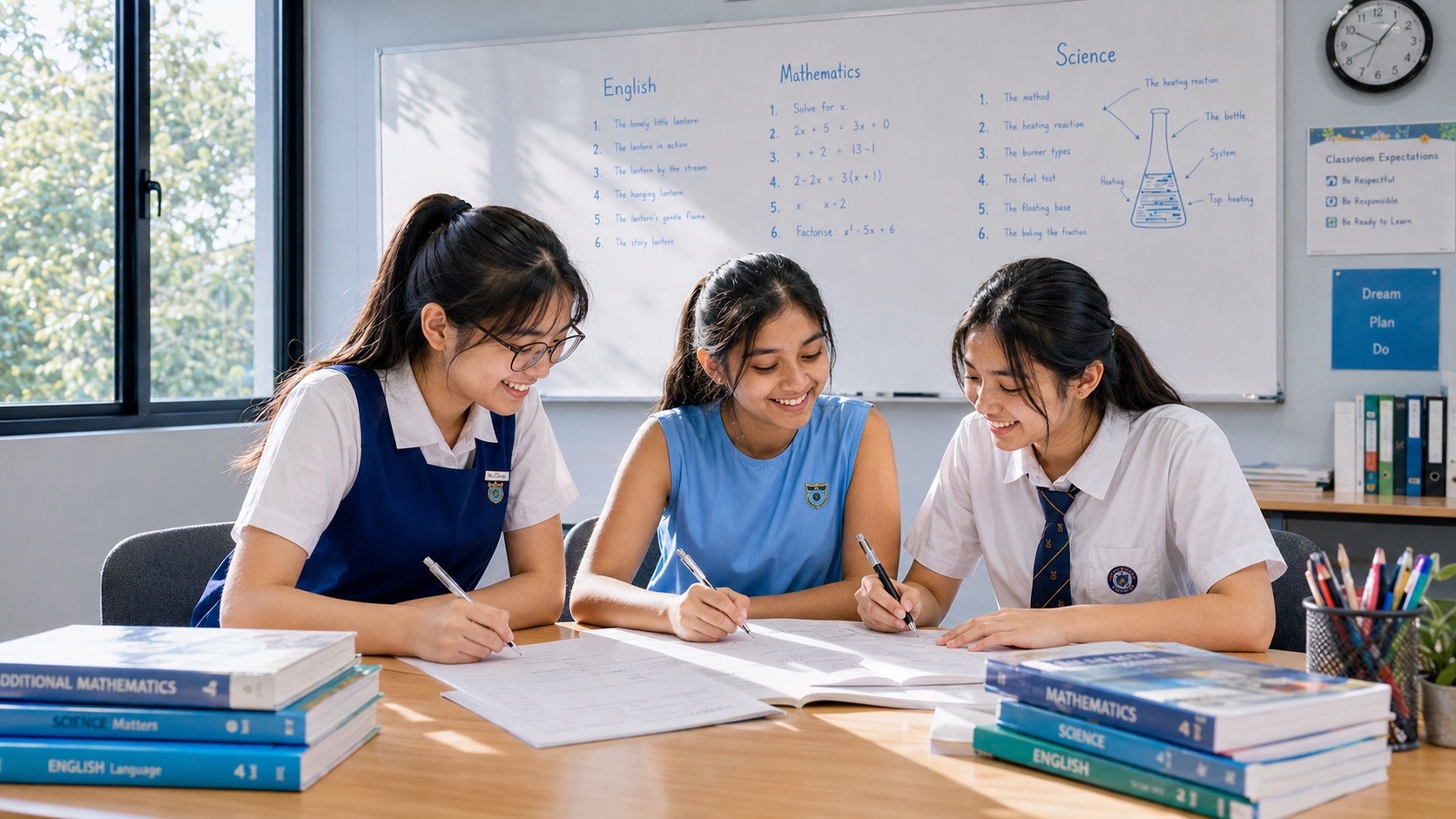
Yishun Mathematics Tuition for Secondary 4 is the transition page from year-level knowledge to final examination control. It supports the main Secondary 4 Final Mathematics Repair Cycle without competing with it, and it does not establish a current physical Yishun class, fee, timetable or vacancy. For specialist Mathematics teaching, use BTT’s Secondary Mathematics Learning Hub.
The job here is transition from knowing topics to controlling a paper. By Secondary 4, revision should become more selective. Secure relationships move into maintenance; recurring high-cost mechanisms stay active; timing is added only after the route is sufficiently stable to make the result interpretable.
1. Final-year revision starts from current evidence
Do not reopen every chapter equally. Use recent marked work to identify secure topics, recurring mechanisms and paper-condition problems. A final-year plan should become smaller as knowledge becomes dependable.
Read each lost question from the beginning. Was the target identified correctly? Was the representation useful? Did the first transformation preserve the relationship? Was the answer interpreted back in context? The first unsupported line is more useful than the final cross.
2. Protect the marks already under control
Maintain secure algebra, graph, geometry and data skills through short spaced retrieval rather than constant full revision. A relationship that survives a delayed mixed question without a cue can move toward maintenance.
This protects revision time. If a topic remains in the active queue forever despite repeated independent success, the programme is not using evidence to reduce workload.
3. Repair the mechanism, not the topic label
A geometry question may fail because of algebra. A statistics question may fail because total and mean are confused. A percentage question may fail because the reference quantity changes. Find the first unsupported step before choosing revision.
If the learner forms the correct model and makes one arithmetic slip, preserve the modelling success. If the learner can execute perfectly only after someone names the method, method selection remains active. These two results should not receive identical homework.
4. Algebra under mixed conditions
Solve 5x − 6 = 2x + 15. Subtract 2x and add 6 to obtain 3x = 21, so x = 7. Substitution into the original equation gives 29 on both sides.
For 2(3x − 4) = 20, divide by two first or expand first. Both routes are valid and both give x = 14/3. A learner should know why equality is preserved rather than depend on one memorised route.
Mixed papers also test recognition. A learner who solves immediately after being told “use simultaneous equations” has shown execution, not independent method selection. The next question should remove that cue.
5. Graph control: scale, gradient and intercept
A line through (0, 2) and (4, 14) has gradient 3 and equation y = 3x + 2. Gradient, intercept and coordinates are different pieces of the same relationship.
Decode scale before interpretation. If 0 to 80 spans eight equal intervals, each interval is 10. A point at the sixth interval represents 60. A visually correct point can still be numerically misread when scale is ignored.
Direct proportion is a special case where the line passes through the origin. y = 3x + 2 has constant gradient but is not directly proportional. This distinction should remain available without a chapter label.
6. Geometry and measurement control
A 12 cm by 8 cm rectangle has perimeter 40 cm and area 96 cm². Units help distinguish boundary from surface. If the question asks for fencing, square centimetres cannot be the final unit.
A right triangle with legs 9 and 12 has hypotenuse 15. The right-angle condition licenses Pythagoras’ theorem. A diagram that merely looks right-angled does not.
Where trigonometry is used, label sides relative to the reference angle before selecting a ratio. The calculator should evaluate a relationship the learner has already justified.
7. Percentage and ratio under examination pressure
A:B = 4:5 and total 81 gives one ratio unit of 9, so the quantities are 36 and 45. If A alone is known as 36, divide by four to recover one unit. The reference information changes while the ratio structure remains.
After a 20% discount, a price of $64 represents 80% of the original, so original = 64/0.8 = $80. Adding 20% of the final value uses the wrong base. Reference control matters more than memorising a special reverse-percentage key sequence.
8. Statistics and probability control
Seven values with mean 13 have total 91. If six known values total 76, the seventh is 15. The mean-total relationship should be retrievable directly.
A bag with 4 red and 6 blue counters gives P(red) = 2/5. If one red is removed without replacement, the next probability becomes 3/9 = 1/3. The sample space changed, so the original fraction cannot simply be reused.
9. Checking should be personal and selective
One learner may need to check signs, another units, another whether the final value answers the question. Use the learner’s error history to choose a small checking repertoire instead of asking for a complete second solution to every question.
Useful checks include substitution for equations, expansion for factorisations, estimation for magnitude, graph inspection for coordinate results, recombination of ratio parts and unit logic for mensuration. Each check targets a particular risk.
10. Add timing only after the route is visible
Time short sections and record where the delay occurs. Reading, retrieval, method selection, calculation and repeated checking require different responses. A clock measures duration, not cause.
A learner who chooses the right method immediately but calculates slowly needs fluency work. A learner who spends three minutes deciding how to start needs selection and representation practice. Do not accelerate an unstable method with a stricter clock.
11. Past papers should update the repair queue
A full paper is useful for mixed recognition, endurance, timing and prioritisation. It is less efficient for teaching one unstable algebraic relationship from scratch. Use targeted repair between papers so the next paper tests whether the mechanism changed.
Cluster first errors after marking. Five lost questions may share one reference-quantity weakness. Another three may share graph-scale reading. The repair queue should be built from recurring mechanisms rather than question numbers.
12. Four examination-control cases
Case A · correct x, incomplete final answer
A rectangle problem gives width x = 6 and length x + 3. If area is requested, the answer is 6 × 9 = 54 square units. The solved variable is only an intermediate value.
Case B · percentage base is reversed
After a 25% discount, an item costs $90. The final price is 75% of the original, so original = 90/0.75 = $120.
Case C · graph intercept is mistaken for gradient
For y = 4x − 6, the gradient is 4 and the y-intercept is −6. The x-intercept occurs when y = 0, giving x = 1.5. These are different features of the same line.
Case D · mean after removal
Five values have mean 18, so total 90. Removing a value of 10 leaves 80 across four values, giving a new mean of 20. Subtracting 10 from the old mean would combine unlike quantities.
13. Fresh transition check
Solve 6x + 1 = 31. Find the equation of the line through (0, −2) and (5, 13). A:B = 4:5 and total 81; find both quantities. Six values have mean 12 and five known values total 59; find the sixth. A bag has 5 red and 5 blue counters; one blue is removed without replacement—find P(red) next.
The answers are x = 5; y = 3x − 2; 36 and 45; 13; and 5/9. Record independence, time and the check selected rather than only correctness.
14. Route into the final repair cycle
Use The Final Mathematics Repair Cycle for the canonical last-stage process, Examination Performance for paper-condition work and Student Diagnostics when the source of a recurring loss remains uncertain.
Part II · The Secondary 4 Mathematics Tuition Programme
This expansion gives the page a programme-level role: how a final-year Mathematics tuition system should diagnose, prioritise, teach, retest and convert knowledge into examination performance. It is distinct from the tutor-focused page and the separate Final Mathematics Repair Cycle owner. The student already has years of mathematical knowledge; the task is to make that knowledge reliably available under mixed and timed conditions.
The programme should become more selective as the year progresses. Secure topics move into maintenance. Active weaknesses are limited to a small queue. Timed work is added only after the relevant mathematics is stable enough to support it. Every paper should change the next revision decision rather than simply add another score.
1. Programme diagnosis
Programme role. convert recent marked work into a final-year teaching map. Final-year tuition is most effective when every task has a reason: diagnose, repair, retrieve, transfer, time or verify. The student should know which function the work is serving instead of experiencing revision as an endless pile of undifferentiated questions.
Common failure. beginning tuition with a generic revision schedule before seeing the student’s actual work. This can consume large amounts of time without changing the mechanism that is actually costing marks. The programme therefore preserves every secure part of the learner’s solution and identifies the first point at which the route becomes invalid or inefficient.
Diagnostic action. sort losses into prerequisite, method choice, execution, interpretation, timing and checking. The result should be a small actionable description, not a global label such as weak or careless. A good diagnosis names the relationship, representation or control routine that must change on the next fresh question.
Practice sequence. choose the first two high-value repairs and define how each will be retested. Begin untimed when understanding is unstable. Add variation after direct execution is reliable. Mix the method with nearby alternatives so selection becomes part of the task. Add realistic time only when the learner can recognise and execute the method without heavy prompting.
Evidence of conversion. make the programme responsive from the first lesson. The repair counts as final-year progress when it survives changed surface features, delayed retesting and reduced support. At that point the skill can move into maintenance and the active repair queue can become smaller.
2. Secure-mark defence
Programme role. protect dependable topics while repair concentrates elsewhere. Final-year tuition is most effective when every task has a reason: diagnose, repair, retrieve, transfer, time or verify. The student should know which function the work is serving instead of experiencing revision as an endless pile of undifferentiated questions.
Common failure. revising every chapter equally after one disappointing paper. This can consume large amounts of time without changing the mechanism that is actually costing marks. The programme therefore preserves every secure part of the learner’s solution and identifies the first point at which the route becomes invalid or inefficient.
Diagnostic action. identify secure topics and place them on low-volume maintenance. The result should be a small actionable description, not a global label such as weak or careless. A good diagnosis names the relationship, representation or control routine that must change on the next fresh question.
Practice sequence. use brief retrieval rather than full reteaching. Begin untimed when understanding is unstable. Add variation after direct execution is reliable. Mix the method with nearby alternatives so selection becomes part of the task. Add realistic time only when the learner can recognise and execute the method without heavy prompting.
Evidence of conversion. preserve a stable performance floor. The repair counts as final-year progress when it survives changed surface features, delayed retesting and reduced support. At that point the skill can move into maintenance and the active repair queue can become smaller.
3. Active-repair queue
Programme role. limit simultaneous weaknesses being attacked. Final-year tuition is most effective when every task has a reason: diagnose, repair, retrieve, transfer, time or verify. The student should know which function the work is serving instead of experiencing revision as an endless pile of undifferentiated questions.
Common failure. keeping a long list of every mistake ever made. This can consume large amounts of time without changing the mechanism that is actually costing marks. The programme therefore preserves every secure part of the learner’s solution and identifies the first point at which the route becomes invalid or inefficient.
Diagnostic action. rank weaknesses by recurrence, mark cost and connectivity. The result should be a small actionable description, not a global label such as weak or careless. A good diagnosis names the relationship, representation or control routine that must change on the next fresh question.
Practice sequence. allow only a small active queue and replace items when evidence improves. Begin untimed when understanding is unstable. Add variation after direct execution is reliable. Mix the method with nearby alternatives so selection becomes part of the task. Add realistic time only when the learner can recognise and execute the method without heavy prompting.
Evidence of conversion. make revision cognitively manageable. The repair counts as final-year progress when it survives changed surface features, delayed retesting and reduced support. At that point the skill can move into maintenance and the active repair queue can become smaller.
4. Prelim triage
Programme role. turn prelim evidence into a selective final runway. Final-year tuition is most effective when every task has a reason: diagnose, repair, retrieve, transfer, time or verify. The student should know which function the work is serving instead of experiencing revision as an endless pile of undifferentiated questions.
Common failure. treating the prelim score as a forecast of final outcome. This can consume large amounts of time without changing the mechanism that is actually costing marks. The programme therefore preserves every secure part of the learner’s solution and identifies the first point at which the route becomes invalid or inefficient.
Diagnostic action. compare error clusters and unfinished marks across the paper. The result should be a small actionable description, not a global label such as weak or careless. A good diagnosis names the relationship, representation or control routine that must change on the next fresh question.
Practice sequence. repair high-yield mechanisms before returning to another full paper. Begin untimed when understanding is unstable. Add variation after direct execution is reliable. Mix the method with nearby alternatives so selection becomes part of the task. Add realistic time only when the learner can recognise and execute the method without heavy prompting.
Evidence of conversion. restore agency after a difficult result. The repair counts as final-year progress when it survives changed surface features, delayed retesting and reduced support. At that point the skill can move into maintenance and the active repair queue can become smaller.
5. School-tuition alignment
Programme role. keep extra teaching connected to the student’s real assessment context. Final-year tuition is most effective when every task has a reason: diagnose, repair, retrieve, transfer, time or verify. The student should know which function the work is serving instead of experiencing revision as an endless pile of undifferentiated questions.
Common failure. running a private syllabus that competes with school demands. This can consume large amounts of time without changing the mechanism that is actually costing marks. The programme therefore preserves every secure part of the learner’s solution and identifies the first point at which the route becomes invalid or inefficient.
Diagnostic action. track current school sequence, marked papers and teacher feedback. The result should be a small actionable description, not a global label such as weak or careless. A good diagnosis names the relationship, representation or control routine that must change on the next fresh question.
Practice sequence. repair prerequisites then reconnect them to the current task. Begin untimed when understanding is unstable. Add variation after direct execution is reliable. Mix the method with nearby alternatives so selection becomes part of the task. Add realistic time only when the learner can recognise and execute the method without heavy prompting.
Evidence of conversion. make tuition immediately usable. The repair counts as final-year progress when it survives changed surface features, delayed retesting and reduced support. At that point the skill can move into maintenance and the active repair queue can become smaller.
6. Subject-level fit
Programme role. match pace and question complexity to the student’s actual Mathematics subject level. Final-year tuition is most effective when every task has a reason: diagnose, repair, retrieve, transfer, time or verify. The student should know which function the work is serving instead of experiencing revision as an endless pile of undifferentiated questions.
Common failure. assuming every Secondary 4 learner needs the same worksheet. This can consume large amounts of time without changing the mechanism that is actually costing marks. The programme therefore preserves every secure part of the learner’s solution and identifies the first point at which the route becomes invalid or inefficient.
Diagnostic action. use school placement and current cohort materials as the immediate scope. The result should be a small actionable description, not a global label such as weak or careless. A good diagnosis names the relationship, representation or control routine that must change on the next fresh question.
Practice sequence. adjust scaffolds, pace and extension accordingly. Begin untimed when understanding is unstable. Add variation after direct execution is reliable. Mix the method with nearby alternatives so selection becomes part of the task. Add realistic time only when the learner can recognise and execute the method without heavy prompting.
Evidence of conversion. avoid false deficits and premature acceleration. The repair counts as final-year progress when it survives changed surface features, delayed retesting and reduced support. At that point the skill can move into maintenance and the active repair queue can become smaller.
7. Algebra reliability
Programme role. make algebra dependable across mixed-paper contexts. Final-year tuition is most effective when every task has a reason: diagnose, repair, retrieve, transfer, time or verify. The student should know which function the work is serving instead of experiencing revision as an endless pile of undifferentiated questions.
Common failure. treating algebra as one chapter instead of a cross-topic engine. This can consume large amounts of time without changing the mechanism that is actually costing marks. The programme therefore preserves every secure part of the learner’s solution and identifies the first point at which the route becomes invalid or inefficient.
Diagnostic action. audit signs, brackets, like terms, equations, formulae and substitution. The result should be a small actionable description, not a global label such as weak or careless. A good diagnosis names the relationship, representation or control routine that must change on the next fresh question.
Practice sequence. embed repairs in graphs, geometry and modelling. Begin untimed when understanding is unstable. Add variation after direct execution is reliable. Mix the method with nearby alternatives so selection becomes part of the task. Add realistic time only when the learner can recognise and execute the method without heavy prompting.
Evidence of conversion. recover marks across several areas at once. The repair counts as final-year progress when it survives changed surface features, delayed retesting and reduced support. At that point the skill can move into maintenance and the active repair queue can become smaller.
8. Fraction and proportion maintenance
Programme role. keep lower-level number relationships active under final-year pressure. Final-year tuition is most effective when every task has a reason: diagnose, repair, retrieve, transfer, time or verify. The student should know which function the work is serving instead of experiencing revision as an endless pile of undifferentiated questions.
Common failure. assuming fractions and ratio are permanently secure. This can consume large amounts of time without changing the mechanism that is actually costing marks. The programme therefore preserves every secure part of the learner’s solution and identifies the first point at which the route becomes invalid or inefficient.
Diagnostic action. use short retrieval within current problems. The result should be a small actionable description, not a global label such as weak or careless. A good diagnosis names the relationship, representation or control routine that must change on the next fresh question.
Practice sequence. connect them to percentage, rate, scale and probability. Begin untimed when understanding is unstable. Add variation after direct execution is reliable. Mix the method with nearby alternatives so selection becomes part of the task. Add realistic time only when the learner can recognise and execute the method without heavy prompting.
Evidence of conversion. prevent old gaps from resurfacing in new forms. The repair counts as final-year progress when it survives changed surface features, delayed retesting and reduced support. At that point the skill can move into maintenance and the active repair queue can become smaller.
9. Percentage control
Programme role. separate forward, change, new-value and reverse-percentage intents. Final-year tuition is most effective when every task has a reason: diagnose, repair, retrieve, transfer, time or verify. The student should know which function the work is serving instead of experiencing revision as an endless pile of undifferentiated questions.
Common failure. applying one memorised percentage procedure everywhere. This can consume large amounts of time without changing the mechanism that is actually costing marks. The programme therefore preserves every secure part of the learner’s solution and identifies the first point at which the route becomes invalid or inefficient.
Diagnostic action. name the reference quantity and multiplier first. The result should be a small actionable description, not a global label such as weak or careless. A good diagnosis names the relationship, representation or control routine that must change on the next fresh question.
Practice sequence. contrast similar-looking percentage questions. Begin untimed when understanding is unstable. Add variation after direct execution is reliable. Mix the method with nearby alternatives so selection becomes part of the task. Add realistic time only when the learner can recognise and execute the method without heavy prompting.
Evidence of conversion. reduce reference errors. The repair counts as final-year progress when it survives changed surface features, delayed retesting and reduced support. At that point the skill can move into maintenance and the active repair queue can become smaller.
10. Compound change
Programme role. model successive percentage changes multiplicatively. Final-year tuition is most effective when every task has a reason: diagnose, repair, retrieve, transfer, time or verify. The student should know which function the work is serving instead of experiencing revision as an endless pile of undifferentiated questions.
Common failure. adding percentage changes as if the reference never changes. This can consume large amounts of time without changing the mechanism that is actually costing marks. The programme therefore preserves every secure part of the learner’s solution and identifies the first point at which the route becomes invalid or inefficient.
Diagnostic action. use stage multipliers and interpret the combined factor. The result should be a small actionable description, not a global label such as weak or careless. A good diagnosis names the relationship, representation or control routine that must change on the next fresh question.
Practice sequence. test increase-then-decrease examples. Begin untimed when understanding is unstable. Add variation after direct execution is reliable. Mix the method with nearby alternatives so selection becomes part of the task. Add realistic time only when the learner can recognise and execute the method without heavy prompting.
Evidence of conversion. build reliable final-year modelling. The repair counts as final-year progress when it survives changed surface features, delayed retesting and reduced support. At that point the skill can move into maintenance and the active repair queue can become smaller.
11. Ratio scaling
Programme role. preserve multiplicative relationships in mixed contexts. Final-year tuition is most effective when every task has a reason: diagnose, repair, retrieve, transfer, time or verify. The student should know which function the work is serving instead of experiencing revision as an endless pile of undifferentiated questions.
Common failure. using additive changes in ratio questions. This can consume large amounts of time without changing the mechanism that is actually costing marks. The programme therefore preserves every secure part of the learner’s solution and identifies the first point at which the route becomes invalid or inefficient.
Diagnostic action. identify one ratio unit or scale factor. The result should be a small actionable description, not a global label such as weak or careless. A good diagnosis names the relationship, representation or control routine that must change on the next fresh question.
Practice sequence. connect to similarity and rates where appropriate. Begin untimed when understanding is unstable. Add variation after direct execution is reliable. Mix the method with nearby alternatives so selection becomes part of the task. Add realistic time only when the learner can recognise and execute the method without heavy prompting.
Evidence of conversion. strengthen transferable proportional reasoning. The repair counts as final-year progress when it survives changed surface features, delayed retesting and reduced support. At that point the skill can move into maintenance and the active repair queue can become smaller.
12. Rate and speed
Programme role. keep total quantities and compound units visible. Final-year tuition is most effective when every task has a reason: diagnose, repair, retrieve, transfer, time or verify. The student should know which function the work is serving instead of experiencing revision as an endless pile of undifferentiated questions.
Common failure. averaging rates without considering time or distance. This can consume large amounts of time without changing the mechanism that is actually costing marks. The programme therefore preserves every secure part of the learner’s solution and identifies the first point at which the route becomes invalid or inefficient.
Diagnostic action. reconstruct total distance and total time. The result should be a small actionable description, not a global label such as weak or careless. A good diagnosis names the relationship, representation or control routine that must change on the next fresh question.
Practice sequence. use unit checks and reasonableness estimates. Begin untimed when understanding is unstable. Add variation after direct execution is reliable. Mix the method with nearby alternatives so selection becomes part of the task. Add realistic time only when the learner can recognise and execute the method without heavy prompting.
Evidence of conversion. avoid common modelling errors. The repair counts as final-year progress when it survives changed surface features, delayed retesting and reduced support. At that point the skill can move into maintenance and the active repair queue can become smaller.
13. Graph reading
Programme role. read axes, units, scale and intercepts before interpretation. Final-year tuition is most effective when every task has a reason: diagnose, repair, retrieve, transfer, time or verify. The student should know which function the work is serving instead of experiencing revision as an endless pile of undifferentiated questions.
Common failure. describing visual shape without numerical context. This can consume large amounts of time without changing the mechanism that is actually costing marks. The programme therefore preserves every secure part of the learner’s solution and identifies the first point at which the route becomes invalid or inefficient.
Diagnostic action. annotate the graph first. The result should be a small actionable description, not a global label such as weak or careless. A good diagnosis names the relationship, representation or control routine that must change on the next fresh question.
Practice sequence. translate selected points into table or equation forms. Begin untimed when understanding is unstable. Add variation after direct execution is reliable. Mix the method with nearby alternatives so selection becomes part of the task. Add realistic time only when the learner can recognise and execute the method without heavy prompting.
Evidence of conversion. make graph judgement evidence-led. The repair counts as final-year progress when it survives changed surface features, delayed retesting and reduced support. At that point the skill can move into maintenance and the active repair queue can become smaller.
14. Coordinate control
Programme role. protect signed coordinates and ordered-pair meaning. Final-year tuition is most effective when every task has a reason: diagnose, repair, retrieve, transfer, time or verify. The student should know which function the work is serving instead of experiencing revision as an endless pile of undifferentiated questions.
Common failure. reversing x and y or losing negative signs. This can consume large amounts of time without changing the mechanism that is actually costing marks. The programme therefore preserves every secure part of the learner’s solution and identifies the first point at which the route becomes invalid or inefficient.
Diagnostic action. write horizontal and vertical changes explicitly. The result should be a small actionable description, not a global label such as weak or careless. A good diagnosis names the relationship, representation or control routine that must change on the next fresh question.
Practice sequence. embed coordinate work inside geometry or graph questions. Begin untimed when understanding is unstable. Add variation after direct execution is reliable. Mix the method with nearby alternatives so selection becomes part of the task. Add realistic time only when the learner can recognise and execute the method without heavy prompting.
Evidence of conversion. connect integer fluency to spatial reasoning. The repair counts as final-year progress when it survives changed surface features, delayed retesting and reduced support. At that point the skill can move into maintenance and the active repair queue can become smaller.
15. Gradient and linear relationships
Programme role. connect rate of change, coordinate differences and linear rules where taught. Final-year tuition is most effective when every task has a reason: diagnose, repair, retrieve, transfer, time or verify. The student should know which function the work is serving instead of experiencing revision as an endless pile of undifferentiated questions.
Common failure. using a gradient formula without interpreting the result. This can consume large amounts of time without changing the mechanism that is actually costing marks. The programme therefore preserves every secure part of the learner’s solution and identifies the first point at which the route becomes invalid or inefficient.
Diagnostic action. calculate with consistent coordinate order and inspect sign. The result should be a small actionable description, not a global label such as weak or careless. A good diagnosis names the relationship, representation or control routine that must change on the next fresh question.
Practice sequence. connect table, equation and graph. Begin untimed when understanding is unstable. Add variation after direct execution is reliable. Mix the method with nearby alternatives so selection becomes part of the task. Add realistic time only when the learner can recognise and execute the method without heavy prompting.
Evidence of conversion. build coherent modelling. The repair counts as final-year progress when it survives changed surface features, delayed retesting and reduced support. At that point the skill can move into maintenance and the active repair queue can become smaller.
16. Geometry evidence
Programme role. use properties rather than visual appearance. Final-year tuition is most effective when every task has a reason: diagnose, repair, retrieve, transfer, time or verify. The student should know which function the work is serving instead of experiencing revision as an endless pile of undifferentiated questions.
Common failure. assuming equal sides or right angles from the drawing. This can consume large amounts of time without changing the mechanism that is actually costing marks. The programme therefore preserves every secure part of the learner’s solution and identifies the first point at which the route becomes invalid or inefficient.
Diagnostic action. mark only given or derived facts. The result should be a small actionable description, not a global label such as weak or careless. A good diagnosis names the relationship, representation or control routine that must change on the next fresh question.
Practice sequence. write concise reason chains. Begin untimed when understanding is unstable. Add variation after direct execution is reliable. Mix the method with nearby alternatives so selection becomes part of the task. Add realistic time only when the learner can recognise and execute the method without heavy prompting.
Evidence of conversion. make geometry robust under rotated diagrams. The repair counts as final-year progress when it survives changed surface features, delayed retesting and reduced support. At that point the skill can move into maintenance and the active repair queue can become smaller.
17. Pythagoras selection
Programme role. use the theorem only under the right-triangle condition. Final-year tuition is most effective when every task has a reason: diagnose, repair, retrieve, transfer, time or verify. The student should know which function the work is serving instead of experiencing revision as an endless pile of undifferentiated questions.
Common failure. applying it to any three-side problem. This can consume large amounts of time without changing the mechanism that is actually costing marks. The programme therefore preserves every secure part of the learner’s solution and identifies the first point at which the route becomes invalid or inefficient.
Diagnostic action. identify the right angle and hypotenuse first. The result should be a small actionable description, not a global label such as weak or careless. A good diagnosis names the relationship, representation or control routine that must change on the next fresh question.
Practice sequence. contrast with a trigonometric question and a non-right triangle. Begin untimed when understanding is unstable. Add variation after direct execution is reliable. Mix the method with nearby alternatives so selection becomes part of the task. Add realistic time only when the learner can recognise and execute the method without heavy prompting.
Evidence of conversion. link method to condition. The repair counts as final-year progress when it survives changed surface features, delayed retesting and reduced support. At that point the skill can move into maintenance and the active repair queue can become smaller.
18. Trigonometric selection
Programme role. choose ratio from reference angle and known or unknown sides. Final-year tuition is most effective when every task has a reason: diagnose, repair, retrieve, transfer, time or verify. The student should know which function the work is serving instead of experiencing revision as an endless pile of undifferentiated questions.
Common failure. memorising formulae without reading the triangle. This can consume large amounts of time without changing the mechanism that is actually costing marks. The programme therefore preserves every secure part of the learner’s solution and identifies the first point at which the route becomes invalid or inefficient.
Diagnostic action. label hypotenuse, opposite and adjacent before writing an equation. The result should be a small actionable description, not a global label such as weak or careless. A good diagnosis names the relationship, representation or control routine that must change on the next fresh question.
Practice sequence. rotate diagrams and change the unknown. Begin untimed when understanding is unstable. Add variation after direct execution is reliable. Mix the method with nearby alternatives so selection becomes part of the task. Add realistic time only when the learner can recognise and execute the method without heavy prompting.
Evidence of conversion. make selection independent of orientation. The repair counts as final-year progress when it survives changed surface features, delayed retesting and reduced support. At that point the skill can move into maintenance and the active repair queue can become smaller.
19. Calculator control
Programme role. separate mathematical setup from numerical input. Final-year tuition is most effective when every task has a reason: diagnose, repair, retrieve, transfer, time or verify. The student should know which function the work is serving instead of experiencing revision as an endless pile of undifferentiated questions.
Common failure. changing the method when calculator entry caused the error. This can consume large amounts of time without changing the mechanism that is actually costing marks. The programme therefore preserves every secure part of the learner’s solution and identifies the first point at which the route becomes invalid or inefficient.
Diagnostic action. estimate sign and magnitude before pressing equals. The result should be a small actionable description, not a global label such as weak or careless. A good diagnosis names the relationship, representation or control routine that must change on the next fresh question.
Practice sequence. check mode, brackets, rounding and plausibility. Begin untimed when understanding is unstable. Add variation after direct execution is reliable. Mix the method with nearby alternatives so selection becomes part of the task. Add realistic time only when the learner can recognise and execute the method without heavy prompting.
Evidence of conversion. make technology inspectable. The repair counts as final-year progress when it survives changed surface features, delayed retesting and reduced support. At that point the skill can move into maintenance and the active repair queue can become smaller.
20. Similarity and scale
Programme role. pair corresponding parts before using scale factor. Final-year tuition is most effective when every task has a reason: diagnose, repair, retrieve, transfer, time or verify. The student should know which function the work is serving instead of experiencing revision as an endless pile of undifferentiated questions.
Common failure. matching sides by page position. This can consume large amounts of time without changing the mechanism that is actually costing marks. The programme therefore preserves every secure part of the learner’s solution and identifies the first point at which the route becomes invalid or inefficient.
Diagnostic action. mark correspondence first. The result should be a small actionable description, not a global label such as weak or careless. A good diagnosis names the relationship, representation or control routine that must change on the next fresh question.
Practice sequence. apply one consistent factor and verify it. Begin untimed when understanding is unstable. Add variation after direct execution is reliable. Mix the method with nearby alternatives so selection becomes part of the task. Add realistic time only when the learner can recognise and execute the method without heavy prompting.
Evidence of conversion. protect similarity marks. The repair counts as final-year progress when it survives changed surface features, delayed retesting and reduced support. At that point the skill can move into maintenance and the active repair queue can become smaller.
21. Dimensional scaling
Programme role. distinguish linear, area and volume changes where taught. Final-year tuition is most effective when every task has a reason: diagnose, repair, retrieve, transfer, time or verify. The student should know which function the work is serving instead of experiencing revision as an endless pile of undifferentiated questions.
Common failure. using one scale factor for every measure. This can consume large amounts of time without changing the mechanism that is actually costing marks. The programme therefore preserves every secure part of the learner’s solution and identifies the first point at which the route becomes invalid or inefficient.
Diagnostic action. name the target dimension before applying the factor. The result should be a small actionable description, not a global label such as weak or careless. A good diagnosis names the relationship, representation or control routine that must change on the next fresh question.
Practice sequence. compare all three measures on one pair of objects. Begin untimed when understanding is unstable. Add variation after direct execution is reliable. Mix the method with nearby alternatives so selection becomes part of the task. Add realistic time only when the learner can recognise and execute the method without heavy prompting.
Evidence of conversion. develop dimensional sense. The repair counts as final-year progress when it survives changed surface features, delayed retesting and reduced support. At that point the skill can move into maintenance and the active repair queue can become smaller.
22. Mensuration
Programme role. choose perimeter, area, surface area or volume by attribute. Final-year tuition is most effective when every task has a reason: diagnose, repair, retrieve, transfer, time or verify. The student should know which function the work is serving instead of experiencing revision as an endless pile of undifferentiated questions.
Common failure. selecting formulae from visible dimensions alone. This can consume large amounts of time without changing the mechanism that is actually costing marks. The programme therefore preserves every secure part of the learner’s solution and identifies the first point at which the route becomes invalid or inefficient.
Diagnostic action. name the physical quantity and unit before calculation. The result should be a small actionable description, not a global label such as weak or careless. A good diagnosis names the relationship, representation or control routine that must change on the next fresh question.
Practice sequence. decompose composite figures and solids where needed. Begin untimed when understanding is unstable. Add variation after direct execution is reliable. Mix the method with nearby alternatives so selection becomes part of the task. Add realistic time only when the learner can recognise and execute the method without heavy prompting.
Evidence of conversion. prevent attribute confusion. The repair counts as final-year progress when it survives changed surface features, delayed retesting and reduced support. At that point the skill can move into maintenance and the active repair queue can become smaller.
23. Statistics interpretation
Programme role. pair calculation with careful description. Final-year tuition is most effective when every task has a reason: diagnose, repair, retrieve, transfer, time or verify. The student should know which function the work is serving instead of experiencing revision as an endless pile of undifferentiated questions.
Common failure. reporting one statistic as the whole story. This can consume large amounts of time without changing the mechanism that is actually costing marks. The programme therefore preserves every secure part of the learner’s solution and identifies the first point at which the route becomes invalid or inefficient.
Diagnostic action. compare centre, spread and outliers where in scope. The result should be a small actionable description, not a global label such as weak or careless. A good diagnosis names the relationship, representation or control routine that must change on the next fresh question.
Practice sequence. ask what the measure supports and what it does not. Begin untimed when understanding is unstable. Add variation after direct execution is reliable. Mix the method with nearby alternatives so selection becomes part of the task. Add realistic time only when the learner can recognise and execute the method without heavy prompting.
Evidence of conversion. improve data reasoning. The repair counts as final-year progress when it survives changed surface features, delayed retesting and reduced support. At that point the skill can move into maintenance and the active repair queue can become smaller.
24. Mean-total-count
Programme role. use the reversible relationship for missing-value and changed-group questions. Final-year tuition is most effective when every task has a reason: diagnose, repair, retrieve, transfer, time or verify. The student should know which function the work is serving instead of experiencing revision as an endless pile of undifferentiated questions.
Common failure. knowing only the forward mean formula. This can consume large amounts of time without changing the mechanism that is actually costing marks. The programme therefore preserves every secure part of the learner’s solution and identifies the first point at which the route becomes invalid or inefficient.
Diagnostic action. write total equals mean times count before solving. The result should be a small actionable description, not a global label such as weak or careless. A good diagnosis names the relationship, representation or control routine that must change on the next fresh question.
Practice sequence. practise forward and reverse forms. Begin untimed when understanding is unstable. Add variation after direct execution is reliable. Mix the method with nearby alternatives so selection becomes part of the task. Add realistic time only when the learner can recognise and execute the method without heavy prompting.
Evidence of conversion. make averages flexible. The repair counts as final-year progress when it survives changed surface features, delayed retesting and reduced support. At that point the skill can move into maintenance and the active repair queue can become smaller.
25. Probability modelling
Programme role. define event, sample space and assumptions before arithmetic. Final-year tuition is most effective when every task has a reason: diagnose, repair, retrieve, transfer, time or verify. The student should know which function the work is serving instead of experiencing revision as an endless pile of undifferentiated questions.
Common failure. guessing denominators or copying tree shapes. This can consume large amounts of time without changing the mechanism that is actually costing marks. The programme therefore preserves every secure part of the learner’s solution and identifies the first point at which the route becomes invalid or inefficient.
Diagnostic action. organise outcomes with lists, tables or trees. The result should be a small actionable description, not a global label such as weak or careless. A good diagnosis names the relationship, representation or control routine that must change on the next fresh question.
Practice sequence. change replacement conditions and rebuild the model. Begin untimed when understanding is unstable. Add variation after direct execution is reliable. Mix the method with nearby alternatives so selection becomes part of the task. Add realistic time only when the learner can recognise and execute the method without heavy prompting.
Evidence of conversion. make sequential probability reliable. The repair counts as final-year progress when it survives changed surface features, delayed retesting and reduced support. At that point the skill can move into maintenance and the active repair queue can become smaller.
26. Command-word precision
Programme role. match solve, simplify, calculate, state, explain, show and hence to the required output. Final-year tuition is most effective when every task has a reason: diagnose, repair, retrieve, transfer, time or verify. The student should know which function the work is serving instead of experiencing revision as an endless pile of undifferentiated questions.
Common failure. performing valid mathematics that does not answer the instruction. This can consume large amounts of time without changing the mechanism that is actually costing marks. The programme therefore preserves every secure part of the learner’s solution and identifies the first point at which the route becomes invalid or inefficient.
Diagnostic action. translate the command into an action before solving. The result should be a small actionable description, not a global label such as weak or careless. A good diagnosis names the relationship, representation or control routine that must change on the next fresh question.
Practice sequence. use contrast examples with the same data but different commands. Begin untimed when understanding is unstable. Add variation after direct execution is reliable. Mix the method with nearby alternatives so selection becomes part of the task. Add realistic time only when the learner can recognise and execute the method without heavy prompting.
Evidence of conversion. protect easy marks. The repair counts as final-year progress when it survives changed surface features, delayed retesting and reduced support. At that point the skill can move into maintenance and the active repair queue can become smaller.
27. Representation choice
Programme role. select the representation that exposes structure fastest. Final-year tuition is most effective when every task has a reason: diagnose, repair, retrieve, transfer, time or verify. The student should know which function the work is serving instead of experiencing revision as an endless pile of undifferentiated questions.
Common failure. using one house method on every problem. This can consume large amounts of time without changing the mechanism that is actually costing marks. The programme therefore preserves every secure part of the learner’s solution and identifies the first point at which the route becomes invalid or inefficient.
Diagnostic action. ask what needs to become visible. The result should be a small actionable description, not a global label such as weak or careless. A good diagnosis names the relationship, representation or control routine that must change on the next fresh question.
Practice sequence. compare equation, table, graph and diagram routes. Begin untimed when understanding is unstable. Add variation after direct execution is reliable. Mix the method with nearby alternatives so selection becomes part of the task. Add realistic time only when the learner can recognise and execute the method without heavy prompting.
Evidence of conversion. improve efficiency. The repair counts as final-year progress when it survives changed surface features, delayed retesting and reduced support. At that point the skill can move into maintenance and the active repair queue can become smaller.
28. Intermediate-state control
Programme role. keep multi-step values labelled and usable. Final-year tuition is most effective when every task has a reason: diagnose, repair, retrieve, transfer, time or verify. The student should know which function the work is serving instead of experiencing revision as an endless pile of undifferentiated questions.
Common failure. carrying bare numbers across long questions. This can consume large amounts of time without changing the mechanism that is actually costing marks. The programme therefore preserves every secure part of the learner’s solution and identifies the first point at which the route becomes invalid or inefficient.
Diagnostic action. write quantity and unit beside intermediate results. The result should be a small actionable description, not a global label such as weak or careless. A good diagnosis names the relationship, representation or control routine that must change on the next fresh question.
Practice sequence. refer back to labels when choosing the next operation. Begin untimed when understanding is unstable. Add variation after direct execution is reliable. Mix the method with nearby alternatives so selection becomes part of the task. Add realistic time only when the learner can recognise and execute the method without heavy prompting.
Evidence of conversion. reduce late-step drift. The repair counts as final-year progress when it survives changed surface features, delayed retesting and reduced support. At that point the skill can move into maintenance and the active repair queue can become smaller.
29. Estimation
Programme role. build an independent plausibility layer. Final-year tuition is most effective when every task has a reason: diagnose, repair, retrieve, transfer, time or verify. The student should know which function the work is serving instead of experiencing revision as an endless pile of undifferentiated questions.
Common failure. copying calculator output without judgement. This can consume large amounts of time without changing the mechanism that is actually costing marks. The programme therefore preserves every secure part of the learner’s solution and identifies the first point at which the route becomes invalid or inefficient.
Diagnostic action. predict sign and approximate size. The result should be a small actionable description, not a global label such as weak or careless. A good diagnosis names the relationship, representation or control routine that must change on the next fresh question.
Practice sequence. compare exact result with prediction. Begin untimed when understanding is unstable. Add variation after direct execution is reliable. Mix the method with nearby alternatives so selection becomes part of the task. Add realistic time only when the learner can recognise and execute the method without heavy prompting.
Evidence of conversion. catch input and modelling errors. The repair counts as final-year progress when it survives changed surface features, delayed retesting and reduced support. At that point the skill can move into maintenance and the active repair queue can become smaller.
30. Checking system
Programme role. match verification to the likely risk. Final-year tuition is most effective when every task has a reason: diagnose, repair, retrieve, transfer, time or verify. The student should know which function the work is serving instead of experiencing revision as an endless pile of undifferentiated questions.
Common failure. rereading without a plan. This can consume large amounts of time without changing the mechanism that is actually costing marks. The programme therefore preserves every secure part of the learner’s solution and identifies the first point at which the route becomes invalid or inefficient.
Diagnostic action. use substitution, inverse operations, units, estimation, geometry constraints or alternate representations. The result should be a small actionable description, not a global label such as weak or careless. A good diagnosis names the relationship, representation or control routine that must change on the next fresh question.
Practice sequence. practise checks during normal work. Begin untimed when understanding is unstable. Add variation after direct execution is reliable. Mix the method with nearby alternatives so selection becomes part of the task. Add realistic time only when the learner can recognise and execute the method without heavy prompting.
Evidence of conversion. make checking efficient. The repair counts as final-year progress when it survives changed surface features, delayed retesting and reduced support. At that point the skill can move into maintenance and the active repair queue can become smaller.
31. Error library
Programme role. turn repeated mistakes into short prevention routines. Final-year tuition is most effective when every task has a reason: diagnose, repair, retrieve, transfer, time or verify. The student should know which function the work is serving instead of experiencing revision as an endless pile of undifferentiated questions.
Common failure. keeping corrections as a pile of old papers. This can consume large amounts of time without changing the mechanism that is actually costing marks. The programme therefore preserves every secure part of the learner’s solution and identifies the first point at which the route becomes invalid or inefficient.
Diagnostic action. record only recurring mechanisms and one check each. The result should be a small actionable description, not a global label such as weak or careless. A good diagnosis names the relationship, representation or control routine that must change on the next fresh question.
Practice sequence. retrieve the prevention cue before timed practice. Begin untimed when understanding is unstable. Add variation after direct execution is reliable. Mix the method with nearby alternatives so selection becomes part of the task. Add realistic time only when the learner can recognise and execute the method without heavy prompting.
Evidence of conversion. convert failure history into control. The repair counts as final-year progress when it survives changed surface features, delayed retesting and reduced support. At that point the skill can move into maintenance and the active repair queue can become smaller.
32. Retrieval
Programme role. keep important methods available without notes. Final-year tuition is most effective when every task has a reason: diagnose, repair, retrieve, transfer, time or verify. The student should know which function the work is serving instead of experiencing revision as an endless pile of undifferentiated questions.
Common failure. rereading as the main revision method. This can consume large amounts of time without changing the mechanism that is actually costing marks. The programme therefore preserves every secure part of the learner’s solution and identifies the first point at which the route becomes invalid or inefficient.
Diagnostic action. begin with closed-book prompts. The result should be a small actionable description, not a global label such as weak or careless. A good diagnosis names the relationship, representation or control routine that must change on the next fresh question.
Practice sequence. repair only what was missing. Begin untimed when understanding is unstable. Add variation after direct execution is reliable. Mix the method with nearby alternatives so selection becomes part of the task. Add realistic time only when the learner can recognise and execute the method without heavy prompting.
Evidence of conversion. increase long-term access. The repair counts as final-year progress when it survives changed surface features, delayed retesting and reduced support. At that point the skill can move into maintenance and the active repair queue can become smaller.
33. Spacing
Programme role. return to repaired skills after a delay. Final-year tuition is most effective when every task has a reason: diagnose, repair, retrieve, transfer, time or verify. The student should know which function the work is serving instead of experiencing revision as an endless pile of undifferentiated questions.
Common failure. cramming one topic and abandoning it. This can consume large amounts of time without changing the mechanism that is actually costing marks. The programme therefore preserves every secure part of the learner’s solution and identifies the first point at which the route becomes invalid or inefficient.
Diagnostic action. schedule short retests over increasing intervals. The result should be a small actionable description, not a global label such as weak or careless. A good diagnosis names the relationship, representation or control routine that must change on the next fresh question.
Practice sequence. move secure skills to maintenance. Begin untimed when understanding is unstable. Add variation after direct execution is reliable. Mix the method with nearby alternatives so selection becomes part of the task. Add realistic time only when the learner can recognise and execute the method without heavy prompting.
Evidence of conversion. strengthen retention. The repair counts as final-year progress when it survives changed surface features, delayed retesting and reduced support. At that point the skill can move into maintenance and the active repair queue can become smaller.
34. Interleaving
Programme role. practise choosing among nearby methods. Final-year tuition is most effective when every task has a reason: diagnose, repair, retrieve, transfer, time or verify. The student should know which function the work is serving instead of experiencing revision as an endless pile of undifferentiated questions.
Common failure. keeping every set topical until the final month. This can consume large amounts of time without changing the mechanism that is actually costing marks. The programme therefore preserves every secure part of the learner’s solution and identifies the first point at which the route becomes invalid or inefficient.
Diagnostic action. mix common confusion pairs after direct practice. The result should be a small actionable description, not a global label such as weak or careless. A good diagnosis names the relationship, representation or control routine that must change on the next fresh question.
Practice sequence. ask for the method before full calculation. Begin untimed when understanding is unstable. Add variation after direct execution is reliable. Mix the method with nearby alternatives so selection becomes part of the task. Add realistic time only when the learner can recognise and execute the method without heavy prompting.
Evidence of conversion. prepare for mixed papers. The repair counts as final-year progress when it survives changed surface features, delayed retesting and reduced support. At that point the skill can move into maintenance and the active repair queue can become smaller.
35. Contrast practice
Programme role. learn the boundary between valid methods. Final-year tuition is most effective when every task has a reason: diagnose, repair, retrieve, transfer, time or verify. The student should know which function the work is serving instead of experiencing revision as an endless pile of undifferentiated questions.
Common failure. memorising a shortcut without its conditions. This can consume large amounts of time without changing the mechanism that is actually costing marks. The programme therefore preserves every secure part of the learner’s solution and identifies the first point at which the route becomes invalid or inefficient.
Diagnostic action. place similar-looking questions side by side. The result should be a small actionable description, not a global label such as weak or careless. A good diagnosis names the relationship, representation or control routine that must change on the next fresh question.
Practice sequence. state the feature that changes the method. Begin untimed when understanding is unstable. Add variation after direct execution is reliable. Mix the method with nearby alternatives so selection becomes part of the task. Add realistic time only when the learner can recognise and execute the method without heavy prompting.
Evidence of conversion. reduce overgeneralisation. The repair counts as final-year progress when it survives changed surface features, delayed retesting and reduced support. At that point the skill can move into maintenance and the active repair queue can become smaller.
36. Worked-example fading
Programme role. reduce scaffolding deliberately. Final-year tuition is most effective when every task has a reason: diagnose, repair, retrieve, transfer, time or verify. The student should know which function the work is serving instead of experiencing revision as an endless pile of undifferentiated questions.
Common failure. keeping model solutions visible throughout practice. This can consume large amounts of time without changing the mechanism that is actually costing marks. The programme therefore preserves every secure part of the learner’s solution and identifies the first point at which the route becomes invalid or inefficient.
Diagnostic action. remove steps, labels and method cues gradually. The result should be a small actionable description, not a global label such as weak or careless. A good diagnosis names the relationship, representation or control routine that must change on the next fresh question.
Practice sequence. finish with a fresh problem. Begin untimed when understanding is unstable. Add variation after direct execution is reliable. Mix the method with nearby alternatives so selection becomes part of the task. Add realistic time only when the learner can recognise and execute the method without heavy prompting.
Evidence of conversion. measure independence. The repair counts as final-year progress when it survives changed surface features, delayed retesting and reduced support. At that point the skill can move into maintenance and the active repair queue can become smaller.
37. Small-group individualisation
Programme role. use a shared mathematical problem while varying follow-up support. Final-year tuition is most effective when every task has a reason: diagnose, repair, retrieve, transfer, time or verify. The student should know which function the work is serving instead of experiencing revision as an endless pile of undifferentiated questions.
Common failure. assuming a small class is automatically personalised. This can consume large amounts of time without changing the mechanism that is actually costing marks. The programme therefore preserves every secure part of the learner’s solution and identifies the first point at which the route becomes invalid or inefficient.
Diagnostic action. begin with individual work and compare first decisions. The result should be a small actionable description, not a global label such as weak or careless. A good diagnosis names the relationship, representation or control routine that must change on the next fresh question.
Practice sequence. branch practice by error mechanism. Begin untimed when understanding is unstable. Add variation after direct execution is reliable. Mix the method with nearby alternatives so selection becomes part of the task. Add realistic time only when the learner can recognise and execute the method without heavy prompting.
Evidence of conversion. preserve accountability. The repair counts as final-year progress when it survives changed surface features, delayed retesting and reduced support. At that point the skill can move into maintenance and the active repair queue can become smaller.
38. Peer comparison
Programme role. learn from different valid methods without copying. Final-year tuition is most effective when every task has a reason: diagnose, repair, retrieve, transfer, time or verify. The student should know which function the work is serving instead of experiencing revision as an endless pile of undifferentiated questions.
Common failure. adopting the strongest student’s wording or layout automatically. This can consume large amounts of time without changing the mechanism that is actually costing marks. The programme therefore preserves every secure part of the learner’s solution and identifies the first point at which the route becomes invalid or inefficient.
Diagnostic action. compare why each route works and which is efficient. The result should be a small actionable description, not a global label such as weak or careless. A good diagnosis names the relationship, representation or control routine that must change on the next fresh question.
Practice sequence. require each learner to revise their own work. Begin untimed when understanding is unstable. Add variation after direct execution is reliable. Mix the method with nearby alternatives so selection becomes part of the task. Add realistic time only when the learner can recognise and execute the method without heavy prompting.
Evidence of conversion. turn peers into reasoning resources. The repair counts as final-year progress when it survives changed surface features, delayed retesting and reduced support. At that point the skill can move into maintenance and the active repair queue can become smaller.
39. Parent reporting
Programme role. show evidence of changed mechanisms. Final-year tuition is most effective when every task has a reason: diagnose, repair, retrieve, transfer, time or verify. The student should know which function the work is serving instead of experiencing revision as an endless pile of undifferentiated questions.
Common failure. reporting only marks or generic effort. This can consume large amounts of time without changing the mechanism that is actually costing marks. The programme therefore preserves every secure part of the learner’s solution and identifies the first point at which the route becomes invalid or inefficient.
Diagnostic action. name one stable strength, one current repair and one independence indicator. The result should be a small actionable description, not a global label such as weak or careless. A good diagnosis names the relationship, representation or control routine that must change on the next fresh question.
Practice sequence. attach a before and after example where useful. Begin untimed when understanding is unstable. Add variation after direct execution is reliable. Mix the method with nearby alternatives so selection becomes part of the task. Add realistic time only when the learner can recognise and execute the method without heavy prompting.
Evidence of conversion. keep family support aligned. The repair counts as final-year progress when it survives changed surface features, delayed retesting and reduced support. At that point the skill can move into maintenance and the active repair queue can become smaller.
40. Home practice
Programme role. reinforce tuition without turning home into another classroom. Final-year tuition is most effective when every task has a reason: diagnose, repair, retrieve, transfer, time or verify. The student should know which function the work is serving instead of experiencing revision as an endless pile of undifferentiated questions.
Common failure. parents supplying a competing method for every error. This can consume large amounts of time without changing the mechanism that is actually costing marks. The programme therefore preserves every secure part of the learner’s solution and identifies the first point at which the route becomes invalid or inefficient.
Diagnostic action. use brief retrieval and targeted practice selected by the tutor. The result should be a small actionable description, not a global label such as weak or careless. A good diagnosis names the relationship, representation or control routine that must change on the next fresh question.
Practice sequence. ask the child to explain the existing method first. Begin untimed when understanding is unstable. Add variation after direct execution is reliable. Mix the method with nearby alternatives so selection becomes part of the task. Add realistic time only when the learner can recognise and execute the method without heavy prompting.
Evidence of conversion. protect coherence. The repair counts as final-year progress when it survives changed surface features, delayed retesting and reduced support. At that point the skill can move into maintenance and the active repair queue can become smaller.
41. Timed-section progression
Programme role. add pressure only after the method is stable. Final-year tuition is most effective when every task has a reason: diagnose, repair, retrieve, transfer, time or verify. The student should know which function the work is serving instead of experiencing revision as an endless pile of undifferentiated questions.
Common failure. jumping from topical work straight to full papers. This can consume large amounts of time without changing the mechanism that is actually costing marks. The programme therefore preserves every secure part of the learner’s solution and identifies the first point at which the route becomes invalid or inefficient.
Diagnostic action. move through untimed mixed work, generous timing and realistic sections. The result should be a small actionable description, not a global label such as weak or careless. A good diagnosis names the relationship, representation or control routine that must change on the next fresh question.
Practice sequence. track accuracy and unfinished marks. Begin untimed when understanding is unstable. Add variation after direct execution is reliable. Mix the method with nearby alternatives so selection becomes part of the task. Add realistic time only when the learner can recognise and execute the method without heavy prompting.
Evidence of conversion. build controlled speed. The repair counts as final-year progress when it survives changed surface features, delayed retesting and reduced support. At that point the skill can move into maintenance and the active repair queue can become smaller.
42. Paper navigation
Programme role. allocate limited time across the whole assessment. Final-year tuition is most effective when every task has a reason: diagnose, repair, retrieve, transfer, time or verify. The student should know which function the work is serving instead of experiencing revision as an endless pile of undifferentiated questions.
Common failure. solving rigidly in order despite being stuck. This can consume large amounts of time without changing the mechanism that is actually costing marks. The programme therefore preserves every secure part of the learner’s solution and identifies the first point at which the route becomes invalid or inefficient.
Diagnostic action. use first-pass, return and final-check phases where rules allow. The result should be a small actionable description, not a global label such as weak or careless. A good diagnosis names the relationship, representation or control routine that must change on the next fresh question.
Practice sequence. leave re-entry notes on parked questions. Begin untimed when understanding is unstable. Add variation after direct execution is reliable. Mix the method with nearby alternatives so selection becomes part of the task. Add realistic time only when the learner can recognise and execute the method without heavy prompting.
Evidence of conversion. protect global performance. The repair counts as final-year progress when it survives changed surface features, delayed retesting and reduced support. At that point the skill can move into maintenance and the active repair queue can become smaller.
43. Stop-loss routine
Programme role. know when persistence stops being productive. Final-year tuition is most effective when every task has a reason: diagnose, repair, retrieve, transfer, time or verify. The student should know which function the work is serving instead of experiencing revision as an endless pile of undifferentiated questions.
Common failure. letting one question consume disproportionate time. This can consume large amounts of time without changing the mechanism that is actually costing marks. The programme therefore preserves every secure part of the learner’s solution and identifies the first point at which the route becomes invalid or inefficient.
Diagnostic action. set a sensible threshold by mark value and paper stage. The result should be a small actionable description, not a global label such as weak or careless. A good diagnosis names the relationship, representation or control routine that must change on the next fresh question.
Practice sequence. practise park-return-reset in timed sets. Begin untimed when understanding is unstable. Add variation after direct execution is reliable. Mix the method with nearby alternatives so selection becomes part of the task. Add realistic time only when the learner can recognise and execute the method without heavy prompting.
Evidence of conversion. make recovery procedural. The repair counts as final-year progress when it survives changed surface features, delayed retesting and reduced support. At that point the skill can move into maintenance and the active repair queue can become smaller.
44. Late-paper stamina
Programme role. maintain decision quality after sustained work. Final-year tuition is most effective when every task has a reason: diagnose, repair, retrieve, transfer, time or verify. The student should know which function the work is serving instead of experiencing revision as an endless pile of undifferentiated questions.
Common failure. misdiagnosing fatigue errors as topic gaps. This can consume large amounts of time without changing the mechanism that is actually costing marks. The programme therefore preserves every secure part of the learner’s solution and identifies the first point at which the route becomes invalid or inefficient.
Diagnostic action. compare error rates by paper segment. The result should be a small actionable description, not a global label such as weak or careless. A good diagnosis names the relationship, representation or control routine that must change on the next fresh question.
Practice sequence. simulate target sections after prior work. Begin untimed when understanding is unstable. Add variation after direct execution is reliable. Mix the method with nearby alternatives so selection becomes part of the task. Add realistic time only when the learner can recognise and execute the method without heavy prompting.
Evidence of conversion. train stamina specifically. The repair counts as final-year progress when it survives changed surface features, delayed retesting and reduced support. At that point the skill can move into maintenance and the active repair queue can become smaller.
45. Final-answer audit
Programme role. complete the actual task after correct working. Final-year tuition is most effective when every task has a reason: diagnose, repair, retrieve, transfer, time or verify. The student should know which function the work is serving instead of experiencing revision as an endless pile of undifferentiated questions.
Common failure. reporting an intermediate variable, wrong unit or wrong rounding. This can consume large amounts of time without changing the mechanism that is actually costing marks. The programme therefore preserves every secure part of the learner’s solution and identifies the first point at which the route becomes invalid or inefficient.
Diagnostic action. reread target and accuracy instruction. The result should be a small actionable description, not a global label such as weak or careless. A good diagnosis names the relationship, representation or control routine that must change on the next fresh question.
Practice sequence. check answer form before leaving. Begin untimed when understanding is unstable. Add variation after direct execution is reliable. Mix the method with nearby alternatives so selection becomes part of the task. Add realistic time only when the learner can recognise and execute the method without heavy prompting.
Evidence of conversion. recover marks after correct mathematics. The repair counts as final-year progress when it survives changed surface features, delayed retesting and reduced support. At that point the skill can move into maintenance and the active repair queue can become smaller.
46. Full-paper analysis
Programme role. make every full paper change the revision plan. Final-year tuition is most effective when every task has a reason: diagnose, repair, retrieve, transfer, time or verify. The student should know which function the work is serving instead of experiencing revision as an endless pile of undifferentiated questions.
Common failure. doing paper after paper without targeted repair. This can consume large amounts of time without changing the mechanism that is actually costing marks. The programme therefore preserves every secure part of the learner’s solution and identifies the first point at which the route becomes invalid or inefficient.
Diagnostic action. classify the first error and time distribution. The result should be a small actionable description, not a global label such as weak or careless. A good diagnosis names the relationship, representation or control routine that must change on the next fresh question.
Practice sequence. select the next active repairs before another paper. Begin untimed when understanding is unstable. Add variation after direct execution is reliable. Mix the method with nearby alternatives so selection becomes part of the task. Add realistic time only when the learner can recognise and execute the method without heavy prompting.
Evidence of conversion. turn papers into diagnostics. The repair counts as final-year progress when it survives changed surface features, delayed retesting and reduced support. At that point the skill can move into maintenance and the active repair queue can become smaller.
47. Final-six-weeks plan
Programme role. narrow resources and focus on recurring mark leaks. Final-year tuition is most effective when every task has a reason: diagnose, repair, retrieve, transfer, time or verify. The student should know which function the work is serving instead of experiencing revision as an endless pile of undifferentiated questions.
Common failure. collecting more papers and notes continuously. This can consume large amounts of time without changing the mechanism that is actually costing marks. The programme therefore preserves every secure part of the learner’s solution and identifies the first point at which the route becomes invalid or inefficient.
Diagnostic action. use a small active set of error log, retrieval prompts, selected sections and representative papers. The result should be a small actionable description, not a global label such as weak or careless. A good diagnosis names the relationship, representation or control routine that must change on the next fresh question.
Practice sequence. alternate repair, mixed performance and maintenance. Begin untimed when understanding is unstable. Add variation after direct execution is reliable. Mix the method with nearby alternatives so selection becomes part of the task. Add realistic time only when the learner can recognise and execute the method without heavy prompting.
Evidence of conversion. reduce noise. The repair counts as final-year progress when it survives changed surface features, delayed retesting and reduced support. At that point the skill can move into maintenance and the active repair queue can become smaller.
48. Final-fortnight plan
Programme role. stabilise rather than reinvent. Final-year tuition is most effective when every task has a reason: diagnose, repair, retrieve, transfer, time or verify. The student should know which function the work is serving instead of experiencing revision as an endless pile of undifferentiated questions.
Common failure. introducing new tricks and exhausting workloads. This can consume large amounts of time without changing the mechanism that is actually costing marks. The programme therefore preserves every secure part of the learner’s solution and identifies the first point at which the route becomes invalid or inefficient.
Diagnostic action. review known routines and personal risks. The result should be a small actionable description, not a global label such as weak or careless. A good diagnosis names the relationship, representation or control routine that must change on the next fresh question.
Practice sequence. keep representative practice and normal rest. Begin untimed when understanding is unstable. Add variation after direct execution is reliable. Mix the method with nearby alternatives so selection becomes part of the task. Add realistic time only when the learner can recognise and execute the method without heavy prompting.
Evidence of conversion. arrive with an available system. The repair counts as final-year progress when it survives changed surface features, delayed retesting and reduced support. At that point the skill can move into maintenance and the active repair queue can become smaller.
49. Exam-day recovery
Programme role. separate one difficult item from the rest of the paper. Final-year tuition is most effective when every task has a reason: diagnose, repair, retrieve, transfer, time or verify. The student should know which function the work is serving instead of experiencing revision as an endless pile of undifferentiated questions.
Common failure. carrying frustration into later questions. This can consume large amounts of time without changing the mechanism that is actually costing marks. The programme therefore preserves every secure part of the learner’s solution and identifies the first point at which the route becomes invalid or inefficient.
Diagnostic action. reset, park if needed, secure other marks and return with a new representation. The result should be a small actionable description, not a global label such as weak or careless. A good diagnosis names the relationship, representation or control routine that must change on the next fresh question.
Practice sequence. practise the routine before exam day. Begin untimed when understanding is unstable. Add variation after direct execution is reliable. Mix the method with nearby alternatives so selection becomes part of the task. Add realistic time only when the learner can recognise and execute the method without heavy prompting.
Evidence of conversion. protect performance under surprise. The repair counts as final-year progress when it survives changed surface features, delayed retesting and reduced support. At that point the skill can move into maintenance and the active repair queue can become smaller.
50. Post-paper learning
Programme role. convert every practice or school paper into the next cycle. Final-year tuition is most effective when every task has a reason: diagnose, repair, retrieve, transfer, time or verify. The student should know which function the work is serving instead of experiencing revision as an endless pile of undifferentiated questions.
Common failure. looking only at the final score. This can consume large amounts of time without changing the mechanism that is actually costing marks. The programme therefore preserves every secure part of the learner’s solution and identifies the first point at which the route becomes invalid or inefficient.
Diagnostic action. identify first weak links and preserved strengths. The result should be a small actionable description, not a global label such as weak or careless. A good diagnosis names the relationship, representation or control routine that must change on the next fresh question.
Practice sequence. repair and schedule delayed retests. Begin untimed when understanding is unstable. Add variation after direct execution is reliable. Mix the method with nearby alternatives so selection becomes part of the task. Add realistic time only when the learner can recognise and execute the method without heavy prompting.
Evidence of conversion. make revision cumulative. The repair counts as final-year progress when it survives changed surface features, delayed retesting and reduced support. At that point the skill can move into maintenance and the active repair queue can become smaller.
Final-Year Programme Practice Bank
Use these laboratories selectively according to the learner’s active repair queue. They are original training structures, not official examination questions.
Final-Year Lab 1 · build a three-list Secure, Active Repair and Maintenance map
Begin with a real marked question or a fresh original task. Record the first unsupported decision and the strongest prompt required. This tells the tutor whether the difficulty lies in recognition, representation, execution, interpretation or paper control.
Repair only the smallest useful mechanism, then change numbers, wording, diagram orientation or unknown quantity. The changed version is essential because it removes the possibility that the learner is simply remembering the previous page.
Schedule a delayed retest when this mechanism has been a recurring mark loss. If the learner can now select, solve and check independently, move the skill toward maintenance. If not, change the representation or prerequisite rather than increasing volume blindly.
Final-Year Lab 2 · analyse a prelim by first-error family
Begin with a real marked question or a fresh original task. Record the first unsupported decision and the strongest prompt required. This tells the tutor whether the difficulty lies in recognition, representation, execution, interpretation or paper control.
Repair only the smallest useful mechanism, then change numbers, wording, diagram orientation or unknown quantity. The changed version is essential because it removes the possibility that the learner is simply remembering the previous page.
Schedule a delayed retest when this mechanism has been a recurring mark loss. If the learner can now select, solve and check independently, move the skill toward maintenance. If not, change the representation or prerequisite rather than increasing volume blindly.
Final-Year Lab 3 · repair a negative-sign leak across three topics
Begin with a real marked question or a fresh original task. Record the first unsupported decision and the strongest prompt required. This tells the tutor whether the difficulty lies in recognition, representation, execution, interpretation or paper control.
Repair only the smallest useful mechanism, then change numbers, wording, diagram orientation or unknown quantity. The changed version is essential because it removes the possibility that the learner is simply remembering the previous page.
Schedule a delayed retest when this mechanism has been a recurring mark loss. If the learner can now select, solve and check independently, move the skill toward maintenance. If not, change the representation or prerequisite rather than increasing volume blindly.
Final-Year Lab 4 · contrast direct percentage and reverse percentage
Begin with a real marked question or a fresh original task. Record the first unsupported decision and the strongest prompt required. This tells the tutor whether the difficulty lies in recognition, representation, execution, interpretation or paper control.
Repair only the smallest useful mechanism, then change numbers, wording, diagram orientation or unknown quantity. The changed version is essential because it removes the possibility that the learner is simply remembering the previous page.
Schedule a delayed retest when this mechanism has been a recurring mark loss. If the learner can now select, solve and check independently, move the skill toward maintenance. If not, change the representation or prerequisite rather than increasing volume blindly.
Final-Year Lab 5 · solve a compound-change problem with multipliers
Begin with a real marked question or a fresh original task. Record the first unsupported decision and the strongest prompt required. This tells the tutor whether the difficulty lies in recognition, representation, execution, interpretation or paper control.
Repair only the smallest useful mechanism, then change numbers, wording, diagram orientation or unknown quantity. The changed version is essential because it removes the possibility that the learner is simply remembering the previous page.
Schedule a delayed retest when this mechanism has been a recurring mark loss. If the learner can now select, solve and check independently, move the skill toward maintenance. If not, change the representation or prerequisite rather than increasing volume blindly.
Final-Year Lab 6 · connect ratio scale to similarity
Begin with a real marked question or a fresh original task. Record the first unsupported decision and the strongest prompt required. This tells the tutor whether the difficulty lies in recognition, representation, execution, interpretation or paper control.
Repair only the smallest useful mechanism, then change numbers, wording, diagram orientation or unknown quantity. The changed version is essential because it removes the possibility that the learner is simply remembering the previous page.
Schedule a delayed retest when this mechanism has been a recurring mark loss. If the learner can now select, solve and check independently, move the skill toward maintenance. If not, change the representation or prerequisite rather than increasing volume blindly.
Final-Year Lab 7 · model average speed using total distance and total time
Begin with a real marked question or a fresh original task. Record the first unsupported decision and the strongest prompt required. This tells the tutor whether the difficulty lies in recognition, representation, execution, interpretation or paper control.
Repair only the smallest useful mechanism, then change numbers, wording, diagram orientation or unknown quantity. The changed version is essential because it removes the possibility that the learner is simply remembering the previous page.
Schedule a delayed retest when this mechanism has been a recurring mark loss. If the learner can now select, solve and check independently, move the skill toward maintenance. If not, change the representation or prerequisite rather than increasing volume blindly.
Final-Year Lab 8 · read graph axes and scale before interpreting
Begin with a real marked question or a fresh original task. Record the first unsupported decision and the strongest prompt required. This tells the tutor whether the difficulty lies in recognition, representation, execution, interpretation or paper control.
Repair only the smallest useful mechanism, then change numbers, wording, diagram orientation or unknown quantity. The changed version is essential because it removes the possibility that the learner is simply remembering the previous page.
Schedule a delayed retest when this mechanism has been a recurring mark loss. If the learner can now select, solve and check independently, move the skill toward maintenance. If not, change the representation or prerequisite rather than increasing volume blindly.
Final-Year Lab 9 · construct a linear rule from two points where taught
Begin with a real marked question or a fresh original task. Record the first unsupported decision and the strongest prompt required. This tells the tutor whether the difficulty lies in recognition, representation, execution, interpretation or paper control.
Repair only the smallest useful mechanism, then change numbers, wording, diagram orientation or unknown quantity. The changed version is essential because it removes the possibility that the learner is simply remembering the previous page.
Schedule a delayed retest when this mechanism has been a recurring mark loss. If the learner can now select, solve and check independently, move the skill toward maintenance. If not, change the representation or prerequisite rather than increasing volume blindly.
Final-Year Lab 10 · solve a geometry-algebra angle problem
Begin with a real marked question or a fresh original task. Record the first unsupported decision and the strongest prompt required. This tells the tutor whether the difficulty lies in recognition, representation, execution, interpretation or paper control.
Repair only the smallest useful mechanism, then change numbers, wording, diagram orientation or unknown quantity. The changed version is essential because it removes the possibility that the learner is simply remembering the previous page.
Schedule a delayed retest when this mechanism has been a recurring mark loss. If the learner can now select, solve and check independently, move the skill toward maintenance. If not, change the representation or prerequisite rather than increasing volume blindly.
Final-Year Lab 11 · choose Pythagoras versus trigonometry
Begin with a real marked question or a fresh original task. Record the first unsupported decision and the strongest prompt required. This tells the tutor whether the difficulty lies in recognition, representation, execution, interpretation or paper control.
Repair only the smallest useful mechanism, then change numbers, wording, diagram orientation or unknown quantity. The changed version is essential because it removes the possibility that the learner is simply remembering the previous page.
Schedule a delayed retest when this mechanism has been a recurring mark loss. If the learner can now select, solve and check independently, move the skill toward maintenance. If not, change the representation or prerequisite rather than increasing volume blindly.
Final-Year Lab 12 · rotate a trigonometry diagram and relabel sides
Begin with a real marked question or a fresh original task. Record the first unsupported decision and the strongest prompt required. This tells the tutor whether the difficulty lies in recognition, representation, execution, interpretation or paper control.
Repair only the smallest useful mechanism, then change numbers, wording, diagram orientation or unknown quantity. The changed version is essential because it removes the possibility that the learner is simply remembering the previous page.
Schedule a delayed retest when this mechanism has been a recurring mark loss. If the learner can now select, solve and check independently, move the skill toward maintenance. If not, change the representation or prerequisite rather than increasing volume blindly.
Final-Year Lab 13 · check a calculator result against geometric constraints
Begin with a real marked question or a fresh original task. Record the first unsupported decision and the strongest prompt required. This tells the tutor whether the difficulty lies in recognition, representation, execution, interpretation or paper control.
Repair only the smallest useful mechanism, then change numbers, wording, diagram orientation or unknown quantity. The changed version is essential because it removes the possibility that the learner is simply remembering the previous page.
Schedule a delayed retest when this mechanism has been a recurring mark loss. If the learner can now select, solve and check independently, move the skill toward maintenance. If not, change the representation or prerequisite rather than increasing volume blindly.
Final-Year Lab 14 · pair corresponding sides in similar figures
Begin with a real marked question or a fresh original task. Record the first unsupported decision and the strongest prompt required. This tells the tutor whether the difficulty lies in recognition, representation, execution, interpretation or paper control.
Repair only the smallest useful mechanism, then change numbers, wording, diagram orientation or unknown quantity. The changed version is essential because it removes the possibility that the learner is simply remembering the previous page.
Schedule a delayed retest when this mechanism has been a recurring mark loss. If the learner can now select, solve and check independently, move the skill toward maintenance. If not, change the representation or prerequisite rather than increasing volume blindly.
Final-Year Lab 15 · compare linear, area and volume scale factors where taught
Begin with a real marked question or a fresh original task. Record the first unsupported decision and the strongest prompt required. This tells the tutor whether the difficulty lies in recognition, representation, execution, interpretation or paper control.
Repair only the smallest useful mechanism, then change numbers, wording, diagram orientation or unknown quantity. The changed version is essential because it removes the possibility that the learner is simply remembering the previous page.
Schedule a delayed retest when this mechanism has been a recurring mark loss. If the learner can now select, solve and check independently, move the skill toward maintenance. If not, change the representation or prerequisite rather than increasing volume blindly.
Final-Year Lab 16 · decompose a composite figure efficiently
Begin with a real marked question or a fresh original task. Record the first unsupported decision and the strongest prompt required. This tells the tutor whether the difficulty lies in recognition, representation, execution, interpretation or paper control.
Repair only the smallest useful mechanism, then change numbers, wording, diagram orientation or unknown quantity. The changed version is essential because it removes the possibility that the learner is simply remembering the previous page.
Schedule a delayed retest when this mechanism has been a recurring mark loss. If the learner can now select, solve and check independently, move the skill toward maintenance. If not, change the representation or prerequisite rather than increasing volume blindly.
Final-Year Lab 17 · reconstruct total from mean and count
Begin with a real marked question or a fresh original task. Record the first unsupported decision and the strongest prompt required. This tells the tutor whether the difficulty lies in recognition, representation, execution, interpretation or paper control.
Repair only the smallest useful mechanism, then change numbers, wording, diagram orientation or unknown quantity. The changed version is essential because it removes the possibility that the learner is simply remembering the previous page.
Schedule a delayed retest when this mechanism has been a recurring mark loss. If the learner can now select, solve and check independently, move the skill toward maintenance. If not, change the representation or prerequisite rather than increasing volume blindly.
Final-Year Lab 18 · compare datasets with the same mean
Begin with a real marked question or a fresh original task. Record the first unsupported decision and the strongest prompt required. This tells the tutor whether the difficulty lies in recognition, representation, execution, interpretation or paper control.
Repair only the smallest useful mechanism, then change numbers, wording, diagram orientation or unknown quantity. The changed version is essential because it removes the possibility that the learner is simply remembering the previous page.
Schedule a delayed retest when this mechanism has been a recurring mark loss. If the learner can now select, solve and check independently, move the skill toward maintenance. If not, change the representation or prerequisite rather than increasing volume blindly.
Final-Year Lab 19 · build a probability sample space before calculating
Begin with a real marked question or a fresh original task. Record the first unsupported decision and the strongest prompt required. This tells the tutor whether the difficulty lies in recognition, representation, execution, interpretation or paper control.
Repair only the smallest useful mechanism, then change numbers, wording, diagram orientation or unknown quantity. The changed version is essential because it removes the possibility that the learner is simply remembering the previous page.
Schedule a delayed retest when this mechanism has been a recurring mark loss. If the learner can now select, solve and check independently, move the skill toward maintenance. If not, change the representation or prerequisite rather than increasing volume blindly.
Final-Year Lab 20 · contrast replacement and no replacement
Begin with a real marked question or a fresh original task. Record the first unsupported decision and the strongest prompt required. This tells the tutor whether the difficulty lies in recognition, representation, execution, interpretation or paper control.
Repair only the smallest useful mechanism, then change numbers, wording, diagram orientation or unknown quantity. The changed version is essential because it removes the possibility that the learner is simply remembering the previous page.
Schedule a delayed retest when this mechanism has been a recurring mark loss. If the learner can now select, solve and check independently, move the skill toward maintenance. If not, change the representation or prerequisite rather than increasing volume blindly.
Final-Year Lab 21 · translate a command word into the required output
Begin with a real marked question or a fresh original task. Record the first unsupported decision and the strongest prompt required. This tells the tutor whether the difficulty lies in recognition, representation, execution, interpretation or paper control.
Repair only the smallest useful mechanism, then change numbers, wording, diagram orientation or unknown quantity. The changed version is essential because it removes the possibility that the learner is simply remembering the previous page.
Schedule a delayed retest when this mechanism has been a recurring mark loss. If the learner can now select, solve and check independently, move the skill toward maintenance. If not, change the representation or prerequisite rather than increasing volume blindly.
Final-Year Lab 22 · choose among equation, table, graph and diagram
Begin with a real marked question or a fresh original task. Record the first unsupported decision and the strongest prompt required. This tells the tutor whether the difficulty lies in recognition, representation, execution, interpretation or paper control.
Repair only the smallest useful mechanism, then change numbers, wording, diagram orientation or unknown quantity. The changed version is essential because it removes the possibility that the learner is simply remembering the previous page.
Schedule a delayed retest when this mechanism has been a recurring mark loss. If the learner can now select, solve and check independently, move the skill toward maintenance. If not, change the representation or prerequisite rather than increasing volume blindly.
Final-Year Lab 23 · label intermediate results in a multi-step problem
Begin with a real marked question or a fresh original task. Record the first unsupported decision and the strongest prompt required. This tells the tutor whether the difficulty lies in recognition, representation, execution, interpretation or paper control.
Repair only the smallest useful mechanism, then change numbers, wording, diagram orientation or unknown quantity. The changed version is essential because it removes the possibility that the learner is simply remembering the previous page.
Schedule a delayed retest when this mechanism has been a recurring mark loss. If the learner can now select, solve and check independently, move the skill toward maintenance. If not, change the representation or prerequisite rather than increasing volume blindly.
Final-Year Lab 24 · estimate before exact calculation
Begin with a real marked question or a fresh original task. Record the first unsupported decision and the strongest prompt required. This tells the tutor whether the difficulty lies in recognition, representation, execution, interpretation or paper control.
Repair only the smallest useful mechanism, then change numbers, wording, diagram orientation or unknown quantity. The changed version is essential because it removes the possibility that the learner is simply remembering the previous page.
Schedule a delayed retest when this mechanism has been a recurring mark loss. If the learner can now select, solve and check independently, move the skill toward maintenance. If not, change the representation or prerequisite rather than increasing volume blindly.
Final-Year Lab 25 · build a personal three-risk checking card
Begin with a real marked question or a fresh original task. Record the first unsupported decision and the strongest prompt required. This tells the tutor whether the difficulty lies in recognition, representation, execution, interpretation or paper control.
Repair only the smallest useful mechanism, then change numbers, wording, diagram orientation or unknown quantity. The changed version is essential because it removes the possibility that the learner is simply remembering the previous page.
Schedule a delayed retest when this mechanism has been a recurring mark loss. If the learner can now select, solve and check independently, move the skill toward maintenance. If not, change the representation or prerequisite rather than increasing volume blindly.
Final-Year Lab 26 · retrieve five older methods without notes
Begin with a real marked question or a fresh original task. Record the first unsupported decision and the strongest prompt required. This tells the tutor whether the difficulty lies in recognition, representation, execution, interpretation or paper control.
Repair only the smallest useful mechanism, then change numbers, wording, diagram orientation or unknown quantity. The changed version is essential because it removes the possibility that the learner is simply remembering the previous page.
Schedule a delayed retest when this mechanism has been a recurring mark loss. If the learner can now select, solve and check independently, move the skill toward maintenance. If not, change the representation or prerequisite rather than increasing volume blindly.
Final-Year Lab 27 · retest one repair after a three-day delay
Begin with a real marked question or a fresh original task. Record the first unsupported decision and the strongest prompt required. This tells the tutor whether the difficulty lies in recognition, representation, execution, interpretation or paper control.
Repair only the smallest useful mechanism, then change numbers, wording, diagram orientation or unknown quantity. The changed version is essential because it removes the possibility that the learner is simply remembering the previous page.
Schedule a delayed retest when this mechanism has been a recurring mark loss. If the learner can now select, solve and check independently, move the skill toward maintenance. If not, change the representation or prerequisite rather than increasing volume blindly.
Final-Year Lab 28 · mix four methods with no headings
Begin with a real marked question or a fresh original task. Record the first unsupported decision and the strongest prompt required. This tells the tutor whether the difficulty lies in recognition, representation, execution, interpretation or paper control.
Repair only the smallest useful mechanism, then change numbers, wording, diagram orientation or unknown quantity. The changed version is essential because it removes the possibility that the learner is simply remembering the previous page.
Schedule a delayed retest when this mechanism has been a recurring mark loss. If the learner can now select, solve and check independently, move the skill toward maintenance. If not, change the representation or prerequisite rather than increasing volume blindly.
Final-Year Lab 29 · fade a complete worked example to silence
Begin with a real marked question or a fresh original task. Record the first unsupported decision and the strongest prompt required. This tells the tutor whether the difficulty lies in recognition, representation, execution, interpretation or paper control.
Repair only the smallest useful mechanism, then change numbers, wording, diagram orientation or unknown quantity. The changed version is essential because it removes the possibility that the learner is simply remembering the previous page.
Schedule a delayed retest when this mechanism has been a recurring mark loss. If the learner can now select, solve and check independently, move the skill toward maintenance. If not, change the representation or prerequisite rather than increasing volume blindly.
Final-Year Lab 30 · run an individual-discussion-individual small-group cycle
Begin with a real marked question or a fresh original task. Record the first unsupported decision and the strongest prompt required. This tells the tutor whether the difficulty lies in recognition, representation, execution, interpretation or paper control.
Repair only the smallest useful mechanism, then change numbers, wording, diagram orientation or unknown quantity. The changed version is essential because it removes the possibility that the learner is simply remembering the previous page.
Schedule a delayed retest when this mechanism has been a recurring mark loss. If the learner can now select, solve and check independently, move the skill toward maintenance. If not, change the representation or prerequisite rather than increasing volume blindly.
Final-Year Lab 31 · write a parent update from one paper
Begin with a real marked question or a fresh original task. Record the first unsupported decision and the strongest prompt required. This tells the tutor whether the difficulty lies in recognition, representation, execution, interpretation or paper control.
Repair only the smallest useful mechanism, then change numbers, wording, diagram orientation or unknown quantity. The changed version is essential because it removes the possibility that the learner is simply remembering the previous page.
Schedule a delayed retest when this mechanism has been a recurring mark loss. If the learner can now select, solve and check independently, move the skill toward maintenance. If not, change the representation or prerequisite rather than increasing volume blindly.
Final-Year Lab 32 · design a sustainable home revision set
Begin with a real marked question or a fresh original task. Record the first unsupported decision and the strongest prompt required. This tells the tutor whether the difficulty lies in recognition, representation, execution, interpretation or paper control.
Repair only the smallest useful mechanism, then change numbers, wording, diagram orientation or unknown quantity. The changed version is essential because it removes the possibility that the learner is simply remembering the previous page.
Schedule a delayed retest when this mechanism has been a recurring mark loss. If the learner can now select, solve and check independently, move the skill toward maintenance. If not, change the representation or prerequisite rather than increasing volume blindly.
Final-Year Lab 33 · complete a 25-minute timed section
Begin with a real marked question or a fresh original task. Record the first unsupported decision and the strongest prompt required. This tells the tutor whether the difficulty lies in recognition, representation, execution, interpretation or paper control.
Repair only the smallest useful mechanism, then change numbers, wording, diagram orientation or unknown quantity. The changed version is essential because it removes the possibility that the learner is simply remembering the previous page.
Schedule a delayed retest when this mechanism has been a recurring mark loss. If the learner can now select, solve and check independently, move the skill toward maintenance. If not, change the representation or prerequisite rather than increasing volume blindly.
Final-Year Lab 34 · diagnose where time was lost
Begin with a real marked question or a fresh original task. Record the first unsupported decision and the strongest prompt required. This tells the tutor whether the difficulty lies in recognition, representation, execution, interpretation or paper control.
Repair only the smallest useful mechanism, then change numbers, wording, diagram orientation or unknown quantity. The changed version is essential because it removes the possibility that the learner is simply remembering the previous page.
Schedule a delayed retest when this mechanism has been a recurring mark loss. If the learner can now select, solve and check independently, move the skill toward maintenance. If not, change the representation or prerequisite rather than increasing volume blindly.
Final-Year Lab 35 · practise a stop-loss decision
Begin with a real marked question or a fresh original task. Record the first unsupported decision and the strongest prompt required. This tells the tutor whether the difficulty lies in recognition, representation, execution, interpretation or paper control.
Repair only the smallest useful mechanism, then change numbers, wording, diagram orientation or unknown quantity. The changed version is essential because it removes the possibility that the learner is simply remembering the previous page.
Schedule a delayed retest when this mechanism has been a recurring mark loss. If the learner can now select, solve and check independently, move the skill toward maintenance. If not, change the representation or prerequisite rather than increasing volume blindly.
Final-Year Lab 36 · leave a re-entry note and return later
Begin with a real marked question or a fresh original task. Record the first unsupported decision and the strongest prompt required. This tells the tutor whether the difficulty lies in recognition, representation, execution, interpretation or paper control.
Repair only the smallest useful mechanism, then change numbers, wording, diagram orientation or unknown quantity. The changed version is essential because it removes the possibility that the learner is simply remembering the previous page.
Schedule a delayed retest when this mechanism has been a recurring mark loss. If the learner can now select, solve and check independently, move the skill toward maintenance. If not, change the representation or prerequisite rather than increasing volume blindly.
Final-Year Lab 37 · simulate the last 20 minutes of a paper
Begin with a real marked question or a fresh original task. Record the first unsupported decision and the strongest prompt required. This tells the tutor whether the difficulty lies in recognition, representation, execution, interpretation or paper control.
Repair only the smallest useful mechanism, then change numbers, wording, diagram orientation or unknown quantity. The changed version is essential because it removes the possibility that the learner is simply remembering the previous page.
Schedule a delayed retest when this mechanism has been a recurring mark loss. If the learner can now select, solve and check independently, move the skill toward maintenance. If not, change the representation or prerequisite rather than increasing volume blindly.
Final-Year Lab 38 · perform a final-answer audit
Begin with a real marked question or a fresh original task. Record the first unsupported decision and the strongest prompt required. This tells the tutor whether the difficulty lies in recognition, representation, execution, interpretation or paper control.
Repair only the smallest useful mechanism, then change numbers, wording, diagram orientation or unknown quantity. The changed version is essential because it removes the possibility that the learner is simply remembering the previous page.
Schedule a delayed retest when this mechanism has been a recurring mark loss. If the learner can now select, solve and check independently, move the skill toward maintenance. If not, change the representation or prerequisite rather than increasing volume blindly.
Final-Year Lab 39 · turn one full paper into three repairs
Begin with a real marked question or a fresh original task. Record the first unsupported decision and the strongest prompt required. This tells the tutor whether the difficulty lies in recognition, representation, execution, interpretation or paper control.
Repair only the smallest useful mechanism, then change numbers, wording, diagram orientation or unknown quantity. The changed version is essential because it removes the possibility that the learner is simply remembering the previous page.
Schedule a delayed retest when this mechanism has been a recurring mark loss. If the learner can now select, solve and check independently, move the skill toward maintenance. If not, change the representation or prerequisite rather than increasing volume blindly.
Final-Year Lab 40 · build a final-six-weeks calendar
Begin with a real marked question or a fresh original task. Record the first unsupported decision and the strongest prompt required. This tells the tutor whether the difficulty lies in recognition, representation, execution, interpretation or paper control.
Repair only the smallest useful mechanism, then change numbers, wording, diagram orientation or unknown quantity. The changed version is essential because it removes the possibility that the learner is simply remembering the previous page.
Schedule a delayed retest when this mechanism has been a recurring mark loss. If the learner can now select, solve and check independently, move the skill toward maintenance. If not, change the representation or prerequisite rather than increasing volume blindly.
Part III · Final-Year Casebook and Programme Decisions
These fictional cases and original worked examples show how a final-year programme turns evidence into a decision. They are not testimonials, official examination items or guarantees about how quickly results will change.
Case 1 · Falling prelim mark with strong foundations
A fictional learner’s prelim score falls sharply, but inspection shows that algebra, percentage and geometry methods are mostly correct. Lost marks cluster in unfinished late-paper questions and repeated unit or rounding slips. The programme protects the strong concepts and shifts the active repair queue toward time allocation, final-answer audit and selective checking.
A second timed section is used after these routines are taught. If completion and checking improve without a drop in accuracy, the intervention is working. The programme does not respond by reteaching every chapter merely because the overall mark was disappointing.
The case ends with a changed problem and a delayed retest. The learner’s support level is recorded honestly so revision can become more selective rather than simply more intensive.
Case 2 · Acceptable score with hidden algebra leakage
Another learner’s score looks reasonable, but geometry, graph and rate questions often fail after the correct setup because algebraic rearrangement breaks. The programme identifies rearrangement as a high-connectivity weakness and repairs it directly.
Fresh geometry and graph problems are then used as transfer tests. Several apparent topic weaknesses improve together. This illustrates why final-year revision should prioritise dependencies rather than chapter count.
The case ends with a changed problem and a delayed retest. The learner’s support level is recorded honestly so revision can become more selective rather than simply more intensive.
Case 3 · Strong topical work, weak mixed-paper selection
A student completes topical exercises quickly but hesitates when a paper mixes percentage, ratio, algebra and geometry. The programme introduces first-line drills: identify the target, choose the representation and write only the opening mathematical relationship.
Once method selection improves, full solving returns. The learner is not given harder arithmetic; the challenge is recognising which familiar relationship belongs. This is the conversion from topic knowledge to paper judgement.
The case ends with a changed problem and a delayed retest. The learner’s support level is recorded honestly so revision can become more selective rather than simply more intensive.
Case 4 · Correct methods, unreliable calculator control
The student writes the correct trigonometric or percentage setup but inputs the expression incorrectly, rounds too early or copies an implausible value. The programme separates calculator execution from concept repair.
Every calculator-heavy question now begins with a rough expected range or sign and ends with a reasonableness check. Input accuracy is trained without changing methods that were already mathematically sound.
The case ends with a changed problem and a delayed retest. The learner’s support level is recorded honestly so revision can become more selective rather than simply more intensive.
Case 5 · Overchecking causes unfinished work
A careful learner repeatedly redoes easy questions and runs out of time. The programme identifies three personal risk types and restricts final checking to those plus incomplete questions.
Timed sections are repeated. If the learner remains accurate while completing more of the paper, checking has become more strategic. ‘Check carefully’ is replaced by a controlled allocation of attention.
The case ends with a changed problem and a delayed retest. The learner’s support level is recorded honestly so revision can become more selective rather than simply more intensive.
Case 6 · One hard question destabilises the paper
A learner spends too long on a difficult geometry question, then rushes several later items. The tuition programme practises a stop-loss and re-entry routine on mixed sections.
The student leaves a labelled diagram and note about the uncertainty, secures other marks, and returns later with a different representation. Recovery becomes a rehearsed behaviour rather than an exam-day improvisation.
The case ends with a changed problem and a delayed retest. The learner’s support level is recorded honestly so revision can become more selective rather than simply more intensive.
Case 7 · High marks but fragile unfamiliarity
A student scores highly on familiar formats but struggles when diagrams rotate, unknowns reverse or contexts change. Extension focuses on variation within taught content rather than racing ahead.
The learner begins to identify invariants: equation structure, scale factor, geometric property or probability model. That recognition is the bridge from school familiarity to examination resilience.
The case ends with a changed problem and a delayed retest. The learner’s support level is recorded honestly so revision can become more selective rather than simply more intensive.
Case 8 · Strong reasoning, weak retrieval
A learner can explain methods once reminded but reconstructs basic algebra slowly under time. The programme uses brief spaced retrieval before mixed timed work.
If retrieval improves, the student spends less working memory on routine transformations and can allocate more attention to unfamiliar problem structure.
The case ends with a changed problem and a delayed retest. The learner’s support level is recorded honestly so revision can become more selective rather than simply more intensive.
Case 9 · Repeated careless label hides a pattern
The student calls every lost sign, unit and rounding mark careless. Paper review shows predictable clusters. The programme replaces the label with three prevention routines tied to specific high-risk moments.
A later paper is checked for recurrence. Improvement is measured by fewer repeated mechanisms, not by whether the student promises to be more careful.
The case ends with a changed problem and a delayed retest. The learner’s support level is recorded honestly so revision can become more selective rather than simply more intensive.
Case 10 · The final month becomes overloaded
The learner collects new papers, new notes and new online resources every week. The programme stops acquisition and narrows the active set to representative papers, an error log, retrieval prompts and selected repair questions.
Revision becomes quieter. Fewer resources are used more deliberately, and the learner can explain why each practice session exists.
The case ends with a changed problem and a delayed retest. The learner’s support level is recorded honestly so revision can become more selective rather than simply more intensive.
Part IV · Integrated Final-Year Worked Problems
Worked Problem 1 · Reverse percentage
A final price of $136 represents 80% of an original price after a 20% discount. Original price = 136/0.8 = 170. Check forward: 20% of 170 is 34 and 170 – 34 = 136. The critical decision is naming the original as the reference.
After the worked route, change one feature and solve again with the model hidden. The variation may reverse the unknown, alter a reference quantity, rotate a diagram or change the representation. The purpose is transfer, not repetition.
Worked Problem 2 · Geometry and algebra
An isosceles triangle has equal base angles x+15 and a vertex angle of 50 degrees. Then 2(x+15)+50=180, so x=50 and each base angle is 65 degrees. The variable is not the requested angle, so the final-answer audit matters.
After the worked route, change one feature and solve again with the model hidden. The variation may reverse the unknown, alter a reference quantity, rotate a diagram or change the representation. The purpose is transfer, not repetition.
Worked Problem 3 · Graph and equation
For y=4x-8, the y-intercept is (0,-8). The x-intercept satisfies 0=4x-8, so x=2 and the point is (2,0). The problem connects axis language with equation solving.
After the worked route, change one feature and solve again with the model hidden. The variation may reverse the unknown, alter a reference quantity, rotate a diagram or change the representation. The purpose is transfer, not repetition.
Worked Problem 4 · Mean and missing value
Seven values have mean 12, so their total is 84. Six known values total 70, leaving a missing value of 14. The relationship total = mean × count is the reverse tool.
After the worked route, change one feature and solve again with the model hidden. The variation may reverse the unknown, alter a reference quantity, rotate a diagram or change the representation. The purpose is transfer, not repetition.
Worked Problem 5 · Average speed
A journey covers 80 km in 2 hours and 120 km in 2 hours. Total distance is 200 km, total time is 4 hours, average speed is 50 km/h. A second example should use unequal times so the student sees why total distance over total time is the general method.
After the worked route, change one feature and solve again with the model hidden. The variation may reverse the unknown, alter a reference quantity, rotate a diagram or change the representation. The purpose is transfer, not repetition.
Worked Problem 6 · Compound change
A value increases by 25% and then decreases by 20%. Combined multiplier is 1.25 × 0.8 = 1.00, so this particular pair returns to the original value. Contrast with plus 20% then minus 20%, which gives 0.96 of the original.
After the worked route, change one feature and solve again with the model hidden. The variation may reverse the unknown, alter a reference quantity, rotate a diagram or change the representation. The purpose is transfer, not repetition.
Worked Problem 7 · Ratio to percentage
A:B=2:3, so A represents 2/5 = 40% of the combined total and B represents 60%. If total is 90, the values are 36 and 54. The representation can shift between ratio and percentage without changing the underlying proportion.
After the worked route, change one feature and solve again with the model hidden. The variation may reverse the unknown, alter a reference quantity, rotate a diagram or change the representation. The purpose is transfer, not repetition.
Worked Problem 8 · Pythagoras and area
A right triangle with legs 9 and 12 has hypotenuse 15. Its area is 54 square units. One diagram supports two different targets; the learner should label which derived value is actually needed next.
After the worked route, change one feature and solve again with the model hidden. The variation may reverse the unknown, alter a reference quantity, rotate a diagram or change the representation. The purpose is transfer, not repetition.
Worked Problem 9 · Probability complement
In an equally likely one-draw model with 7 red and 3 non-red counters, P(red)=0.7 and P(not red)=0.3. If non-red is divided into several colours, the complement still includes all non-red outcomes.
After the worked route, change one feature and solve again with the model hidden. The variation may reverse the unknown, alter a reference quantity, rotate a diagram or change the representation. The purpose is transfer, not repetition.
Worked Problem 10 · Algebraic equivalence
If a student claims 2(x+5)=2x+5, substitute x=1. The left side is 12 and the proposed right side is 7, so the claim cannot be equivalent. Correct expansion is 2x+10. A test value is a useful disproof even though proof of equivalence requires structural reasoning.
After the worked route, change one feature and solve again with the model hidden. The variation may reverse the unknown, alter a reference quantity, rotate a diagram or change the representation. The purpose is transfer, not repetition.
Worked Problem 11 · Similarity
Two similar figures have corresponding side lengths 6 and 15. Scale factor from small to large is 2.5. A corresponding small side 8 becomes 20. The first risk is correspondence, not arithmetic.
After the worked route, change one feature and solve again with the model hidden. The variation may reverse the unknown, alter a reference quantity, rotate a diagram or change the representation. The purpose is transfer, not repetition.
Worked Problem 12 · Trigonometric side
Where right-triangle trigonometry is in scope, a triangle with hypotenuse 14 and acute angle 35 degrees has opposite side 14 sin 35 degrees, approximately 8.03. Check that the side is positive and shorter than the hypotenuse.
After the worked route, change one feature and solve again with the model hidden. The variation may reverse the unknown, alter a reference quantity, rotate a diagram or change the representation. The purpose is transfer, not repetition.
Worked Problem 13 · Coordinate geometry
Points A(-2,1) and B(4,9) have horizontal difference 6 and vertical difference 8. Where coordinate distance is in scope, AB equals 10. This combines signs, coordinates and Pythagoras.
After the worked route, change one feature and solve again with the model hidden. The variation may reverse the unknown, alter a reference quantity, rotate a diagram or change the representation. The purpose is transfer, not repetition.
Worked Problem 14 · Formula rearrangement
Given A=bh/2, make h the subject: h=2A/b for b not zero. The student should check by substituting a simple rectangle or triangle-compatible set of values if appropriate.
After the worked route, change one feature and solve again with the model hidden. The variation may reverse the unknown, alter a reference quantity, rotate a diagram or change the representation. The purpose is transfer, not repetition.
Worked Problem 15 · Data interpretation
Datasets 4,4,5,7,20 and 7,8,8,9,8 can have similar central values while differing in spread and outliers. A final-year answer should calculate the requested statistic and interpret what it says without overclaiming.
After the worked route, change one feature and solve again with the model hidden. The variation may reverse the unknown, alter a reference quantity, rotate a diagram or change the representation. The purpose is transfer, not repetition.
Worked Problem 16 · Rounding
A result 0.00784631 rounded to 3 significant figures is 0.00785. Leading zeros are not significant. If the paper asks for decimal places instead, the instruction must be read separately.
After the worked route, change one feature and solve again with the model hidden. The variation may reverse the unknown, alter a reference quantity, rotate a diagram or change the representation. The purpose is transfer, not repetition.
Worked Problem 17 · Insufficient information
A general triangle has two side lengths but no suitable angle, height or third side. Its area is not uniquely determined. Recognising underdetermination is better Mathematics than forcing all visible numbers into a formula.
After the worked route, change one feature and solve again with the model hidden. The variation may reverse the unknown, alter a reference quantity, rotate a diagram or change the representation. The purpose is transfer, not repetition.
Worked Problem 18 · Paper navigation
A question remains blocked after a sensible attempt. The learner leaves the target, known relation and exact uncertainty on the page, moves on, then returns later. The re-entry note prevents mental restart from zero.
After the worked route, change one feature and solve again with the model hidden. The variation may reverse the unknown, alter a reference quantity, rotate a diagram or change the representation. The purpose is transfer, not repetition.
Worked Problem 19 · High-risk check
A learner who often loses negative signs after expansion performs a two-second sign audit immediately after every negative distribution. A learner with unit errors checks the final dimension only on measurement questions. Personal checks should be targeted.
After the worked route, change one feature and solve again with the model hidden. The variation may reverse the unknown, alter a reference quantity, rotate a diagram or change the representation. The purpose is transfer, not repetition.
Worked Problem 20 · Final mixed decision
Give a fresh mixed question and ask only for the target, representation and first relationship. If those are correct, allow full solving. If not, diagnose before calculation. Final-year control begins with the quality of the start.
After the worked route, change one feature and solve again with the model hidden. The variation may reverse the unknown, alter a reference quantity, rotate a diagram or change the representation. The purpose is transfer, not repetition.
Parent and Student FAQ
Should Secondary 4 tuition cover every chapter every week?
No. Secure topics should move into maintenance. Active time should go to mechanisms currently costing marks or blocking several topics. Cumulative retrieval keeps old learning alive without equal-volume revision.
When should full papers begin?
When enough relevant content is secure and the purpose is mixed selection, stamina and paper control. Earlier, timed sections and mixed problem sets may provide cleaner diagnosis.
How should prelim results be used?
As evidence. Separate prerequisite gaps, method errors, execution errors, time and checking. Build a ranked repair plan rather than treating the score as a forecast.
What if the child keeps saying errors are careless?
Look for recurrence. Repeated signs, units, rounding, references or copied values deserve a specific prevention routine.
Should strong students still do topical practice?
Yes while learning or repairing a method, but move quickly to mixed transfer, explanation, counterexamples and paper-level decisions once execution is secure.
How much checking is enough?
Use risk-based checking. Students should know the few error types they personally repeat and apply fast checks at those points.
What if a student runs out of time but is accurate?
Observe where time goes. Slow retrieval, method selection, calculator input and overchecking require different interventions.
What if the student finishes quickly but loses marks?
Build checkpoints at predictable high-risk moments and practise reasonableness checks without imposing unnecessary slowness everywhere.
How should parents help in the final month?
Protect a manageable routine, ask what the current repair is, and avoid introducing extra resources or competing methods without coordination.
What is the final sign that tuition is working?
The learner can use marked evidence to identify a weakness, repair it, transfer the repair, manage a mixed paper and require less tutor direction over time.
A 30-Day Final Conversion Schedule
Days 30–24: repair the two highest-connectivity weaknesses and keep secure topics on brief retrieval. Days 23–18: mix repaired skills with neighbouring topics and run short timed sections. Days 17–12: use representative paper sections or full papers where appropriate, then classify errors by mechanism.
Days 11–7: repair repeated paper errors and retest them after a delay. Days 6–3: narrow to personal checking routines, compact retrieval and representative mixed questions. Days 2–1: follow school guidance, preserve normal routines and avoid replacing sleep with a last-minute attempt to relearn the entire course.
The schedule is illustrative rather than a fixed prescription. The learner’s school calendar, subject level, current readiness and other subjects determine the actual workload.
Final Programme Handoff Card
Record three secure areas, two active risks, one paper-navigation routine, one checking routine and the strongest tutor prompt still required. Remove resolved weaknesses rather than carrying them forward as permanent labels. The handoff should describe the learner who exists now.
The final standard is a learner who can enter a mixed paper, understand what is being asked, select a valid route, work accurately enough to preserve the Mathematics, check the risks that matter most, and recover when the first attempt is not successful. That is the kind of control a final-year tuition programme should build.
Leave a Reply