
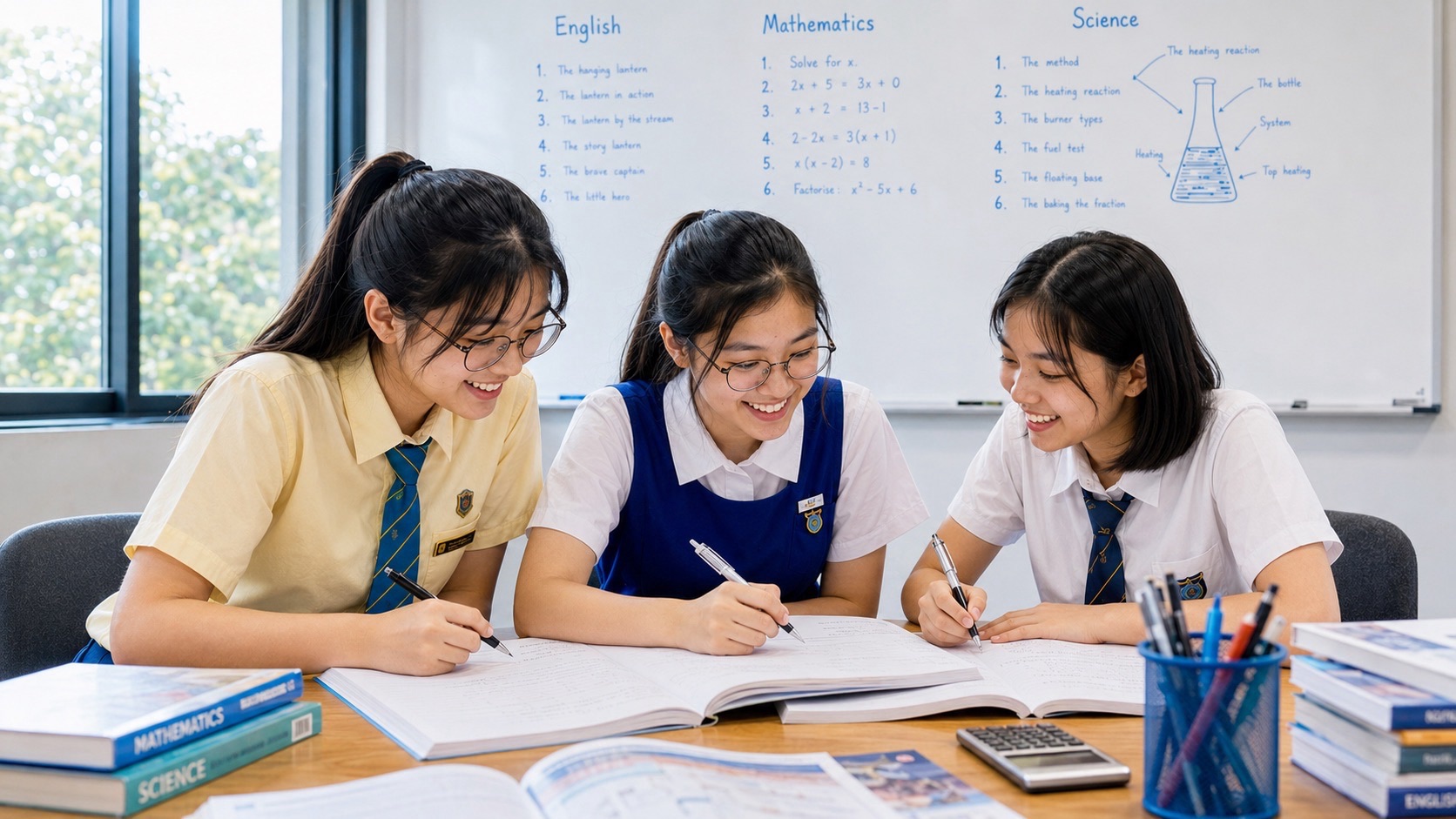
Secondary 4 Mathematics coaching is most useful when it finds why a familiar problem still went wrong. This guide helps Yishun students and tutors inspect the first mistaken decision, distinguish understanding from execution, and choose a repair that can be tested in fresh examination practice.
For the 2026 graduating cohort, Singapore-Cambridge GCE O-Level Mathematics remains syllabus 4052. Students need standard techniques, problem solving in varied contexts, mathematical reasoning and clear communication. That means tutoring in Secondary 4 should increasingly shift from explanation toward diagnosis, mixed-topic selection, timed execution and independent correction. A student who can only perform when the tutor names the method is not yet examination-ready.
Start with a marked paper and trace the working from the question to the first point where the reasoning breaks down. Explain or model the repair, then remove the prompt and ask the student to apply it to a different-looking problem. The aim is a dependable routine for reading, recognising, selecting, carrying out and checking a method independently.
The Tutor’s Final-Year Job Changes
In earlier years, a larger share of tuition may involve teaching new content.
By Secondary 4, the balance changes.
- diagnose where marks are actually being lost;
- repair high-impact concept gaps;
- build mixed-topic recognition;
- train timing and question triage;
- improve checking;
- reduce dependence on prompts.
Start with Evidence
“Weak at Maths” is not a useful enough diagnosis.
- Which topics lose the most marks?
- Which routine questions should be secure?
- Which error types repeat?
- Where does time begin to run short?
- Which questions are left blank?
- Can corrections be reproduced without the answer key?
The Tutor Should Find the First Wrong Decision
The final wrong answer is only the last event in a solution.
The useful teaching information is often earlier:
- the question was misread;
- the wrong method was selected;
- the diagram was not annotated;
- the algebra became unstable;
- a calculator entry did not match the written expression;
- the student stayed too long on an unproductive route.
Algebra Is Still the Shared Dependency
Signs, brackets, fractions, equations, expansion, factorisation, substitution and rearrangement appear throughout E-Math.
That makes algebra one of the highest-leverage areas to repair when errors are widespread.
Graphs and Coordinate Geometry
- read axes and scale;
- identify units;
- interpret gradient and intercepts;
- connect equations and graphs;
- distinguish exact values from estimates.
Students should read the representation before they start calculating.
Geometry, Mensuration and Trigonometry
The tutor should train setup before calculator use.
- mark known angles;
- label lengths;
- show parallel lines;
- record units;
- identify the required value;
- write the relevant relationship.
Statistics and Probability
These topics often reveal whether the student can organise information and interpret evidence rather than merely perform arithmetic.
Past Papers Should Change Future Behaviour
- Attempt honestly.
- Mark accurately.
- Classify each lost mark.
- Redo before reading the solution where possible.
- Study the solution only when necessary.
- Close it and reproduce the method.
- Retest the same error type later.
If paper ten contains the same mistakes as paper one, paper count is not the problem.
Question Triage Is a Tutorable Skill
Students can learn when to continue, when to pause, when to change representation and when to park a question temporarily.
This is not giving up. It is protecting accessible marks.
Time Management Is Not “Work Faster”
Time problems can come from slow recall, uncertain method selection, overlong algebra, poor triage or excessive checking.
The tutor should identify the cause before prescribing speed.
Checking Should Be Targeted
- negative signs;
- copied values;
- units;
- rounding;
- graph scales;
- calculator entries;
- answers produced during rushed periods.
A student who knows their own error pattern can check more intelligently.
From Tutor Prompt to Independent Routine
Explain
Teach or repair the concept clearly.
Model
Make the decision process visible.
Prompt
Ask a question that helps the student find the next step.
Remove
Use a similar but different-looking question with less support.
Retest
Bring the same error type back later without warning.
Small-Group Tuition and Tutor Visibility
A small group allows the tutor to see when one student needs concept repair, another needs a harder transfer question and another simply needs more time before intervention.
Good tutoring is partly knowing when not to interrupt productive struggle.
A 90-Minute Final-Year Lesson
- Retrieval: short mixed questions.
- Error repair: one recurring weakness from recent papers.
- Guided application: practise the repaired idea.
- Independent mixed set: remove prompts.
- Timed section: train pacing and triage.
- Review: classify errors and set the retest.
After Prelims
Use prelims as a diagnostic sample rather than a verdict.
- separate content gaps from execution errors;
- identify repeated losses;
- find routine marks that should be recoverable;
- note where time ran out;
- build a final repair list.
What Progress Looks Like
- more routine marks are secured;
- repeated errors decline;
- paper completion improves;
- question triage becomes calmer;
- checking becomes more targeted;
- corrections are reproduced without solutions;
- the student asks for less help on familiar structures.
No responsible tutor can guarantee a particular grade. The useful objective is to make the student’s examination system more reliable.
Frequently Asked Questions
Should a tutor explain every difficult question?
No. When the student has a productive route, additional thinking time can be more valuable than immediate explanation.
How many full papers should a student do?
There is no magic number. Track whether review is reducing repeated error patterns.
Can a tutor help with time management?
Yes, by identifying whether the cause is slow recall, inefficient method selection, overlong working or poor question triage.
The Final-Year Tutor Should Build Independence
The examination hall has no tutor beside the desk.
That fact should shape final-year tuition.
That is the direction of a Yishun Maths Tutor for Secondary 4: diagnose precisely, teach what is missing, reduce prompts, train execution and leave the student increasingly capable of controlling the paper independently.
Yishun Maths Tutor for Secondary 4
Explore the eduKate Yishun Mathematics Tuition & Learning Hub for related Mathematics guides and learning routes.
This is a legacy learning resource, not confirmation of a current Yishun class, timetable, tutor assignment, fee or vacancy. For present-day tuition-service decisions, use the Yishun Tuition Centre Hub and confirm current arrangements separately.
Properly taught kids shine a bright light into the future.
Build a tutor dashboard that tracks the student, not the worksheet
A Secondary 4 tutor needs a compact way to track whether the student is becoming more reliable. A useful dashboard can use five measures: independent-start rate, recurring-error frequency, completion under time, delayed retrieval and checking quality. These five measures reveal more than a raw score because they separate knowledge from performance.
Independent-start rate asks how many questions the student can begin without a hint. Recurring-error frequency shows whether the same sign, percentage, graph or geometry error is shrinking. Completion under time reveals whether the student can bring enough of the paper into reach. Delayed retrieval tests whether repairs last beyond the lesson. Checking quality shows whether avoidable errors are being contained before marking.
The tutor does not need a large spreadsheet. A one-page record updated after major practice sessions is enough. The purpose is to make the next lesson evidence-led rather than habitual.
The tutor should coach the first ninety seconds of a hard question
Many final-year students do not lose time in the middle of a calculation. They lose it at the beginning, rereading the question while waiting for a method to appear. A good tutor should coach those first ninety seconds directly.
- State the target quantity.
- Identify the known information and units.
- Decide which mathematical systems are plausible.
- Write one useful relationship, equation, annotation or table entry.
- Estimate whether the route is producing meaningful progress.
This routine prevents the blank-page response. It also reveals recognition latency: how long the student takes to identify a plausible method. If the first useful line appears quickly but the answer later fails, the tutor should stop treating recognition as the problem and move to execution.
Coach method rejection, not only method selection
Strong students need to know why a tempting method does not apply. A triangle is present, but trigonometry may be unnecessary. A percentage sign appears, but the task may simply be comparison. Two equations may appear, but one may not be independent. A graph may be present, but the question may ask only for a value rather than a rate.
Ask the student, “Why not this method?” This develops discrimination and reduces reflexive use of recently practised techniques. Examination papers reward students who can identify the mathematical conditions that justify a method rather than reacting to surface cues.
Turn tutor prompts into student self-prompts
Most good tutors use useful questions repeatedly: “What is the base quantity?” “What does the graph scale show?” “Which side is opposite the angle?” “What stays equal?” “What unit should the answer have?” These questions should eventually become the student’s own internal prompts.
A practical strategy is to write down the tutor’s most common prompts for one week. Then ask the student to choose three that they will deliberately use without being reminded. In the next lesson, the tutor waits. If the learner applies the prompt independently, the scaffolding has begun to transfer.
Use a three-level hint policy
Hints should be controlled. Level 1 is a focusing question: “What is the target?” Level 2 points to a representation: “Would a diagram or equation help?” Level 3 identifies a specific relationship or models one step. The tutor should begin with the least invasive hint that can restart productive thinking.
Record which level the student needed. Over time, important question types should move toward Level 1 or no hint. A student who still requires Level 3 on familiar structures has not yet reached independent performance.
Coach algebraic control across the whole paper
Algebra remains one of the largest shared dependencies in final-year Mathematics. A tutor should therefore look for algebraic errors across topics, not only in algebra questions. A sign error may occur in coordinate geometry. Factorisation may block an equation. Formula rearrangement may damage trigonometry. Fraction control may fail inside probability.
Once the shared dependency is visible, repair it once and then retest it in several contexts. This is more efficient than treating every affected chapter as a separate weakness.
Use an algebra risk checklist
- Are negative values placed in brackets during substitution?
- Are unlike terms kept separate?
- Are brackets expanded to every term?
- Is equality preserved line by line?
- Are fractions handled with clear numerator and denominator structure?
- Is a factorisation checked by expansion where useful?
- Is the final value substituted back when the cost is low?
The checklist should not be written on every question forever. It is a training device. As the routines become automatic, the tutor removes the visible checklist and watches whether the behaviour remains.
Coach proportional reasoning as one connected family
Percentage, ratio, rate and scale should not live in isolated folders. The tutor should repeatedly ask what the reference quantity is. A percentage change compares a change with the original. A rate compares one quantity per unit of another. Scale compares represented and actual quantities. Ratio compares parts.
Final-year paper errors often happen because the student remembers a calculation but chooses the wrong reference. The tutor should coach the reference decision before the arithmetic.
Train forward and reverse reasoning together
If a 20% discount is practised, reverse it in the same lesson. If 80% remains after the discount, final = 0.8 × original. When the final amount is known, original = final ÷ 0.8. This pairing prevents one-direction memorisation.
The same principle applies to rate and scale. If the student can move one way, ask whether they can reconstruct the original quantity. Reverse reasoning is a strong test of structure.
Coach graph questions through task type
Students often say they are weak at graphs when the actual problem is narrower. The tutor should classify graph tasks: value reading, scale interpretation, gradient or rate, intersection, trend, equation connection or contextual interpretation. One student may be strong at plotting and weak at meaning. Another may understand meaning but misread scales.
Once the task type is known, the repair becomes smaller. “Graphs” stops being a giant red category and becomes a specific, trainable problem.
Coach geometry by requiring proof of every added fact
Ask the student to label each statement in a geometry solution as given, known property or calculated. This makes hidden assumptions visible. If the learner writes that two angles are equal, what property justifies it? If two triangles are similar, what evidence establishes similarity?
This habit improves both reasoning and communication. It also reduces the risk of trusting a diagram simply because it looks convenient.
Coach trigonometry as a chain of decisions
Trigonometry can be broken into a chain: identify the reference angle, label the sides, choose the relationship, write the equation, rearrange, calculate and interpret. A wrong final answer should be traced to the first broken link.
The tutor should not say “trigonometry is weak” until the chain has been inspected. If side labelling is correct but rearrangement fails, algebra is the repair target. If all setup is correct but the output is wrong, inspect calculator mode and entry.
Coach statistics by asking what the number means
Final-year statistics should include interpretation. A student may calculate the mean correctly and still make a weak conclusion. Ask what the mean captures, how an outlier affects it and whether a comparison is fair. Ask whether a graph scale creates a misleading visual impression.
This training supports AO-style reasoning demands because the student moves beyond procedure into explanation and judgement.
Coach probability from the sample space outward
Before forming a probability fraction, define the possible outcomes. For multi-stage situations, use a tree, table or systematic list where it clarifies the structure. Distinguish replacement from no replacement and independent from dependent stages when relevant.
Then check that the answer lies in the valid probability range. Simple boundary checks are part of tutor-coached independence.
Use a past-paper ladder instead of endless full papers
- selected questions targeting recent repairs;
- mixed clusters;
- timed sections;
- half papers;
- full untimed papers for deep analysis;
- full timed papers;
- delayed reattempts of selected failures.
The ladder allows the tutor to isolate the missing performance layer. A student does not need another full paper when the real issue can be diagnosed in a twenty-minute section.
Every paper should generate the next week of tutoring
After marking, choose the two largest recurring causes and one control issue. Those become the next week’s priorities. For example: algebraic signs, reverse percentage and staying too long on one difficult question.
The tutor should then retest the same mechanisms in new forms. If they improve, the repair leaves the active list. If they do not, the teaching approach changes. This creates a closed coaching loop rather than a sequence of unrelated lessons.
Train the final fifteen minutes
During practice, announce the final fifteen minutes and require the student to switch into a rehearsed sequence. Complete near-finished work, return to marked questions with partial progress, scan for blanks and run the high-risk checks.
The end of a paper is its own performance phase. Students should practise it before the actual examination.
Use a final-error register
After prelims, maintain a short list of errors that still recur. Limit the register to the few patterns that genuinely continue to cost marks. Typical examples include negative signs, reverse percentage, graph scale, missing geometry reasons or excessive time on one question.
Review the register before timed practice. Remove an item only after it stays absent across several opportunities. The register should shrink as the examination approaches.
Use an exit condition for every active repair
A repair should know when it is finished. For example: “This sign-handling repair leaves the active list after two mixed sets with no repeated sign error and one delayed timed retest.” The condition prevents endless remediation.
Once the condition is met, the skill moves to light maintenance retrieval and tutor attention moves to the next priority.
Strong students need coaching too
High-performing students may need fewer concept repairs but still benefit from coaching in efficiency, method comparison, communication and precision. Ask whether a shorter route exists. Ask how an answer can be estimated. Ask which assumption a model makes. Ask the student to produce a counterexample.
The tutor’s role becomes less about explanation and more about sharpening mathematical judgement.
Struggling students need triage
When the student is far behind, do not attempt every chapter simultaneously. Triage the high-dependency systems: number sense, fractions, algebra, percentage, equations and graph reading. These produce the widest payoff.
Keep current school work connected, but accept that some lesson time must move backward to rebuild the machinery that later work requires.
Coach the final two weeks on one page
The final plan should fit on one page: remaining error-register items, retrieval rotation, selected timed work, checking script and normal school commitments. Complexity is the enemy of execution at this stage.
If a new resource or technique does not solve a diagnosed problem, leave it out. Final tutoring should protect stability rather than create novelty.
The final tutor handoff
Before the examination, ask the student to state the two risks still worth watching, the move-on rule, the checking sequence and the topics that are already secure. The student should understand why the final plan is narrow.
This is the final handoff from tutor-led coaching to student-owned performance. The tutor remains part of the preparation, but the learner carries the operating system into the examination.
The tutor should separate paper performance into four coaching layers
After every significant practice paper, the tutor should classify lost marks into four layers: knowledge, recognition, execution and control. Knowledge means the Mathematics itself was not understood or remembered. Recognition means the student knew the method but failed to identify it. Execution means the correct route was chosen but the algebra, arithmetic, units or calculator work failed. Control means the student lost time, sequence or checking discipline.
This classification prevents broad overreaction. A paper can look weak overall while the actual problem is narrow. If most losses belong to execution, the tutor should not reteach the entire syllabus. If recognition dominates, more topical explanation may not help. The coaching layer should determine the lesson.
Use a paper-to-lesson conversion protocol
A marked paper should automatically generate the next lesson plan. First, identify the largest recurring error family. Second, choose one smaller secondary target. Third, decide how both will be retested. Fourth, preserve strong topics through light retrieval only.
For example, a student may lose seven marks through algebraic signs, four through graph scale and two through one unusual geometry idea. The next lesson should emphasise algebraic execution, include one graph-scale drill and give the geometry idea a short clarification rather than equal time across all three.
Build a tutor-controlled error budget
An error budget counts how many marks repeatedly disappear through each cause. The tutor should compare budgets across several papers. If algebraic losses fall from eight marks to two while timing losses remain unchanged, the intervention has worked in one layer but not another.
The budget is not a grade forecast. It is a prioritisation tool. It helps the tutor decide whether the next hour is better spent on algebra, method recognition, time control or a genuine content gap.
Teach examination recovery as a deliberate skill
Students will occasionally choose a poor method or discover that an early line is wrong. A tutor should teach them how to recover without emotional spillover. Identify the last reliable line, separate the failed route clearly and restart from there. If the method is still unclear, mark the question and move on.
This prevents one mistake from consuming the rest of the paper. Recovery is part of final-year mathematical control because perfect first attempts are unrealistic.
Coach section transitions
A difficult question can occupy working memory even after the student has turned the page. During timed practice, train a section transition: stop replaying the previous problem, reset, read the new target from the beginning and treat the next question independently.
This simple routine helps prevent one difficult item from lowering performance on several later questions that the student actually knows how to solve.
Use confidence coding to improve checking
During practice, the student can mark selected answers as high-, medium- or low-confidence. After marking, the tutor compares confidence with accuracy. High-confidence wrong answers may reveal misconceptions. Low-confidence correct answers often need fluency and repeated retrieval.
This calibration improves the final checking strategy because the student becomes better at identifying which answers genuinely deserve another look.
Build a final checking hierarchy
Checking time is limited. The tutor should help the learner prioritise the highest-risk work first: long calculator expressions, negative substitutions, graph readings, reverse percentage, unit conversions, geometry reasons and questions that produced surprising answers.
Only after these high-risk items are reviewed should the student spend time rereading routine work. A hierarchy is more useful than the vague instruction to “check carefully.”
Tutor the final month differently from the rest of the year
In the final month, a tutor should reduce broad teaching and increase selective retrieval, paper control and recurring-error repair. New resources should be introduced only when they solve a defined problem. Stable methods should be preserved rather than replaced by clever alternatives.
The student should know the small set of active priorities. One might be algebraic execution, another timing, another reverse percentage. Everything else remains on maintenance retrieval. This narrowing is a sign that the coaching process has become evidence-led.
Create a final two-week coaching card
The last two weeks can fit on one coaching card: the final-error register, the remaining timed papers or sections, the retrieval rotation and the student’s move-on and checking rules. If the card becomes crowded, the plan may still contain too many active priorities.
The purpose of the card is clarity. The student should enter each session knowing why the task is being done and what evidence would allow it to leave the plan.
Coach the student to explain their own revision plan
Near the end of the tutoring cycle, ask the student to explain the plan without looking at the tutor’s notes. Which topics are secure? Which two error families remain active? What should happen if a difficult question cannot be started? What should be checked first?
If the learner can answer clearly, the revision logic has transferred. That is more valuable than a student who can follow a sophisticated plan but cannot recreate it without the tutor.
The tutor’s quality test: does support shrink as evidence improves?
A strong final-year tutor should be able to point to places where support has reduced. Fewer questions need hints. More corrections are completed independently. Error families shrink. The student chooses better first moves and recovers more calmly when something fails.
If tutor involvement stays equally heavy even as marks improve, the learner may be performing better without becoming more independent. The final-year quality test is not only score improvement; it is transfer of control.
The final tutor principle: preserve stable systems
Once a routine has proved reliable across mixed, delayed and timed work, the tutor should trust it. Do not keep changing algebra layouts, checking sequences or paper strategies simply because a new method exists. Change should follow evidence.
That stability matters in the final weeks. The student should enter the examination with a small number of well-practised behaviours rather than a large collection of recently acquired tricks.
Use a final tutor-to-student control audit
Before the final examination, the tutor should audit how much control has actually moved to the student. Can the learner identify the current weak link without being told? Can they choose whether a mistake needs reteaching, retrieval, mixed practice or time-control work? Can they decide when to move on from a difficult question? Can they run the checking script without a reminder?
This audit matters because high lesson performance can hide dependence. A student who solves difficult questions after subtle tutor cues may still struggle alone. The final-year goal is not simply correct answers in tuition; it is correct decisions when the tutor is absent.
Build a final self-coaching script
A compact self-coaching script can replace many tutor prompts: read the target, identify the structure, write one useful move, check the risky step, move on if stuck, return strategically. The student should rehearse this sequence in the final weeks until it feels normal.
The script does not solve the Mathematics for the learner. It organises attention. Under examination pressure, that organisation can prevent blank starts and impulsive method changes.
The final tutor success measure
A tutor has succeeded when support has become lighter while performance has become more stable. Fewer hints are needed. Corrections become more independent. The final-error register shrinks. The student knows which methods to trust and which risks still deserve checking.
That is the final handoff: the tutor has helped build the system, but the student now operates it.
The final tutor-to-exam bridge
In the last lessons, the tutor should deliberately stop adding new layers of support and instead rehearse the exact routines the student will carry into the paper: identify the target, choose a representation, protect algebra and units, move on when progress stops and run the high-risk checking sequence. These routines should feel familiar because they have already survived timed practice.
The tutor can then step back and observe one final mixed paper with minimal intervention. The important evidence is not only the mark. Does the student start more questions independently? Do they recover after a wrong turn? Do they use the checking hierarchy? Can they explain afterward which error still deserves attention?
When the answers are mostly yes, the tutor has completed the real final-year job. The learner is carrying a working mathematical and examination system rather than depending on last-minute rescue.
The final observation lesson should therefore feel different from earlier tutoring. The tutor says less, records more and intervenes only when necessary. The student should carry the start routine, move-on rule and checking sequence independently. Afterward, the debrief is short: what remained secure, what still repeated and whether the last active repair genuinely deserves more time. This final reduction in tutor involvement is itself evidence. It shows that the revision architecture has transferred from the lesson into the learner’s own examination behaviour.
The student is ready when this behaviour remains stable without tutor narration. They can read the paper, protect the Mathematics they know, recover from difficulty and make sensible decisions with limited time. That is the practical meaning of final-year independence.
That independent control is the final product of good Sec 4 tutoring: the student can act sensibly when the tutor is no longer beside them.
The tutor can now step back with confidence because the student owns the final-year routine.
Final-year tutoring is complete.
Ready.
Extended Final-Year Operating Manual: Secondary 4 Mathematics Tutor in Yishun
Secondary 4 Mathematics tutoring should behave differently from lower-secondary tutoring. The syllabus is no longer an empty field waiting to be taught chapter by chapter. Most students have already encountered a large proportion of the required ideas. The final-year problem is therefore often one of reliability: recognising the right method under mixed conditions, retrieving it fast enough, executing it accurately, controlling calculator and notation errors, and recovering when a question does not resemble the revision worksheet.
A strong Secondary 4 Maths tutor in Yishun should turn marked papers, prelim work, school assignments and mixed practice into a performance map. The student should know which topics are secure, which are fragile, which errors repeat across topics and which decisions consume too much time. Revision then becomes selective. Strong areas move into maintenance; weak dependencies receive targeted repair; examination control is trained only after the mathematics itself is stable enough to support it.
Singapore’s current transition to the Singapore-Cambridge Secondary Education Certificate also makes cohort accuracy important. SEAB publishes current SEC syllabus information by subject level. Students should use the official syllabus and assessment information for their own examination cohort and subject level rather than assume that an older GCE label or another cohort’s document applies unchanged. This page therefore focuses on durable final-year learning and examination mechanisms while directing official syllabus questions to SEAB and the student’s school.
1. Final-year Mathematics is a reliability problem
A student can know a method and still lose marks because the method is not available when needed. They may recognise a topic only after seeing a worked solution. They may solve accurately untimed but deteriorate under a paper. They may finish routine questions quickly but stall on unfamiliar combinations. They may understand concepts but lose signs, units or calculator accuracy.
The final year should therefore measure more than “topic covered”. Ask whether knowledge is retrievable, selectable, executable, interpretable and checkable under conditions increasingly similar to assessment.
This changes tutoring priorities. Teaching still matters, but revision architecture and error control become central.
2. Begin with the last two marked papers
One paper can be unusual. Two or three reveal patterns. Collect recent school assessments, prelims where available, weighted tests or timed practice. For every lost mark, find the first point where the solution stopped being viable.
Classify errors: concept, prerequisite, representation, method selection, algebraic manipulation, arithmetic/calculator, answer form, unit, reading, checking or time. Keep the categories simple enough to use.
The result is an error map rather than a mark. Two students scoring 55 may need entirely different final-year plans.
3. Separate repair mode from performance mode
Repair mode slows the problem down. The tutor may use smaller numbers, diagrams, worked examples, contrast cases and untimed practice. The goal is understanding and accurate execution.
Performance mode restores mixed questions, normal notation, time limits, calculator use and independent decision making. The goal is reliable access under assessment conditions.
Do not confuse the two. Timing a broken method can train rushing. Staying forever in repair mode can produce comfortable lessons that never transfer to papers.
4. The three-list revision map
Create three lists: Secure, Active Repair, and Maintenance/Monitor. Secure topics have survived delayed mixed questions. Active Repair contains the small set of mechanisms currently costing the most marks. Maintenance/Monitor contains topics that are mostly reliable but should appear in spaced review.
Do not allocate equal time to every chapter. Revision time is limited. A student who is strong in coordinate geometry but weak in algebraic manipulation should not spend identical hours on both merely to feel balanced.
Update the lists after every substantial paper.
5. Rank weaknesses by mark impact and connectivity
Some weaknesses affect many topics. Algebraic manipulation can damage graphs, geometry, trigonometry and formula work. Fractions can affect ratio, probability and algebra. Calculator control can affect many numerical questions.
A high-connectivity weakness deserves priority because repairing it can recover marks across several chapters.
Combine this with likely mark impact from the student’s actual papers. Revision becomes evidence-led, not anxiety-led.
6. The 50-second final-year router
Before solving a mixed question: read the command word, name the target, list known quantities and units, identify conditions, choose a representation, then choose the relationship or method.
The router should be short enough to become automatic. It prevents method selection from being outsourced to chapter headings.
For a difficult problem, write the target explicitly. “Find angle”, “find original value”, “show equality”, “find probability”, “find gradient”. A named target reduces wandering.
7. High-yield algebra audit
Test algebra because it appears everywhere. Include expansion, factorisation where relevant, equations, formula rearrangement, substitution, fractions, indices and graph relationships according to subject level.
A student who loses algebra marks should not simply receive “more algebra”. Identify whether the first failure is notation, signs, like terms, bracket structure, inverse operations or equation construction.
Build a small repair set around that first failure, then retest it inside another topic.
8. Negative-sign control
Final-year students often describe sign errors as careless. If they repeat, make them predictable. High-risk moments include subtracting a negative, expanding with a negative multiplier, moving through coordinate differences, substituting negative values and rearranging equations.
Use a sign checkpoint after those moments. Bracket signed substitutions. Separate products under negative distribution. Estimate the direction of change.
The purpose is not to slow every line. It is to spend two seconds where the student has historically lost marks.
9. Algebraic equivalence checks
When expanding or factorising, verify by reversing the process. When rearranging a formula, substitute simple test values or compare dimensions where appropriate. When solving an equation, substitute the solution into the original.
Checks should be independent enough to catch the likely error. Repeating the same manipulation mentally may reproduce the same mistake.
Students should know which algebraic questions are most worth checking.
10. Equations under pressure
A student may solve equations well in isolation but make errors late in a long paper. Fatigue exposes weak notation. Use one transformation per line on high-risk equations. Avoid compressing several sign changes into one mental leap.
For 4(2x-3)=3x+17, expansion gives 8x-12=3x+17, then 5x=29, x=29/5. A fractional answer is not evidence of error by itself.
Substitute back rather than forcing the answer into a neat integer because the student expected one.
11. Formula manipulation
Final-year papers often expect students to use formulae flexibly. Treat formulae as equations. Identify which operations surround the target variable and undo them while preserving equality.
If A=bh/2, h=2A/b. If y=mx+c, x=(y-c)/m for m not zero. The exact formulae depend on the student’s course; the algebraic principle is stable.
Train rearrangement both symbolically and inside context.
12. Percentage control
Separate four intents: find a percentage of a quantity; find percentage change; find the new value after a change; find an original value from a final value.
The common error is using the wrong reference. Write the multiplier or reference before calculation.
For a 15% decrease, multiplier 0.85. For a 15% increase, 1.15. Reverse problems divide by the multiplier rather than applying the same percentage to the final number.
13. Compound percentage
Repeated changes multiply. A 10% increase followed by 10% decrease gives factor 1.1×0.9=0.99, a 1% decrease overall.
Students who add and subtract percentage points without regard to changing references need multiplicative modelling.
Use multipliers to compress repeated change, then interpret the final factor in percentage language.
14. Ratio, rate and proportion
Final-year problems often hide proportion inside context. Identify what remains constant: ratio, rate, scale factor, product or another relationship.
Use units. A rate has compound units. A scale factor is dimensionless when comparing corresponding lengths. Percentage is relative to a reference.
If the student starts combining numbers before naming the relationship, slow the first step.
15. Speed and average rate
Average speed is total distance divided by total time. It is not generally the arithmetic mean of two speed readings.
If 60 km is travelled at 30 km/h and 60 km at 60 km/h, total time is 2+1=3 hours; average speed=120/3=40 km/h.
This classic contrast checks whether the student models the journey rather than memorises “average means add and divide by two”.
16. Graphs under examination conditions
Read axes, scale and units before shape. Identify intercepts and key points. If a relationship is linear, connect gradient and intercept to the equation where the course requires it.
Under time pressure, students often plot accurately but forget what the question asks next. Label derived values and reread the command word.
A graph is a representation from which multiple questions can be asked; the first calculation is not automatically the final target.
17. Coordinate geometry control
Coordinate questions combine signed numbers, algebra and geometry. Keep x- and y-differences paired consistently.
For points (-2,3) and (4,11), horizontal difference is 6, vertical difference 8. Distance is 10 where the distance relationship is in scope.
A sign mistake in coordinate subtraction can propagate through the rest of the question. Estimate the direction and size before accepting the result.
18. Pythagoras versus trigonometry
In right triangles, choose method from the known and unknown quantities. Pythagoras connects side lengths. Trigonometric ratios connect an acute angle with side ratios.
Label the hypotenuse and reference angle first. Then opposite and adjacent become clear.
A formula list cannot replace diagram interpretation. The tutor should use contrast pairs until selection is automatic.
19. Trigonometric calculator discipline
Write the ratio equation before using the calculator. Check mode according to examination requirements. Use brackets when evaluating inverse functions or compound expressions. Round only according to instructions, preferably keeping sufficient intermediate accuracy.
Perform a magnitude check. A leg cannot exceed the hypotenuse in a right triangle. An acute angle should fall in the expected range.
Calculator errors should be classified separately from method errors.
20. Similarity and scale
Label corresponding sides. Find the linear scale factor. Apply it consistently. Where area or volume scale relationships are in the course, use square or cube factors appropriately rather than the linear factor itself.
Students often know the rule but pair wrong sides. Correspondence is the first decision.
Rotate diagrams in practice so visual position does not become a shortcut for correspondence.
21. Geometry reason chains
Use given fact -> property -> conclusion. A line or angle is not special because it looks special. Use markings, stated parallelism, right angles, equal sides and proven relationships.
Write short reasons on questions where the course expects them. Reasons also function as a self-check: if the student cannot name why two angles are equal, the calculation may be built on appearance.
Geometry marks become more reliable when the logic is visible.
22. Mensuration and dimensional checks
Length, area and volume use different units. Perimeter and area can use the same dimensions but answer different attributes. Composite figures may need derived lengths before a formula applies.
Do a dimensional audit before the final answer. cm, cm² and cm³ should not be interchangeable.
Estimate whether the magnitude is plausible for the diagram.
23. Statistics and data interpretation
Calculate accurately, then interpret. Mean, median, mode and spread describe different features. Graph scales and class intervals matter.
A strong final-year student should not overclaim. A graph may show association or difference without proving a cause. A mean may be affected by extreme values.
Where more advanced representations such as histograms or cumulative frequency are in the course, follow the official convention and read axes before applying formulas.
24. Probability control
Define the event and sample space. Use tree diagrams, tables or lists when sequential structure is easy to miss.
With replacement and without replacement create different probability models. The second-stage probability may change after an outcome is removed.
Check that final probabilities lie between 0 and 1 and that complementary events sum appropriately.
25. Mixed-question recognition
Topical revision should gradually give way to mixed recognition. The page should stop announcing the method.
Use paired contrasts first: expansion vs factorisation; Pythagoras vs trig; direct vs reverse percentage; mean vs median; similarity vs congruence.
Then place them into larger mixed sets. Method selection becomes a trained skill.
26. The prelim paper as a diagnostic goldmine
Prelims often expose final-year weaknesses because they mix content and add time pressure. Do not respond only by redoing the whole paper.
For each question, record: knew and executed; knew but slow; wrong method; execution error; missing prerequisite; unfinished; misread; checking failure.
Count patterns. The next two weeks should be built around the highest-impact clusters.
27. Post-prelim triage
Do not attempt to fix every lost mark equally. Choose three tiers.
Tier A: foundational/high-connectivity repairs that affect many questions. Tier B: high-frequency or high-mark topics with realistic recovery. Tier C: rare, highly difficult or currently low-return areas.
This is not giving up on Tier C. It is sequencing under limited time. After A and B improve, return to C where appropriate.
28. A 12-week final-year cycle
Weeks 1-2: diagnostic map and foundational repair. Weeks 3-4: reconnect repairs to mixed topic questions. Weeks 5-6: timed sections and method-selection practice.
Weeks 7-8: full or substantial paper practice appropriate to school progression, followed by error clustering. Weeks 9-10: repair paper-specific weaknesses and repeat delayed mixed sections. Weeks 11-12: maintenance, personal error checklist and final paper-control rehearsal.
Adjust to actual assessment dates. The cycle describes functions, not a fixed calendar.
29. A six-week compressed cycle
When less time remains, compress without skipping diagnosis. Week 1 maps errors. Week 2 repairs the highest-connectivity gap. Week 3 repairs the next and retrieves the first. Week 4 mixed timed sections. Week 5 paper practice and error control. Week 6 selective repair and maintenance.
Avoid introducing large new topic loads unless genuinely necessary. Final-year gains often come from reliability of existing knowledge.
30. The final four weeks
Protect secure topics with brief retrieval. Spend most time on recurring error clusters and realistic mixed practice. Keep one day or session for error-log review and delayed retests.
Avoid doing full papers daily simply because the exam is near. Papers are useful when they produce analysis and repair. Unreviewed paper volume can repeat the same mistakes.
Sleep, school workload and other subjects matter. A revision plan should be sustainable enough to execute.
31. Timed-section training
Start with 20-30 minute mixed sections rather than immediate full-paper marathons. Observe where time is lost.
Afterward, separate knowledge time from decision time. Did the student know the method but manipulate slowly? Did they stare before starting? Did calculator entry consume time? Did they overcheck easy questions?
Train the bottleneck, then retest.
32. Full-paper training
Use full papers when the student has enough syllabus coverage and the purpose is paper endurance, navigation and timing. Recreate conditions reasonably but do not turn every practice into a high-stakes event.
After the paper, spend significant time analysing. A two-hour paper with no repair may be less valuable than a shorter section followed by precise correction.
Track repeated errors across papers.
33. Paper navigation
Know the examination rules. Where flexible movement between questions is allowed, avoid sacrificing excessive time to one blocked item.
Use a re-entry mark and leave partial working. On return, the student should know what has been tried.
Navigation is strategic allocation, not avoidance.
34. The stuck-question recovery protocol
Step 1: reread the target. Step 2: list givens and units. Step 3: draw or relabel the representation. Step 4: identify possible relationships. Step 5: write one valid intermediate fact.
If no route emerges within a sensible time, move temporarily and return. A blocked question should not destabilise the next five.
Practise this protocol before the actual examination.
35. The 90-second error check
At high-risk questions, spend a short audit: signs, brackets, units, rounding, target quantity and calculator mode where relevant.
This does not mean re-solve the whole problem. It is targeted checking based on known personal risks.
Students should build their own checklist from marked papers.
36. Algebra checking
Equation: substitute. Expansion: factor or substitute a test value. Factorisation: expand. Formula rearrangement: substitute compatible test values or reverse the transformation.
The check should target structural errors. Arithmetic can be recalculated if that was the risk.
Do not let checking become longer than solving every routine question.
37. Geometry checking
Verify angle sums, corresponding relationships, right-triangle conditions and side magnitude. Make sure the answer corresponds to the requested angle or side, not the variable alone.
Use units for length, area and volume.
If a computed hypotenuse is shorter than a leg, stop and investigate.
38. Percentage checking
State the original reference. Convert the final answer forward. If an original price was found from a discount, apply the discount to see whether the given final price returns.
Estimate: a 5% change should be modest; a 150% increase should more than double the original.
These checks catch reference errors.
39. Graph checking
Substitute plotted points into an equation where relevant. Check axis scale. Confirm intercept coordinates. Compare direction of line with sign of gradient where taught.
In context, verify that the graph statement matches units. A horizontal segment means the vertical quantity is unchanged, not that the horizontal variable stopped.
40. Statistics checking
Recompute totals. Ensure data is ordered for median. Confirm denominator/count. Read graph intervals carefully.
Ask whether the result is plausible relative to the data. A mean far outside the range is impossible for ordinary finite real data without weights or transformations that change the interpretation.
Interpretation is part of checking.
41. Probability checking
Ensure favourable outcomes are a subset of the sample space. Probabilities must lie between 0 and 1. Complementary events should sum to 1. Branch probabilities at a stage should account for the relevant possibilities.
For without-replacement models, update counts.
A tree should reflect the actual process, not a memorised shape.
42. The personal error library
Keep only recurring patterns. Example entries: negative sign after expansion; wrong percentage reference; pairs wrong corresponding sides; forgets final unit; reads graph scale as one per grid; rounds too early.
Beside each, write a prevention action.
Review the library before timed practice and after new papers. Delete or lower priority when the error stops recurring.
43. The strong-topic maintenance deck
Secure topics receive one or two retrieval prompts per week rather than full worksheets. This preserves access while freeing time.
A maintenance prompt should be representative enough to expose loss of method, not merely a trivial fact.
If a previously secure topic fails twice, promote it back to Active Repair.
44. The weak-topic repair deck
For each active weakness, keep three questions: direct, contrast and transfer. Direct tests execution. Contrast tests method selection. Transfer changes surface.
After successful same-day work, schedule one delayed question.
The deck remains small and targeted.
45. Fictional case: 45 marks with algebra leakage
A fictional student scores 45. Paper analysis shows many geometry and graph questions started correctly but failed during algebra. The instinct may be to revise geometry and graphs separately.
Instead, the tutor repairs equation manipulation and signed algebra, then retests those topics. Several apparent topic weaknesses improve simultaneously.
This is why dependencies matter more than chapter count.
46. Fictional case: 45 marks with method-selection failure
Another fictional student also scores 45. Algebra execution is strong once a method is identified, but mixed questions are frequently started with the wrong method.
The tutor uses contrast practice and first-line drills. The student must identify conditions before calculation.
Same mark, different intervention.
47. Fictional case: 65 marks with time failure
A fictional student scores 65 and leaves a substantial section incomplete. Earlier work is mostly accurate.
The tutor observes timed sections and finds overlong checking and slow retrieval of basic algebra. Revision shifts toward retrieval fluency, selective checking and navigation.
Teaching new content would not address the main lost marks.
48. Fictional case: 75 marks with recurring careless losses
A fictional student scores 75 but loses marks repeatedly from units, rounding and sign slips.
The tutor builds three personal checkpoints rather than adding harder questions immediately. High-risk errors are reviewed after each timed set.
The aim is converting knowledge into marks, not proving the student can survive even harder material.
49. Fictional case: high marks but fragile unfamiliarity
A fictional student scores highly on school papers with familiar formats but struggles with unseen structures.
Extension focuses on variation: reverse unknowns, rotated diagrams, mixed topics, counterexamples and construction tasks.
The goal is robustness rather than acceleration alone.
50. Parent guide: what good final-year tuition should show
Parents should be able to hear a specific plan: which marks are being lost, what mechanism causes them, what is already secure, and how the repair will be retested.
A useful report might say: “Algebra and graph concepts are secure; current lost marks cluster around negative-sign control and reverse percentage. This week we repair those and retest them in mixed questions.”
That is more actionable than “needs more practice”.
51. Parent guide: when to worry about volume
More worksheets can be counterproductive if they reduce sleep, displace other subjects or repeat already secure material.
Ask whether each practice set has a purpose. Is it retrieval, repair, transfer, timing or paper simulation?
A final-year plan should become more selective over time.
52. Parent guide: after prelims
Avoid turning the prelim result into a global verdict. Use it as a high-information sample.
Identify recoverable marks, repeated mechanisms and time issues. Celebrate nothing artificially, but preserve real strengths. A student needs to know which parts already work so revision is not psychologically and academically wasteful.
Build the next plan from evidence.
53. Student guide: what to do the day after a bad paper
Do not immediately redo every question. First classify the errors while memory of the paper remains. Which methods were unknown? Which were known but unavailable? Which were rushed? Which were misread?
Choose one or two high-value repairs. Solve fresh questions after reviewing.
A bad paper becomes less threatening when it produces a concrete next action.
54. Student guide: what to do after a good paper
Do not stop revising the subject entirely. Identify why performance was good. Which routines worked? Which errors disappeared? Which questions were still slow?
Move secure topics into maintenance and select the next fragile area.
Good papers should make revision more efficient.
55. Student guide: managing a blank during an exam
Write something useful: a labelled diagram, formula condition, known relationship or target. This can unlock memory and create a re-entry point.
Avoid filling the page with random formulas. Each written line should relate to the givens.
If the route remains unclear, protect the rest of the paper and return later.
56. Student guide: calculator confidence
Know the calculator functions used in your course before the examination. Practise entering fractions, powers and trigonometric expressions accurately as applicable.
Do not learn key sequences without understanding the written expression.
Always compare the display with an estimate or geometric expectation when possible.
57. Student guide: revision notes
Keep them compact. One page per major topic or error cluster may include conditions, key relationships, one worked example, common trap and check.
Do not spend final weeks copying textbooks.
Notes should support retrieval, not replace it.
58. Student guide: final-week retrieval
Use short mixed prompts. Write formulae and conditions from memory. Solve representative problems. Review error checks.
Avoid exhausting yourself with endless new hard questions. Final-week work should strengthen availability and control.
The exact schedule should respect school guidance and personal workload.
59. A final-year mixed set: problem 1
Solve 5x-7=3x+15. Then 2x=22, x=11. Check both sides: 55-7=48; 33+15=48.
The problem tests equation balance and substitution checking.
60. Mixed set: problem 2
A value falls from 250 to 215. Decrease=35. Percentage decrease=35/250×100%=14%.
The reference is the original 250.
61. Mixed set: problem 3
A price is $153 after a 15% discount. Final multiplier 0.85, so original=153/0.85=180.
Check: 15% of 180=27; 180-27=153.
62. Mixed set: problem 4
A right triangle has legs 7 and 24. Hypotenuse=25.
If area is also asked, area=84 square units. Different targets use different relationships.
63. Mixed set: problem 5
In a right triangle, angle θ has adjacent side 8 and hypotenuse 10. cosθ=0.8, so θ≈36.87° where trigonometry is in scope.
Check that θ is acute.
64. Mixed set: problem 6
The ratio A:B=4:9 and A=28. Scale factor=7, so B=63.
Check 28:63 simplifies by 7 to 4:9.
65. Mixed set: problem 7
Mean of six values is 12. Five values total 59. Required total=72, missing=13.
Check total.
66. Mixed set: problem 8
For y=-2x+5, y at x=4 is -3. The line decreases as x increases.
If asked for y-intercept, it is (0,5).
67. Mixed set: problem 9
An isosceles triangle has equal angles x+10 and third angle 40. Then 2(x+10)+40=180, so 2x=120, x=60. Equal angles=70°.
Do not stop at x if the angle is requested.
68. Mixed set: problem 10
A bag has 6 red, 3 blue, 1 green counter in an equally likely one-draw model. P(red)=6/10=3/5; P(not red)=4/10=2/5.
Check complement sums to 1.
69. Mixed set: problem 11
Expand (x+6)(x-2)=x²+4x-12 where quadratic expansion is in scope.
Factorisation check returns (x+6)(x-2).
70. Mixed set: problem 12
A dataset 3,4,4,5,24 has median 4 and mean 8. The outlier raises the mean.
Interpretation matters more than one calculation.
71. Mixed set: problem 13
A line passes through (2,7) and (6,15). Gradient=8/4=2 where taught. Using y=2x+c gives c=3, so y=2x+3.
Check both points.
72. Mixed set: problem 14
A rectangle’s length is 14 cm and area 126 cm². Width=9 cm. Perimeter=46 cm.
Label width before continuing.
73. Mixed set: problem 15
A value increases by 20% twice. Overall multiplier=1.44, so overall increase=44%.
Percentages compound.
74. Mixed set: problem 16
Under an inverse-proportion model xy=72. If x=9, y=8. If x doubles to 18, y halves to 4.
State the model assumption.
75. Mixed set: problem 17
If P(A)=0.63, P(not A)=0.37.
Do not confuse complement with another named event unless it is exactly the complement.
76. Mixed set: problem 18
Round 0.007846 to 3 significant figures: 0.00785.
Leading zeros are not significant.
77. Mixed set: problem 19
A proposed factorisation (x+2)(x+8) for x²+10x+12 is wrong because product constant would be 16. Correct integer factorisation, where possible, depends on factors summing to 10 and multiplying to 12; there is no integer pair satisfying both. This alerts students not to force neat factorisation.
Use the method appropriate to the course if solving is required.
78. Mixed set: problem 20
A graph axis labels every fifth grid line. Before reading a point, determine the value per small square.
Scale-reading errors can invalidate otherwise correct graph work.
79. Final 30-day countdown framework
Days 30-24: repair high-connectivity weaknesses. Days 23-18: mixed sections and delayed retests. Days 17-12: paper practice plus error clustering. Days 11-7: targeted repair from papers. Days 6-3: maintenance, retrieval, personal checklist. Days 2-1: follow school guidance, avoid unnecessary overload, preserve normal routines.
This is a framework, not a guarantee or mandatory calendar. Adapt to actual exam dates and the student’s other subjects.
80. The final paper-control card
Before a paper: know the required equipment and permitted calculator rules, sleep sufficiently, and review only compact retrieval prompts rather than trying to relearn the whole course.
During: read command words, allocate time, use re-entry points, apply personal high-risk checks.
After: do not judge immediately from feelings. Wait for marked evidence, then analyse.
81. Current official reference
Use the SEAB SEC syllabus portal for the student’s relevant examination cohort and subject level. The examination structure is changing across cohorts, so official current documents and school instructions take priority over legacy labels on an old URL.
This guide is an educational operating manual, not an official examination specification.
82. Final Secondary 4 principle
The final year is not won by touching every chapter equally. It is managed by making knowledge reliable: diagnose, triage, repair, retrieve, mix, time, check and retest.
The tutor’s job becomes increasingly selective. The student should finish the year knowing not only more Mathematics, but how to turn a marked error into a repair and a repair into dependable performance.
Use the Yishun Mathematics Tuition and Learning Hub for broader routing.
Part III · Final-Year Repair, Paper Control and Examination Conversion
This part extends the page from topic tuition into a complete final-year operating manual. It keeps the public focus on practical Mathematics: diagnose from evidence, protect secure marks, repair high-cost mechanisms, convert repairs into mixed timed work, practise recovery and gradually reduce support. It does not promise a particular grade or assume that one paper determines a student’s future.
83. Prelim triage
Final-year job. turn a marked prelim into a ranked recovery plan.
Typical breakdown. revising every chapter equally because the overall score feels alarming.
Diagnostic move. classify lost marks by prerequisite, method selection, execution, interpretation, timing and checking; rank recurring mechanisms by mark cost.
Practice architecture. repair one high-connectivity weakness at a time, then place it back into mixed paper sections.
Transfer target. show the learner that a prelim is evidence for action rather than a prediction of final performance.
84. Secure-mark defence
Final-year job. protect marks that are already dependable while repair happens elsewhere.
Typical breakdown. allowing panic revision to destabilise strong topics.
Diagnostic move. identify a maintenance set for secure topics and keep it brief.
Practice architecture. alternate light retrieval of strengths with deeper repair of fragile mechanisms.
Transfer target. preserve a stable mark floor while revision becomes more selective.
85. Algebra under time
Final-year job. keep algebraic transformations legible when working speed increases.
Typical breakdown. compressing several sign changes into one mental leap.
Diagnostic move. use one transformation per line for high-risk expressions and equations.
Practice architecture. practise short algebra bursts, then embed them inside geometry and graph questions.
Transfer target. transfer sign control into mixed paper conditions.
86. Negative-sign checkpoint
Final-year job. prevent predictable sign loss across expansion, substitution and coordinates.
Typical breakdown. calling repeated sign errors careless without changing the routine.
Diagnostic move. mark signed substitutions with brackets and separate products under negative distribution.
Practice architecture. use a two-second sign audit at known danger points.
Transfer target. reduce recurring losses without slowing every line of working.
87. Equation recovery
Final-year job. reconstruct an equation method after a wrong first move.
Typical breakdown. repeating the same failed transposition several times.
Diagnostic move. return to equality and inverse operations, then rebuild from the last correct line.
Practice architecture. compare two valid solution routes and select the cleaner one.
Transfer target. make recovery possible even when the first method choice is imperfect.
88. Formula rearrangement
Final-year job. treat formulae as equations rather than fixed templates.
Typical breakdown. memorising many rearranged versions separately.
Diagnostic move. identify operations surrounding the target variable and undo them in reverse order.
Practice architecture. check rearrangements with simple compatible values.
Transfer target. transfer algebraic control into measurement and modelling contexts.
89. Percentage reference
Final-year job. keep original, change and final quantities distinct.
Typical breakdown. using the most recent number as the percentage base automatically.
Diagnostic move. write the reference quantity before the fraction or multiplier.
Practice architecture. contrast forward, change and reverse percentage questions.
Transfer target. prevent reference drift under timed word problems.
90. Compound percentage
Final-year job. model repeated percentage changes multiplicatively.
Typical breakdown. adding percentage changes as if they share one fixed base.
Diagnostic move. use multipliers for each stage and multiply them.
Practice architecture. compare increase-then-decrease cases that appear to cancel but do not.
Transfer target. build reliable reasoning for successive changes.
91. Ratio scaling
Final-year job. preserve multiplicative relationships under changing quantities.
Typical breakdown. adding the same amount to both ratio terms.
Diagnostic move. identify one ratio unit or common scale factor.
Practice architecture. move between table, bar and algebraic representations.
Transfer target. transfer ratio control into similarity, scale and rates.
92. Rate units
Final-year job. keep compound units visible throughout a question.
Typical breakdown. calculating numerically while ignoring what the quotient represents.
Diagnostic move. write the unit with each rate quantity before substitution.
Practice architecture. use dimensional sense to reject impossible outputs.
Transfer target. transfer unit discipline into speed and other rates.
93. Average speed
Final-year job. use total distance over total time.
Typical breakdown. taking an arithmetic mean of speed readings without considering durations.
Diagnostic move. rebuild the journey into distance and time segments.
Practice architecture. check total distance and time before computing the average.
Transfer target. avoid one of the most common rate-modelling traps.
94. Graph axes first
Final-year job. read axes, scale and units before interpreting the shape.
Typical breakdown. describing a graph from visual steepness alone.
Diagnostic move. state what one horizontal and vertical interval represents.
Practice architecture. translate selected points into a table or rule where appropriate.
Transfer target. turn graph reading into evidence rather than appearance.
95. Gradient meaning
Final-year job. connect rate of change to coordinate differences where taught.
Typical breakdown. memorising a gradient formula without interpreting signs or units.
Diagnostic move. write vertical change over horizontal change with consistent point order.
Practice architecture. check sign against the direction of the line.
Transfer target. transfer gradient reasoning into equations and modelling.
96. Intercept control
Final-year job. distinguish x- and y-intercepts and their meanings.
Typical breakdown. reversing coordinates or calling every axis crossing an x-intercept.
Diagnostic move. set the appropriate coordinate to zero and solve.
Practice architecture. verify the resulting point on the graph.
Transfer target. reduce easy mark loss in linear graph questions.
97. Coordinate signs
Final-year job. maintain signed differences in coordinate calculations.
Typical breakdown. treating negative coordinates as labels rather than values.
Diagnostic move. draw quick axis positions and write coordinate differences explicitly.
Practice architecture. use magnitude checks on horizontal and vertical displacement.
Transfer target. transfer integer fluency into graph and geometry work.
98. Pythagoras condition
Final-year job. use Pythagoras only when the right-triangle condition is satisfied.
Typical breakdown. applying the theorem to any triangle with three side lengths.
Diagnostic move. mark the right angle and identify the hypotenuse before substitution.
Practice architecture. contrast with a non-right triangle and a trig problem.
Transfer target. make formula choice depend on conditions.
99. Trigonometric ratio choice
Final-year job. select sine, cosine or tangent from known and required sides.
Typical breakdown. reciting SOHCAHTOA but labelling sides relative to the wrong angle.
Diagnostic move. mark the reference angle and label O, A and H before choosing a ratio.
Practice architecture. rotate diagrams and repeat with the same relationship.
Transfer target. make ratio selection independent of diagram orientation.
100. Trig calculator control
Final-year job. separate correct setup from numerical calculator execution.
Typical breakdown. changing the method when the real error was input or mode.
Diagnostic move. estimate angle or side magnitude, then enter the written expression faithfully.
Practice architecture. use a final geometric plausibility check.
Transfer target. prevent calculator handling from masquerading as concept weakness.
101. Similarity correspondence
Final-year job. pair corresponding sides before using scale.
Typical breakdown. matching sides by visual position instead of structural correspondence.
Diagnostic move. mark equivalent vertices and build a correspondence table.
Practice architecture. use the same scale factor across all matched lengths.
Transfer target. transfer similarity into unfamiliar orientations.
102. Scale dimensions
Final-year job. distinguish linear, area and volume scale factors where taught.
Typical breakdown. using the linear scale factor for every dimensional measure.
Diagnostic move. name the dimension of the target before applying the factor.
Practice architecture. compare length, area and volume changes on the same pair of similar objects.
Transfer target. build dimensional reasoning rather than a memorised exponent list.
103. Geometry reason chains
Final-year job. make each angle or length conclusion traceable to a property.
Typical breakdown. writing numbers with no reason and relying on appearance.
Diagnostic move. use fact → property → conclusion in short working.
Practice architecture. rotate or redraw the figure while preserving the reasoning.
Transfer target. make geometry robust under unfamiliar diagrams.
104. Composite mensuration
Final-year job. decompose complex shapes into familiar components.
Typical breakdown. searching for one formula for the whole figure.
Diagnostic move. draw cut lines, derive missing lengths and label each sub-area.
Practice architecture. compare additive and subtractive decompositions.
Transfer target. transfer decomposition into paper problems with less visual familiarity.
105. Unit discipline
Final-year job. protect linear, square, cubic and rate units.
Typical breakdown. adding a unit only at the final line from memory.
Diagnostic move. write the expected unit beside the target before calculation.
Practice architecture. use the unit as a check on the chosen formula.
Transfer target. reduce marks lost after otherwise-correct working.
106. Mean-total-count
Final-year job. use total = mean × count as the central relationship.
Typical breakdown. memorising only mean = total ÷ count.
Diagnostic move. reconstruct totals before changes or missing-value questions.
Practice architecture. solve both forward and reverse average problems.
Transfer target. transfer the relationship into combined-data tasks.
107. Median and order
Final-year job. separate positional summaries from arithmetic ones.
Typical breakdown. calculating before ordering data.
Diagnostic move. order values first and identify the middle position or pair.
Practice architecture. contrast datasets with equal means but different medians.
Transfer target. improve statistical interpretation.
108. Graph scale literacy
Final-year job. inspect truncated or uneven scales before judging magnitude.
Typical breakdown. accepting visual differences without numerical reading.
Diagnostic move. calculate the value per interval and compare actual differences.
Practice architecture. redraw mentally against a broader scale when useful.
Transfer target. build resistance to misleading visual impressions.
109. Probability sample space
Final-year job. structure possible outcomes before counting favourable cases.
Typical breakdown. guessing denominators or omitting ordered outcomes.
Diagnostic move. use tables, lists or trees appropriate to the process.
Practice architecture. label event and complement clearly.
Transfer target. transfer probability from formula recall to model construction.
110. Replacement awareness
Final-year job. update the sample space when an outcome is removed.
Typical breakdown. keeping second-stage probabilities unchanged automatically.
Diagnostic move. write new counts after each branch when there is no replacement.
Practice architecture. contrast with replacement using the same initial bag.
Transfer target. make multi-stage probability conditional structure visible.
111. Rounding control
Final-year job. apply significant figures or decimal-place instructions at the correct stage.
Typical breakdown. rounding intermediate values too early or using the wrong accuracy rule.
Diagnostic move. retain sufficient working accuracy and round at the requested final stage.
Practice architecture. contrast examples where decimal places and significant figures differ.
Transfer target. protect final-answer accuracy.
112. Calculator estimation
Final-year job. estimate before trusting the display.
Typical breakdown. copying an implausible number because the calculator produced it.
Diagnostic move. predict order of magnitude and sign before entry.
Practice architecture. compare display with the estimate and units.
Transfer target. create an independent error-detection layer.
113. Paper first pass
Final-year job. secure accessible marks without overinvesting in one difficult item.
Typical breakdown. solving strictly in order despite being blocked.
Diagnostic move. use a deliberate first pass to collect questions with clear routes.
Practice architecture. mark re-entry points for uncertain questions.
Transfer target. protect the rest of the paper from one local difficulty.
114. Re-entry notes
Final-year job. make it easy to return to a parked question.
Typical breakdown. leaving a blank page and having to reconstruct the entire problem later.
Diagnostic move. record target, known relationships and the exact uncertainty.
Practice architecture. return with a different representation or fresh angle.
Transfer target. reduce cognitive cost of paper navigation.
115. Stop-loss rule
Final-year job. decide when to move on from a stubborn question.
Typical breakdown. staying trapped because leaving feels like failure.
Diagnostic move. set a sensible time threshold based on mark value and paper stage.
Practice architecture. practise parking and returning during timed sections.
Transfer target. make recovery procedural rather than emotional.
116. High-risk checks
Final-year job. focus checking on personal recurrent errors.
Typical breakdown. trying to re-solve every question or simply rereading.
Diagnostic move. build a three- or four-item personal risk list from marked papers.
Practice architecture. embed checks immediately after risky transformations.
Transfer target. use limited checking time where it has highest expected value.
117. Timed-section progression
Final-year job. compress time gradually after accuracy stabilises.
Typical breakdown. jumping from topical practice directly to full-paper timing.
Diagnostic move. move from untimed mixed sets to generous timing, then realistic sections.
Practice architecture. track accuracy, unfinished marks and decision delays separately.
Transfer target. build speed without sacrificing control.
118. Full-paper simulation
Final-year job. integrate knowledge, stamina, navigation and checking.
Typical breakdown. doing full papers repeatedly without changing the revision plan.
Diagnostic move. analyse every simulation by error family and time distribution.
Practice architecture. repair high-value patterns before the next paper.
Transfer target. make papers diagnostic instead of merely exhausting.
119. Late-paper fatigue
Final-year job. protect decision quality in the final portion of a paper.
Typical breakdown. assuming late errors prove weak topics.
Diagnostic move. compare error rates by paper segment and simulate target sections after prior work.
Practice architecture. train brief reset routines and selective checking.
Transfer target. separate stamina issues from conceptual gaps.
120. Prelim-to-final conversion
Final-year job. turn a disappointing prelim into a bounded final plan.
Typical breakdown. treating the prelim score as destiny.
Diagnostic move. rank recoverable mark clusters and pair each with an intervention and retest.
Practice architecture. alternate repair weeks with mixed performance weeks.
Transfer target. restore agency through visible evidence of change.
121. Final six weeks
Final-year job. narrow resources and increase selectivity.
Typical breakdown. collecting more notes and papers as the exam approaches.
Diagnostic move. use a small active set: error log, representative mixed questions, selected papers and retrieval prompts.
Practice architecture. cycle repair, timed transfer and maintenance.
Transfer target. reduce cognitive noise.
122. Final fortnight
Final-year job. stabilise routines rather than reinvent them.
Typical breakdown. introducing new tricks, resources and long study marathons.
Diagnostic move. review known methods, personal risks and representative questions.
Practice architecture. preserve normal sleep and manageable workload.
Transfer target. arrive at the examination with an available system.
123. Final three days
Final-year job. maintain readiness without exhausting attention.
Typical breakdown. trying to finish every remaining worksheet.
Diagnostic move. use brief retrieval and light representative questions.
Practice architecture. review paper-control and checking routines.
Transfer target. protect mental availability.
124. Exam-day start
Final-year job. build early rhythm through controlled reading and secure execution.
Typical breakdown. letting adrenaline turn the first page into a speed race.
Diagnostic move. read command words and units carefully and establish accurate early working.
Practice architecture. use the first questions to settle into the operating routine.
Transfer target. start from control rather than panic.
125. Exam-day recovery
Final-year job. separate one difficult item from the rest of the paper.
Typical breakdown. carrying frustration from one question into several later ones.
Diagnostic move. park, reset, complete another question and return later.
Practice architecture. use a fresh representation on return.
Transfer target. protect global performance from local uncertainty.
126. Post-paper learning
Final-year job. use practice papers and school papers to improve the next attempt.
Typical breakdown. checking only the total score.
Diagnostic move. classify first errors, preserve strengths and select one or two high-value repairs.
Practice architecture. schedule delayed retests rather than immediate copying.
Transfer target. turn every paper into the next training cycle.
Final-Year Practice Bank
Select these laboratories according to the student’s actual error map. They are original practice structures, not official examination questions.
The strongest Secondary 4 outcome is a learner who can read a mixed paper, recognise mathematical structure, choose a defensible method, execute it accurately, use technology with judgement, recover from a blocked question and check personal risks. That operating system is more durable than a last-minute stack of memorised solutions.
For cohort-specific examination requirements, use the official SEAB SEC syllabus portal and current school instructions. For broader eduKateYishun routing, return to the Mathematics Tuition & Learning Hub.
Leave a Reply