
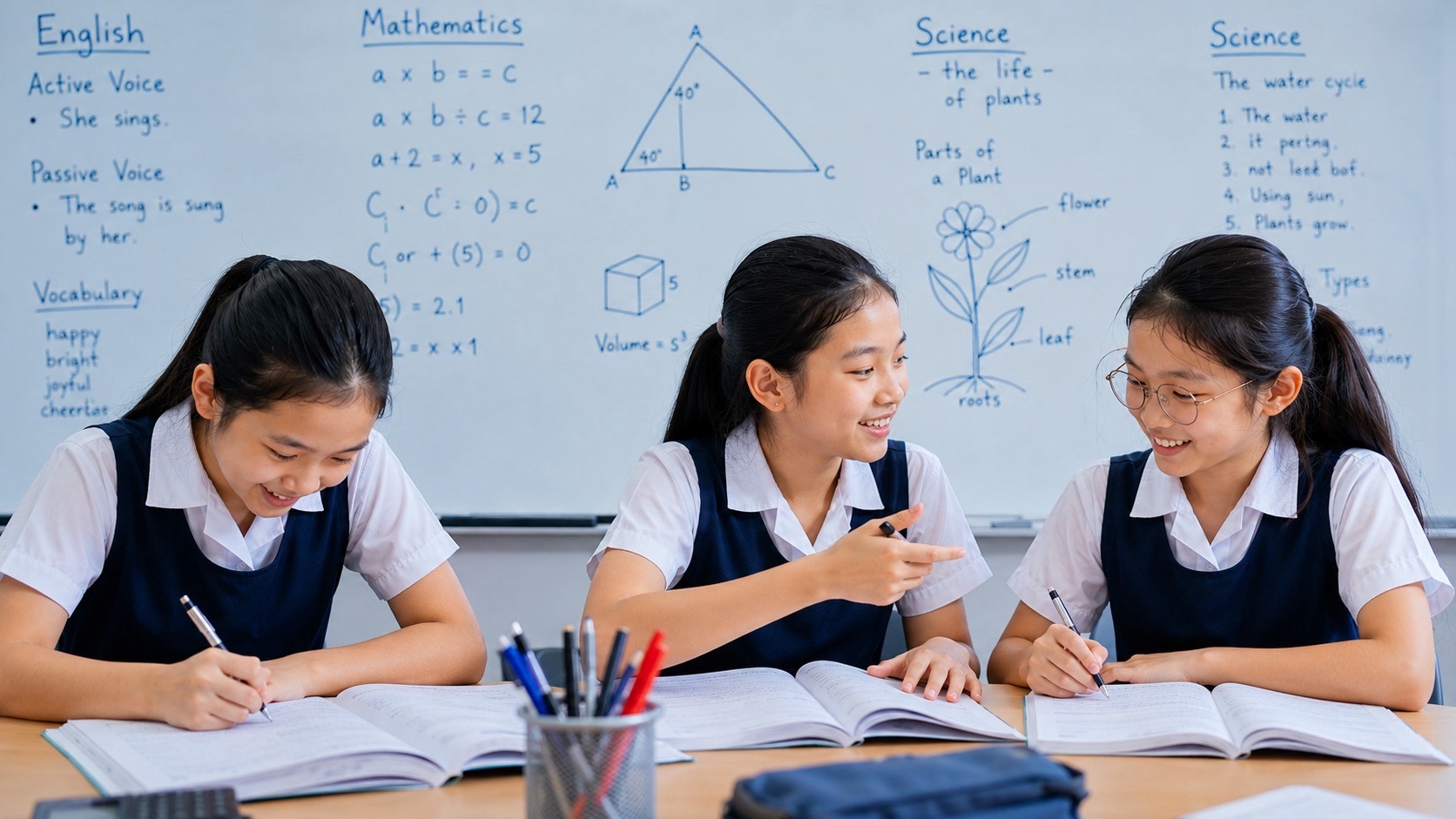
Primary 3 English Tuition Buangkok should help pupils move from reading short texts and writing separate sentences to giving complete answers and building simple paragraphs. The next step becomes easier when the child can see what to do: read the question, find the detail, say the answer and write it clearly.
This guide is for pupils who know the story but answer with a single unclear word, leave sentences unfinished or put unrelated ideas into one paragraph. It gives an original reading activity, worked repairs and a fresh task to try without the models.
The passages and responses below are fictional teaching examples, not official questions or marking schemes. Use the requirements of the actual school assignment when applying the methods.
Who benefits from this Primary 3 approach?
A useful lesson starts with the child’s work. One pupil may need help understanding a question; another may understand it but struggle to express the answer. Those difficulties need different support.
- If the child answers “Who?” with a place, practise identifying the question’s job.
- If the child knows the reason but writes only an object, practise a complete explanation.
- If sentences stop after “because”, connect the reason to an action.
- If pronouns are unclear, name the person before shortening the sentence.
- If a paragraph jumps between topics, choose one event and keep its details together.
Teach a small step, give a supported attempt and then remove the support. Record whether the child can do the step independently, rather than only whether the final page looks correct.
Four moves from reading to answering
The pupil can practise a short routine: identify the question’s job, find the useful detail, explain it aloud and write the answer.
Identify the job
“Who?” asks for a person. “Where?” asks for a place. “Why?” asks for a reason. “What did the person do?” asks for an action.
These reminders are starting points. Read the whole question, because it may also ask for a particular time or two details.
Find and explain
Ask the child to point to the relevant part of the passage and explain it in plain language. If the explanation is inaccurate, reread that part before asking for a polished sentence.
Write and check
After writing, compare the answer with the question. Does it give the person, place, action or reason requested? Does it say enough for another reader to understand?
A short answer can be complete. The aim is clear meaning, not unnecessary length.
Original reading passage: the missing page
Read this fictional story about a pupil preparing to read aloud.
The passage
Anya placed her story on the classroom desk. She had written three pages about a lost kitten. When she counted the pages, she found only two.
Anya checked her bag and the space under her chair. The last page was not there. Ben noticed that she was looking around and asked what was wrong.
“The ending is missing,” Anya said. Ben pointed to the reading corner. Anya had practised there before the lesson.
They went to the corner and found the page beside a cushion. Anya put it with the other pages and numbered them. When the teacher called her name, she carried all three pages to the front.
Worked questions: choose the right kind of answer
Use the passage to compare an incomplete response with a clearer one.
Who helped Anya look for the page?
“Reading corner” gives a place rather than a person. The answer is: “Ben helped Anya look for the page.”
The repair is question reading. Before searching the passage again, ask which kind of information “who” requires.
Where did they find the missing page?
A complete practice answer is: “They found it beside a cushion in the reading corner.”
“In school” is true but too broad to identify the location given in the story. The useful detail is the particular place, rather than the general setting.
Why did Ben point to the reading corner?
A weak answer is: “Because cushion.” The child has noticed an object but has not explained Ben’s reason.
A clearer response is: “He pointed there because Anya had practised in the reading corner before the lesson.” This uses the information available when Ben made the suggestion. The page’s later discovery does not replace that earlier reason.
What did Anya do after finding the page?
“She was happy” gives a possible feeling, but the question asks for an action. A sound response is: “She put it with the other pages and numbered them.”
The passage does not directly say she was happy. It gives actions that the pupil can report accurately.
Why might numbering the pages help?
This question asks for a simple inference. A reasonable answer is: “The numbers could help Anya keep the pages in order and check that she had them all.”
Explain that this is an interpretation of the action, rather than a sentence copied directly from the passage. Do not add a claim that the numbers would prevent every page from being lost.
Repair the earliest difficulty
The same answer can reveal different needs. Ask the child to explain before deciding what practice comes next.
If the child misunderstood the question
Compare a person answer with a place answer. Ask which fits “who”. Then try a different short question without giving the category first.
If the child chose the wrong event
Return to the story’s sequence: two pages found, bag checked, Ben’s suggestion, page discovered, pages numbered.
For Ben’s reason, look at what he knew before the discovery. This prevents the pupil from using a later result to explain an earlier choice.
If the child understands but writes too little
Let the child say the complete answer aloud. Then ask for the same meaning in writing. A temporary sentence start may help during teaching, but cover it in the next attempt.
Record the support used. “Answered independently” and “answered after a sentence starter” show different stages.
Sentence repair: complete the thought
A Primary 3 pupil benefits from seeing exactly what is missing.
Add the person and action
“Beside the cushion.”
This names a place but does not make a complete sentence for the writing exercise. A complete version is: “Anya found the page beside the cushion.”
Ask who did what. Keep the useful detail, then attach it to a complete thought.
Attach the reason
“Because she had practised there.”
For a complete sentence, write: “Ben suggested the reading corner because Anya had practised there.”
The reason remains the same. The repair supplies the action it explains. Avoid treating “because” as a word that automatically makes a sentence complete.
Separate two sentences
“Anya found the page she numbered the pages.”
A straightforward repair is: “Anya found the page. She numbered the pages.” Another is: “Anya found the page and then numbered the pages.”
The pupil should hear the two actions and decide how to connect them. Check capital letters and punctuation after the meaning is clear.
Keep the past sequence
“Anya checked her bag and finds two pages.”
For this past-tense practice account, revise it to: “Anya checked her bag and found two pages.”
The exercise teaches consistency within a past sequence. It does not mean that every verb in a whole text must always have the same tense; dialogue can do a different job.
Make the person clear
“Anya told Sara that she had the page.”
This could mean Anya had it or Sara had it. If Sara had it, write: “Anya told Sara, ‘You have the page.’” If Anya had it, write: “Anya told Sara, ‘I have the page.’”
These are separate language examples. They are not additional events in the original story. Decide the intended meaning before editing.
Vocabulary: missing, discovered and relieved
Choose a few words that the pupil can understand and use accurately.
Missing
The page was missing when Anya could not find it among her story pages. “Missing” does not necessarily mean destroyed or stolen.
Ask the pupil to explain the difference between “missing” and “damaged”. A page may be undamaged but still missing from the place where it is expected.
Discovered
“They discovered the page beside a cushion” means they found it there. A natural new sentence is: “Rafi discovered his ruler inside the folder.”
“The page discovered Anya” reverses who found what. Vocabulary practice also needs sentence meaning.
Relieved
“Relieved” describes feeling less worried after a problem or concern has eased. In a separate creative-writing exercise, a pupil could write: “Anya felt relieved when she found the ending.”
When answering a reading question, explain that the original passage does not name this feeling directly. Use a supported inference when the question permits it, rather than presenting imagined feelings as stated facts.
Retrieve without the definitions
On another day, ask the child to explain a missing item, use “discovered” in a fresh sentence and describe a situation in which someone might feel relieved.
Keep the examples different from the story. A child who can only repeat the original sentence may need more practice using the meaning independently.
From sentences to a focused paragraph
Practice task: write a short paragraph about how Anya found the missing page. Use the passage’s events.
A paragraph with unrelated details
“Anya had a story. Kittens are cute. Ben likes football. There was a cushion. She went to the front. My bag is blue.”
The sentences do not work together to explain the search. Some details are invented, and some belong to other topics.
Choose the paragraph’s job
For this task, the paragraph should explain the problem, useful suggestion and discovery. Use brief notes: “last page missing; bag checked; Ben remembered corner; page beside cushion”.
Do not include every event simply because it appears in the story. Numbering the pages may belong in a final sentence, but a long description of the kitten story is unnecessary here.
A focused model
“Anya could not find the last page of her story. She checked her bag, but the page was not there. Ben suggested the reading corner because she had practised there earlier. They found the page beside a cushion, and Anya put it with the other pages.”
The sentences follow one event. The reason for Ben’s suggestion makes the sequence understandable.
Close the model
Leave the brief notes visible and cover the paragraph. Ask the pupil to write a new version.
Check for the same meaning, not the same wording. “The final page was missing” can replace “could not find the last page”. A clear alternative shows that the pupil is constructing the paragraph.
Build a simple story when the task allows invention
For creative practice, imagine a different child losing part of something needed for a presentation.
Plan who is involved, what is missing, how the search changes and how the event ends. Keep the setting manageable so that the pupil can develop the important actions.
Develop one moment
A thin version is: “The page was gone. She was worried. She found it.”
A developed fictional version is: “Anya counted the sheets again. One, two—there should have been three. She opened her bag and felt along the bottom. No page. Beside her, Ben looked towards the reading corner.”
The added actions help the reader experience the problem. They are invented for writing practice and should not be copied into comprehension answers about the supplied story.
Check the story’s shape
The beginning introduces the need. The middle shows the problem and search. A useful clue changes the search. The ending completes the event.
This is a planning aid for the example, not a compulsory plot for every composition. Follow the actual prompt and choose details that fit it.
Speaking and listening: answer, reason, example
Ask: “What would you do if you could not find something you needed for class?”
A useful spoken response is: “I would check where I last used it. That might help me choose where to look first. For example, if I used a ruler at the reading table, I would check that table before searching every cupboard.”
The pupil gives a response, reason and example. A follow-up can ask when to seek help from a teacher or classmate.
A short listening exercise
An adult can read this invented instruction: “Put your story pages in order. Write a number on each page. Leave the pages in your folder until the teacher calls your name.”
Ask what to do first, what to write and where to leave the pages. The checks are: put them in order; a number on each page; in the folder.
Keep the printed instruction hidden for the first attempt. If the pupil misses a step, practise another short instruction later with a changed object or order.
Independent practice: the model pieces
Complete the tasks before reading the checks. This passage changes the object, clue and discovery place.
New original passage
Luis brought a paper model to class. Before showing it, he noticed that one small piece was missing. He checked the tray where he had placed the model, but the piece was not there.
Rina reminded him that he had used the art table that morning. They went to the table and looked beside the glue bottle. The piece was underneath a scrap of paper.
Luis attached it to the model. He checked the other pieces before placing the model on the display shelf.
Your tasks
- Who reminded Luis about the art table?
- Where was the missing piece found?
- Why did Rina suggest looking at the art table?
- What did Luis do before placing the model on the shelf?
- Correct this sentence: “Because he used the table that morning.”
- Write a paragraph explaining how Luis found the piece.
Work without the earlier answers and paragraph visible. Find the new story’s details rather than copying the reading-corner reason.
Answer checks
Rina reminded Luis. The piece was underneath a scrap of paper beside the glue bottle at the art table.
Rina suggested the table because Luis had used it that morning. Do not say he had practised reading there; that belongs to the first story.
Luis attached the piece and checked the other pieces before placing the model on the shelf. Answer the particular action question with relevant events.
A complete sentence could be: “Rina suggested the art table because Luis had used it that morning.” Other versions are possible if the reason is connected to a complete thought.
Paragraph check
A possible paragraph is: “Luis noticed that a piece of his model was missing. He checked the tray but did not find it. Rina reminded him that he had used the art table that morning. They looked there and found the piece underneath a scrap of paper beside the glue bottle.”
Check whether the paragraph explains one search, follows the sequence and uses details from the new passage. Do not require the exact model wording.
Let the attempt choose the next lesson
If the child confuses people and places, return to question reading with shorter tasks. If the child understands but writes fragments, practise one complete answer at a time.
If sentences are clear but paragraphs wander, choose one event and sort relevant details before writing. If the child succeeds only with models nearby, reduce the support gradually and test again in new material.
After a few days, give another short passage. Ask for a reason and a paragraph without first reminding the child of the earlier routine. This helps show what can now be retrieved independently.
A useful progress note
“Reason question: correct after spoken prompt on missing-page task; correct without prompt on model-piece task. Paragraph: sequence clear, one sentence boundary still needed correction. Later check planned.”
This is more useful than “good work” alone because it identifies the next repair. Keep a few active targets rather than a long catalogue of faults.
Small-group and home-practice guidance
A group can compare a place answer with a person answer and explain which question each fits. Pupils can discuss a story together, then each write an individual response.
A practical lesson can include a short retrieval activity, one worked example, guided practice, an independent attempt and a review of the next target. Adjust it to the pupil’s work. This is a suggested learning sequence, not a confirmed class timetable.
At home, choose a manageable task and let the child attempt it before helping. Ask for an explanation, supply only the support needed and record that support. A copied correct paragraph should be followed by a fresh attempt.
For a tuition enquiry, bring a recent reading exercise, a writing sample, teacher comments and the instructions. Use the Yishun Tuition Centre Hub to confirm current suitability, location, arrangements and availability. This Buangkok guide does not establish a current Buangkok venue or school affiliation.
Frequently asked questions
Why does my child know the story but give a wrong answer?
The child may answer the wrong kind of question or select a detail from the wrong moment. Ask what the question requires and where the answer is supported.
Should every answer be a long sentence?
No. Give enough information to answer the question clearly. For sentence-writing practice, complete thoughts help build control; avoid adding unrelated detail for length.
How do we reduce dependence on sentence starters?
Use a starter during teaching, then cover it for the next attempt. Keep the source passage visible and ask for the same meaning in fresh words.
Does a longer paragraph mean stronger writing?
A focused paragraph with clear connections is more useful than several unrelated sentences. Add details when they develop the event or idea.
How should vocabulary be revised?
Explain meaning, use the word in a natural new sentence and retrieve it later without the definition beside it. Check both understanding and use.
What progress should we look for?
Look for better question reading, complete reasons, clearer sentences and focused paragraphs produced with fewer prompts. Check that the method travels to a different passage.
Relevant reading and the next step
The Primary 4 English Tuition Buangkok guide develops the next reading-to-paragraph stage. For broader routes, visit English by Area and School and Student Diagnostics.
Begin with one short question. Help the pupil find its job, choose the detail and write a clear answer. Then connect a few relevant sentences into a paragraph and try the method in a new story.
Continue through Primary 3 English: Primary 1–3 article index · Primary English directory · English by area & school · Diagnostics · Examinations · Library
Leave a Reply