
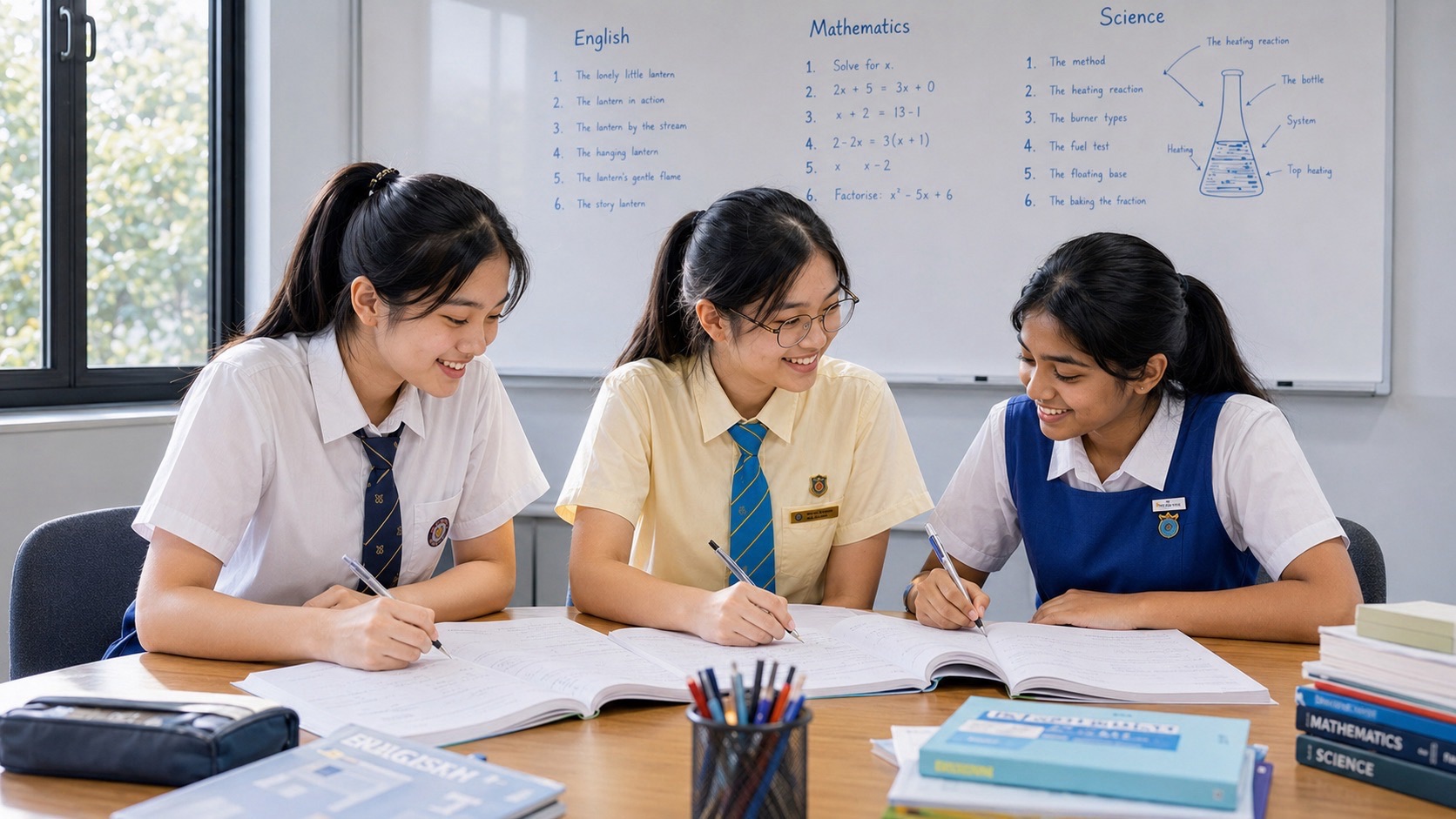
Yishun small-group English tuition for Secondary 2 should help students become more precise, not simply busier. Families searching for a Sec 2 English tutor in Yishun, small-group Secondary English tuition, comprehension, summary writing, editing, vocabulary, grammar, situational writing, oral communication or MOE-aligned English support are often dealing with a familiar pattern: the student understands the lesson broadly but loses marks because answers are not exact enough, summaries include the wrong points, or writing is competent without being tightly controlled.
Current Secondary English programmes in Singapore commonly emphasise comprehension depth, inference, visual text, summary writing, argumentative or discursive writing, situational writing, current affairs, editing and oral communication. A three-student tutorial can sharpen those jobs because each learner’s reasoning is visible. One student identifies the evidence, another challenges the interpretation, and a third improves the wording. The group then returns to an independent task so peer comparison becomes calibration rather than copying.
Secondary 2 is the ideal year for this work. It is no longer the first shock of Secondary 1, yet upper-secondary examination pressure has not fully arrived. Under Full Subject-Based Banding, students may study English at G1, G2 or G3 according to readiness and school arrangements. Whatever the subject level, the useful goal is the same: move from “roughly right” to precisely supported, clearly expressed and increasingly independent.
Why Sec 2 Benefits From Calibration
Many Secondary 2 errors are not caused by complete misunderstanding. They are caused by near misses.
- The evidence is relevant but too broad.
- The inference is plausible but slightly over-read.
- The summary point is correct but mixed with an example.
- The paragraph contains good ideas but weak connection.
- The oral response is sensible but underdeveloped.
These are calibration problems. The student is close, but needs a sharper internal standard.
Three Students Can Compare Degrees of Precision
Imagine a question asking what a character’s behaviour suggests. Three answers may all sound reasonable, but only one may fit the passage precisely.
Student A says “he was sad”. Student B says “he regretted what he had done”. Student C says “he feared the consequences of being discovered”. The group must return to the evidence.
Which answer explains the largest number of clues with the fewest invented assumptions?
That comparison teaches more than simply revealing the answer key.
Silent First Attempts Protect Ownership
Every student should answer before discussion begins. Otherwise, the quickest learner sets the direction for everyone else.
Attempt alone → compare → defend → revise → transfer alone.
This sequence keeps peer learning useful. The group widens perspective; independent transfer proves learning.
Comprehension: Compare Evidence Boundaries
One of the most useful small-group routines is to ask each student to mark the smallest complete evidence boundary for a question.
Students often copy too much because they do not know exactly which phrase carries the answer. By comparing boundaries, they learn to distinguish relevant context from essential evidence.
This habit makes answers shorter and more accurate.
Inference: Defensible, Not Imaginative
Inference is disciplined reasoning from evidence, not free imagination.
Use a three-step check:
- What clue matters?
- What does the clue reasonably imply?
- Is another interpretation better supported?
Three students are enough to generate alternative interpretations without making the discussion chaotic.
Reference Tracking: Small Words, Big Meaning
Pronouns and phrases such as this situation, such behaviour or the latter often create quiet comprehension errors.
Ask each student to draw an arrow to the referent. If the arrows disagree, the group explains why.
This makes reference tracking visible and turns a vague “read more carefully” instruction into a concrete habit.
Visual Text: Read Design as Part of the Message
Secondary English can require students to interpret visuals together with text. In a small group, students can compare what attracts their attention first and why.
- What is made visually prominent?
- Who is the likely audience?
- What action is encouraged?
- How do image and wording support one another?
The exercise teaches modern literacy, not just one examination question type.
Summary: Select Before Paraphrasing
Summary is an excellent small-group task because selection disagreements reveal reading differences.
Each student identifies the points independently. Then the group compares:
- Which item is an example rather than a point?
- Which sentence contains two separate ideas?
- Which two points are actually repetitions?
- Which idea falls outside the summary scope?
Only after the point set is sound should paraphrasing begin.
Paraphrasing: Change Structure, Preserve Meaning
Students often paraphrase by swapping words. That can distort meaning.
A better routine is to read the source, cover it, explain the idea aloud and then write from the explanation. Peers can check whether the new sentence preserves cause, degree and certainty.
“May reduce” must not become “will eliminate”. Precision matters.
Vocabulary: Test Nuance in Conversation
Secondary 2 vocabulary should move beyond generic words without becoming artificially ornate.
Compare angry, resentful, frustrated, indignant. Each word carries different causes and shades of meaning. Students can propose sentences and challenge whether the word really fits.
The tutor then adds collocations and register.
Collocation: Why Naturalness Matters
A word can be grammatically possible but still sound strange.
Students should learn patterns such as raise a concern, pose a threat, reach a conclusion and draw attention.
A three-student group can quickly test which phrasing feels natural and why, while the tutor grounds the discussion in standard usage rather than preference alone.
Grammar: Compare Error Families
Grammar improvement becomes more efficient when students recognise recurring categories.
| Error family | Example symptom | Repair |
|---|---|---|
| Agreement | Verb follows nearest noun | Locate true subject |
| Tense | Time shifts inside recount | Map time before editing |
| Reference | Ambiguous pronoun | Name referent explicitly |
| Sentence boundary | Run-on or fragment | Find main clauses |
Students can diagnose anonymous sentences, then return to their own writing.
Writing: Paragraphs Need One Controlling Job
Three decent sentences do not automatically make one good paragraph.
Ask each student to write the paragraph’s job in five words or fewer. If that is impossible, the paragraph may contain too many unrelated ideas.
Peers can then identify which sentences develop, exemplify, qualify or repeat the main point.
Expository Writing: Explain the Mechanism
Secondary 2 students often know that a paragraph needs a point and example. The missing middle is explanation.
Point → why/how → example → what the example proves → link.
Small-group discussion is especially useful for the “why/how” stage. Peers can ask the question the writer avoided.
Reflective Writing: Avoid Generic Lessons
Reflection becomes stronger when it grows from a specific conflict rather than ending with “I learned never to give up.”
Students can compare endings and ask whether the insight is genuinely supported by the event.
A subtle change in understanding is often more believable than a giant moral transformation.
Situational Writing: Let the Reader Test the Message
One student writes, one student acts as the intended reader, and one checks required content.
Does the message make the purpose clear? Is the tone suitable? Is the requested action obvious?
This turns audience awareness into a practical test rather than a memorised acronym.
Oral: Depth Without Rambling
Use a four-part oral scaffold:
Position → reason → example → wider reflection.
One peer listens for missing development. Another asks a follow-up. The tutor gives one correction.
Then the speaker repeats the idea more concisely.
Current Affairs: One Story, Several Language Jobs
A reliable current-affairs article can support:
- summary;
- vocabulary;
- source judgement;
- oral discussion;
- one expository paragraph.
Three students may notice different aspects of the same story. Comparing those choices helps them distinguish central from peripheral information.
Peer Challenge Builds Better Evidence
When a student gives an example, another can ask: “What does this prove?”
That simple question exposes decorative examples. The writer must connect evidence to the point.
By Sec 2, this habit begins preparing students for the stronger argument required in upper secondary.
Small-Group Feedback Should Stay Narrow
Do not correct ten things at once.
Each student should leave the lesson with one or two high-value priorities. One learner may focus on evidence scope, another on paragraph explanation, another on oral development.
The shared lesson remains coherent while the repair target is personal.
Micro-Conferences
A three-student tutorial allows short individual conferences.
While one student receives two minutes of writing feedback, the others edit, retrieve vocabulary or complete a transfer question.
The conference should end with an action, not merely a comment.
Rewrite Immediately
Feedback becomes more useful when students rewrite while the reasoning is still fresh.
See error → understand cause → revise → explain change → retest later.
This closes the learning loop.
A 90-Minute Sec 2 Small-Group Lesson
- 10 min: retrieval and personal error check.
- 15 min: shared passage or visual text.
- 15 min: independent comprehension answers.
- 15 min: compare evidence and precision.
- 20 min: writing, summary or oral application.
- 10 min: individual micro-conferences and rewrite.
- 5 min: fresh transfer item.
Support Should Decrease Over Time
Record whether the student needed a hint, a question, partial modelling or no help.
A learner who writes a strong answer after three prompts has not reached the same state as a learner who writes it independently.
The goal is equal or better quality with less support.
Use School Assessments as Calibration Data
After a school paper, classify losses:
- question interpretation;
- evidence selection;
- inference;
- summary selection;
- paraphrase;
- grammar;
- writing organisation;
- timing.
Then let the next tuition task change because of the evidence.
Worked Case: The Student Who Knows the Answer but Writes Too Much
A student regularly locates the correct part of the passage but copies three sentences for a one-mark question.
In group work, all three students mark evidence boundaries. The learner sees that classmates are using a much smaller unit of evidence.
The repair becomes concrete: find the smallest complete answer.
Worked Case: The Student Who Paraphrases Into Wrong Meaning
The learner aggressively replaces words and accidentally changes certainty or cause.
The group practises explaining ideas aloud before writing. Peers check whether the relationship survives.
The student learns that paraphrasing is meaning preservation, not thesaurus performance.
Worked Case: The Student With Good Ideas and Weak Links
A student’s expository paragraphs contain relevant examples but feel like lists.
Peers ask one question after every example: “Why does this support your point?”
The missing analytical sentence becomes visible.
Worked Case: The Quiet Student Who Speaks Better After Structure
A student gives short oral responses because planning and speaking occur simultaneously.
The tutor allows four keywords. A peer asks one follow-up. Over time, keywords shrink.
The goal is not charisma. It is organised spoken thought.
Repair, Stabilise, Extend
Repair
Rebuild unresolved Sec 1 weaknesses that are now causing precision problems.
Stabilise
Use spaced retrieval and fresh tasks until good decisions repeat reliably.
Extend
Introduce more nuanced texts, competing viewpoints, broader current affairs and tighter expository writing.
What Parents Can Watch For
- Answers become shorter but more precise.
- The student can explain why evidence is sufficient.
- Summary selection improves before paraphrasing.
- Vocabulary becomes more natural.
- Paragraphs have clearer jobs.
- Oral answers include examples and reflection.
- The student needs fewer hints.
What Not to Do
- Do not let peer discussion begin before individual thinking.
- Do not reward long answers when precision is missing.
- Do not teach summary as synonym substitution.
- Do not give identical feedback to all three learners.
- Do not make the strongest student the permanent model.
- Do not skip the fresh transfer task after discussion.
A Twelve-Week Calibration Build
Weeks 1–2: audit comprehension precision, summary and paragraph control.
Weeks 3–5: repair evidence boundaries, inference and paraphrase.
Weeks 6–8: strengthen expository writing, vocabulary nuance and oral development.
Weeks 9–10: reduce prompts and add timed component work.
Weeks 11–12: test transfer with fresh passages, new topics and mixed tasks.
Frequently Asked Questions
Why use a small group for Sec 2 English?
Because students are ready to compare interpretations and language choices while still benefiting from close individual correction.
Can peer discussion confuse students?
It can if the tutor does not return the group to evidence. Discussion should compare support and reasoning, not opinions alone.
How do students avoid copying?
Require silent first attempts and fresh independent transfer after comparison.
How should summary be taught?
Select the correct points first, then paraphrase while preserving meaning and scope.
How is progress tracked?
Track marks together with support level, recurring error frequency, answer precision and independent transfer.
Continue Through the eduKateYishun English Route
- English Tuition Yishun (Sec 2 Tutor) — full Sec 2 precision and analytical reading guide.
- Yishun Small Group English Tutor Secondary 1 — transition and participation.
- English Tuition Yishun (Sec 3 Tutor) — upper-secondary argument and inference.
The Sec 2 Small-Group Rule
The group should make a student’s internal standard sharper: what counts as enough evidence, an accurate inference, a usable summary point and a complete paragraph.
That sharper standard is what Sec 2 needs before upper secondary raises the stakes.
Historical Image Archive
The original 2019 image material is retained below.


Leave a Reply