
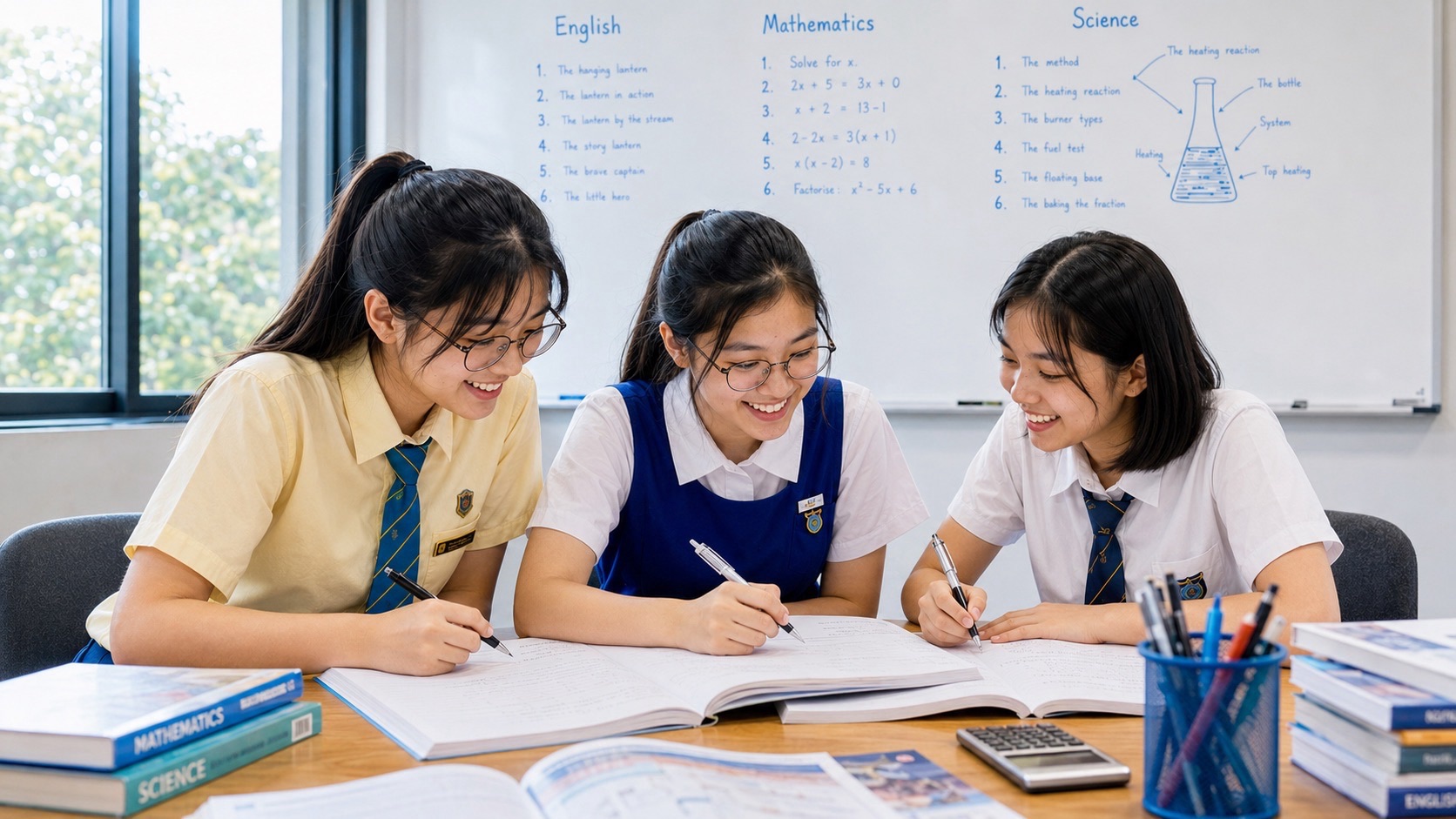
Families searching for English Tuition Yishun near Safra Yishun, Yishun English tuition, small-group English tuition, Primary English support, Secondary English tuition, comprehension, writing, vocabulary, oral communication and school-exam preparation are often looking for more than geographical convenience. They want a class small enough for the tutor to actually see how the learner works: who starts without reading the question, who waits for reassurance, who understands orally but writes weakly, who knows grammar rules but loses them inside composition, and who appears confident while guessing.
Strong English tuition near Safra Yishun should therefore use small-group size to create visibility → diagnosis → correction → transfer → independence. A class of three is useful only if the tutor can observe individual decisions and act on them. The learning advantage does not come from the number “three” by itself. It comes from what becomes visible when the tutor can inspect each script, hear each oral response, compare different approaches and still give every student independent work.
This rebuilt guide is deliberately different from the Wisteria parent-diagnostic page and the Yishun Ring Road continuity page. This page owns the small-group learning architecture: how a three-pupil lesson can be designed, what visibility should reveal, how feedback can remain individual inside shared teaching, how peer comparison can strengthen judgement without creating competition, how prompts should fade and how parents can tell whether a small group is producing genuine independence rather than three students watching one tutor perform.
Small-group tuition is valuable only when the learning is visible
A small class can still be passive. Three students can sit quietly while the tutor solves every question. That is not the advantage families are paying for.
The useful difference is that a tutor can observe the learner’s process: where they hesitate, what they underline, how they plan, what they erase, whether they check and when they ask for help.
Visibility begins before the answer
The final answer tells whether the response is correct. The process tells why.
For comprehension, the tutor can see whether the student misread the command or selected weak evidence. For writing, the tutor can see whether the plan was absent before grammar began to fail. For oral, the tutor can hear whether the student has ideas but lacks structure.
Use a first-five-minutes observation
Give all three students a fresh task and do not intervene immediately. Watch who reads the instructions fully, who begins at once, who highlights broadly, who asks for reassurance and who uses a known routine.
These behaviours are diagnostic data.
Three students can have the same wrong answer for different reasons
Student A may not understand the vocabulary. Student B may misunderstand the command. Student C may understand both but write an incomplete sentence.
Small-group teaching should therefore avoid treating identical marks as identical problems.
Shared text, individual weak links
All three students can work on the same passage while the tutor tracks different priorities.
One may focus on question scope, another on evidence selection and another on answer construction. The common text keeps teaching efficient; the individual target keeps it diagnostic.
Use colour or symbols privately for tutor tracking
A tutor can keep simple notes: S = scope, E = evidence, G = grammar, P = prompt dependence, T = time. These are not grades.
The purpose is to remember patterns across lessons and prevent the class from resetting every week.
Small groups make comparison possible
Different answers can become learning material. Which one is more relevant? Which uses stronger evidence? Which paragraph has a clearer line?
Students learn criteria by comparing real alternatives.
Comparison should not become ranking
The useful question is not “Who is best?” but “What makes this answer stronger?”
This keeps peer learning analytical rather than competitive.
Comprehension benefits from answer comparison
Three students may infer differently from the same passage. The group can inspect which claims are supported.
Worked example
Text: “Rina checked the clock twice, packed her notes early and waited beside the door.” Student A says she is bored. Student B says she is eager or anxious to leave. Student C says she is meeting a friend. The strongest answer is the one supported by the behaviours without inventing unsupported detail.
Use the evidence receipt
Ask each student which words pay for the claim. The group can see that English may allow more than one interpretation, but interpretations are still constrained by evidence.
This is a powerful lesson in disciplined reading.
Small groups support vocabulary discussion
Give one word in context and ask each student for a possible meaning, synonym, contrast or collocation. Compare precision.
A student may know that reluctant means “not wanting to” while another contributes “reluctant to admit”. The group builds a richer network.
Vocabulary should still be individually retrieved
Shared discussion is not enough. Several days later, each student should recall the word without hearing a peer say it first.
Independent retrieval prevents group familiarity from being mistaken for personal learning.
Grammar comparison can reveal different reasoning
Give the same sentence and ask each student to explain the correction.
Worked example
“Each of the students were given a form.” The correct form is “was given” because the grammatical head is Each. A student who chooses “was” only because it sounds right needs a different repair from one who can explain the relationship.
Writing plans are especially useful in small groups
Before full writing, each student creates a short plan. Compare the routes.
For a narrative, one plan may contain random events; another may show clear causality. For discursive writing, one may have repeated claims; another distinct reasons.
Peer plans should not be copied
The purpose is to inspect decision quality, not to let the weakest planner borrow the strongest plot.
After discussion, change the prompt or require each student to revise their own route.
Use paragraph workshops
All three students write one paragraph on the same general issue using different examples.
Compare point clarity, explanation, evidence and analysis. One strong paragraph can teach more than three rushed full essays.
Worked paragraph skeleton
Point: public libraries remain useful. Explanation: they provide shared access to resources and study spaces. Example: students who cannot study easily at home can use quiet work areas. Analysis: the library therefore provides an environment for learning, not only books.
Examples should be analysed, not admired
Ask every student, “What does your example prove?”
This question often reveals whether the paragraph has real reasoning.
Narrative writing benefits from consequence comparison
Ask each student what happens because of the character’s decision. If the next event could occur regardless, the story may lack causality.
Peers can see how different choices create different narrative routes.
Oral communication is naturally suited to three pupils
Each student can give a response and hear two alternatives. The tutor can compare relevance, development and examples.
Every pupil should still speak individually; group discussion should not allow one confident speaker to carry the lesson.
Worked oral prompt
Question: Should schools use more outdoor learning? One student may focus on health, another on real-world observation, another on practical limitations. The tutor can show how several lines can be valid when developed well.
Use follow-up rotation
After each response, a peer asks one follow-up: “Why?”, “Can you give an example?”, “What is one limitation?”
This trains listening and interaction while keeping the tutor from being the only source of questions.
Listening tasks can include peer reconstruction
After a short audio, each student writes the main idea and two details independently. Then compare.
Differences reveal what each listener prioritised. Only after independent capture should discussion begin.
Small groups make prompt dependence visible
Some students answer only after another student starts. Others wait for tutor confirmation. Track this.
A class can feel lively while individual independence remains weak.
Use a prompt ladder for each student
Full model → strong hint → small cue → independent. The three pupils do not need to be at the same level.
A tutor can ask one student an open question while giving another a narrower cue.
Do not equalise support artificially
Fairness does not mean identical hints. Fairness means each learner receives the support needed to move toward independence.
The common goal is decreasing support over time.
Use independent blocks inside every lesson
For ten to twenty minutes, students work without hints. They may mark uncertainty and continue.
The tutor observes process and intervenes after the block.
Independent blocks should happen before peer discussion
If students hear one another’s answers first, the tutor cannot tell what each learner knew.
Attempt first, compare second.
A useful 90-minute three-pupil lesson
10 minutes: individual retrieval. 20 minutes: shared text with individual annotation. 20 minutes: targeted teaching. 20 minutes: independent writing or mixed transfer. 15 minutes: compare answers and diagnose. 5 minutes: personal next-time cue.
The exact proportions can change by age and task.
Every student should leave with a different personal cue if needed
Student A: “circle quantity words”. Student B: “use the strongest clue”. Student C: “check tense after drafting”.
The shared lesson becomes individually actionable.
Small groups should not produce three identical homework packs
Some common homework is efficient, but one targeted item can differ. A student with weak vocabulary may retrieve words; another with paragraph drift may plan one composition.
Personalisation does not require completely separate curricula.
Use common core + individual repair
For example, all three students read the same article. Student A answers scope questions. Student B builds vocabulary. Student C writes a paragraph using the article’s argument structure.
The group remains coherent while the repair remains personal.
Parents should receive mechanism-based updates
Instead of “worked hard today”, useful updates might be: “inference is accurate but still prompt-dependent”, “writing plan now independent; tense remains a recurring risk”, or “reading fluency improved; vocabulary is the current bottleneck”.
This gives families a clearer picture of progress.
Do not over-report every lesson
Daily detail can create noise. Summarise stable patterns and meaningful changes.
A termly or periodic progress map can be more useful than constant micro-updates.
Build a Receiver Gauge for learning states
A tutor should recognise when a student is lost for different reasons: does not understand the word, does not understand the task, knows the method but cannot retrieve it, can perform only with a prompt, or is overwhelmed by time.
The intervention should match the state.
Use narrowing questions
“Do you understand the passage but not the question?” “Do you know the evidence but not what it proves?” “Do you have ideas but not know how to organise them?”
A narrow question diagnoses faster than a long explanation.
Small groups are ideal for first-weak-link diagnosis
The tutor can observe the same task across three learners and see where each chain breaks.
This is especially useful when final answers look similarly weak.
Primary learners need different group dynamics from Secondary students
Younger children may need shorter turns, more oral work and visible routines. Secondary students can sustain longer independent blocks and deeper comparison.
The class architecture should change with developmental level.
For Primary 1–2, visibility includes decoding and sentence production
Listen to each child read. Check whether errors come from guessing, weak sound patterns, endings or meaning.
Then observe whether spoken sentences transfer into writing.
For Primary 3–4, visibility includes reading-to-learn
Can the child explain instructions, locate evidence, make a simple inference and build a paragraph?
Small groups should help tutors see the move from basic literacy to academic literacy.
For Primary 5–6, visibility includes transfer and timing
Can the pupil use comprehension, grammar, writing and oral methods on unfamiliar work? Are prompts reducing? Is timing introduced without method collapse?
The group should support PSLE readiness without turning every lesson into a paper race.
For Secondary 1–2, visibility includes transition and independence
Can the student read longer texts, infer, summarise, adapt tone and manage homework?
Track whether lower-secondary skills are becoming robust enough for upper-secondary work.
For Secondary 3–4, visibility includes reasoning and execution
Can the student form a thesis, develop evidence, summarise, manage time, recover from difficult items and self-check?
Small groups should increasingly resemble coaching for independent performance rather than guided completion.
Use school scripts as periodic evidence
Bring recent school work into the group when it reveals a recurring mechanism. The tutor can compare how each student handles similar demands.
Do not let tuition become disconnected from school performance.
Use a correction ledger for each learner
Task, first failure, mechanism, next-time cue, fresh retest. Keep it short.
The tutor should be able to remember the learner’s current active risks.
Fresh retests should be individual
After group discussion, give each student a new question that targets their weak mechanism.
This prevents peer familiarity from being mistaken for personal mastery.
Delayed retests matter in groups too
Return to the mechanism several lessons later without announcing it. The student should recognise the skill independently.
This reveals whether the learning has become durable.
Use a termly Independence Test
Give fresh reading, language, writing and oral tasks appropriate to the level. No tutor hints during the first attempt. Peers work independently.
Record where each learner needs support.
Progress should include peer-independence
A student should become less dependent not only on the tutor but also on hearing another student’s answer first.
Independent attempt before discussion is essential.
Common failure pattern: one strong student dominates
Use turn-taking, independent writing and directed questions. The strongest speaker should not become an unofficial assistant teacher.
Common failure pattern: tutor explains for most of the lesson
Small groups need student output. Build reading, writing, oral and correction into the lesson.
Common failure pattern: all three students receive the same feedback
Shared teaching can be common; feedback should still reflect individual mechanisms.
Common failure pattern: comparison becomes competition
Compare criteria, not status. Ask why an answer is stronger, not whose child is stronger.
Common failure pattern: parents choose small groups only for “more attention”
Attention is useful when it creates visibility, diagnosis and feedback. Ask what the tutor does with the extra visibility.
Common failure pattern: small-group tuition creates dependence
If a tutor can answer instantly, students may ask instantly. Use waiting time, prompt ladders and independent blocks.
Practice set: fifteen small-group visibility tasks
- All three students attempt an unseen question silently before discussion.
- Compare three question-scope interpretations.
- Rank three evidence choices.
- Write three different but defensible inferences.
- Compare vocabulary nuance across three sentences.
- Explain the same grammar correction in three ways.
- Build three different writing plans from one prompt.
- Write one paragraph independently, then compare development.
- Ask each student what their example proves.
- Give three oral responses to one prompt.
- Rotate peer follow-up questions.
- Complete one ten-minute no-hint block.
- Record each learner’s prompt level.
- Give individual fresh retests after shared teaching.
- Review the correction ledger at the next lesson.
What a strong three-pupil class looks like
The room is not silent, but neither is it tutor-dominated. Students attempt independently, discuss differences, receive targeted feedback and return to independent transfer.
The tutor can name each learner’s current weak link and show how the support is being reduced.
A six-week small-group cycle
Week 1: baseline visibility and individual target. Week 2: explicit teaching. Week 3: peer comparison and varied transfer. Week 4: school evidence review. Week 5: independent block and fresh retest. Week 6: Independence Test and new target.
Parent checkpoints
- Does every learner produce independent work?
- Can the tutor name each student’s current weak link?
- Are shared tasks used for individual diagnosis?
- Does peer comparison focus on criteria?
- Are vocabulary and grammar individually retrieved?
- Are writing plans independently generated?
- Does every student speak during oral work?
- Are prompt levels tracked?
- Are fresh retests individual?
- Are school scripts used periodically?
- Do homework tasks include individual repairs where needed?
- Are progress updates mechanism-based?
- Is one student prevented from dominating?
- Are prompts gradually reducing?
- Is the learner becoming less dependent on both tutor and peers?
Frequently asked questions
Why can three students be a useful group size?
It can be small enough for the tutor to observe individual processes while large enough for comparison, discussion and alternative answers. The benefit depends on lesson design.
Is one-to-one always better?
Not necessarily. One-to-one offers maximum individual attention, while a small group can add peer comparison and discussion. The better format depends on the learner’s needs and how the teaching is designed.
How do you prevent one student from falling behind?
Use shared core tasks with individual repair targets, prompt ladders and independent retests. The tutor should track each learner’s active mechanism.
How do you prevent copying?
Require independent attempt before discussion, change surface details in fresh retests and ask students to explain their reasoning.
How can parents tell whether the class is personalised?
The tutor should be able to describe the learner’s specific recurring patterns, not only the chapter covered. Feedback and retests should reflect those patterns.
How do you know independence is improving?
The student starts sooner, asks more precise questions, needs lighter prompts, self-corrects more often and succeeds on fresh tasks before hearing peers’ answers.
Teaching Guide
Teach a three-pupil English class by exploiting visibility. Observe before intervening. Use shared material, but track individual first weak links. Ask students to attempt before comparing.
Use peer difference as analytical material: why is this answer more complete, this evidence stronger, this paragraph clearer? Keep the comparison about criteria, not ranking.
Build independent blocks, prompt ladders, personal error ledgers and fresh retests into the routine. The class should cycle from individual attempt to shared insight back to individual transfer.
The destination is not three students who become good at following one tutor. It is three increasingly independent learners who can read, decide, write, speak, check and recover on their own while benefiting from the perspectives of a small group.
Build a termly Small-Group Independence Test
Give all three learners fresh tasks with no hints during the first attempt. Do not allow answer comparison until the independent block ends.
Record first weak links, prompt needs and self-correction. Compare with earlier terms.
Progress should look like richer comparison and lighter support
As students improve, discussions become more analytical: evidence, wording, organisation and judgement. At the same time, tutor interventions become smaller.
That combination—better peer discussion and less dependency—is one of the strongest signs that a small-group system is working.
A final small-group quality checklist
- Independent attempt comes first.
- Individual targets remain visible.
- Shared texts create useful comparison.
- Peer differences are analysed.
- Every learner reads, writes and speaks.
- Feedback is specific.
- Corrections create fresh retests.
- Prompt levels are tracked.
- School evidence informs teaching.
- Parents receive mechanism-based progress.
- No student dominates.
- No student disappears.
- The tutor models less over time.
- Students self-correct more often.
- Independence grows alongside performance.
That is the real value of small-group English tuition near Safra Yishun: not merely fewer students in a room, but enough visibility to teach the right problem and enough structure to hand the learning process back to each student.
Leave a Reply