
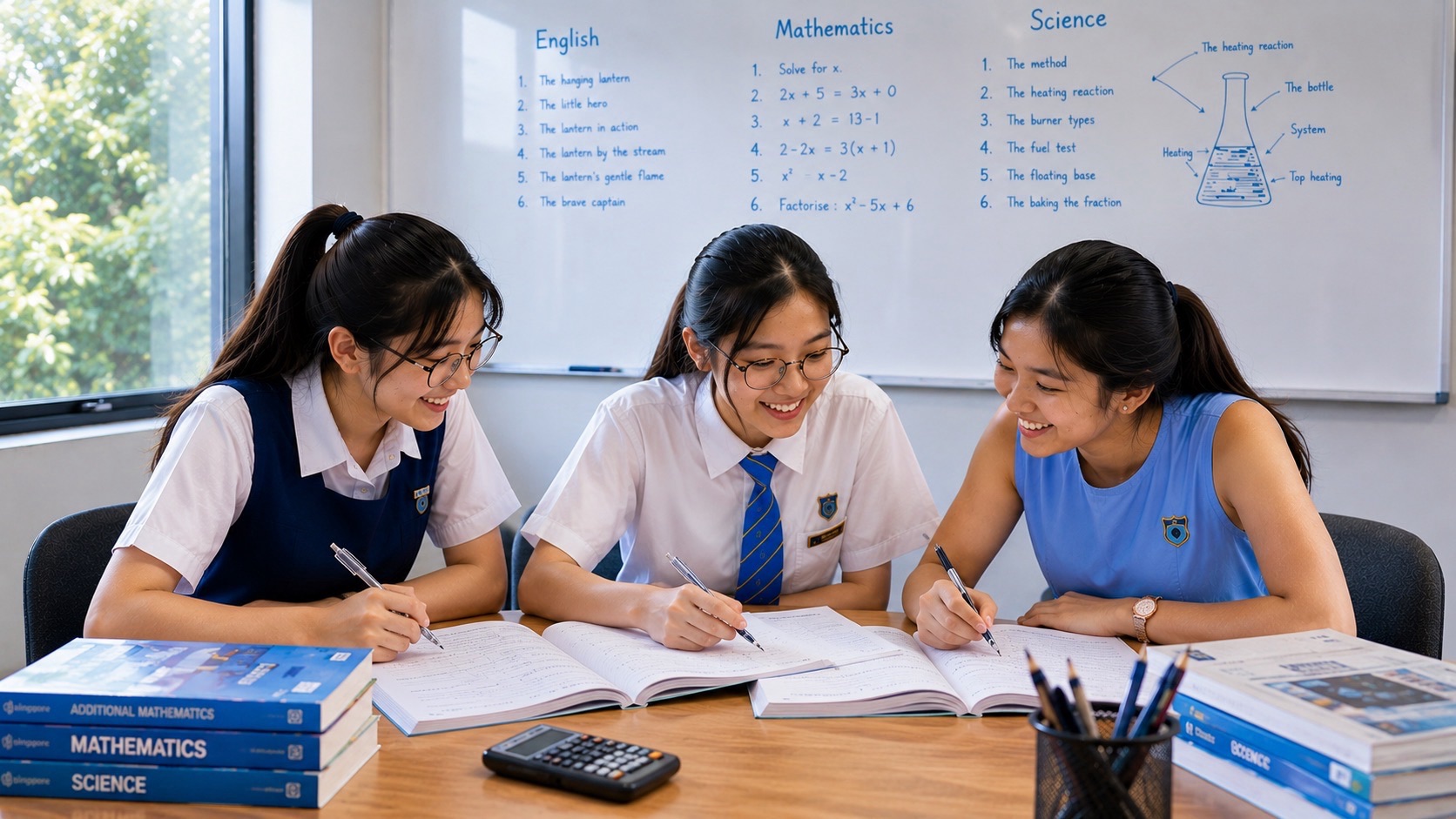
Secondary 2 English Tuition Punggol should help students do something that becomes increasingly important in lower secondary: turn what they read into something they can explain and write. Families searching for Sec 2 English tuition in Punggol, Secondary English tutor, comprehension, summary writing, expository writing, situational writing, vocabulary, editing, grammar or small-group English tuition often describe a learner who understands a passage broadly but struggles to extract the right point, explain why evidence matters or turn reading into a clear paragraph.
Current Secondary English programmes commonly emphasise critical comprehension, summary, writing, vocabulary, grammar, oral communication, current affairs and personalised feedback. These skills are connected through a reading-to-writing bridge. When a student can identify a claim, separate it from an example, recognise cause and contrast, infer meaning from evidence and compress a paragraph accurately, writing also improves because the learner has seen how ideas are structured.
Secondary 2 is an excellent year to strengthen that bridge before upper-secondary English asks for more independent argument. Under Full Subject-Based Banding, students may study English at different subject levels according to school arrangements and readiness, but the core job remains useful across levels: read relationships, extract meaning, reorganise it and express it clearly in the student’s own words.
Reading and Writing Are Not Separate Subjects
Students often think reading is about finding answers and writing is about producing essays.
In reality, good writers are usually skilled readers of structure.
They notice how paragraphs introduce ideas, how examples are attached, how contrast is signalled and how conclusions are built.
Start by Finding the Paragraph’s Job
After reading each paragraph, ask:
- Does it make a claim?
- Give an example?
- Explain a cause?
- Show a consequence?
- Challenge an earlier idea?
- Offer a solution?
This structural reading makes later summary and writing easier.
Claim Versus Evidence
Students need to distinguish what a writer asserts from what the writer uses to support it.
For example:
“Regular reading improves vocabulary because students repeatedly meet words in meaningful contexts.”
The claim is that regular reading improves vocabulary. The explanation is that repeated contextual encounters help learning.
Recognising this relationship prepares students for expository writing.
Examples Are Not the Main Point
A vivid example can distract students from the idea it illustrates.
Ask:
If the example disappeared, what idea would remain?
This question is powerful for summary and paragraph writing.
Cause and Effect
Look for relationships signalled by:
- because;
- therefore;
- as a result;
- consequently;
- leads to;
- results in.
Then ask students to rewrite the relationship in a new sentence without changing meaning.
Contrast and Qualification
Words such as however, although, while, yet, nevertheless change the direction of thought.
Students should learn to notice where a writer moves from one side to another.
This supports comprehension, summary and later argumentative writing.
Inference: Read What the Evidence Suggests
Inference is the missing step between evidence and meaning.
Evidence → reasonable interpretation → check against alternatives.
A student should be able to explain why an interpretation follows from the text.
From Inference to Writing
When students explain an inference, they practise the same mechanism needed in writing: make a claim and support it.
Comprehension therefore becomes reasoning practice for composition.
Vocabulary in Context
Students should infer word meaning from:
- surrounding examples;
- contrast;
- word form;
- tone;
- known roots or related words.
Then confirm with a dictionary.
Vocabulary learning becomes connected to real reading.
Paraphrasing Begins With Understanding
Students often paraphrase by replacing words one at a time.
This can create awkward or inaccurate sentences.
A better routine:
- Read the sentence.
- Cover it.
- Explain the meaning aloud.
- Write from the explanation.
- Compare meaning afterwards.
Preserve the Relationship
When paraphrasing, check:
- cause;
- degree;
- certainty;
- sequence;
- comparison.
“May reduce” is not the same as “will eliminate”.
Summary: Select Before You Rewrite
The first summary job is not vocabulary.
It is selection.
Students should identify:
- main points;
- repeated points;
- examples;
- minor detail;
- information outside the task scope.
Only then paraphrase.
The Compression Test
Ask students to reduce a paragraph to one sentence.
Then reduce that sentence to five key words.
Finally reconstruct the idea.
This teaches what information is load-bearing.
Reading Notes Should Be Reusable
Instead of copying a passage, record:
- claim;
- evidence;
- relationship;
- one useful phrase;
- one question.
These notes can later become writing material.
From Reading to Paragraph Planning
After analysing a good text, ask students to plan a new paragraph using the same structural job.
If the model uses:
claim → explanation → example → implication
students write a new paragraph on another topic using that architecture.
Do Not Copy the Surface
Model texts are useful for craft, not memorisation.
Borrow the structure. Do not copy sentences or phrases mechanically.
Expository Writing: Build From the Reading Mechanism
A strong paragraph often follows:
- state the point;
- explain how or why;
- give an example;
- analyse what the example shows;
- connect back to the question.
This is simply claim-and-evidence reading turned outward into writing.
Argumentative Readiness Begins in Sec 2
Students do not need full final-year argument every week.
They can begin by learning that texts may contain different positions.
Read two short sources on one issue and ask:
- What does each claim?
- What evidence is used?
- Where do they disagree?
- What assumption differs?
Situational Writing Is Reading-to-Writing Too
The student must read the task, extract role, audience, purpose and required content, then reorganise that information for a real reader.
This is another form of transformation.
Reading Visuals
Texts may include diagrams, photographs, captions or graphics.
Students should ask:
- What information comes from the words?
- What comes from the visual?
- What conclusion requires both?
Multimodal reading supports modern communication.
Reading Current Affairs
One reliable article can provide:
- new vocabulary;
- one claim;
- supporting evidence;
- a contrasting perspective;
- material for a writing paragraph.
Students should process a few articles deeply rather than skim many headlines.
From Article to Summary
Write an 80-word summary of the central issue.
Then compare with the original:
- Did the main idea survive?
- Were examples removed appropriately?
- Did the paraphrase change meaning?
From Article to Oral
Explain the issue in one minute without looking at the article.
This tests retrieval and understanding.
From Oral to Writing
Use the spoken explanation as the plan for one paragraph.
Students learn that thinking can move between reading, speech and writing.
Grammar From Reading
Instead of teaching grammar only through isolated sentences, inspect how real texts use:
- conjunctions;
- relative clauses;
- pronoun reference;
- parallel structures;
- tense.
Then imitate the structure with original content.
Vocabulary From Reading
Collect words in phrase form:
- raise a concern;
- pose a challenge;
- reach a conclusion;
- significant impact;
- strong evidence.
Phrase learning improves writing naturalness.
The Reading-to-Writing Error Ledger
| Error | Reading cause | Writing consequence |
|---|---|---|
| Example mistaken for main point | Weak paragraph-job reading | Essay examples replace argument |
| Cause/effect missed | Signal words ignored | Explanation lacks mechanism |
| Over-copying | Meaning not reconstructed | Paraphrase awkward |
| Claim unsupported | Evidence relationship unclear | Paragraph feels thin |
A 90-Minute Sec 2 Reading-to-Writing Lesson
- 10 min: vocabulary retrieval.
- 20 min: close read a short substantial text.
- 15 min: identify claims, evidence and relationships.
- 15 min: summary/paraphrase.
- 20 min: write a fresh paragraph using the structure learned.
- 5 min: peer/tutor feedback.
- 5 min: rewrite.
Worked Case: The Student Who Copies Relevant Lines
A learner finds the correct section but reproduces whole sentences.
The tutor asks for the smallest evidence boundary and an oral explanation of what it means.
Only then does the student write the answer.
Worked Case: The Student With Thin Paragraphs
The student states a point and gives an example but never explains the relationship.
Reading lessons now identify how published writers connect evidence to claims.
The student imitates the mechanism in original writing.
Worked Case: Summary Sounds Like a Thesaurus
The student changes every word and damages meaning.
The tutor uses read-cover-explain-write.
Paraphrase becomes meaning-based.
Worked Case: Strong Reader, Weak Writer
The learner discusses texts intelligently but freezes when writing.
The tutor turns spoken reading analysis into paragraph plans.
Reading becomes a source of writing architecture.
What Parents Can Watch For
- The student can state a paragraph’s job.
- Claims and examples are distinguished.
- Summary points are selected before paraphrasing.
- Writing examples receive analysis.
- Vocabulary from reading appears naturally in writing.
- The student can explain a text and then write about the idea.
What Not to Do
- Do not separate reading and writing completely.
- Do not paraphrase by changing every word.
- Do not treat examples as main points.
- Do not copy model sentences into unrelated topics.
- Do not begin summary language work before selecting the right ideas.
- Do not read current affairs without turning some of it into output.
A Twelve-Week Reading-to-Writing Build
Weeks 1–2: paragraph jobs and claim/evidence distinction.
Weeks 3–4: cause, contrast and inference.
Weeks 5–6: summary selection and paraphrase.
Weeks 7–8: expository paragraph architecture.
Weeks 9–10: current affairs, visual texts and situational transformation.
Weeks 11–12: independent transfer from unseen reading to fresh writing.
Frequently Asked Questions
Why connect reading and writing?
Because reading teaches students how ideas are organised, supported and expressed. Writing asks them to perform the same relationships independently.
How can summary improve?
Select the correct ideas first, then paraphrase while preserving meaning.
Should students copy good sentences?
They can study sentence structure and craft, but original writing should express original content.
How much reading is enough?
Regular deep reading is more valuable than large amounts of shallow reading. A few substantial texts processed properly each week can support growth.
What is the main Sec 2 outcome?
A learner who can read an idea, understand its structure and reconstruct it clearly in their own language.
Continue Through the eduKateYishun English Route
- Yishun Sec 2 English Tutor — grammar and editing transfer.
- Yishun English Tuition Sec 2 Tutor — Sec 3 readiness audit.
- Yishun Small Group Secondary 2 English Tutor — weekly error dashboards and transfer checks.
The Reading-to-Writing Rule
Read the relationship, not just the information; then rebuild that relationship clearly in your own words.
Historical Image Archive
The original image gallery remains on this 2019 page.


Leave a Reply