
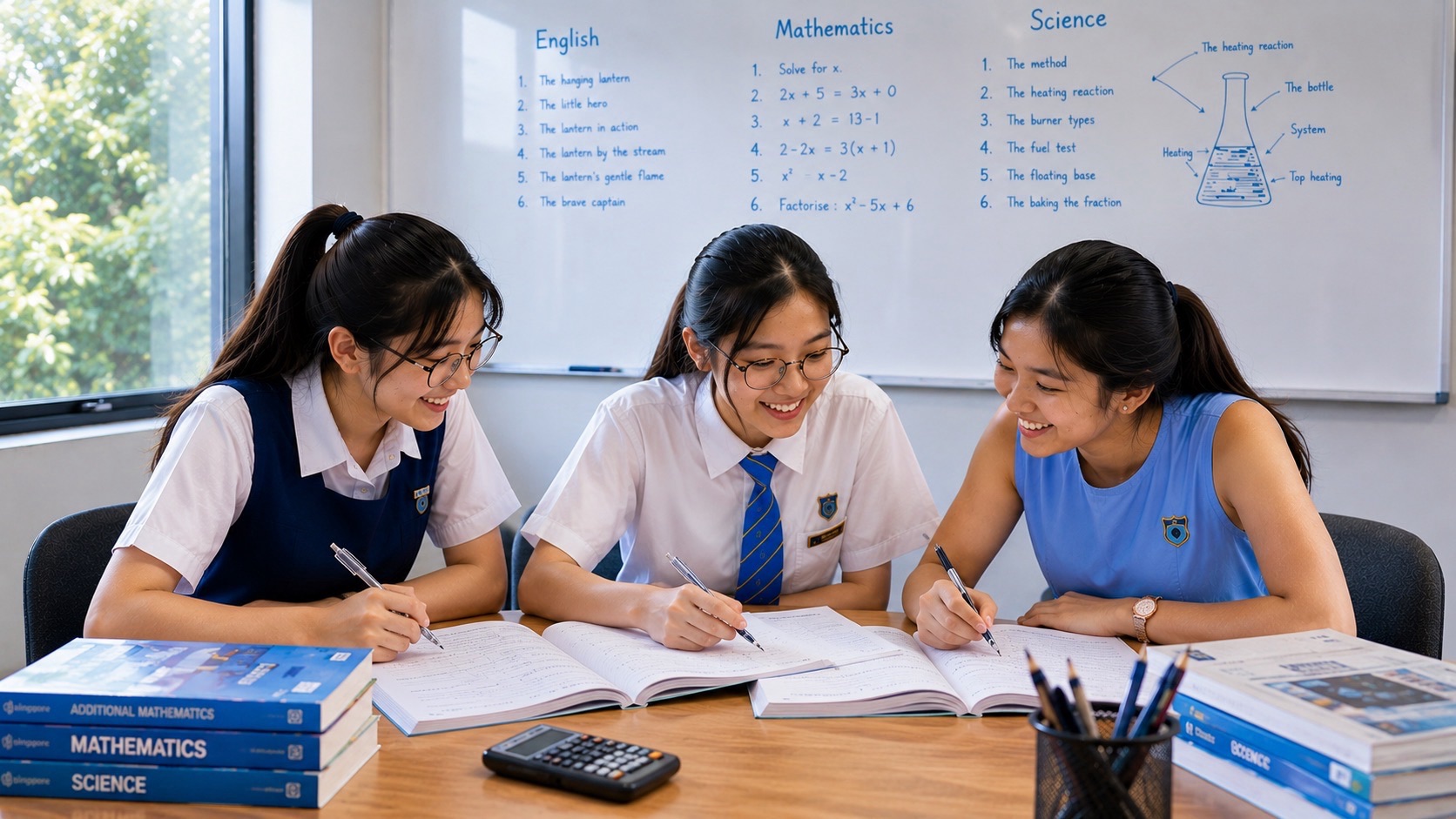
Yishun Maths Tuition for Secondary Schools works best when it does more than supply extra worksheets. A useful Secondary Maths tuition programme in Yishun should help a student understand the mathematics, recognise which method belongs to which question, explain the working clearly, and transfer that reasoning when the numbers or wording change. That is the difference between completing practice and becoming independently good at Mathematics.
Families searching for secondary maths tuition Yishun, E Maths tuition Yishun, Secondary 1 Mathematics tuition Yishun, or support for Sec 2, Sec 3 and Sec 4 are often looking at the same underlying problem from different angles: the student can do some familiar questions, but the system breaks when algebra, graphs, geometry, data or examination pressure begin to interact. The useful question is not simply, “Which chapter is weak?” It is, “Which mathematical decision fails first?”
This guide explains how Secondary Mathematics develops from Secondary 1 to Secondary 4, how Full Subject-Based Banding and the 2027 Singapore-Cambridge Secondary Education Certificate affect the language parents now see, and how tutoring can be organised around diagnosis, explanation, transfer and examination control. It is deliberately practical. The aim is to help a family recognise what good progress looks like before they count the number of worksheets completed.
Secondary Mathematics is a system, not a pile of chapters
Primary Mathematics already asks pupils to reason, model and solve unfamiliar problems, but Secondary Mathematics changes the language of the subject. Letters become quantities. Graphs become relationships. Geometry becomes more formal. A problem may require the student to move from a sentence to an equation, from an equation to a graph, and from a graph back to a conclusion in words. The chapter headings remain useful, but the deeper skill is moving accurately between representations.
This is why a student can appear strong in isolated topic practice and then look unexpectedly weak in a mixed test. The student may know how to solve a linear equation when the worksheet heading announces “Linear Equations”, yet fail to recognise that the same algebra is hiding inside a speed, percentage or geometry problem. The missing skill is not always more algebra. It may be method recognition.
A good Secondary Mathematics learning system therefore trains four things together: concepts, procedures, recognition and checking. Concepts explain why a method works. Procedures make execution fluent. Recognition tells the student when to use the method. Checking protects the answer from avoidable errors. If one part is missing, performance becomes fragile.
Know the student’s actual subject level and examination route
Singapore secondary schools now operate under Full Subject-Based Banding. Students may take subjects at G1, G2 or G3 levels according to their strengths, interests and learning needs, and subject levels can be adjusted at suitable points. From 2027, graduating students sit the Singapore-Cambridge Secondary Education Certificate examinations at their respective subject levels. That makes the old habit of talking only in broad stream labels increasingly unhelpful.
For Mathematics, the official 2027 SEC school-candidate syllabuses list G3 Mathematics as K310 and G2 Mathematics as K210. Families should always check the student’s school-issued materials, subject level and examination year before buying revision books or following an online plan. The official SEAB syllabus documents are the safest reference for the current examination route: G3 Mathematics K310 and G2 Mathematics K210.
The names matter because a sensible learning plan should match the student’s actual work. However, the teaching principles in this guide remain stable: understand the relationship, practise accurately, identify the first error, repair it, then test whether the student can transfer the repaired skill to a fresh question.
The first job of tuition is diagnosis
When marks fall, it is tempting to begin with the lowest-scoring topic. Sometimes that is right. Sometimes it is misleading. A student may lose marks across algebra, graphs and geometry because the same underlying weakness appears in all three: careless sign control, weak fractions, difficulty translating words into equations, or a habit of stopping after the first plausible answer.
Take a marked paper and find the first wrong decision in each lost-mark sequence. Do not begin with the final red cross. Ask what happened just before it. Did the student misread a condition? Choose the wrong formula? Substitute the wrong quantity? Rearrange incorrectly? Lose a negative sign? Round too early? Forget a unit? The first wrong decision is often the most teachable point.
Then group the errors by cause rather than by page number. Five mistakes that come from weak negative-number control may deserve one repair programme. Five unrelated slips may require five smaller interventions. This approach makes tuition more efficient because the teacher is fixing mechanisms, not merely revisiting chapters.
Secondary 1: the transition from arithmetic to mathematical language
Secondary 1 is where many students discover that being quick at arithmetic is not the same as being comfortable with algebra. The symbols are not decoration. They are a compressed language for relationships. A learner who sees x as a mysterious blank will struggle. A learner who understands x as a quantity that can vary, be compared, or satisfy a condition has a much stronger starting point.
Consider 3x + 7 = 25. The mechanical procedure is short: subtract 7, then divide by 3, giving x = 6. But the deeper idea is balance. The equation states that two expressions have the same value. Whatever operation is applied to one side must preserve equality by being applied to the other. That concept becomes important later when expressions are more complicated.
A useful Sec 1 learning plan strengthens integers, fractions, ratio, percentages, algebraic notation, simple equations, geometry and data while building disciplined working. It is a year for habits: write one logical step per line, label diagrams, estimate before calculating, and check whether the final answer fits the question. Those habits compound.
Secondary 2: readiness before the upper-secondary step-up
Secondary 2 is often underestimated because the public examination still feels distant. Yet it is one of the best years to identify structural weakness. Algebra becomes denser, graphs carry more information, geometry depends on better visualisation, and proportional reasoning appears across many contexts. A student who enters Secondary 3 with unstable foundations will spend the next year learning new content while repairing old machinery.
Use Secondary 2 as a readiness audit. Can the student manipulate fractions inside algebra? Can they rearrange a formula without guessing? Can they read a graph as a relationship rather than a picture? Can they distinguish direct from inverse changes? Can they use angle facts without losing track of the reason? These questions are more valuable than asking whether the latest worksheet was completed.
A good Sec 2 tutor should gradually reduce prompts. At first, the teacher may ask, “What is the unknown?” Later, the student should ask that internally. At first, the teacher may suggest drawing a diagram. Later, the student should recognise when the diagram is the shortest route. The goal is not permanent dependence on excellent hints. It is the transfer of those decisions into the student’s own thinking.
Secondary 3: Mathematics becomes connected
Secondary 3 is where topic-by-topic learning starts to fail more visibly. Algebra supports graphs. Graphs describe functions and relationships. Geometry connects to trigonometry. Statistics requires interpretation rather than button-pressing. A mixed paper can move between these without announcing the change politely.
This year needs a method-selection system. When a question appears, the student should identify the mathematical object before choosing an operation. Is the problem about a ratio, an equation, a gradient, a triangle, a probability, or a rate of change between quantities? The first classification narrows the field. Then conditions in the question decide the method.
One useful exercise is to give five questions without asking students to solve them. Instead, ask them to name the likely method and explain one clue from the wording or diagram. This removes the pressure of calculation and exposes recognition directly. Once recognition improves, return the arithmetic and algebra.
Secondary 4: revision becomes a control system
By Secondary 4, revision should stop being a tour through every chapter. The better sequence is test, diagnose, repair, transfer, retest. A full paper identifies weaknesses. Focused work repairs them. Mixed questions test whether the repair survives without a topic label. A later paper checks whether the system is stronger.
This is also the year when timing matters more. A student can understand every method and still lose marks if too much time is spent on one resistant question. Timed practice should therefore measure where time disappears: reading, choosing a method, algebraic execution, calculator entry or checking. The repair depends on the bottleneck.
Final-year tuition should make the student more independent under pressure. A teacher can explain a beautiful solution after the paper, but examination performance depends on the student’s own decisions during the paper. That is why late-stage tutoring should contain fresh questions, mixed sets, timed segments and explicit checking routines.
Algebra is the grammar of Secondary Mathematics
Many Mathematics difficulties are really algebra difficulties wearing different clothes. A geometry question may end with an equation. A graph problem may require substitution. A rate problem may require rearranging a formula. If algebra is slow or unreliable, several topics become harder at once.
For example, suppose 5(x − 2) = 3x + 8. Expand carefully: 5x − 10 = 3x + 8. Collect like terms: 2x = 18. Therefore x = 9. The arithmetic is simple. The important discipline is maintaining equivalence at every step. Randomly moving terms across the equals sign may produce the same answer in easy cases, but it becomes fragile when fractions and negatives appear.
Practise algebra in short, precise sets. One day might focus on expanding and factorising. Another on equations with fractions. A third on formula rearrangement. Then mix the forms. Fluency is useful, but transfer matters more. The student should recognise algebra when it is embedded inside a word problem rather than announced in a heading.
Graphs should be read as stories about relationships
A graph is not merely a shape. It tells a story about how one quantity changes with another. A straight line may express a constant rate. A curve may show a changing rate. An intercept may have a practical meaning. A gradient may be a speed, cost per unit, or rate of change depending on the context.
Take y = 2x + 5. The gradient 2 tells us y increases by 2 when x increases by 1. The intercept 5 tells us y = 5 when x = 0. In a taxi-fare model, those numbers could represent a variable rate and a starting charge. The algebra and the graph are two representations of the same relationship.
During tuition, ask students to move in both directions: equation to graph and graph to equation; table to graph and graph to sentence. The ability to translate between representations is one of the most reliable signs that the mathematics is becoming connected rather than memorised.
Geometry improves when diagrams become working tools
Students often look at a geometry diagram and wait for inspiration. A better approach is to make the diagram work. Mark known equal lengths. Write angle facts beside the angles. Add parallel arrows. Label the variable that must be found. Extend a line if an exterior angle matters. The diagram should become a record of reasoning.
Suppose two parallel lines are cut by a transversal. If one angle is 68°, corresponding angles, alternate angles and supplementary relationships generate other values. The student should not merely remember a list of rules. They should be able to point to the geometric relationship that justifies each angle.
Later, trigonometry adds another layer. A right triangle can connect angle, length and ratio. The first question should not be “Which button do I press?” It should be “Which sides are known relative to the angle, and which side is required?” Choosing sine, cosine or tangent becomes a relationship decision rather than a mnemonic reflex.
Statistics and probability need interpretation, not just formulas
Data questions can look friendly because calculators handle much of the arithmetic. Yet the marks often depend on interpretation. A mean may be affected by an extreme value. A median may better represent a skewed set. A graph can exaggerate a difference if the scale is truncated. Probability requires the sample space to be understood before fractions are written.
A tutor should therefore ask “What does this number tell us?” after the calculation. If the mean is 12.4, what is being averaged? Is the answer plausible? What would happen if one value doubled? These questions turn statistics into reasoning rather than a calculator ritual.
When students can explain data in ordinary language, their mathematical writing usually improves as well. This matters in real-world modelling questions, where the final sentence may be as important as the preceding calculation.
Word problems reveal whether the mathematics transfers
A word problem is a translation exercise before it is a calculation. The student must decide what is known, what is unknown, and how the quantities relate. This is why a learner can solve an equation perfectly on one page and fail to create the same equation from a sentence on the next.
Consider: “A school club sells adult tickets at $12 and student tickets at $7. It sells 80 tickets for $745. How many adult tickets are sold?” Let a be adult tickets and s be student tickets. Then a + s = 80 and 12a + 7s = 745. The Mathematics becomes manageable once the relationships are represented correctly.
The teaching job is not to hand over the equations immediately. Ask the student to identify the two facts that create them. When they can build the model independently, the problem-solving skill becomes portable. Different prices and totals will no longer create a completely new problem.
Checking should be designed, not improvised
“Check your work” is too vague. Students need specific checking methods. Substitute a solution back into the original equation. Estimate a calculation before using the calculator. Check that a probability lies between 0 and 1. Check that a length is positive. Check the units. Check whether every requested part has been answered.
Different topics need different checks. For a linear equation, substitution is powerful. For a graph, verify an intercept or point. For geometry, ask whether the angle size is plausible. For percentage change, compare the final value with the original direction of change. This turns checking from a final glance into a mathematical skill.
Strong students use checking to protect marks; developing students use it to learn. When an answer fails a check, the student has immediate evidence that something went wrong. That creates a natural reason to revisit the working rather than waiting for a teacher to mark it later.
Small-group tuition should make thinking visible
A small group is useful only if the teacher can still see individual thinking. Three students can solve the same question for three different reasons. One understands the structure. One follows a memorised sequence. One copies the neighbour’s first step and recovers from there. A page of identical answers can hide those differences.
Good small-group Mathematics tuition creates moments where each learner must commit to a method. Students may explain why they chose a formula, compare two solutions, predict which error is likely, or solve a short variation independently. The group provides extra explanations and useful contrasts without replacing individual accountability.
The tutor should also know when not to help. If a student can solve the next line independently, silence may be more useful than another hint. The long-term aim is not to make tuition indispensable. It is to make the student’s own mathematical decisions more dependable.
What a productive lesson looks like
A productive lesson can begin with a short retrieval task from earlier work. This tells the tutor what survived since the previous session. Next comes focused teaching on one or two high-value weaknesses. The student then practises nearby questions while the idea is still visible.
The important phase comes after that: mixed transfer. The repaired skill appears among unrelated questions without a topic label. Can the student still recognise it? If yes, support can be reduced. If not, the issue may be recognition rather than execution.
End with one brief reflection: “What condition tells you to use this method?” or “What error will you check for next time?” This should not become a long journal exercise. One precise sentence can make the learning easier to retrieve later.
Build a weekly revision rhythm that is sustainable
Secondary students already have school, homework, assessments and activities. A revision plan that requires heroic energy every day is unlikely to survive. A more useful week contains small repeated contacts with Mathematics: retrieval, focused practice, mixed application and correction.
For example, Monday may revisit ten minutes of previous errors. Wednesday may contain a focused set on one weak skill. Friday may mix that skill with older topics. The weekend may include a timed segment or part of a paper, followed by diagnosis. The exact days can change. The learning sequence matters more than the calendar.
Keep the error log small enough to use. Record the question type, the first wrong decision, the corrected rule and one successful transfer question. A giant notebook of copied corrections can become another object to avoid. A compact record should help the student notice patterns quickly.
Use timed papers after the methods are stable enough to test
Timed papers are excellent diagnostic tools, but they are poor substitutes for teaching. If the same algebra mistake appears in three papers, a fourth paper does not automatically fix it. Stop, repair the mechanism, then return to timed conditions.
When timing a paper, record more than the total duration. Which questions consumed too much time? Was the delay caused by reading, method selection, calculation, calculator entry or repeated checking? Two students who both run out of time may need completely different interventions.
Practise moving on deliberately. If a question is blocking progress, write any valid setup, mark it, continue, and return later. This skill should be rehearsed before the examination. The paper is a resource-allocation problem as well as a Mathematics test.
Calculator fluency is part of mathematical control
A calculator is powerful because it follows instructions exactly. That is also why students must think before pressing buttons. Estimate the sign and approximate size of the answer first. If the display contradicts a sensible estimate, investigate the entry before trusting it.
Bracket errors are common. So are angle-mode errors, early rounding and copying a value incorrectly from one line to the next. The solution is not to avoid the calculator. It is to integrate calculator use with written structure and checking.
Students should also understand what the calculator is not showing. A decimal answer may hide an exact relationship. A statistical output still needs interpretation. A graphing result still depends on the expression entered. Technology should reduce mechanical load while leaving judgment with the learner.
What parents can observe without reteaching Mathematics
Parents do not need to become substitute Mathematics teachers. Ask the student to show one question that is easier now than two weeks ago and explain what changed. A good answer sounds specific: “I now know how to identify inverse proportion,” or “I check my equation by substituting the answer back.”
Look for increasing independence. Is homework starting with less resistance? Are corrections shorter because the first error is found faster? Can the student explain why a method works instead of only showing that it works? Are careless errors becoming more predictable and therefore more preventable?
One test score can move for many reasons. Look at a series of work samples. Stronger reasoning, better completion, clearer working and more successful transfer provide useful evidence before the grade line becomes perfectly smooth.
When tuition may be useful—and when it may not be the first answer
Tuition can be useful when a student needs diagnosis that school time cannot provide, has persistent gaps that block current work, requires more guided practice, or needs a structured revision cycle. It can also help a capable student learn to transfer methods into harder mixed questions.
But not every disappointing result means more tuition is required. Sometimes the student understands the work but does not complete assignments. Sometimes sleep is poor. Sometimes revision begins too late. Sometimes the problem is a single short-lived topic gap. The first task is still diagnosis.
The best intervention is the smallest one that reliably changes the learning system. If a short repair solves the problem, keep it short. If the weakness is broader, build a broader plan. The purpose of support is progress, not maximum instructional volume.
Questions families can ask a Mathematics tutor
Ask how the tutor diagnoses a new student. Ask what happens after an error. Ask how the tutor distinguishes a concept gap from a careless slip. Ask when full papers are introduced. Ask how independent transfer is tested. Ask how the student’s actual G1, G2 or G3 subject level is reflected in the materials.
Useful answers should describe a process, not a promise. “We identify the first broken decision, teach it, practise it, then test it in a new context” is informative. “We guarantee a grade jump” tells you much less about what will actually happen in the lesson.
Families can also ask how progress will be visible. The answer may include marked-paper error patterns, mixed-question accuracy, independence, completion speed and later assessment results. A good system uses more than one signal.
A simple four-stage repair cycle
Stage one: Observe. Use current work, not assumptions. Find where the solution first becomes unstable.
Stage two: Repair. Teach the missing concept or decision with the smallest clear explanation that restores the relationship.
Stage three: Transfer. Change the numbers, wording or context. Remove the topic label. Ask the student to decide independently.
Stage four: Retest. Return later. A skill that works immediately after explanation is promising; a skill that works after a delay in a mixed paper is becoming dependable.
The standard to aim for
A strong Secondary Mathematics student is not someone who never makes mistakes. It is someone who can interpret a question, choose a defensible method, execute it with reasonable fluency, notice when an answer is implausible and repair errors with increasing independence.
That is the useful standard for Yishun Maths Tuition for Secondary Schools as well. The work should not merely make today’s worksheet easier. It should make tomorrow’s unfamiliar question less mysterious. Across Secondary 1, Secondary 2, Secondary 3 and Secondary 4, the visible topics change, but the deeper direction stays the same: from guided procedure to connected reasoning and reliable examination control.
When families judge progress through that lens, the conversation becomes calmer and more precise. Instead of asking whether the student is simply “good” or “bad” at Mathematics, we can ask what is stable, what is fragile, what has been repaired, and what still needs to transfer. Those questions lead to better teaching—and, importantly, to better learning.
Extended Secondary Mathematics diagnostic workshop
A useful diagnosis should tell the tutor what to teach next, not merely confirm that the student has weaknesses. One practical workshop is to sample five mathematical jobs in one sitting: algebraic control, representation, geometric reasoning, data interpretation and modelling. The questions do not need to be unusually difficult. In fact, moderate questions are often better because they expose how the student thinks without allowing one spectacularly hard item to dominate the result.
For algebraic control, use an equation containing a negative sign, a fraction or a bracket. For representation, ask the learner to move from words to an equation or from a table to a graph. For geometry, use a diagram that must be annotated before calculation. For data, require one calculation and one interpretation sentence. For modelling, give a short real-world problem in which the student must define quantities before solving. Record not only whether the answer is correct, but how long it takes the learner to identify the first sensible method.
Separate five different kinds of weakness
Concept weakness means the relationship itself is not understood. Fluency weakness means the idea is understood but execution is slow or unstable. Recognition weakness means the student knows the method after being told the topic but does not recognise it independently. Control weakness means errors enter through signs, copying, units, calculator input or presentation. Checking weakness means the student has no dependable way to notice that the answer is implausible. These categories overlap, but naming the first dominant weakness makes intervention far more efficient.
Imagine three students who each score 58%. Student A loses marks across several chapters because fractions and negative signs keep breaking algebra. Student B executes methods accurately but chooses them too slowly in mixed questions. Student C knows the work and chooses methods quickly, yet leaves six marks unfinished because paper movement and checking are poorly managed. The same score therefore leads to three different plans: rebuild algebraic control for A, train recognition for B, and train examination resource management for C.
Measure progress with more than the next test score
A termly Mathematics dashboard can remain simple. Track mixed-question accuracy, time to identify the first method, the number of prompts needed, the percentage of corrections that transfer to a fresh problem, and the success rate when repaired skills are retested after a delay. Add school assessment results as one important measure, but not the only one. This lets families see progress that may begin before the next major examination.
For example, a student may move from needing a hint on six out of ten mixed questions to needing one on only two. Their test score may rise only modestly at first because algebra is still slow, but the independence signal has improved substantially. That evidence tells the tutor to keep building fluency rather than changing the entire programme.
Route the learner by developmental job
A Secondary 1 learner usually needs mathematical language, disciplined working and a bridge from Primary 6 reasoning. A Secondary 2 learner needs a readiness audit before upper secondary. A Secondary 3 learner needs connected method selection across algebra, graphs, geometry and trigonometry. A Secondary 4 learner needs revision triage, mixed-paper control and examination independence. Keeping these jobs distinct prevents a broad Secondary Mathematics programme from becoming four copies of the same worksheet sequence.
The broad guide on this page provides the diagnostic map. Once the learner’s main need is clear, the year-specific article or lesson plan can go deeper. Use this page to understand the whole system and the level guides for the learning challenges specific to each year.
Know when to fade support
Good tutoring should contain an exit mechanism. If the student can identify the method, complete the working, check the result and repeat the performance on a fresh question after a delay, the tutor should reduce scaffolding. That might mean fewer prompts, longer independent segments, less topic-labelled practice or more mixed work. The intervention has succeeded when the learner increasingly supplies the questions that the tutor once had to ask.
This is the final test of a Secondary Mathematics learning system: does it produce a student who can operate when the teacher is absent? Worksheets, explanations and feedback are tools. Independence is the result they should be building toward.
Leave a Reply