
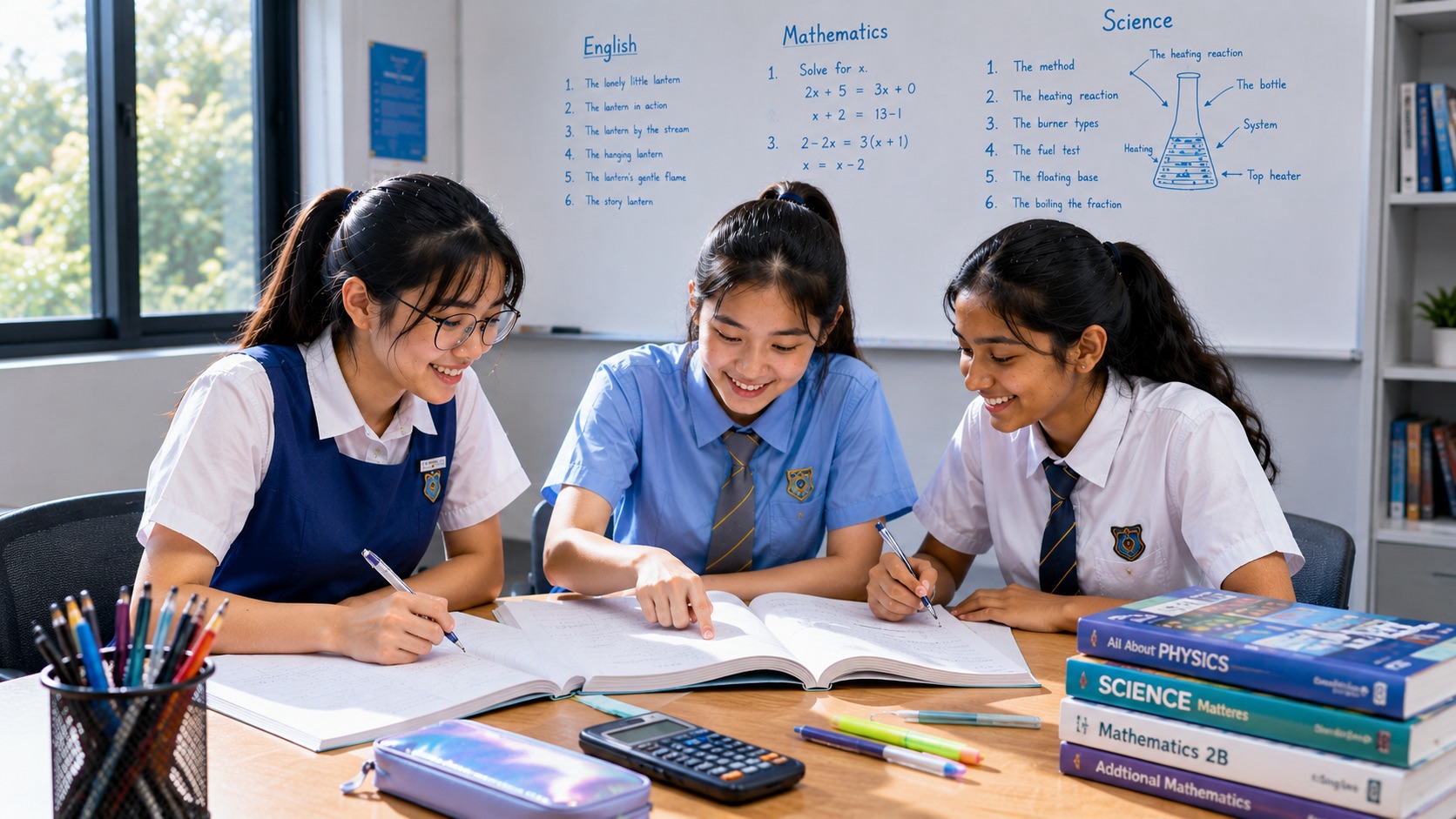
Sec 4 E Maths Tutor Yishun support should change character in the final year. By Secondary 4, most students have already seen much of the Mathematics they will need. The problem is no longer simply exposure. It is control: recognising the method inside mixed questions, executing accurately under time pressure, recovering from mistakes, checking strategically and turning four years of learning into reliable examination marks.
Families searching for Secondary 4 Maths tuition Yishun, Sec 4 E Maths tuition Yishun or a Secondary 4 Mathematics tutor in Yishun often arrive with a marked paper and a frustrating sentence: “They know the topic at home, but the marks do not come out in the exam.” That gap is real. Examination performance depends on more than knowing methods. It depends on selecting them quickly, keeping working stable, allocating time and noticing when an answer has gone off course.
This guide is built around a final-year repair cycle: test, diagnose, repair, transfer, retest. It covers revision triage, algebra maintenance, graphs, geometry, trigonometry, statistics, probability, modelling, calculator control, paper strategy and the final weeks before major assessments. The goal is not to produce endless revision. It is to make revision increasingly precise.
First, confirm the student’s examination route
Secondary 4 students in Singapore may be taking Mathematics at different subject levels. Under Full Subject-Based Banding, students offer subjects at G1, G2 or G3 levels according to their learning needs and strengths. The exact assessment route therefore matters.
From 2027, the Singapore-Cambridge Secondary Education Certificate replaces the previous separate N- and O-Level certificates, with students sitting subjects at their respective subject levels. For 2027 school candidates, SEAB lists G3 Mathematics as K310 and G2 Mathematics as K210. Students taking examinations before that transition should follow the syllabus and instructions for their own examination year.
Before building a revision calendar, check the school-issued syllabus, assessment format and exam year. Revision becomes much more efficient when every paper and topic list matches the student’s actual route.
Stop revising everything equally
Final-year students often respond to anxiety by revising broadly. They reopen every chapter, copy every formula and attempt paper after paper. This feels hardworking because the volume is impressive. But equal revision is rarely efficient when weaknesses are unequal.
Use evidence to create priorities. A topic that is consistently secure needs maintenance, not a rescue operation. A topic that is mostly secure but slow needs fluency work. A topic with recurring conceptual mistakes needs focused repair. A topic that disappears only under mixed conditions needs recognition practice.
Divide the revision map into four states: secure, fragile, weak and untested. This is more useful than red, amber and green if the labels lead to action. “Fragile” means the student can do it with cues but not reliably in mixed work. “Untested” means confidence should not be assumed.
A marked paper is the fastest route to a useful plan
Take the latest marked paper and inspect every lost mark. Do not begin with the topic. Begin with the first failed decision. Was the question misread? Was the method wrong? Was the algebra unstable? Was a calculator entry wrong? Was the final result not interpreted? Did time expire?
Then group similar causes. If five lost marks across unrelated questions come from early rounding, the repair is not five topics. It is calculator and accuracy control. If several questions were left blank despite familiar methods, the issue may be recognition or time allocation.
Write one repair sentence per recurring mechanism. “Keep exact values until the final line.” “Check the graph scale before reading coordinates.” “Define both unknowns before forming simultaneous equations.” These sentences become a practical final-year checklist.
Use the test–repair–transfer–retest cycle
Test. Use a school paper, timed section or mixed diagnostic to reveal current performance.
Repair. Teach or revisit the first weak relationship. Practise enough nearby questions to restore accuracy.
Transfer. Change the wording, values or context. Hide the topic inside a mixed set. Reduce prompts.
Retest. Return after a delay under more realistic conditions. If the error returns, diagnose again. If the skill survives, reduce the revision priority and move resources elsewhere.
Algebra must be maintained throughout the final year
Students sometimes “finish algebra” and move on. That is risky because algebra is embedded across the paper. Equations, graphs, geometry, rates and modelling all depend on manipulation. Small algebra weaknesses can leak marks everywhere.
Maintain short fluency sets: expanding, factorising, solving equations, rearranging formulas, handling fractions and indices. These do not need to dominate revision, but they should remain active.
For example, solve 2x² − 7x + 3 = 0. Factorising gives (2x − 1)(x − 3) = 0, so x = 1/2 or 3. Then ask where such a quadratic might appear: graph intersections, area relationships or modelling. The connection is the useful part.
Graphs should become fast sources of information
In examination conditions, students should be able to read a graph efficiently. Identify axes, scales, intercepts and relevant regions before calculating. A minute spent understanding the graph can save several minutes of wrong work.
For straight-line relationships, connect gradient to rate and intercept to starting value. For curves, focus on what the shape tells you: increasing, decreasing, crossing, turning or approaching a value. The graph is evidence, not decoration.
When a graph and equation appear together, move between them deliberately. Substitute a point to verify. Use algebra to find an intersection. Use the graph to check whether the algebraic answer is plausible. Two representations should support each other.
Geometry revision should prioritise recognition and justification
Geometry consumes time when students cannot see which facts matter. During revision, practise annotating diagrams before solving. Mark parallel lines, equal lengths, right angles and known values. The diagram should become a structured workspace.
State reasons where needed. An angle result should be linked to a property, not to how the picture looks. Similarity should match corresponding vertices carefully. Pythagoras should be used only when the right-triangle condition is present.
Use rotated and unfamiliar diagrams. If the student recognises a property only in the standard textbook orientation, transfer is weak. Examination questions are not obliged to present shapes politely.
Trigonometry needs relationship control and calculator discipline
Before touching the calculator, identify the angle, known sides and target. In a right triangle, decide which ratio links them. In more general situations, use the applicable relationships from the student’s syllabus. The method comes before the button sequence.
Check degree mode when the question uses degrees. Keep enough precision through intermediate steps. If the final angle or length is implausible, inspect the setup before assuming the calculator is wrong.
Students should also practise reading diagrams where the required triangle is not immediately obvious. Sometimes an auxiliary length or angle must be found first. That is a planning problem, not a calculator problem.
Rates, speed and proportion should be checked with units
Unit errors are among the easiest final-year marks to prevent. Write units through the working. If speed is required in km/h and the data uses metres and seconds, convert deliberately rather than hoping the calculator fixes the mismatch.
Dimensional checks are powerful. Distance divided by time produces a speed unit. Cost divided by quantity produces a unit price. If the units produced by the calculation do not match the requested quantity, the setup deserves review.
For proportion, predict the direction. If more workers complete the same fixed job under ideal assumptions, time should decrease. If the calculation says it increases, stop. Qualitative reasoning can catch a quantitative mistake.
Statistics and probability need interpretation under pressure
Students often treat statistics as an easy calculator section and then lose interpretation marks. Read what the measure represents. A mean can be affected by extreme values. A median may be more resistant. Spread tells a different story from centre.
Probability requires an organised sample space. Tables, lists and tree diagrams reduce omission errors. The final probability should lie between 0 and 1; complementary probabilities should behave sensibly.
After any data calculation, answer the contextual question explicitly. The numerical result is often not the last mark. Write the conclusion the examiner asked for.
Modelling questions reward a calm sequence
Long real-world questions can look intimidating because they contain more reading than algebra. Use a stable sequence: define, represent, solve, interpret, check.
Define the quantities and units. Represent the relationships with equations, graphs or tables. Solve accurately. Interpret the result in the original context. Then check scale, sign and constraints.
This sequence turns a paragraph into smaller mathematical decisions. Students who rush directly into calculation often answer a question the problem never asked.
Method recognition is the heart of mixed-paper performance
By Secondary 4, topic labels should disappear from much of revision. Give mixed sets and ask the student to name the first method before solving. This trains classification under conditions closer to an examination.
Look for clue-method links. Two unknowns plus two relationships may suggest simultaneous equations. A constant rate may suggest gradient. A right triangle with side information may suggest trigonometry. A “percentage of original” phrase fixes the reference quantity.
If recognition is slow, full-paper practice alone may reinforce hesitation. Pause and train the decision directly, then return to the paper.
Time management begins with knowing where time is lost
“Work faster” is not a useful instruction until the bottleneck is known. Time can disappear in reading, choosing a method, algebra, calculator entry, drawing, checking or repeatedly restarting a question.
During timed practice, mark the questions where hesitation begins. Afterward, classify the delay. A student who spends four minutes choosing a method needs different training from a student who chooses correctly in twenty seconds but takes four minutes on algebra.
Use timed sections before full papers. Ten to twenty minutes of mixed work can isolate the bottleneck without exhausting the student. Expand duration as control improves.
Question triage is a skill, not a panic response
A student should know how to leave and return to a difficult question. If progress stops, write a valid setup or formula, mark the question clearly, continue, and revisit later. This protects accessible marks elsewhere.
Practise this during revision. If the first experience of moving on happens in the real examination, it may feel like failure. If it has been rehearsed, it becomes a deliberate resource decision.
Returning later can also help because another question may trigger the relevant idea. Fresh attention often sees structure that a stuck mind missed.
Checking should target known risks
Do not spend the final minutes rereading every line with equal attention. Check high-risk features: negative signs, copied values, units, angle mode, decimal rounding, rejected solutions, unanswered subparts and final answers that do not match the requested quantity.
Use topic-specific checks. Substitute equation solutions. Estimate percentages. Verify graph points. Recalculate one critical statistic. Ask whether a probability is possible. Ask whether a length or area is physically sensible.
Build a personal checklist from the student’s actual errors. A generic checklist is useful; a personalised one is better.
Calculator control protects easy marks
Before calculating, estimate. During entry, use brackets. After calculating, compare the display with the estimate. Keep exact values when useful and avoid premature rounding. Check degree mode for trigonometry.
Students should know that a calculator can execute a wrong expression perfectly. If the written formula and entered formula differ, the machine has no way to rescue the mathematics.
During revision, save a few examples of calculator errors and explain the cause. One well-understood bracket mistake can prevent many later repetitions.
Full papers are tests, not the whole revision programme
A full paper tests endurance, timing, recognition and topic integration. It is valuable. But if the paper exposes a weakness, the next step is not automatically another full paper.
Repair the weakness with focused work, then use mixed transfer, then retest in a later paper. Otherwise, the student may rehearse the same error repeatedly and call it revision.
Keep a simple paper log: score, unfinished marks, recurring error types, time bottlenecks and one or two repair priorities. The log should guide action rather than become a trophy chart.
A practical twelve-week final-year structure
Weeks 12–9: diagnose the full syllabus. Repair major foundation gaps. Build a short error ledger. Keep current school topics moving.
Weeks 8–6: increase mixed practice. Alternate focused repair with timed sections. Train method recognition explicitly.
Weeks 5–3: use more full or near-full papers. Analyse timing and recurring error patterns. Reduce support during practice.
Weeks 2–1: consolidate. Revisit personal error patterns, formulas and high-value weak spots. Avoid creating chaos by opening large new revision projects at the last moment.
The final month should become narrower
As the examination approaches, revision should become more selective. The student now has evidence from multiple papers. Use it. If algebra is secure, maintain it. If graph interpretation still causes repeated losses, prioritise it. If timing remains the major issue, increase realistic timed practice.
Do not chase every rare question type equally. Protect the broad, high-frequency foundations first. Strong control of core Mathematics usually creates more value than a frantic search for exotic tricks.
Keep sleep and routine stable. A tired student may make errors that look conceptual. Final preparation should increase control, not increase chaos.
The final week is for retrieval and confidence in the system
In the final week, use short retrieval sets, selected corrections and one or two realistic timed segments. Revisit the personal checking list. Confirm calculator familiarity and examination materials according to school instructions.
Avoid staying up late to relearn entire chapters unless there is a specific reason. The student needs access to what they already know. Retrieval, sleep and calm execution matter.
Confidence at this stage should come from evidence: repaired errors, completed mixed work, timed practice and a known strategy for when a question becomes difficult.
Small-group tuition should become increasingly exam-like
Early in the year, a tutor may model more. Later, the student should attempt more before discussion. Timed independent segments should grow. Prompts should shrink. Fresh questions should replace repeated copies of the same pattern.
The group can still be valuable. Students compare methods, notice common traps and hear alternative explanations. But each learner must produce their own first attempt and their own correction.
By the final stretch, the tutor’s job is partly to disappear from the student’s decision sequence. The examination will not provide a hint, so practice should increasingly teach the learner to generate one internally.
What parents can do without becoming the examiner
Ask for evidence rather than reassurance. “Which two errors are you repairing this week?” is more useful than “Are you ready?” Ask the student to explain one checking routine. Ask which question type still causes hesitation.
Help protect the revision environment. Reduce avoidable schedule collisions where possible. Encourage sleep. Keep conversations about one poor paper proportional. A paper is information, not a final identity statement.
If tuition is used, look for increasing independence. The strongest sign is not that the tutor can solve difficult questions. It is that the student can now solve more of them alone.
Questions to ask a Secondary 4 Mathematics tutor
How do you turn marked papers into revision priorities? How do you distinguish weak knowledge from slow method selection? When do you use full papers? How do you train timing and checking? How do you adapt to the student’s actual G1, G2 or G3 level?
Ask how a repaired error is tested. A useful answer includes a fresh question, a delay and mixed context. Immediate repetition after seeing the model is not enough evidence.
Ask also what the tutor will stop doing as the student improves. Strong tuition should reduce dependence as examination day approaches.
The Secondary 4 target: reliable performance, not perfect practice
No student needs to make every practice question perfect before the examination. The more useful target is reliability: recognise most structures, choose sensible methods, execute with controlled working, move on when necessary, return strategically and check known risks.
That reliability is built through repeated cycles of evidence and repair. A weak paper can become useful if it reveals the next intervention. A strong paper can become useful if it confirms which topics now need only maintenance.
For Sec 4 E Maths Tutor Yishun support, the final job is therefore simple to state and demanding to execute: convert known Mathematics into marks under real conditions. When revision becomes precise, checking becomes habitual and method selection becomes faster, the student carries a far stronger system into the examination room.
Sec 4 examination-control workshop
A final-year workshop should rehearse decisions that happen inside the paper, not only content that appears on the syllabus. One useful format is a 45-minute mixed simulation containing enough questions to force choices but not so many that the student is exhausted. The objective is to observe how marks are allocated, where hesitation begins, how the student responds to a blocked question and whether checking is targeted or random.
Use A, B and C triage before the paper becomes emotional
Label questions mentally as A, B or C after a quick read. An A question has a clear route and should be collected efficiently. A B question is solvable but needs planning. A C question is currently unclear or time-expensive. The labels are temporary, not judgments about ability. Their purpose is to protect accessible marks while preventing one resistant question from consuming the paper.
During practice, record whether the student classifies sensibly. A learner who calls every unfamiliar-looking question C may have a recognition problem. A learner who calls everything A and repeatedly gets stuck may be overconfident about method choice. Good triage becomes more accurate as mixed practice improves.
Build an error budget
Review the last three timed papers and count marks lost to concept gaps, method selection, algebra or arithmetic, calculator entry, units, incomplete answers and time. The largest category deserves attention first. If eight marks vanish through algebra control while only two are lost to obscure content, the revision plan should reflect that evidence.
This makes the final weeks calmer because revision becomes a budget rather than a panic list. Every hour has a job. Some hours repair; some build mixed recognition; some test timing; some maintain already-secure topics. The student no longer needs to “revise Maths” as one enormous task.
Worked mixed example 1: graph plus algebra
Suppose two linear graphs have equations y = 3x − 4 and y = x + 6. Their intersection satisfies both equations, so 3x − 4 = x + 6. Hence 2x = 10, x = 5 and y = 11. The checking route is immediate: substitute (5, 11) into both equations. In a timed paper, this is an A or B question for a prepared student because the relationship between intersection and simultaneous equality is familiar.
Worked mixed example 2: geometry plus trigonometry
A diagram may require the student to use an angle property before trigonometry becomes possible. Practise writing that intermediate angle onto the diagram rather than holding it mentally. Then state which side is known, which is required and which trigonometric relationship fits. This sequence protects the student from a common final-year mistake: pressing calculator buttons before the correct triangle has been identified.
Worked mixed example 3: percentage and reverse reasoning
If an item costs $96 after a 20% discount, $96 represents 80% of the original price. The original price is $96 ÷ 0.8 = $120. A quick check is to take 20% of $120, which is $24, and subtract it: $120 − $24 = $96. The important examination habit is to identify the reference quantity before selecting the operation.
Plan the last six weeks by function
Weeks 6–5: finish major repairs and keep algebra fluent. Week 4: increase mixed-question density and timed sections. Week 3: use full or near-full papers with disciplined post-paper diagnosis. Week 2: target recurring error patterns and maintain secure topics. Final week: shorten sessions, retrieve key methods, revisit the personal error list and protect sleep and routine.
The plan should narrow as the examination approaches. Early weeks can still fix mechanisms. Late weeks should avoid opening unnecessary new projects. A student who has evidence of what is secure should spend less time proving it repeatedly.
An exam-day decision sequence
Read the question and identify the target. Mark key conditions. Choose the representation or method. Write enough structure to make the reasoning recoverable. Calculate carefully. Check the answer with a topic-appropriate method. If progress stops beyond a sensible time threshold, leave a valid setup, move on and return. At the end, scan for unanswered parts, units, signs, calculator mode and final values that contradict reasonable estimates.
This sequence is not meant to make the examination robotic. It reduces avoidable decisions under stress. The student can spend attention on the Mathematics because the paper-management routine has already been rehearsed.
After every paper, close the loop
A practice paper is unfinished until the next action is chosen. Identify two high-value repairs, complete focused practice, test each repair on a fresh mixed question, and return later to see whether it survives. If it does, reduce its priority. If it returns, diagnose more deeply. This prevents students from accumulating piles of completed papers while preserving the same errors.
The strongest final-year signal is not the number of papers completed. It is that the student’s error patterns become narrower, method recognition becomes faster, unfinished marks shrink and checking catches more mistakes before submission. That is examination control becoming visible.
Leave a Reply