
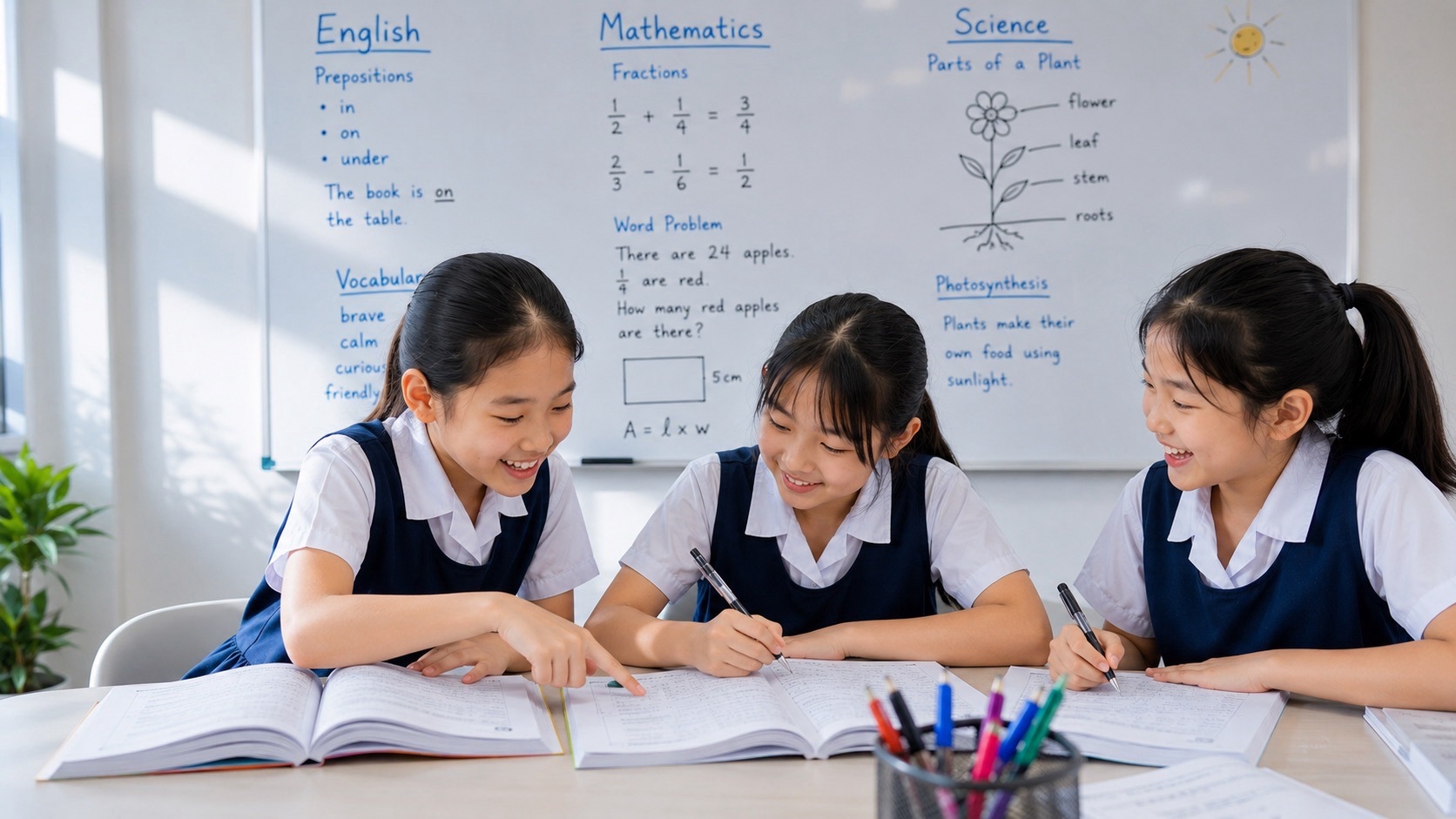
Pri 1 Pasir Ris English Tuition is a legacy 2019 title. The original page mixed obsolete phone and address details, cross-location claims, A1 marketing language and large image galleries. This renewal preserves the title, URL, original publication date, published status and featured image, while giving the page one clear learning job: how Primary 1 English builds decoding, reading fluency, oral language, sentence formation and confident independent task starts.
Parents searching for Pasir Ris Primary 1 English tuition, P1 English tutor, phonics, reading, vocabulary, grammar, sentence writing and small-group English tuition are usually not looking for advanced examination tricks. They are looking for a child to become comfortable with print, understand classroom instructions, express complete ideas and begin work without needing an adult beside them at every step.
The durable P1 sequence is hear → decode → understand → say → write → check.
1. Primary 1 English Builds the Language Operating System
P1 students are learning more than vocabulary and grammar. They are also learning how to follow instructions, sustain attention, decode print and turn spoken ideas into written sentences.
2. Decoding Must Become Reliable
- letter-sound relationships;
- common spelling patterns;
- blending;
- high-frequency words;
- recognising familiar words in sentences.
Phonics helps children work out unfamiliar words. Meaning still matters, so decoding practice should stay connected to real sentences and stories.
3. Fluency Connects Reading to Meaning
When every word requires effort, the sentence can disappear from working memory. Short repeated reading, echo reading and read-aloud modelling help the child move from word-by-word effort toward phrased reading.
4. Oral Language Comes Before Strong Writing
Ask the child to explain first:
- What happened?
- Who was involved?
- Why did it happen?
- What happened next?
If the idea is clear aloud, it is easier to turn into a sentence.
5. Vocabulary Should Grow From Context
A few words learned deeply are more useful than a long list copied once.
- hear the word;
- explain it simply;
- use it in speech;
- meet it again in reading;
- use it later in writing.
6. Sentence Writing Should Prioritise Complete Meaning
who or what + what happened + one useful detail
Sentence expansion should add meaning rather than decorative adjectives.
7. Grammar Is Functional
- capital letters mark beginnings and names;
- full stops close complete ideas;
- verbs show action or state;
- pronouns reduce repetition;
- simple tense helps place events in time.
8. Comprehension Starts With Literal Accuracy
Before complex inference, make sure the learner can identify who, where, what happened, when and simple cause-and-effect relationships.
9. Independent Task Starts Matter
listen/read instruction → identify action → begin → check
This routine reduces dependence on repeated adult prompting.
10. Small Groups Should Keep Every Child Visible
A small group is useful when the tutor can see who reads independently, who waits for reassurance, who copies, and who understands but cannot express the idea yet. Every child still needs an individual attempt.
11. A Simple Weekly P1 Pattern
- short read-aloud;
- one independent reading passage;
- three useful vocabulary words;
- three to five complete sentences;
- one simple grammar pattern;
- one oral retelling;
- one old error revisited.
12. Signs of Progress
- reading begins with less hesitation;
- the child retells more accurately;
- sentences become complete;
- instructions are followed more independently;
- corrections appear in later work.
13. Historical Note
The original 2019 page contained an old phone number, an outdated Yishun address, A1 marketing claims, Woodlands/Pasir Ris location errors and extensive galleries. Those have been removed. This page does not claim current Pasir Ris operations or a current tutor assignment.
14. Current Routes
Primary 1 English succeeds when a child becomes increasingly able to decode, understand, speak and write without constant rescue.
Continue through Primary 1 English: Primary 1–3 article index · Primary English directory · English by area & school · Diagnostics · Examinations · Library
Leave a Reply