
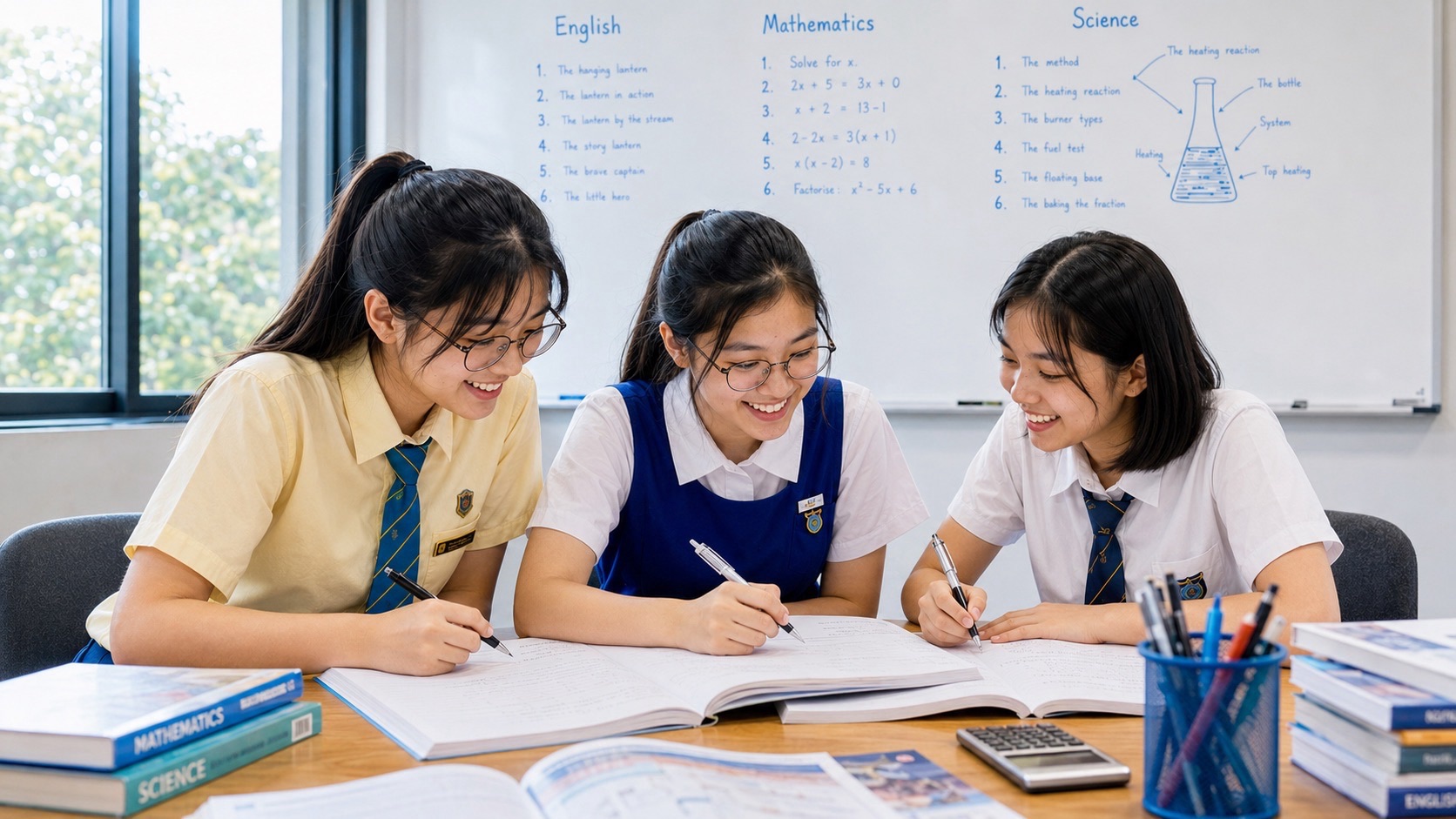
Families searching for a Woodlands English Tutor Sec 3, Secondary 3 English tutor Woodlands, G3 English, argumentative writing, situational writing, comprehension, summary, vocabulary, editing, oral communication and upper-secondary exam preparation are usually looking at the year when English stops feeling like lower-secondary practice and starts becoming final-year preparation. Secondary 3 is not yet the examination year, but it is the year when the architecture of Sec 4 should become familiar enough that the student does not enter the final year still learning how to plan, analyse, summarise and manage time from scratch.
Strong Secondary 3 English tuition in Woodlands should therefore build a deliberate Sec 3→4 bridge. Current upper-secondary programmes emphasise comprehension, summary, continuous writing, situational writing, editing, oral, listening and examination skills because these are the visible components. The deeper transition is from learning isolated skills to coordinating them. Can the student read an unfamiliar text analytically, build a defensible position, select summary points, adapt tone, edit personal language risks and begin timed sections without the underlying method falling apart?
This rebuilt guide is deliberately different from the Sembawang Secondary 3 pages. Those pages own the upper-secondary ramp, claim–evidence reasoning and performance system. This Woodlands page owns the Sec 3→4 readiness bridge: what must be secure before final-year revision dominates, how to build examination-shaped habits without premature paper drilling, how to introduce time, how to use school papers as readiness evidence and how to ensure the student enters Sec 4 with working architecture rather than a list of techniques.
Secondary 3 should make Secondary 4 less expensive
Every weakness becomes harder to repair when the final year compresses time. Reading stamina takes months. Vocabulary grows through repeated exposure. Paragraph development improves through cycles of writing and feedback. Summary selection becomes more reliable through varied practice.
Secondary 3 gives enough runway for these mechanisms to improve before full examination pressure arrives.
Do not turn Sec 3 into an early Sec 4 boot camp
Premature full-paper volume can create the appearance of preparation while leaving architecture fragile. Students learn the look of the paper but not the decisions underneath it.
Use exam-shaped components gradually. Build the method, vary the context, introduce modest time, then combine components.
Build a Sec 4 readiness dashboard
Track six areas: reading, summary, writing, language control, oral/listening and self-management.
- Reading: structure, evidence, inference, language effect.
- Summary: focus, selection, paraphrase, compression.
- Writing: task reading, thesis/plot, paragraph development, audience.
- Language control: editing, sentence boundaries, word forms, grammar risks.
- Oral/listening: idea development, follow-up, note-taking, recovery.
- Self-management: start, time, checking, correction transfer.
Rate each as Secure, Developing, Prompt-dependent or Time-sensitive.
Reading readiness begins with passage structure
A Sec 4 candidate cannot afford to treat every paragraph as an isolated block of sentences. Students should see how a passage develops.
Practise mapping paragraphs: introduces issue, explains cause, gives example, changes viewpoint, challenges claim, concludes.
Mapping should become quick
The student should not spend minutes writing summaries of each paragraph. Three to five words are enough.
The purpose is navigation. A map reduces repeated rereading and makes questions about development easier to answer.
Question scope must already be a habit
By Sec 3, the student should identify the command before searching for evidence.
“Why” = cause or purpose. “How do you know” = evidence. “What does this suggest” = inference. “Explain the effect” = word choice and impact. “Compare” = similarity/difference under a stated dimension.
Use command drills without full passages
Give ten question stems and ask the student to state the required answer shape. This isolates scope reading from comprehension difficulty.
A strong Sec 4 bridge includes fast command recognition.
Evidence selection should be deliberate
Students often underline too much. Ask for the strongest clue rather than all clues.
Worked evidence example
Text: “Ethan checked the schedule three times, arrived early and reorganised his notes while waiting.” If asked how we know he is anxious or very prepared, the repeated checking and early arrival are strong evidence. Reorganising notes may support the pattern, but the student should still explain the connection.
Inference should be restrained before it becomes timed
Upper-secondary passages often tempt students into over-reading. Teach the smallest defensible claim.
Worked inference example
“Mira thanked the teacher, but folded the marked essay and placed it immediately beneath her books.” Supported: she may feel uncomfortable or disappointed about the feedback. Unsupported: she failed the examination.
The text has not paid for the larger claim.
Use the evidence receipt
Ask which words support each important part of the inference. If one phrase has no receipt, reduce it.
This habit should be automatic before final-year speed becomes important.
Language-effect analysis should be more than terminology
Students should identify the word, unpack its associations and explain the contextual effect.
Worked language-effect example
“The deadline loomed over the team.” “Loomed” suggests something large and threatening hanging close by, so the deadline feels increasingly oppressive and difficult to ignore.
Replacing “loomed” with “approached” shows what emotional force would be lost.
Vocabulary readiness means nuance and collocation
Upper-secondary writing and comprehension require more than definitions. Students should know connotation, word family and natural combinations.
Persistent, stubborn and determined overlap but carry different judgement. Raise a concern, draw a conclusion and pose a challenge are useful collocations.
Use active retrieval
Cover the notebook. Retrieve five words. Explain differences between two. Use one in an oral response or paragraph.
A vocabulary bank becomes exam-useful only when words can be retrieved independently.
Summary readiness should be diagnosed by stage
Separate focus, selection, paraphrase and compression.
If the student chooses irrelevant points, do not spend the lesson teaching synonyms. If selection is accurate but wording distorts meaning, focus on paraphrase.
Build a focus filter
Rewrite the summary task: “Only reasons for…” or “Only benefits and challenges of…” Then test each point.
Sec 4 speed improves when the filtering habit is already internalised.
Selection comes before rewriting
Highlight or list all eligible points first. Only after selection stabilises should the student paraphrase and compress.
This separation reduces omissions and duplicated effort.
Paraphrase the proposition
Worked paraphrase
Original: “The redesigned bus routes reduced travel time for residents.” Paraphrase: “Residents reached their destinations more quickly after the bus network was reorganised.”
The idea survives without awkward word substitution.
Compression should use categories
If three examples represent the same broader idea, generalise accurately. Buses, trains and cycling may become “alternative transport” in the right context.
Generalisation should save words without erasing important distinctions.
Writing readiness begins with task recognition
Students should distinguish argumentative, discursive, reflective and narrative demands where their school programme uses them. The planning structure changes with purpose.
Do not let every question become the same memorised essay.
Argumentative readiness begins with a defensible thesis
Worked thesis example
Question: “Schools should place less emphasis on examinations. Do you agree?” A workable thesis: “Examinations provide useful common standards, but schools should reduce excessive dependence on them when other forms of assessment can reveal skills that timed tests measure poorly.”
The thesis creates a balanced but clear direction.
Build claims before writing the introduction
List the body claims first. What does each paragraph add? What counterpoint matters?
This prevents polished openings attached to weak essay structures.
Paragraph development must be secure before timing
Use claim → explanation → example → analysis → link/qualification. The exact visible form can vary, but the reasoning sequence should exist.
Worked paragraph skeleton
Claim: project work can reveal collaboration skills that written exams do not. Explanation: students must divide tasks and respond to others’ progress. Example: a group presentation requires coordination and revision. Analysis: the quality depends partly on communication and shared responsibility, skills not easily captured in a silent individual paper.
Examples should be analysed
Ask “How does this example prove the claim?” until the student begins asking it internally.
This single habit improves upper-secondary essay quality dramatically because it closes the gap between illustration and reasoning.
Counterargument should already be familiar
Students entering Sec 4 should be able to state a reasonable opposing concern without caricature.
Worked counterargument
“Continuous assessment can reduce the pressure of one major exam, but it may also create constant low-level assessment and reduce opportunities for extended learning. The value therefore depends on design, not simply frequency.”
Discursive writing needs dimensions
Instead of “advantages” and “disadvantages” lists, organise around dimensions such as learning effect, fairness, practicality or long-term consequence.
This creates more analytical structure.
Narrative readiness means causal planning
Use situation → disruption → response → consequence → decision → resolution.
Worked narrative plan
Situation: student leads a team project. Disruption: a message about a deadline is misunderstood. Response: student assumes there is more time and delays. Consequence: team discovers the error late. Decision: student admits responsibility and reorganises tasks. Resolution: the group completes the project and changes how deadlines are confirmed.
Reflection should be specific
Ask what the character now understands differently. “I learned to check important information instead of assuming someone else had understood it” is specific to the plot.
Generic morals should be challenged before final-year writing.
Situational Writing readiness means reader control
Identify role, audience, purpose, context, required details and desired response.
Then organise information in the order useful to the reader rather than the order of the stimulus.
Use five-minute planning drills
Give a visual-text prompt and ask for a content matrix, tone choice and paragraph order in five minutes. Do not always write the full piece.
This builds planning speed before Sec 4.
Editing readiness should use personal risk categories
Track agreement, tense, word form, article, preposition, pronoun, sentence boundary and punctuation. Which ones recur in the student’s own writing?
Upper-secondary readiness includes knowing what to check.
Grammar transfer should be mixed
Once a rule is understood, combine it with other error types. The student should recognise which relationship controls the sentence without a chapter label.
Worked editing example
“Each of the teams were given a schedule.” The subject head “Each” is singular, so “was given”. Later, test the principle inside a paragraph with several plural nouns.
Sentence control should be visible in longer writing
Students should recognise fragments, run-ons and overloaded sentences. Ask them to split one unstable sentence and combine two choppy ones.
Complexity should serve meaning, not impress the reader.
Oral readiness should include idea flexibility
Use position → reason → example → qualification. Then change the angle with follow-up questions.
Worked oral example
Prompt: Should young people work part-time? “Part-time work can teach responsibility and communication because students have commitments beyond school. However, the benefit depends on hours and timing; excessive work can reduce sleep and study time.”
Build flexible theme banks
Discuss education, technology, environment, health, work, community, media and youth issues. For each theme, collect mechanisms and trade-offs rather than scripts.
This material can support both oral and continuous writing.
Listening readiness should include one-listen discipline
Use short audio segments where some information is heard once. Ask students to predict the information type, take efficient notes and recover after a missed detail.
These habits reduce final-year novelty.
Introduce time gradually
Sec 3 should not be completely untimed. Once methods are stable, time a thesis drill, comprehension set, summary selection or situational plan.
Timing should compress a good process, not replace teaching.
Time the stages separately
Record reading time, selection time, planning time, writing time and checking time. This reveals where a student is slow.
A broad label such as “writes slowly” may hide long topic choice or repeated sentence rewriting.
Use component mini-mocks
A 45-minute mixed set can include Editing, comprehension, summary selection and a writing plan. The student practises switching between skills.
Switching is one of the hidden costs of full examination papers.
Do not overuse full papers in Sec 3
Full papers can be useful periodically for stamina and integration. They should not replace targeted repair.
If the same summary selection error appears again, stop and fix it before another full simulation.
Use school papers as readiness evidence
After common tests or year-end exams, classify lost marks. Which mechanisms are recurring? Which skills remain prompt-dependent?
The Sec 4 plan should begin from this evidence rather than a generic January checklist.
Build a readiness error ledger
Columns: component, first failure, mechanism, next-time cue, prompt level, fresh retest. Keep active entries short.
Students should review the current high-frequency cues before practice.
Fresh retests should change the surface
After repairing an inference, use a different genre. After repairing paragraph development, use a new topic. After repairing tone, change the audience.
Transfer is the bridge to final-year readiness.
Use delayed retests
Same-day success may be recognition. Return after several days without the model.
If the student can retrieve the method, the repair is becoming durable.
Track prompt dependence explicitly
Full model → strong hint → small cue → independent. The goal is to move important Sec 4 skills toward independent by year-end.
A student who can write only after the tutor supplies the outline is not yet fully ready even if the final essay looks polished.
Build recovery habits before they are urgently needed
Comprehension recovery: reread command → locate paragraph → identify strongest clue → write simplest defensible answer. Writing recovery: return to thesis or central problem → identify paragraph job → continue. Summary recovery: return to focus filter.
Recovery routines should be familiar before the final year.
Common failure pattern: exam-format familiarity mistaken for readiness
Knowing where sections appear on a paper does not mean the student can perform the underlying decisions. Test fresh tasks without labels.
Common failure pattern: vocabulary grows but paragraphs remain thin
Do not respond with more vocabulary. Build explanation and analysis. Stronger reasoning often improves writing more than additional phrases.
Common failure pattern: summary practised only as a full task
Isolate selection, paraphrase and compression. Short drills repair mechanisms faster.
Common failure pattern: timing creates panic
Introduce time to stable methods in small doses. Time one stage first. The student should experience the clock as information, not threat.
Common failure pattern: every correction happens with the model visible
Close the model, change the surface and retest. The goal is retrieval.
Practice set: fifteen Sec 3→4 bridge tasks
- Map five paragraphs of an unseen article.
- Identify the answer shape for ten command words.
- Rank three clues by strength.
- Write a restrained inference.
- Explain the effect of one vivid verb.
- Create a vocabulary network with connotation and collocation.
- Select summary points through a focus filter.
- Paraphrase one proposition naturally.
- Compress two related summary points.
- Write a defensible thesis for an upper-secondary prompt.
- Develop one paragraph with analysis.
- Write one fair counterargument.
- Plan a situational response in five minutes.
- Complete a mixed Editing paragraph.
- Complete a 45-minute mini-mock and identify the time bottleneck.
What strong readiness looks like
The student recognises task demands quickly, selects evidence rather than highlighting everything, keeps inference within the text, paraphrases without distortion, develops paragraphs, adapts tone and can handle a modest timer without the method collapsing.
Equally important, the student can explain what went wrong and design a next attempt.
An eight-week Sec 3→4 bridge cycle
Weeks 1–2: reading structure, scope, evidence and inference. Week 3: summary stages and vocabulary. Week 4: editing and sentence control. Weeks 5–6: argumentative/discursive writing, narrative and situational writing. Week 7: oral/listening and timed components. Week 8: mixed Independence Test and Sec 4 readiness audit.
A 90-minute Woodlands Sec 3 lesson rhythm
10 minutes: retrieve old cues. 25 minutes: close reading and evidence. 20 minutes: summary/editing. 25 minutes: writing/oral transfer. 10 minutes: timed fresh task and ledger update.
Small groups reveal different readiness gaps
One student may be ready in reading but weak in writing architecture. Another may write well but remain slow at summary. A third may know methods but depend on reassurance.
Small-group tuition should make those differences visible while preserving common teaching.
Parent checkpoints
- Can the student map passage structure quickly?
- Are question commands recognised?
- Is evidence selection disciplined?
- Are inferences restrained?
- Can language effect be explained?
- Does vocabulary include nuance and collocation?
- Are summary stages separated?
- Can a thesis be generated independently?
- Do body paragraphs include analysis?
- Can counterarguments be handled fairly?
- Does situational writing adapt to audience?
- Are personal editing risks known?
- Can oral ideas handle follow-up?
- Has modest component timing begun?
- Are fresh delayed retests used?
- Is prompt dependence reducing?
Frequently asked questions
Should Secondary 3 students already do O-Level or SEC-style papers?
Selected exam-shaped tasks and occasional full papers are useful, but they should support—not replace—skill development. Component drills and mixed mini-mocks are often more diagnostic during Sec 3.
What is the most important Sec 4 preparation?
Stable reading, summary, writing architecture and independent correction. Final-year timing works best when those foundations already exist.
How can essay writing improve before Sec 4?
Practise thesis creation, paragraph development, example analysis and counterarguments across varied topics. Do not rely on memorised introductions.
How can summary become faster?
Make selection, paraphrase and compression individually efficient before combining them under time.
What if the student does well untimed but poorly under time?
That suggests a performance gap. Measure which stage expands and add timing gradually to that stable method.
How do we know the student is ready for Sec 4?
They can handle varied upper-secondary tasks with decreasing prompts, maintain quality under modest component timing and use errors to guide their own next practice.
Teaching Guide
Teach Secondary 3 as a bridge year, not a rehearsal year. The student needs upper-secondary architecture and enough examination-shaped practice to make Sec 4 familiar without allowing paper volume to replace learning.
Prioritise durable decisions: read the command, select evidence, infer carefully, filter summary points, develop paragraphs, adapt tone and check personal language risks.
Introduce time only after the method works. Use component timing and mini-mocks to reveal bottlenecks. Use fresh retests to confirm transfer and reduce tutor prompting deliberately.
The destination is a student who enters Sec 4 with working systems already installed. The final year can then refine pace, stamina and examination judgement instead of rebuilding reading, writing and summary under pressure.
Build a year-end Sec 4 Readiness Test
Use unseen comprehension, summary, mixed editing, a writing-plan choice and an oral prompt. Add modest realistic component limits. No hints during the first attempt.
Record where independence breaks: understanding, selection, execution, time or checking. That becomes the January Sec 4 plan.
Progress should look like reduced start-up cost
The student takes less time to decide what a question requires, less time to build a thesis, less tutor prompting to develop a paragraph and fewer reminders to apply the summary focus.
When starting becomes easier, more attention is available for quality.
A final Sec 3→4 readiness checklist
- Passage structure is mapped quickly.
- Question commands are recognised.
- Evidence selection is controlled.
- Inference stays within evidence.
- Language effect is explained.
- Vocabulary is retrievable and precise.
- Summary selection is disciplined.
- Paraphrase preserves meaning.
- Compression is efficient.
- Theses create clear routes.
- Paragraphs are developed.
- Counterarguments are fair.
- Narratives have causality.
- Situational writing is reader-centred.
- Editing risks are personalised.
- Oral and listening recovery are familiar.
- Modest timing does not destroy the method.
- Prompts are fading.
When these foundations are in place, Secondary 4 becomes the year to sharpen and execute—not the year to discover what upper-secondary English was supposed to be.
Historical eduKate Woodlands photo archive
The original image sequence is preserved below.


Leave a Reply