
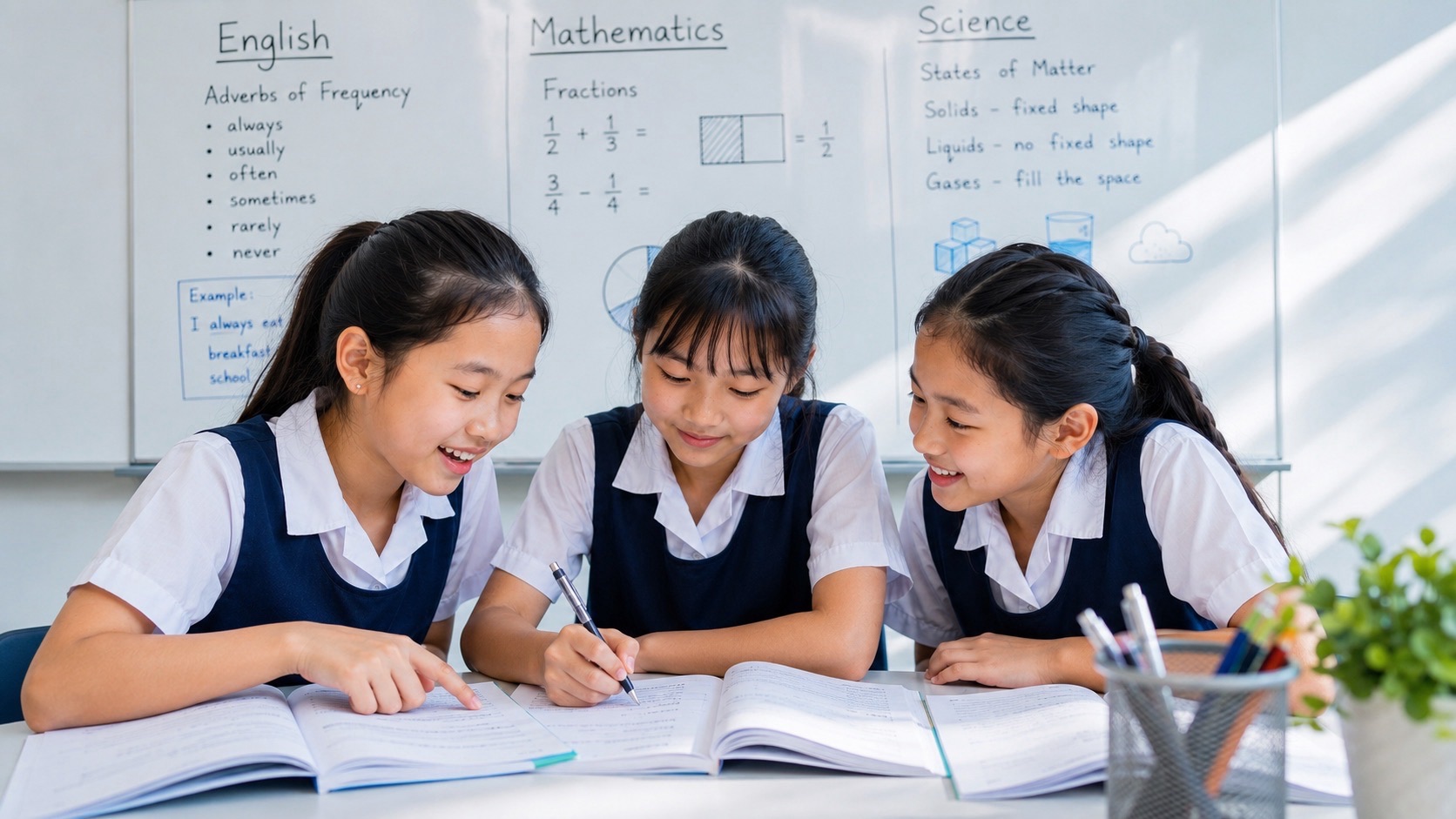
Parents looking for a Sembawang English tutor for Primary 2 are often trying to solve a very specific puzzle: their child can say a sensible idea aloud, yet the written version arrives with missing words, mixed tenses or events in a rather adventurous order. Primary 2 English tuition, sentence construction, grammar practice, vocabulary building and picture composition are common search phrases, but the real learning job is to help a young writer turn thought into clear language without making writing feel like a weekly inspection.
A useful Primary 2 English tuition lesson in Sembawang should connect reading, speaking, grammar and writing. The child needs to notice who is doing the action, choose a verb that matches, keep the time consistent, place words in a natural order, punctuate the sentence and then link several sentences so that a reader can follow what happened. Picture-to-sentence practice and short paragraph writing work best when they teach this chain of meaning, rather than asking children to memorise decorative phrases they cannot yet control.
This guide is for families comparing a Sembawang Primary 2 English tutor, lower-primary English support or a practical home routine. It focuses on sentence building and narrative sequencing: grammar as meaning, subject–verb agreement, tense, connectors, punctuation, vocabulary choice, picture clues and coherent short paragraphs. It makes no promises about marks and does not assume that every school uses the same worksheet or assessment format. Its aim is simpler and more durable: help a seven- or eight-year-old write so that another person can understand the idea.
Primary 2 writing begins with a message worth carrying
A sentence is not merely a row of correctly spelled words. It carries a complete message from one mind to another. When a child writes, “The puppy,” the reader waits. What did the puppy do? When the child writes, “The puppy chased,” the reader still waits. Chased what? “The puppy chased a red ball across the garden” gives the reader a doer, an action and enough information to see the moment.
This meaning-first view makes grammar less mysterious. A noun names the person, animal, place or thing in the message. A verb tells what happens or what something is. An adjective may help the reader identify or imagine a noun. A connector shows the relationship between ideas. Punctuation tells the reader where the thought begins, pauses or finishes. Each feature has a job. Grammar is not a bag of traps set by adults; it is the traffic system that helps meaning reach its destination without bumping into a lamp post.
The Ministry of Education’s English Language Syllabus 2020 describes English learning across listening, reading, viewing, speaking, writing and representing, with communication as a central purpose. For a Primary 2 child, that means a writing lesson should not begin and end with silent correction. Looking at a picture, talking through an event, reading a model, arranging ideas and writing a short text can all contribute to the same language goal. School implementation and assessment details can differ, so parents should use the child’s current school materials and teacher feedback as the immediate reference.
Diagnose the broken link before adding more worksheets
“My child cannot write” is understandable, but too broad to guide teaching. Use one unaided piece of work and inspect six links separately.
- Idea: Can the child say what is happening and why it matters?
- Sentence: Is there a clear doer and a complete action or state?
- Grammar: Do the noun and verb agree, and is the time kept steady?
- Sequence: Can a reader tell what happened first, next and last?
- Word choice: Are the nouns and verbs specific enough to carry the picture?
- Editing: Can the child find capitals, stops, spelling slips or missing words?
These checks separate very different needs. One child can tell a delightful story but omits words while writing. Another constructs accurate sentences yet cannot decide which picture detail matters. A third knows the events but uses “and then” so often that the paragraph sounds like a train with forty identical carriages. The teaching response should match the broken link.
Ask the child to read the work aloud exactly as written. Do not quietly supply a missing word. If the mouth automatically adds “was” although the page does not contain it, place a small caret where the ear detected the gap. This turns editing into listening. Keep the correction load sensible: choose one meaning problem and one surface problem for the next attempt. A page corrected in six colours may look industrious while teaching the child only that adults own the writing.
Build a sentence around who and what happened
Begin with a two-part frame: Who or what? plus What happened? “The children laughed.” “A branch snapped.” “Mei Lin was worried.” These are modest sentences, but they stand up properly. Once the base is secure, the child can add useful information: where, when, how or why.
Take the base “The children laughed.” Ask one question at a time. Why? “The children laughed because the kitten climbed into the empty basket.” Where? “The children laughed beside the picnic table because the kitten climbed into the empty basket.” The expansion works because every added part serves the event. By contrast, “The happy, cheerful, excited, delighted children laughed loudly” piles words onto the same idea without moving it forward.
Word order matters. English readers expect familiar patterns. “Quickly the across puppy path ran” contains several useful words but no safe route through them. Let the child move word cards into “The puppy ran quickly across the path.” Then ask whether “quickly” is essential. If the picture shows the puppy escaping a sudden spray of water, perhaps it is. If speed does not matter, “The puppy ran across the path” is cleaner.
A simple oral rehearsal helps. The child points to the doer, taps once for the action and slides a finger to the extra information. Say the whole sentence before writing it. After writing, compare the spoken and written versions. This brief routine protects working memory: the child does not have to invent, spell, punctuate and remember the ending all at the same instant.
Subject–verb agreement is a meaning signal
Agreement tells the reader whether the sentence is about one doer or more than one. In the present tense, “The bird sings” and “The birds sing” carry different number signals. Children sometimes attach s to both the plural noun and its verb—“The birds sings”—because both seem to describe “more”. English, with its usual fondness for keeping learners alert, does not work that way.
Teach agreement by pairing, not by chanting a rule in isolation. Make two columns: one and more than one. Place “the boy / he / my sister” in the first, and “the boys / they / my sisters” in the second. Match them with “runs / run”, “has / have” and “is / are”. Then put each pair into a meaningful sentence. “My sister has a blue umbrella.” “My sisters have matching umbrellas.” The picture changes, and the verb changes with it.
Pronouns deserve attention because they can hide the subject. A child may write “Sara and I is ready” after correctly writing “Sara is ready”. Ask the child to replace the names with a pronoun: “Sara and I” becomes “we”, so “We are ready” reveals the matching verb. Similarly, “The box of crayons is open” agrees with the main noun box, not the nearby plural crayons. At Primary 2, use clear examples before introducing trickier phrases.
Keep tense steady enough for the reader to travel
Tense locates an action in time. A child telling a completed incident will often use the past: “Nadia opened the gate, saw the puppy and called her father.” A child describing a routine may use the present: “Every morning, Nadia fills the puppy’s bowl.” Problems appear when the paragraph leaps between times without a reason: “Yesterday, Nadia opened the gate and sees a puppy. She calls her father.”
Draw a tiny timeline before editing. Mark yesterday, now or every day. Circle the time clue in the sentence. Then underline the verbs. Do they live on the same part of the timeline? “Yesterday” invites “walked”, “noticed” and “picked up”. “Every Saturday” invites “walks”, “notices” and “picks up”. The visual line makes tense a decision about time, not merely a spelling exercise.
Irregular verbs need repeated encounters because they do not accept a simple -ed. Children may write “goed”, “catched” or “runned” because they are applying a sensible pattern too faithfully. Keep a small personal verb bank based on errors that actually occur: go/went, see/saw, take/took, catch/caught, run/ran. Use each in a fresh sentence. A bank of ten useful verbs that the child controls is better than a poster of eighty that nobody consults.
Connectors explain relationships, not just order
Sequencing words—first, next, later and finally—help organise events. Yet a coherent paragraph needs more than a numbered queue. Connectors can show addition, contrast, cause, result and time. “Asha wanted to continue playing, but dark clouds covered the sky.” “She packed the kite because thunder rumbled.” “The rain began after she reached the shelter.”
Ask what relationship the child wants to express before choosing the connector. If one event causes another, use a cause or result link. If two ideas pull in different directions, use contrast. If the second event simply follows the first, use time. This prevents random swapping from a connector list. “The floor was wet, but Amir fetched a mop” may be grammatically possible, but “so Amir fetched a mop” states the intended result.
Do not demand a connector at the start of every sentence. “First… Next… Then… After that… Finally…” can make a six-sentence story sound like assembly instructions. Some events connect through repeated nouns, pronouns and logical order. “A paper boat floated towards the drain. It caught against a twig. Siti reached down carefully, but the current pulled it away.” The paragraph moves without announcing every step.
Punctuation lets the reader hear the sentence
At this stage, punctuation should be tied to meaning. A capital letter opens the sentence and marks a proper name. A full stop closes a statement. A question mark signals that an answer is sought. An exclamation mark can show a strong command or reaction, but it is not confetti. Three exclamation marks do not make “I saw a bag” three times more exciting.
Use breath only as a first clue, not the complete rule. Children may pause while thinking in the middle of a perfectly ordinary sentence. Better questions are: Has the message finished? Is this asking something? Are these words spoken by a character? When introducing direct speech, keep the model short and consistent: “Wait for me!” Jia called. The capital, quotation marks, exclamation mark and speaker tag each have a visible job.
For editing, ask the child to touch the first letter and then the final mark of every sentence. If a line stretches across half the page with several complete actions joined by “and”, read it aloud and locate where one message finishes. Split “Ben found the key and he ran upstairs and he opened the box and a note was inside” into deliberate units. The reader deserves a small rest; so does Ben.
Choose vocabulary for accuracy before sparkle
Vocabulary growth matters, but advanced words are useful only when they fit. “The girl ambled away from the barking dog” creates an odd picture because ambled suggests an easy, leisurely walk. “The girl backed away” or “darted through the gate” may match the action. A precise familiar verb often does more work than an impressive stranger wearing the wrong shoes.
Build word choices around scenes. For movement, compare strode, crept, skipped, stumbled and raced. Act each verb and discuss what it reveals. For speech, compare whispered, asked, called and muttered. Then return to the picture: which action can we actually infer? The child learns that vocabulary is a set of meaning tools, not a ladder with “big words” at the top.
Useful nouns reduce clutter. “The thing for watering plants” becomes “the watering can”. “The place where the bus stops” becomes “the bus stop”. Specific nouns free the sentence to do something interesting. Keep a small scene bank—playground, kitchen, market, classroom, park—with objects and actions commonly found there. Revisit the words in reading and writing so they become available, not merely recognised on a Friday spelling list.
Read a picture as evidence, not an invitation to guess wildly
Before writing from a picture, separate what can be seen from what might be inferred. Suppose the image shows a boy kneeling beside a toppled plant pot while an older woman holds a broom. We can see the pot, soil, boy, woman and broom. We may infer that the pot fell and that they will clean the mess. We cannot know that the boy is called Marcus, broke it deliberately or will be grounded until next Thursday.
Use a four-question scan: Who is present? Where are they? What has just happened or is happening? Which detail changes the situation? The answers provide the sentence core. “A boy stared at the broken pot.” Add evidence: “A boy stared at the broken pot while soil spread across the corridor.” Add a reasonable response: “He fetched a dustpan before anyone stepped on the mess.” Each sentence grows from a visible clue or a sensible next action.
For a picture sequence, give every frame one event label of three to five words: spots wallet, asks nearby adults, takes it to counter, owner returns. Then draw arrows between frames and say the story orally. The child should identify the same main person or object across pictures. If a new character appears, name the connection. This prevents a common leap in which “the man” in frame two mysteriously becomes “the boy” in frame three.
Move from four pictures to one coherent paragraph
Consider four imagined pictures. In the first, Hana carries a tray of seedlings to the corridor. In the second, a football rolls towards her. In the third, the tray tips and soil spills. In the fourth, two children help her replant the seedlings. A weak version merely labels the frames: “Hana had plants. A ball came. The plants fell. The children helped.” The order is correct, but the relationships are thin.
A stronger Primary 2 paragraph might read: “Hana carried a tray of seedlings along the school corridor. Suddenly, a football rolled towards her feet. She stepped aside, but the tray tilted and two pots fell. The football players hurried over because they had kicked the ball too hard. Together, the children swept up the soil and placed the seedlings back into their pots.”
Notice the work done by ordinary language. Suddenly marks the change. But links the attempted escape to the accident. Because explains responsibility. Together gathers the characters for the resolution. The nouns remain consistent: tray, seedlings, football, players and pots. The past tense stays steady. The paragraph does not need a villain, an ambulance or an inexplicable prize from the principal. Its small event is complete.
Use a five-step writing routine that a child can remember
- Look: scan the picture or prompt for people, place, action and the important change.
- Say: tell the event aloud in order, using complete sentences.
- Plan: write three to five tiny event notes, not a second full story.
- Write: turn each event into a sentence and connect ideas where the relationship is clear.
- Check: read for meaning first, then inspect capitals, punctuation, tense, agreement and spelling.
The routine should become lighter with practice. At first, an adult may ask every question. Later, the child points to a small card labelled Look–Say–Plan–Write–Check and manages more of the process. Independence is the objective. A teaching method has succeeded when the learner can use it without the teacher performing each step beside the pencil.
Keep the planning notes brief. “Milo hears scratching / opens cupboard / kitten trapped / calls neighbour / returns kitten” is enough to hold the sequence. Full sentences at the planning stage can tire a young writer before drafting begins. If the child tends to rush, require oral rehearsal. If the child talks endlessly, limit the plan to five boxes. Different habits need different rails.
A worked example: The runaway lunch bag
Picture clues: a windy walkway, a girl holding an umbrella, a lunch bag on the ground, a drain and a school security officer. We need not use every background detail. The moving lunch bag and nearby drain create the main problem.
Oral story: Farah leaves the canteen when a gust turns her umbrella. She loosens her grip on the lunch bag. It slides towards the drain. The security officer stops it with his shoe. Farah thanks him and closes the umbrella before picking up the bag.
First draft: “Farah walked outside. It was windy and her umbrella turned. Her lunch bag fell and it went to the drain. A security guard stopped it. Farah was happy.” The draft has a logical sequence, but “went” is vague, the repeated and hides relationships, and the ending names an emotion without showing a response.
Revised paragraph: “Farah stepped out of the canteen as a strong gust twisted her umbrella. When she grabbed the handle with both hands, her lunch bag slipped to the ground. It skidded towards an open drain, but the security officer trapped it beneath his shoe. Farah quickly closed the umbrella and picked up the dusty bag. ‘Thank you for saving my lunch!’ she said with a relieved smile.”
The revision does not change the whole story. It clarifies cause: Farah uses both hands on the umbrella, so the bag slips. It replaces “went” with skidded, a verb that fits the surface and wind. It uses but to turn danger towards rescue. The final action and words show relief and gratitude. The grammar serves the event.
Guided practice: twelve short jobs with answers
Task 1: complete the message
Turn this fragment into a complete sentence: “The nervous swimmer near the pool.”
Model answer: “The nervous swimmer waited near the pool.” Why: The original names a person and place but supplies no complete action or state. Waited finishes the message.
Task 2: repair word order
Rearrange these words: “under / hid / table / the / kitten / the”.
Model answer: “The kitten hid under the table.” Why: The sentence places the doer first, follows with the action, and ends with the location.
Task 3: match subject and verb
Choose the correct verbs: “The parrot (copy/copies) sounds, but the two rabbits (hide/hides) quietly.”
Answer: “The parrot copies sounds, but the two rabbits hide quietly.” Why: The singular parrot takes copies; the plural rabbits take hide.
Task 4: keep the past tense
Correct the verb shift: “Yesterday, Ravi opened the cupboard and finds a stack of old cards.”
Answer: “Yesterday, Ravi opened the cupboard and found a stack of old cards.” Why: Yesterday and opened establish past time, so the second action should stay there.
Task 5: choose the relationship
Select but, because or so: “The path was slippery, ___ Elena walked slowly.”
Answer: “The path was slippery, so Elena walked slowly.” Why: The slippery path causes the careful response. So expresses that result.
Task 6: punctuate the speaker
Add capitals and punctuation: “where is my library book asked tom”.
Answer: “Where is my library book?” asked Tom. Why: The spoken words ask a question, while Tom is a proper name.
Task 7: replace a vague verb
Improve “The marble went across the tiled floor” after someone dropped it.
Model answer: “The marble rolled across the tiled floor.” Why: Rolled names the movement precisely. Slid could fit a coin, but a round marble usually rolls.
Task 8: infer without inventing
A picture shows wet footprints leading from a doorway to a puddle beside a boy’s shoes. Write one careful sentence.
Model answer: “Wet footprints led from the doorway to the puddle beside the boy’s shoes.” Why: It reports visible evidence. It does not claim that the boy caused the puddle unless another clue proves it.
Task 9: order the events
Arrange these events: Mina dries the puppy; Mina hears whining; Mina finds a puppy in the rain; Mina takes an umbrella outside.
Answer: Mina hears whining. She takes an umbrella outside. She finds a puppy in the rain. She dries the puppy. Why: The sound triggers the search, the umbrella supports the action, the discovery follows, and care comes last.
Task 10: combine without a run-on
Improve: “Jay dropped his art box and crayons rolled everywhere and the bell rang and he was worried.”
Model answer: “Jay dropped his art box, and crayons rolled across the floor. When the bell rang, he frowned at the scattered colours.” Why: Two sentences separate the accident from the pressure of time. The action shows worry.
Task 11: connect three picture sentences
Join these ideas into a short paragraph: Lila sees smoke from the toaster. She switches it off. She calls her father.
Model answer: “Lila noticed a thin curl of smoke rising from the toaster. She switched it off immediately and called her father for help.” Why: The paragraph preserves safe, logical order and uses a pronoun to maintain the same subject.
Task 12: revise a four-sentence story
Revise: “Kai is at the park yesterday. He see a wallet. Then he picked it up. Then he gives it to a police officer.”
Model answer: “Kai was at the park yesterday when he saw a wallet near a bench. He picked it up and gave it to a police officer.” Why: The revision keeps the past tense, removes repetitive then, adds a useful location and combines related actions.
What to look for in Primary 2 English support
Whether support comes from school, home practice or a tutor, ask what the child actually does during a lesson. Does the learner speak and rehearse ideas? Are grammar choices explained through meaning? Does feedback identify a next step? Are examples appropriate for Primary 2 rather than reduced versions of upper-primary examination drills? Is progress visible in independent work, not only in corrected worksheets?
A sound lesson can move through model, guided attempt, independent attempt and review. The teacher first demonstrates how to turn picture clues into a sentence. Teacher and child build the next one together. The child then writes from a new picture. Finally, the child explains one choice and repairs one error. This gradual release avoids two extremes: leaving a beginner alone with a blank page or producing every sentence for the learner.
Useful records are specific. “Needs improvement” offers no route. “Can sequence four pictures orally; loses past tense after the second sentence; can correct tense when verbs are underlined” suggests the next lesson. Parents comparing Primary 2 English tuition in Sembawang can ask how teaching, practice and feedback connect. A glossy stack of material is not the same as a coherent learning sequence.
Frequently asked questions
Should a Primary 2 child memorise model compositions?
Short models are useful for noticing sentence patterns, connectors and event order. Memorising entire stories is less useful if the child cannot adapt them. Ask the learner to borrow a structure—problem, response, result—while changing the situation and language. Understanding should travel farther than memory.
How long should a Primary 2 paragraph be?
There is no single universal length for every school task. Follow the actual instruction and teacher guidance. For skill practice, four to six connected sentences may be enough to reveal sentence completeness, sequence, tense and punctuation. A shorter coherent paragraph teaches more than a longer piece assembled through adult dictation.
Should grammar be taught separately from writing?
Focused exercises can make a pattern visible, but the child also needs to use that pattern in meaningful reading, speaking and writing. Practise agreement in pairs, then use it in a picture sentence. Correct past tense in a short exercise, then retell yesterday’s event. Application is where the grammar earns its place.
What if my child has ideas but writes very slowly?
Separate idea generation from transcription. Let the child tell the story first and record three event notes. Practise high-frequency spelling and handwriting separately where needed, but avoid turning every writing session into a speed contest. If difficulties are persistent or substantial, discuss observations with the school teacher so support can be coordinated.
How much should a parent correct?
Choose corrections the child can understand and reuse. First repair any gap that prevents the reader from following the event. Then select one or two recurring conventions. Keep the original draft so progress remains visible. Rewriting an adult’s perfect version in neat handwriting is copying practice, not independent revision.
Are big vocabulary lists useful?
They can introduce words, but recognition alone does not guarantee useful writing. Study smaller sets by scene or meaning, compare near-synonyms, act out verbs and use each word in a fresh sentence. Revisit words after several days. A child truly knows a word when it can be selected accurately, not merely highlighted.
How can I tell whether tuition is helping?
Compare independent samples over time. Look for complete sentences, steadier tense, clearer event order, more accurate verbs and greater ability to explain or correct a choice. Improvement may appear first in the process: the child plans without prompting, rereads the work or notices a missing word. Those are meaningful signs of growing control.
A calm route through the eduKate English library
Families who want the wider language map can continue to the English Tuition Learning Hub. For level-by-level navigation, use the Primary English directory. These routes connect sentence work to reading, comprehension, oral communication, vocabulary and later writing development without asking one page to do every job.
Teaching Guide
Teach this material as a sequence of small decisions. First establish the message: who or what, and what happened. Next secure agreement and time. Then show how connectors express relationships, punctuation closes or shapes the message, and precise words sharpen the picture. Only after individual sentences hold together should the learner build a short narrative paragraph.
For each new skill, use four moves: model the thinking aloud, construct one example together, ask for an independent example, and revisit the same idea in a different context. Keep oral rehearsal available, especially when a child’s spoken language is stronger than written output. Reduce prompts gradually. The child should become the person asking, “Does my verb match?” and “Can my reader follow the next event?”
Review writing in two passes. In the first, check the reader’s journey: complete ideas, sensible order and clear relationships. In the second, check selected conventions: capitals, sentence endings, agreement, tense and high-value spelling. Record one transferable repair and test it later in fresh work. The aim is not a flawless page produced with heavy adult help. It is a young writer who can carry an idea across the page, notice when it has gone astray, and bring it cheerfully back.


Continue through Primary 2 English: Primary 1–3 article index · Primary English directory · English by area & school · Diagnostics · Examinations · Library
Leave a Reply