
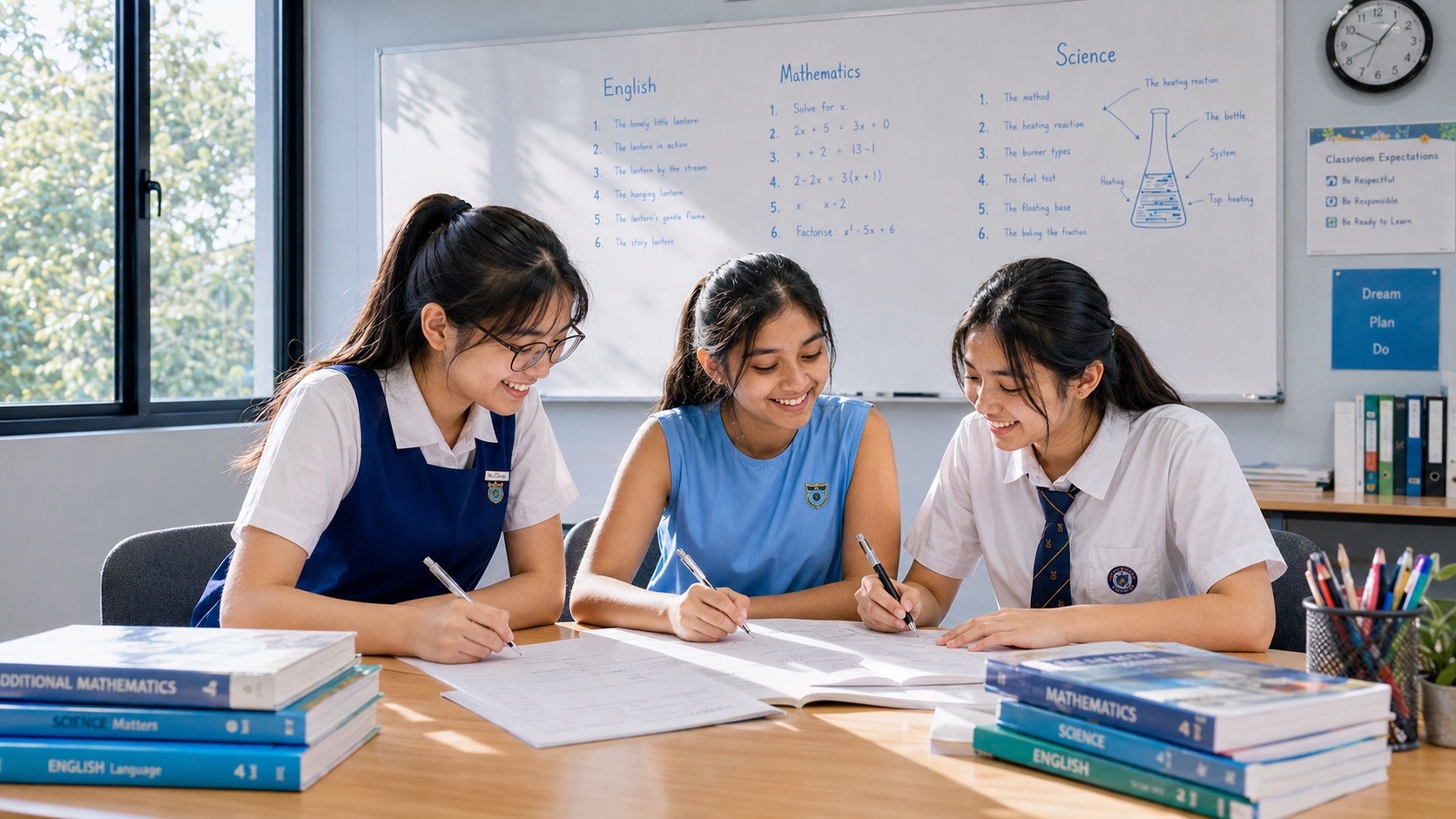
Families searching for Sembawang English Tuition Secondary 3, Secondary 3 English tuition Singapore, SEC G3 English, argumentative writing, discursive writing, situational writing, comprehension, summary, editing, oral communication and upper-secondary English support are usually facing the year when knowledge must become performance. A Secondary 3 student may already understand inference, paragraph structure and grammar, yet still produce uneven results because those skills are not stable when tasks are mixed, unfamiliar or timed.
Strong Secondary 3 English tuition in Sembawang should therefore build a performance system rather than simply introduce more advanced content. Current upper-secondary programmes emphasise comprehension, summary, continuous writing, situational writing, oral, editing and examination strategies because those are the visible demands. The deeper job is reliability: can the student choose a method, sustain quality, manage time, recover after a weak start and produce another strong attempt without needing the tutor to recreate the whole process?
This rebuilt guide is deliberately different from the separate Secondary 3 upper-secondary ramp page on this site. That page explains the architecture students need to learn. This page focuses on making that architecture stable under variation and pressure. For students who will sit the first Singapore-Cambridge Secondary Education Certificate in 2027 at G3, SEAB lists English Language as syllabus K300, with 1184 shown as the reference code for 2026 and earlier. The article therefore builds around transferable writing, reading, summary, editing and oral processes while reminding families to follow the student’s actual registered subject level and current school materials.
Secondary 3 performance is about reliability
A student may write one excellent essay and one weak essay the next week. They may answer inference accurately in tuition but miss a similar mechanism in school. Performance becomes stable when the underlying decisions can be retrieved across topics, texts and time limits.
Secondary 3 is the right year to make variation deliberate before final-year pressure becomes dominant.
Build a performance dashboard
Track five dimensions: understanding, selection, execution, time and checking. A mark alone cannot show which one failed.
- Understanding: did the student understand the text or task?
- Selection: was the right method, evidence or question chosen?
- Execution: was the chosen method carried out accurately?
- Time: was quality maintained under realistic limits?
- Checking: were familiar risks reviewed intelligently?
Each week, choose one or two dimensions to improve rather than trying to “get better at English” in the abstract.
Use secure, unstable and pressure-sensitive states
Secure means the skill works independently on fresh material. Unstable means it works inconsistently. Pressure-sensitive means it works untimed but degrades under time or task-switching.
This distinction matters. Pressure-sensitive summary needs timing practice; unstable summary may need the process retaught.
Performance starts with question selection
In writing, students should learn to assess a prompt quickly. Do I understand the wording? Can I form a clear position or narrative route? Do I have enough development? Does the form suit my strengths?
Choice should be strategic but bounded. Spending fifteen minutes deciding is itself a performance problem.
Argumentative writing needs a thesis that controls the essay
A thesis should answer the exact question and provide a direction for the body paragraphs.
Worked thesis
Question: “Social media does more harm than good for young people. Do you agree?” A workable thesis might be: “Social media can amplify distraction and unhealthy comparison, but its overall impact depends on how deliberately it is used; the greatest harm occurs when platforms replace rather than support real judgement, relationships and purposeful activity.”
The thesis creates claims and room for qualification.
Test a thesis with three questions
Can I defend it? Can I build two or three distinct claims from it? Can I respond to a reasonable opposing view? If not, the thesis may be too vague or too absolute.
Plan body paragraphs before introductions
Students often polish an opening while the argument underneath remains uncertain. Write the claim sequence first. Once the route exists, the introduction can frame it efficiently.
Paragraph performance depends on development
A strong paragraph moves through claim → explanation → example or evidence → analysis → link or qualification. Not every paragraph needs the same visible template, but the logic should be present.
Worked paragraph
Claim: part-time work can teach responsibility. Explanation: students must manage time and meet commitments outside school. Example: a student working a weekend shift has to arrive punctually and communicate if unavailable. Analysis: these consequences make responsibility practical rather than theoretical. Qualification: excessive work hours can damage study and rest, so the benefit depends on balance.
Examples should be tested for relevance
Ask: If I removed this example, would the claim become less convincing? If not, the example may be decorative.
Then ask how the example proves the point. Analysis makes evidence work.
World knowledge should support reasoning, not become trivia
Read across technology, environment, education, health, work, media, culture and community issues. The goal is to understand mechanisms and trade-offs, not memorise hundreds of numbers.
Useful questions include: What caused this? Who benefits? What trade-off appears? What might an opposing view say?
Use evidence honestly
If the student cannot remember the source or context of a statistic, avoid inventing precision. A well-explained real-world example can be stronger than a confident but unreliable number.
Counterarguments should be fair
Represent the opposing view at its strongest reasonable form, then respond. This shows control rather than insecurity.
Worked counterargument
“Supporters of strict phone bans argue that removing devices entirely protects attention during lessons. That concern is reasonable when phones are unrelated to learning. However, a blanket ban can also remove useful research and accessibility tools, so rules should distinguish purposeful use from distraction.”
Discursive writing needs balance without shapelessness
Discussing both sides does not mean writing two unrelated lists. Organise the essay around dimensions: educational effect, social effect, practical limits or long-term consequence.
End by synthesising what the comparison reveals.
Narrative performance needs a causal route
Under time pressure, students may invent events as they go. A short plan protects causality: situation → disruption → response → consequence → decision → resolution.
Worked narrative plan
Situation: student agrees to coordinate a class project. Disruption: misreads a deadline. Response: tries to hide the mistake. Consequence: teammates prepare for the wrong date. Decision: admits error and contacts everyone. Resolution: project is reorganised and trust is repaired through action.
Reflective writing should show a change in understanding
Reflection is not a moral sentence attached to the ending. It explains how the event changed the writer’s view of themselves, others or an issue.
Specific insight is stronger than generic “I learned to be responsible”.
Situational Writing performance begins with task fulfilment
Identify role, audience, purpose, context, required information and desired response before drafting. Then order the content for the reader.
Under pressure, a checklist protects against missing a stimulus point.
Adapt tone deliberately
Tone is built from relationship, vocabulary, sentence structure and degree of directness. A proposal to an organisation, speech to peers and message to a friend should not sound identical.
Use a two-minute situational audit
Before writing: audience, purpose, content, order. After writing: completeness, tone, action requested. A short audit is more useful than vague rereading.
Comprehension performance begins with passage mapping
Write a short function for each paragraph. In non-fiction: introduces issue, explains cause, gives example, challenges view, concludes. In narrative: sets situation, creates tension, reveals turning point, resolves.
Mapping reduces repeated rereading and improves evidence selection.
Use the question as a search instruction
Before looking back at the text, identify the demand. Why? Evidence? Inference? Language effect? Comparison? Summary focus?
This prevents correct information from being used for the wrong answer.
Inference should weigh multiple clues
Upper-secondary passages often contain mixed signals. One polite phrase may coexist with irritated body language. Students should weigh the whole pattern.
Worked inference example
“The coach smiled as he returned the form, but tapped the unsigned section twice and waited without speaking.” The smile alone suggests friendliness, but the tapping and silence suggest he still expects the omission to be corrected. A strong inference incorporates both.
Language effect needs word-level precision
Ask why the writer chose this word rather than a neutral alternative. What association does it carry? What image, movement or attitude does it create?
Worked effect example
“Complaints flooded the website.” “Flooded” suggests a sudden, large volume arriving faster than the system can comfortably handle, creating a sense of overwhelming pressure.
Use timed evidence selection
Give a question and thirty seconds to identify the best supporting clue before writing. This isolates selection from sentence construction and shows where time is being spent.
Summary performance begins before writing
Rewrite the focus as a filter. Select relevant points. Remove examples and repetition. Only then paraphrase and compress.
Students who write while searching often miss points and duplicate ideas.
Use point clusters
Group related points before writing. If several details concern cost, combine them where meaning allows. If several details describe accessibility, treat them as a cluster.
Clustering supports compression and coherence.
Paraphrase the proposition
Identify what the sentence claims, then rebuild it. Do not replace every word with a synonym.
Worked paraphrase
Original: “Flexible schedules allowed employees to avoid peak-hour travel.” Paraphrase: “Employees could travel outside the busiest periods because their working hours were more flexible.”
Editing performance should use personal risk categories
Track the student’s recurring categories: agreement, tense, word form, preposition, article, pronoun, sentence boundary, punctuation.
Before submitting writing, check the top two personal risks first.
Mixed language practice should remove chapter labels
Once a rule is secure, mix it with others. The student must recognise what controls the sentence.
This mimics the cognitive demand of real editing more closely than twenty identical items.
Oral performance requires planned structure and real listening
Use position → reason → example → qualification. Then practise follow-up questions that force the student to adjust.
Worked oral response
Prompt: Should schools use more technology? “Technology is useful when it gives access to tools that improve learning, such as simulations or collaborative documents. However, using devices simply because they are available can increase distraction, so the educational purpose should come first.”
Do not memorise complete oral scripts
Scripts can make a student sound prepared until the examiner asks a follow-up. Build flexible theme banks and practise connecting examples to new questions.
Listening performance includes recovery
One missed detail should not become three. Practise marking uncertainty and returning immediately to the current audio.
Recovery is a performance skill that can be trained before Sec 4.
Use component timing before full-paper timing
Time essay planning, one body paragraph, one comprehension section, summary selection and oral preparation separately. This reveals bottlenecks.
A full paper only tells you that the student was slow; component timing tells you where.
Build time checkpoints
During practice, note where the student should approximately be after a chosen interval. Checkpoints help detect over-investment early rather than at the end.
They should be flexible guides, not panic alarms.
Mini-mocks train switching
Create a mixed 45-minute task: editing, short comprehension, summary selection, situational plan and one argumentative paragraph. The student must switch among processes.
Switching is part of examination performance.
Full papers should answer a specific question
Is the purpose stamina? Timing? Question selection? Recovery? Score stability? Use full papers deliberately.
Then analyse the relevant evidence rather than simply recording the total.
Use a performance error ledger
Columns: task, first failure, mechanism, time impact, next-time cue, fresh retest. This adds time to the familiar error-analysis loop.
An error may be conceptually small but expensive if it repeatedly consumes minutes.
Train first-wrong-decision review
A weak essay may fail with a vague thesis before any grammar issue appears. A weak summary may fail at point selection. A weak inference may fail at the question command.
Repair the earliest cause.
Use delayed retests under slightly more pressure
After a repair succeeds untimed, wait several days and repeat with different surface details and a modest time limit. This tests whether the method survives pressure.
Track prompt dependence
A correct answer after “look at paragraph four” is different from an independent answer. Record prompt level: model, strong hint, small cue, independent.
Performance should improve as prompts disappear.
Common failure pattern: one good essay creates false confidence
Repeat the same architecture on different topics. Stability across variation is stronger evidence than one polished piece.
Common failure pattern: timing introduced before method stability
If the student does not know how to select summary points, a timer teaches rushed confusion. Clarify the process first.
Common failure pattern: world knowledge collected but never used
Turn reading into paragraph practice or oral discussion. Knowledge becomes useful when the student explains a mechanism or trade-off.
Common failure pattern: feedback is remembered only on the old question
Change the surface. If the student cannot recognise the same mechanism, the repair has not transferred.
Common failure pattern: overchecking everything
Checking every possible risk is slow. Use personal high-frequency risks and task-specific checklists.
Practice set: twelve Secondary 3 performance tasks
- Classify three skills as secure, unstable or pressure-sensitive.
- Choose between two writing prompts in two minutes and justify the choice.
- Write a thesis that creates three distinct claims.
- Develop one argumentative paragraph with analysis.
- Write a fair counterargument and response.
- Plan a situational task from role, audience and purpose.
- Map five paragraphs of an unseen passage.
- Write an inference that weighs mixed clues.
- Explain the effect of “complaints flooded the website”.
- Select and cluster summary points before paraphrasing.
- Time one component and identify the bottleneck.
- Retest one old correction under a modest time limit.
What strong responses look like
1. Classification is based on fresh independent performance.
2. Choice uses understanding, content depth and form suitability rather than topic attractiveness alone.
3. Thesis answers the exact question and provides a route.
4. Paragraph includes analysis of the example.
5. Opposing view is represented accurately.
6. Plan includes content and reader strategy.
7. Map identifies paragraph function, not copied detail.
8. Answer incorporates all relevant evidence.
9. “Flooded” suggests sudden, overwhelming volume.
10. Clustering happens before sentence writing.
11. Timing data identifies a trainable stage.
12. Retest demonstrates transfer rather than memory of the old answer.
An eight-week performance cycle
Weeks 1–2: dashboard, mixed diagnostic and writing architecture. Weeks 3–4: comprehension, summary and evidence selection. Week 5: editing and situational writing. Week 6: oral/listening and world knowledge transfer. Week 7: timed components and mini-mocks. Week 8: delayed retests and Independence Test.
A 90-minute small-group lesson
10 minutes: retrieve personal performance cues. 25 minutes: one high-value reading or writing mechanism. 20 minutes: variation practice. 25 minutes: timed mixed task. 10 minutes: first-failure analysis and fresh retest.
The lesson should end with independent output, not only explanation.
Small groups improve judgement
Three students can compare thesis choices, evidence selections and paragraph plans. The tutor can ask why one is stronger, more relevant or more efficient.
This turns peer difference into analytical practice.
Parent checkpoints
- Can the student identify pressure-sensitive skills?
- Does writing choice happen efficiently?
- Can a thesis control the essay?
- Are examples analysed?
- Can counterarguments be handled fairly?
- Does situational writing adapt to audience?
- Can comprehension structure be mapped quickly?
- Are inferences evidence-bound?
- Can language effect be explained?
- Does summary begin with selection and clustering?
- Are personal editing risks known?
- Can oral responses handle follow-up?
- Have time bottlenecks been measured?
- Do corrections survive delayed timed retests?
Frequently asked questions
What is the current 2027 G3 English code?
SEAB lists G3 English Language under the 2027 Singapore-Cambridge SEC as syllabus K300, with 1184 shown as the reference code for 2026 and earlier. Students should confirm their registered level with their school.
Should Secondary 3 students do full papers?
Selected full papers are useful, but component timing and mixed mini-mocks often provide clearer learning while the performance system is still being built.
How can writing become more consistent?
Use repeatable planning architecture, practise across varied topics, measure time and analyse first failures. Consistency is built through transfer, not one model essay.
How can comprehension improve under time?
Map passage structure, interpret the command before searching, practise evidence selection separately and add timing after the method is stable.
How can summary become faster?
Select and cluster before writing. Separate point identification from paraphrase and compression.
How do we know Sec 4 readiness?
The student handles varied upper-secondary tasks independently, maintains method under realistic component timing and uses error evidence to guide revision.
Teaching Guide
Teach Secondary 3 as a performance-building year. Begin with reliable methods, then introduce variation, switching and time. Do not mistake exposure to exam-shaped work for stable performance.
Measure where quality breaks. If a student writes well untimed but weakly under pressure, train pace and recovery. If the method itself is unstable, return to explicit teaching before adding more time pressure.
Use error ledgers and delayed retests. The same repair should survive different topics and a reasonable time constraint. Prompt levels should fall as the year progresses.
The destination is a learner who enters Secondary 4 with stable language architecture and an emerging examination operating system: choose, plan, execute, check, recover and learn from evidence. That is the performance bridge Secondary 3 should build.
Build a termly Independence Test
Use an unseen comprehension set, summary, editing cluster, writing plan and oral prompt. Add component time limits appropriate to the skills already taught. Give no hints during the first attempt.
Record whether performance fails at understanding, selection, execution, time or checking. That profile becomes the next cycle.
Progress should look like stability under variation
A student begins producing comparable quality across different prompts, genres and passages. They spend less time deciding how to start, recover more quickly after difficulty and use checking selectively.
Stable decisions are the foundation of stable examination results.
A final Secondary 3 performance checklist
- Knows current subject route.
- Can choose a writing question efficiently.
- Builds a defensible thesis.
- Develops paragraphs fully.
- Uses fair counterarguments.
- Adapts tone for audience.
- Maps passages quickly.
- Weighs evidence for inference.
- Explains language effect.
- Selects and clusters summary points.
- Tracks personal language risks.
- Handles oral follow-up.
- Knows personal time bottlenecks.
- Recovers after a difficult item.
- Passes delayed transfer tests with fewer prompts.
When these behaviours are working, final-year tuition can refine examination execution rather than rebuild the whole system from the beginning.
Historical eduKate Sembawang photo archive
The original image sequence is preserved below.


Leave a Reply