
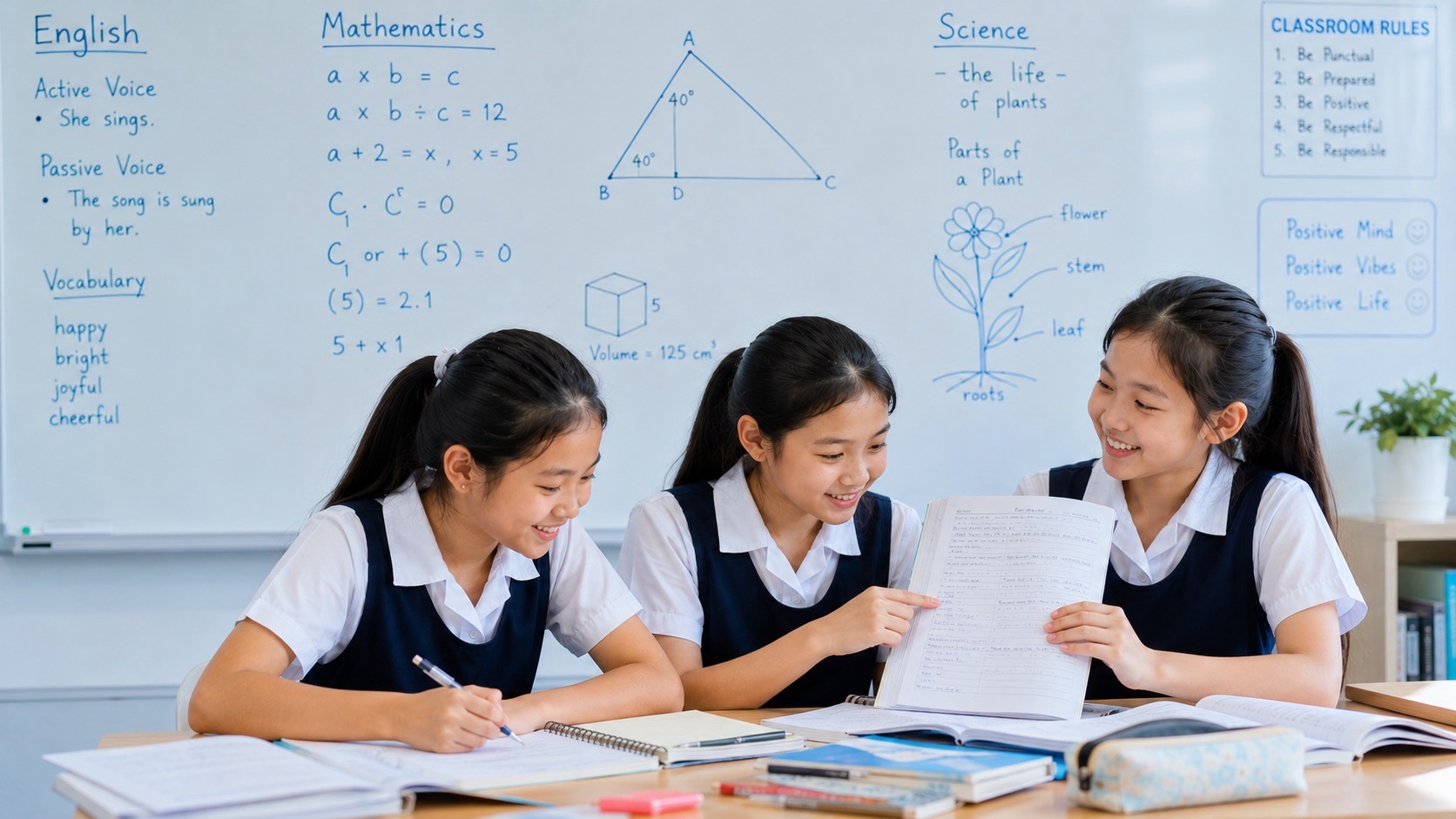
Parents searching for Sembawang English Tuition for Primary 2, Primary 2 English tuition Singapore, grammar, comprehension, vocabulary, sentence construction, picture composition and English enrichment are often looking at the same transition from different directions. Primary 2 is the year when a child who can write one sensible sentence must learn to connect several sentences so a reader can follow an idea. The language becomes longer, grammar begins carrying more weight, comprehension passages ask for more than word spotting, and writing starts to demand sequence rather than isolated captions.
Strong Primary 2 English tuition in Sembawang should therefore build a sentence-to-paragraph system. It should strengthen sentence completeness, subject–verb agreement, tense, vocabulary in context, reading comprehension, cloze, sequencing, picture composition and oral language together. Current high-ranking Primary 2 English programmes use exactly these search terms because they describe real learning jobs. The useful question is not whether a child can complete another page of exercises; it is whether the child can understand an idea, express it clearly, connect it to the next idea and revise it with less adult help.
This rebuilt guide is deliberately different from a general “Primary 2 tutor” page. It focuses on how a Primary 2 programme should move a learner from sentence control to paragraph control. We will diagnose the first weak link, build complete sentences, connect ideas with cause and sequence, use grammar to preserve meaning, teach vocabulary through reading, construct short responses, plan picture compositions and test independence on fresh material. The goal is a pupil who can carry a thought across several sentences without losing the reader halfway down the corridor.
Primary 2 is where sentences begin working together
A Primary 1 pupil may succeed with one sentence at a time. By Primary 2, school tasks increasingly expect several related sentences: a short composition, a comprehension answer with explanation, a retell, a note or an oral response. The child now has to maintain topic, tense, reference and sequence across more than one line.
This is why Primary 2 can feel unexpectedly difficult. The individual words are not always harder; the coordination is. The pupil must remember what happened first, who “he” refers to, which tense the paragraph began with and whether the next sentence adds, contrasts, explains or concludes.
Start by locating the first weak link
Do not begin with a global label such as “weak English”. Collect a short reading passage, five language-use items, a picture sequence and a four-sentence writing sample. Ask the child to read, explain and write without heavy prompting. Then classify what actually happens.
- Reading access: important words cannot be decoded or recognised.
- Vocabulary: sentences can be read but key words are not understood.
- Sentence control: ideas are present but words are omitted or misordered.
- Grammar: tense, agreement or pronouns make meaning unstable.
- Sequence: events are known but arranged unclearly.
- Paragraph control: each sentence is reasonable but the group wanders.
- Comprehension scope: the text is understood but the response does not answer the question.
The first failing mechanism determines the repair. If a child tells a coherent story aloud but writes fragments, the writing bridge needs attention. If the child writes neat sentences that do not follow the pictures, sequencing is the issue. If the story is clear but tense shifts repeatedly, grammar is the bottleneck.
Build the complete sentence before the longer paragraph
A sentence should carry one complete message. A useful starting frame is who or what + what happened. “The kitten hid.” “Maya laughed.” “The leaves were wet.” Once the message stands, the writer can add where, when, how or why.
Take “Maya laughed.” Add a reason: “Maya laughed because the puppy wore a paper cup on its head.” Add location only if useful: “Maya laughed beside the picnic table because the puppy wore a paper cup on its head.” The sentence becomes richer because each addition answers a reader’s question.
Worked example: repairing a fragment
Fragment: “The boy near the wet bench.” Ask, “What did the boy do?” Revised: “The boy waited near the wet bench.” Now the sentence has a subject and complete predicate. If the picture shows rain, the child might extend it: “The boy waited near the wet bench because his mother was bringing an umbrella.”
Teach word order as meaning
Young writers sometimes possess all the necessary words but arrange them according to the order in which ideas arrived. English readers expect familiar patterns. “Quickly the bus after ran boy” contains a complete scene somewhere inside it, but the reader has to excavate.
Use movable word cards and ask the child to build “The boy ran quickly after the bus.” Then vary one part: “The girl ran quickly after the bus.” “The boy ran slowly towards the bus.” This keeps syntax visible without reducing writing to copying.
Subject–verb agreement should be noticed in context
Agreement tells the reader whether one or more people or things perform the action. “The bird sings” and “The birds sing” use different verb forms. Children often overgeneralise the plural s and write “The birds sings”.
Teach with matched pairs: he runs / they run; the dog has / the dogs have; she is / they are. Then place the pair inside short meaningful sentences rather than leaving it on a chart.
Worked example: agreement inside a paragraph
Draft: “The boys is at the court. One boy kick the ball. His friends cheers.” Repair sentence by sentence: “The boys are at the court. One boy kicks the ball. His friends cheer.” The number changes, so the verb relationship changes.
Tense gives the paragraph a time home
A story about yesterday usually belongs mainly in the past. A routine belongs mainly in the present. Primary 2 pupils often begin correctly, then shift because the event becomes exciting: “Yesterday, Ali walked to the park and sees a dog. He runs to his mother.”
Use a tiny time marker at the top of the page: yesterday, now or every day. Ask the child to underline key verbs after writing and check whether they belong to the same time frame unless there is a clear reason to change.
Worked example: tense repair
Draft: “Last Saturday, Nina goes to the beach. She finds a shell and gives it to her sister.” Revised: “Last Saturday, Nina went to the beach. She found a shell and gave it to her sister.” The time marker controls the verb choices.
Build a personal bank of irregular verbs
Children reasonably produce forms such as goed, runned or catched because they are applying a regular rule. Correct the pattern explicitly and keep a small bank based on the child’s actual errors: go/went, see/saw, run/ran, take/took, give/gave, catch/caught.
Use each pair in a fresh sentence after several days. Retrieval is more valuable than copying the list repeatedly.
Connect sentences by relationship, not decoration
Paragraphs become coherent when sentences relate clearly. The connection may show time, cause, result, contrast or addition. Teach the relationship before the connector.
- Time: first, next, later, after, before, finally.
- Cause: because, since.
- Result: so, therefore at a later stage.
- Contrast: but, although.
- Addition: and, also.
Worked example: choose the correct relationship
“The floor was wet, ___ Sara walked carefully.” The intended relationship is result, so “The floor was wet, so Sara walked carefully.” “Because” would require reordering: “Sara walked carefully because the floor was wet.” Both can work; the sentence structure must match.
Do not begin every sentence with “Then”
Sequence words are useful, but a paragraph made entirely of “Then… Then… Then…” sounds like instructions for assembling a cupboard. Some sentences can connect naturally through pronouns, repeated topic and logic.
“Ben opened the cupboard. A small box sat behind the plates. He lifted it carefully and heard something rattle inside.” The sequence is clear without a connector at every step.
Pronouns help flow only when the reader knows the referent
Pronouns prevent repetitive naming, but too many can create fog. “He gave it to him because he needed it” may be grammatically possible and practically useless.
Teach the child to replace a pronoun with the noun when more than one person or object could fit. “Kai gave the torch to Ben because Ben needed it.” Once the reference is stable, pronouns can return naturally.
Punctuation supports paragraph control
At Primary 2, punctuation should make sentence boundaries visible. Capitals begin sentences and proper names. Full stops close statements. Question marks close questions. Commas may appear in familiar structures. Direct speech can be introduced carefully where the school programme supports it.
Teach children to tap the first word and final mark of each sentence during editing. This simple physical routine catches many run-ons and missing capitals.
Vocabulary should sharpen meaning
Primary 2 pupils benefit from a growing bank of precise verbs, nouns and descriptive words, but “big words” are not the target. A correct ordinary verb is stronger than an advanced word used incorrectly.
Compare went, walked, rushed, crept, stumbled and skipped. Act the verbs. Discuss when each fits. The child learns that word choice changes the picture.
Worked example: replace a vague verb
Draft: “The marble went under the cupboard.” Better: “The marble rolled under the cupboard.” The verb describes the movement more precisely.
Vocabulary in context should begin early
When reading, do not explain every unfamiliar word before the child thinks. Ask what the sentence and picture suggest. If “The puppy was drenched after the storm,” nearby rain clues may support “very wet”. Then confirm and use the word in a new sentence.
This prepares children for later comprehension cloze and vocabulary questions without turning Primary 2 into an upper-primary exam course.
Reading should feed writing
After a short story, notice one useful move: how the writer begins, connects events, chooses a verb or shows a feeling. Then write a new sentence or mini-paragraph using the same structural idea with different content.
If the model says, “Because the gate was locked, Amir waited outside,” the child can transfer the cause-first pattern to “Because the road was flooded, the bus stopped.” This is learning from writing without copying it.
Comprehension answers should match the question
Primary 2 comprehension may still be short, but answer scope matters. “Who?” needs a person. “Where?” needs a place. “Why?” needs a reason. “What happened next?” needs sequence.
Teach the child to circle or say the question word before searching the passage. This makes the reading purposeful.
Worked comprehension example
Text: “Leah left her hat on the bench. When the wind grew stronger, it rolled towards the pond. Her brother caught it before it reached the water.” Question: Why did her brother run? Supported answer: “He ran to stop Leah’s hat from reaching the pond.” The question asks for purpose, not simply the fact that the wind was strong.
Inference should remain modest
Young children can make simple inferences when evidence is clear. Text: “Ravi hugged the parcel and bounced on his toes when the delivery van stopped.” We may infer he is excited. We should not invent what the parcel contains unless the text tells us.
Use “I think ___ because ___” during learning. The frame makes evidence visible and can later disappear.
Picture composition begins with evidence
Before writing, separate what the picture clearly shows from what might reasonably happen next. If a girl holds an umbrella beside a puddle and a bus is approaching, we can see the umbrella, puddle and bus. We may infer she is waiting for the bus. We should not invent that she is travelling to a birthday party unless another clue supports it.
This evidence habit prevents stories from becoming disconnected adventures that ignore the stimulus.
Use a four-picture event map
For a picture sequence, label each frame in three to five words: finds lost wallet, looks for owner, takes to counter, owner returns. Say the entire story aloud before drafting.
Then convert each label into one or two sentences. Oral rehearsal reduces the load of inventing, spelling and punctuating simultaneously.
Worked picture-composition example
Frame 1: Ken sees a wallet near the playground gate. Frame 2: he asks nearby pupils. Frame 3: he brings it to the school office. Frame 4: a teacher returns it to the owner.
Paragraph: “Ken noticed a brown wallet beside the playground gate. He asked two pupils whether it belonged to them, but neither recognised it. Ken carried the wallet to the school office and explained where he had found it. Later, a teacher returned it to its relieved owner.”
The paragraph uses sequence, pronouns and a contrast connector. It remains close to the evidence.
Paragraphs need one centre
At this age, a paragraph can be short. The important idea is unity. If the paragraph is about finding a lost wallet, a sentence about the child’s favourite lunch may be grammatically correct and structurally irrelevant.
Ask the child to complete the sentence “This paragraph is mainly about ___.” Every sentence should contribute to that idea or its sequence.
Teach beginning, middle and ending as functions
A beginning establishes the situation. The middle introduces or develops the main event. The ending completes the immediate problem or shows the result. These are functions, not fixed phrases.
Primary 2 children do not need elaborate openings. “On Saturday morning, Zara visited the park with her father” is perfectly useful if the event then develops clearly.
Show feelings through small actions
Instead of repeating “He was sad,” teach children to choose one observable sign. “He stared at the torn card and lowered his head.” The action lets the reader infer the feeling.
Keep the scale age-appropriate. One action can be enough. The point is precision, not melodrama.
Dialogue should be short and purposeful
If dialogue is introduced, use it to change the event or reveal a response. “Watch out!” Mei shouted as the ball rolled towards the stairs. The speech matters because it triggers attention.
Dialogue that merely repeats narration adds punctuation difficulty without adding meaning.
Editing should happen in two passes
Pass one: meaning. Can the reader follow who did what and in what order? Are any words missing? Does one sentence contradict another?
Pass two: surface control. Capitals, full stops, tense, agreement, common spelling and spacing. Separating the passes keeps attention manageable.
Use a five-question editing card
- Does every sentence make sense?
- Do I know who each pronoun means?
- Did I keep the time mostly the same?
- Did I start with a capital and finish with a mark?
- Is there one word I should check?
The card should become less necessary over time. The aim is to internalise the questions.
Oral language should support paragraph writing
Some children can tell a coherent story but cannot write it efficiently. Let them speak the paragraph first. Record three event words. Then write one sentence at a time.
Over time, shorten the oral scaffold. A child who once needed the full story conversation may later need only a thirty-second plan.
Listening develops sequence and detail
Read a short four-sentence story aloud and ask for first, next and last. Then ask one reason question. Listening practice develops the same mental organisation that paragraphs require.
Do not repeat the text automatically. If the child misses a detail, ask what was remembered first. This shows whether the issue is attention, vocabulary or memory.
Build world knowledge through ordinary conversation
Talk about markets, buses, parks, weather, animals, school routines, food and neighbourhood events. Everyday knowledge gives children words and situations that later appear in reading and writing.
Ask open but manageable questions: “Why do we stand behind the line at the MRT platform?” “What happens to a puddle after a hot afternoon?” Language grows when ideas have somewhere to live.
Use a weekly sentence-to-paragraph cycle
Day 1: sentence completeness and agreement. Day 2: reading and vocabulary. Day 3: sequencing and connectors. Day 4: four-picture oral plan and short paragraph. Day 5: reread an earlier paragraph and repair one recurring error.
The cycle is more useful than completing five unrelated worksheets because each day strengthens a shared system.
Spaced retrieval matters in lower primary too
If a child learns past-tense verbs on Monday, revisit them in a different story later in the week. If “because” is introduced today, ask for one cause sentence during an ordinary conversation two days later.
A skill that appears only while the lesson page is open has not yet become available independently.
Common failure pattern: copying a model without owning the sentence
A child may produce beautiful writing by copying. That can practise handwriting and spelling, but it does not show composition control. After studying a model, cover it and change the subject or picture.
Ask the child to reuse the structure rather than the wording.
Common failure pattern: adult rewriting
A parent sees “The dog run and boy scared” and turns it into a polished paragraph. The final page improves; the child may not. Better: ask who is running, what tense the story uses and what the boy does because he is scared. Let the child rebuild the sentence.
Common failure pattern: too many corrections at once
If every spelling, grammar, vocabulary and punctuation issue is corrected simultaneously, the child may only learn that writing produces a page of red marks. Choose the highest-value meaning problem and one recurring convention.
Later drafts can carry new targets.
Common failure pattern: “good phrases” before sentence control
Memorised expressions can become awkward if the child cannot place them naturally. Secure clear sentence structure first. Then add precise vocabulary where it serves the event.
Common failure pattern: paragraph as sentence pile
Four correct sentences are not automatically a paragraph. Ask what the paragraph is about and how each sentence connects. Rearranging sentence cards can make coherence visible.
Common failure pattern: repeated “and”
Do not ban “and”; it is useful. Instead, identify the relationship. Some clauses should be separate sentences. Some require because, but, so or a time connector. Sentence variety grows from meaning.
Practice set: twelve sentence-to-paragraph tasks
- Repair the fragment: “The noisy children near the gate.”
- Choose: “The birds sings/sing every morning.”
- Change to past tense: “She goes to the shop and buys bread.”
- Join with a cause connector: “Leo took an umbrella. Dark clouds covered the sky.”
- Replace “went” in: “The marble went across the floor.”
- Repair the unclear pronouns: “He gave it to him because he lost his.”
- Put in order: dries puppy / hears whining / finds puppy / goes outside.
- Write one sentence from a picture of a child holding a broken kite.
- Write a two-sentence cause-and-result pair about a spilled drink.
- Turn these labels into a paragraph: sees smoke / switches off toaster / calls adult.
- Edit: “yesterday maya go park she finds a kitten”.
- Write a four-sentence paragraph about returning a lost item.
Model answers and rationales
1. “The noisy children waited near the gate.” The original had no complete action.
2. “The birds sing every morning.” Plural subject takes the base form.
3. “She went to the shop and bought bread.” Both actions belong in the past.
4. “Leo took an umbrella because dark clouds covered the sky.” The second idea explains the reason.
5. “The marble rolled across the floor.” The verb fits the movement.
6. One clear version: “Kai gave the ruler to Ben because Ben had lost his ruler.” Names remove ambiguity.
7. Hears whining → goes outside → finds puppy → dries puppy. The sound causes the search.
8. Example: “The boy stared at his broken kite beside the field.” The sentence states a visible situation without inventing a whole backstory.
9. “Mina knocked over her cup, so juice spread across the table. She fetched a cloth and wiped it up.” Cause and response are connected.
10. “Lila noticed smoke rising from the toaster. She switched it off immediately and called an adult for help.” The response is safe and logical.
11. “Yesterday, Maya went to the park. She found a kitten.” Capitals, end marks and past tense are restored.
12. Example: “At recess, Hana found a purse beneath a bench. She asked nearby pupils whether it belonged to them, but no one recognised it. Hana brought the purse to the school office. Later, its owner collected it and thanked her.”
A 60-minute Primary 2 lesson rhythm
10 minutes: retrieve two earlier sentence patterns and read a short passage. 15 minutes: teach one sentence or grammar relationship. 15 minutes: guided practice that fades to independence. 15 minutes: connect the skill to a short paragraph, comprehension item or oral response. 5 minutes: child states one editing question to remember.
The lesson should move from sentence-level accuracy to meaningful use rather than staying in drills for the entire hour.
Small groups make language visible
With three pupils, the tutor can compare sentence choices without losing individual accountability. One pupil may use “because”, another may split the idea into two sentences. The group can discuss which relationship each version expresses.
Different support can be given around the same task: one child receives a sentence frame, another receives only a connector prompt, and a third writes independently.
Parent checkpoints
- Can the child say a complete sentence before writing?
- Do subject and verb usually agree?
- Is tense becoming steadier across several sentences?
- Can the child explain why because, but or so fits?
- Are pronouns clear?
- Can a paragraph stay on one event?
- Can picture details be separated from invented details?
- Does the child plan a short sequence before writing?
- Can vocabulary be chosen for precision?
- Does the child edit meaning before punctuation?
- Can a comprehension answer match who/where/why?
- Are prompts being reduced over time?
Frequently asked questions
How long should a Primary 2 paragraph be?
Follow the school task. For skill practice, four to six connected sentences can be enough to reveal sequence, grammar and paragraph control. Coherence matters more than arbitrary length.
Should Primary 2 children memorise compositions?
Short models are useful for noticing structure, but whole-piece memorisation can hide whether the child can generate and connect ideas. Study a model, cover it, change the task and transfer the principle.
How much grammar drilling is useful?
Enough to make a pattern visible and retrievable, followed by use in reading, speaking or writing. Grammar should travel into communication.
What if the child has strong ideas but writes slowly?
Separate oral planning from transcription. Reduce the amount while preserving the thinking challenge. Build spelling and handwriting fluency separately when needed.
What if every paragraph uses “and then”?
Ask what relationship is actually present: cause, contrast, result or simple time. Replace only where meaning requires it. Also allow some sentences to stand without connectors.
How can parents help without rewriting?
Ask one diagnostic question at a time: “Who is doing this?”, “When did it happen?”, “Why does this sentence follow the previous one?” Let the child make the change.
Teaching Guide
Teach Primary 2 English as the move from sentence ownership to paragraph ownership. Begin with meaning: who, what happened and what the reader needs next. Secure complete sentences, agreement and tense, then connect sentences by real relationships. Use picture composition as a laboratory where sequence, vocabulary and grammar meet.
When correcting, locate the first place the reader loses the message. If the event order is wrong, do not begin with spelling. If tense shifts make the timeline confusing, fix the timeline before adding vocabulary. If the paragraph is coherent but punctuation is weak, the surface convention becomes the next target.
Fade support deliberately. Model one sentence, construct the next together, then ask the child to write from a fresh picture. Later, ask for a four-sentence paragraph with only a tiny event plan. Return to the same skills after several days. A method is becoming durable when the child starts asking their own editing questions.
The destination is modest and powerful: a Primary 2 pupil who can understand an event, express it in complete sentences, connect those sentences into a small coherent paragraph and repair a familiar error without an adult supplying the whole answer. That is the sentence-to-paragraph bridge Primary 2 should build.
Historical eduKate Sembawang photo archive
The original image sequence is preserved below.


Continue through Primary 2 English: Primary 1–3 article index · Primary English directory · English by area & school · Diagnostics · Examinations · Library
Leave a Reply