
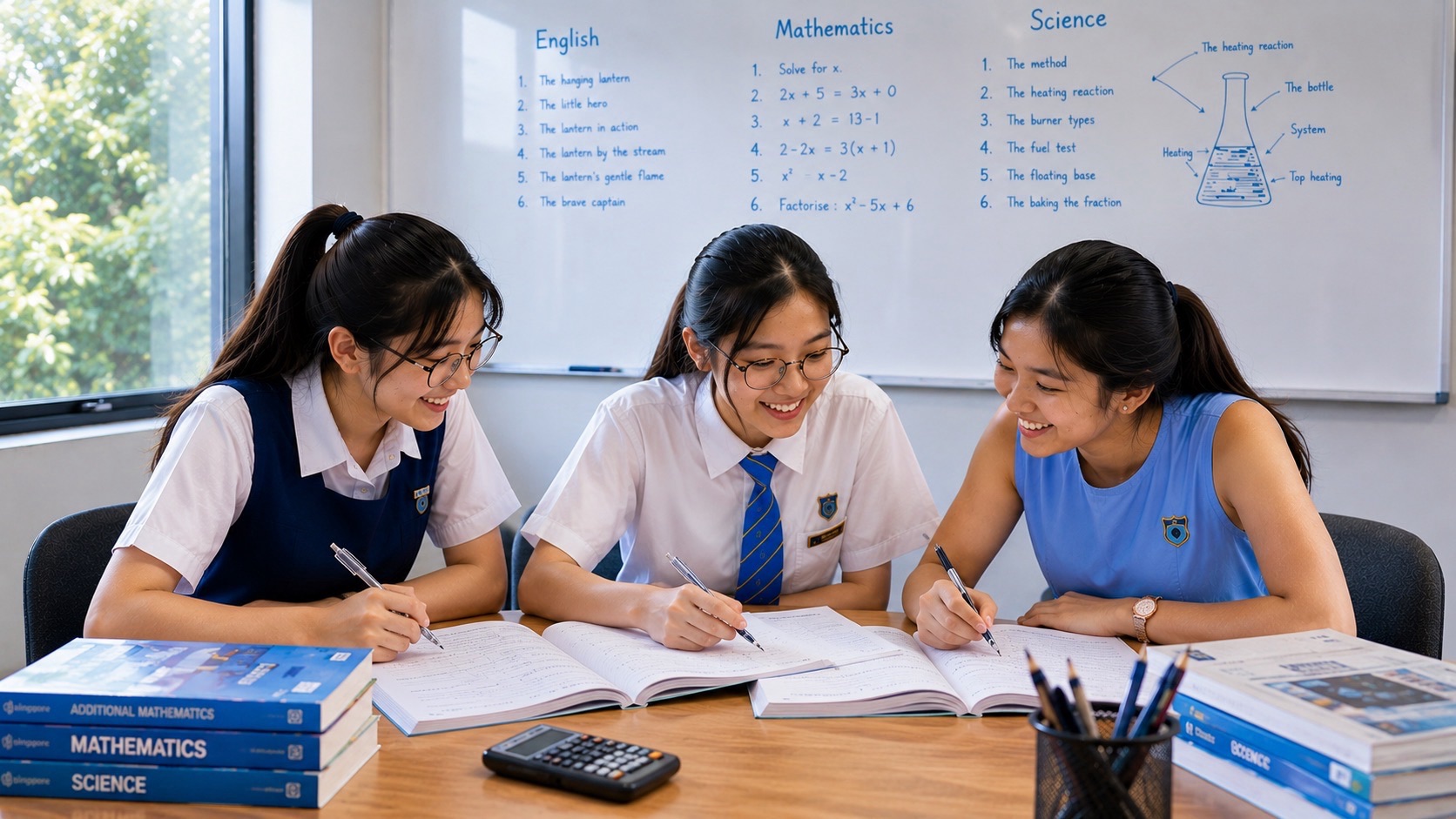
Sec 3 English Tuition Woodlands should help a student understand how writing creates an effect, not just what a passage says. Families searching for Secondary 3 English tuition in Woodlands, Sec 3 English tutor, writer’s craft, tone, comprehension, vocabulary, continuous writing, situational writing, oral communication or small-group English tuition often see students who can identify techniques by name but struggle to explain what those techniques actually do.
Secondary 3 is an ideal year for a writer’s craft and tone laboratory. Students can learn how diction, syntax, imagery, sentence length, repetition, contrast, punctuation and viewpoint shape a reader’s response. The same mechanisms can then be transferred into original writing so analysis and composition strengthen one another.
This page owns one learning job: notice craft → infer effect → explain mechanism → compare alternatives → transfer into new writing. It complements other Secondary 3 pages that focus on argument structure and source evaluation. Here, the central question is: how did the writer make this passage feel this way?
Technique Names Are Not the Final Answer
Students often write:
The writer uses imagery.
That identifies a feature but does not explain its effect.
Move to:
feature → language choice → reader effect → purpose.
Diction
Word choice affects tone.
Compare:
- walked;
- strolled;
- staggered;
- marched;
- crept.
Each carries different movement, energy and emotion.
Connotation
Compare:
- confident / arrogant;
- persistent / stubborn;
- curious / intrusive.
The dictionary meanings overlap, but the attitude changes.
Syntax
Sentence structure can change pace and emphasis.
Short sentence:
He stopped.
Longer sentence:
He kept walking despite the rain, the darkness and the growing certainty that he had taken the wrong road.
The effects are different.
Sentence Length as a Craft Choice
Short sentences can:
- create impact;
- slow the reader;
- signal a turning point.
Longer sentences can:
- build accumulation;
- create momentum;
- show layered thought.
Repetition
Repetition can create rhythm, emphasis or emotional pressure.
Ask:
Why was this word or structure worth repeating?
Contrast
Writers often place opposing images, ideas or sentence patterns beside one another.
Contrast can sharpen:
- change;
- conflict;
- irony;
- difference in values.
Imagery
Do not stop at “creates a vivid image”.
Ask what kind of image:
- violent;
- fragile;
- cold;
- crowded;
- calm;
- unsettling.
Then explain why that image matters.
Metaphor
A metaphor transfers qualities from one thing to another.
Ask:
- What qualities are being borrowed?
- Which interpretation does that encourage?
- What tone results?
Sound and Rhythm
In prose, sound can still matter through:
- alliteration;
- repeated consonants;
- rhythmic phrasing;
- abrupt punctuation.
Use these only when the effect is genuinely supported.
Punctuation as Craft
Dashes, colons, fragments and parentheses can influence pacing and voice.
Students should explain the local effect, not memorise one universal meaning for each mark.
Tone
Tone is the writer’s attitude as expressed through language.
Useful tone labels include:
- admiring;
- critical;
- amused;
- sarcastic;
- concerned;
- nostalgic;
- urgent.
But labels need evidence.
Build Tone From Clusters
One word rarely proves the entire tone.
Use a cluster:
diction + syntax + imagery + context.
Tone Can Shift
A passage may begin playful and become serious.
Track:
- where the shift occurs;
- which language changes;
- why the change matters.
Viewpoint
Who sees the event affects what the reader notices.
Ask:
- Whose perspective dominates?
- What does that person know?
- What might they misunderstand?
Distance
A writer can sound close to an experience or detached from it.
First person may create immediacy, but not always reliability.
Craft Comparison
Rewrite one sentence in two different ways.
Example:
The room was quiet.
Version A:
The room held its breath.
Version B:
No one spoke.
Compare tone and effect.
Alternative-Choice Analysis
Ask:
Why this word and not the obvious alternative?
This pushes analysis toward precision.
Writer’s Craft in Comprehension
A strong answer often uses:
quotation or reference → precise feature → effect → link to context.
Avoid Empty Effect Phrases
Weak:
This makes the reader want to read on.
Better:
The abrupt fragment interrupts the slower description, making the character’s realisation feel sudden.
Transfer Craft Into Writing
After analysing a technique, use it in a fresh piece.
Example:
- analyse a short sentence used for shock;
- write a new scene where a short sentence marks a turning point.
Do Not Copy the Model
Transfer the mechanism, not the wording.
Craft Imitation Exercise
Model pattern:
Long build-up sentence. Short impact sentence.
Student creates an entirely new context using the same pacing pattern.
Diction Transfer
Give a neutral verb and ask students to choose alternatives for different tones.
Example: looked
- glanced;
- stared;
- peered;
- glared.
Syntax Transfer
Ask students to write the same idea as:
- one short sentence;
- one complex sentence;
- one sentence beginning with a subordinate clause.
Then discuss which version suits the intended effect.
Imagery Transfer
Choose one sensory field:
- sound;
- temperature;
- movement;
- light.
Use only the details that support the scene’s emotional purpose.
Voice
Voice emerges from repeated choices in:
- diction;
- sentence rhythm;
- attitude;
- detail selection;
- level of formality.
It is not one technique.
Register and Voice
A situational piece may need a controlled formal voice. A narrative may need intimacy or urgency.
Students should be able to shift appropriately.
Craft Under Time
In timed writing, students should not try to use every technique.
Choose a small number that serve the purpose.
Craft Hierarchy
Priority:
- clear meaning;
- relevant content;
- controlled structure;
- purposeful craft.
Technique should strengthen the message, not replace it.
Small-Group Craft Lab
Three students rewrite the same neutral paragraph for different tones:
- hopeful;
- threatening;
- comic.
Then identify which language choices created each effect.
The Craft Ledger
| Craft move | Observed effect | Transfer task |
|---|---|---|
| Short fragment | Sudden emphasis | Turning point |
| Concrete verb | Stronger motion | Action scene |
| Contrast | Highlights change | Before/after paragraph |
| Image cluster | Builds atmosphere | New setting |
Do Not Over-Interpret
Every effect claim should be defensible from the actual words.
If several interpretations are possible, compare which is best supported.
A 90-Minute Writer’s Craft Lesson
- 10 min: read for overall tone.
- 15 min: identify craft cluster.
- 15 min: explain effect precisely.
- 15 min: compare alternative wording.
- 20 min: transfer one mechanism into original writing.
- 10 min: peer tone check.
- 5 min: rewrite one choice.
Worked Case: Student Names Techniques Without Effect
The tutor bans technique labels for one exercise and asks only: “What changed in the reader’s experience?”
Analysis becomes more concrete.
Worked Case: Writing Is Full of Techniques but Feels Forced
The student is using devices as a checklist.
The tutor starts from intended effect and chooses only techniques that serve it.
Worked Case: Tone Label Is Too Broad
The student calls the passage “sad”.
Language evidence suggests regret mixed with nostalgia. Tone becomes more precise.
Worked Case: Model Text Gets Copied
The student borrows exact phrases.
The tutor extracts the craft pattern, removes the model, and requires a new context.
What Parents Can Watch For
- Technique analysis becomes more specific.
- Tone labels are supported by evidence.
- The student compares alternative word choices.
- Craft mechanisms appear naturally in original writing.
- Writing becomes more purposeful rather than merely decorative.
What Not to Do
- Do not reward technique naming alone.
- Do not assume every image has the same effect.
- Do not force literary devices into every paragraph.
- Do not copy model wording.
- Do not over-interpret beyond the textual evidence.
A Twelve-Week Craft Build
Weeks 1–2: diction and connotation.
Weeks 3–4: syntax and sentence rhythm.
Weeks 5–6: imagery and contrast.
Weeks 7–8: tone shifts and viewpoint.
Weeks 9–10: craft transfer into original writing.
Weeks 11–12: timed analysis and selective craft use.
Frequently Asked Questions
What is writer’s craft?
The deliberate use of language and structure to create meaning, tone and effect.
How should students answer language-effect questions?
Identify the exact language, explain the effect it creates in context, and connect that effect to the writer’s purpose.
Should students use many literary techniques in compositions?
No. A few purposeful choices are usually stronger than a checklist of forced devices.
What is the independence goal?
A student who can notice how language works in a model and transfer the underlying mechanism into original writing without copying.
The Secondary 3 Craft Rule
Do not collect techniques. Learn how language choices change the reader’s experience, then make those choices deliberately yourself.
Historical Image Archive
The original 2019 image archive remains below.


Leave a Reply