
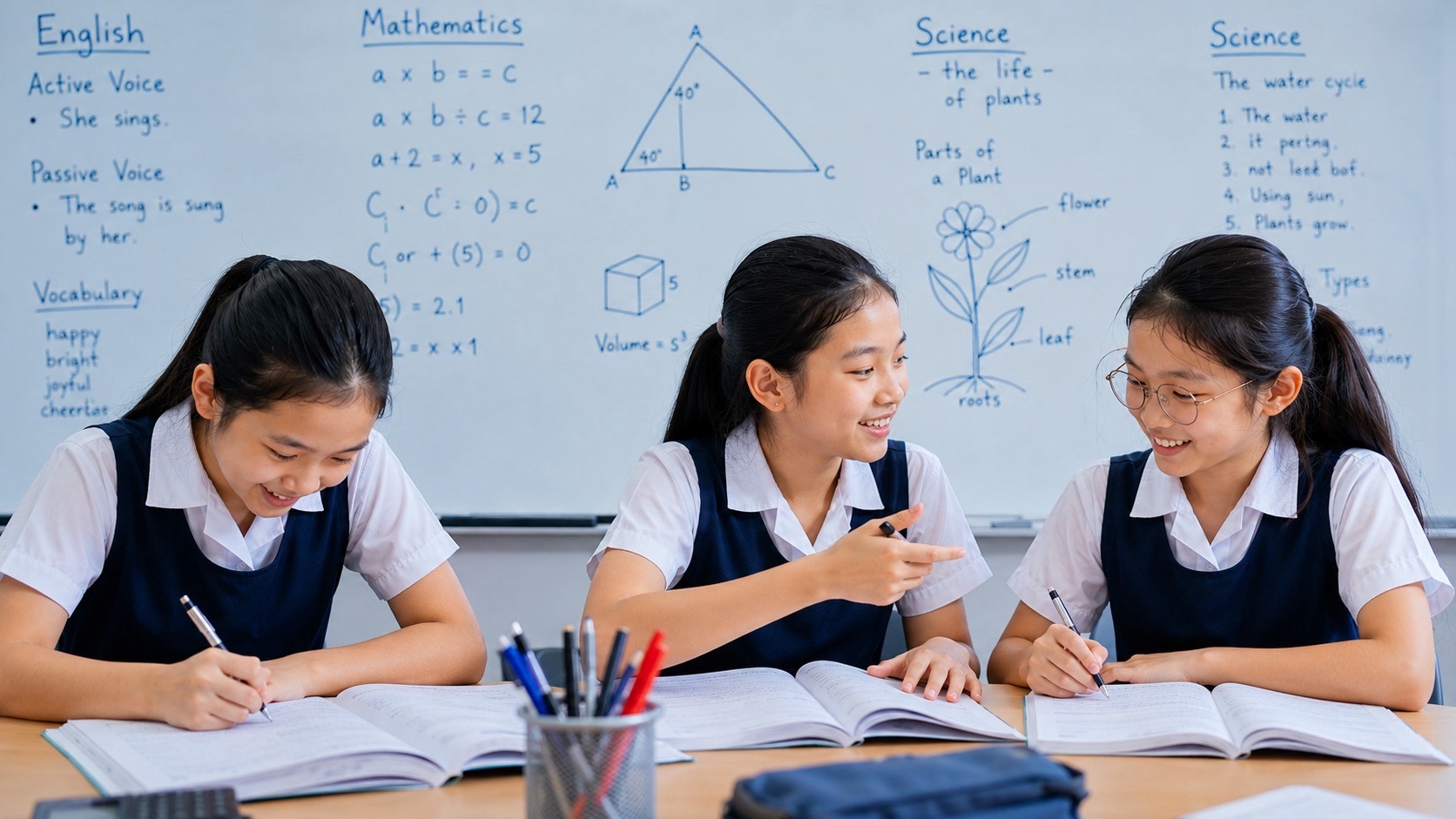
Science Tutor Bidadari is a legacy 2019 title rebuilt for families searching for a Bidadari Science tutor, Primary Science tuition Singapore, PSLE Science tuition, small-group Science tuition, scientific inquiry, fair tests, variables, experiment questions and MOE-aligned Science support. A strong Science student does more than remember facts: the student can ask what changed, what was measured, what must be kept the same and whether the evidence really supports the conclusion.
Primary 3, Primary 4, Primary 5 and Primary 6 Science increasingly require children to move between concepts and investigations. PSLE Science preparation therefore needs conceptual understanding together with experiment design, observation, prediction, hypothesis, variables, data interpretation, evaluation and clear scientific explanation. Students who memorise labels such as “independent variable” and “dependent variable” without understanding comparison logic often struggle when a question presents an unfamiliar setup.
This guide concentrates on that inquiry gap. It shows how a three-student Science group can turn experiments from a vocabulary exercise into a reasoning system: identify the question, control the comparison, collect evidence, test the claim and explain what the results do—and do not—show. The historical title is retained for continuity and does not claim affiliation with any school, examination body or tuition centre in Bidadari.
Science begins with a question worth testing
Children often meet experiments after the apparatus has already been drawn for them. They see two beakers, two lamps or two plants and immediately start hunting for the answer. A better habit begins one step earlier: what is the experiment trying to find out?
If the question is “Does the distance from a lamp affect the rate of photosynthesis?”, the entire design becomes easier to read. Distance should change. A suitable indicator of photosynthesis should be measured. Other important conditions should remain the same. The experiment is not a collection of objects; it is a controlled comparison built around one question.
The comparison principle
Fair-test reasoning becomes much clearer when students understand one simple principle: if two setups differ in many important ways, we cannot confidently attribute a difference in results to one chosen factor. Control is therefore not a ritual. It protects the meaning of the comparison.
Suppose two identical plants receive different amounts of water, but one plant also receives more light and has a larger pot. If one grows taller, the result cannot cleanly answer whether water amount caused the difference. The child should learn to ask, “What else could have caused this?” That question sits at the heart of experimental design.
Changed, measured and controlled variables
Students often memorise variable names in isolation. It is more durable to understand their jobs:
- Changed variable: the factor deliberately altered to create the comparison.
- Measured variable: the result observed or recorded to see what happened.
- Controlled variables: relevant conditions kept the same so the changed variable can be interpreted fairly.
In an investigation of whether water temperature affects dissolving time, temperature is changed and dissolving time is measured. The amount of solute, volume of water, stirring procedure and container should be kept consistent where relevant. Rather than naming the variables mechanically, ask the child to justify each one. “Why must the amount of sugar be the same?” is a much stronger test of understanding than “What is the controlled variable?”
A hypothesis is more than a guess
A scientific prediction becomes more useful when it links the changed variable to an expected result and rests on a scientific idea. “I think the warmer water will be faster” is a prediction. “As water temperature increases, the sugar should dissolve in a shorter time because particles in warmer water move more rapidly and interact with the solute more frequently” contains a proposed relationship and a reason.
At Primary level, the exact terminology used by schools may vary, but the thinking remains valuable: state what you expect to happen, identify the direction of change and connect the expectation to relevant Science.
Observation before explanation
Scientific inquiry depends on disciplined observation. If a graph shows that the temperature fell from 80°C to 45°C in ten minutes, that is the evidence. “The object lost heat to the surroundings” is an explanation based on a model. Both may be correct, but they perform different jobs.
Students who jump immediately to explanation can overlook what the data actually says. A useful classroom routine is Observe → Describe → Infer → Explain. First state what can be seen or measured. Then describe the pattern. Next infer what may be happening. Finally use the relevant scientific concept to explain the pattern.
Reading tables without inventing a story
A table can look simple and still expose weak reasoning. Students should read headings, units and values before deciding what the results mean. If the table compares plant height over four weeks, check whether the starting heights were equal. If not, comparing final heights alone may be misleading. Sometimes change over time is more relevant than the final number.
Good table reading asks: What was measured? In what units? At what intervals? Which rows or columns should be compared? Is there a clear pattern? Is there an unusual result? Does the conclusion match every relevant value or only the convenient ones?
Graphs: read axes, scale and trend in that order
Many graph errors are not Science errors at all. They begin with careless reading. The student ignores the scale, confuses the horizontal and vertical axes, reads a value from the wrong interval or describes a rising line as “high” rather than “increasing”. These habits can be repaired explicitly.
- Read the horizontal axis and its unit.
- Read the vertical axis and its unit.
- Check the scale and intervals.
- Locate the relevant range or points.
- Describe the trend neutrally.
- Only then explain the trend using Science.
Why “same experiment, different picture” is such useful practice
Students often learn the appearance of an experiment instead of the logic. If every evaporation question uses two identical dishes under a fan, the child may memorise that picture. The tutor should change the surface: use cloths, trays, containers, airflow, temperature or exposed surface area. The student must still identify what changes, what is measured and what must be controlled.
This is transfer practice. It tells us whether the student has learned an experimental relationship or simply remembered a familiar diagram. Changed-question practice is one of the fastest ways to expose fragile understanding.
The first weak link in experiment questions
When a child repeatedly loses marks in experiment questions, the first weak link may sit in different places. One student cannot identify the investigation question. Another confuses changed and measured variables. Another understands variables but cannot explain why controls matter. Another reads data inaccurately. Another makes a conclusion that goes beyond the evidence.
A good Science tutor should not prescribe the same worksheet to all five problems. Diagnose first. Repair the earliest broken step. Then retest the entire reasoning chain.
Read → Diagnose → Prioritise → Repair → Practise → Connect → Perform → Review
The eduKate learning loop works particularly well for scientific inquiry. Read the experimental setup carefully. Diagnose where the student loses the logic. Prioritise the first weak link. Repair it with a concrete comparison. Practise several variations. Connect the idea to graphs, tables and open-ended explanations. Perform a fresh question without help. Review the reasoning, not just the mark.
How a three-student group makes experimental thinking visible
In a three-student lesson, each pupil can commit to an answer before discussion. One identifies the changed variable. Another argues whether a condition needs controlling. A third challenges the conclusion. The tutor can then see whether students are reasoning from evidence or simply agreeing with the most confident voice.
Small-group Science is powerful when every student must speak, draw, annotate and perform independently. The class size itself is not the educational mechanism. Visibility is.
A sample inquiry lesson
- Retrieval: identify variables from two older experiments.
- Cold attempt: solve a fresh fair-test question without hints.
- Diagnosis: locate the earliest reasoning failure.
- Repair: rebuild comparison logic with a simple real-world example.
- Variation: change apparatus, context and representation.
- Data phase: interpret a table or graph from the investigation.
- Explanation: justify the conclusion using evidence.
- Independence test: complete a new inquiry question alone.
Primary 3: learn to notice carefully
Primary 3 pupils benefit from learning to observe systematically. Instead of saying “This leaf is different,” describe the colour, shape, texture, edge or arrangement. Instead of saying “The material is strong,” ask what evidence supports that property. Classification should be based on explicit properties rather than vague resemblance.
Simple investigations at this stage can build the habit of asking one clear question and making one fair comparison. The goal is not advanced terminology. It is disciplined curiosity.
Primary 4: move from observation to relationship
Primary 4 pupils can begin to reason about systems and relationships more explicitly. What changes when one part of a circuit changes? How does a material property affect its use? What evidence distinguishes one group of organisms from another? Inquiry becomes a way to connect observations to models.
Primary 5: variables and evidence become central
Primary 5 is an important year for experimental reasoning. Students encounter more complex questions and are expected to combine topic knowledge with process skills. This is where fragile variable knowledge often becomes visible. A child may know the chapter but fail to evaluate a setup or interpret a graph.
Regular retrieval from older topics matters here. Scientific inquiry is not a chapter that ends. The same reasoning tools should appear across heat, light, forces, plants, systems, cycles and matter.
Primary 6 and PSLE Science: evidence under pressure
By Primary 6, students need to analyse unfamiliar information efficiently. They may be asked to interpret a graph, compare experimental conditions, predict a result, justify a conclusion or explain whether a method is fair. The strongest preparation is not endless repetition of one question type but broad transfer across contexts.
The current SEAB PSLE Science assessment objectives include applying scientific facts, concepts and principles together with scientific inquiry: making predictions and hypotheses, interpreting and analysing information, evaluating observations and methods, and communicating explanations and reasoning. Those objectives are a useful blueprint for revision.
Open-ended answers in inquiry questions
An inquiry answer often needs three layers: evidence, scientific relationship and conclusion. For example: “The plant in Setup A produced more bubbles per minute than the plant in Setup B. Setup A received greater light intensity because it was closer to the lamp. With more light available, the plant could carry out photosynthesis at a higher rate under these conditions.” Each sentence performs a different job.
A weak answer might simply say, “A has more light so it photosynthesises more.” That may point in the right direction but omit the evidence and the measured outcome. Precision helps the marker see that the student has connected the data to the concept.
Evaluating a method: ask what could make the comparison unreliable
When asked how to improve an experiment, students sometimes suggest random changes: “repeat more,” “use a bigger beaker,” “measure carefully.” A better method is to identify a specific threat to the comparison. Were starting conditions unequal? Was a variable uncontrolled? Was the measurement too subjective? Was the sample too small? Was the timing inconsistent?
Then propose a matching repair. If initial masses differ, standardise them. If temperature changes during the trial, monitor or control it. If one reading could be anomalous, repeat and compare results. Method evaluation should be causal, not decorative.
Repeated trials: why they help and what they cannot fix
Repeating an investigation can reduce the influence of random variation and reveal unusual readings. But repetition does not rescue a fundamentally unfair design. If Setup A receives both more light and more water than Setup B, repeating the same flawed comparison ten times still leaves the causal question unresolved.
This distinction is useful because it teaches students to evaluate the structure of evidence, not merely follow laboratory rituals.
Common inquiry failure patterns
- Names the variable but cannot justify it: vocabulary without comparison logic.
- Lists every condition as a control: weak sense of relevance.
- Changes two major factors: does not understand causal isolation.
- Describes a graph inaccurately: representation-reading weakness.
- Explains before reading data: conclusion driven by expectation instead of evidence.
- Claims “proved” from limited data: conclusion stronger than the evidence allows.
- Suggests “repeat” for every method flaw: improvement strategy is memorised rather than diagnosed.
An error log for Science investigations
Instead of recording only the corrected answer, classify the mistake. Use short labels such as question misread, changed variable wrong, control missing, graph scale error, evidence not cited, conclusion too broad or mechanism incomplete. Patterns become visible after several papers.
Retest those error types later with new contexts. If the same error returns, the original correction was understood temporarily but not consolidated.
The independence test
After guided practice, give the student a fresh experiment question with changed apparatus and no prompts. The pupil should identify the investigation question, variables, controls, evidence and conclusion independently. If the child can do this, the inquiry framework is becoming portable.
If the student succeeds only after the tutor asks, “What should be kept the same?”, the skill is not yet independent. That is useful information, not failure. It tells us exactly what still needs repair.
Parent questions that reveal understanding
- What is this experiment trying to find out?
- What was deliberately changed?
- What was measured?
- What conditions must stay the same, and why?
- What does the data actually show?
- Does the conclusion match the evidence?
- What could make this comparison unfair?
- What would you change to improve the method?
These questions are more productive than simply asking, “Do you know your variables?” because they require the child to demonstrate the reasoning.
Choosing Science tuition: look for inquiry, not only notes
Families comparing Science tuition can ask how experiments are taught, how misconceptions are diagnosed, how students practise graph and table interpretation, how open-ended reasoning is corrected and how independence is checked. A good programme should integrate content knowledge with scientific practices rather than treat them as separate revision topics.
Small-group tuition earns its value when every child’s reasoning becomes visible. Three students should mean three predictions, three explanations, three pieces of evidence and three independent attempts—not one explanation delivered to three quiet listeners.
Official reference points
The MOE Primary Science Teaching and Learning Syllabus frames Science around knowledge, practices and values, including investigating, analysing data, communicating and evaluating ideas with evidence. The SEAB PSLE Science syllabus sets out assessment objectives covering knowledge with understanding, application and scientific inquiry.
Continue through the Science library
For broader Primary and PSLE Science learning, continue to Singapore Science Tuition. For small-group reasoning and discussion, see Punggol Science Tutors Small Groups.
Final idea
A good experiment is a carefully controlled question. A good Science student learns to see that structure. What changed? What was measured? What stayed the same? What evidence appeared? What conclusion is justified? Once those questions become automatic, fair tests stop feeling like a chapter to memorise and become a general method for thinking clearly.
Science learning route: Continue to the Science directory · Student Diagnostics. If you are choosing a current tuition service rather than using this free learning guide, use the Yishun Tuition Centre Hub and confirm current arrangements separately.
Leave a Reply