

Yishun English Tuition Centre (Secondary 4) should help a student keep language control when the task becomes cognitively demanding. Families searching for Secondary 4 English tuition in Yishun, Sec 4 English tutor, final-year English tuition, comprehension, summary, situational writing, continuous writing, editing, oral communication or examination preparation often see students who know grammar rules and vocabulary well in isolation but lose control when they must plan, reason, write and manage time simultaneously.
Secondary 4 therefore needs language control under cognitive load. The challenge is not only knowing English. It is keeping tense, sentence boundaries, pronoun reference, register, vocabulary precision and paragraph structure stable while attention is also occupied by ideas, evidence, audience and time pressure. A student who writes accurately in a grammar worksheet but makes repeated errors in essays has a transfer problem, not necessarily a knowledge problem.
This page owns one learning job: stable language knowledge → higher task load → identify breakdown → simplify the checking system → practise transfer → preserve control under pressure. It complements other Sec 4 pages on stamina, score variance and script analysis. Here, the focus is the language layer itself.
Cognitive Load Changes Performance
Writing requires several processes at once:
- understand the task;
- generate ideas;
- organise paragraphs;
- choose vocabulary;
- build sentences;
- control grammar;
- monitor time;
- edit.
When too many processes compete for attention, familiar grammar can fail.
Knowledge Versus Automaticity
A rule can be known but not automatic.
Example:
The student can explain subject-verb agreement but still writes an incorrect verb while building a complex argument.
The repair should move the rule into higher-load tasks.
Find the Load Point
Ask where the error appears:
- isolated sentence;
- short paragraph;
- full essay;
- timed essay;
- late in the paper.
The stage where the rule first collapses reveals the current transfer limit.
The Load Ladder
- isolated exercise;
- sentence generation;
- short paragraph;
- long paragraph;
- full writing task;
- timed mixed task.
Move up only when control is reasonably stable.
Personal Grammar Risks
Secondary 4 students should know their recurring families.
Common risks include:
- tense;
- subject-verb agreement;
- pronoun reference;
- sentence boundaries;
- articles;
- prepositions;
- word forms.
Do Not Check “Grammar” as One Giant Category
Choose two or three personal risks.
This reduces checking load and improves consistency.
Tense Control Under Load
Before editing, identify the timeline.
Then scan verbs around:
- flashbacks;
- reported speech;
- general statements;
- examples.
Agreement Under Load
Long noun phrases can hide the true subject.
Train:
locate subject → ignore interrupting phrases → check verb.
Pronoun Reference Under Load
When several people or ideas appear in one paragraph, pronouns become risky.
If the referent is unclear, repeat the noun.
Sentence Boundaries Under Load
Complex thinking often produces long sentences.
Watch for:
- run-ons;
- comma splices;
- fragments;
- overloaded sentences.
The Clarity-First Rule
When a sentence becomes hard to control:
split before sophistication.
Two clear sentences are better than one unstable “advanced” sentence.
Vocabulary Precision Under Load
Students sometimes reach for difficult words while managing complex ideas.
Use the exact-word test:
- Do I know the meaning?
- Does it fit the grammar?
- Does it fit the register?
- Does it collocate naturally?
- Would a simpler word be clearer?
Register Under Load
Situational writing can become too casual or too stiff when attention shifts to content coverage.
Before drafting, state:
role → audience → relationship → desired response.
That becomes the register anchor.
Register Drift
Students may begin formally and become conversational later.
During editing, compare the opening, middle and ending tone.
Paragraph Control Under Load
When cognitive load rises, paragraphs can lose their jobs.
Use one-line paragraph labels:
- claim;
- reason;
- example;
- counterargument;
- resolution.
If a paragraph cannot be labelled, its purpose may be unclear.
Writing Architecture Reduces Language Load
A dependable structure frees attention for language.
Argument paragraph:
claim → mechanism → evidence → implication.
Situational paragraph:
required point → explanation → requested action.
Do Not Invent Structure During the Draft
Short planning reduces decision load later.
Comprehension Language Control
Even comprehension answers can lose precision under time.
Use:
question scope → evidence → concise expression.
Summary Language Control
Paraphrasing under pressure can distort meaning.
Use:
understand → look away → rebuild → compare meaning.
Oral Language Under Load
Unexpected follow-ups increase load.
Use a flexible response frame:
position → reason → example → reflection.
Then vary the topic so the structure becomes automatic.
Recovery Language
Students can use natural phrases such as:
- Let me put that another way.
- A clearer example would be…
- What I mean is…
This protects fluency when retrieval fails.
Editing Under Load
A giant checklist creates more cognitive demand.
Use a priority sequence:
- task coverage;
- personal grammar risks;
- sentence breakdowns;
- register;
- surface polish.
Distributed Editing
Some students benefit from a short local check after a section plus a final global pass.
This prevents all checking from being left to exhausted final minutes.
Do Not Edit While Generating Every Sentence
Constant self-correction can interrupt idea flow.
Separate drafting from deeper editing where possible.
The Language-Control Ledger
| Language risk | Stable in | Breaks in | Next test |
|---|---|---|---|
| Tense | isolated work | timed essay | timed paragraph |
| Register | planned email | unfamiliar task | fresh audience |
| Pronouns | short paragraph | long analysis | multi-person passage |
Increase Load Deliberately
Do not jump directly from an isolated grammar worksheet to a full timed paper.
Use:
stable simple task → fresh paragraph → mixed paragraph → timed full task.
Mixed Error Practice
Once individual grammar families are stable, mix them so the student must identify the error type independently.
Unlabel the Practice
If every worksheet heading says “Tenses”, the student is not practising recognition.
Mixed editing is closer to examination conditions.
Delayed Transfer
Return to the same language risk later.
A correction that survives after delay is stronger evidence of automaticity.
Small-Group Cognitive-Load Lab
Three students complete the same paragraph task.
The tutor observes:
- who loses grammar when ideas become complex;
- who loses register;
- who overloads sentences;
- who can self-correct.
The Tutor Should Not Fix Every Error Immediately
Mark the sentence and ask the student to identify the error family first.
This builds independent monitoring.
A 90-Minute Language-Control Lesson
- 10 min: retrieve personal error families.
- 15 min: isolated accuracy check.
- 20 min: fresh paragraph under moderate load.
- 15 min: diagnose breakdown.
- 20 min: timed mixed writing.
- 5 min: priority edit.
- 5 min: update load ledger.
Worked Case: Grammar Perfect in Worksheets, Weak in Essays
The student does not need more of the same grammar sheet.
The rule moves into paragraph and timed writing where transfer can be trained.
Worked Case: Formal Email Becomes Casual
The student covers content well but register drifts midway.
An audience anchor is written before drafting and checked at the end.
Worked Case: Sentences Become Too Long
Complex ideas create run-ons.
The student uses the clarity-first rule and splits sentences before adding sophistication.
Worked Case: Vocabulary Sounds Forced
The student reaches for memorised advanced words under time.
The exact-word test prioritises natural precision.
What Parents Can Watch For
- Grammar remains stable in real writing.
- Sentence boundaries improve under time.
- Register stays consistent.
- Vocabulary becomes more precise and natural.
- The student uses a short personal editing routine.
- Prompting decreases.
What Not to Do
- Do not assume worksheet accuracy equals transfer.
- Do not use a giant grammar checklist under time.
- Do not force complexity when clarity is unstable.
- Do not correct every sentence before the student attempts self-diagnosis.
A Twelve-Week Language-Control Build
Weeks 1–2: identify personal error families and load point.
Weeks 3–4: paragraph-level transfer.
Weeks 5–6: register and vocabulary under fresh tasks.
Weeks 7–8: mixed editing and sentence control.
Weeks 9–10: timed full-task transfer.
Weeks 11–12: delayed retesting and independent priority editing.
Frequently Asked Questions
Why do grammar mistakes appear only in essays?
Because generating ideas, organising paragraphs and managing time increase cognitive load. The rule may not yet be automatic enough to survive that load.
How should students edit under time?
Prioritise task coverage and a small number of recurring personal language risks rather than checking everything equally.
Should students use more complex sentences?
Only when the relationship between ideas remains clear and controlled. Complexity without control increases error risk.
What is the final-year independence goal?
A student who can notice when language control is slipping and use a compact repair or editing routine without tutor intervention.
The Secondary 4 Language-Control Rule
Knowing a grammar rule is only the beginning. Final-year control means keeping that rule alive while your attention is busy doing everything else.
Historical Image Archive
The original image archive remains below as part of this page’s history.



Singapore English tuition with Tutor Yuet Ling. With Singapore school’s requirement for English as a First language, our primary aim in teaching English are highly focussed on tasking English student’s communication skills to be competent as well as to be an effective, accurate and efficient tool to absorb and relay information to others.
English is Singapore’s main language of communication and it is imperative that our student’s English Language skills are on parity with the requirements set forth by the Ministry of Education to study well in school. It is the main skill that will help students to perform consistently across their other subjects as their ability to understand and use English effectively will help them to comprehend what is taught in class and asked in tests.
English Tuition Centre with English tutor of 20 years in the business helping English students to improve their ability to communicate. An improvement of their linguistic competence in both the passive reading/listening and active speaking/writing process of the English Language are part of our course curriculum.
With that in mind, our English classes are geared to teach and train our students to be able to understand the media that they read or hear, and to have the ability to express and communicate their complex thoughts and ideas to others naturally. Any improvements in information absorption and dissemination will automatically translate to cognitive skills and ultimately, help students to do well in their studies.
English should be treated as our native language, to be the main Lingua franca for a cosmopolitan Singapore where over generations, English has been integrated well into our everyday life. As a first language, the focus of our tuition will be to task our Yishun students to learn the skills needed to communicate proficiently for both their studies in school as well as for their everyday life.
Local English Tutor for English tuition are the dependable, trustworthy tutor that delivers the results. Join our English tutorials and have our English Teacher get you on track. Small groups of 3.
increase general knowledge and all necessary skills needed for the PSLE
score maximum marks by understanding the marking scheme of the examination
in a safe, comfortable air con environment with properly equipped classes
by discerning tutors that can detect weaknesses, solve student’s problems during class
by qualified female tutors with experience in improving students for the crucial PSLE
Give us a call at +65 82226327 for more information on our Singapore English classes.
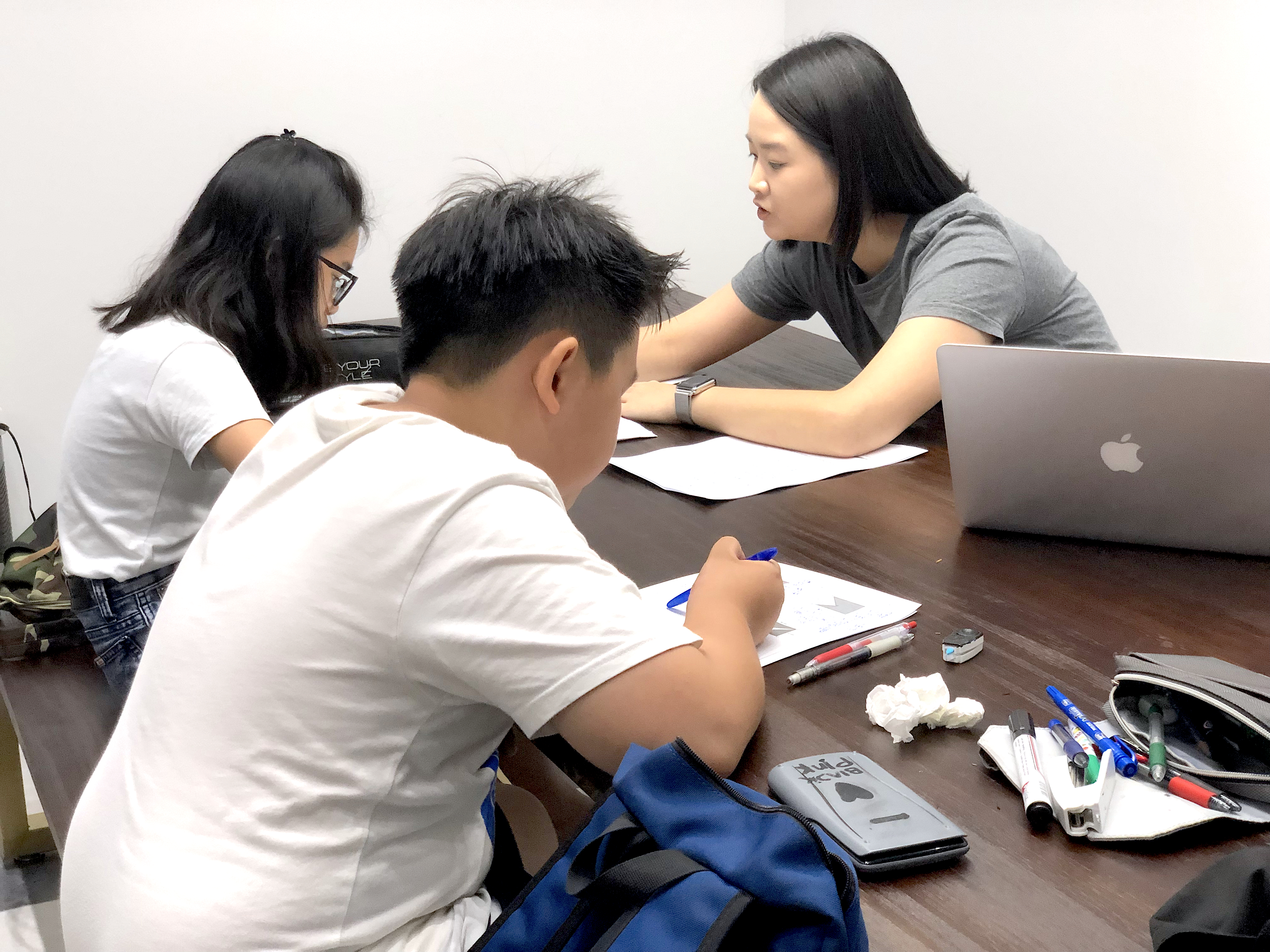














Pri3 Yishun The best Pri 3 English Tuition in Yishun with SEAB MOE PSLE syllabus English. Pri3 Yishun Primary English Tutor for Pri1 Pri2 Pri3 Pri4 Pri5 Pri6 PSLE English Paper 1 and Paper 2.
Call Yuet Ling +65 82226327 for our Pri3 Yishun English classes.


Learn English and make it useful.
Working closely with parents are part of our teaching culture to create the desired effect to get our English students positive changes in their studies. Our Yishun PSLE English tutors teach from scratch, making sure our English students master their language, and we do all the necessary practices from basic easy to complex advanced questions with our students, including past exam papers that helps them to understand and appreciate English as lingua franca in Singapore and use it to further their studies.
Class Culture
At eduKate Yishun, we work hard to have an affirmative class culture that empowers our students to do more, learn more, and develop a love for their own education by creating a class culture with great friends and tutors. Our positive classes also creates a constructive environment that teaches them the relevance of what they study to their everyday lives. With relevance creates the true reason for a proper education. That is our trademark that differentiates our teaching to others, but don’t just take our words for it, let these photos show you how much our passion and love for our Yishun student’s English lessons.





Leave a Reply