
Families searching for a Secondary 3 Additional Maths Tutor in Ang Mo Kio, Sec 3 A-Math tuition or small-group Additional Mathematics lessons are often trying to answer a deceptively simple question: why does the student understand when someone explains the solution, yet struggle to begin alone? Secondary 3 Additional Mathematics exposes this gap because algebra, quadratics, polynomials, coordinate geometry, trigonometry and calculus foundations all demand independent method recognition.
Strong tuition should therefore emphasise worked-example fading, retrieval practice, algebraic control, method recognition, mixed-topic practice, error analysis and delayed retesting. The tutor’s explanation matters, but the long-term goal is to make that explanation increasingly unnecessary. A student should move from watching, to completing with prompts, to solving independently, to solving after a delay and finally to recognising the method inside a mixed paper.
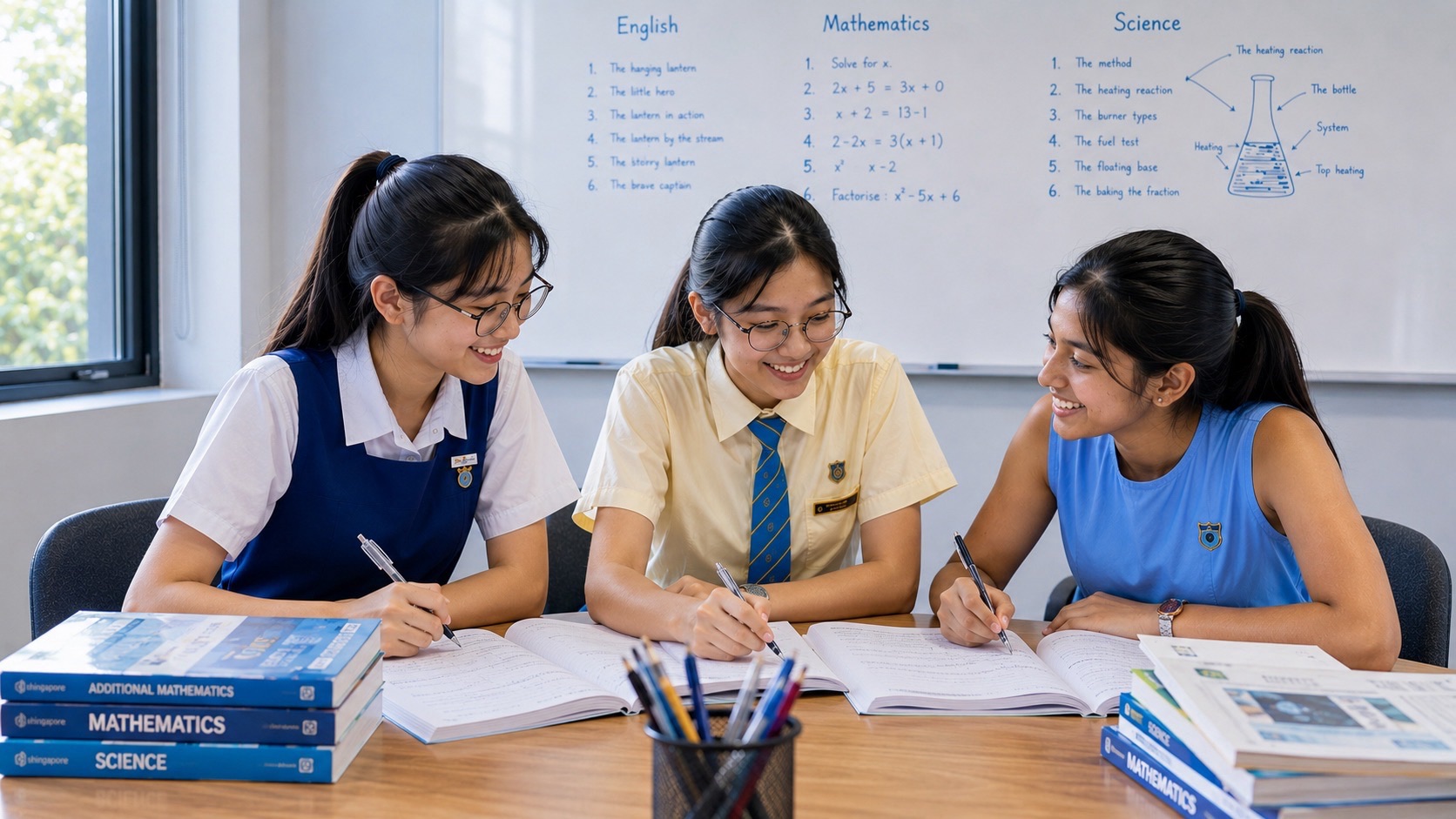
In a three-student tutorial, support levels can be observed precisely. One student may need a full model, another may need one structural cue, and a third may only need error correction. The useful progression is Attempt → Diagnose → Explain → Practise → Fade Support → Transfer → Retest. Secondary 3 is the ideal year to build this independence before examination pressure rises.
Understanding With the Tutor Is Not the Final Goal
“I understand when it is explained” is positive, but it does not yet prove mastery. Examination conditions remove the tutor, the chapter label and the immediate worked example. The student must recognise the structure and start alone.
Worked Examples Should Fade
- Full worked example.
- Partially completed example.
- Structural hint only.
- Independent attempt.
- Delayed retest.
- Mixed-topic retest.
This progression reduces the illusion of mastery that comes from copying complete solutions immediately after they are shown.
Retrieval Should Be Short and Frequent
A-Math depends heavily on prerequisite fluency. Short retrieval of algebraic identities, factorisation patterns, indices, equations and earlier methods helps keep the system available without consuming the whole lesson.
Algebraic Control Should Be Audited
Students should know their recurring algebraic risks. Do signs disappear after expansion? Are common factors incomplete? Are brackets dropped? Are fractions simplified incorrectly? Repeated errors are not random once a pattern appears.
Quadratics Need Representation Flexibility
A quadratic should be understood as more than one formula. Students should connect expanded, factorised, completed-square and graphical forms. This makes roots, turning points and behaviour easier to recognise.
Polynomials Need Condition Translation
When a question gives a factor or remainder condition, the student should translate that condition into algebra early. Recognition can turn a long question into a short mathematical statement.
Coordinate Geometry Needs Two Languages
The student should be able to read the geometry and express it algebraically. Gradient, midpoint, distance and line relationships should move naturally between diagram and equation.
Trigonometry Needs Purposeful Manipulation
Students should not manipulate identities randomly. Start from a clear target and use known relationships deliberately. When a diagram is involved, interpret the geometry before applying a formula.
Calculus Foundations Need Concept Before Speed
Differentiation should first make sense as change and gradient. Once the concept is stable, the rules can become fluent. Meaning helps students recognise when calculus belongs in a problem.
Contrast Practice Builds Method Recognition
Two questions may look almost identical but require different methods. Asking why develops recognition. The student learns which feature changes the decision instead of relying on superficial appearance.
Mixed Practice Should Follow Stability
Do not mix a method before it is understood. But do not leave it in a labelled chapter forever. Once stable, return the skill to mixed sets so the student must recognise it independently.
Build a Personal A-Math Error Dictionary
- sign disappears after expansion;
- common factor incomplete;
- wrong quadratic route chosen;
- graph information not connected to algebra;
- identity manipulated without purpose;
- working too compressed to audit;
- method remembered only after a hint.
The more precise the error description, the more precise the repair can be.
A Three-Student Secondary 3 A-Math Lesson
- Retrieval: recall one prerequisite without notes.
- Cold attempt: solve before explanation.
- Diagnosis: classify the breakdown.
- Explanation: repair only the missing idea.
- Faded support: reduce hints across successive questions.
- Contrast: compare nearby methods.
- Independent transfer: solve a fresh question alone.
- Delayed retest: verify that the method survives later.
The Independence Ladder
- I can follow the tutor.
- I can complete the final steps.
- I can start with one hint.
- I can solve alone immediately.
- I can solve alone after a delay.
- I can recognise the method inside a mixed paper.
Progress should move upward through this ladder over time.
How Parents Can Read A-Math Progress
- Does the student need fewer hints?
- Are repeated sign errors decreasing?
- Can the student explain why a method fits?
- Does performance survive mixed practice?
- Can corrections be completed independently?
- Does the student retain methods after a delay?
Strong Students Need More Independence, Not Just Harder Worksheets
Extension can ask students to derive a relationship, compare methods, explain efficiency, create a variant or solve without a familiar cue. These tasks deepen control.
Students Who Are Behind Need Support Faded Carefully
Struggling students may initially need more modelling. The key is not to remove support too quickly or leave it permanently. Support should reduce as competence increases.
Questions Parents Can Ask a Secondary 3 A-Math Tutor
- How do you know whether my child truly understands or is only following examples?
- How do you fade support?
- How do you train method recognition?
- How do you track recurring algebraic errors?
- How do you use mixed practice?
- How do you test retention after a delay?
The Real Goal of a Secondary 3 Additional Maths Tutor in Ang Mo Kio
The goal is not to make the tutor indispensable. It is to make the student’s mathematical system strong enough that the tutor can gradually step away.
A student who can recognise, start, solve, check and explain independently is far better prepared for the final year than a student who only understands while watching. Properly taught kids shine a bright light into the future.
Leave a Reply