

Punggol English Tuition Centre (Secondary 4) should help a student decide what still deserves attention when examination time is limited. Families searching for Secondary 4 English tuition in Punggol, Sec 4 English tutor, final revision, comprehension, summary, situational writing, continuous writing, editing, oral communication or examination preparation often face a crowded final-stage problem: too many notes, too many papers, too many possible weaknesses, and not enough time to repair everything equally.
Secondary 4 therefore needs last-mile revision triage. The student should be able to sort skills into three lanes: Repair for recurring high-cost weaknesses, Maintain for stable skills that only need light retrieval, and Deprioritise for low-yield work that would consume time without meaningfully improving the examination floor.
This page owns one learning job: evidence from recent work → classify → prioritise → repair → retest → simplify. It complements other Sec 4 pages on stamina, score reliability, answer economy and script autopsy. Here, the central question is: what should I still change now—and what should I stop touching?
Final Revision Is a Prioritisation Problem
At the last stage, doing more is not automatically better.
Useful revision protects:
- high-frequency weaknesses;
- high-mark components;
- skills that still collapse under time;
- known error families that can still be repaired efficiently.
The Three-Lane Revision Board
| Lane | Meaning | Action |
|---|---|---|
| Repair | recurring high-cost weakness | target + fresh retest |
| Maintain | stable but important | light retrieval/mixed practice |
| Deprioritise | low-yield or already stable | stop spending heavy time |
Use Recent Evidence, Not Anxiety
Priorities should come from:
- recent school papers;
- timed practices;
- error ledgers;
- teacher comments;
- fresh retests;
- late-paper performance.
Do not rebuild the plan from fear alone.
Repair Lane
A skill belongs in Repair when:
- the error repeats;
- it costs significant marks or time;
- the mechanism is identifiable;
- there is enough time to test the repair.
Maintain Lane
Stable skills still need occasional contact.
Examples:
- one summary selection drill;
- one oral follow-up chain;
- one mixed editing paragraph;
- one planning prompt.
Deprioritise Lane
Deprioritise when:
- the skill is already stable;
- the gain would be tiny;
- practice would displace a more urgent repair;
- the student is chasing sophistication before reliability.
Do Not Add New Systems Late Without Need
A new acronym, template or strategy may create switching cost.
Keep the best current system unless evidence shows it is failing.
The Last-Mile Question
What one change would most improve the next paper?
Prioritise by Expected Value
Ask:
- How often does the problem occur?
- How costly is it?
- How repairable is it?
- How transferable is the repair?
High-Frequency, High-Cost Problems First
Examples:
- misreading question scope;
- losing time in one comprehension cluster;
- tense collapse in writing;
- summary selection errors;
- unfinished situational content.
Low-Frequency, Low-Cost Problems Later
One rare awkward phrase should not displace a recurring timing failure.
Repair One Mechanism at a Time
For each Repair item:
- name the mechanism;
- teach or recall the rule;
- apply to one fresh task;
- retest after delay.
Do Not Use Full Papers for Every Repair
Use micro-drills when the weakness is narrow.
Save full papers for integration, stamina and timing checks.
Recent Work Matters Most
An error from months ago may already be resolved.
Final triage should weight recent, repeated evidence more heavily.
But Do Not Ignore Old Recurrence
If the same error disappeared and then returned, it may belong back in Repair.
The Revision Dashboard
| Skill | Evidence | Lane | Next action |
|---|---|---|---|
| Inference | 3 recent misses | Repair | fresh clue→interpretation set |
| Editing | stable 3 weeks | Maintain | mixed paragraph |
| Fancy openings | not mark-critical | Deprioritise | stop extra drills |
Protect Strong Components
Do not overtrain a strong component until it becomes fatigued or overcomplicated.
Maintenance should be enough to keep retrieval alive.
Revision and Confidence
Confidence should come from proof:
- fresh success;
- delayed success;
- timed success;
- mixed success.
Do Not Chase Confidence With Easy Work Only
Use tasks that genuinely test the skill.
Final Writing Triage
Check:
- task interpretation;
- planning time;
- paragraph development;
- completion;
- personal language risks.
Final Comprehension Triage
Check:
- question-command accuracy;
- evidence boundaries;
- inference control;
- answer economy;
- timing.
Final Summary Triage
Check:
- selection;
- example removal;
- paraphrase fidelity;
- qualification preservation;
- completion under time.
Final Oral Triage
Check:
- position clarity;
- specific examples;
- follow-up flexibility;
- recovery;
- natural register.
Final Listening Triage
Check:
- attention drift;
- recovery after a miss;
- late-task concentration;
- note or selection habits where relevant.
The Stop-Improving Rule
If a skill is stable enough and additional work risks confusion, stop changing it.
Maintenance is not neglect.
The Last-Week Simplification Pass
Reduce the active system to:
- top 3 repair rules;
- top 3 checking risks;
- one timing plan;
- one recovery cue.
Do Not Carry a Library Into the Examination
The final operating system should be small enough to remember under stress.
Small-Group Triage Conference
Each student presents:
- one Repair item;
- one Maintain item;
- one Deprioritise item.
Peers can challenge whether the evidence supports the classification.
A 90-Minute Last-Mile Lesson
- 10 min: review latest evidence.
- 15 min: classify Repair/Maintain/Deprioritise.
- 20 min: targeted repair.
- 15 min: fresh retest.
- 15 min: maintenance mixed task.
- 10 min: simplify final checklist.
- 5 min: schedule delayed proof.
Worked Case: Student Revises Everything
The plan contains twenty active weaknesses.
The tutor reduces it to three high-cost recurring mechanisms and moves stable skills to maintenance.
Worked Case: Student Keeps Practising Strong Writing
Writing is already stable, while comprehension scope errors continue.
Revision time is reallocated.
Worked Case: New Strategy Added Too Late
The student becomes slower because two systems compete.
The newer system is removed unless it clearly outperforms the established one.
Worked Case: One Weak Paper Creates Panic
The rolling evidence shows the problem was isolated.
No major rebuild is made.
What Parents Can Watch For
- The active revision list becomes smaller.
- Recent evidence drives priorities.
- Stable skills receive maintenance, not constant rebuilding.
- Fresh retests follow repairs.
- The student’s final checklist becomes simpler.
What Not to Do
- Do not revise everything equally.
- Do not introduce unnecessary new systems late.
- Do not keep stable skills in emergency mode.
- Do not react to one unusual paper without pattern evidence.
A Twelve-Week Revision-Triage Build
Weeks 1–2: evidence inventory.
Weeks 3–4: high-cost repairs.
Weeks 5–6: fresh/delayed proof.
Weeks 7–8: integration checks.
Weeks 9–10: second triage and simplification.
Weeks 11–12: maintenance, final retests and compact operating rules.
Frequently Asked Questions
What should students revise first near the examination?
Recent, recurring, high-cost weaknesses that can still be repaired and retested.
Should strong skills still be practised?
Yes, but usually through light maintenance rather than heavy rebuilding.
When should a weakness be deprioritised?
When the expected gain is low relative to the time and attention it would consume.
What is the final-year independence goal?
A student who can use evidence from recent work to decide what deserves attention and what no longer does.
The Secondary 4 Triage Rule
Final revision is not the art of doing everything. It is the discipline of spending scarce time where evidence says it can still change the result.
Historical Image Archive
The original image archive remains below as part of this page’s history.



Singapore English tuition with Tutor Yuet Ling. With Singapore school’s requirement for English as a First language, our primary aim in teaching English are highly focussed on tasking English student’s communication skills to be competent as well as to be an effective, accurate and efficient tool to absorb and relay information to others.
English is Singapore’s main language of communication and it is imperative that our student’s English Language skills are on parity with the requirements set forth by the Ministry of Education to study well in school. It is the main skill that will help students to perform consistently across their other subjects as their ability to understand and use English effectively will help them to comprehend what is taught in class and asked in tests.
English Tuition Centre with English tutor of 20 years in the business helping English students to improve their ability to communicate. An improvement of their linguistic competence in both the passive reading/listening and active speaking/writing process of the English Language are part of our course curriculum.
With that in mind, our English classes are geared to teach and train our students to be able to understand the media that they read or hear, and to have the ability to express and communicate their complex thoughts and ideas to others naturally. Any improvements in information absorption and dissemination will automatically translate to cognitive skills and ultimately, help students to do well in their studies.
English should be treated as our native language, to be the main Lingua franca for a cosmopolitan Singapore where over generations, English has been integrated well into our everyday life. As a first language, the focus of our tuition will be to task our Yishun students to learn the skills needed to communicate proficiently for both their studies in school as well as for their everyday life.
Local English Tutor for English tuition are the dependable, trustworthy tutor that delivers the results. Join our English tutorials and have our English Teacher get you on track. Small groups of 3.
increase general knowledge and all necessary skills needed for the PSLE
score maximum marks by understanding the marking scheme of the examination
in a safe, comfortable air con environment with properly equipped classes
by discerning tutors that can detect weaknesses, solve student’s problems during class
by qualified female tutors with experience in improving students for the crucial PSLE
Give us a call at +65 82226327 for more information on our Singapore English classes.
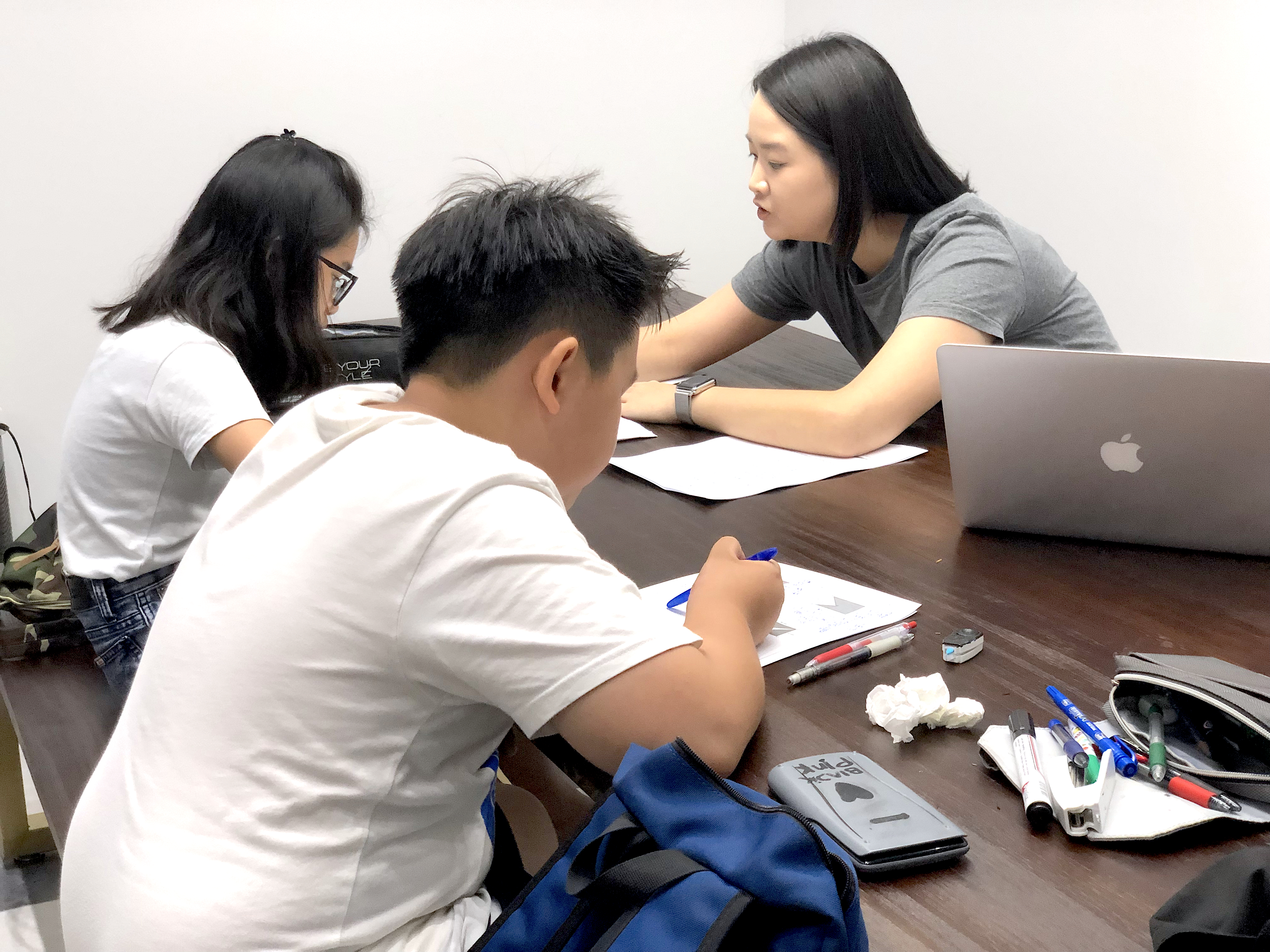














Pri3 Yishun The best Pri 3 English Tuition in Yishun with SEAB MOE PSLE syllabus English. Pri3 Yishun Primary English Tutor for Pri1 Pri2 Pri3 Pri4 Pri5 Pri6 PSLE English Paper 1 and Paper 2.
Call Yuet Ling +65 82226327 for our Pri3 Yishun English classes.


Learn English and make it useful.
Working closely with parents are part of our teaching culture to create the desired effect to get our English students positive changes in their studies. Our Yishun PSLE English tutors teach from scratch, making sure our English students master their language, and we do all the necessary practices from basic easy to complex advanced questions with our students, including past exam papers that helps them to understand and appreciate English as lingua franca in Singapore and use it to further their studies.
Class Culture
At eduKate Yishun, we work hard to have an affirmative class culture that empowers our students to do more, learn more, and develop a love for their own education by creating a class culture with great friends and tutors. Our positive classes also creates a constructive environment that teaches them the relevance of what they study to their everyday lives. With relevance creates the true reason for a proper education. That is our trademark that differentiates our teaching to others, but don’t just take our words for it, let these photos show you how much our passion and love for our Yishun student’s English lessons.





Leave a Reply