
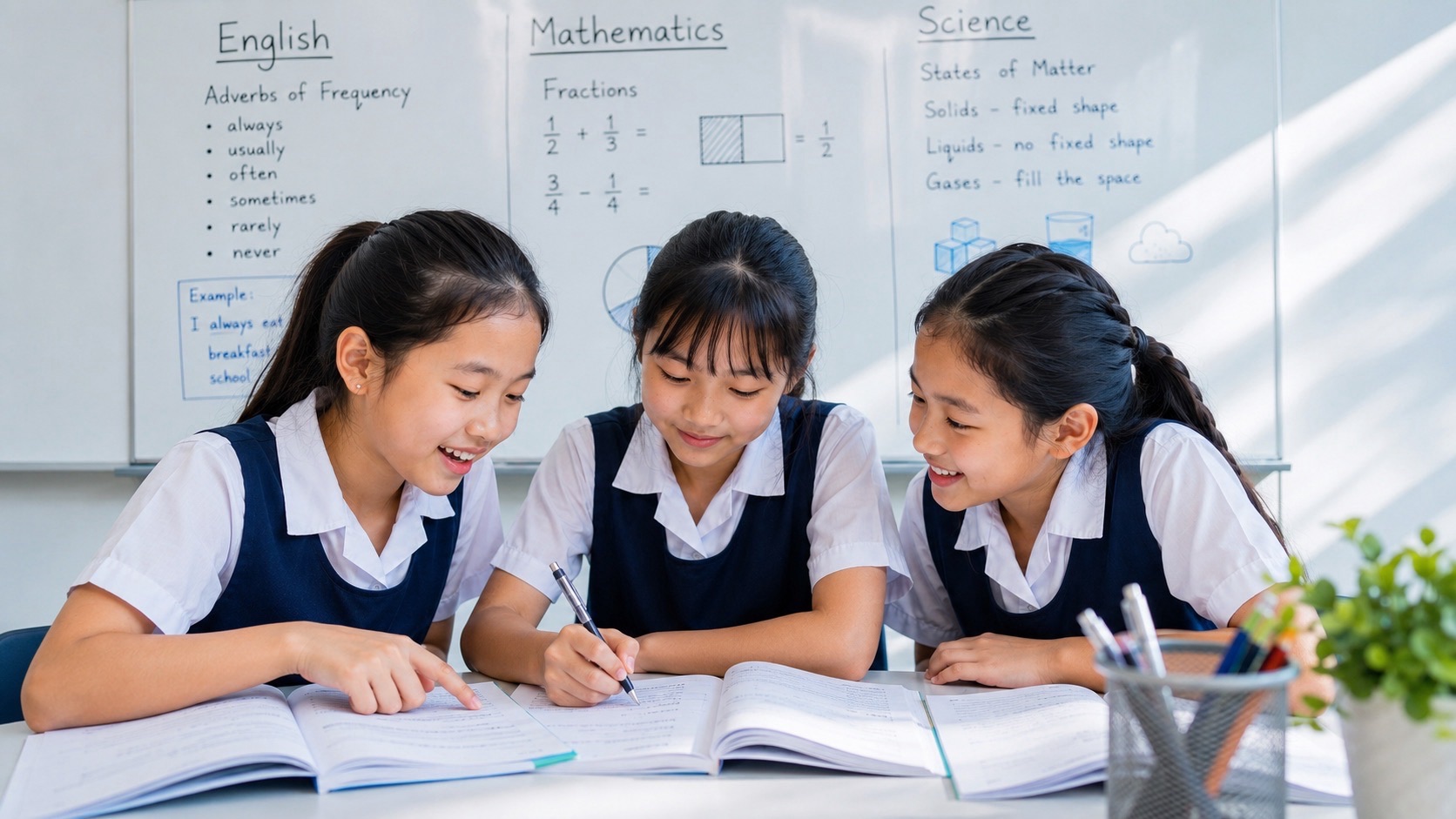
Families searching for Pri 6 Simei Science tuition, Primary 6 Science tuition, PSLE Science tuition, PSLE Science open-ended questions, Science answering techniques, scientific keywords or help with application and transfer questions are usually facing the final Primary Science challenge: a student may know the syllabus and still struggle when a familiar concept appears in an unfamiliar form. At Primary 6, the question often changes the objects, diagram, data display, experimental condition or wording while preserving the same underlying scientific mechanism.
Good P6 Science tuition should therefore train transfer. Students need to recognise stable relationships beneath changed surfaces, connect evidence to mechanisms, switch between diagrams, tables and graphs, reason across topics, and adapt open-ended explanations when one condition changes. This is where scientific reasoning, variables, fair tests, data interpretation, cause-and-effect explanation and PSLE exam readiness come together.
This rebuilt guide keeps the historical title Pri 6 Simei Science Tuition while giving the page one clear learning job: operate as a changed-condition transfer laboratory. The central proposition is that real understanding survives variation. If a student knows a concept only when the question looks like the example, the learning is not yet examination-ready.
PSLE Science Changes the Surface to Test the Structure
A learner may practise evaporation using wet cloths and later meet the same rate relationship through puddles, containers, exposed surfaces or moving air. The nouns change. The mechanism does not.
A forces idea learned with toy cars may reappear in a shoe, bicycle, box or ramp. A heat-transfer relationship may move from spoons to containers. A plant process may be tested through a graph rather than a labelled diagram.
Transfer means recognising what remains scientifically invariant when the story changes.
Ask Two Questions: What Changed? What Stayed Scientifically the Same?
After every worked example, a tutor can change one detail and ask the learner to identify:
- what changed on the surface;
- what scientific relationship remained the same;
- which part of the answer must therefore change;
- and which part should remain stable.
This makes transfer explicit rather than hoping it appears automatically.
Changed-Condition Practice Should Be Systematic
One solved question can generate several transfer questions.
- Increase the variable instead of decreasing it.
- Reverse the starting condition.
- Replace the material.
- Change the apparatus.
- Remove one component.
- Present the result as a graph instead of a table.
- Ask for a prediction rather than an explanation.
- Ask which conclusion is no longer valid.
The student learns to rebuild, not repeat.
Near Transfer Comes Before Far Transfer
Do not jump from one example to a wildly different context immediately. Build transfer in stages.
- Same structure, small change: alter one number or condition.
- Same structure, new objects: change the story while keeping the mechanism obvious.
- Same structure, new representation: diagram becomes table or graph.
- Same structure, mixed-topic context: combine the idea with another concept.
- Far transfer: present the mechanism in a substantially unfamiliar setting.
This progression allows the learner to see the bridge rather than being thrown across a gap.
Representation Transfer: Diagram, Table, Graph, Words
A student may understand a concept in words and fail when it appears in a graph. That is not necessarily a content failure. It may be a representation failure.
Train the same relationship across forms:
- explain a diagram in words;
- turn a table into a verbal trend;
- sketch a graph from a described relationship;
- draw an experimental setup from written instructions;
- write a conclusion from a graph;
- identify which parts of two representations correspond.
The student becomes less dependent on one familiar visual form.
Cross-Topic Questions Are Often System Questions
PSLE-style Science can feel difficult when two familiar ideas appear together. The learner may think a brand-new concept is required.
Often the solution is to separate the parts, identify the relationship in each, then reconnect them.
For example, a plant investigation may involve both photosynthesis and water transport. A heat experiment may require both material properties and data interpretation. A forces question may involve measurement and graph reading.
The student should ask: Which parts of this problem belong to which mechanisms, and how do those mechanisms interact?
Transfer Fails When Students Memorise Surface Cues
A learner may associate “wet cloth” with evaporation, “plant” with photosynthesis or “metal spoon” with conduction. These cues help at first but become dangerous when the context changes.
The tutor should ask the student to name the deeper relationship, not the chapter label.
What is the system doing here?
That question encourages structural thinking.
A Worked Transfer Sequence: Evaporation
Start with two identical wet cloths under different air movement. Establish the relationship clearly.
Then vary the surface:
- two shallow dishes of water in different air conditions;
- two puddles with different exposed surface areas;
- the same liquid at different temperatures;
- a graph showing amount of water remaining over time;
- a question asking which setup dries fastest and why.
The learner should recognise the rate relationship rather than memorise “cloth + fan”.
A Worked Transfer Sequence: Heat
Begin with a metal and wooden spoon in warm water. Once conduction is understood, move to:
- handles of cooking utensils;
- different cup materials;
- insulation around containers;
- a table of temperature changes;
- a graph showing cooling over time;
- a design question asking which material should be chosen and why.
Each new version tests whether the concept travels.
A Worked Transfer Sequence: Plants
Start with light affecting photosynthesis. Then change the context:
- a leaf partly covered from light;
- two plants under different light durations;
- a graph of growth under different conditions;
- a question about food production rather than growth;
- a system question combining water transport and photosynthesis.
The student must decide which causal links remain valid in each case.
A Worked Transfer Sequence: Forces
A friction example with a toy car can move to shoes, bicycle tyres, rough surfaces, braking or an object sliding down a slope.
The learner should identify the interacting surfaces, direction of the force and effect on motion. The story changes; the reasoning structure stays.
A Worked Transfer Sequence: Electrical Circuits
Students can memorise one circuit diagram and still fail when components are rearranged. Train them to trace the conducting path and reason from the arrangement.
Change:
- the number of components;
- the arrangement;
- whether a switch is open or closed;
- which component is removed;
- what is measured or observed.
The student should not rely on “I have seen this picture before”.
Transfer Requires Accurate Concept Boundaries
If a student’s concept is too broad, transfer becomes overgeneralisation. If the concept is too narrow, transfer fails because the learner cannot recognise new examples.
This is why examples and non-examples matter. The student should know not only where a rule applies but where it does not.
Open-Ended Answers Must Adapt With the Conditions
Memorised model answers often fail because the question changes one condition. A sentence that was correct in the original context becomes inaccurate in the new one.
After learning a model explanation, ask:
- Which clause is tied to this specific condition?
- Which clause expresses the general scientific mechanism?
- If the condition reverses, which part must change?
This teaches students to reconstruct answers rather than reproduce them.
Scientific Keywords Should Survive Context Change
If a student understands a keyword, they should be able to use it appropriately in several situations. If the word works only in one memorised sentence, the concept is brittle.
Test the word across examples, diagrams and changed conditions. Ask what relationship it names each time.
Data Transfer: The Same Relationship Can Look Different
A table and a graph can represent the same underlying data. Students should practise moving between them.
Ask the learner to:
- describe a graph in words;
- predict what a table with the same pattern might look like;
- identify the same trend in two representations;
- notice whether one format reveals a feature more clearly.
This strengthens data interpretation beyond one format.
Experiment Transfer: Purpose Before Apparatus
When the equipment changes, students can become lost even though the experimental logic is identical.
Return to the purpose:
- What relationship is being tested?
- What factor is deliberately changed?
- What outcome shows the effect?
- What relevant factors must be controlled?
- What result would support the proposed relationship?
This works whether the apparatus contains plants, beakers, bulbs, springs or blocks.
Comparison Transfer: Use the Same Dimension
Students should learn that comparison requires a common dimension. This principle applies to temperature, rate, mass, length, brightness, number of leaves, time and many other quantities.
The objects change; the comparison logic does not.
Mixed Sets Reveal Whether Transfer Is Real
Blocked practice is useful for learning. Mixed practice is useful for testing selection.
A mixed set might contain:
- one graph;
- one plant system question;
- one circuit diagram;
- one fair-test critique;
- one forces explanation;
- one changed-condition prediction.
The learner must decide which concept and reasoning tool each question needs.
Error Logs Should Track Transfer Failures Separately
A student may write “I knew this topic” after getting the question wrong. That can be true. The problem may be transfer.
Label transfer errors explicitly:
- concept known, new context not recognised;
- representation changed and student became confused;
- two topics combined and learner selected only one;
- condition reversed but memorised answer was not adapted.
Once transfer is named, it can be trained.
Retest After a Delay
Immediate success can be misleading because the tutor’s explanation is still fresh. Return to the mechanism later in a different context.
If the student can reconstruct the reasoning after time has passed and surface cues have changed, the learning is becoming durable.
Small-Group Science Can Make Transfer Visible
Give three learners different-looking questions built on the same scientific relationship. Let each solve one, then ask the group what the questions have in common.
This reverse-engineering activity helps students discover the deeper structure themselves.
The Tutor Should Reduce Hints as Transfer Improves
At first the tutor may ask, “Which variable changed?” Later the hint becomes, “What is different?” Eventually there is no hint.
Scaffolding should fade because the exam will not label the underlying mechanism for the learner.
A Weekly P6 Simei Transfer Routine
- Concept retrieval: reconstruct one core mechanism without notes.
- Near transfer: solve a lightly changed example.
- Representation transfer: move the idea into a graph, table or new diagram.
- Cross-topic transfer: combine it with another concept.
- Mixed set: identify concepts without chapter labels.
- Delayed retest: return to an earlier mechanism under new surface details.
The week trains recognition, adaptation and reconstruction rather than repetition.
How Parents Can Recognise a Transfer Problem
Common signs include:
- the child succeeds on practice immediately after teaching but fails later;
- the learner says, “We never learned this,” even though the underlying concept is familiar;
- graphs cause failure even when verbal questions are answered well;
- the student memorises model answers but cannot adapt them;
- mixed papers are much weaker than chapter worksheets;
- changing one condition causes the entire reasoning process to collapse.
These patterns suggest that the next job is not more content. It is transfer training.
What Examination-Ready Transfer Looks Like
A transfer-ready P6 student increasingly can:
- identify the underlying concept in an unfamiliar context;
- explain what changed and what relationship stayed stable;
- adapt a causal chain when conditions change;
- move between diagrams, words, tables and graphs;
- combine two familiar mechanisms;
- recognise fair-test logic in unfamiliar apparatus;
- use keywords flexibly rather than as memorised phrases;
- and recover when the question does not look like the worksheet.
That is a much stronger definition of readiness than “has completed many papers”.
Final Perspective
The strongest job of Pri 6 Simei Science Tuition is to make scientific understanding portable. A student should not need the same nouns, picture and sentence structure every time.
When transfer is trained deliberately, unfamiliar questions become less frightening. The learner begins to ask, “What is this really testing?” rather than “Have I seen this exact question before?”
That shift—from recognition of examples to recognition of mechanisms—is one of the clearest signs that Primary Science has become a usable system of thought.
Continue through eduKateYishun: Science Tuition & Learning Hub · Science Directory · Examination Performance Hub · Student Diagnostics Hub
Science learning route: Continue to the Science directory · Examination Performance. For current tuition-service decisions, use the Yishun Tuition Centre Hub and confirm current arrangements separately.
Leave a Reply