
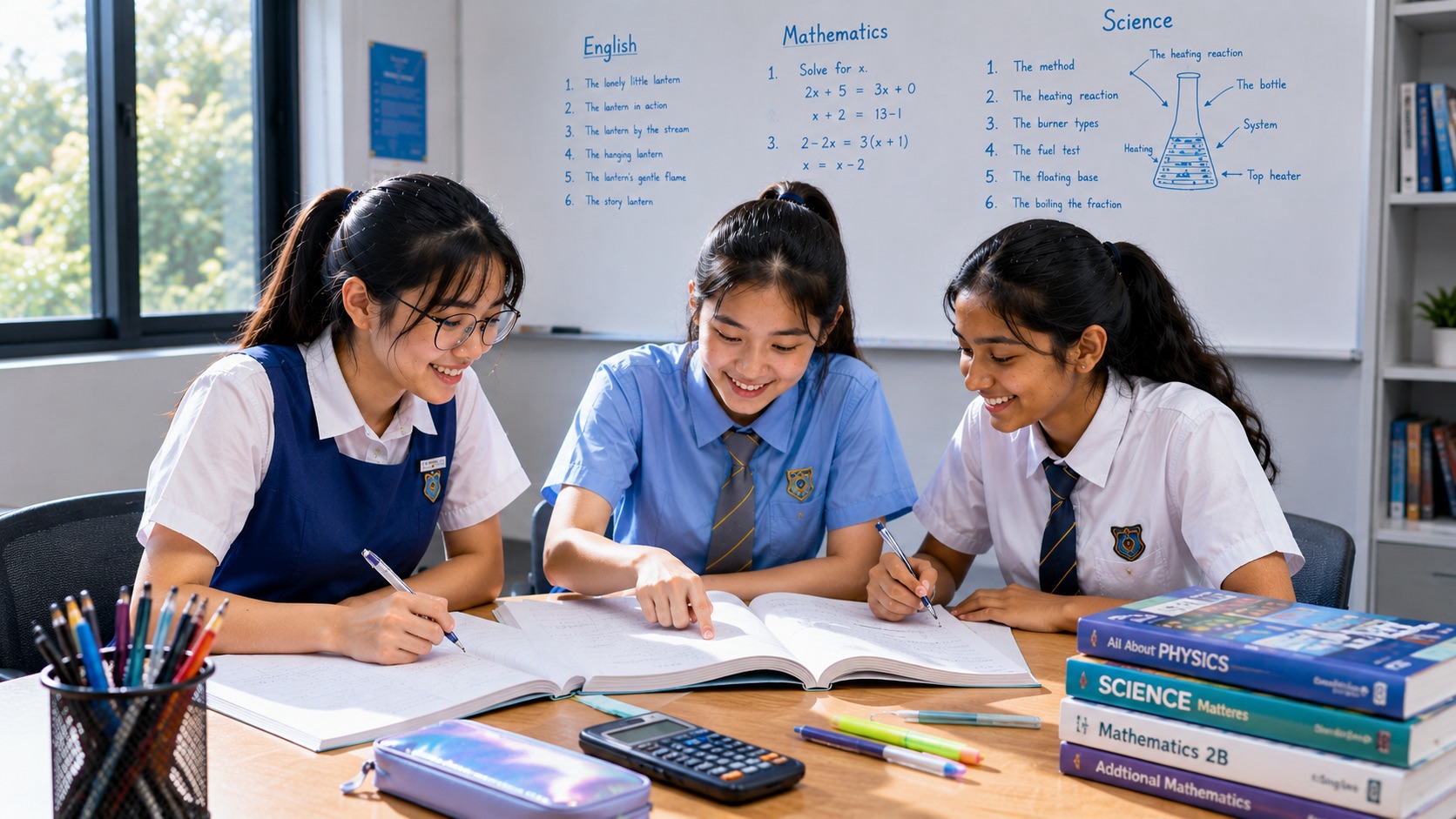
Families searching for Ang Mo Kio Maths Tuition Sec 4 Additional Maths, a Secondary 4 Additional Mathematics tutor in Ang Mo Kio or small-group A-Math tuition are usually dealing with the final-year challenge: the syllabus may already be familiar, but performance is still uneven. Algebra, quadratics, polynomials, coordinate geometry, trigonometry and calculus now need to work together under examination conditions. Good tuition should therefore move from explanation to diagnosis, from diagnosis to mixed performance, and from mixed performance to independent paper control.
Strong Sec 4 A-Math preparation should combine targeted algebra repair, mixed-topic revision, timed sections, full-paper practice, method recognition, error analysis, checking routines and examination strategy. More papers are useful only when each paper changes what happens next. If a student repeats the same factorisation or sign error across several papers, assigning another paper without repair simply repeats the problem under a new date.
In a three-student tutorial, final-year revision can stay highly specific. One student may need algebraic control, another may need faster method recognition, and a third may understand everything but mismanage time. The useful loop is Read → Diagnose → Prioritise → Repair → Practise → Connect → Perform → Review. Secondary 4 is about making that loop increasingly efficient because every lesson should reduce uncertainty before the examination.
Sec 4 A-Math Is About Reliability
A student may understand most chapters and still produce unstable scores. Reliability means the methods survive unfamiliar wording, mixed topics, time pressure and fatigue.
The target is not perfect performance every time. The target is less volatility and more control.
Build an Error Map Before Building the Revision Plan
- concept gap;
- method-recognition gap;
- sign or algebraic manipulation error;
- factorisation error;
- graph interpretation error;
- trigonometric identity error;
- calculus execution error;
- time-management or checking failure.
Revision should attack the most frequent and expensive patterns first.
Algebraic Control Still Has the Highest Transfer Value
Expansion, factorisation, equations, algebraic fractions, indices and rearrangement support almost every other A-Math topic. Final-year revision should keep these active even when the focus shifts to calculus or trigonometry.
Quadratics Need Fast Representation Switching
Students should move comfortably among expanded, factorised, completed-square and graphical forms. Each representation reveals something different, and method choice becomes faster when the student knows what information each form offers.
Polynomials Need Condition Recognition
Factor and remainder conditions should be translated into algebra immediately. The goal is to recognise the compact structure before beginning long manipulation.
Trigonometry Needs Purposeful Manipulation
Identity questions should not become random algebra. Students need a clear target and should transform expressions deliberately toward known relationships.
Calculus Needs Meaning and Fluency
Differentiation and integration should be fluent enough for examination work but still connected to meaning. Differentiation concerns change and gradient. Integration concerns accumulation and recovery.
Mixed Practice Should Dominate the Later Phase
Topical practice remains useful for repair. Once the repair is stable, return the skill to mixed questions. Otherwise the student becomes dependent on chapter labels.
- Diagnose.
- Repair topically.
- Contrast with a nearby method.
- Mix the skill.
- Time the work.
- Review the new error pattern.
Full Papers Are Diagnostic Instruments
A full paper should reveal more than a total score. It should show where time is lost, which methods are recognised slowly, which errors recur under pressure and whether checking is effective.
Paper Strategy Should Protect Secure Marks
The student has limited time and attention. One difficult question should not consume the resources needed for several accessible questions. A sensible paper strategy protects secure marks first and returns deliberately to harder work.
Checking Should Target Known Risk Points
- sign changes after expansion;
- copied coefficients;
- incomplete factorisation;
- calculator entries;
- notation and final-answer format;
- whether the answer addresses the exact question.
Checking becomes efficient when it follows the student’s personal error profile.
A Three-Student Sec 4 A-Math Lesson
- Retrieval: one high-transfer algebraic skill.
- Timed cold question: test recognition under mild pressure.
- Diagnosis: locate the first weak link.
- Repair: reteach only what is unstable.
- Contrast: compare nearby methods.
- Mixed transfer: integrate the repaired skill with other topics.
- Paper strategy: practise timing and recovery.
- Review: update the error map.
The Final-Year Independence Test
Can the student solve without hints, under realistic timing, after a delay and in a mixed context? Can the student recover after taking a wrong route? Can the student find likely errors without being told where to look?
These are signs of examination control.
How Parents Can Read a Sec 4 A-Math Paper
- Are losses concentrated in one chapter or spread across algebraic execution?
- Are unfamiliar questions left blank?
- Do correct solutions take too long?
- Does performance deteriorate late in the paper?
- Are corrections understood or simply copied?
- Does checking catch recurring mistakes?
A Twelve-Week Revision Architecture
Weeks 1–3: Stabilise prerequisites
Repair algebraic manipulation, factorisation, equations and other high-transfer weaknesses.
Weeks 4–6: Connect topics
Increase contrast practice and mixed questions. Remove chapter labels.
Weeks 7–9: Increase performance pressure
Use timed sections and partial papers. Track time loss and recurring error types.
Weeks 10–12: Simulate and refine
Use full-paper conditions, analyse the new error pattern and refine checking and recovery routines.
Strong Students Need Precision, Not Volume
High-performing students often gain more from alternative methods, efficiency, unfamiliar problems and explanation than from repeating familiar exercises.
Students Who Are Behind Need Ruthless Prioritisation
When time is limited, prioritise algebraic manipulation, factorisation, equations, graph reading and the topic families that repeatedly cost marks. Do not attempt to repair every weakness with equal intensity.
Questions Parents Can Ask a Sec 4 A-Math Tutor
- How do you decide what my child should revise first?
- How do you separate concept gaps from algebraic execution errors?
- When do you use full papers versus topical repair?
- How do you train method recognition?
- How do you track timing and recurring errors?
- How do you reduce prompting as the examination approaches?
The Real Goal of Ang Mo Kio Maths Tuition Sec 4 Additional Maths
The final goal is examination independence. The student should be able to read structure, select a method, manipulate accurately, manage time, check intelligently and recover from uncertainty.
That is stronger preparation than simply completing the largest possible stack of papers. Properly taught kids shine a bright light into the future.
Leave a Reply